light MERCEDES-BENZ S-COUPE 2016 User Guide
[x] Cancel search | Manufacturer: MERCEDES-BENZ, Model Year: 2016, Model line: S-COUPE, Model: MERCEDES-BENZ S-COUPE 2016Pages: 410, PDF Size: 8.62 MB
Page 17 of 410
Parking brakeDisplay message ............................2 55
Electric parking brake .................... 172
Warning lamp ................................. 292
Parking lamps
Switching on/off ........................... 125
PARKTRONIC
Deactivating/activating ................. 201
Driving system ............................... 199
Function/notes .............................1 99
Important safety notes .................. 199
Problem (malfunction) ................... 202
Range of the sensors ..................... 199
Warning display ............................. 200
PASSENGER AIR BAG
Display message ............................ 264
Indicator lamps ................................ 45
Problem (malfunction) ................... 264
Perfume atomizer
Operating ....................................... 144
Perfume vial ................................... 144
Problem (malfunction) ................... 146
Pets in the vehicle ............................... 67
Plastic trim (cleaning instruc-
tions) .................................................. 338
Power locks ......................................... 90
Power washers .................................. 333
Power windows
see Side windows
PRE-SAFE
®(anticipatory occupant
protection)
Display message ............................ 259
Operation ......................................... 61
PRE-SAFE
®Brake
Activating/deactivating ................. 245
Display message ............................ 260
Function/notes ................................ 75
Important safety notes .................... 75
Warning lamp ................................. 296
PRE-SAFE
®PLUS (anticipatory
occupant protection PLUS)
Display message ............................ 260
Operation ......................................... 61
Program selector button .................. 163
Protection against theft
ATA (Anti-Theft Alarm system) ......... 78
Immobilizer ...................................... 78 Protection of the environment
General notes .................................. 22
Pulling away
Automatic transmission ................. 154
General notes ................................ 154
Hill start assist ............................... 155
Q
QR codeMercedes-Benz Guide App ................. 1
Rescue card ..................................... 28
Qualified specialist workshop ........... 26
R
Radio
Selecting a station ......................... 239
Radio-wave reception/transmis-
sion in the vehicle
Declaration of conformity ................ 26
Reading lamp ..................................... 129
Rear compartment
Setting the air vents ...................... 147
Stowage compartment .................. 302
Rear lamps
see Lights
Rear seats
Overview .......................................... 41
Rear view camera
Cleaning instructions ..................... 336
Displays in the COMAND display ... 208
Function/notes ............................. 207
Rear window blind ............................ 306
Rear window defroster
Problem (malfunction) ................... 143
Switching on/off ........................... 142
Rear-view mirror
Anti-glare (manual) ........................ 117
Dipping (automatic) ....................... 119
Refrigerant (air-conditioning sys-
tem)
Important safety notes .................. 405
Refueling
Fuel gauge ....................................... 33
Important safety notes .................. 167
Notes for Mercedes‑ AMG vehi-
cles ................................................ 402
Index15
Page 20 of 410
Button overview ............................... 35
Buttons (on-board computer) ......... 231
Cleaning .........................................338
EASY ENTRY/EXIT feature ............. 116
Important safety notes .................. 114
Paddle shifters ............................... 163
Steering wheel heating .................. 115
Storing settings (memory func-
tion) ............................................... 121
Steering wheel heating
Problem (malfunction) ................... 116
Switching on/off ........................... 115
Steering wheel paddle shifters ........163
Stop&Go Pilot
see DISTRONIC PLUS
Stowage areas ................................... 300
Stowage compartments
Armrest (under) .............................3 02
Center console .............................. 301
Center console in rear compart-
ment .............................................. 302
Cup holders ................................... 304
Door ............................................... 302
Eyeglasses compartment ...............3 01
Glove box ....................................... 301
Important safety information ......... 300
Rear ............................................... 302
Rear seat backrest ......................... 302
Stowage net ................................... 303
see Stowage areas
Stowage net ....................................... 303
Stowage space
Parcel net retainers ....................... 303
Securing a load .............................. 303
Stowage well beneath the trunk
floor .................................................... 303
Summer tires
In winter ........................................ 364
Sun visor ............................................ 305
Suspension tuning
Active Body Control ABC ...............1 95
AIRMATIC ...................................... 198
SETUP (on-board computer) .......... 250
Switching air-recirculation mode
on/off ................................................. 143T
Tachometer ........................................ 230
Tail lamps
Display message ............................ 266
see Lights
Tank content
Fuel gauge ....................................... 33
Technical data
Capacities ...................................... 400
Information ....................................3 98
Tires/wheels ................................. 388
Vehicle data ................................... 406
Telephone
Accepting a call (multifunction
steering wheel) .............................. 242
Display message ............................ 283
Introduction ................................... 241
Menu (on-board computer) ............ 241
Number from the phone book ........2 42
Redialing ........................................ 243
Rejecting/ending a call ................. 242
Temperature
Coolant .......................................... 231
Engine oil (on-board computer,
Mercedes-AMG vehicles) ...............2 49
Outside temperature ......................2 31
Setting (climate control) ................ 140
Transmission oil (on-board com-
puter, Mercedes-AMG vehicles) ..... 249
Tire pressure
Calling up (on-board computer) ..... 369
Checking manually ........................ 368
Display message ............................ 279
Maximum ....................................... 368
Not reached (TIREFIT) .................... 346
Notes ............................................. 367
Reached (TIREFIT) .......................... 346
Recommended ............................... 365
Tire pressure monitor
Checking the tire pressure elec-
tronically ........................................ 370
Function/notes .............................3 69
General notes ................................ 369
Important safety notes .................. 369
Radio type approval for the tire
pressure monitor ........................... 372
Restarting ...................................... 371
18Index
Page 34 of 410
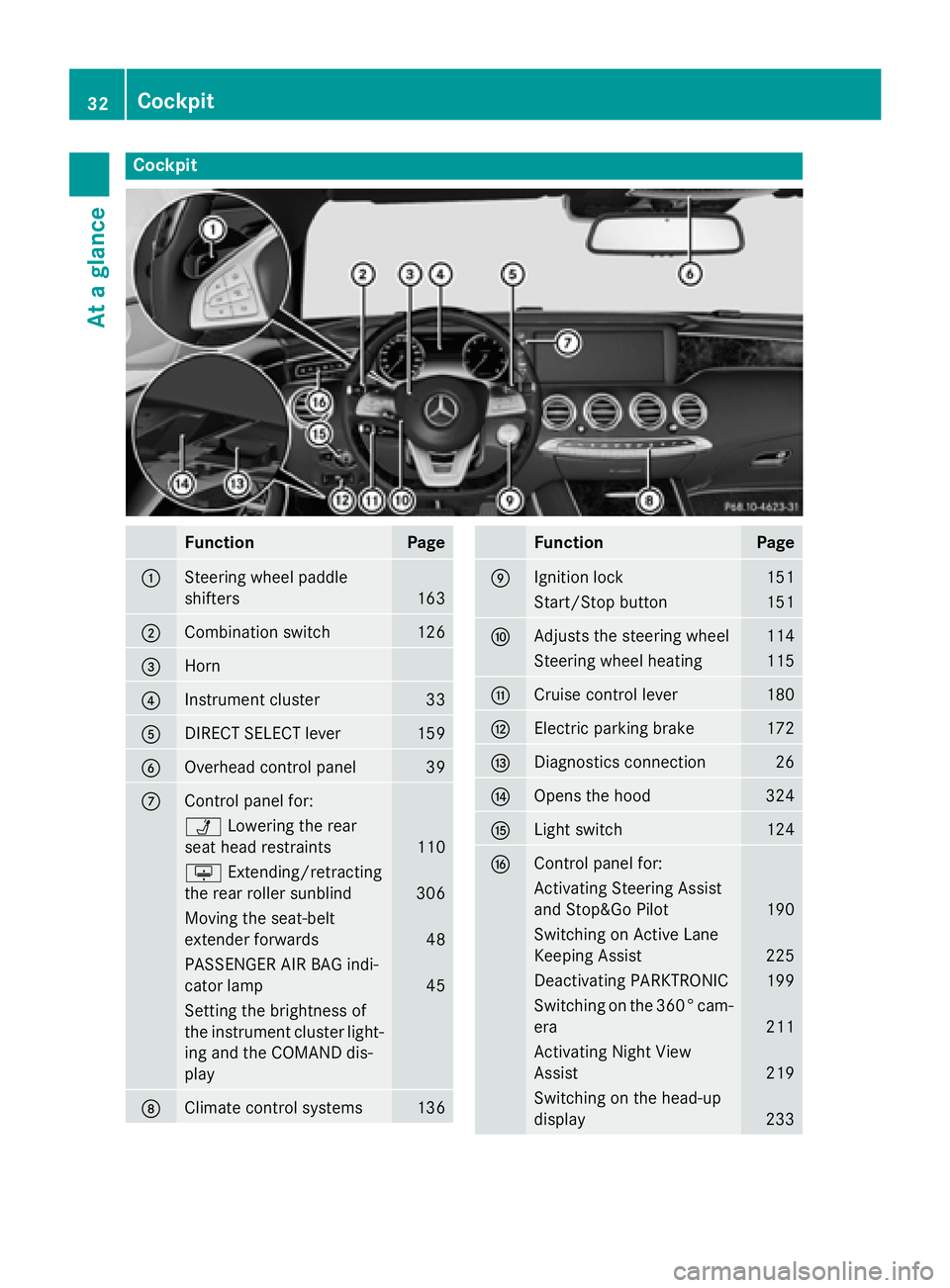
Cockpit
FunctionPage
:Steering wheel paddle
shifters
163
;Combination switch126
=Horn
?Instrument cluster33
ADIRECT SELECT lever159
BOverhead control panel39
CControl panel for:
ÜLowering the rear
seat head restraints
110
u Extending/retracting
the rear roller sunblind
306
Moving the seat-belt
extender forwards
48
PASSENGER AIR BAG indi-
cator lamp
45
Setting the brightness of
the instrument cluster light-
ing and the COMAND dis-
play
DClimate control systems136
FunctionPage
EIgnition lock151
Start/Stop button151
FAdjusts the steering wheel114
Steering wheel heating115
GCruise control lever180
HElectric parking brake172
IDiagnostics connection26
JOpens the hood324
KLight switch124
LControl panel for:
Activating Steering Assist
and Stop&Go Pilot
190
Switching on Active Lane
Keeping Assist
225
Deactivating PARKTRONIC199
Switching on the 360° cam-
era
211
Activating Night View
Assist
219
Switching on the head-up
display
233
32Cockpit
At a glance
Page 36 of 410
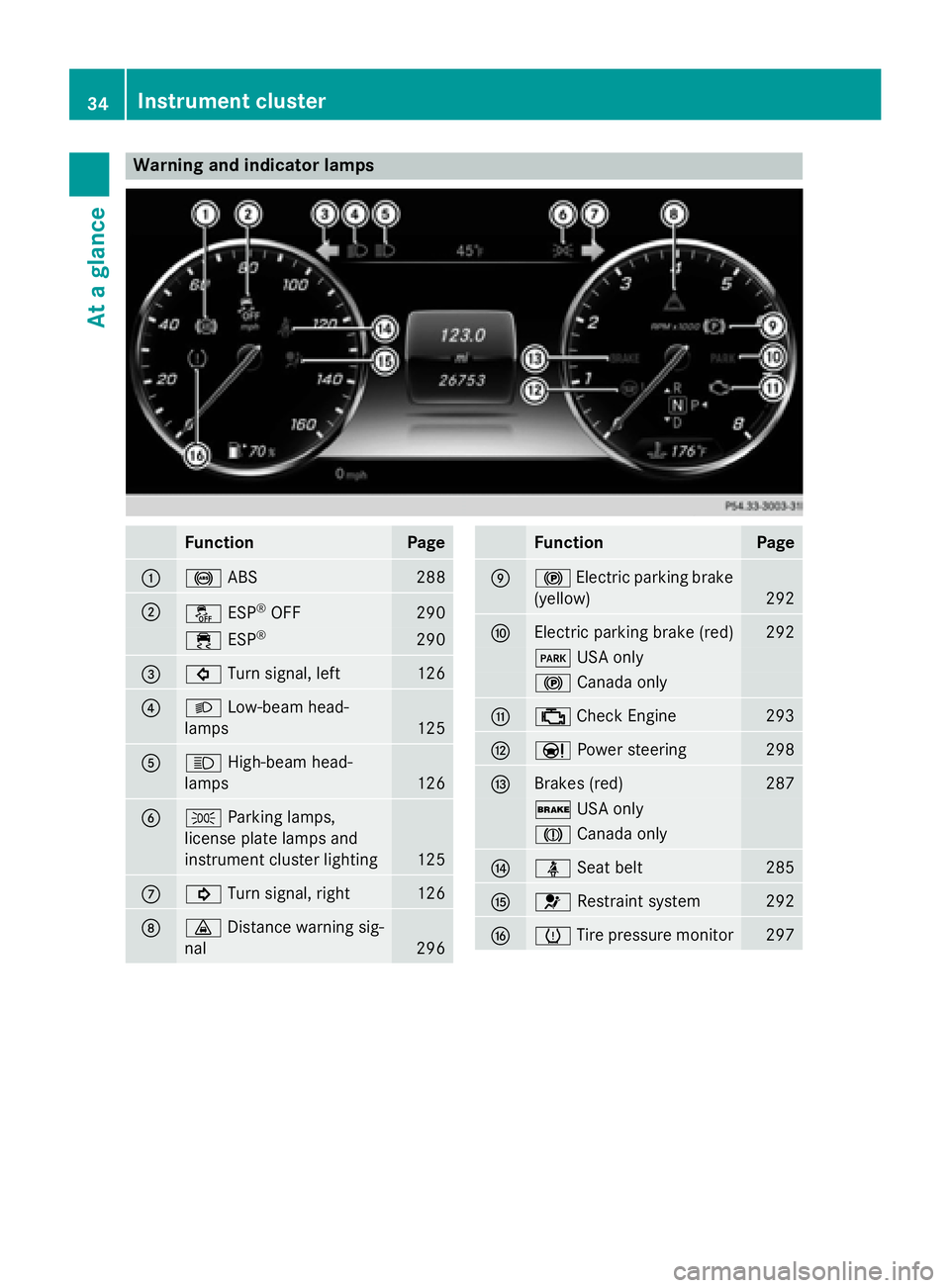
Warning and indicator lamps
FunctionPage
:!ABS288
;åESP®OFF290
÷ESP®290
=#Turn signal, left126
?LLow-beam head-
lamps
125
AK High-beam head-
lamps
126
BT Parking lamps,
license plate lamps and
instrument cluster lighting
125
C! Turn signal, right126
D·Distance warning sig-
nal
296
FunctionPage
E! Electric parking brake
(yellow)
292
FElectric parking brake (red)292
F USA only
!Canada only
G;Check Engine293
HÐ Power steering298
IBrakes (red)287
$USA only
JCanada only
JüSeat belt285
K6Restraint system292
LhTire pressure monitor297
34Instrument cluster
At a glance
Page 41 of 410
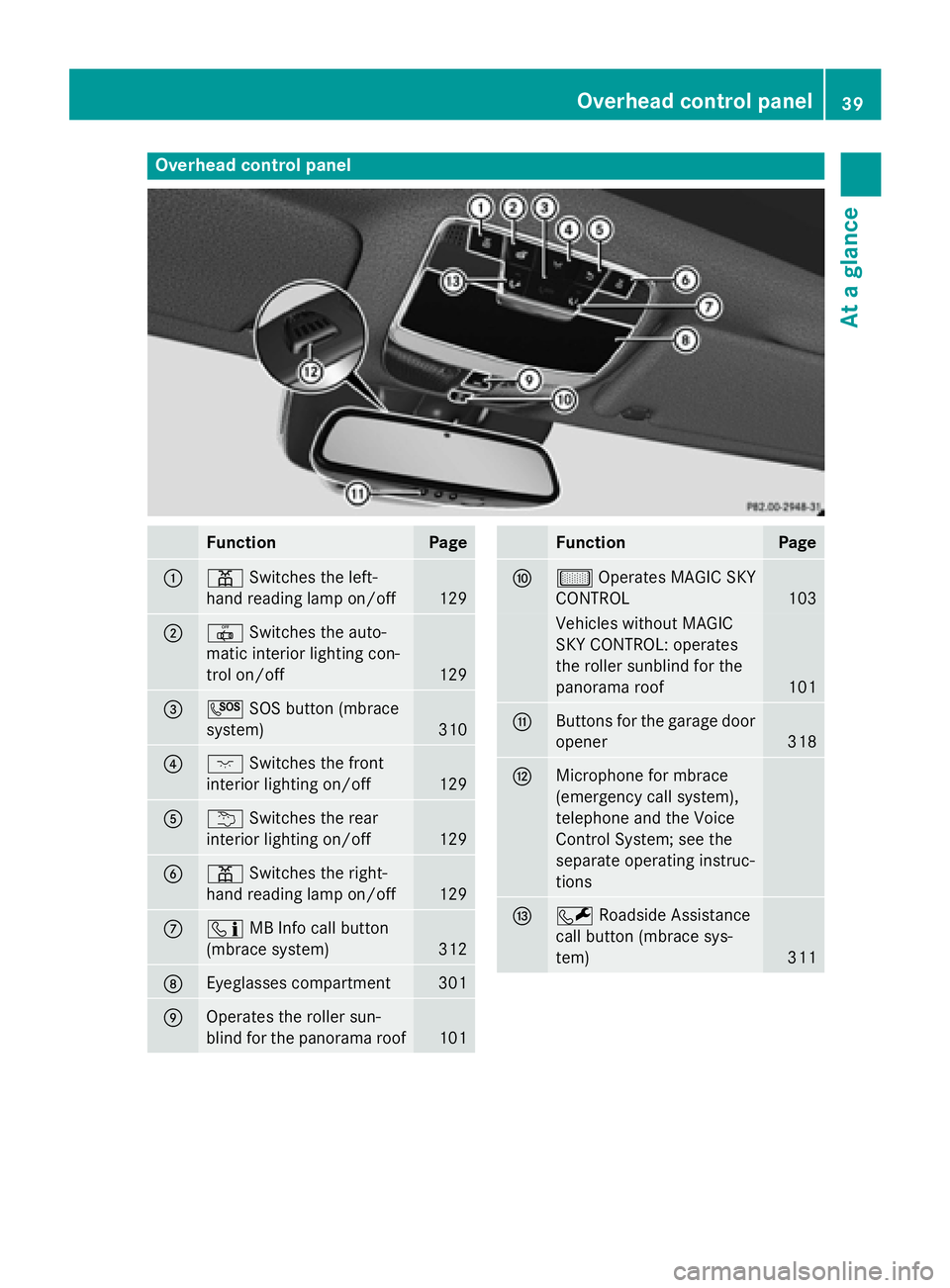
Overhead control panel
FunctionPage
:pSwitches the left-
hand reading lamp on/off
129
;| Switches the auto-
matic interior lighting con-
trol on/off
129
=G SOS button (mbrace
system)
310
?c Switches the front
interior lighting on/off
129
Au Switches the rear
interior lighting on/off
129
Bp Switches the right-
hand reading lamp on/off
129
Cï MB Info call button
(mbrace system)
312
DEyeglasses compartment301
EOperates the roller sun-
blind for the panorama roof
101
FunctionPage
Fµ Operates MAGIC SKY
CONTROL
103
Vehicles without MAGIC
SKY CONTROL: operates
the roller sunblind for the
panorama roof
101
GButtons for the garage door
opener
318
HMicrophone for mbrace
(emergency call system),
telephone and the Voice
Control System; see the
separate operating instruc-
tions
IF Roadside Assistance
call button (mbrace sys-
tem)
311
Overhead control panel39
At a glance
Page 47 of 410
Important safety notes
GWARNING
Modification sto th erestrain tsystem may
caus eit to no longer wor kas intended. The
restrain tsystem may then no tperfor mits
intended protective function and may fail in an
acciden tor trigge runexpectedly, for example.
This poses an increased ris kof injury or eve n
fatal injury.
Never modify part sof th erestrain tsystem.
Never tamper wit hth ewiring, th eelectronic
component sor their software.
If it is necessar yto modify an air bag system to
accommodat e aperson wit hdisabilities, con-
tac tan authorize dMercedes-Ben zCente rfor
details. US Aonly: for further information con-
tac tour Custome rAssistanc eCente rat
1-800-FOR-MERCedes (1 ‑80 0‑3 67‑6372).
Restraint system warning lamp
The functions of the restraint system are
checked after the ignition isswitched on and
at regular intervals while the engine is run-
ning. Therefore, malfunctions can bedetec-
ted ingood time.
The 6 restraint system warning lamp in
the instrument cluster lights up when the igni-
tion is swit ched on. Itgoes out no later than a
few seconds after the vehicle is started. The
components of the restraint system are in
operational readiness.
A malfunction has occurred if the 6
restraint system warning lamp:
Rdoes not light up after the ignition is
swit ched on
Rdoes not go out after a few seconds with
the engine running
Rligh ts up again while the engine is running
GWARNIN G
If restrain tsystem is malfunctioning ,restrain t
system component smay be triggered unin -
tentionally or might no tbe triggered at all in
th eevent of an acciden twit h a high rat eof
vehicl edeceleration .This can affec tth eEmer-
gency Tensioning Devic eor air bag, for exam-
ple. This poses an increased ris kof injury or
eve nfatal injury.
Hav eth erestrain tsystem checke dand
repaire din aqualified specialist workshop as
soo nas possible .
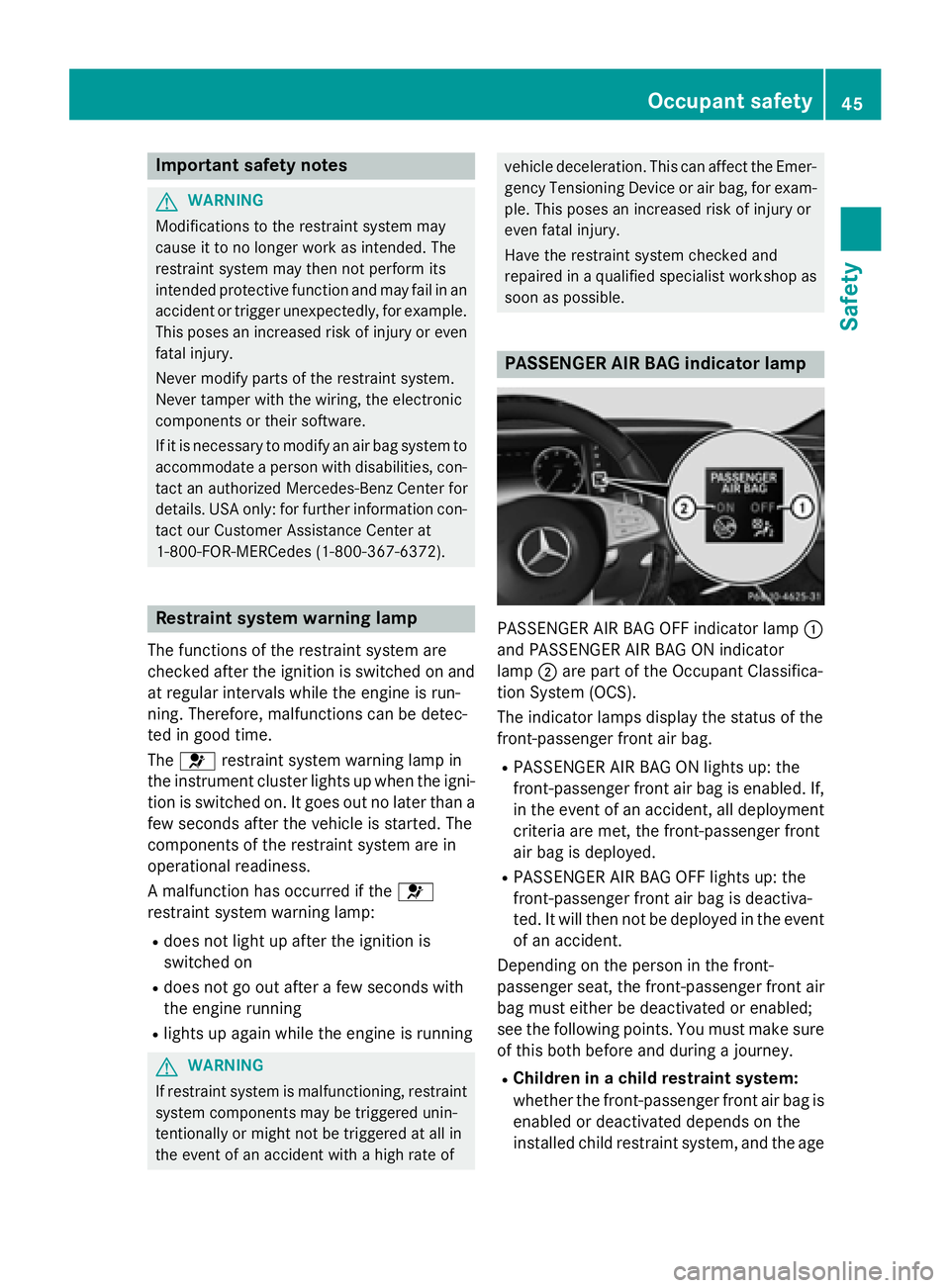
PASSENGER AIR BAG indicator lamp
PASSENGER AIR BAG OFF indicator lamp :
and PASS ENGER AIR BAG ON indicator
lamp ;are part of the Occupant Classific a-
tion System (OCS).
The indicator lamps display the status of the
front-passenger front air bag.
RPASS ENGER AIR BAG ON lights up: the
front-passenger front air bag isenabled. If,
in the event of an acc ident, all deplo yment
cr iteria are met, the front-passenger front
air bag is deplo yed.
RPASSENGER AIR BAG OFF lights up: the
front-passenger front air bag isdeactiva-
te d. It will then not be deployedinthe event
of an accident.
Depending on the person inthe front-
passenger seat, the front-passenger front air
bag must either bedeactivated or enabled;
see the following points. You must make sure
of th isboth before and during a journey.
RChildren in a child res traint system:
whether the front-passenger front air bag is
enabled or deactivated depends on the
installed ch ildrestraint system, and the age
Occupant safety45
Safety
Z
Page 52 of 410
Seat belt adjustment
The seat-belt adjustment is an integral part ofthe PRE-SAFE®convenience function. This
function adjusts the driver's and front-
passenger seat belt to the upper body of the
occupants.
The belt strap is tightened slightly when:
Rthe belt tongue is engaged in the buckle
when the seat-belt extender is retracted
and
Rthe ignition is switched on
The seat-belt adjustment will apply a certain
retraction force if any slack is detected
between the vehicle occupant and the seat
belt. Do not hold on to the seat belt tightly
while it is adjusting.
You can switch the seat-belt adjustment on
and off using COMAND. Information on acti-
vating and deactivating the seat-belt adjust-
ment function can be found in the Digital
Operator's Manual.
Belt warning for the driver and front
passenger
The 7 seat belt warning lamp in the instru-
ment cluster is a reminder that all vehicle
occupants must wear their seat belts. It may
light up continuously or flash. In addition,
there may be a warning tone.
Regardless of whether the driver's seat belt
has already been fastened, the 7seat belt
warning lamp lights up for six seconds each
time the engine is started. If, after
six seconds, the driver or front-passenger
seat belt has not been fastened and the doors
are closed, the 7seat belt warning lamp
lights up. As soon as the driver's and front-
passenger seat belts are fastened or a front
door is opened again, the 7seat belt
warning lamp goes out.
If the driver's seat belt is not fastened after
the engine is started, an additional warning
tone will sound. This warning tone stops after
six seconds or when the driver's seat belt is
fastened. If the vehicle's speed exceeds 15 mph
(25 km/h) once and the driver's and front-
passenger seat belts are not fastened, a
warning tone sounds. A warning tone also
sounds with increasing intensity for
60 seconds or until the driver or front
passenger have fastened their seat belts.
If the driver or front passenger unfasten their
seat belts during the journey, the seat belt
warning is activated again.
iFor more information on the
7seat
belt warning lamp, see "Warning and indi-
cator lamps in the instrument cluster, seat
belts" (
Ypage 285).
Air bags
Introduction
The installation point of an air bag can be rec-
ognized by the AIR BAG symbol.
An air bag complements the correctly fas-
tened seat belt. It is no substitute for the seat
belt. The air bag provides additional protec-
tion in applicable accident situations.
Not all air bags are deployed in an accident.
The different air bag systems function inde-
pendently from one another (
Ypage 59).
However, no system available today can com-
pletely eliminate injuries and fatalities.
It is also not possible to rule out a risk of injury
caused by an air bag due to the high speed at
which the air bag must be deployed.
Important safety notes
GWARNING
If you do not sit in the correct seat position,
the air bag cannot protect as intended and
could even cause additional injury when
deployed. This poses an increased risk of
injury or even fatal injury.
50Occupant safety
Safety
Page 56 of 410
Prerequisite
To be classified correctly, the front passenger
must sit:
Rwith the seat belt fastened correctly
Rin an almost upright position with their
back against the seat backrest
Rwith their feet resting on the floor, if possi-
ble
If the front passenger does not observe these
conditions, OCS may produce a false classi-
fication, e.g. because the front passenger:
Rtransfers their weight by supporting them-
selves on a vehicle armrest
Rsits in such a way that their weight is raised from the seat cushion
If it is absolutely necessary to install a child
restraint system on the front-passenger seat,
be sure to observe the correct positioning of
the child restraint system. Never place
objects under or behind the child restraint
system, e.g. cushions. Fully retract the seat
cushion length. The entire base of the child
restraint system must always rest on the seat
cushion of the front-passenger seat. The
backrest of the forward-facing child restraint
system must lie as flat as possible against the
backrest of the front-passenger seat.
The child restraint system must not touch the
roof or be subjected to a load by the head
restraint. Adjust the angle of the seat back-
rest and the head restraint position accord-
ingly.
Only then can OCS be guaranteed to function
correctly. Always observe the child restraint
system manufacturer's installation instruc-
tions.
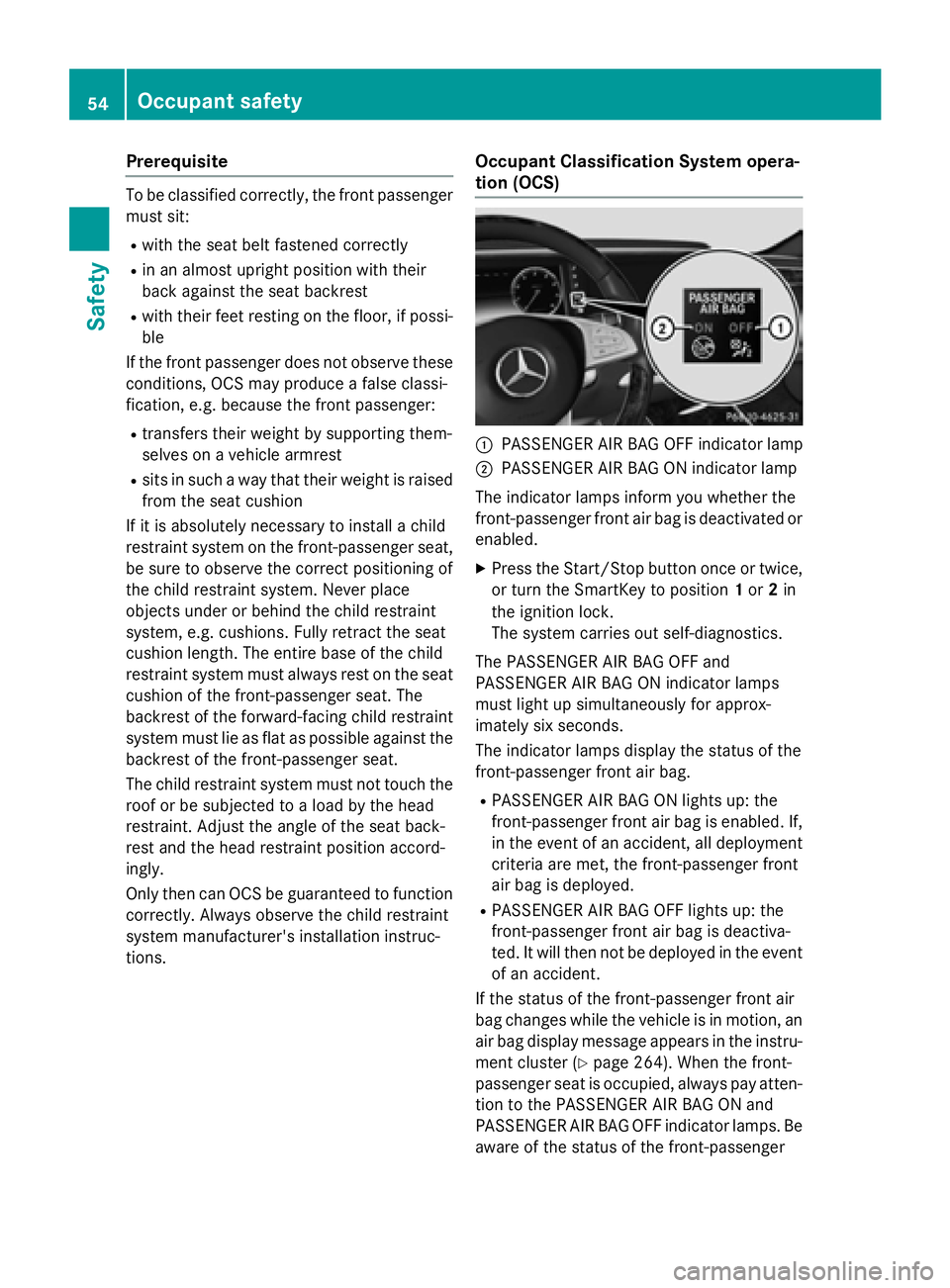
Occupant Classification System opera-
tion (OCS)
:PASSENGER AIR BAG OFF indicator lamp
;PASSENGER AIR BAG ON indicator lamp
The indicator lamps inform you whether the
front-passenger front air bag is deactivated or
enabled.
XPress the Start/Stop button once or twice,
or turn the SmartKey to position 1or 2in
the ignition lock.
The system carries out self-diagnostics.
The PASSENGER AIR BAG OFF and
PASSENGER AIR BAG ON indicator lamps
must light up simultaneously for approx-
imately six seconds.
The indicator lamps display the status of the
front-passenger front air bag.
RPASSENGER AIR BAG ON lights up: the
front-passenger front air bag is enabled. If,
in the event of an accident, all deployment
criteria are met, the front-passenger front
air bag is deployed.
RPASSENGER AIR BAG OFF lights up: the
front-passenger front air bag is deactiva-
ted. It will then not be deployed in the event
of an accident.
If the status of the front-passenger front air
bag changes while the vehicle is in motion, an
air bag display message appears in the instru-
ment cluster (
Ypage 264). When the front-
passenger seat is occupied, always pay atten-
tion to the PASSENGER AIR BAG ON and
PASSENGER AIR BAG OFF indicator lamps. Be
aware of the status of the front-passenger
54Occupant safety
Safety
Page 57 of 410
front air bag both before and during the jour-
ney.
GWARNING
If the PASSENGER AIR BAG OFF indicator
lamp is lit, the front-passenger front air bag is
disabled. It will not be deployed in the event of
an accident and cannot perform its intended
protective function. A person in the front-
passenger seat could then, for example, come
into contact with the vehicle's interior, espe-
cially if the person is sitting too close to the
dashboard. This poses an increased risk of
injury or even fatal injury.
When the front-passenger seat is occupied,
always ensure that:
Rthe classification of the person in the front- passenger seat is correct and the front-
passenger front air bag is enabled or disa-
bled in accordance with the person in the
front-passenger seat
Rthe front-passenger seat has been moved
back as far back as possible.
Rthe person is seated correctly.
Make sure, both before and during the jour-
ney, that the status of the front-passenger
front air bag is correct.
GWARNING
If you secure a child in a rearward-facing child
restraint system on the front-passenger seat
and the PASSENGER AIR BAG ON indicator
lamp is lit up, the front-passenger front air bag may deploy in an accident. The child could be
struck by the air bag. This poses an increased
risk of injury or even fatal injury.
Make sure that the front-passenger front air
bag has been disabled. The PASSENGER AIR
BAG OFF indicator lamp must be lit.
If the PASSENGER AIR BAG OFF indicator
lamp remains off and/or the PASSENGER AIR
BAG ON indicator lamp lights up, do not install
a rearward-facing child restraint system on
the front-passenger seat. You can find more
information on OCS under "Problems with the Occupant Classification System"
(
Ypage 58).
GWARNING
If you secure a child in a forward-facing child
restraint system on the front-passenger seat
and you position the front-passenger seat too close to the dashboard, in the event of an
accident, the child could:
Rcome into contact with the vehicle's inte-
rior if the PASSENGER AIR BAG OFF indi-
cator lamp is lit, for example
Rbe struck by the air bag if the PASSENGER
AIR BAG ON is lit up
This poses an increased risk of injury or even fatal injury.
Always move the front-passenger seat as far
back as possible and fully retract the seat
cushion length. Always make sure that the
shoulder belt strap is correctly routed from
the vehicle seat-belt extender to the shoulder
belt guide on the child restraint system. The
shoulder belt strap must be routed forwards
and downwards from the retracted seat-belt
extender. If necessary, adjust the front-
passenger seat accordingly. Always observe
the child restraint system manufacturer's
installation instructions.
If OCS determines that:
Rthe front-passenger seat is unoccupied, the
PASSENGER AIR BAG OFF indicator lamp
lights up after the system self-test and
remains lit. This indicates that the front-
passenger front air bag is deactivated.
Rthe front-passenger seat is occupied by a
child of up to twelve months old, in a stand-
ard child restraint system, the PASSENGER
AIR BAG OFF indicator lamp lights up after
the system self-test and remains lit. This
indicates that the front-passenger front air bag is deactivated.
But even in the case of a twelve-month-old
child, in a standard child restraint system,
the PASSENGER AIR BAG ON can light up
permanently after the system self-test. This
indicates that the front-passenger front air
Occupant safety55
Safety
Z
Page 58 of 410
bag is activated. The result of the classifi-
cation is dependent on, among other fac-
tors, the child restraint system and the
child's stature. It is recommended that you
install the child restraint system on a suit-
able rear seat.
Rthe front-passenger seat is occupied by a
person of smaller stature (e.g. a teenager
or small adult), either the PASSENGER AIR
BAG ON or PASSENGER AIR BAG OFF indi-
cator lamp lights up and remains lit after
the system self-test depending on the
result of the classification.
-If the PASSENGER AIR BAG ON indicatorlamp lights up, move the front-passenger
seat as far back as possible. Alterna-
tively, a person of smaller stature can sit
on a rear seat.
-If the PASSENGER AIR BAG OFF indicator
lamp is lit, a person of smaller stature
should not use the front-passenger seat.
Rthe front-passenger seat is occupied by an
adult or a person of a stature correspond-
ing to that of an adult, the PASSENGER AIR
BAG ON indicator lamp lights up after the
system self-test and remains lit. This indi-
cates that the front-passenger front air bag
is activated.
If children are traveling in the vehicle, be sure
to observe the notes on "Children in the vehi-
cle" (
Ypage 62).
When OCS is malfunctioning, the red 6
restraint system warning lamp in the instru-
ment cluster and the PASSENGER AIR BAG
OFF indicator lamp light up simultaneously.
The front-passenger front air bag is deactiva- ted in this case and does not deploy during an
accident. Have the system checked by quali-
fied technicians as soon as possible. Consult
an authorized Mercedes-Benz Center. The
front-passenger seat should only be repaired
at an authorized Mercedes-Benz Center.
If the front-passenger seat, the seat cover or
the seat cushion is damaged, have the nec-
essary repair work carried out at an author-
ized Mercedes-Benz Center. For safet
y reasons, Mercedes-Benz recom-
mends that you only use seat accessories
that have been approved by Mercedes-Benz.
If the driver's air bag deploys, this does not
mean that the front-passenger front air bag
will also deploy. The Occupant Classification
System (OCS) categorizes the occupant in the
front-passenger seat. Depending on that
result, the front-passenger front air bag is
either enabled or deactivated.
System self-test
GDANGER
If both the PASSENGER AIR BAG OFF and
PASSENGER AIR BAG ON indicator lamps do
not light up during the system self-test, the
system is malfunctioning. The front-
passenger front air bag might be triggered
unintentionally or might not be triggered at all
in the event of an accident with high deceler-
ation. This poses an increased risk of injury or
even fatal injury.
In this case the front-passenger seat may not
be used. Do not install a child restraint system
on the front-passenger seat. Have the Occu-
pant Classification System (OCS) checked
and repaired immediately at a qualified spe-
cialist workshop.
GDANGER
If the PASSENGER AIR BAG OFF indicator
lamp remains lit after the system self-test, the
front-passenger front air bag is disabled. It will
not be deployed in the event of an accident. In
this case, the front-passenger front air bag
cannot perform its intended protective func-
tion, e.g. when a person is seated in the front-
passenger seat.
That person could, for example, come into
contact with the vehicle's interior, especially
if the person is sitting too close to the dash-
board. This poses an increased risk of injury or
even fatal injury.
56Occupant safety
Safety