wheel MERCEDES-BENZ S-COUPE 2016 User Guide
[x] Cancel search | Manufacturer: MERCEDES-BENZ, Model Year: 2016, Model line: S-COUPE, Model: MERCEDES-BENZ S-COUPE 2016Pages: 410, PDF Size: 8.62 MB
Page 23 of 410

VideoOperating the DVD ......................... 241
VIN ...................................................... 399
W
Warning and indicator lamps
ABS ................................................ 288
Brakes ........................................... 287
Check Engine ................................. 293
Coolant .......................................... 294
Distance warning ........................... 296
ESP
®.............................................. 290
ESP®OFF ....................................... 291
Fuel tank ........................................ 293
General notes ................................ 285
Overview .......................................... 34
Parking brake ................................ 292
PASSENGER AIR BAG ...................... 45
Reserve fuel ................................... 293
Restraint system ............................ 292
Seat belt ........................................ 285
Steering ......................................... 298
Tire pressure monitor .................... 297
Warranty .............................................. 23
Washer fluid
Display message ............................ 283
Wheel and tire combinations
Tires ............................................... 391
Wheel bolt tightening torque ........... 388
Wheel chock ...................................... 384
Wheels
Changing a wheel .......................... 383
Checking ........................................ 363
Cleaning ......................................... 334
General notes ................................ 388
Important safety notes .................. 362
Information on driving .................... 362
Interchanging/changing ................ 383
Mounting a new wheel ................... 387
Mounting a wheel .......................... 384
Removing a wheel .......................... 387
Snow chains .................................. 365
Storing ........................................... 384
Tightening torque ........................... 388
Wheel size/tire size ....................... 388
Window curtain air bag
Operation ......................................... 53 Windows
see Side windows
Windshield
Defrosting ...................................... 141
Infrared reflective .......................... 321
Windshield washer fluid
see Windshield washer system
Windshield washer system
Adding washer fluid ....................... 329
Notes ............................................. 405
Windshield wipers
Problem (malfunction) ................... 133
Replacing the wiper blades ............ 131
Switching on/off ........................... 130
Winter driving
Important safety notes .................. 364
Slippery road surfaces ................... 178
Snow chains .................................. 365
Winter operation
Summer tires ................................. 364
Winter tires
M+S tires ....................................... 364
Wi
per blades
Cleaning ......................................... 335
Important safety notes .................. 131
Replacing ....................................... 131
Wooden trim (cleaning instruc-
tions) .................................................. 338
Workshop
see Qualified specialist workshop
Index21
Page 25 of 410

You could jeopardize the operating safety of
your vehicle if you use parts, tires and wheels
as well as accessories relevant to safety
which have not been approved by Mercedes.
This could lead to malfunctions in safety-rel-
evant systems, e.g. the brake system. Use
only genuine Mercedes-Benz parts or parts of
equal quality. Only use tires, wheels and
accessories that have been specifically
approved for your vehicle.
Genuine Mercedes-Benz parts are subject to
strict quality control. Every part has been spe- cifically developed, manufactured or selected
for and adapted to Mercedes-Benz vehicles.
Only genuine Mercedes-Benz parts should
therefore be used.
More than 300,000 different genuine
Mercedes-Benz parts are available for
Mercedes-Benz models.
All authorized Mercedes-Benz Centers main-
tain a supply of genuine Mercedes-Benz parts for necessary service and repair work. In addi-
tion, strategically located parts delivery cen-
ters provide quick and reliable parts service.
Always specify the vehicle identification num-
ber (VIN) when ordering genuine Mercedes-
Benz parts (
Ypage 399).
Operator's Manual
Vehicle equipment
This Operator's Manual describes all models
and all standard and optional equipment of
your vehicle available at the time of going to
print. Country-specific differences are possi-
ble. Bear in mind that your vehicle may not
feature all functions described here. This also
applies to safety-relevant systems and func-
tions. The equipment in your vehicle may
therefore differ from that shown in the
descriptions and illustrations.
The original purchase agreement lists all sys-
tems installed in your vehicle.
Should you have any questions concerning
equipment and operation, please consult an
authorized Mercedes-Benz Center. The Operator's Manual and Maintenance
Booklet are important documents and should
be kept in the vehicle.
Service and vehicle operation
Warranty
The implied warranty for your vehicle applies
in accordance with the warranty terms and
conditions in the Service and Warranty Infor-
mation booklet.
Your authorized Mercedes-Benz Center will
replace and repair all factory-installed parts in
accordance with the following warranty terms
and conditions:
RNew Vehicle Limited Warranty
REmission System Warranty
REmission Performance Warranty
RCalifornia, Connecticut, Maine, Massachu-
setts, New York, Pennsylvania, Rhode
Island and Vermont Emission Control Sys-
tem Warranty
RState warranty enforcement laws (lemon
laws)
Replacement parts and accessories are cov-
ered by the Mercedes-Benz Parts and Acces-
sories warranties. These are available at any
authorized Mercedes-Benz Center.
iShould you lose your Service and War-
ranty Information booklet, have an author-
ized Mercedes-Benz Center arrange for a
replacement. The new Service and War-
ranty Information booklet will be posted to
you.
Introduction23
Z
Page 27 of 410

the Service and Guarantee booklet or simply
call the Mercedes-Benz Customer Assistance
Center (USA) at the hotline number
1-800-FOR-MERCedes(1-800-367-6372) or
Customer Service (Canada) at
1-800-387-0100.
Vehicle operation outside the USA
and Canada
If you plan to operate your vehicle in foreign
countries, please be aware that:
Rservice facilities or replacement parts may
not be readily available.
Runleaded fuel for vehicles with a catalytic
converter may not be available. Leaded fuel may cause damage to the catalytic con-
verter.
Rthe fuel may have a considerably lower
octane rating. Unsuitable fuel can cause
engine damage.
Some Mercedes-Benz models are available
for delivery in Europe through our European
Delivery Program. For details, consult an
authorized Mercedes-Benz Center or write to
one of the following addresses.
In the USA
Mercedes-Benz USA, LLC
European Delivery Department
One Mercedes Drive
Montvale, NJ 07645-0350
In Canada
Mercedes-Benz Canada, Inc.
European Delivery Department
98 Vanderhoof Avenue
Toronto, Ontario M4G 4C9
Operating safety
Important safety notes
GWARNING
If you do not have the prescribed service/
maintenance work or any required repairs
carried out, this can result in malfunctions or system failures. There is a risk of an accident.
Always have the prescribed service/mainte-
nance work as well as any required repairs
carried out at a qualified specialist workshop.
GWARNING
Flammable material such as leaves, grass or
twigs may ignite if they come into contact with
hot parts of the exhaust system. There is a risk of fire.
When driving off road or on unpaved roads,
check the vehicle's underside regularly. In
particular, remove parts of plants or other
flammable materials which have become
trapped. In the case of damage, contact a
qualified specialist workshop.
GWARNING
Modifications to electronic components, their software as well as wiring can impair their
function and/or the function of other net-
worked components. In particular, systems
relevant to safety could also be affected. As a
result, these may no longer function as inten-
ded and/or jeopardize the operating safety of
the vehicle. There is an increased risk of an
accident and injury.
Never tamper with the wiring as well as elec-
tronic components or their software. You
should have all work to electrical and elec-
tronic equipment carried out at a qualified
specialist workshop.
!There is a risk of damage to the vehicle if:
Rthe vehicle becomes stuck, e.g. on a high
curb or an unpaved road
Ryou drive too fast over an obstacle, e.g. a
curb or a hole in the road
Ra heavy object strikes the undercarriage
or parts of the chassis
In situations like this, the body, the under-
carriage, chassis parts, wheels or tires
could be damaged without the damage
being visible. Components damaged in this
way can unexpectedly fail or, in the case of
Introduction25
Z
Page 33 of 410

Cockpit................................................. 32
Instrument cluster ..............................33
Multifunction steering wheel .............35
Center console .................................... 37
Overhead control panel ......................39
Door control panel .............................. 40
Rear seats ............................................ 41
31
At a glance
Page 34 of 410
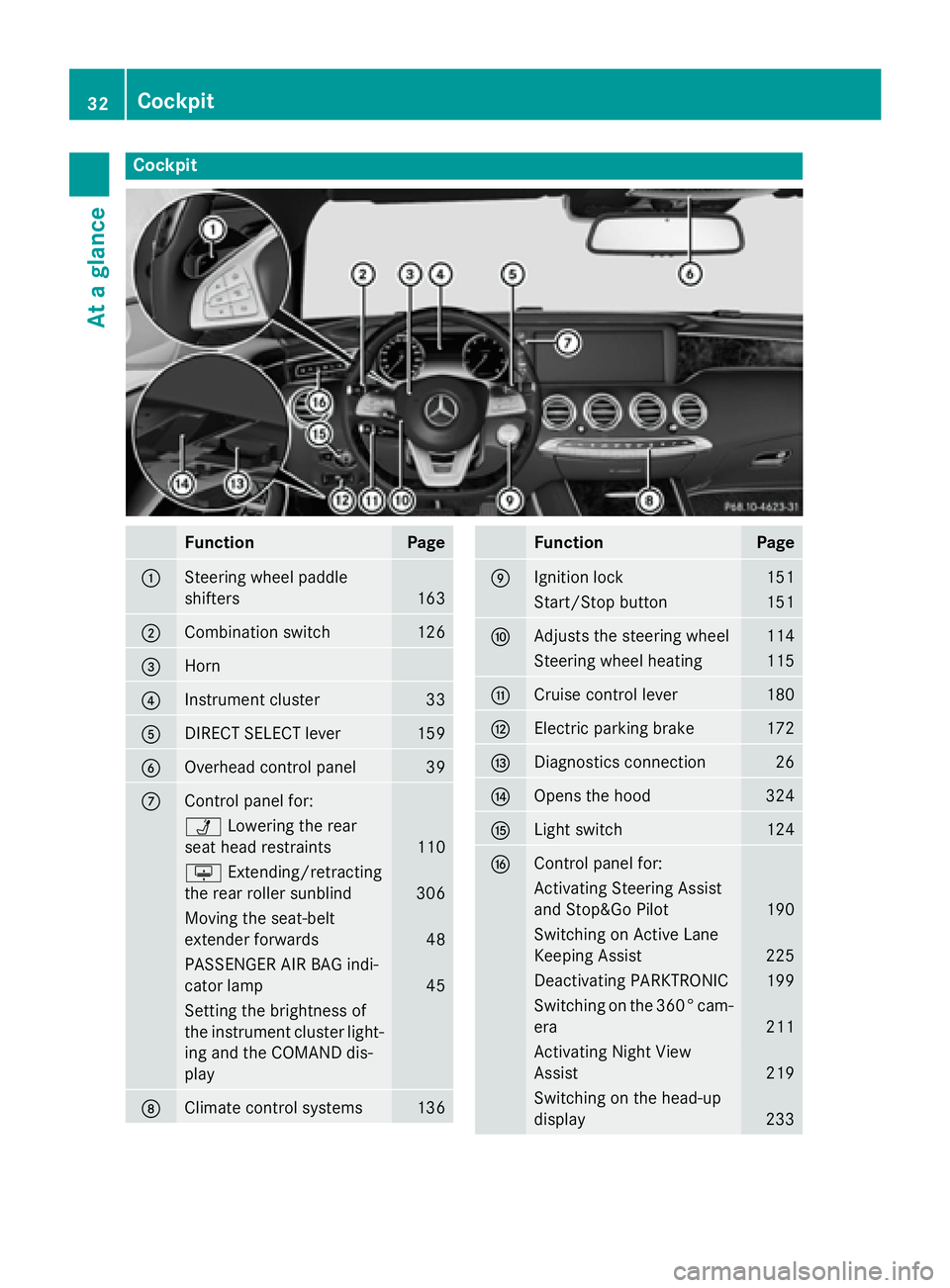
Cockpit
FunctionPage
:Steering wheel paddle
shifters
163
;Combination switch126
=Horn
?Instrument cluster33
ADIRECT SELECT lever159
BOverhead control panel39
CControl panel for:
ÜLowering the rear
seat head restraints
110
u Extending/retracting
the rear roller sunblind
306
Moving the seat-belt
extender forwards
48
PASSENGER AIR BAG indi-
cator lamp
45
Setting the brightness of
the instrument cluster light-
ing and the COMAND dis-
play
DClimate control systems136
FunctionPage
EIgnition lock151
Start/Stop button151
FAdjusts the steering wheel114
Steering wheel heating115
GCruise control lever180
HElectric parking brake172
IDiagnostics connection26
JOpens the hood324
KLight switch124
LControl panel for:
Activating Steering Assist
and Stop&Go Pilot
190
Switching on Active Lane
Keeping Assist
225
Deactivating PARKTRONIC199
Switching on the 360° cam-
era
211
Activating Night View
Assist
219
Switching on the head-up
display
233
32Cockpit
At a glance
Page 37 of 410
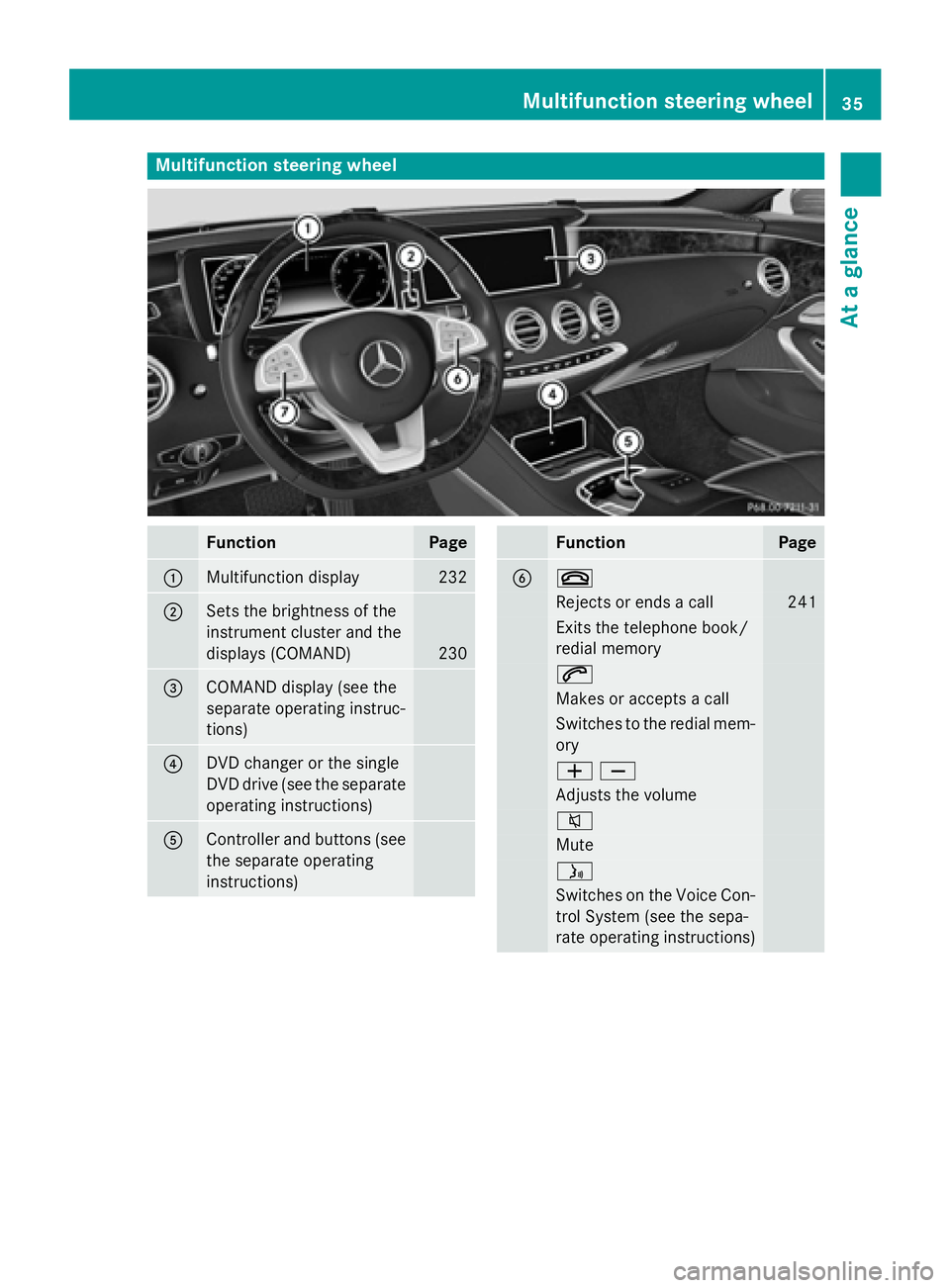
Multifunction steering wheel
FunctionPage
:Multifunction display232
;Sets the brightness of the
instrument cluster and the
displays (COMAND)
230
=COMAND display (see the
separate operating instruc-
tions)
?DVD changer or the single
DVD drive (see the separate
operating instructions)
AController and buttons (see
the separate operating
instructions)
FunctionPage
B~
Rejects or ends a call241
Exits the telephone book/
redial memory
6
Makes or accepts a call
Switches to the redial mem-
ory
WX
Adjusts the volume
8
Mute
ó
Switches on the Voice Con-
trol System (see the sepa-
rate operating instructions)
Multifunction steering wheel35
At a glance
Page 38 of 410
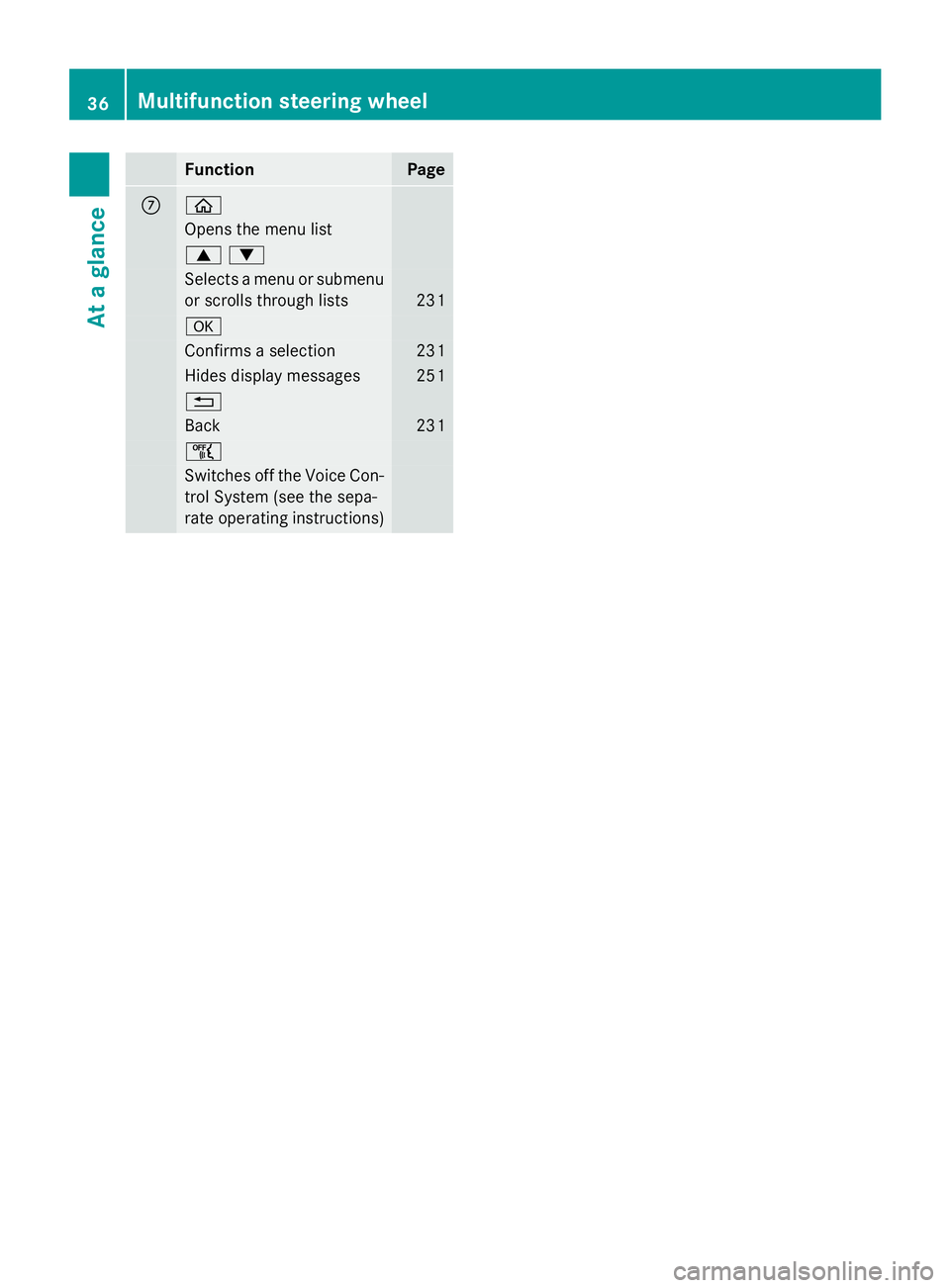
FunctionPage
Cò
Opens the menu list
9:
Selects a menu or submenu
or scrolls through lists
231
a
Confirms a selection231
Hides display messages251
%
Back231
ñ
Switches off the Voice Con-
trol System (see the sepa-
rate operating instructions)
36Multifunction steering wheel
At a glance
Page 42 of 410
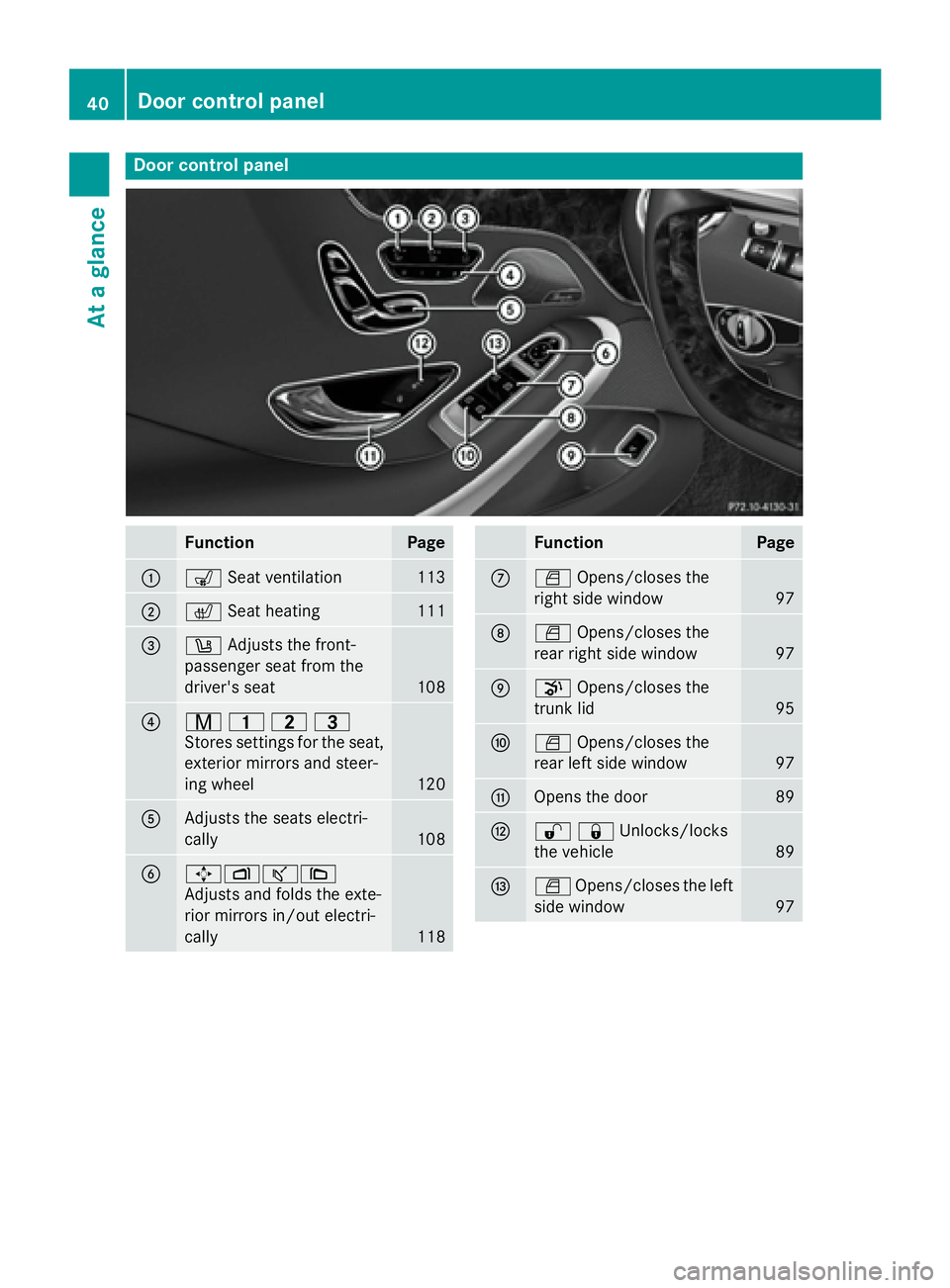
Door controlpanel
FunctionPage
:s Seat ventilation113
;c Seat heatin g111
=w Adjust sth efront-
passenger seat from th e
driver's seat
10 8
?r 45=
Stores settings for the seat,
exterior mirrors and steer-
ing wheel
120
AAdjusts the seats electri-
cally
108
B7Zª\
Adjusts and folds the exte-
rior mirrors in/out electri-
cally
118
FunctionPage
CW Opens/closes the
right side window
97
DW Opens/closes the
rear right side window
97
Ep Opens/closes the
trunk lid
95
FW Opens/closes the
rear left side window
97
GOpens the door89
H%&Unlocks/locks
the vehicle
89
IW Opens/closes the left
side window
97
40Door control panel
At a glance
Page 46 of 410
Useful information
i
This Operator's Manual describes all
models and all standard and optional equip-
ment of your vehicle available at the time of
publication of the Operator's Manual.
Country-specific differences are possible.
Please note that your vehicle may not be
equipped with all features described. This
also applies to safety-related systems and
functions.
iRead the information on qualified special-
ist workshops (
Ypage 26).
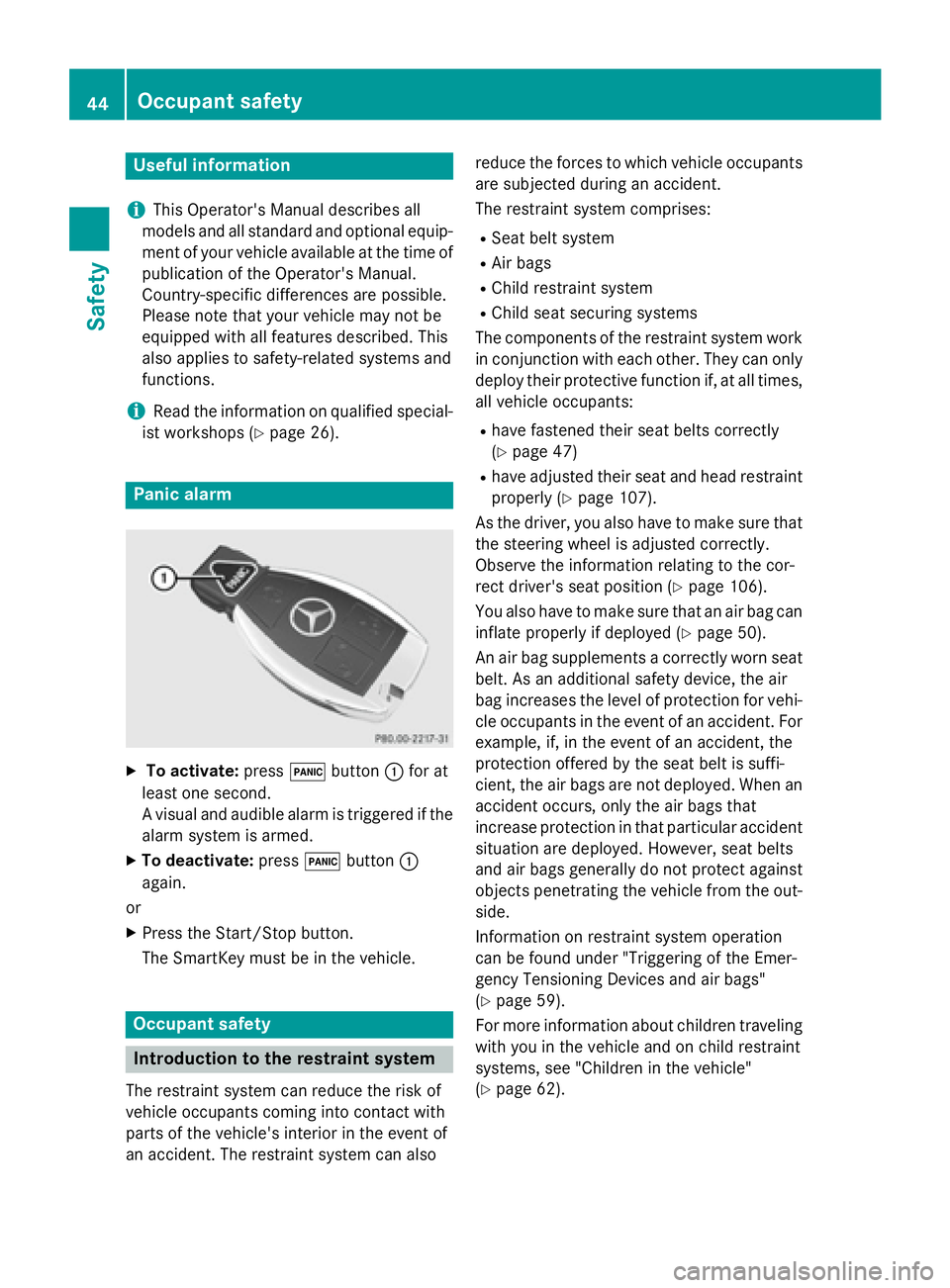
Panic alarm
XTo activate: press!button :for at
least one second.
A visual and audible alarm is triggered if the
alarm system is armed.
XTo deactivate: press!button :
again.
or
XPress the Start/Stop button.
The SmartKey must be in the vehicle.
Occupant safety
Introduction to the restraint system
The restraint system can reduce the risk of
vehicle occupants coming into contact with
parts of the vehicle's interior in the event of
an accident. The restraint system can also reduce the forces to which vehicle occupants
are subjected during an accident.
The restraint system comprises:
RSeat belt system
RAir bags
RChild restraint system
RChild seat securing systems
The components of the restraint system work in conjunction with each other. They can only
deploy their protective function if, at all times,
all vehicle occupants:
Rhave fastened their seat belts correctly
(
Ypage 47)
Rhave adjusted their seat and head restraint
properly (
Ypage 107).
As the driver, you also have to make sure that
the steering wheel is adjusted correctly.
Observe the information relating to the cor-
rect driver's seat position (
Ypage 106).
You also have to make sure that an air bag can inflate properly if deployed (
Ypage 50).
An air bag supplements a correctly worn seat
belt. As an additional safety device, the air
bag increases the level of protection for vehi-
cle occupants in the event of an accident. For
example, if, in the event of an accident, the
protection offered by the seat belt is suffi-
cient, the air bags are not deployed. When an
accident occurs, only the air bags that
increase protection in that particular accident
situation are deployed. However, seat belts
and air bags generally do not protect against objects penetrating the vehicle from the out-
side.
Information on restraint system operation
can be found under "Triggering of the Emer-
gency Tensioning Devices and air bags"
(
Ypage 59).
For more information about children traveling
with you in the vehicle and on child restraint
systems, see "Children in the vehicle"
(
Ypage 62).
44Occupant safety
Safety
Page 53 of 410
To avoid hazardous situations, always make
sure that all of the vehicle's occupants:
Rhave fastened their seat belts correctly,
including pregnant women
Rare sitting correctly and maintain the great-
est possible distance to the air bags
Rfollow the following instructions
Always make sure that there are no objects
between the air bag and the vehicle's occu-
pants.
RAdjust the seats properly before beginning
your journey. Always make sure that the
seat is in an almost upright position. The
center of the head restraint must support
the head at about eye level.
RMove the driver's and front-passenger
seats as far back as possible. The driver's
seat position must allow the vehicle to be
driven safely.
ROnly hold the steering wheel on the out-
side. This allows the air bag to be fully
deployed.
RAlways lean against the backrest while driv-
ing. Do not lean forwards or lean against
the door or side window. You may other-
wise be in the deployment area of the air
bags.
RAlways keep your feet in the footwell in
front of the seat. Do not put your feet on the
dashboard, for example. Your feet may oth- erwise be in the deployment area of the air
bag.
RFor this reason, always secure persons less
than 5 ft (1.50 m) tall in suitable restraint
systems. Up to this height, the seat belt
cannot be worn correctly.
If a child is traveling in your vehicle, also
observe the following notes:
RAlways secure children under twelve years
of age and less than 5 ft (1.50 m)tall in
suitable child restraint systems.
RChild restraint systems should be installed on the rear seats.
ROnly secure a child in a rearward-facing
child restraint system on the front-
passenger seat when the front-passenger
front air bag is deactivated. If the
PASSENGER AIR BAG OFF indicator lamp ispermanently lit, th
e front-passenger front
air bag is deactivated (
Ypage 45).
RAlways observe the instructions and safety
notes on the "Occupant Classification Sys-
tem (OCS)" (
Ypage 53) and on "Children
in the vehicle" (
Ypage 62) in addition to
the child restraint system manufacturer's
installation instructions.
Objects in the vehicle interior may pre-
vent an air bag from functioning correctly.
Before starting your journey and to avoid risks
resulting from the speed of the air bag as it
deploys, make sure that:
Rthere are no people, animals or objects
between the vehicle occupants and an air
bag.
Do not place any objects on the dashboard
e.g. above the front-passenger front air
bag.
Rthere are no objects between the seat, door
and B-pillar.
Rno hard objects, e.g. coat hangers, hang on
the grab handles or coat hooks.
Rno accessories, such as cup holders, are
attached to the vehicle within the deploy-
ment area of an air bag, e.g. to doors, side
windows, rear side trim or side walls.
Rno heavy, sharp-edged or fragile objects
are in the pockets of your clothing. Store
such objects in a suitable pla
ce.
GWARNING
If you modify the air bag cover or affix objects
such as stickers to it, the air bag can no longer
function correctly. There is an increased risk
of injury.
Never modify an air bag cover or affix objects
to it.
Occupant safety51
Safety
Z