tires MERCEDES-BENZ S-COUPE 2016 Owner's Manual
[x] Cancel search | Manufacturer: MERCEDES-BENZ, Model Year: 2016, Model line: S-COUPE, Model: MERCEDES-BENZ S-COUPE 2016Pages: 410, PDF Size: 8.62 MB
Page 274 of 410

Drivingsystems
Display messagesPossible causes/consequences an dMSolutions
À
ATTENTION ASSIST :
Take a Break!
Based on certain criteria, ATTENTION ASSIST has detecte dfatigue
or alac kof concentration on th epar tof th edriver . Awarnin gtone
also sounds.
XIf necessary, take abreak .
Durin glon gjourneys, take regular break sin goo dtime so you get
enough rest.
À
ATTENTION ASSIST
Inoperative
ATTENTION ASSIST is inoperative .
XVisitaqualified specialist workshop .
¨
VehicleRising
Your vehicle is adjustin gto th elevel you hav eselected.
¨
Vehicl eRising
Please Wai t
The vehicle level is to olow when th evehicle is stationary. Awarn -
in g tone also sounds.
XDo no tpull away.
The vehicle level is set when th edisplay message disappears .
¨
StopVehicl eVehi‐
cle Too Low
You hav epulle daway whil eth evehicle level is still to olow.
AIRMATIC set sth evehicle to th eselecte dlevel after ashort
period.
XPull over and stop th evehicle safely as soo nas possible, payin g
attention to road and traffic conditions.
XSecur eth evehicle against rollin gaway (Ypage 170).
XWait until th edisplay message disappears befor epulling away.
AIRMATIC is defective. Awarnin gtone also sounds.
XDo no tdrive at speeds abov e50 mph (80 km/h).
XMak eonly slight steerin gmovements .Otherwise ,th efron t
fender or th etires could be damaged if th esteerin gmovemen t
is to olarge.
XListe nfo rscrapin gsounds.
XPull over and stop th evehicle safely, payin gattention to road
and traffic conditions, and set ahigher vehicle level.
Dependin gon th emalfunction ,it may be possible to rais eth e
vehicle.
XVisit aqualified specialist workshop .
272Display messages
On-board computer and displays
Page 275 of 410

Display messagesPossible causes/consequences andMSolutions
¨
Malfunction
The AIRMATIC function is restricted. The vehicle's handlin gchar-
acteristics may be affected.
XDo no tdrive at speeds abov e50 mph (80 km/ h).
XVisit a qualified specialist workshop.
ABC Malfunction
Stop Vehicle
The Active Body Control (ABC) vehicle level is too low.
XPull over and stop the vehicle safely as soon as possible, paying
attention to road and traffic conditions.
After a few seconds, the vehicle level is adjusted and the display
message disappears.
The multifunction display continuously shows the display mes-
sage.
The vehicle is leaking oil.
XPull over and stop the vehicle safely as soon as possible, paying
attention to road and traffic conditions. Do not continue driving
under any circumstances.
XConsult a qualified specialist workshop.
The multifunction display continuously shows the display mes-
sage.
Active Body Control (ABC) is malfunctioning.
XDo not drive at speeds above 50 mph (80 km/h).
XMake only slight steering movements. Otherwise, the front
fender or the tires could be damaged if the steering movement
is too large.
XListen for scraping sounds.
XVisit a qualified specialist workshop.
ABCVehicleRising
PleaseWaitBriefly
The vehicle level is too low when the vehicle is stationary. A warn-
ing tone also sounds.
XDo not pull away.
The vehicle level is set when the display message disappears.
ABC MalfunctionThe Active Body Control (ABC) function is restricted. The vehicle's
handling characteristics may be affected.
XDo not drive at speeds above 50 mph (80 km/h).
XVisit a qualified specialist workshop.
Display messages273
On-board computer and displays
Z
Page 281 of 410
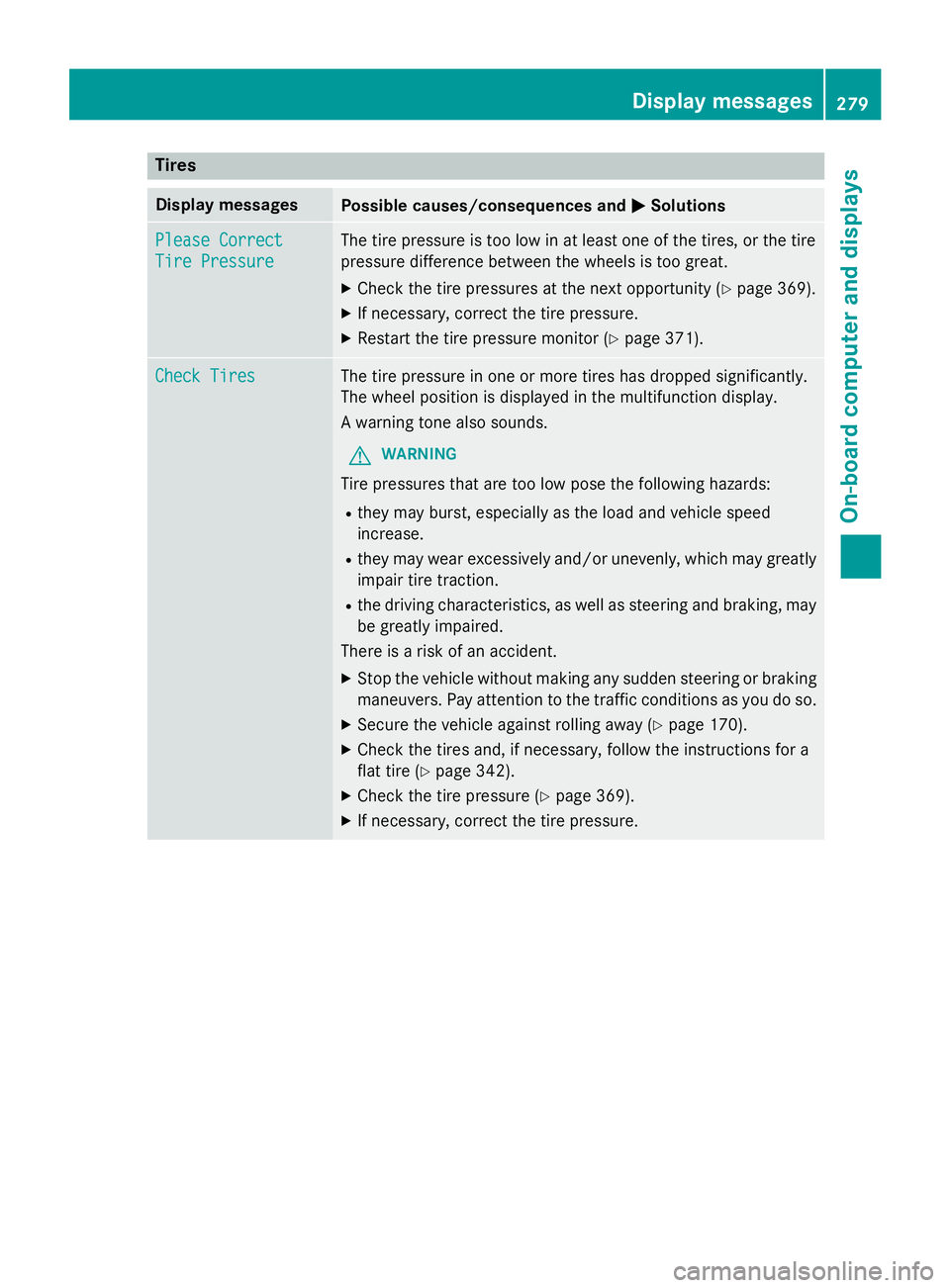
Tires
Display messagesPossible causes/consequences andMSolutions
Please Correct
Tire Pressure
The tire pressure is too low in at least one of the tires, or the tire
pressure difference between the wheels is too great.
XCheck the tire pressures at the next opportunity (Ypage 369).
XIf necessary, correct the tire pressure.
XRestart the tire pressure monitor (Ypage 371).
Check TiresThe tire pressure in one or more tires has dropped significantly.
The wheel position is displayed in the multifunction display.
A warning tone also sounds.
GWARNING
Tire pressures that are too low pose the following hazards:
Rthey may burst, especially as the load and vehicle speed
increase.
Rthey may wear excessively and/or unevenly, which may greatly
impair tire traction.
Rthe driving characteristics, as well as steering and braking, may
be greatly impaired.
There is a risk of an accident.
XStop the vehicle without making any sudden steering or braking
maneuvers. Pay attention to the traffic conditions as you do so.
XSecure the vehicle against rolling away (Ypage 170).
XCheck the tires and, if necessary, follow the instructions for a
flat tire (
Ypage 342).
XCheck the tire pressure (Ypage 369).
XIf necessary, correct the tire pressure.
Displa y messages279
On-board computer and displays
Z
Page 282 of 410
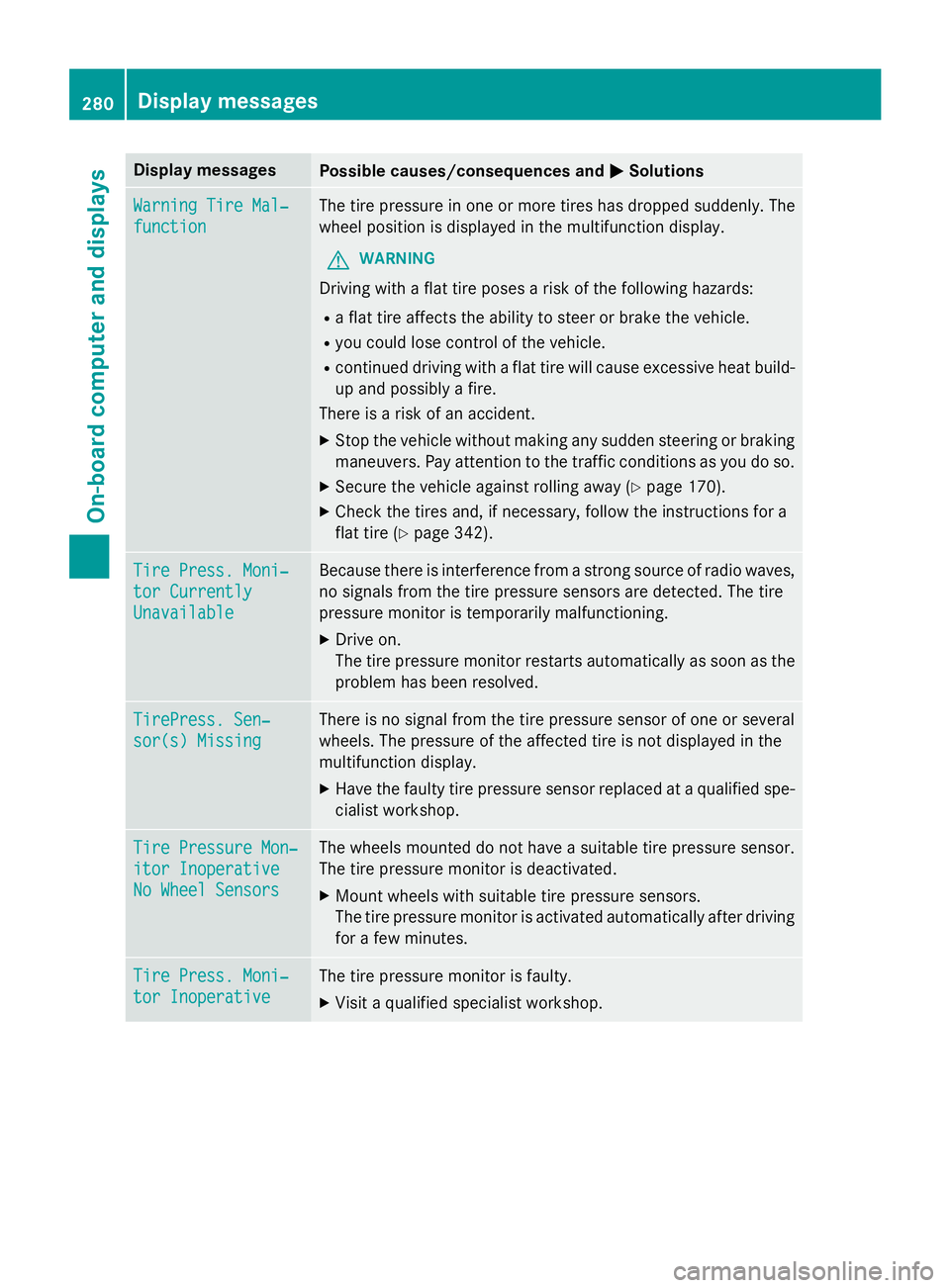
Display messagesPossible causes/consequences andMSolutions
WarningTir eMal ‐
function
The tire pressur ein on eor mor etires has dropped suddenly. The
whee lposition is displayed in th emultifunction display.
GWARNIN G
Drivingwit h a flat tire poses aris kof th efollowing hazards :
Raflat tire affects th eabilit yto steer or brak eth evehicle.
Ryou could los econtrol of th evehicle.
Rcontinued drivin gwit h a flat tire will caus eexcessive heat build-
up and possibl y afire.
There is aris kof an accident.
XStop th evehicl ewithout makin gany sudden steerin gor brakin g
maneuvers .Pay attention to th etraffic condition sas you do so.
XSecur eth evehicl eagainst rollin gaway (Ypage 170).
XCheckth etires and ,if necessary, follow th einstruction sfo r a
flat tire (
Ypage 342).
TirePress. Moni‐
tor Currently
Unavailable
Becaus ethere is interferenc efrom astron gsource of radi owaves,
no signal sfrom th etire pressur esensor sare detected. The tire
pressur emonitor is temporarily malfunctioning.
XDrive on .
The tire pressur emonitor restarts automatically as soo nas th e
problem has been resolved.
TirePress .Sen ‐
sor(s) Missin g
There is no signal from th etire pressur esensor of on eor several
wheels. The pressur eof th eaffecte dtire is no tdisplayed in th e
multifunction display.
XHav eth efault ytire pressur esensor replaced at aqualified spe -
cialist workshop .
TirePressure Mon ‐
itorInoperative
No Wheel Sensor s
The wheels mounted do no thav e a suitable tire pressur esensor .
The tire pressur emonitor is deactivated.
XMoun twheels wit hsuitable tire pressur esensors.
The tire pressur emonitor is activated automatically after drivin g
fo r a few minutes.
Tir ePress. Moni‐
tor Inoperative
The tire pressur emonitor is faulty.
XVisit aqualified specialist workshop .
280Display messages
On-board computer and displays
Page 299 of 410
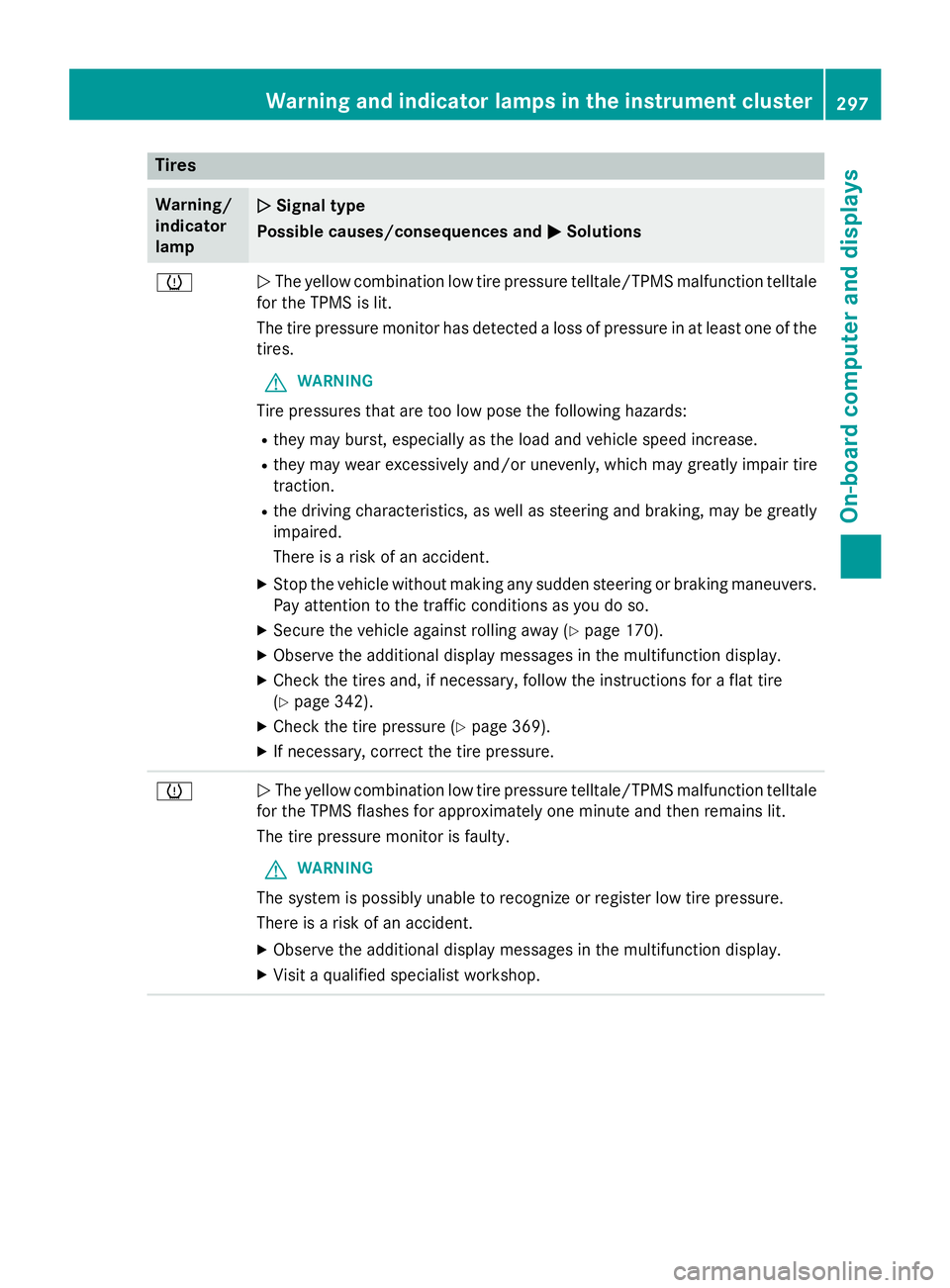
Tires
Warning/
indicator
lampNSignal type
Possible causes/consequences and M
Solutions
hNThe yellow combination low tire pressure telltale/TPMS malfunction telltale
for the TPMS is lit.
The tire pressure monitor has detected a loss of pressure in at least one of the
tires.
GWARNING
Tire pressures that are too low pose the following hazards:
Rthey may burst, especially as the load and vehicle speed increase.
Rthey may wear excessively and/or unevenly, which may greatly impair tire
traction.
Rthe driving characteristics, as well as steering and braking, may be greatly
impaired.
There is a risk of an accident.
XStop the vehicle without making any sudden steering or braking maneuvers.
Pay attention to the traffic conditions as you do so.
XSecure the vehicle against rolling away (Ypage 170).
XObserve the additional display messages in the multifunction display.
XCheck the tires and, if necessary, follow the instructions for a flat tire
(
Ypage 342).
XCheck the tire pressure (Ypage 369).
XIf necessary, correct the tire pressure.
hN The yellow combination low tire pressure telltale/TPMS malfunction telltale
for the TPMS flashes for approximately one minute and then remains lit.
The tire pressure monitor is faulty.
GWARNING
The system is possibly unable to recognize or register low tire pressure.
There is a risk of an accident.
XObserve the additional display messages in the multifunction display.
XVisit a qualified specialist workshop.
Warning and indicator lamps in the instrument cluster297
On-board computer and displays
Z
Page 333 of 410
the ASSYST PLUS service interval display
after the service work has been carried out.
You can also obtain further information on
maintenance work, for example.
Special service requirements
The specified maintenance interval takes only
the normal operation of the vehicle into
account. Under arduous operating conditions
or increased load on the vehicle, mainte-
nance work must be carried out more fre-
quently, for example:
Rregular city driving with frequent intermedi-ate stops
Rif the vehicle is primarily used to travel
short distances
Ruse in mountainous terrain or on poor road
surfaces
Rif the engine is often left idling for long peri-ods
Under these or similar conditions, have, for
example, the air filter, engine oil and oil filter
replaced or changed more frequently. Under
arduous operating conditions, the tires must
be checked more often. Further information
can be obtained at a qualified specialist work-
shop, e.g. an authorized Mercedes-Benz Cen-
ter.
Driving abroad
An extensive Mercedes-Benz Service network
is also available in other countries. You can
obtain further information from any author-
ized Mercedes-Benz Center.
Care
General notes
HEnvironmental note
Dispose of empty packaging and cleaning
cloths in an environmentally responsible man-
ner.
!For cleaning your vehicle, do not use any
of the following:
Rdry, rough or hard cloths
Rabrasive cleaning agents
Rsolvents
Rcleaning agents containing solvents
Do not scrub.
Do not touch the surfaces or protective
films with hard objects, e.g. a ring or ice
scraper. You could otherwise scratch or
damage the surfaces and protective film.
!Do not park the vehicle for an extended
period straight after cleaning it, particularly
after having cleaned the wheels with wheel
cleaner. Wheel cleaners could cause
increased corrosion of the brake discs and
brake pads/linings. For this reason, you
should drive for a few minutes after clean-
ing. Braking heats the brake discs and the
brake pads/linings, thus drying them. The
vehicle can then be parked.
Regular care of your vehicle is a condition for
retaining the quality in the long term.
Use care products and cleaning agents rec-
ommended and approved by Mercedes-Benz.
Washing the vehicle and cleaning the
paintwork
Automatic car wash
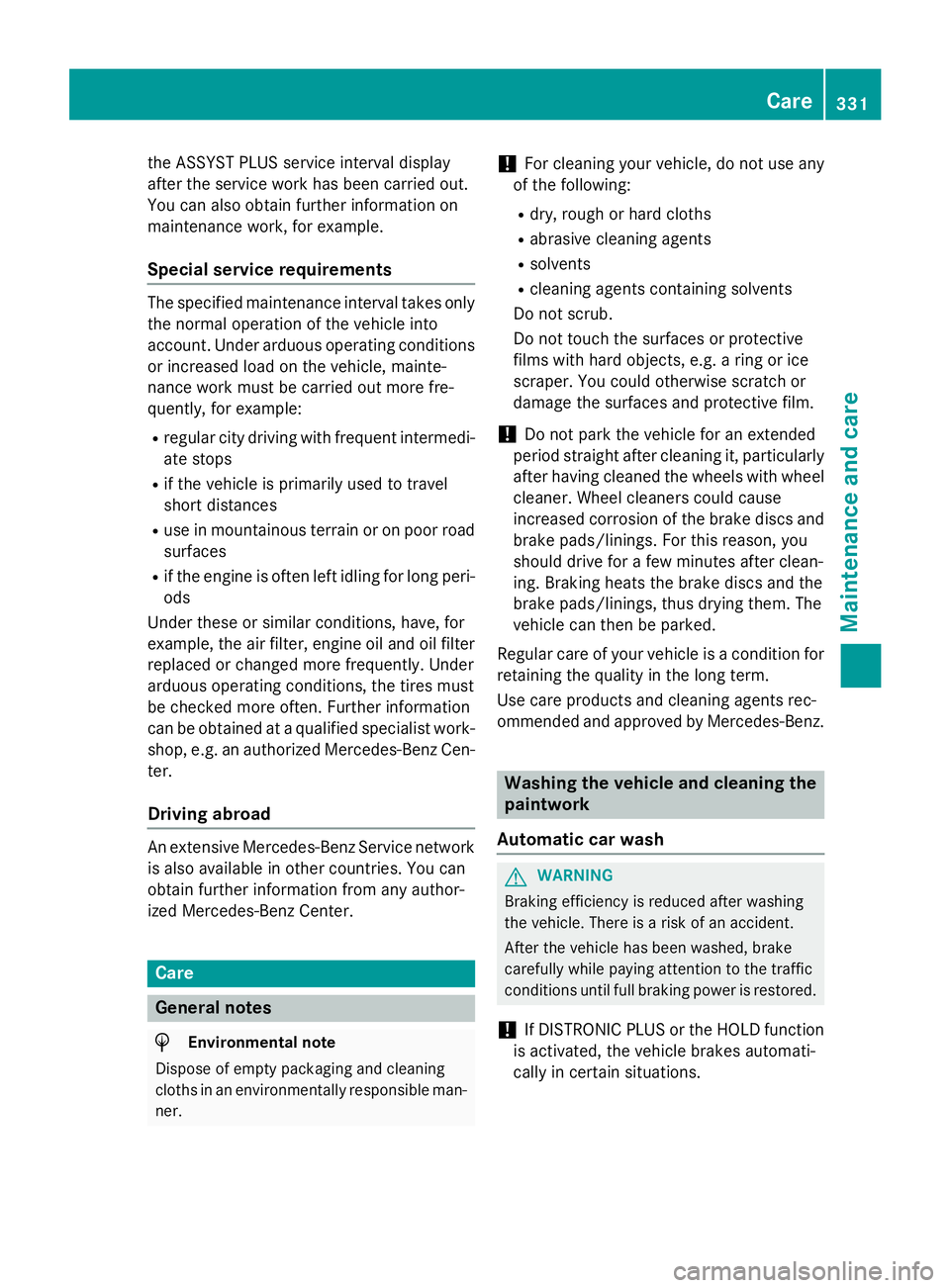
GWARNING
Braking efficiency is reduced after washing
the vehicle. There is a risk of an accident.
After the vehicle has been washed, brake
carefully while paying attention to the traffic
conditions until full braking power is restored.
!If DISTRONIC PLUS or the HOLD function
is activated, the vehicle brakes automati-
cally in certain situations.
Care331
Maintenance and care
Z
Page 335 of 410
wiping noises caused by residue on the wind-
shield.
Washing by hand
In some countries, washing by hand is only
allowed at specially equipped washing bays.
Observe the legal requirements in each coun-
try.
XDo not use hot water and do not wash the
vehicle in direct sunlight.
XUse a soft sponge to clean.
XUse a mild cleaning agent, such as a car
shampoo approved by Mercedes-Benz.
XThoroughly hose down the vehicle with a
gentle jet of water.
XDo not point the water jet directly towards
the air inlet.
XUse plenty of water and rinse out the
sponge frequently.
XRinse the vehicle with clean water and dry
thoroughly with a chamois.
XDo not let the cleaning agent dry on the
paintwork.
Carefully remove all deposits of road salt as
soon as possible when driving in winter.
Power washers
GWARNING
The water jet from a circular jet nozzle (dirt
blasters) can cause invisible exterior damage
to the tires or chassis components. Compo-
nents damaged in this way may fail unexpect-
edly. There is a risk of an accident.
Do not use power washers with circular jet
nozzles to clean the vehicle. Have damaged
tires or chassis components replaced imme-
diately.
!Always maintain a distance of at least
11.8 in (30 cm)betwee nth evehicl e and the
power washer nozzle. Information about
the correct distance is available from the
equipment manufacturer. Move the power washer nozzle around
when cleaning your vehicle.
Do not aim directly at any of the following:
Rtires
Rdoor gaps, roof gaps, joints, etc.
Relectrical components
Rbattery
Rconnectors
Rlights
Rseals
Rtrim
Rventilation slots
Damaged seals or electrical components
can lead to leaks or failures.
!If the SmartKey is within the rear detec-
tion range of KEYLESS-GO, the following
situations, for example, could lead to the
unintentional opening of the trunk:
Rusing a car wash
Rusing a power washer
Make sure that the SmartKey is at least
10 ft (3 m) away from the vehicle.
Cleaning the paintwork
!Do not affix:
Rstickers
Rfilms
Rmagnetic plates or similar items
to painted surfaces. You could otherwise
damage the paintwork.
Scratches, corrosive deposits, areas affected
by corrosion and damage caused by inade-
quate care cannot always be completely
repaired. In such cases, visit a qualified spe-
cialist workshop.
XRemove dirt immediately, where possible,
while avoiding rubbing too hard.
XSoak insect remains with insect remover
and rinse off the treated areas afterwards.
XSoak bird droppings with water and rinse
off the treated areas afterwards.
Care333
Maintenance and care
Z
Page 336 of 410

XRemove coolant, brakefluid ,tree resin ,
oils ,fuel sand greases by rubbin ggentl y
wit h a cloth soaked in petroleum ether or
lighte rfluid .
XUse tar remove rto remove tar stains.
XUse silicon eremove rto remove wax .
If water no longer forms "beads "on th epain t
surface, use th epain tcar eproducts recom-
mended and approve dby Mercedes-Benz.
This is th ecas eapproximately every three to
fiv emonths, dependin gon th eclimat econ-
dition sand th ecar eproduc tused .
If dir thas penetrated th epain tsurfac eor if
th epain thas become dull, th epain tcleane r
recommended and approve dby Mercedes -
Benz should be used .
Do no tuse these car eproducts in th esun or
on th ehoo dwhile th ehoo dis hot .
XUseasuitable touch-up stick ,e.g. MB
Touch-Up Stick ,to repair slight damag eto
th epaintwork quickl yand provisionally.
Matt e finish car e
!Never polis hth evehicl eor th eligh talloy
wheels. Polishing causes th efinish to
shine .
!The followin gmay caus eth epain tto
become shiny and thus reduce th ematte
effect:
Rstron grubbin gof th epaintwork wit h
unsuitable materials
Rfrequen tuse of automatic car washes
Rwashin gth evehicl ein direc tsunligh t
!Never use pain tcleaner, buffin gor pol-
ishin gproducts ,or glos spreserver ,e.g.
wax .These products are only suitable for
high-gloss surfaces. Their use on vehicles
wit hmatte finish leads to considerable sur -
fac edamag e(shiny, spotted areas).
Always hav epaintwork repairs carrie dout
at aqualified specialist workshop .
!Do notuse wash programs wit h ahot wax
treatmen tunder any circumstances. Observ
ethese note sif your vehicl ehas a
clear matte finish .This will help you to avoid
damag eto th epaintwork due to incorrec t
treatment.
These note salso apply to ligh talloy wheels
wit h a clear matte finish .
The vehicl eshould preferably be washed by
han dusin g asoftsponge, car shampoo and
plenty of water.
Use only insec tremove rand car shampoo
from th erange of approve dMercedes-Ben z
car eproducts .
Cleaning th e vehicle part s
Cleaning th ewheels
GWARNIN G
The water je tfrom acircula rje tnozzle (dir t
blasters )can caus einvisible exterio rdamage
to th etires or chassi scomponents. Compo-
nent sdamaged in this way may fail unexpect-
edly. There is aris kof an accident.
Do no tuse powe rwashers wit hcircula rje t
nozzles to clean th evehicle. Hav edamaged
tires or chassi scomponent sreplaced imme-
diately.
!Do no tuse acidic whee lcleaning products
to remove brak edust .This could damag e
whee lbolt sand brak ecomponents.
!Do no tpark th evehicl efor an extended
period straight after cleaning it ,particularly
after havin gcleane dth ewheels wit hwhee l
cleaner. Wheel cleaners could caus e
increase dcorrosio nof th ebrak edisc sand
brak epads/linings. Fo rthis reason ,you
should drive for afew minute safter clean-
ing. Braking heat sth ebrak edisc sand th e
brak epads/linings, thus drying them. The
vehicl ecan then be parked.
334Care
Maintenance and care
Page 344 of 410
Useful information
i
This Operator's Manual describes all
models and all standard and optional equip-
ment of your vehicle available at the time of
publication of the Operator's Manual.
Country-specific differences are possible.
Please note that your vehicle may not be
equipped with all features described. This
also applies to safety-related systems and
functions.
iRead the information on qualified special-
ist workshops (
Ypage 26).
Where will I find...?
Vehicle tool kit
General notes
Apart from certain country-specific varia-
tions, the vehicles are not equipped with a
tire-change tool kit. If the vehicle is equipped
with tire-changing tools, these are located in
the stowage well under the trunk floor. Some
tools for changing a wheel are specific to the
vehicle. For more information on which tire
changing tools are required and approved to
perform a wheel change on your vehicle, con-
sult a qualified specialist workshop.
Tools required for changing a wheel may
include, for example:
RJack
RWheel chock
RLug wrench
RRatchet wrench
RAlignment bolt
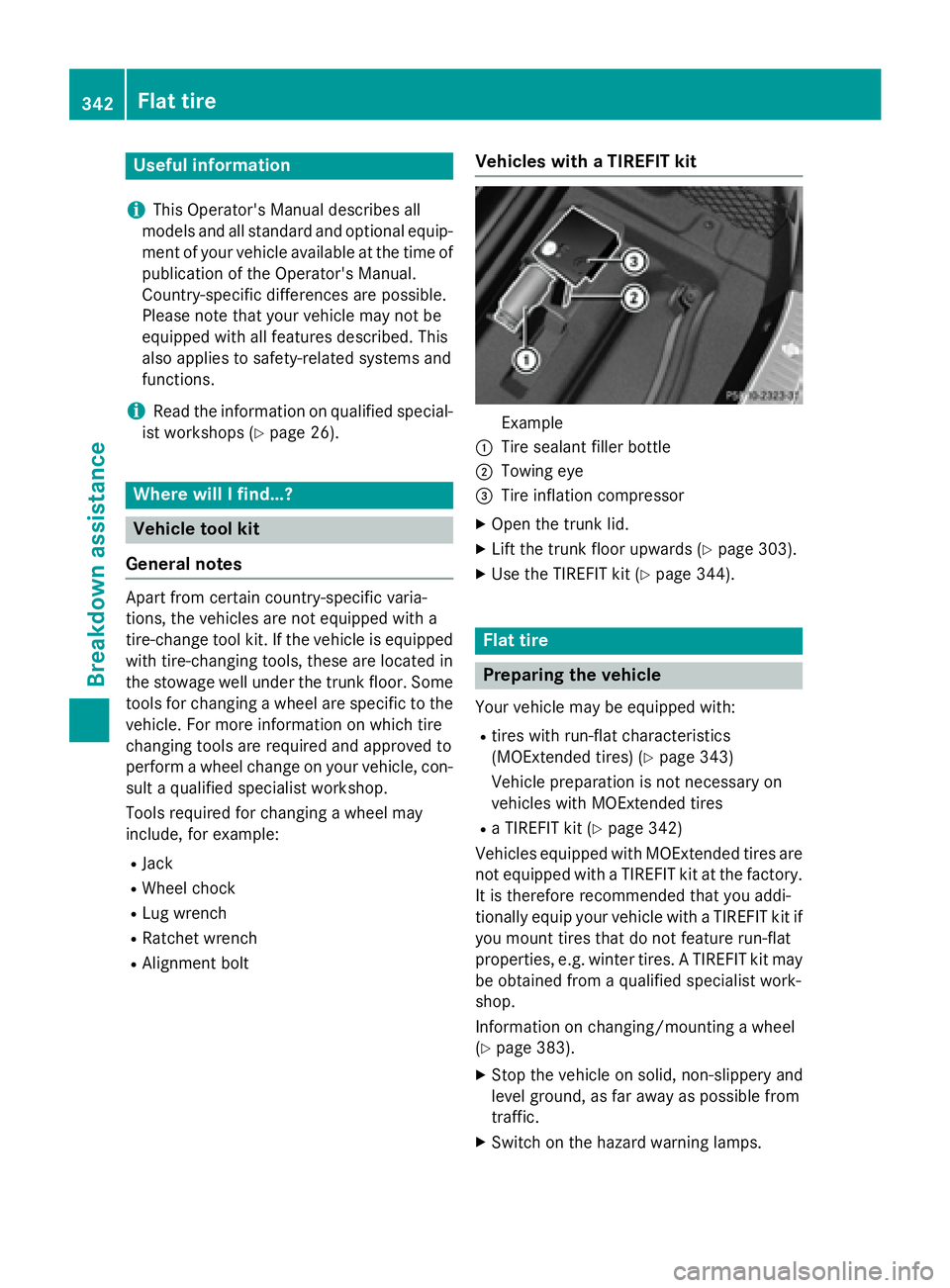
Vehicles with a TIREFIT kit
Example
:Tire sealant filler bottle
;Towing eye
=Tire inflation compressor
XOpen the trunk lid.
XLift the trunk floor upwards (Ypage 303).
XUse the TIREFIT kit (Ypage 344).
Flat tire
Preparing the vehicle
Your vehicle may be equipped with:
Rtires with run-flat characteristics
(MOExtended tires) (
Ypage 343)
Vehicle preparation is not necessary on
vehicles with MOExtended tires
Ra TIREFIT kit (Ypage 342)
Vehicles equipped with MOExtended tires are
not equipped with a TIREFIT kit at the factory.
It is therefore recommended that you addi-
tionally equip your vehicle with a TIREFIT kit if you mount tires that do not feature run-flat
properties, e.g. winter tires. A TIREFIT kit may
be obtained from a qualified specialist work-
shop.
Information on changing/mounting a wheel
(
Ypage 383).
XStop the vehicle on solid, non-slippery and
level ground, as far away as possible from
traffic.
XSwitch on the hazard warning lamps.
342Flat tire
Breakdown assistance
Page 345 of 410
XSecure the vehicle against rolling away
(
Ypage 170).
XIf possible, bring the front wheels into the
straight-ahead position.
XSwitch off the engine.
XOpen the driver's door.
The on-board electronics now have status
0. This is the same as the SmartKey having
been removed.
XRemove the Start/Stop button from the
ignition lock (
Ypage 151).
or, if the SmartKey is inserted in the ignition
lock:
XRemove the SmartKey from the ignition
lock.
XMake sure that the engine cannot be star-
ted via your smartphone (
Ypage 154).
XMake sure that the passengers are not
endangered as they do so. Make sure that
no one is near the danger area while a
wheel is being changed. Anyone who is not directly assisting in the wheel change
should, for example, stand behind the bar-
rier.
XGet out of the vehicle. Pay attention to traf-
fic conditions when doing so.
XClose the driver's door.
MOExtended tires (tires with run-flat
properties)
General notes
With MOExtended tires (tires with run flat
characteristics), you can continue to drive
your vehicle even if there is a total loss of
pressure in one or more tires. The affected
tire must not show any clearly visible damage.
You can recognize MOExtended tires by the
MOExtended marking which appears on the
sidewall of the tire. You will find this marking next to the tire size designation, the load-
bearing capacity and the speed index
(
Ypage 377). MOExtended tires may only be used in con-
junction with an active tire pressure monitor.
If a pressure loss warning message
appears in the multifunction display:
Robserve the instructions in the display mes-
sages (
Ypage 279).
Rcheck the tire for damage.
Rif driving on, observe the following notes.
The driving distance possible in run-flat mode
is approximately 50 miles (80 km) when the
vehicle is partially laden and approximately
18 miles (30 km) when the vehicle is fully
laden.
In addition to the vehicle load, the driving dis-
tance possible depends upon:
Rvehicle speed
Rroad condition
Routside temperature
The driving distance possible in run-flat mode
may be reduced by extreme driving condi-
tions/maneuver, or it can be increased
through a moderate style of driving.
The driving distance possible in run-flat mode
i
s counted from the moment the tire pressure
loss warning appears in the multifunction dis-
play.
You must not exceed a maximum speed of
50 mph (80 km/h).
iWhen replacing one or all tires, please
observe the following specifications for
your vehicle's tires:
Rsize
Rthe type and
Rthe "MOExtended" mark
If a tire has gone flat and cannot be
replaced with a MOExtended tire, a stand-
ard tire may be used as a temporary meas-
ure. Make sure that you use the proper size
and type (summer or winter tire).
iVehicles equipped with MOExtended tires
are not equipped with a TIREFIT kit at the
factory. It is therefore recommended that
you additionally equip your vehicle with a
Flat tire343
Breakdown assistance