ignition MERCEDES-BENZ S-COUPE 2016 Owners Manual
[x] Cancel search | Manufacturer: MERCEDES-BENZ, Model Year: 2016, Model line: S-COUPE, Model: MERCEDES-BENZ S-COUPE 2016Pages: 410, PDF Size: 8.62 MB
Page 13 of 410
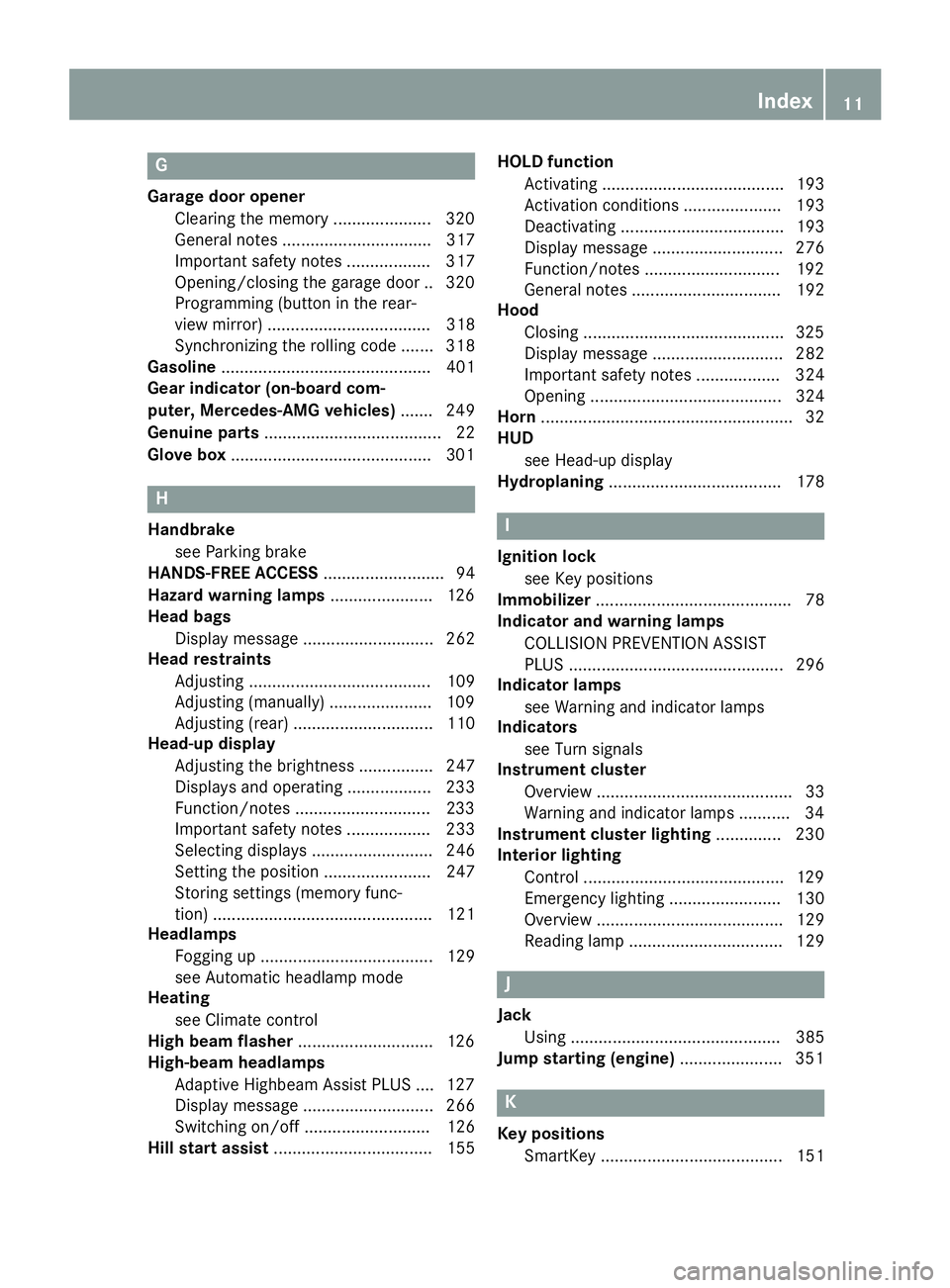
G
Garage door openerClearing the memory .....................3 20
General notes ................................ 317
Important safety notes .................. 317
Opening/closing the garage door .. 320
Programming (button in the rear-
view mirror) ................................... 318
Synchronizing the rolling code ....... 318
Gasoline ............................................. 401
Gear indicator (on-board com-
puter, Mercedes-AMG vehicles) ....... 249
Genuine parts ...................................... 22
Glove box ...........................................3 01
H
Handbrake
see Parking brake
HANDS-FREE ACCESS .......................... 94
Hazard warning lamps ......................126
Head bags
Display message ............................ 262
Head restraints
Adjusting ....................................... 109
Adjusting (manually) ......................1 09
Adjusting (rear) .............................. 110
Head-up display
Adjusting the brightness ................ 247
Displays and operating .................. 233
Function/notes .............................2 33
Important safety notes .................. 233
Selecting displays .......................... 246
Setting the position ....................... 247
Storing settings (memory func-
tion) ............................................... 121
Headlamps
Fogging up ..................................... 129
see Automatic headlamp mode
Heating
see Climate control
High beam flasher .............................1 26
High-beam headlamps
Adaptive Highbeam Assist PLUS .... 127
Display message ............................ 266
Switching on/off ........................... 126
Hill start assist .................................. 155 HOLD function
Activating ....................................... 193
Activation conditions ..................... 193
Deactivating ................................... 193
Display message ............................ 276
Function/notes .............................1 92
General notes ................................ 192
Hood
Closing ...........................................3 25
Display message ............................ 282
Important safety notes .................. 324
Opening ......................................... 324
Horn ...................................................... 32
HUD
see Head-up display
Hydroplaning ..................................... 178I
Ignition lock
see Key positions
Immobilizer .......................................... 78
Indicator and warning lamps
COLLISION PREVENTION ASSIST
PLUS .............................................. 296
Indicator lamps
see Warning and indicator lamps
Indicators
see Turn signals
Instrument cluster
Overview .......................................... 33
Warning and indicator lamps ........... 34
Instrument cluster lighting .............. 230
Interior lighting
Control ...........................................1 29
Emergency lighting ........................ 130
Overview ........................................ 129
Reading lamp ................................. 129
J
Jack
Using ............................................. 385
Jump starting (engine) ......................351
K
Key positions
SmartKey ....................................... 151
Index11
Page 19 of 410
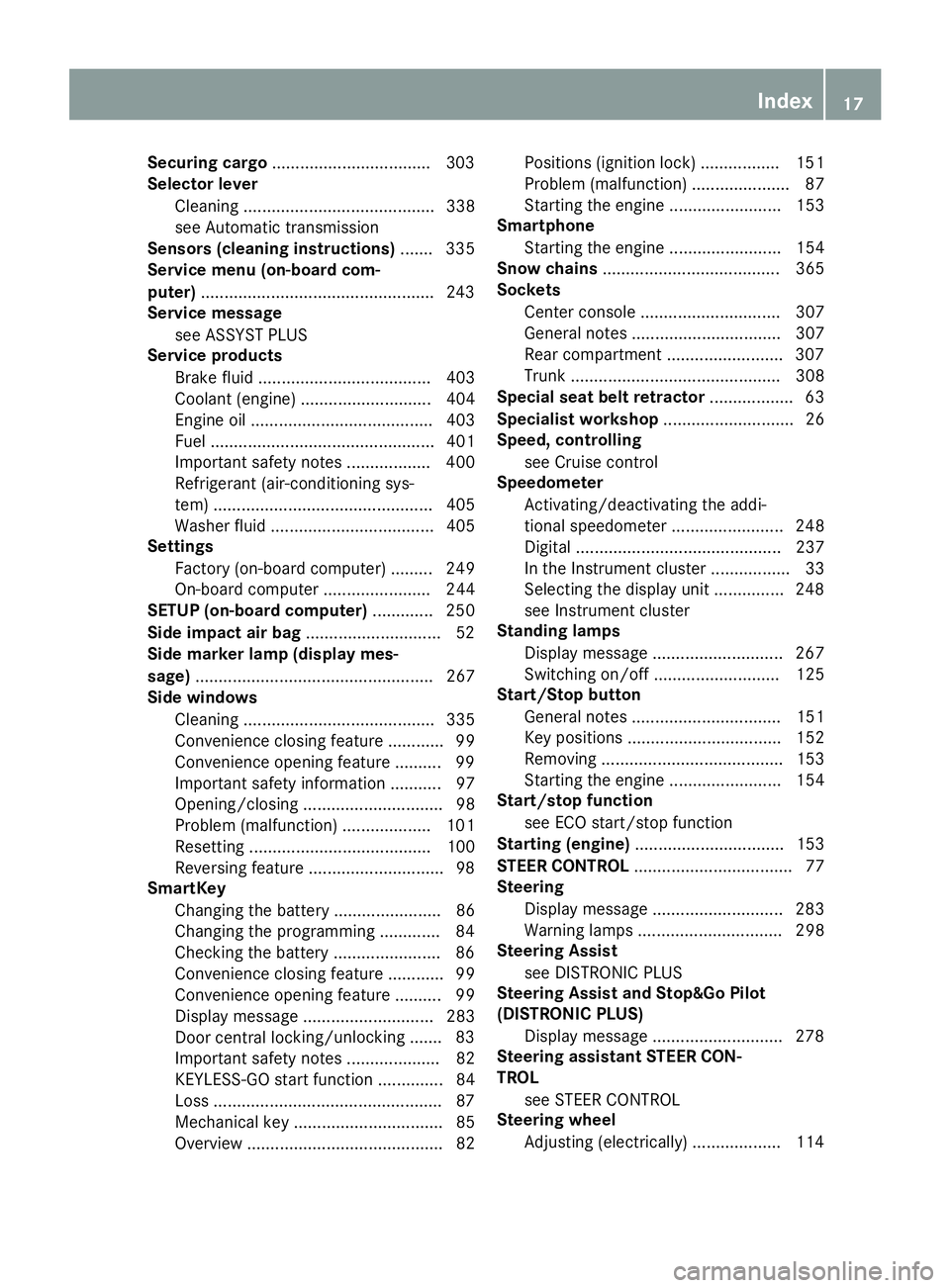
Securing cargo..................................3 03
Selector lever
Cleaning ......................................... 338
see Automatic transmission
Sensors (cleaning instructions) ....... 335
Service menu (on-board com-
puter) ..................................................2 43
Service message
see ASSYST PLUS
Service products
Brake fluid ..................................... 403
Coolant (engine) ............................ 404
Engine oil ....................................... 403
Fuel ................................................ 401
Important safety notes .................. 400
Refrigerant (air-conditioning sys-
tem) ............................................... 405
Washer fluid ................................... 405
Settings
Factory (on-board computer) ......... 249
On-board computer ....................... 244
SETUP (on-board computer) ............. 250
Side impact air bag .............................5 2
Side marker lamp (display mes-
sage) ................................................... 267
Side windows
Cleaning ......................................... 335
Convenience closing feature ............ 99
Convenience opening feature ..........9 9
Important safety information ........... 97
Opening/closing .............................. 98
Problem (malfunction) ................... 101
Resetting ....................................... 100
Reversing feature .............................9 8
SmartKey
Changing the battery ....................... 86
Changing the programming .............8 4
Checking the battery ...................... .86
Convenience closing feature ............ 99
Convenience opening feature .......... 99
Dis play message ............................ 283
Door central loc king/
unlocking ......
.83
Important safety notes .................... 82
KEYLESS-GO start function .............. 84
Loss .................................................8 7
Mechanical key ................................ 85
Overview .......................................... 82 Positions (ignition lock) ................. 151
Problem (malfunction) ..................... 87
Starting the engine ........................ 153
Smartphone
Starting the engine ........................ 154
Snow chains ...................................... 365
Sockets
Center console .............................. 307
General notes ................................ 307
Rear compartment .........................3 07
Trunk ............................................. 308
Special seat belt retractor .................. 63
Specialist workshop ............................ 26
Speed, controlling
see Cruise control
Speedometer
Activating/deactivating the addi-
tional speedometer ........................ 248
Digital ............................................ 237
In the Instrument cluster ................. 33
Selecting the display unit ...............2 48
see Instrument cluster
Standing lamps
Display message ............................ 267
Switching on/off ........................... 125
Start/Stop button
General notes ................................ 151
Key positions ................................. 152
Removing ....................................... 153
Starting the engine ........................ 154
Start/stop function
see ECO start/stop function
Starting (engine) ................................ 153
STEER CONTROL .................................. 77
Steering
Display message ............................ 283
Warning lamps ............................... 298
Steering Assist
see DISTRONIC PLUS
Steering Assist and Stop&Go Pilot
(DISTRONIC PLUS)
Display message ..................... ....... 278
Ste
ering assistant STEER CON-
TROL
see STEER CONTROL
Steering wheel
Adjusting (electrically) ................... 114
Index17
Page 34 of 410
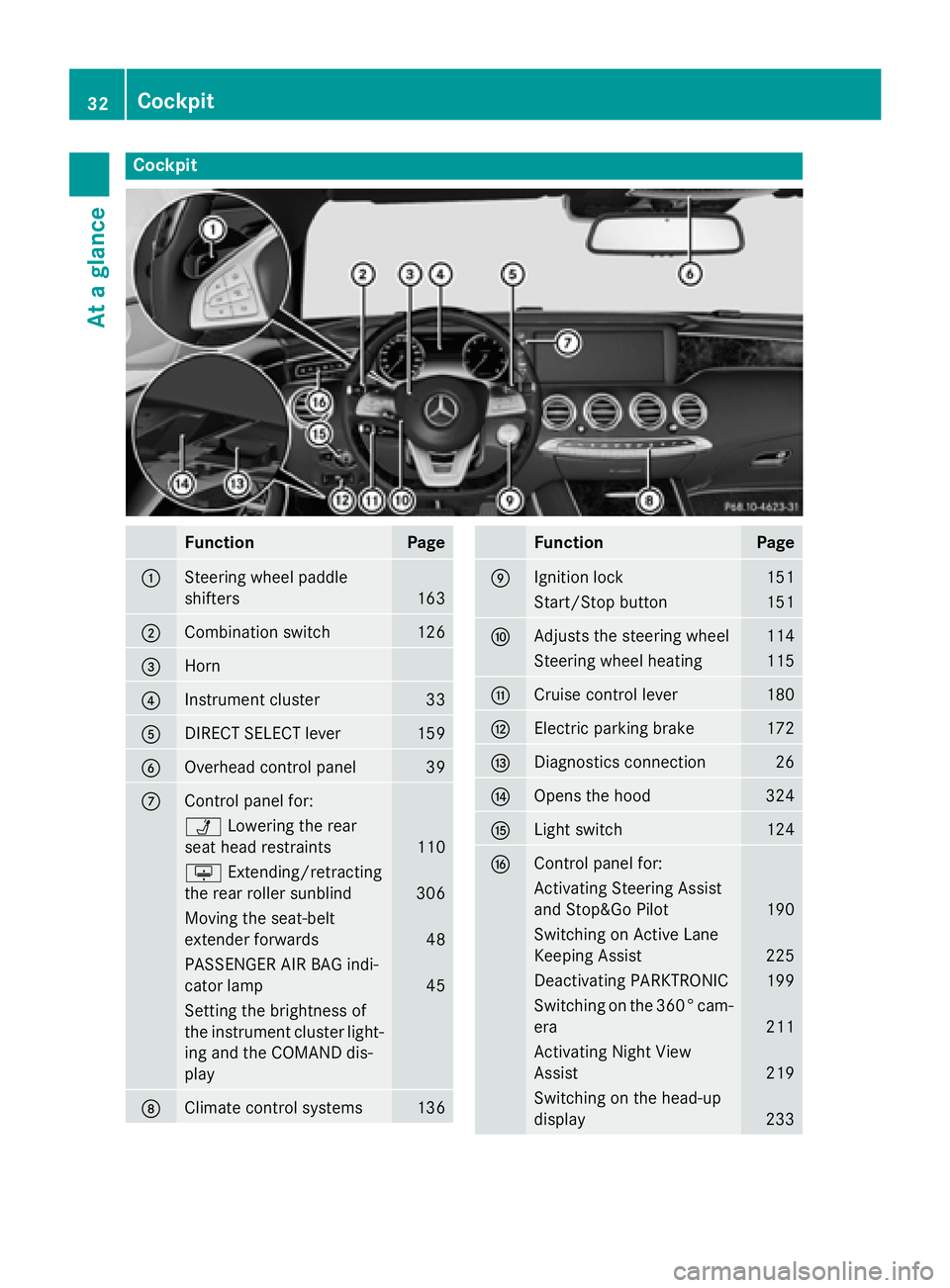
Cockpit
FunctionPage
:Steering wheel paddle
shifters
163
;Combination switch126
=Horn
?Instrument cluster33
ADIRECT SELECT lever159
BOverhead control panel39
CControl panel for:
ÜLowering the rear
seat head restraints
110
u Extending/retracting
the rear roller sunblind
306
Moving the seat-belt
extender forwards
48
PASSENGER AIR BAG indi-
cator lamp
45
Setting the brightness of
the instrument cluster light-
ing and the COMAND dis-
play
DClimate control systems136
FunctionPage
EIgnition lock151
Start/Stop button151
FAdjusts the steering wheel114
Steering wheel heating115
GCruise control lever180
HElectric parking brake172
IDiagnostics connection26
JOpens the hood324
KLight switch124
LControl panel for:
Activating Steering Assist
and Stop&Go Pilot
190
Switching on Active Lane
Keeping Assist
225
Deactivating PARKTRONIC199
Switching on the 360° cam-
era
211
Activating Night View
Assist
219
Switching on the head-up
display
233
32Cockpit
At a glance
Page 47 of 410
Important safety notes
GWARNING
Modification sto th erestrain tsystem may
caus eit to no longer wor kas intended. The
restrain tsystem may then no tperfor mits
intended protective function and may fail in an
acciden tor trigge runexpectedly, for example.
This poses an increased ris kof injury or eve n
fatal injury.
Never modify part sof th erestrain tsystem.
Never tamper wit hth ewiring, th eelectronic
component sor their software.
If it is necessar yto modify an air bag system to
accommodat e aperson wit hdisabilities, con-
tac tan authorize dMercedes-Ben zCente rfor
details. US Aonly: for further information con-
tac tour Custome rAssistanc eCente rat
1-800-FOR-MERCedes (1 ‑80 0‑3 67‑6372).
Restraint system warning lamp
The functions of the restraint system are
checked after the ignition isswitched on and
at regular intervals while the engine is run-
ning. Therefore, malfunctions can bedetec-
ted ingood time.
The 6 restraint system warning lamp in
the instrument cluster lights up when the igni-
tion is swit ched on. Itgoes out no later than a
few seconds after the vehicle is started. The
components of the restraint system are in
operational readiness.
A malfunction has occurred if the 6
restraint system warning lamp:
Rdoes not light up after the ignition is
swit ched on
Rdoes not go out after a few seconds with
the engine running
Rligh ts up again while the engine is running
GWARNIN G
If restrain tsystem is malfunctioning ,restrain t
system component smay be triggered unin -
tentionally or might no tbe triggered at all in
th eevent of an acciden twit h a high rat eof
vehicl edeceleration .This can affec tth eEmer-
gency Tensioning Devic eor air bag, for exam-
ple. This poses an increased ris kof injury or
eve nfatal injury.
Hav eth erestrain tsystem checke dand
repaire din aqualified specialist workshop as
soo nas possible .
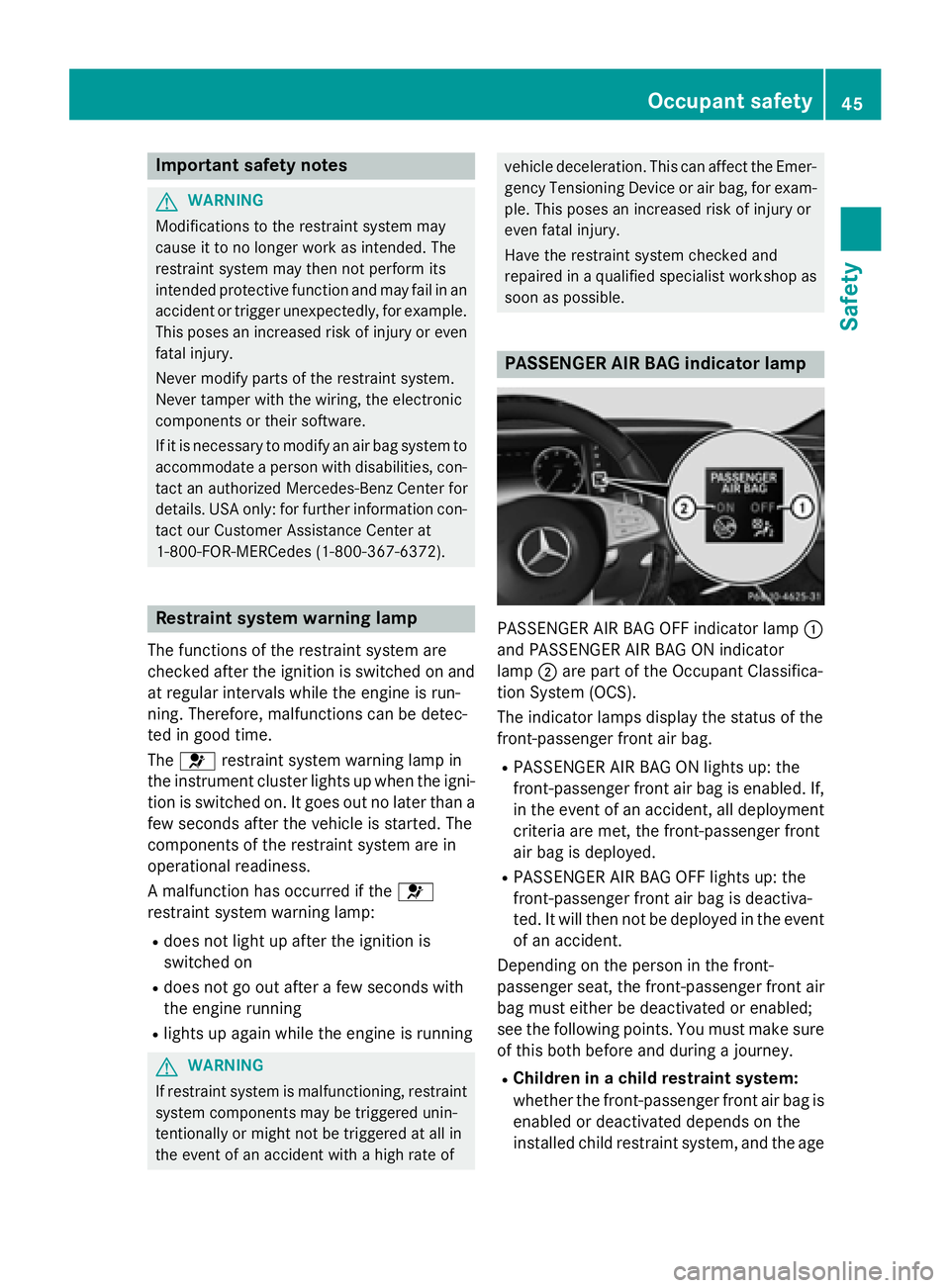
PASSENGER AIR BAG indicator lamp
PASSENGER AIR BAG OFF indicator lamp :
and PASS ENGER AIR BAG ON indicator
lamp ;are part of the Occupant Classific a-
tion System (OCS).
The indicator lamps display the status of the
front-passenger front air bag.
RPASS ENGER AIR BAG ON lights up: the
front-passenger front air bag isenabled. If,
in the event of an acc ident, all deplo yment
cr iteria are met, the front-passenger front
air bag is deplo yed.
RPASSENGER AIR BAG OFF lights up: the
front-passenger front air bag isdeactiva-
te d. It will then not be deployedinthe event
of an accident.
Depending on the person inthe front-
passenger seat, the front-passenger front air
bag must either bedeactivated or enabled;
see the following points. You must make sure
of th isboth before and during a journey.
RChildren in a child res traint system:
whether the front-passenger front air bag is
enabled or deactivated depends on the
installed ch ildrestraint system, and the age
Occupant safety45
Safety
Z
Page 50 of 410
Only then can the forces which occur be
distributed over the area of the belt.
Rthe shoulder section of the belt is always
routed across the center of your shoulder.
The shoulder section of the belt must not
come into contact with your neck or be
routed under your arm.
Rthe lap belt passes tightly and as low down
as possible across your lap.
The lap belt must always be routed across
your hip joints and not across your abdo-
men. This applies particularly to pregnant
women. If necessary, push the lap belt
down to your hip joint and pull it tight using
the shoulder section of the belt.
Rthe seat belt is not routed across sharp,
pointed or fragile objects.
If you have such items located on or in yourclothing, e.g. pens, keys or eyeglasses,
store these in a suitable place.
Ronly one person is using a seat belt at a
time.
Infants and children must never travel sit-
ting on the lap of a vehicle occupant. In the
event of an accident, they could be crushed
between the vehicle occupant and seat
belt.
Robjects are never secured with a seat belt if
the seat belt is also being used by one of the
vehicle's occupants.
Also ensure that there are never objects
between a person and the seat, e.g. cush-
ions.
Seat belts are only intended to secure and
restrain vehicle occupants. Always observe
the "Loading guidelines" for securing objects,
luggage or loads (
Ypage 300).
Fastening seat belts
Observe the safety notes on the seat belt
(
Ypage 46) and the notes on correct use of
seat belts (
Ypage 47).
GWARNING
If the seat-belt extender is extended during
the journey, the seat belt is not fitted properly
on the body. The seat belt can then no longer
perform its intended protective function. This
poses an increased risk of injury or even fatal
injury.
Always make sure that the seat-belt extender is retracted during a journey.
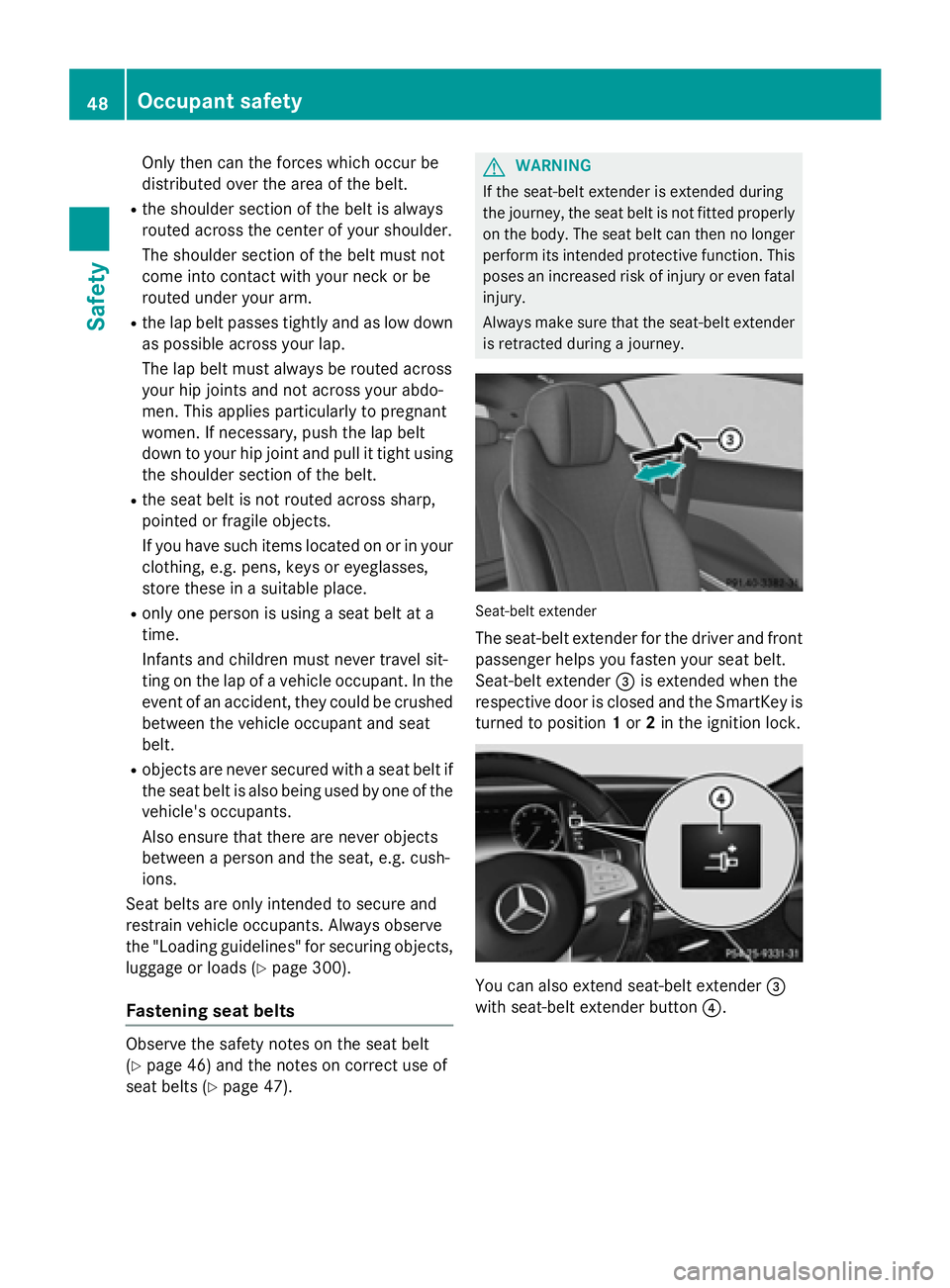
Seat-belt extender
The seat-belt extender for the driver and front
passenger helps you fasten your seat belt.
Seat-belt extender =is extended when the
respective door is closed and the SmartKey is
turned to position 1or 2in the ignition lock.
You can also extend seat-belt extender =
with seat-belt extender button ?.
48Occupant safety
Safety
Page 51 of 410
XPress seat-belt extender button?.
Seat-belt extender =extends.
Seat-belt extender =is retracted again if:
Rthe belt tongue is engaged in the seat belt
buckle.
Rthe belt tongue is not engaged in the seat
belt buckle within 60 seconds.
In this case, you can extend seat-belt
extender =again. Press seat-belt
extender button ?again.
Rthe respective door is opened.
Rthe SmartKey is turned to position 0in the
ignition lock.
Ryou release the seat backrest and fold it
forwards.
Rthe front-passenger seat is unoccupied
after approximately five seconds.
If you press seat-belt extender button ?
after this, seat-belt extender =will not
extend.
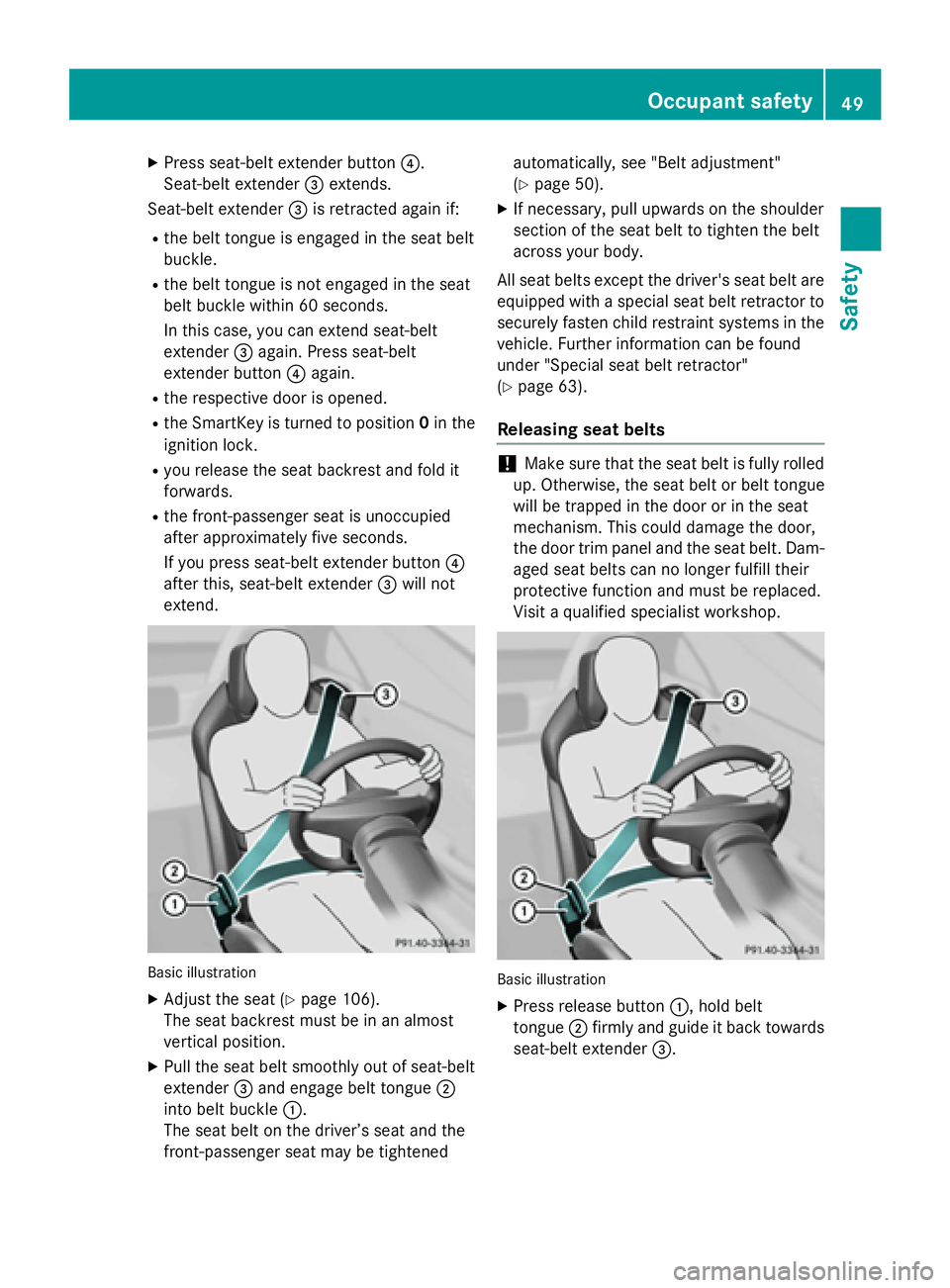
Basic illustration
XAdjust the seat (Ypage 106).
The seat backrest must be in an almost
vertical position.
XPull the seat belt smoothly out of seat-belt
extender =and engage belt tongue ;
into belt buckle :.
The seat belt on the driver’s seat and the
front-passenger seat may be tightened automatically, see "Belt adjustment"
(
Ypage 50).
XIf necessary, pull upwards on the shoulder
section of the seat belt to tighten the belt
across your body.
All seat belts except the driver's seat belt are
equipped with a special seat belt retractor to
securely fasten child restraint systems in the
vehicle. Further information can be found
under "Special seat belt retractor"
(
Ypage 63).
Releasing seat belts
!Make sure that the seat belt is fully rolled
up. Otherwise, the seat belt or belt tongue
will be trapped in the door or in the seat
mechanism. This could damage the door,
the door trim panel and the seat belt. Dam-
aged seat belts can no longer fulfill their
protective function and must be replaced.
Visit a qualified specialist workshop.
Basic illustration
XPress release button :, hold belt
tongue ;firmly and guide it back towards
seat-belt extender =.
Occupant safety49
Safety
Z
Page 52 of 410
Seat belt adjustment
The seat-belt adjustment is an integral part ofthe PRE-SAFE®convenience function. This
function adjusts the driver's and front-
passenger seat belt to the upper body of the
occupants.
The belt strap is tightened slightly when:
Rthe belt tongue is engaged in the buckle
when the seat-belt extender is retracted
and
Rthe ignition is switched on
The seat-belt adjustment will apply a certain
retraction force if any slack is detected
between the vehicle occupant and the seat
belt. Do not hold on to the seat belt tightly
while it is adjusting.
You can switch the seat-belt adjustment on
and off using COMAND. Information on acti-
vating and deactivating the seat-belt adjust-
ment function can be found in the Digital
Operator's Manual.
Belt warning for the driver and front
passenger
The 7 seat belt warning lamp in the instru-
ment cluster is a reminder that all vehicle
occupants must wear their seat belts. It may
light up continuously or flash. In addition,
there may be a warning tone.
Regardless of whether the driver's seat belt
has already been fastened, the 7seat belt
warning lamp lights up for six seconds each
time the engine is started. If, after
six seconds, the driver or front-passenger
seat belt has not been fastened and the doors
are closed, the 7seat belt warning lamp
lights up. As soon as the driver's and front-
passenger seat belts are fastened or a front
door is opened again, the 7seat belt
warning lamp goes out.
If the driver's seat belt is not fastened after
the engine is started, an additional warning
tone will sound. This warning tone stops after
six seconds or when the driver's seat belt is
fastened. If the vehicle's speed exceeds 15 mph
(25 km/h) once and the driver's and front-
passenger seat belts are not fastened, a
warning tone sounds. A warning tone also
sounds with increasing intensity for
60 seconds or until the driver or front
passenger have fastened their seat belts.
If the driver or front passenger unfasten their
seat belts during the journey, the seat belt
warning is activated again.
iFor more information on the
7seat
belt warning lamp, see "Warning and indi-
cator lamps in the instrument cluster, seat
belts" (
Ypage 285).
Air bags
Introduction
The installation point of an air bag can be rec-
ognized by the AIR BAG symbol.
An air bag complements the correctly fas-
tened seat belt. It is no substitute for the seat
belt. The air bag provides additional protec-
tion in applicable accident situations.
Not all air bags are deployed in an accident.
The different air bag systems function inde-
pendently from one another (
Ypage 59).
However, no system available today can com-
pletely eliminate injuries and fatalities.
It is also not possible to rule out a risk of injury
caused by an air bag due to the high speed at
which the air bag must be deployed.
Important safety notes
GWARNING
If you do not sit in the correct seat position,
the air bag cannot protect as intended and
could even cause additional injury when
deployed. This poses an increased risk of
injury or even fatal injury.
50Occupant safety
Safety
Page 56 of 410
Prerequisite
To be classified correctly, the front passenger
must sit:
Rwith the seat belt fastened correctly
Rin an almost upright position with their
back against the seat backrest
Rwith their feet resting on the floor, if possi-
ble
If the front passenger does not observe these
conditions, OCS may produce a false classi-
fication, e.g. because the front passenger:
Rtransfers their weight by supporting them-
selves on a vehicle armrest
Rsits in such a way that their weight is raised from the seat cushion
If it is absolutely necessary to install a child
restraint system on the front-passenger seat,
be sure to observe the correct positioning of
the child restraint system. Never place
objects under or behind the child restraint
system, e.g. cushions. Fully retract the seat
cushion length. The entire base of the child
restraint system must always rest on the seat
cushion of the front-passenger seat. The
backrest of the forward-facing child restraint
system must lie as flat as possible against the
backrest of the front-passenger seat.
The child restraint system must not touch the
roof or be subjected to a load by the head
restraint. Adjust the angle of the seat back-
rest and the head restraint position accord-
ingly.
Only then can OCS be guaranteed to function
correctly. Always observe the child restraint
system manufacturer's installation instruc-
tions.
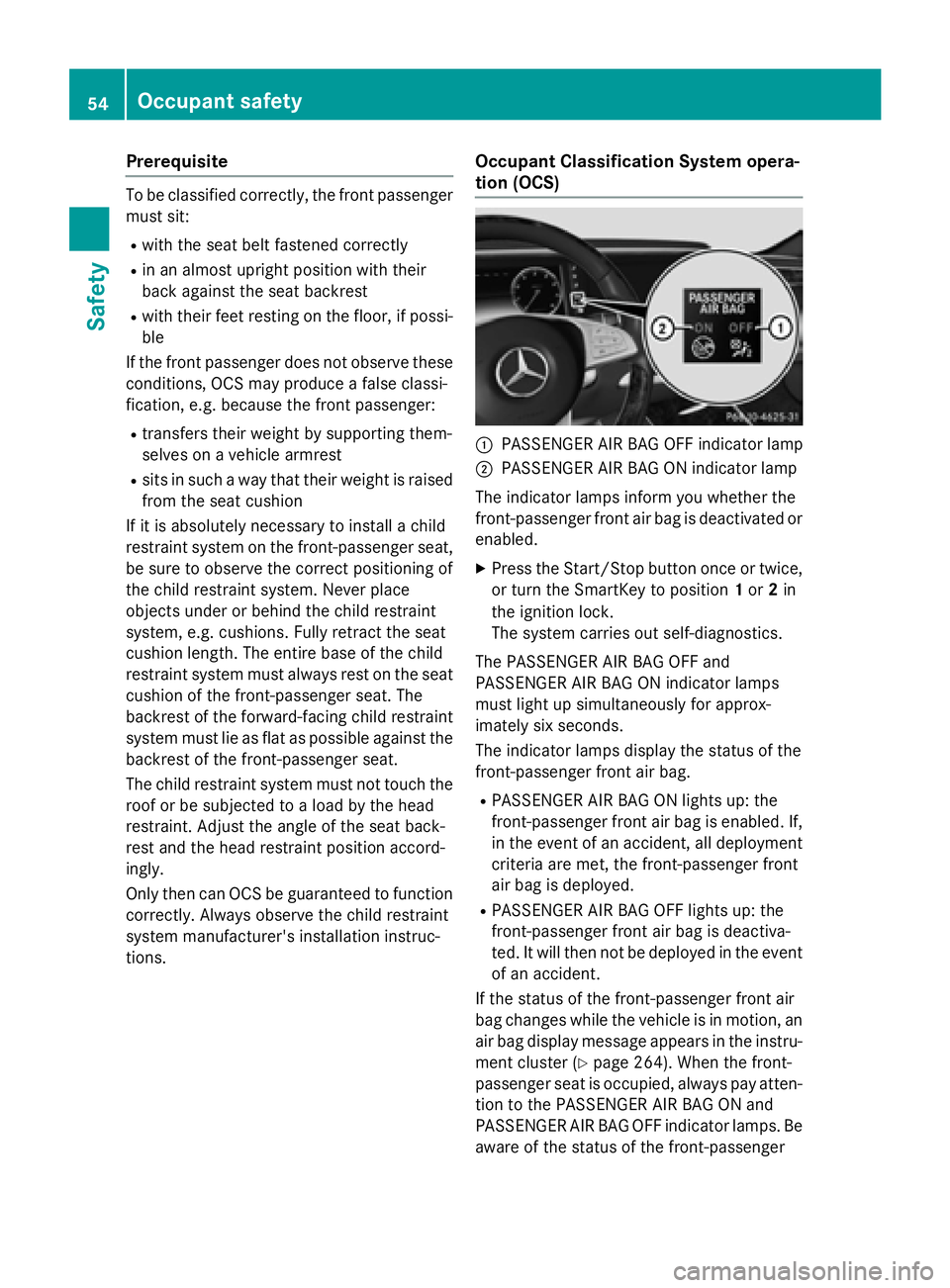
Occupant Classification System opera-
tion (OCS)
:PASSENGER AIR BAG OFF indicator lamp
;PASSENGER AIR BAG ON indicator lamp
The indicator lamps inform you whether the
front-passenger front air bag is deactivated or
enabled.
XPress the Start/Stop button once or twice,
or turn the SmartKey to position 1or 2in
the ignition lock.
The system carries out self-diagnostics.
The PASSENGER AIR BAG OFF and
PASSENGER AIR BAG ON indicator lamps
must light up simultaneously for approx-
imately six seconds.
The indicator lamps display the status of the
front-passenger front air bag.
RPASSENGER AIR BAG ON lights up: the
front-passenger front air bag is enabled. If,
in the event of an accident, all deployment
criteria are met, the front-passenger front
air bag is deployed.
RPASSENGER AIR BAG OFF lights up: the
front-passenger front air bag is deactiva-
ted. It will then not be deployed in the event
of an accident.
If the status of the front-passenger front air
bag changes while the vehicle is in motion, an
air bag display message appears in the instru-
ment cluster (
Ypage 264). When the front-
passenger seat is occupied, always pay atten-
tion to the PASSENGER AIR BAG ON and
PASSENGER AIR BAG OFF indicator lamps. Be
aware of the status of the front-passenger
54Occupant safety
Safety
Page 61 of 410
Deployment of Emergency Tensioning
Devicesan dair bags
Important safet ynotes
GWARNING
The air bag parts are hot after an air bag has
bee ndeployed .There is aris kof injury.
Do no ttouch th eair bag parts .Hav e a
deployed air bag replaced at aqualified spe -
cialis tworkshop as soo nas possible.
GWARNING
A deployed air bag no longer offers any pro -
tection and canno tprovid eth eintended pro -
tection in an accident. There is an increase d
ris kof injury.
Hav eth evehicle towed to aqualified special-
ist workshop in order to hav e adeployed air
bag replaced.
It is important fo ryour safet yand that of your
passenger to hav edeployed air bags replaced
and to hav eany malfunctionin gair bags
repaired. Thi swill help to mak esur eth eair
bags continue to perform their protective
function fo rth evehicle occupant sin th e
event of acrash .
GWARNING
Pyrotechnic Emergency Tensioning Devices
that hav ebee ndeployed are no longer opera-
tional and are unable to perform their inten-
ded protective function .Thi sposes an
increase dris kof injury or eve nfatal injury.
Therefore, hav epyrotechni cEmergency Ten -
sioning Devices whic hhav ebee ntriggere d
immediately replaced at aqualified specialis t
workshop .
An electric moto ris used by PRE-SAF E®to
trigger th etightenin gof th eseat belt in haz -
ardous situations. Thi sprocedur eis reversi-
ble.
If Emergency Tensioning Devices are trig-
gered or air bags are deployed ,you will hear a
bang, and asmall amount of powder may also be released. The
6restrain tsystem warn -
in g lamp lights up.
Only in rar ecases will th eban gaffec tyour
hearing. The powder that is release dgener-
ally doe sno tconstitute ahealth hazard ,but it
may caus eshort-term breathin gdifficulties in
people wit hasthm aor other respirator yprob-
lems. To avoid this, you may wish to get out of
th evehicle or ope nth ewindows as soo nas it
is saf eto do so.
Ai rbags and pyrotechni cEmergency Tension-
in gDevices (ETDs) contain perchlorat emate-
rial ,whic hma
y require special handlin gand
regard fo rth eenvironment. National guide-
lines mus tbe observed durin gdisposal. In
California, see www.dtsc.ca.gov/
HazardousWaste/Perchlorate/
index.cfm .
Method of operation
Duringth efirst stage of acollision ,th e
restrain tsystem contro luni tevaluates impor -
tant physical dat arelatin gto vehicle deceler -
ation or acceleration ,suc has:
Rduration
Rdirection
Rintensit y
Based on th eevaluation of this data, th e
restrain tsystem contro luni ttriggers th e
Emergency Tensioning Devices durin g afron -
ta lor rea rcollision .
An Emergency Tensioning Devic ecan only be
triggered, if:
Rth eignition is switched on
Rth ecomponent sof th erestrain tsystem are
operational; see "Restrain tsystem warnin g
lamp " (
Ypage 45)
Rthebelt tongue is engage din th ebuckl eon
th erespective front-passenger seat
The Emergency Tensioning Devices in th e
rea rcompartmen tare triggere dindepend -
entl yof th eloc kstatus of th eseat belts.
If th erestrain tsystem contro luni tdetects a
more severe accident, further component sof
Occupant safety59
Safety
Z
Page 70 of 410
The driving safety systems described only
work as effectively as possible when there is
adequate contact between the tires and the
road surface. Please pay special attention to
the notes on tires, recommended minimum
tire tread depths, etc. (
Ypage 362).
In wintry driving conditions, always use winter
tires (M+S tires) and if necessary, snow
chains. Only in this way will the driving safety systems described in this section work as
effectively as possible.
ABS (Anti-lock Braking System)
General information
ABS regulates brake pressure in such a way
that the wheels do not lock when you brake.
This allows you to continue steering the vehi-
cle when braking.
The ! ABS warning lamp in the instrument
cluster lights up when the ignition is switched
on. It goes out when the engine is running.
ABS works from a speed of about 5 mph
(8 km/h), regardless of road-surface condi-
tions. ABS works on slippery surfaces, even
when you only brake gently.
Important safety notes
iObserve the "Important safety notes" sec-
tion (
Ypage 67).
GWARNING
If ABS is faulty, the wheels could lock when
braking. The steerability and braking charac-
teristics may be severely impaired. Addition-
ally, further driving safety systems are deac-
tivated. There is an increased danger of skid-
ding and accidents.
Drive on carefully. Have ABS checked imme-
diately at a qualified specialist workshop.
When ABS is malfunctioning, other systems,
including driving safety systems, will also
become inoperative. Observe the information on the ABS warning lamp (
Ypage 288) and display messages which may be shown in the
instrument cluster (
Ypage 252).
Braking
XIf ABS intervenes:
continue to depress the
brake pedal vigorously until the braking sit-
uation is over.
XTo make a full brake application:
depress the brake pedal with full force.
If ABS intervenes when braking, you will feel a
pulsing in the brake pedal.
The pulsating brake pedal can be an indica-
tion of hazardous road conditions, and func-
tions as a reminder to take extra care while
driving.
BAS (Brake Assist System)
General information
BAS operates in emergency braking situa-
tions. If you depress the brake pedal quickly,
BAS automatically boosts the braking force,
thus shortening the stopping distance.
Important safety notes
iObserve the "Important safety notes" sec-
tion (
Ypage 67).
GWARNING
If BAS is malfunctioning, the braking distance
in an emergency braking situation is
increased. There is a risk of an accident.
In an emergency braking situation, depress
the brake pedal with full force. ABS prevents
the wheels from locking.
Braking
XKeep the brake pedal firmly depressed until
the emergency braking situation is over.
ABS prevents the wheels from locking.
The brakes will function as usual once you
release the brake pedal. BAS is deactivated.
68Driving safety systems
Safety