lock MERCEDES-BENZ S450 HYBRID 2010 W221 Owner's Manual
[x] Cancel search | Manufacturer: MERCEDES-BENZ, Model Year: 2010, Model line: S450 HYBRID, Model: MERCEDES-BENZ S450 HYBRID 2010 W221Pages: 40, PDF Size: 1.09 MB
Page 6 of 40
A
ABS (Antilock Brake System) ............. 10
Warning lamp ................................... 24
Anticorrosion/antifreeze .................... 36
Antilock Brake System see ABS
Automatic transmission
Messages in the multifunction
display ............................................. 21
Axle oils ................................................ 35
B
BAS (Brake Assist System) ................. 11
Battery Charging .......................................... 28
Charging condition high-voltage
battery (COMAND) ...........................15
Charging condition high-voltage
battery (instrument cluster) .............15
Jump starting ................................... 29
Messages in the multifunction
display ............................................. 22
Safety notes ..................................... 26
see High-voltage battery
Brake Assist System
see BAS
Brakes
Messages in the multifunction
display ............................................. 23
Warning lamp ................................... 24
Brake system
see RBS
C
Capacities and recommended
fuel/lubricants .................................... 34
Charging condition high-voltage
battery (COMAND) ............................... 15
Climate control system ...................... 19
COMAND
Charging condition high-voltage
battery ............................................. 15
Fuel consumption ............................ 16
Generated electric power ................16
Overview .......................................... 14
Combustion engine
Malfunction ...................................... 25
Starting ............................................ 16
Consumption statistics (COMAND) ... 16
Control system
Overview .......................................... 14
Coolant
Anticorrosion/antifreeze .................36
Capacities ........................................ 35
Cruise control ...................................... 11
D
Displays
Charging condition high-voltage
battery (COMAND) ...........................15
Charging condition high-voltage
battery (instrument cluster) .............15
Messages in the multifunction
display ............................................. 20
Multifunction and COMAND
display ............................................. 15
DISTRONIC PLUS ................................. 11
Driving and parking
Safety notes ..................................... 16
Driving off ............................................ 17
Driving safety systems
ABS .................................................. 10
BAS .................................................. 11
RBS .................................................. 10
Driving systems
Cruise control .................................. 11
DISTRONIC PLUS ............................. 11
Driving tips .......................................... 18
DISTRONIC PLUS ............................. 18
E
ECO Start/Stop function .................... 17
Electric drive
Engine number ................................. 32
Engine
see Combustion engine
Engine number
Electric drive .................................... 32
Enviromental protection ....................... 7
ESC (Electronic Stability Control)
Warning lamp ................................... 24
4Index221_ZA; 1; 21, en-USd2ureepe,Version: 2.11.8.12009-05-13T13:56:31+02:00 - Seite 4
Page 12 of 40
Automatic HYBRID system switch-off
The HYBRID system switches off
automatically if
R the Supplemental Restraint System (SRS)
activates the restraint systems in an
accident
R a short circuit in the HYBRID system is
detected
R a plug connection of the HYBRID system is
disconnected
These measures help to prevent you from
coming into contact with high voltage.
High-voltage battery
GWarning!
The high-voltage battery of the HYBRID
system is located in the engine compartment
on the passenger side of the front wall. When
the pressure inside the high-voltage battery
exceeds a certain value, for example in case
of a vehicle fire, inflammable gas will escape
via a duct. The inflammable gas escapes to an
area close to the passenger-side front wheel.
This prevents the high-voltage battery from
exploding.
Stay away from this area of the vehicle.
Driving safety systems
ABS (Antilock Brake System)
Braking
When the ABS engages during braking, the
ABS/ESC warning lamp ÷ in the
instrument cluster ( Y page 14) flashes. The
brake pedal will pulsate only in certain
situations, for example on a slippery road.
i For more information on the ABS, refer to
the Operator's Manual.
RBS (Recuperative Brake System)
The RBS supports you while braking by
electronic controlled brake boost and allows
for regeneration of braking energy. RBS must
be activated when the vehicle is parked each
time before driving off.XMake sure the automatic transmission is in
park position P.XSwitch on the ignition.XApply the brake pedal fully and release it.
The RBS is activated.
While you activate the RBS, less brake pedal
pressure than usual is required and the brake
pedal travel is longer. When you release the
brake pedal, the brake pedal travel is as usual
again.
For more information on the RBS, see
( Y page 12).
GWarning!
If the RBS malfunctions, the yellow RBS
warning lamp é and/or the red brake
warning lamp $ (USA only) or J
(Canada only) in the instrument cluster comes
on. Read and observe the messages in the
multifunction display that may appear. Find
the subentry “Malfunction” of the entry “RBS
(Recuperative Brake System)” in the index of
this manual and follow the steps described in
that section.
GWarning!
If the RBS malfunctions, less brake pedal
pressure than usual may be required and the
brake pedal travel may be longer. The brake
system still functions with full effectiveness.
If required, you have to depress the brake
pedal further. Adapt your speed and driving
accordingly.
GWarning!
Have work on the RBS, e.g. brake pad
replacement, carried out by qualified
technicians only.
10Safety and security221_ZA; 1; 21, en-USd2ureepe,Version: 2.11.8.12009-05-13T13:56:31+02:00 - Seite 10
Page 13 of 40
When working on the RBS, certain
precautions must be taken, e.g. when putting
the brake system back into service.
Contact an authorized Mercedes-Benz
Center. Service conducted by qualified
technicians is required particularly for safety-
relevant work and work on safety-relevant
systems such as the RBS.
i For more information on the braking
system and for driving instructions, refer to
the Operator’s Manual.
BAS (Brake Assist System)
If you apply the brakes very quickly, the RBS
provides full brake boost as fast as possible.
In doing so, less brake pedal pressure than
usual is required and the brake pedal travel is
longer.
XApply continuous full braking pressure until
the emergency braking situation is over.
The ABS will prevent the wheels from
locking.
i For more information on the BAS, refer to
the Operator’s Manual.
Driving systems
Cruise control/DISTRONIC PLUS*
When the cruise control or the DISTRONIC
PLUS brake the vehicle, the brake pedal is not
depressed.
For information on driving with the
DISTRONIC PLUS, see ( Y page 18).
i For more information on the cruise
control and the DISTRONIC PLUS, refer to
the Operator’s Manual.
Safety and security11* optional221_ZA; 1; 21, en-USd2ureepe,Version: 2.11.8.12009-05-13T13:56:31+02:00 - Seite 11Z
Page 29 of 40
GWarning!
The electrolyte, i.e. the battery fluid, is toxic
and caustic. Do not allow this fluid to come in
contact with eyes, skin or clothing, for
example in case of an accident.
In case it does, immediately flush affected
area with water and seek medical help
immediately.
For information on the location of the 12-volt
battery and the high-voltage battery, see
(Y page 13).
! Deep discharge caused by prolonged
periods of the vehicle not being used, can
damage the high-voltage battery.
During such periods, operate the vehicle
every 4 weeks for several minutes in order
to charge the high-voltage battery.
During the charging process, switch off
electrical consumers that are currently not
needed, e.g. climate control system or seat
heating.
If necessary, get a jump start.
GWarning!
Inhalation of exhaust gas is hazardous to your
health. All exhaust gas contains carbon
monoxide (CO), and inhaling it can cause
unconsciousness and lead to death. Do not
run the engine in confined areas (such as a
garage) which are not properly ventilated.
If you do not intend to operate your vehicle
for an extended period of time, contact an
authorized Mercedes-Benz Center about
steps you need to observe.
Removing/installing high-voltage
battery cover
XEngage the electronic parking brake.XShift the automatic transmission into park
position P.
XSwitch off the ignition.
The green or yellow READY indicator lamp
(Y page 16) in the instrument cluster goes
out.
XRemove the SmartKey from the starter
switch or remove the SmartKey with
KEYLESS-GO from the vehicle.
XObserve the safety notes on the danger of
electric shock in this manual.
XObserve the safety notes regarding the
hood in the Operator's manual.
XOpen the hood, see Operator's Manual.
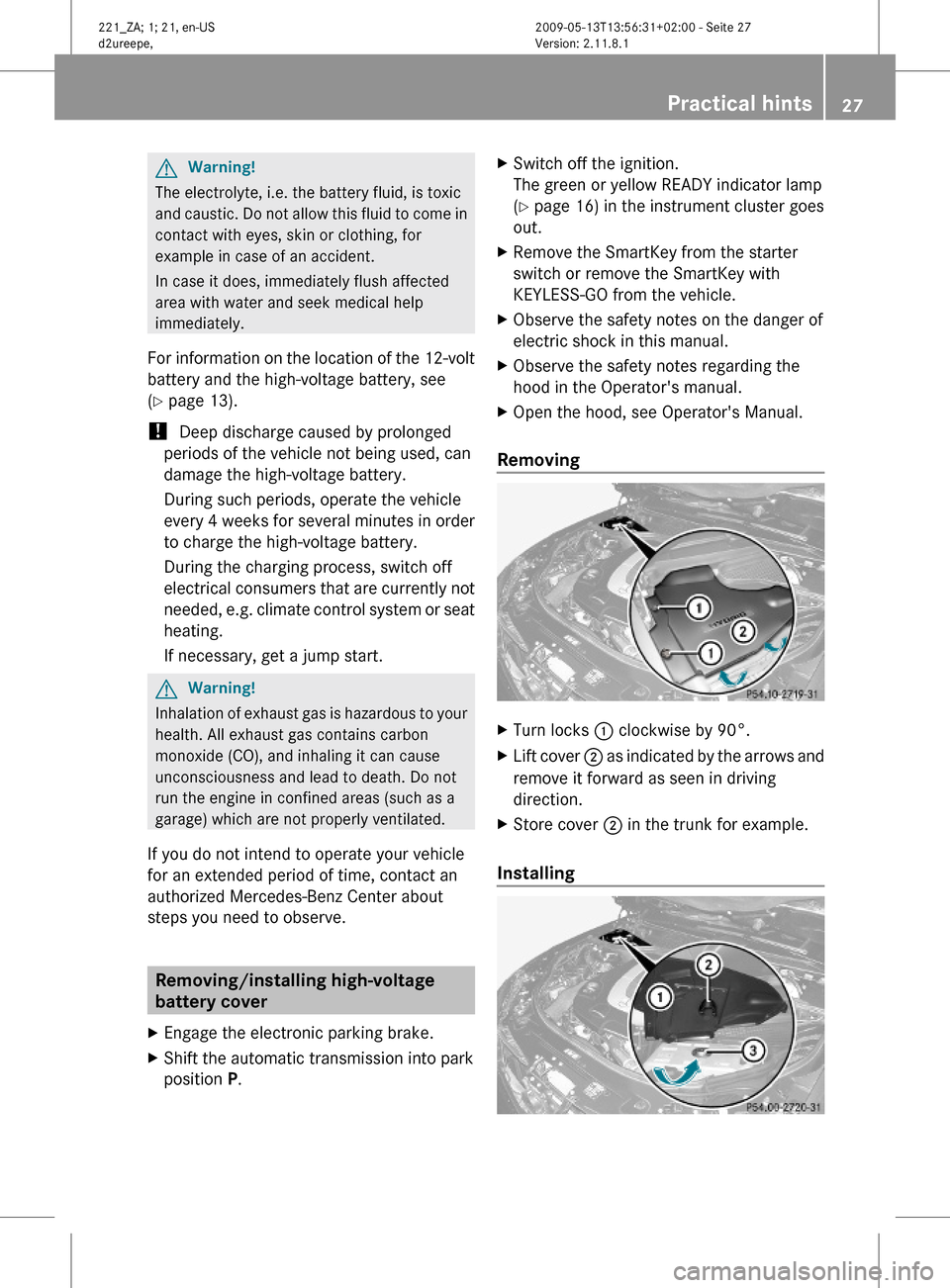
Removing
XTurn locks 1 clockwise by 90°.XLift cover 2 as indicated by the arrows and
remove it forward as seen in driving
direction.
XStore cover 2 in the trunk for example.
Installing
Practical hints27221_ZA; 1; 21, en-USd2ureepe,Version: 2.11.8.12009-05-13T13:56:31+02:00 - Seite 27Z
Page 30 of 40

XPlace cover 1 onto the high-voltage
battery carefully.
XPush holder 2 onto pin 3.XTurn locks 4 counterclockwise by 90°.
The cover is locked.
Removing/installing jump start
contact cover
XRemove the high-voltage battery cover, see
(Y page 27).
Removing
XDisengage tabs :.XRemove cover ;.XStore cover 2 in the trunk for example.
Installing
XPosition cover ;.XPress down on cover ; until tabs 1
engage.
XInstall the high-voltage battery cover.! The cover must be positioned and
installed properly. Otherwise moisture
and/or dirt may impair fuse operation.
XClose the hood.
Charging the batteries
Charging the 12-volt battery
GWarning!
Never charge a battery while still installed in
the vehicle unless the accessory battery
charge unit approved by Mercedes-Benz is
being used. Gases may escape during
charging and could cause an explosion that
may result in personal injury, paint damage or
corrosion.
An accessory battery charge unit specially
adapted for Mercedes-Benz vehicles and
tested and approved by Mercedes-Benz is
available. It permits the charging of the
battery in its installed position. Contact an
authorized Mercedes-Benz Center for
information and availability.
Charge battery in accordance with the
separate instructions for the accessory
battery charger.
XRemove the high-voltage battery cover
(Y page 27).
XRemove the jump start terminal cover
(Y page 28).
XFollow the instructions in the separate
operating instructions of the charge unit.
28Practical hints221_ZA; 1; 21, en-USd2ureepe,Version: 2.11.8.12009-05-13T13:56:31+02:00 - Seite 28