coolant MERCEDES-BENZ SL CLASS 2000 User Guide
[x] Cancel search | Manufacturer: MERCEDES-BENZ, Model Year: 2000, Model line: SL CLASS, Model: MERCEDES-BENZ SL CLASS 2000Pages: 297, PDF Size: 7.11 MB
Page 205 of 297
201 What you should know at the gas station
Technical
data Instruments
and controlsOperationDrivingInstrument
cluster displayPractical hints Car care Index •Engine oil
Engine oil level check, see page 82 or 221.
Fill quantity between upper and lower dipstick
marking level: 2.1 US qt (2.0 l).
Recommended engine oils, see page 276.
•Coolant
For normal replenishing, use water (potable water
quality).
For further information (e.g. anticorrosion/
antifreeze), see page 224.
•Spark plugs
Approved spark plugs, see page 275.
•Tire pressure
For tire pressure, refer to tire pressure label inside
the fuel filler flap.
•Air conditioner
R-134a refrigerant and special PAG lubricant,
see page 276.•Bulbs
High and low beams: Halogen type 9004,
low beam: Xenon, for model SL 600 (SL 500
optional)
high beam (models with Xenon): H 1 (55 W)
fog lamps: H1 (55 W),
turn signal, standing, side marker and parking
lamps, front: 2357 NA (28.5/8.3 W/30/2.2 cp), tail,
parking, standing and driver’s side rear fog lamp:
21 / 4 W,
turn signal lamps, rear: 21 W/32 cp,
side marker lamps, rear: 10W/6 cp,
sto p lamp s: 21 W /32 cp ,
backup lamps: 21 W/32 cp,
license plate lamps: 5W/4 cp.
Page 206 of 297
202 Check regularly and before a long trip
Technical
data Instruments
and controlsOperationDrivingInstrument
cluster displayPractical hints Car care Index
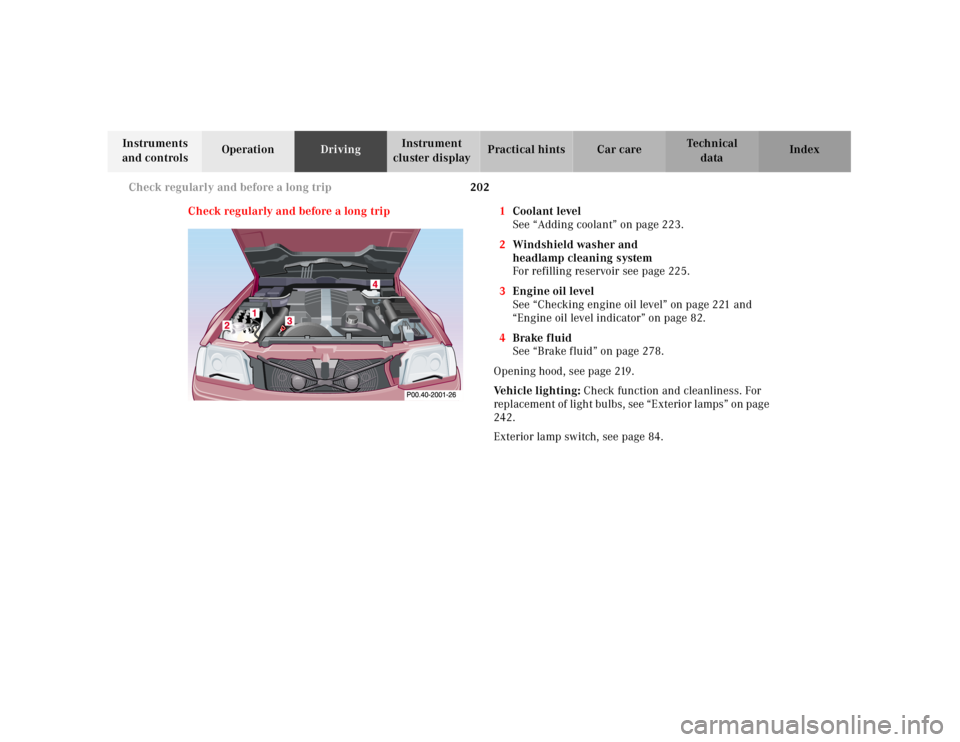
Check regularly and before a long trip 1Coolant level
See “Adding coolant” on page 223.
2Windshield washer and
headlamp cleaning system
For refilling reservoir see page 225.
3Engine oil level
See “Checking engine oil level” on page 221 and
“Engine oil level indicator” on page 82.
4Brake fluid
See “Brake fluid” on page 278.
Opening hood, see page 219.
Ve h i c l e l i g h t i n g : Check function and cleanliness. For
replacement of light bulbs, see “Exterior lamps” on page
242.
Exterior lamp switch, see page 84.
Page 207 of 297
203 Contents – Instrument cluster display
Technical
data Instruments
and controlsOperation DrivingInstrument
cluster displayPractical hints Car care Index
Instrument cluster displayMalfunction and indicator
lamps in the instrument
cluster .........................................204
On-board diagnostic system
Check engine malfunction
indicator lamp .............................204
Brake warning lamp ..................204
Brake pad wear
indicator lamp .............................205
Seat belt warning lamp .............206
Supplemental restraint
system (SRS) indicator lamp ....206Fuel reserve and fuel cap
placement warning ................... 207
Electronic stability program
(ESP) - warning lamp ................ 207
BAS-/ESP malfunction
indicator lamp ............................ 207
ABS malfunction
indicator lamp ............................ 208
Low engine coolant
level warning lamp .................... 209
Low windshield and headlamp
washer system f luid leve l
warning lamp ..............................210
Low engine oil level
warning lamp ..............................210Charge indicator lamp ............... 211
Exterior lamp failure
indicator lamp ............................. 211
Roll bar warning lamp ............... 212
ADS indicator lamp .................... 212
High beam indicator lamp ........ 213
Additional function
indicator lamps
(in the odometer display) .......... 213
Malfunction and indicator
lamp (in the dashboard) .......... 213
Passenger airbag
indicator lamp ............................. 213
Page 213 of 297
209 Malfunction and indicator lamps
Technical
data Instruments
and controlsOperation DrivingInstrument
cluster displayPractical hints Car care Index Low engine coolant level warning lamp
With the key in steering lock position 2, the
warning lamp comes on. It should go out
when the engine is running.
If the warning lamp does not go out after starting the
engine, or if it comes on while driving, then the coolant
level has dropped below the required level. If no leaks
are noticeable and the engine temperature does not
increase, continue to drive to the nearest service station
and have coolant added to the coolant system,
see page 224.
The low engine coolant level warning light should not be
ignored. Extended driving with the light illuminated
may cause serious engine damage not covered by the
Mercedes-Benz Limited Warranty.In cases of major or frequent minor coolant loss, have
the cooling system checked at your authorized
Mercedes-Benz Center as soon as possible.
Note:
Do not drive without coolant in the cooling system. The
engine will overheat causing major engine damage.
Monitor the coolant temperature gauge while driving.
Wa r n i n g !
Do not spill antifreeze on hot engine parts.
Antifreeze contains ethylene glycol which may
burn if it comes into contact with hot engine parts.
You can be seriously burned.
Page 218 of 297
214 Contents – Practical hints
Technical
data Instruments
and controlsOperation DrivingInstrument
cluster displayPractical hintsCar careIndex
Practical hintsFirst aid kit ..................................... 215
Stowing things in the vehicle ...... 215
Vehicle tools .................................... 216
Vehicle jack ..................................... 217
Fuses ................................................ 218
Hood ................................................. 219
Automatic transmission
fluid level ...................................221
Checking engine oil level .............221
Coolant level ...................................223
Adding coolant ...............................224Windshield and headlamp
washer f luid mixing ratio ....... 225
Wheels ............................................ 226
Tire replacement ........................... 226
Rotating wheels ............................. 227
Spare wheel .................................... 228
Changing wheels ........................... 230
Tire inflation pressure ................. 234
Battery ............................................. 236
Battery Recycling ....................... 237
Jump starting ................................. 238
Towing the vehicle ........................ 240Exterior lamps ................................242
Headlamp assembly
(Halogen) .....................................243
Taillamp assemblies ..................249
Changing batteries in
the remote control .................... 251
Synchronizing ............................252
Raising soft top manually .............253
Replacing wiper blade insert .......257
Manual release of
fuel filler flap .............................259
Trunk lamp .....................................259
Page 224 of 297
220 Engine compartment
Technical
data Instruments
and controlsOperation DrivingInstrument
cluster displayPractical hintsCar care Index
To cl os e:
Lower hood and let it drop into lock from a height of
a pprox. 1 f t. (30 cm), assisting w it h h ands pla ced f la t on
edges of hood (3).
To avoid hood damage, please make sure that hood is
fully closed. If not, repeat closing procedure. Do not
push down on hood to attempt to fully close it.
Wa r n i n g !
To help prevent personal injury, stay clear of
moving parts wh en t he hood is open and th e engine
is running. Be sure the hood is properly closed
before driving. When closing hood, use extreme
caution not to catch hands or fingers.The radiator fan may continue to run another
approximate 30 seconds or even restart after the
engine has been turned off. Stay clear from fan
blades.
The engine is equipped with a transistorized
ignition system. Because of the high voltage it is
dangerous to touch any components (ignition coils,
spark plug sockets, diagnostic socket) of the
ignition system
• with the engine running,
• while starting the engine,
• if ignition is “on” and the engine is turned
manually.If you see flames, steam or smoke coming from the
engine compartment, or if the coolant temperature
gauge indicates that the engine is overheated, do
not open the hood. Move away from vehicle and do
not open the hood until the engine has cooled. If
necessary, call a fire department.
Page 227 of 297
223 Coolant level
Technical
data Instruments
and controlsOperation DrivingInstrument
cluster displayPractical hintsCar care Index Coolant level
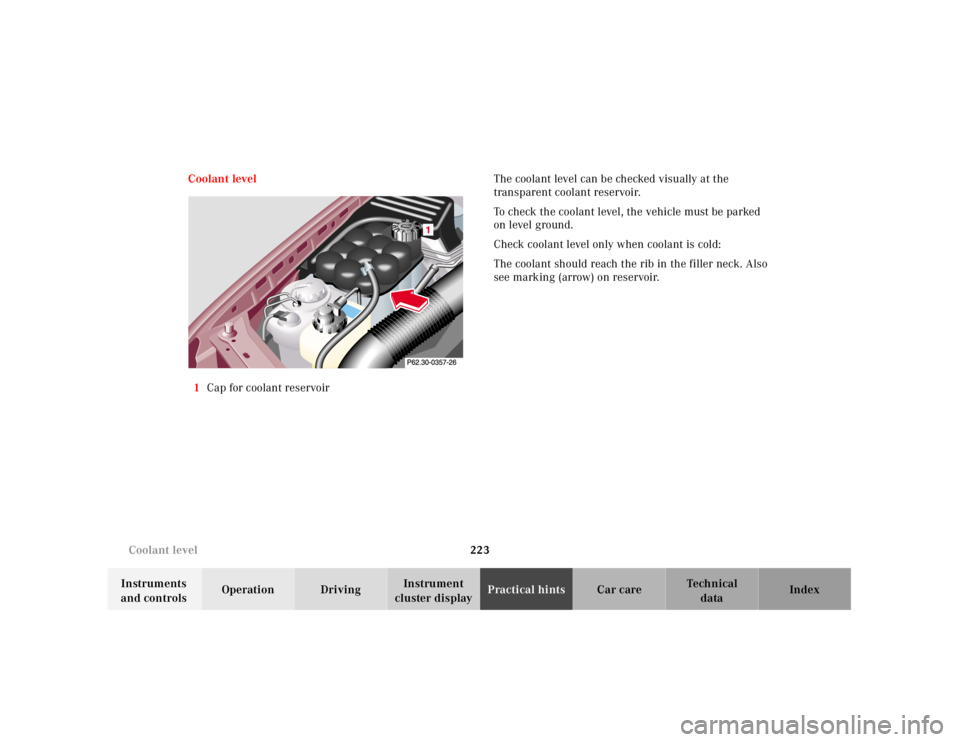
1Cap for coolant reservoirThe coolant level can be checked visually at the
transparent coolant reservoir.
To check the coolant level, the vehicle must be parked
on level ground.
Check coolant level only when coolant is cold:
The coolant should reach the rib in the filler neck. Also
see marking (arrow) on reservoir.
Page 228 of 297
224 Coolant level
Technical
data Instruments
and controlsOperation DrivingInstrument
cluster displayPractical hintsCar care Index
Adding coolant
If coolant has to be add ed, a 50/50 mix ture of water and
MB anticorrosion/antifreeze should be added.
Model SL 500
The drain plugs for the cooling system are located on
the right side of the engine block and at the bottom of
the radiator.
Model SL 600
The drain plugs for the cooling system are located on
the right and left sides of the engine block and at the
bottom of the radiator.
Anticorrosion/antifreeze, see coolants on page 280.
Wa r n i n g !
In order to avoid possible serious burns or injury:
• Use extreme caution when opening the hood if
there are any signs of steam or coolant leaking
from the cooling system, or if the coolant
temperature gauge indicates that the engine is
overheated.• Do not remove pressure cap on coolant
reservoir if engine temperature is above 194°F
(90°C). Allow engine to cool down before
removing cap. The coolant reservoir contains
hot fluid and is under pressure.• Using a rag, slowly open cap approximately 1/2
turn to relieve excess pressure. If opened
immediately, scalding hot fluid and steam will
be blown out under pressure.• Do not spill antifreeze on hot engine parts.
Antifreeze contains ethylene glycol which may
burn if it comes into contact with hot engine
parts.
Page 229 of 297
225 Coolant level
Technical
data Instruments
and controlsOperation DrivingInstrument
cluster displayPractical hintsCar care Index Windshield and headlamp washer fluid mixing ratio
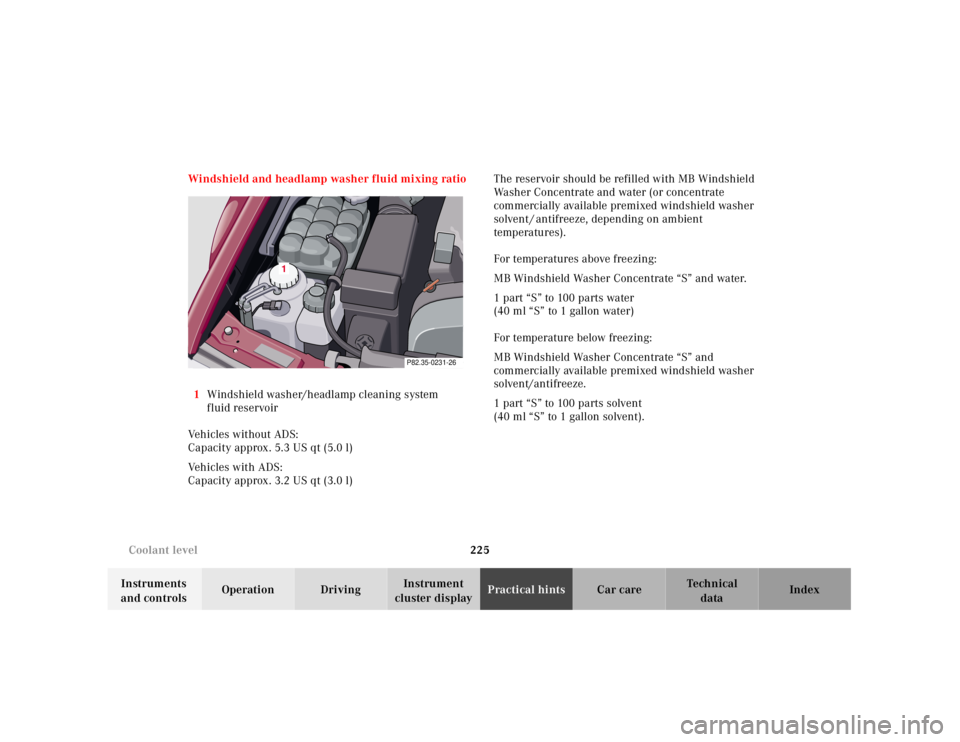
1Windshield washer/headlamp cleaning system
fluid reservoir
Ve h i c l e s w i t h o u t A D S :
Capacity approx. 5.3 US qt (5.0 l)
Ve h i c l e s w i t h A D S :
Capacity approx. 3.2 US qt (3.0 l)The reservoir should be refilled with MB Windshield
Washer Concentrate and water (or concentrate
commercially available premixed windshield washer
solvent / antifreeze, depending on ambient
temperatures).
For temperatures above freezing:
MB Windshield Washer Concentrate “S” and water.
1 part “S” to 100 parts water
(40 ml “S” to 1 gallon water)
For temperature below freezing:
MB Windshield Washer Concentrate “S” and
commercially available premixed windshield washer
solvent/antifreeze.
1 part “S” to 100 parts solvent
(40 ml “S” to 1 gallon solvent).
1
P82.35-0231-26
Page 265 of 297
261 Cleaning and care of the vehicle
Technical
data Instruments
and controlsOperation DrivingInstrument
cluster displayPractical hintsCar careIndex Cleaning and care of the vehicle
In operation, your vehicle is subjected to varying
external inf luences which, if gone unchecked, can
attack the paintwork as well as the underbody and
cause lasting damage.
Such damage is caused not only by extreme and varying
climatic conditions, but also by air pollution, road salt,
tar, gravel and stone chipping. Grease and oil, fuel,
coolant, brake fluid, bird droppings, insects, tree resins
etc. should be removed immediately to avoid paint
damage. Frequent washing reduces and/or eliminates
the aggressiveness and potency of the above adverse
influences.More frequent washings are necessary to deal with
unfavorable conditions; for example, near the ocean, in
industrial areas (smoke, exhaust emissions), or during
winter operation.
You should check your vehicle from time to time for
stone chipping or other damage. Any damage should be
repaired as soon as possible to prevent the start of
corrosion.
In doing so, do not neglect the underside of the vehicle.
A prerequisite for a thorough check is a washing of the
underbody followed by a thorough inspection. Damaged
areas need to be reundercoated.
Your vehicle has been treated at the factory with a wax-
base ru stproof ing in th e body cavities w hich will la st for
the lifetime of the vehicle. Post-production treatment is
neither necessary nor recommended by Mercedes-Benz
because of the possibility of incompatibility between
materials used in the production process and others
applied later.
We have selected car-care products and compiled
recommendations which are specially matched to our
vehicles and which always reflect the latest technology.
You can obtain Mercedes-Benz approved car-care
products at your authorized Mercedes-Benz Center.
Wa r n i n g !
Many cleaning products can be hazardous. Some
are poisonous, others are flammable. Always follow
the instructions on the particular container.
Always open your car’s doors or windows when
cleaning the inside.Never use fluids or solvents that are not designed
for cleaning your car.