dashboard MERCEDES-BENZ SL CLASS 2000 User Guide
[x] Cancel search | Manufacturer: MERCEDES-BENZ, Model Year: 2000, Model line: SL CLASS, Model: MERCEDES-BENZ SL CLASS 2000Pages: 297, PDF Size: 7.11 MB
Page 68 of 297
64 Restraint systems
Technical
data Instruments
and controlsOperationDrivingInstrument
cluster displayPractical hints Car care Index
To reduce the risk of injury when the front airbags
inflate, it is very important for the driver and front
passenger to always be in a properly seated
position and to wear your seat belt.
For maximum protection in the event of a collision
always be in normal seated position w ith your back
against the backrest. Fasten your seat belt and
ensure that it is properly positioned on your body.For unobstructive inflation of door side impact
airbags, keep door pocket lids closed.Since the airbag inflates with considerable speed
and force, a proper seating and hands on steering
wheel position will help to keep you at a safe
distance from the airbag.
Occupants who are unbelted, out of position or too
close to the airbag can be seriously injured by an
airbag as it inflates with great force in the blink of
an eye:• Sit properly belted in an upright position with
your back against the backrest.
• Adjust the driver seat as far as possible
rearward, still permitting proper operation of
vehicle controls. Adjust the driver seat as far
as possible rearward, still permitting proper
operation of vehicle controls. The distance
from the center of the driver’s breastbone to
the center of the airbag cover on the steering
wheel must be at least ten inches (25 cm) or
more. You should be able to accomplish this by
a combination of adjustments to the seat and
steering wheel. If you have any problems,
please see your authorized Mercedes-Benz
Center.• Do not lean wi th you r head or chest close to th e
steering wheel or dashboard.• Keep hands on the outside of steering wheel
rim. Placing hands and arms inside the rim
can increase the risk and potential severity of
hand/arm injury when the driver front airbag
inflates.• Do not lean against doors.
Page 69 of 297

65 Restraint systems
Technical
data Instruments
and controlsOperationDrivingInstrument
cluster displayPractical hints Car care Index
BabySmart
TM is a trademark of Siemens Automotive Corp.
• Occupants, especially children, should never
lean their heads in the area of the door where
the side airbag inflates. This could result in
serious injuries or death should the airbag be
triggered.• Adjust the passenger seat as far as possible
rearward from the dashboard when the seat is
occupied.• Children 12 years old and under must never
ride in this vehicle, except in a Mercedes-Benz
authorized BabySmart
TM c ompati ble ch ild seat,
which operates with the BabySmart
TM system
installed in the vehicle to deactivate the
passenger front airbag when it is properly
installed. Otherwise they will be struck by the
airbag when it inflates in a crash. If this
happens, serious or fatal injury can result.
Failure to follow these instructions can result in
severe or fatal injuries to you or other occupants.
Page 93 of 297
89 Hazard warning flasher switch
Technical
data Instruments
and controlsOperationDrivingInstrument
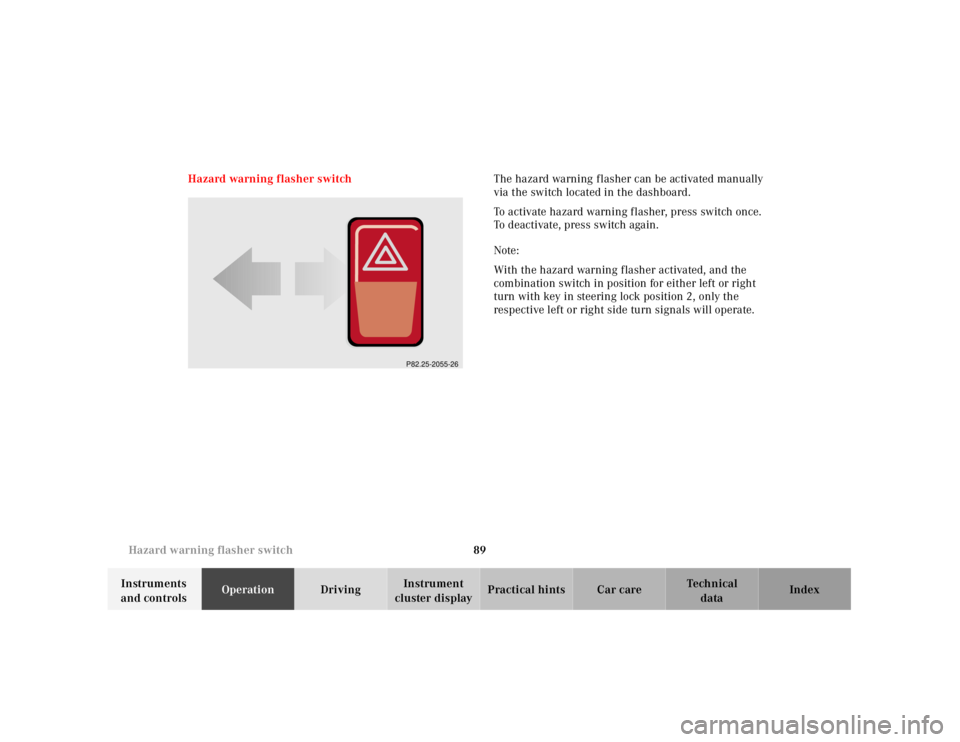
cluster displayPractical hints Car care Index Hazard warning flasher switchThe hazard warning f lasher can be activated manually
via the switch located in the dashboard.
To activate hazard warning flasher, press switch once.
To deactivate, press switch again.
Note:
With the hazard warning flasher activated, and the
combination switch in position for either left or right
turn with key in steering lock position 2, only the
respective left or right side turn signals will operate.
P82.25-2055-26
Page 128 of 297

124 Interior equipment
Technical
data Instruments
and controlsOperationDrivingInstrument
cluster displayPractical hints Car care Index
Interior Storage compartment (eyeglasses compartment) in
the dashboard
1Storage compartment (eyeglasses compartment)
2Button for storage compartment
3Lock
Wa r n i n g !
To help avoid personal injury during a collision or
sudden maneuver, exercise care when stowing
things. Put luggage or cargo in the trunk if
possible.Luggage nets cannot secure hard or heavy objects.
Page 130 of 297

126 Interior equipment
Technical
data Instruments
and controlsOperationDrivingInstrument
cluster displayPractical hints Car care Index
The following storage compartments are part of the
interior central locking system:
• eyeglasses compartment in the dashboard
• console storage compartments,
• rear storage compartments.
Integration with vehicle central locking system
When locking or unlocking the vehicle from the outside
by using the master key, the interior storage
compartments are also locked or unlocked (with lock in
position 1).Separate locking of storage compartments
Locking:
Turn master key to position 2 and remove from lock. The
storage compartments remain locked- even if the vehicle
is unlocked from the outside.
Unlocking :
Turn master key to position 1 and remove from lock.
If the vehicle was locked from the outside, the storage
compartments remain in the locked mode until the
vehicle is unlocked again from the outside.
Note:
If the interior storage compartments are to remain
locked (for example while in a repair shop), leave only
the valet key with the vehicle.
When unlocking a door from the inside, on a vehicle
previously locked from the outside, the storage
compartments still remain locked.
In case of a malfunction the eyeglasses compartment
can still be opened. To do so, turn the master key to
position 3, return it to position 1, remove it from the
lock and press button p.
Page 207 of 297

203 Contents – Instrument cluster display
Technical
data Instruments
and controlsOperation DrivingInstrument
cluster displayPractical hints Car care Index
Instrument cluster displayMalfunction and indicator
lamps in the instrument
cluster .........................................204
On-board diagnostic system
Check engine malfunction
indicator lamp .............................204
Brake warning lamp ..................204
Brake pad wear
indicator lamp .............................205
Seat belt warning lamp .............206
Supplemental restraint
system (SRS) indicator lamp ....206Fuel reserve and fuel cap
placement warning ................... 207
Electronic stability program
(ESP) - warning lamp ................ 207
BAS-/ESP malfunction
indicator lamp ............................ 207
ABS malfunction
indicator lamp ............................ 208
Low engine coolant
level warning lamp .................... 209
Low windshield and headlamp
washer system f luid leve l
warning lamp ..............................210
Low engine oil level
warning lamp ..............................210Charge indicator lamp ............... 211
Exterior lamp failure
indicator lamp ............................. 211
Roll bar warning lamp ............... 212
ADS indicator lamp .................... 212
High beam indicator lamp ........ 213
Additional function
indicator lamps
(in the odometer display) .......... 213
Malfunction and indicator
lamp (in the dashboard) .......... 213
Passenger airbag
indicator lamp ............................. 213
Page 217 of 297

213 Malfunction and warning messages
Technical
data Instruments
and controlsOperation DrivingInstrument
cluster displayPractical hints Car care Index High beam indicator lamp
High beam indicator lamp, see page 86
Additional function indicator lamps
(in the odometer display)
FSS indicator (distance, Service A),
seepage80.
FSS indicator (distance, Service B),
seepage80.
FSS indicator (days, Service A),
seepage80.
FSS indicator (days, Service B),
seepage80.
Start lock-out malfunction, see page 34.Malfunction and indicator lamp
(in the dashboard)
Passenger airbag indicator lamp
üPassenger airbag automatically switched off,
see page 60.
Page 295 of 297

291
Technical
data Instruments
and controlsOperation DrivingInstrument
cluster displayPractical hints Car careIndex Raising ........................................................................ 145
Spare parts service ........................................................269
Spare wheel ....................................................................228
SRS (Supplemental restraint system) ........................... 59
Indicator lamp ...........................................................206
Start lock-out .................................................................... 34
Malfunction lamp ........................................................ 77
Starting and turning off the engine ............................ 167
Steering column
Adjusting ...................................................................... 70
Steering lock ................................................................... 165
Storage compartment (eyeglasses compartment)
in the dashboard ....................................................... 124
Stowing things in the vehicle ...................................... 215
Sun visors ....................................................................... 123
Sunshade, electrical ...................................................... 122
Sunshade, manual ......................................................... 121
Supplemental restraint system (SRS) ........................... 59
Synchronizing power windows .....................................117
TTachometer ....................................................................... 79
Taillamp assemblies ......................................................249
Technical .........................................................................272Technical data ................................................................ 272
Electrical system ...................................................... 275
Main dimensions ..................................................... 275
Rims – Tires .............................................................. 273
Weights ...................................................................... 275
Tele Aid ............................................................................ 155
Information ................................................................ 159
Initiating an emergency call ................................... 157
Roadside Assistance ................................................. 158
Telephone, general ......................................................... 132
Telephones and two-way radio ..................................... 153
The first 1 000 miles (1 500 km) ................................ 154
Tires
Driving instructions .................................................179
Inflation pressure .................................................... 234
Replacement ............................................................. 226
Speed rating ............................................................... 181
Traction ....................................................................... 180
Tow-away alarm ................................................................43
Tow-away protection ........................................................ 43
Towing the vehicle ........................................................ 240
Trip odometer ...................................................................79
Trunk .................................................................................39
Trunk lamp .................................................................... 259
Trunk lid release switch ................................................. 40