transmission MERCEDES-BENZ SL CLASS 2002 User Guide
[x] Cancel search | Manufacturer: MERCEDES-BENZ, Model Year: 2002, Model line: SL CLASS, Model: MERCEDES-BENZ SL CLASS 2002Pages: 302, PDF Size: 7.05 MB
Page 177 of 302
173 Automatic transmission
Te ch n ica l
data Instruments
and controlsOperationDrivingInstrument
cluster displayPractical hints Car care Index Program mode selector switch
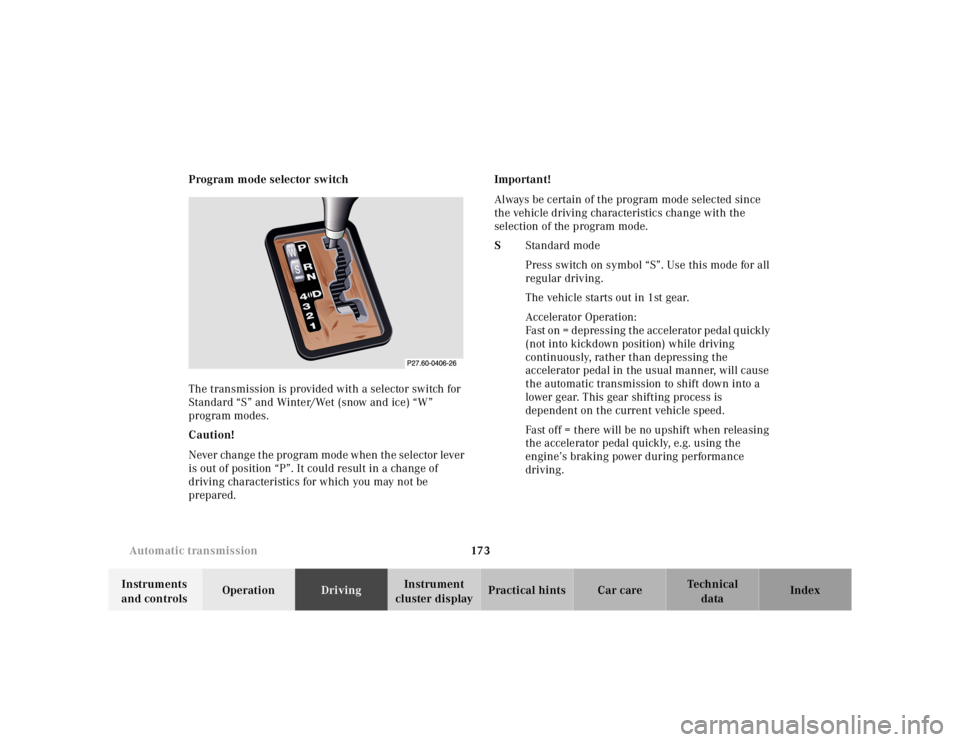
The transmission is provided with a selector switch for
Standard “S” and Winter/Wet (snow and ice) “W”
program modes.
Caution!
Never change the program mode when the selector lever
is out of position “P”. It could result in a change of
driving characteristics for which you may not be
prepared.Important!
Always be certain of the program mode selected since
the vehicle driving characteristics change with the
selection of the program mode.
SStandard mode
Press switch on symbol “S”. Use this mode for all
regular driving.
The vehicle starts out in 1st gear.
Accelerator Operation:
Fast on = depressing the accelerator pedal quickly
(not into kickdown position) while driving
continuously, rather than depressing the
accelerator pedal in the usual manner, will cause
the automatic transmission to shift down into a
lower gear. This gear shifting process is
dependent on the current vehicle speed.
Fast off = there will be no upshift when releasing
the accelerator pedal quickly, e.g. using the
engine’s braking power during performance
driving.
Page 178 of 302

174 Automatic transmission
Te ch n ica l
data Instruments
and controlsOperationDrivingInstrument
cluster displayPractical hints Car care Index
WWinter/Wet (snow and ice) mode
Press switch on symbol "W". The vehicle starts
out in 2nd gear, except with selector lever in 1st
gear, or with accelerator pedal in kick-down
position.
The "W" mode helps to improve traction and
driving stability of the vehicle.
The gear shifting process occurs at lower vehicle
and engine speeds than in the "S" program mode.
Important!
Dependent on the program mode selector switch
position “S” or “W” and the gear selector lever in
position “R”, the ratio of power transmission changes.Emergency operation
(Limp Home Mode)
If vehicle acceleration worsens, or the transmission no
longer shifts, the transmission is most likely operating
in Limp Home Mode which engages when there is a
malfunction of the transmission. This condition may be
accompanied by the “CHECK ENGINE” malfunction
indicator lamp in the instrument cluster coming on.
In this mode only the 2nd gear or reverse gear can be
activated.
To engage 2nd gear or reverse:
1. Sto p t h e v e h i c l e .
2. Move selector lever to position “P”.
3. Turn off the engine.
4. Wait approx. 10 seconds.
5. Restart the engine.
6. Move selector lever to position “D” (for 2nd gear), or
move selector lever to position “R” (for reverse gear).
Have the transmission checked at your authorized
Mercedes-Benz Center as soon as possible.
Page 186 of 302
182 Driving instructions
Te ch n ica l
data Instruments
and controlsOperationDrivingInstrument
cluster displayPractical hints Car care Index
Deep water
Caution!
Do not drive through flooded areas or water of unknown
depth.
If you must drive through deep water, drive slowly to
prevent water from entering the engine compartment or
passenger compartment, being ingested by the air
intake, possibly causing damage to electrical
components or wiring, to engine or transmission that is
not covered by the Mercedes-Benz Limited Warranty.
Winter driving instructions
The most important rule for slippery or icy roads is to
drive sensibly and to avoid abrupt acceleration, braking
and steering maneuvers. Do not use the cruise control
system under such conditions.
When the vehicle is in danger of skidding, move
selector lever to position “N”. Try to keep the vehicle
under control by corrective steering action.
Road salts and chemicals can adversely affect braking
efficiency. Increased pedal force may become necessary
to produce the normal brake effect. We therefore
recommend depressing the brake pedal periodically when traveling at length on salt-strewn roads. This can
bring road salt impaired braking efficiency back to
normal. A prerequisite is, however, that this be done
without endangering other drivers on the road.
If the vehicle is parked after being driven on salt treated
roads, the braking efficiency should be tested as soon as
possible after driving is resumed while observing the
safety rules in the previous paragraph.
Wa r n i n g !
If the vehicle becomes stuck in snow, make sure
that snow is kept clear of the exhaust pipe and
from around the vehicle with engine running.
Otherwise, deadly carbon monoxide (CO) gases may
enter vehicle interior resulting in unconsciousness
and death.To assure sufficient fresh air ventilation, open a
window slightly on the side of the vehicle not
facing the wind.
Page 191 of 302
187 Driving systems
Te ch n ica l
data Instruments
and controlsOperationDrivingInstrument
cluster displayPractical hints Car care Index Notes:
If the engine does not brake the vehicle sufficiently
while driving on a downgrade, the speed you set on the
cruise control may be exceeded. In this case the
automatic transmission shifts down (max. to 3rd gear)
to maintain the set cruise control speed by using the
engine’s braking power.As soon as the grade eases, the automatic transmission
shifts up again dependent on the selector lever position.
Nevertheless, in some cases you may have to step on the
brake pedal to slow down. In this case the cruise control
is switched off.
Use the lever to resume the previously set speed.
Page 219 of 302
215 Contents - Practical hints
Te ch n ica l
data Instruments
and controlsOperation DrivingInstrument
cluster displayPractical hintsCar care Index
Practical hints First aid kit ..................................... 216
Stowing things in the vehicle ...... 216
Vehicle tools .................................... 217
Vehicle jack ..................................... 218
Fuses ................................................ 219
Hood .................................................220
Automatic transmission
fluid level ...................................222
Checking engine oil level .............222
Coolant level ...................................224
Adding coolant ...............................225Windshield and
headlamp washer
fluid mixing ratio ..................... 226
Wheels ............................................ 227
Tire replacement ........................... 227
Rotating wheels ............................. 228
Spare wheel .................................... 229
Changing wheels ........................... 231
Tire inflation pressure ................. 235
Battery ............................................. 237
Battery Recycling ....................... 238
Jump starting ................................. 239
Towing the vehicle ........................ 241Exterior lamps ................................243
Headlamp assembly
(Halogen) .....................................244
Taillamp assemblies ..................250
Changing batteries in the
remote control ...........................252
Synchronizing ............................253
Raising soft top manually .............254
Replacing wiper blade .................258
Manual release of
fuel filler flap .............................260
Trunk lamp .....................................260
Page 226 of 302
222 Checking engine oil level
Te ch n ica l
data Instruments
and controlsOperation DrivingInstrument
cluster displayPractical hintsCar care Index
Automatic transmission fluid level
The transmission has a permanent fill of automatic
transmission fluid.
Regular automatic transmission fluid level checks and
changes are not required. For this reason the dipstick is
omitted.
If you notice f luid loss or gear shifting malfunctions,
have your authorized Mercedes-Benz Center check the
transmission fluid level.Checking engine oil level
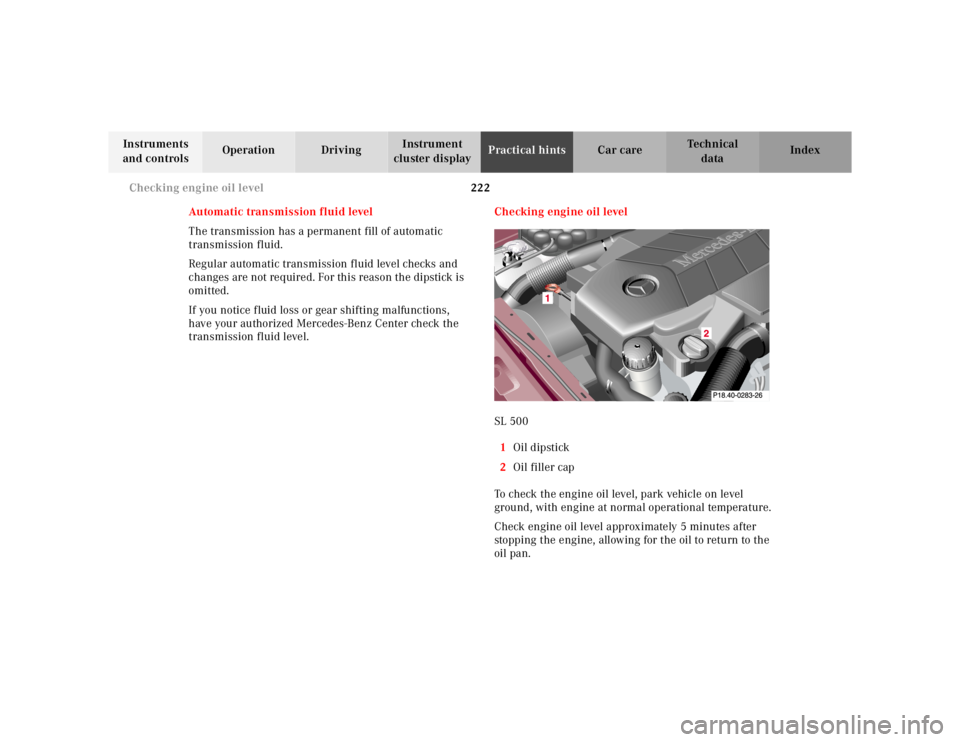
SL 500
1Oil dipstick
2Oil filler cap
To check the engine oil level, park vehicle on level
ground, with engine at normal operational temperature.
Check engine oil level approximately 5 minutes after
stopping the engine, allowing for the oil to return to the
oil pan.
Page 246 of 302
242 Towing the vehicle
Te ch n ica l
data Instruments
and controlsOperation DrivingInstrument
cluster displayPractical hintsCar care Index
The vehicle may be towed with all wheels on the ground
and the selector lever in position “N” for distances up to
30 miles (50 km) and at a speed not to exceed 30 mph
(50 km/h). The key must be in steering lock position 2.
To be certain to avoid a possibility of damage to the
transmission, however, we recommend the drive shaft
be disconnected at the rear axle drive f lange for any
towing beyond a short tow to a nearby garage.
Do not tow with sling-type equipment. Towing with
sling-type equipment over bumpy roads will damage
radiator and supports.
The use of wheel lift equipment will damage engine oil
pan.
Important!
When towing the vehicle, please, note the following:
With the automatic central locking activated and the
key in steering lock position 2, the vehicle doors lock if
the left front wheel as well as the right rear wheel are
turning at vehicle speeds of approx. 9 mph (15 km/h) or
more.
To prevent the vehicle door locks from locking,
deactivate the automatic central locking.When transporting vehicle on flat bed equipment, the
front end of the vehicle must be loaded first. Additional
ramping may be required for loading to protect bumper
fascia.
Note:
To signal turns while being towed with hazard warning
flasher in use, turn key in steering lock to position 2 and
activate combination switch for left or right turn signal
in usual manner – only the selected turn signal will
operate.
Upon canceling the turn signal, the hazard warning
flasher will operate again.
Wa r n i n g !
With the engine not running, there is no power
assistance for the braking and steering systems. In
this case, it is important to keep in mind that a
considerably higher degree of effort in necessary to
brake and steer the vehicle.
Page 281 of 302
277 Fuels, coolants, lubricants etc. - capacities
Te ch n ica l
data Instruments
and controlsOperation DrivingInstrument
cluster displayPractical hints Car care Index Fuels, coolants, lubricants etc. - capacities
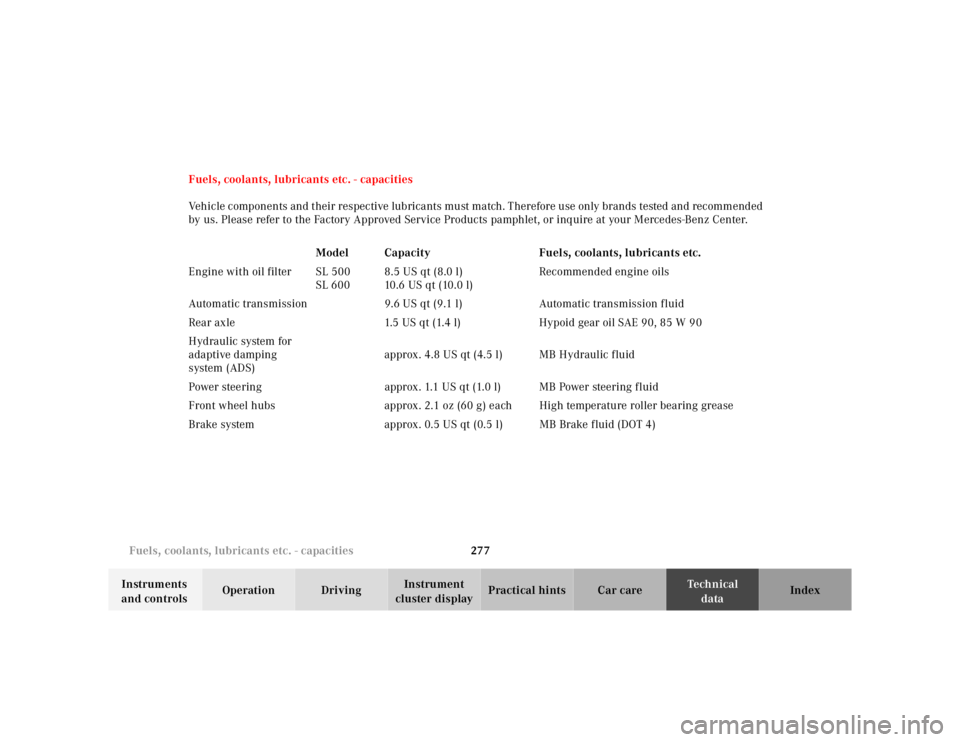
Vehicle components and their respective lubricants must match. Therefore use only brands tested and recommended
by us. Please refer to the Factory Approved Service Products pamphlet, or inquire at your Mercedes-Benz Center.
Model Capacity Fuels, coolants, lubricants etc.
Engine with oil filter SL 500
SL 6008.5 US qt (8.0 l)
10 . 6 U S q t ( 10 . 0 l )Recommended engine oils
Automatic transmission 9.6 US qt (9.1 l) Automatic transmission fluid
Rear axle 1.5 US qt (1.4 l) Hypoid gear oil SAE 90, 85 W 90
Hydraulic system for
adaptive damping
system (ADS)approx. 4.8 US qt (4.5 l) MB Hydraulic f luid
Power steering approx. 1.1 US qt (1.0 l) MB Power steering fluid
Front wheel hubs approx. 2.1 oz (60 g) each High temperature roller bearing grease
Brake system approx. 0.5 US qt (0.5 l) MB Brake fluid (DOT 4)
Page 289 of 302
285 Index
Te ch n ica l
data Instruments
and controlsOperation DrivingInstrument
cluster displayPractical hints Car careIndex
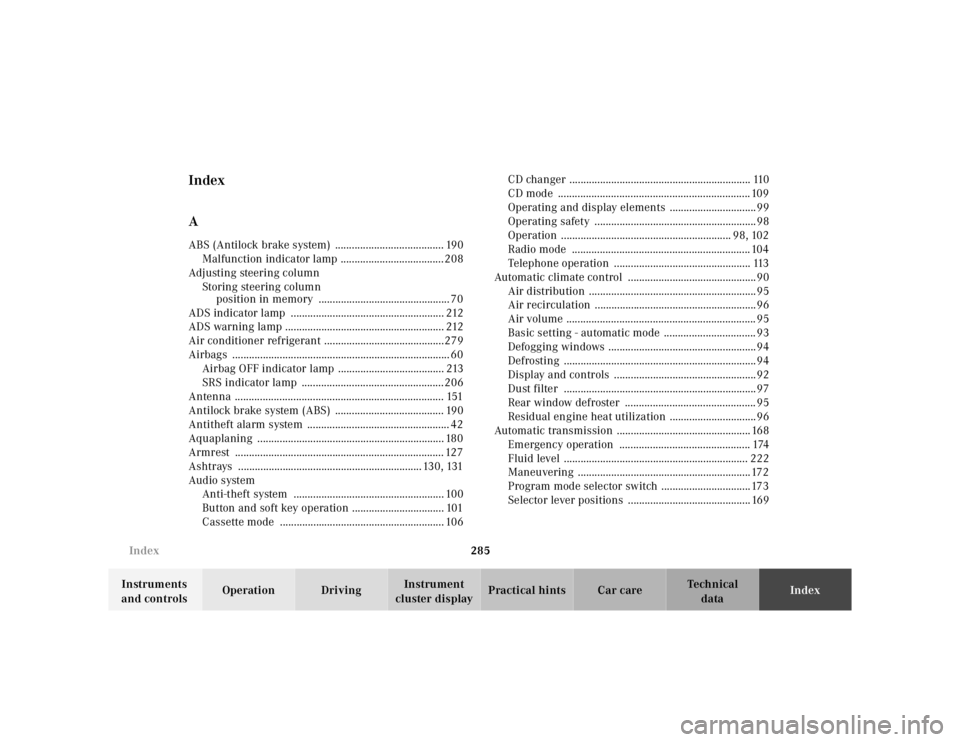
Index
AABS (Antilock brake system) ....................................... 190
Malfunction indicator lamp .....................................208
Adj usting steering c ol umn
Storing steering column
position in memory ............................................... 70
ADS indicator lamp ....................................................... 212
ADS warning lamp ......................................................... 212
Air conditioner refrigerant ...........................................279
Airbags .............................................................................. 60
Airbag OFF indicator lamp ...................................... 213
SRS indicator lamp ...................................................206
Antenna ........................................................................... 151
Antilock brake system (ABS) ....................................... 190
Antitheft alarm system ................................................... 42
Aquaplaning ................................................................... 180
Armrest ........................................................................... 127
Ashtrays .................................................................. 130, 131
Audio system
Anti-theft system ...................................................... 100
Button and soft key operation ................................. 101
Cassette mode ........................................................... 106CD changer ................................................................. 110
CD mode ..................................................................... 109
Operating and display elements ...............................99
Operating safety ..........................................................98
Operation ............................................................. 98, 102
Radio mode ................................................................ 104
Telephone operation ................................................. 113
Automatic climate control ..............................................90
Air distribution ............................................................95
Air recirculation ..........................................................96
Air volume .................................................................... 95
Basic setting - automatic mode ................................. 93
Defogging windows .....................................................94
Defrosting .....................................................................94
Display and controls ...................................................92
Dust filter .....................................................................97
Rear window defroster ............................................... 95
Residual engine heat utilization ...............................96
Automatic transmission ................................................ 168
Emergency operation ............................................... 174
Fluid level .................................................................. 222
Maneuvering ..............................................................172
Program mode selector switch ................................173
Selector lever positions ............................................ 169