brake MERCEDES-BENZ SL CLASS 2011 User Guide
[x] Cancel search | Manufacturer: MERCEDES-BENZ, Model Year: 2011, Model line: SL CLASS, Model: MERCEDES-BENZ SL CLASS 2011Pages: 316, PDF Size: 6.55 MB
Page 56 of 316
they reach a height where a lap/shoulder belt
fits properly without a booster.
When the child restraint is not in use, remove
it from the vehicle or secure it with the seat
belt to prevent the child restraint from
becoming a projectile in the event of an
accident.
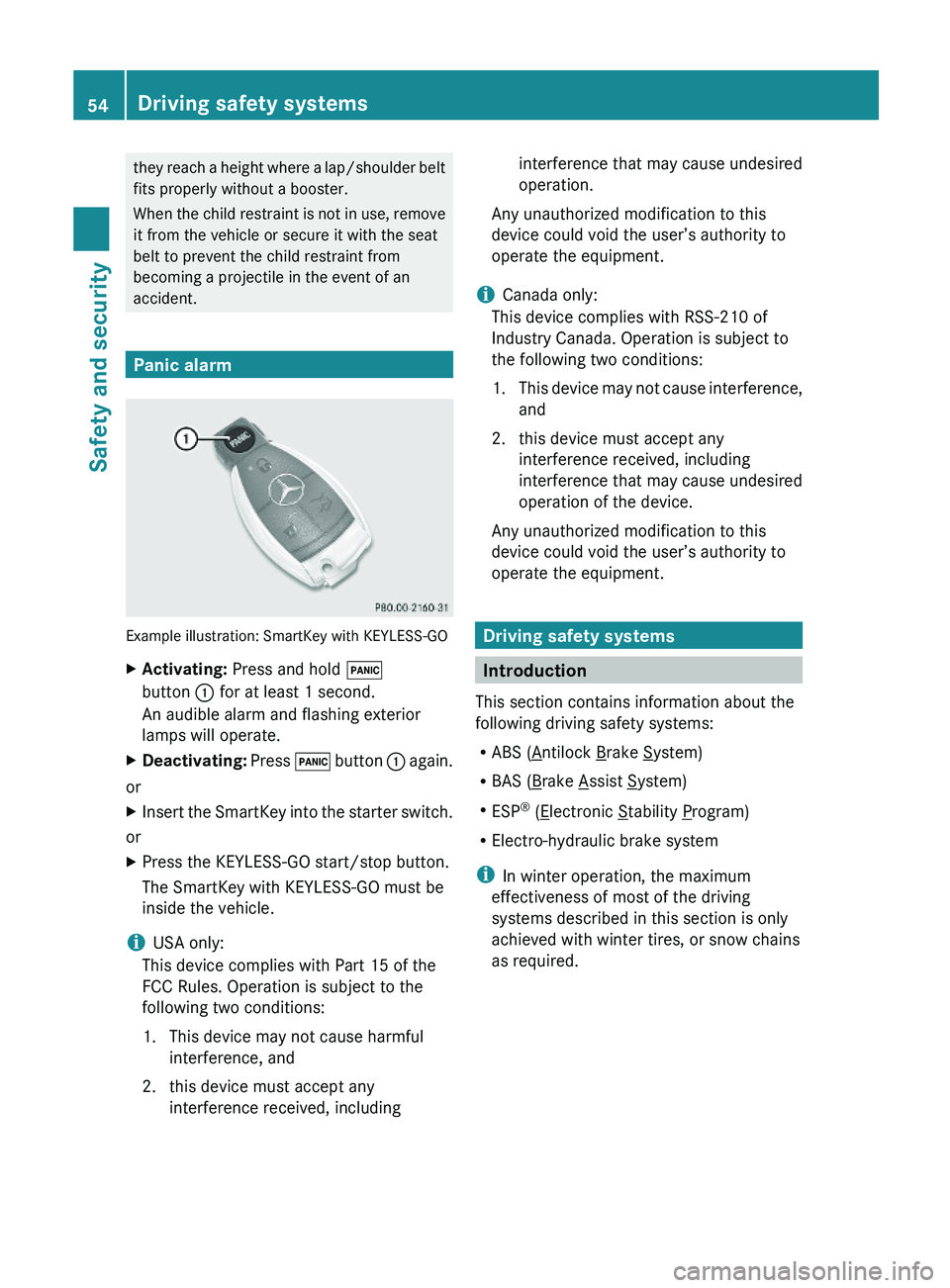
Panic alarm
Example illustration: SmartKey with KEYLESS-GO
XActivating: Press and hold \0003
button \000F for at least 1 second.
An audible alarm and flashing exterior
lamps will operate.
XDeactivating: Press \0003 button \000F again.
or
XInsert the SmartKey into the starter switch.
or
XPress the KEYLESS-GO start/stop button.
The SmartKey with KEYLESS-GO must be
inside the vehicle.
iUSA only:
This device complies with Part 15 of the
FCC Rules. Operation is subject to the
following two conditions:
1. This device may not cause harmful
interference, and
2. this device must accept any
interference received, including
interference that may cause undesired
operation.
Any unauthorized modification to this
device could void the user’s authority to
operate the equipment.
iCanada only:
This device complies with RSS-210 of
Industry Canada. Operation is subject to
the following two conditions:
1.This device may not cause interference,
and
2. this device must accept any
interference received, including
interference that may cause undesired
operation of the device.
Any unauthorized modification to this
device could void the user’s authority to
operate the equipment.
Driving safety systems
Introduction
This section contains information about the
following driving safety systems:
RABS (Antilock Brake System)
RBAS (Brake Assist System)
RESP® (Electronic Stability Program)
RElectro-hydraulic brake system
iIn winter operation, the maximum
effectiveness of most of the driving
systems described in this section is only
achieved with winter tires, or snow chains
as required.
54Driving safety systemsSafety and security
230_AKB; 6; 22, en-USd2ureepe,Version: 2.11.8.12009-07-28T18:49:58+02:00 - Seite 54
Page 57 of 316
Safety notesGWarning!
The following factors increase the risk of
accidents:
R Excessive speed, especially in turns
R Wet and slippery road surfaces
R Following another vehicle too closely
The driving safety systems described in this
section cannot reduce these risks or prevent
the natural laws of physics from acting on the
vehicle. They cannot increase braking or
steering efficiency beyond that afforded by
the condition of the vehicle brakes and tires
or the traction afforded.
Only a safe, attentive, and skillful driver can
prevent accidents.
The capabilities of a vehicle equipped with the
driving safety systems described in this
section must never be exploited in a reckless
or dangerous manner which could jeopardize
the user’s safety or the safety of others.
Always adjust your driving style to the
prevailing road and weather conditions and
keep a safe distance to other road users and
objects on the street.
If a driving system malfunctions, other driving
safety systems may also switch off. Observe
indicator and warning lamps that may come
on as well as messages in the multifunction
display that may appear.
ABS
GObserve Safety notes, see page 55.GWarning!
Do not pump the brake pedal. Use firm, steady
brake pedal pressure instead. Pumping the
brake pedal defeats the purpose of the ABS
and significantly reduces braking
effectiveness.
The Antilock Brake System (ABS) regulates
the brake pressure so that the wheels do not
lock during braking. This allows you to
maintain the ability to steer your vehicle.
The ABS is functional above a speed of
approximately 5 mph (8 km/h) independent
of road surface conditions.
On slippery road surfaces, the ABS will
respond even to light brake pressure.
The ABS indicator lamp 0031 in the
instrument cluster comes on when you switch
on the ignition. It goes out when the engine
is running.
Braking
If the ABS activates during braking, the ABS/
ESP ®
warning lamp 00F2 or 0067 7
in the
instrument cluster flashes. Because of the
electro-hydraulic brake system, you will not
feel any pulsation in the brake pedal.
XKeep firm and steady pressure on the brake
pedal.
Continuous, steady brake pedal pressure
yields the advantages provided by the ABS,
namely braking power and the ability to steer
the vehicle.
The ABS/ESP ®
warning lamp 00F2 or 0067 7
flashes whenever the ABS is activated. It can
be an indication for hazardous road
conditions and functions as a reminder to
take extra care while driving.
Emergency brake maneuver
XKeep continuous full pressure on the brake
pedal.GWarning!
If the ABS malfunctions, other driving safety
systems such as the BAS or the ESP ®
are also
switched off. Observe indicator and warning
lamps that may come on as well as messages
in the multifunction display that may appear.
7 Depending on vehicle production date.Driving safety systems55Safety and security230_AKB; 6; 22, en-USd2ureepe,Version: 2.11.8.12009-07-28T18:49:58+02:00 - Seite 55Z
Page 58 of 316
If the ABS malfunctions, the wheels may lock
during hard braking, reducing steering
capability and extending the braking distance.
BAS
GObserve Safety notes, see page 55.
The Brake Assist System (BAS) operates in
emergency situations. If you apply the brakes
very quickly, the BAS provides full brake
boost automatically, thereby potentially
reducing the braking distance.
XApply continuous full braking pressure until
the emergency braking situation is over.
The ABS will prevent the wheels from
locking.
When you release the brake pedal, the brakes
function again as normal. The BAS is then
deactivated.
GWarning!
If the BAS malfunctions, the brake system still
functions, but without the additional brake
boost available that the BAS would normally
provide in an emergency braking maneuver.
Therefore, the braking distance may increase.
ESP ®
GObserve Safety notes, see page 55.
The Electronic Stability Program (ESP
®
) is
operational as soon as the engine is running.
It monitors the vehicle’s traction (force of
adhesive friction between the tires and the
road surface) and handling.
The ESP ®
recognizes that the vehicle deviates
from the direction of travel as intended by the
driver. By applying brakes to individual
wheels and by limiting the engine output, the
ESP ®
works to stabilize the vehicle. The
ESP ®
is especially useful while driving off and
on wet or slippery road surfaces. The ESP ®
also stabilizes the vehicle during braking and
steering maneuvers.
The ABS/ESP ®
warning lamp 00F2 or 0067 8
in the instrument cluster comes on when you
switch on the ignition. It goes out when the
engine is running.
The ABS/ESP ®
warning lamp 00F2 or 0067 8
in the instrument cluster flashes when the
ESP ®
is engaged.GWarning!
Never switch off the ESP ®
when you see the
ABS/ESP ®
warning lamp 00F2 or 0067 9
flashing in the instrument cluster. In this case
proceed as follows:
R When driving off, apply as little throttle as
possible.
R While driving, ease up on the accelerator
pedal.
R Adapt your speed and driving style to the
prevailing road conditions.
Failure to observe these guidelines could
cause the vehicle to skid. The ESP ®
cannot
prevent accidents resulting from excessive
speed.
! Because the ESP ®
operates
automatically, the engine and ignition must
be shut off (SmartKey in starter switch
position 0 or 1 or KEYLESS-GO start/stop
button in position 0 or 1) when the parking
brake is being tested on a brake test
dynamometer or when the vehicle is being
towed with the front axle raised.
Active braking action through the ESP ®
may otherwise seriously damage the brake
system which is not covered by the
Mercedes-Benz Limited Warranty.
! The ESP ®
will only function properly if you
use wheels of the recommended tire size
8 Depending on vehicle production date.
9 Depending on vehicle production date.56Driving safety systemsSafety and security
230_AKB; 6; 22, en-USd2ureepe,Version: 2.11.8.12009-07-28T18:49:58+02:00 - Seite 56
Page 59 of 316
as specified in the “Technical data” section
of this Operator’s Manual.
iThe Distronic system and cruise control
switch off automatically when the ESP®
engages.
Electronic Traction System (ETS)
GObserve Safety notes, see page 55.
The ETS (Electronic Traction System) is a
component of the ESP®. The ETS improves
the vehicle’s ability to utilize available
traction, especially under slippery road
conditions by applying the brakes to a
spinning wheel.
When you switch off the ESP®, the ETS is still
enabled.
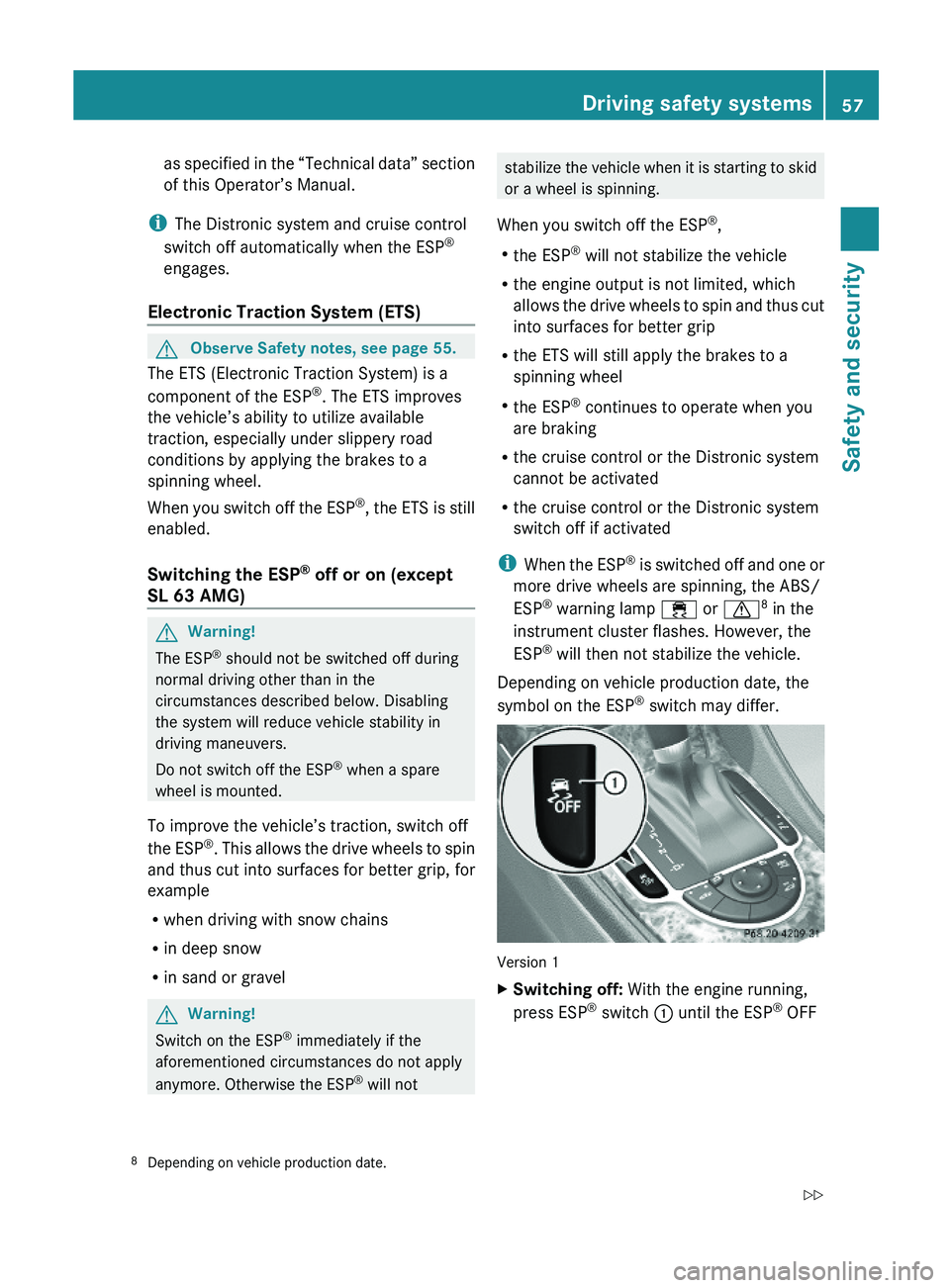
Switching the ESP® off or on (except
SL 63 AMG)
GWarning!
The ESP® should not be switched off during
normal driving other than in the
circumstances described below. Disabling
the system will reduce vehicle stability in
driving maneuvers.
Do not switch off the ESP® when a spare
wheel is mounted.
To improve the vehicle’s traction, switch off
the ESP®. This allows the drive wheels to spin
and thus cut into surfaces for better grip, for
example
Rwhen driving with snow chains
Rin deep snow
Rin sand or gravel
GWarning!
Switch on the ESP® immediately if the
aforementioned circumstances do not apply
anymore. Otherwise the ESP® will not
stabilize the vehicle when it is starting to skid
or a wheel is spinning.
When you switch off the ESP®,
Rthe ESP® will not stabilize the vehicle
Rthe engine output is not limited, which
allows the drive wheels to spin and thus cut
into surfaces for better grip
Rthe ETS will still apply the brakes to a
spinning wheel
Rthe ESP® continues to operate when you
are braking
Rthe cruise control or the Distronic system
cannot be activated
Rthe cruise control or the Distronic system
switch off if activated
iWhen the ESP® is switched off and one or
more drive wheels are spinning, the ABS/
ESP® warning lamp \000
Page 61 of 316
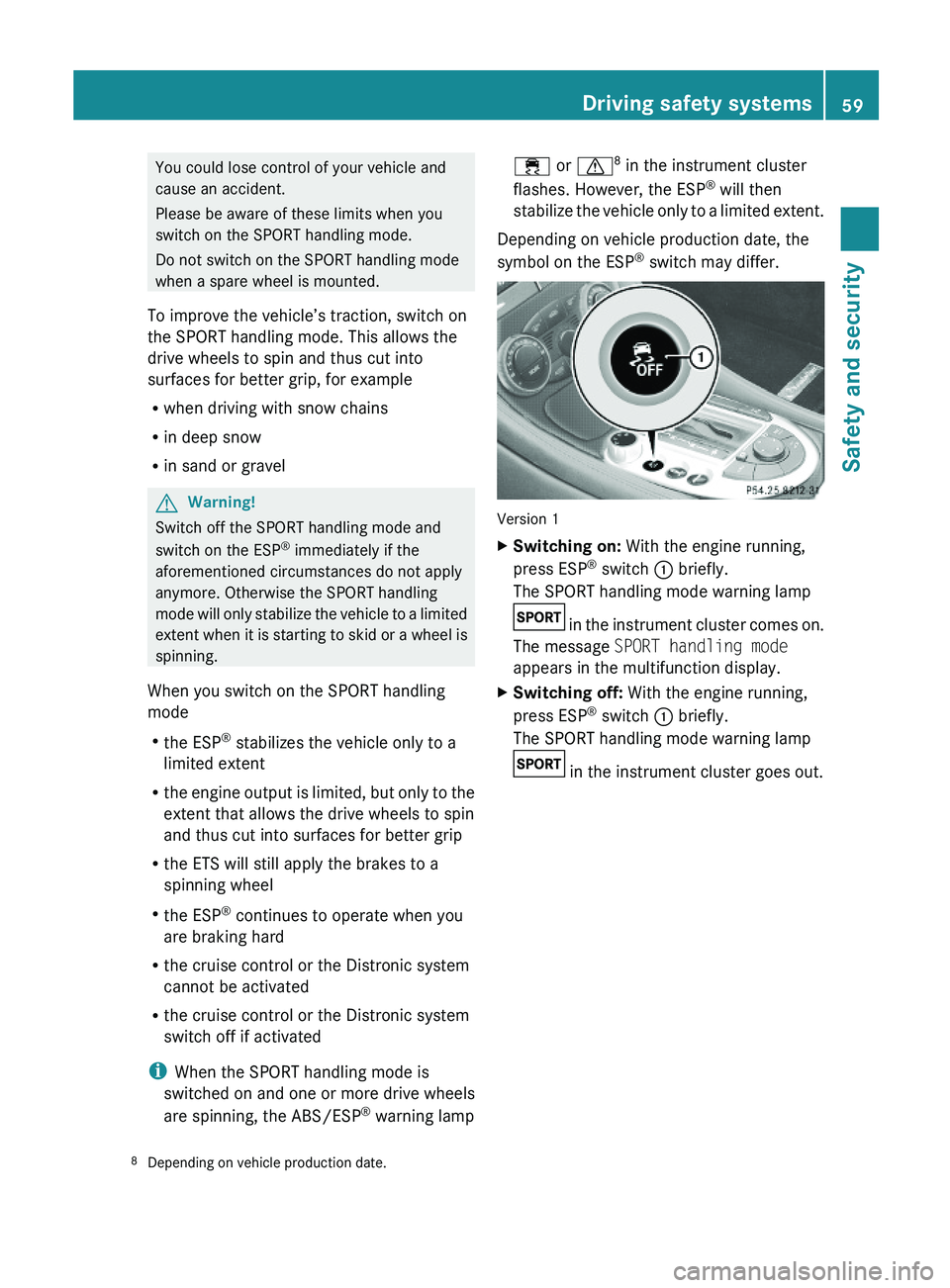
You could lose control of your vehicle and
cause an accident.
Please be aware of these limits when you
switch on the SPORT handling mode.
Do not switch on the SPORT handling mode
when a spare wheel is mounted.
To improve the vehicle’s traction, switch on
the SPORT handling mode. This allows the
drive wheels to spin and thus cut into
surfaces for better grip, for example
Rwhen driving with snow chains
Rin deep snow
Rin sand or gravel
GWarning!
Switch off the SPORT handling mode and
switch on the ESP® immediately if the
aforementioned circumstances do not apply
anymore. Otherwise the SPORT handling
mode will only stabilize the vehicle to a limited
extent when it is starting to skid or a wheel is
spinning.
When you switch on the SPORT handling
mode
Rthe ESP® stabilizes the vehicle only to a
limited extent
Rthe engine output is limited, but only to the
extent that allows the drive wheels to spin
and thus cut into surfaces for better grip
Rthe ETS will still apply the brakes to a
spinning wheel
Rthe ESP® continues to operate when you
are braking hard
Rthe cruise control or the Distronic system
cannot be activated
Rthe cruise control or the Distronic system
switch off if activated
iWhen the SPORT handling mode is
switched on and one or more drive wheels
are spinning, the ABS/ESP® warning lamp
\000
Page 62 of 316

Version 2
XSwitching on: With the engine running,
press ESP® switch \000F briefly.
The ABS/ESP® warning lamp \000g in the
instrument cluster comes on. The message
ESP-SPORT appears in the multifunction
display.
XSwitching off: With the engine running,
press ESP® SPORT switch \000F briefly.
The ABS/ESP® warning lamp \000g in the
instrument cluster goes out. The message
ESP-ON appears in the multifunction
display.
The SPORT handling mode switches off
automatically when you turn off the engine.
When starting the engine, the ESP® is
activated automatically.
Switching the ESP® off or on
GWarning!
The ESP® should not be switched off during
normal driving.
Disabling of the system will result in the
following:
Rno restriction to engine torque
Rloss of system-supported traction control
“ESP® OFF” is designed for driving on closed
tracks when the vehicle’s natural oversteer
and understeer characteristics are desired
and requires a highly skilled and experienced
driver able to handle these critical driving
situations.
You could lose control of your vehicle and
cause an accident.
Please be aware of these limits when you
switch off the ESP®.
Do not switch off the ESP® when a spare
wheel is mounted.
To improve the vehicle’s traction, switch off
the ESP®. This allows the drive wheels to spin
and thus cut into surfaces for better grip, for
example
Rwhen driving with snow chains
Rin deep snow
Rin sand or gravel
GWarning!
Switch on the ESP® immediately if the
aforementioned circumstances do not apply
anymore. Otherwise the ESP® will not
stabilize the vehicle when it is starting to skid
or a wheel is spinning.
When you switch off the ESP®,
Rthe ESP® will not stabilize the vehicle
Rthe engine output is not limited, which
allows the drive wheels to spin and thus cut
into surfaces for better grip
Rthe ETS will still apply the brakes to a
spinning wheel
Rthe ESP® continues to operate when you
are braking hard
Rthe cruise control or the Distronic system
cannot be activated
Rthe cruise control or the Distronic system
switch off if activated
iWhen the ESP® is switched off and one or
more drive wheels are spinning, the ABS/
ESP® warning lamp \000
Page 64 of 316

Electro-hydraulic brake system
The electro-hydraulic brake system combines
a hydraulic brake circuit with electronically
controlled brake servo assistance. You have
increased braking safety and improved
braking comfort.GWarning!
Never ignore a brake malfunction indicated in
the speedometer display, for example by the
0027 (USA only) or 004D (Canada only)
indicator lamp. Refer to the “Practical hints”
section. Also read and observe the messages
in the instrument cluster multifunction
display.
For information on warning and indicator
lamps, see the “Practical hints” section
( Y page 255). For information on the
messages that may appear in the
multifunction display, see the “Practical
hints” section ( Y page 227) and
( Y page 237).
GWarning!
The electro-hydraulic brake system requires
electrical power to operate.
A malfunction in the vehicle’s power supply or
electrical system may impair brake system
operation and switch it into its emergency
operation mode. In such a case, the red brake
warning lamp comes on and warning
messages appear in the multifunction display
while driving. To brake, the driver must then
apply significantly greater brake pedal
pressure and depress the pedal much further
to obtain the expected braking effect. If
necessary, apply full pressure to the brake
pedal. Brakes are only applied to the front
wheels. Stopping distance is increased!
If there is a malfunction in the electro-
hydraulic brake system, we recommend that
the vehicle be transported with all wheels off
the ground using flatbed or appropriate wheel
lift/dolly equipment.
A tow bar must be used if circumstances do
not permit the use of the recommended
towing methods and the vehicle requires
towing with all four wheels on the ground.
Towing the vehicle with all four wheels on the
ground is only permissible for distances up to
30 miles (50 km) and at a speed not to exceed
30 mph (50 km/h). For more information, see
the “Towing the vehicle” section in this
Operator’s Manual.
The electro-hydraulic brake system is
activated automatically when you
R unlock the vehicle with the SmartKey or
with KEYLESS-GO
R open the driver’s or passenger door
R turn the SmartKey in the starter switch to
position 1
R press the start/stop button on the gear
selector lever once (vehicles with
KEYLESS-GO)
R depress the brake pedal
R release the parking brake
If the electro-hydraulic brake system is
activated as the brake pedal is first
depressed, you may feel a reduced pedal
resistance and longer pedal travel than
normal. When releasing the pedal, you may
also feel the brake pedal pulsate and you may
hear a sound which is caused by the
activation of the electro-hydraulic brake
system pump. This is normal and not an
indication of a malfunction. Pedal travel
returns to normal when you release the brake
pedal and the sound soon ceases.
If you experience the above while driving and
the red brake warning lamp illuminates
and/or warning messages appear in the
multifunction display, the brake system is
malfunctioning. Follow the instructions of the
warning message(s) and have the brake
system checked immediately.GWarning!
Have brake pad replacement and other work
on the electro-hydraulic brake system carried
62Driving safety systemsSafety and security
230_AKB; 6; 22, en-USd2ureepe,Version: 2.11.8.12009-07-28T18:49:58+02:00 - Seite 62
Page 65 of 316

out by qualified technicians only. Contact an
authorized Mercedes-Benz Center for further
information.
The electro-hydraulic brake system must be
deactivated prior to working on the system.
High pressure is intermittently built up in the
system as part of its automatic self-test.
In addition, the system is automatically
activated when the vehicle is unlocked by
remote control, when the driver or passenger
door is opened, when the SmartKey in the
starter switch is turned to position 1 or the
KEYLESS-GO start/stop button is pressed
once, when the brake pedal is depressed or
when the parking brake is released. Failure to
deactivate the system prior to maintenance
will cause brake pistons to extend and brake
fluid to leak, which may result in injuries
(contusions and acid burns). Extended brake
pistons may also cause injury.
The electro-hydraulic brake system switches
off automatically
R approximately 2 minutes after you turned
the SmartKey in the starter switch to
position 0 or removed the SmartKey
R approximately 2 minutes after you pressed
the KEYLESS-GO start/stop button to turn
off the engine or power supply and opened
the driver’s door (with driver’s door open,
the starter switch is set to position 0, same
as SmartKey removed from starter switch)
R approximately 20 seconds after you locked
the vehicle from outside
For more information on your vehicle’s
brakes, see the “Driving instructions” section
( Y page 210).
Anti-theft systems
Immobilizer
The immobilizer prevents unauthorized
persons from starting your vehicle.
When leaving the vehicle, always take the
SmartKey with you and lock the vehicle. The
engine can be started by anyone with a valid
SmartKey that is left inside the vehicle.
ActivatingXWith SmartKey: Remove the SmartKey
from the starter switch.XWith KEYLESS-GO: Turn off the engine and
open the driver’s door.
Deactivating
XSwitch on the ignition.
i Starting the engine will also deactivate
the immobilizer.
In the event that the engine cannot be
started (yet the vehicle’s battery is
charged), the system is not operational.
Contact an authorized Mercedes-Benz
Center or call 1-800-FOR-MERCedes (in the
USA) or 1-800-387-0100 (in Canada).
Anti-theft alarm system
Once the alarm system has been armed, a
visual and audible alarm is triggered when
someone opens
R a door
R the trunk
R the hood
R a storage compartment in the rear
R the glove box
R the storage compartment under the
armrest
The alarm will stay on even if the activating
element, a door, for example, is closed
immediately.
The alarm system will also be triggered when
R the vehicle is raised (tow-away alarm)
R the vehicle is opened with the mechanical
key
Anti-theft systems63Safety and security230_AKB; 6; 22, en-USd2ureepe,Version: 2.11.8.12009-07-28T18:49:58+02:00 - Seite 63Z
Page 81 of 316
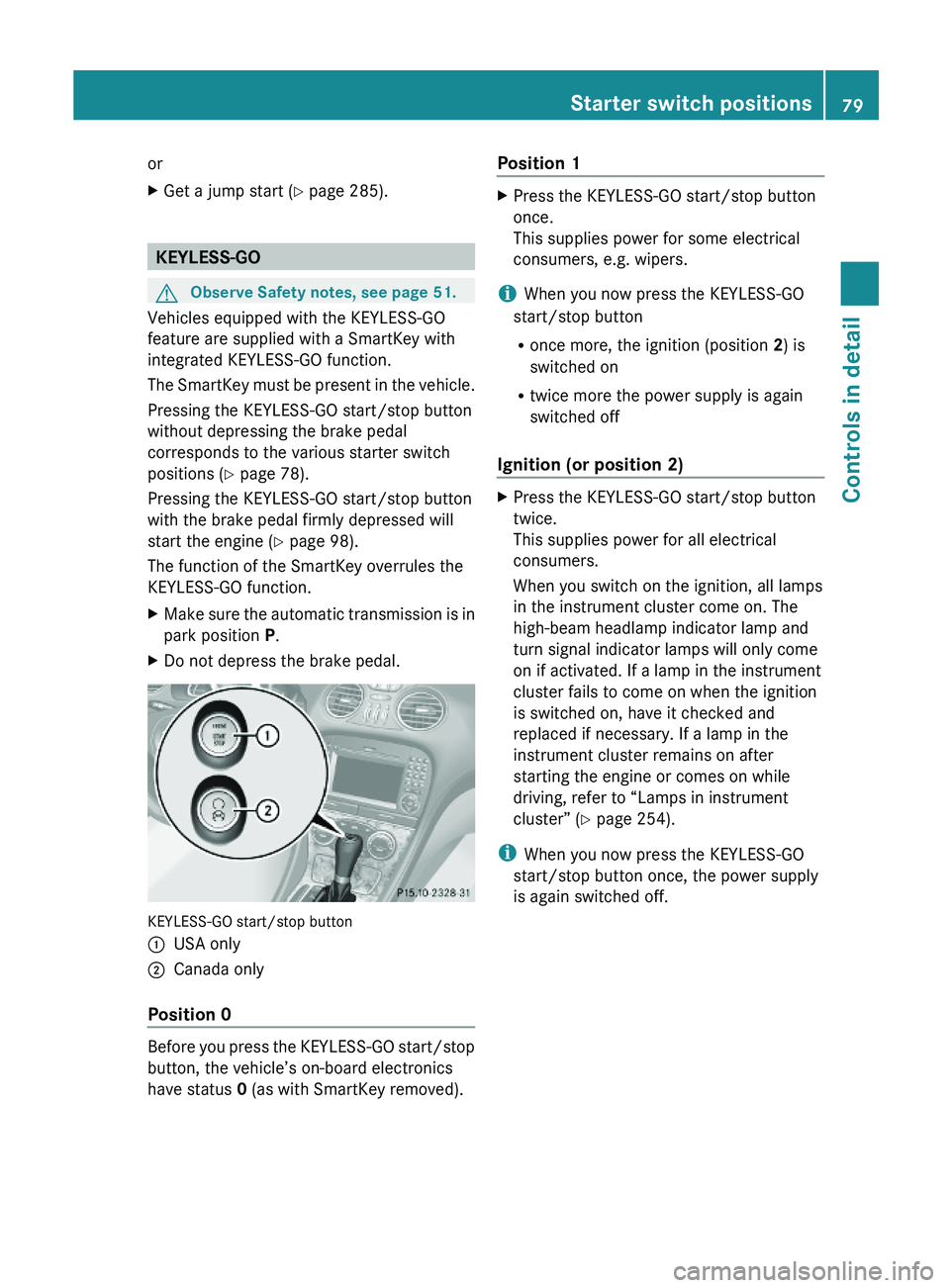
orXGet a jump start (Y page 285).
KEYLESS-GO
GObserve Safety notes, see page 51.
Vehicles equipped with the KEYLESS-GO
feature are supplied with a SmartKey with
integrated KEYLESS-GO function.
The SmartKey must be present in the vehicle.
Pressing the KEYLESS-GO start/stop button
without depressing the brake pedal
corresponds to the various starter switch
positions (Y page 78).
Pressing the KEYLESS-GO start/stop button
with the brake pedal firmly depressed will
start the engine (Y page 98).
The function of the SmartKey overrules the
KEYLESS-GO function.
XMake sure the automatic transmission is in
park position P.
XDo not depress the brake pedal.
KEYLESS-GO start/stop button
\000FUSA only\000GCanada only
Position 0
Before you press the KEYLESS-GO start/stop
button, the vehicle’s on-board electronics
have status 0 (as with SmartKey removed).
Position 1XPress the KEYLESS-GO start/stop button
once.
This supplies power for some electrical
consumers, e.g. wipers.
iWhen you now press the KEYLESS-GO
start/stop button
Ronce more, the ignition (position 2) is
switched on
Rtwice more the power supply is again
switched off
Ignition (or position 2)
XPress the KEYLESS-GO start/stop button
twice.
This supplies power for all electrical
consumers.
When you switch on the ignition, all lamps
in the instrument cluster come on. The
high-beam headlamp indicator lamp and
turn signal indicator lamps will only come
on if activated. If a lamp in the instrument
cluster fails to come on when the ignition
is switched on, have it checked and
replaced if necessary. If a lamp in the
instrument cluster remains on after
starting the engine or comes on while
driving, refer to “Lamps in instrument
cluster” (Y page 254).
iWhen you now press the KEYLESS-GO
start/stop button once, the power supply
is again switched off.
Starter switch positions79Controls in detail230_AKB; 6; 22, en-USd2ureepe,Version: 2.11.8.12009-07-28T18:49:58+02:00 - Seite 79Z
Page 82 of 316
Seats
Safety notes
GWarning!
In order to avoid possible loss of vehicle
control the following must be done before the
vehicle is put into motion:
R seat adjustment
R head restraint adjustment
R steering wheel adjustment
R rear view mirror adjustment
R fastening of seat belts
GWarning!
Do not adjust the driver’s seat while driving.
Adjusting the seat while driving could cause
the driver to lose control of the vehicle.
Never ride in a moving vehicle with the seat
backrest in an excessively reclined position as
this can be dangerous. You could slide under
the seat belt in a collision. If you slide under
it, the seat belt would apply force at the
abdomen or neck. That could cause serious
or fatal injuries. The seat backrest and seat
belts provide the best restraint when the
wearer is in a position that is as upright as
possible and seat belts are properly
positioned on the body.
GWarning!
Your seat must be adjusted so that you can
correctly fasten your seat belt.
Observe the following points:
R Adjust the seat backrest until your arms are
slightly angled when holding the steering
wheel.
R Adjust the seat to a comfortable seating
position that still allows you to reach the
accelerator/brake pedal safely. The
position should be as far back as possible
with the driver still able to operate the
controls properly.
R Adjust the head restraint so that it is as
close to the head as possible. The center of
the head restraint must support the back of
the head at eye level.
R Never place hands under the seat or near
any moving parts while a seat is being
adjusted.
Failure to do so could result in an accident
and/or serious personal injury.GWarning!
The power seats can be operated at any time.
Therefore, do not leave children unattended
in the vehicle, or with access to an unlocked
vehicle. A child’s unsupervised access to a
vehicle could result in an accident and/or
serious personal injury.
GWarning!
Children 12 years old and under must be
seated and properly secured in an
appropriately sized infant restraint, toddler
restraint, or booster seat recommended for
the size and weight of the child. For additional
information, see section “Children in the
vehicle”.
A child’s risk of serious or fatal injuries is
significantly increased if the child restraints
are not properly secured in the vehicle and/
or the child is not properly secured in the child
restraint.
GWarning!
For your protection, drive only with properly
positioned head restraints.
Adjust the head restraint so that it is as close
to the head as possible and the center of the
head restraint supports the back of the head
at eye level. This will reduce the potential for
injury to the head and neck in the event of an
accident or similar situation.
Do not drive the vehicle without the seat head
restraints. Head restraints are intended to
help reduce injuries during an accident.
80SeatsControls in detail
230_AKB; 6; 22, en-USd2ureepe,Version: 2.11.8.12009-07-28T18:49:58+02:00 - Seite 80