ECO mode MERCEDES-BENZ SL CLASS 2011 Owner's Manual
[x] Cancel search | Manufacturer: MERCEDES-BENZ, Model Year: 2011, Model line: SL CLASS, Model: MERCEDES-BENZ SL CLASS 2011Pages: 316, PDF Size: 6.55 MB
Page 199 of 316
Maximum tire loadGWarning!
Do not overload the tires by exceeding the
specified load limit as indicated on the Tire
and Loading Information placard on the
driver’s door B-pillar. Overloading the tires
can overheat them, possibly causing a
blowout. Overloading the tires can also result
in handling or steering problems, or brake
failure.
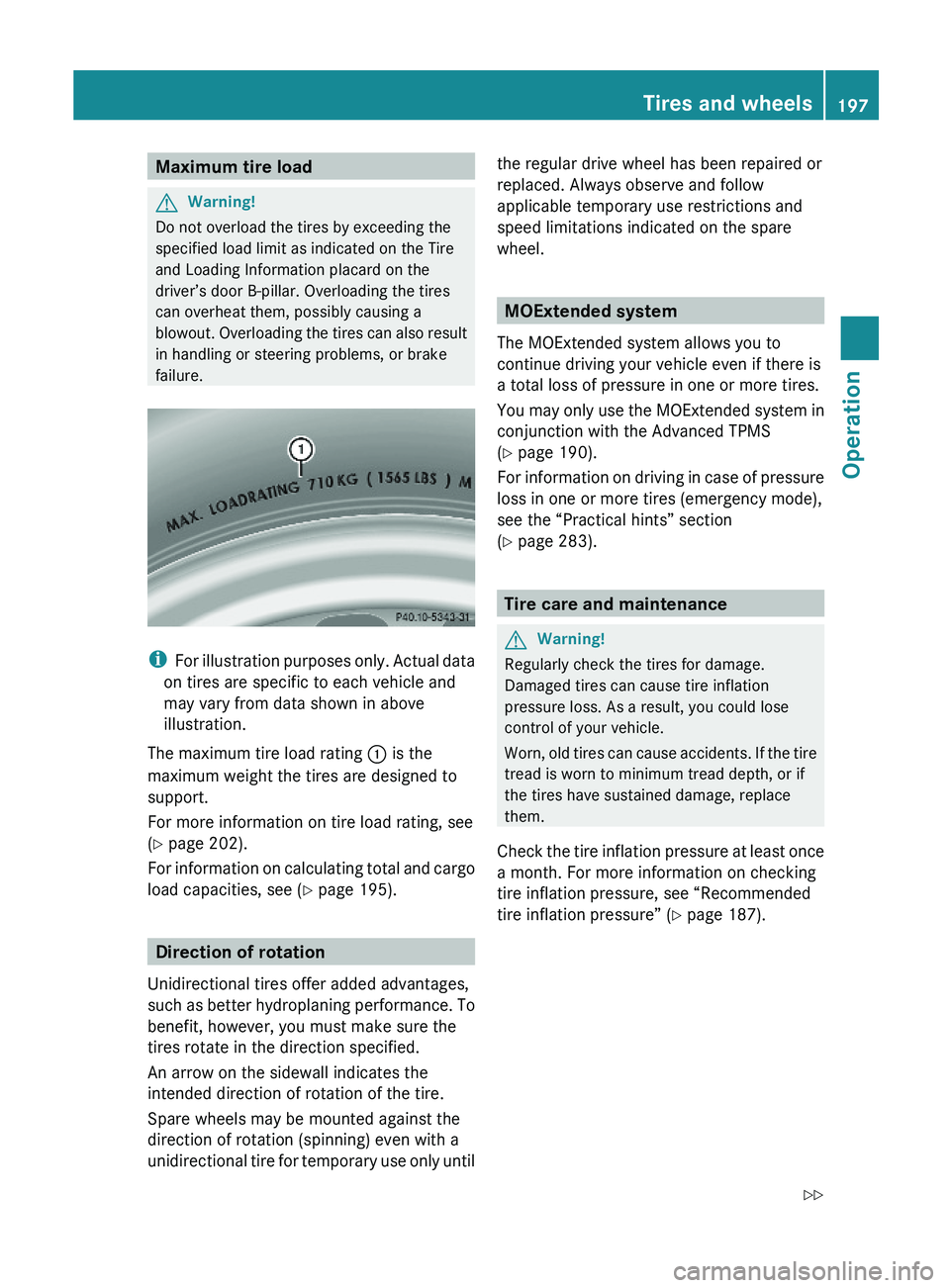
iFor illustration purposes only. Actual data
on tires are specific to each vehicle and
may vary from data shown in above
illustration.
The maximum tire load rating \000F is the
maximum weight the tires are designed to
support.
For more information on tire load rating, see
(Y page 202).
For information on calculating total and cargo
load capacities, see (Y page 195).
Direction of rotation
Unidirectional tires offer added advantages,
such as better hydroplaning performance. To
benefit, however, you must make sure the
tires rotate in the direction specified.
An arrow on the sidewall indicates the
intended direction of rotation of the tire.
Spare wheels may be mounted against the
direction of rotation (spinning) even with a
unidirectional tire for temporary use only until
the regular drive wheel has been repaired or
replaced. Always observe and follow
applicable temporary use restrictions and
speed limitations indicated on the spare
wheel.
MOExtended system
The MOExtended system allows you to
continue driving your vehicle even if there is
a total loss of pressure in one or more tires.
You may only use the MOExtended system in
conjunction with the Advanced TPMS
(Y page 190).
For information on driving in case of pressure
loss in one or more tires (emergency mode),
see the “Practical hints” section
(Y page 283).
Tire care and maintenance
GWarning!
Regularly check the tires for damage.
Damaged tires can cause tire inflation
pressure loss. As a result, you could lose
control of your vehicle.
Worn, old tires can cause accidents. If the tire
tread is worn to minimum tread depth, or if
the tires have sustained damage, replace
them.
Check the tire inflation pressure at least once
a month. For more information on checking
tire inflation pressure, see “Recommended
tire inflation pressure” (Y page 187).
Tires and wheels197Operation230_AKB; 6; 22, en-USd2ureepe,Version: 2.11.8.12009-07-28T18:49:58+02:00 - Seite 197Z
Page 210 of 316
Always use winter tires at temperatures
below 45‡ (7†) and whenever wintry road
conditions prevail. Not all M+S rated tires
provide special winter performance. Make
sure the tires you use show the mountain/
snowflake 004Dmarking on the tire sidewall.
These tires meet specific snow traction
performance requirements of the Rubber
Manufacturers Association (RMA) and the
Rubber Association of Canada (RAC) and
have been designed specifically for use in
snow conditions. Use of winter tires is the
only way to achieve the maximum
effectiveness of your vehicle’s driving safety
systems such as the ABS and the ESP ®
in
winter operation.
For safe handling, make sure all mounted
winter tires are of the same make and have
the same tread design.
For information on winter tires for your
vehicle model, see the “Technical data”
section ( Y page 299).
Always observe the speed rating of the winter
tires installed on your vehicle.
After installing winter tires:XCheck the tire inflation pressure and adjust
it if necessary ( Y page 189).XRestart the Advanced Tire Pressure
Monitoring System ( Y page 190).
Snow chains
! When driving with snow chains, always
select setting 1 of the vehicle level control.
Other settings may result in damage to your
vehicle.
! Some tire sizes do not leave adequate
clearance for snow chains. To help avoid
serious damage to your vehicle or tires,
make sure the use of snow chains is
permissible as specified in the “Technical
data” section of this Operator’s Manual.
Snow chains should only be driven on snow-
covered roads at speeds not to exceed
30 mph (50 km/h). Remove chains as soon
as possible when driving on roads without
snow.
Observe the following guidelines when using
snow chains:
R Use of snow chains is not permissible with
all wheel/tire combinations ( Y page 299).
R Use snow chains in pairs and on rear
wheels only. Follow the manufacturer’s
mounting instructions.
! If snow chains are mounted to the front
wheels, they may scrape against the body
or axle components. The tires or the vehicle
could be damaged as a result.
R Only use snow chains that are approved by
Mercedes-Benz. Any authorized Mercedes-
Benz Center will be glad to advise you on
this subject.
R Use of snow chains may be prohibited
depending on location. Always check local
and state laws before installing snow
chains.
R Do not use snow chains on the spare wheel.
i When driving with snow chains, you may
wish to switch off the ESP ®
(Y page 56)
before setting the vehicle in motion. This
will improve the vehicle’s traction.
Winter driving instructions
GWarning!
If the vehicle becomes stuck in snow, make
sure snow is kept clear of the exhaust pipe
and from around the vehicle with the engine
running. Otherwise, deadly carbon monoxide
(CO) gases may enter vehicle interior
resulting in unconsciousness and death.
To assure sufficient fresh air ventilation, open
a window slightly on the side of the vehicle
not facing the wind.
208Winter drivingOperation
230_AKB; 6; 22, en-USd2ureepe,Version: 2.11.8.12009-07-28T18:49:58+02:00 - Seite 208
Page 212 of 316
carpets in the footwell, make sure that the
pedals still have sufficient clearance.
During sudden driving or braking maneuvers,
the objects could get caught between the
pedals. You could then no longer brake or
accelerate. This could lead to accidents and
injury.
Power assistance
GWarning!
There is no power assistance for the steering
and the brake when the engine is not running.
Steering and braking requires significantly
more effort and you could lose control of the
vehicle and cause an accident as a result.
Do not turn off the engine while the vehicle is
in motion.
GWarning!
The brake system requires electrical energy
for operation.
A malfunction in the vehicle’s power supply or
electrical system may impair brake system
operation and switch it into its emergency
operation mode. In such a case, the red brake
warning lamp and warning messages in the
instrument cluster come on while driving. To
brake, the driver must then apply significantly
greater brake pedal pressure and depress the
pedal much further to obtain the expected
brake effect. If necessary, apply full pressure
to the brake pedal. Brakes are only applied to
the front wheels. Stopping distance is
increased! If there is a malfunction in the
electro-hydraulic brake system, we
recommend that the vehicle be transported
with all wheels off the ground using flatbed or
appropriate wheel lift/dolly equipment.
Brakes
Downhill grades
! When driving down long and steep
grades, relieve the load on the brakes by
shifting into a lower gear to use the
engine’s braking power. This helps prevent
overheating of the brakes and reduces
wear.
When using the engine’s braking power, a
drive wheel may not spin for an extended
period of time, e.g. on slippery road
surfaces. This may cause serious damage
to the drivetrain which is not covered by the
Mercedes-Benz Limited Warranty.
Continuous or hard braking
GWarning!
Resting your foot on the brake pedal will
cause excessive and premature wear of the
brake pads.
It can also result in the brakes overheating,
thereby significantly reducing their
effectiveness. It may not be possible to stop
the vehicle in sufficient time to avoid an
accident.
After hard braking, it is advisable to drive on
for some time, rather than immediately park,
so that the air stream will cool down the
brakes faster.
Wet roads
GWarning!
After driving in heavy rain for some time
without applying the brakes or through water
deep enough to wet brake components, the
first braking action may be somewhat
reduced and increased pedal pressure may be
necessary to obtain expected brake effect.
Maintain a safe distance from vehicles in
front.
To help prevent brake disk corrosion after
driving on wet or salt-covered roads, it is
advisable to brake the vehicle with
210Driving instructionsOperation
230_AKB; 6; 22, en-USd2ureepe,Version: 2.11.8.12009-07-28T18:49:58+02:00 - Seite 210
Page 213 of 316
considerable force prior to parking. The heat
generated serves to dry the brakes.
Salt-covered roadsGWarning!
A layer of salt on the brake discs and the brake
linings may cause a delay in the braking
effect, resulting in a significantly increased
braking distance, which could lead to an
accident.
To avoid this danger, you should:
R occasionally brake carefully when you are
driving on salt-covered roads, so that any
layer of salt that may have built up on the
brake discs and the brake linings is
removed without putting other road users
at risk
R maintain a greater distance to the vehicle
ahead and drive with particular care
R carefully apply the brakes at the end of a
trip and immediately after commencing a
new trip, so that salt residues are removed
from the brake disc
Brake service
! The brake fluid level in the reservoir may
be too low or the electro-hydraulic brake
system may be malfunctioning if the brake
warning lamp in the instrument cluster
comes on and an acoustic warning sounds
although the parking brake is released.
Observe additional messages in the
multifunction display that may appear.
Brake pad wear or a leak in the system may
be the reason for low brake fluid in the
reservoir.
Have the brake system inspected
immediately. Contact an authorized
Mercedes-Benz Center.
All checks and service work on the brake
system should be carried out by qualified
technicians only. Contact an authorized
Mercedes-Benz Center.
Only install brake pads and use brake fluid
recommended by Mercedes-Benz.GWarning!
If other than recommended brake pads are
installed, or other than recommended brake
fluid is used, the braking properties of the
vehicle can be degraded to an extent that safe
braking is substantially impaired. This could
result in an accident.
! Because the ESP ®
operates
automatically, the engine and ignition must
be shut off (SmartKey in starter switch
position 0 or 1 or KEYLESS-GO start/stop
button in position 0 or 1) when the parking
brake is being tested on a brake test
dynamometer or when the vehicle is being
towed with the front axle raised.
Active braking action through the ESP ®
may otherwise seriously damage the brake
system which is not covered by the
Mercedes-Benz Limited Warranty.
If your brake system is only subjected to
moderate loads, you should occasionally test
the effectiveness of the brakes by applying
above-normal braking pressure at higher
speeds. This will also enhance the grip of the
brake pads.
GWarning!
Make sure not to endanger any other road
users when carrying out these braking
maneuvers.
Refer to the description of the Brake Assist
System (BAS) ( Y page 56).
High-performance brake system
The high-performance brake system is only
available on SL 63 AMG and SL 65 AMG.
GWarning!
New vehicle brake pads and disks, and
replacement brake pads and disks may take
several hundred miles of driving until they
Driving instructions211Operation230_AKB; 6; 22, en-USd2ureepe,Version: 2.11.8.12009-07-28T18:49:58+02:00 - Seite 211Z
Page 239 of 316
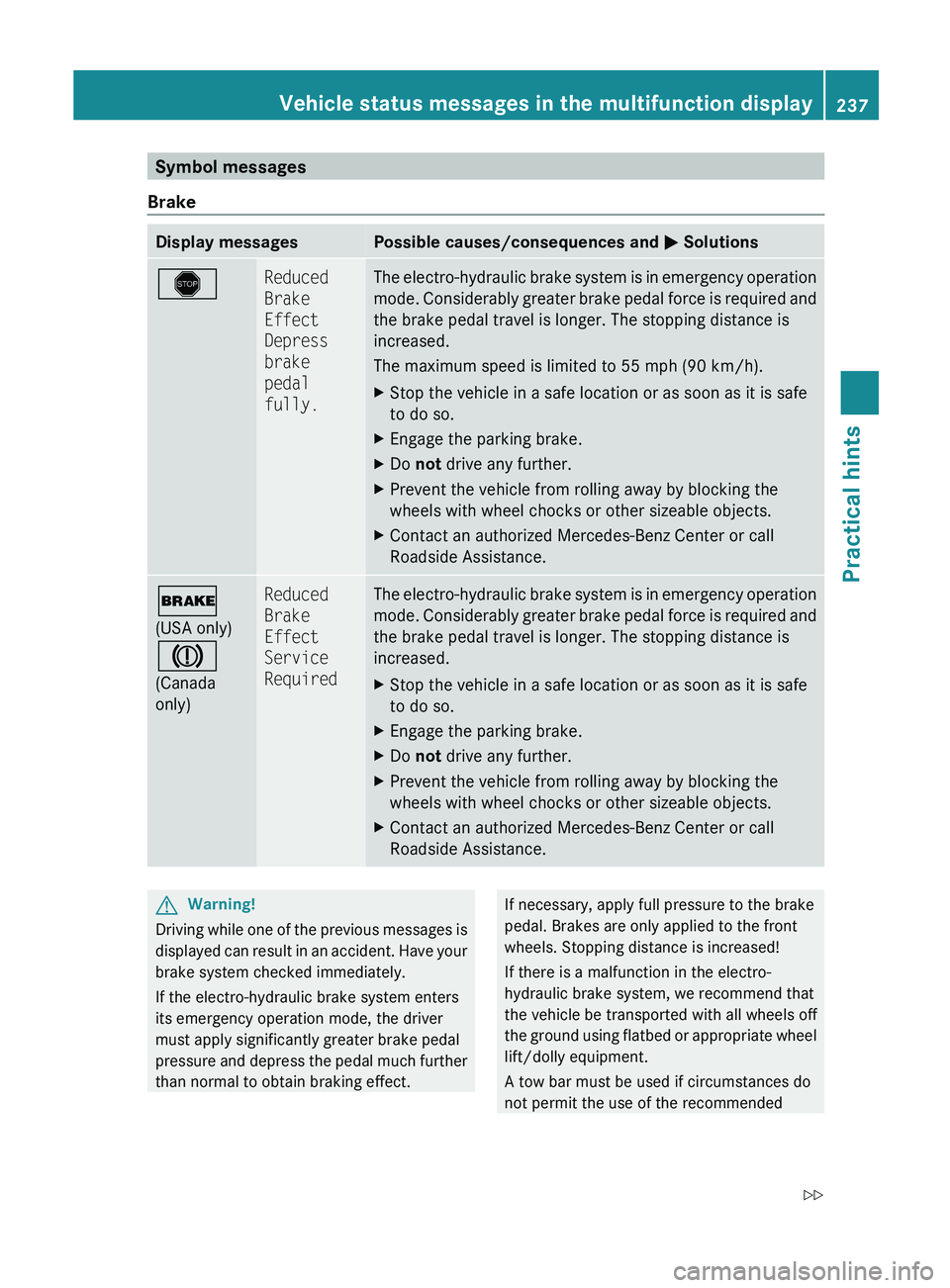
Symbol messages
BrakeDisplay messagesPossible causes/consequences and 0050 Solutions0051Reduced
Brake
Effect
Depress
brake
pedal
fully.The electro-hydraulic brake system is in emergency operation
mode. Considerably greater brake pedal force is required and
the brake pedal travel is longer. The stopping distance is
increased.
The maximum speed is limited to 55 mph (90 km/h).XStop the vehicle in a safe location or as soon as it is safe
to do so.XEngage the parking brake.XDo not drive any further.XPrevent the vehicle from rolling away by blocking the
wheels with wheel chocks or other sizeable objects.XContact an authorized Mercedes-Benz Center or call
Roadside Assistance.0027
(USA only)
004D
(Canada
only)Reduced
Brake
Effect
Service
RequiredThe electro-hydraulic brake system is in emergency operation
mode. Considerably greater brake pedal force is required and
the brake pedal travel is longer. The stopping distance is
increased.XStop the vehicle in a safe location or as soon as it is safe
to do so.XEngage the parking brake.XDo not drive any further.XPrevent the vehicle from rolling away by blocking the
wheels with wheel chocks or other sizeable objects.XContact an authorized Mercedes-Benz Center or call
Roadside Assistance.GWarning!
Driving while one of the previous messages is
displayed can result in an accident. Have your
brake system checked immediately.
If the electro-hydraulic brake system enters
its emergency operation mode, the driver
must apply significantly greater brake pedal
pressure and depress the pedal much further
than normal to obtain braking effect.
If necessary, apply full pressure to the brake
pedal. Brakes are only applied to the front
wheels. Stopping distance is increased!
If there is a malfunction in the electro-
hydraulic brake system, we recommend that
the vehicle be transported with all wheels off
the ground using flatbed or appropriate wheel
lift/dolly equipment.
A tow bar must be used if circumstances do
not permit the use of the recommendedVehicle status messages in the multifunction display237Practical hints230_AKB; 6; 22, en-USd2ureepe,Version: 2.11.8.12009-07-28T18:49:58+02:00 - Seite 237Z
Page 261 of 316
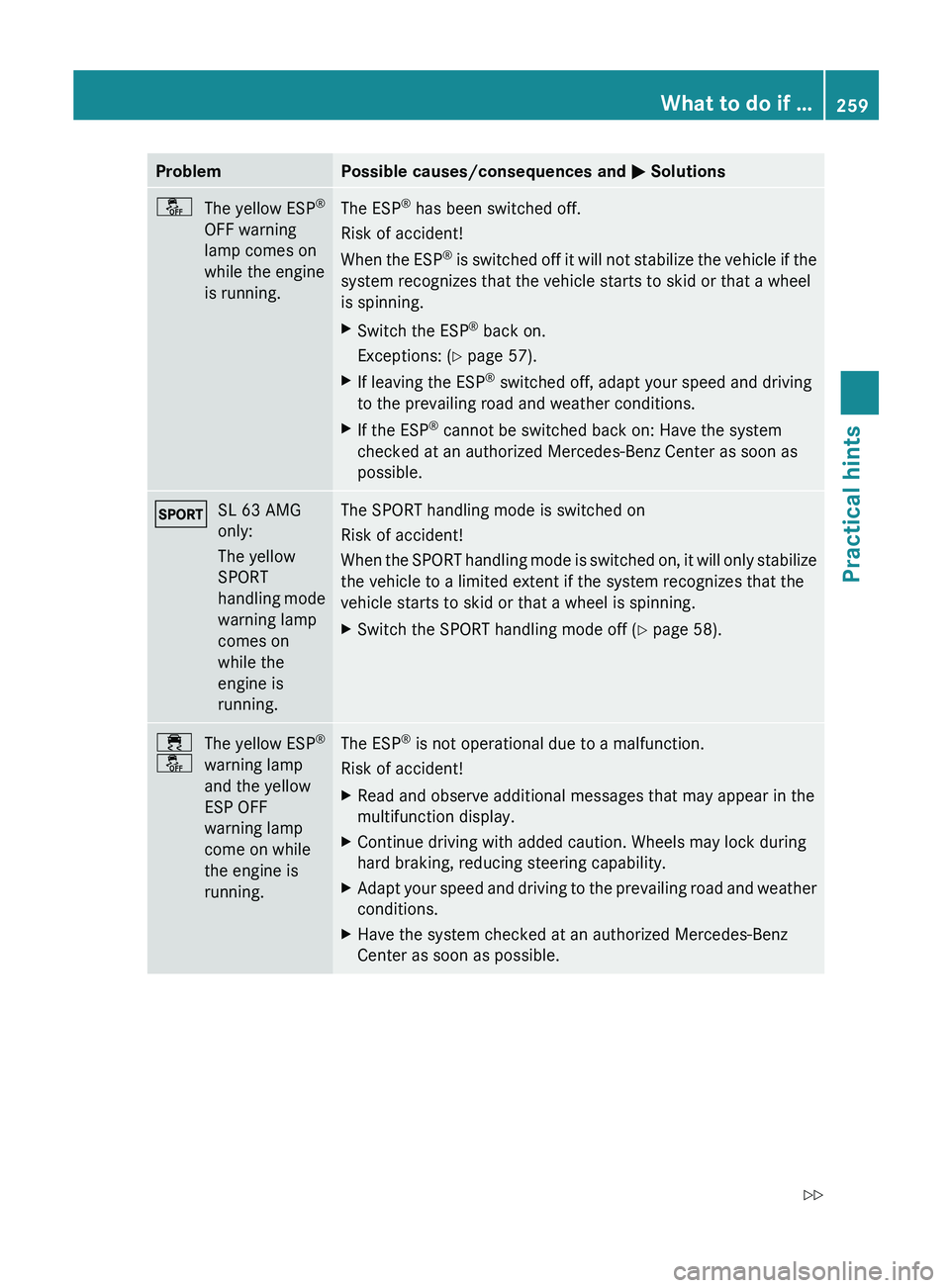
ProblemPossible causes/consequences and 0050 Solutions00C7The yellow ESP ®
OFF warning
lamp comes on
while the engine
is running.The ESP ®
has been switched off.
Risk of accident!
When the ESP ®
is switched off it will not stabilize the vehicle if the
system recognizes that the vehicle starts to skid or that a wheel
is spinning.XSwitch the ESP ®
back on.
Exceptions: ( Y page 57).XIf leaving the ESP ®
switched off, adapt your speed and driving
to the prevailing road and weather conditions.XIf the ESP ®
cannot be switched back on: Have the system
checked at an authorized Mercedes-Benz Center as soon as
possible.SL 63 AMG
only:
The yellow
SPORT
handling mode
warning lamp
comes on
while the
engine is
running.The SPORT handling mode is switched on
Risk of accident!
When the SPORT handling mode is switched on, it will only stabilize
the vehicle to a limited extent if the system recognizes that the
vehicle starts to skid or that a wheel is spinning.XSwitch the SPORT handling mode off ( Y page 58).00F2
00C7The yellow ESP ®
warning lamp
and the yellow
ESP OFF
warning lamp
come on while
the engine is
running.The ESP ®
is not operational due to a malfunction.
Risk of accident!XRead and observe additional messages that may appear in the
multifunction display.XContinue driving with added caution. Wheels may lock during
hard braking, reducing steering capability.XAdapt your speed and driving to the prevailing road and weather
conditions.XHave the system checked at an authorized Mercedes-Benz
Center as soon as possible.What to do if …259Practical hints230_AKB; 6; 22, en-USd2ureepe,Version: 2.11.8.12009-07-28T18:49:58+02:00 - Seite 259Z
Page 262 of 316
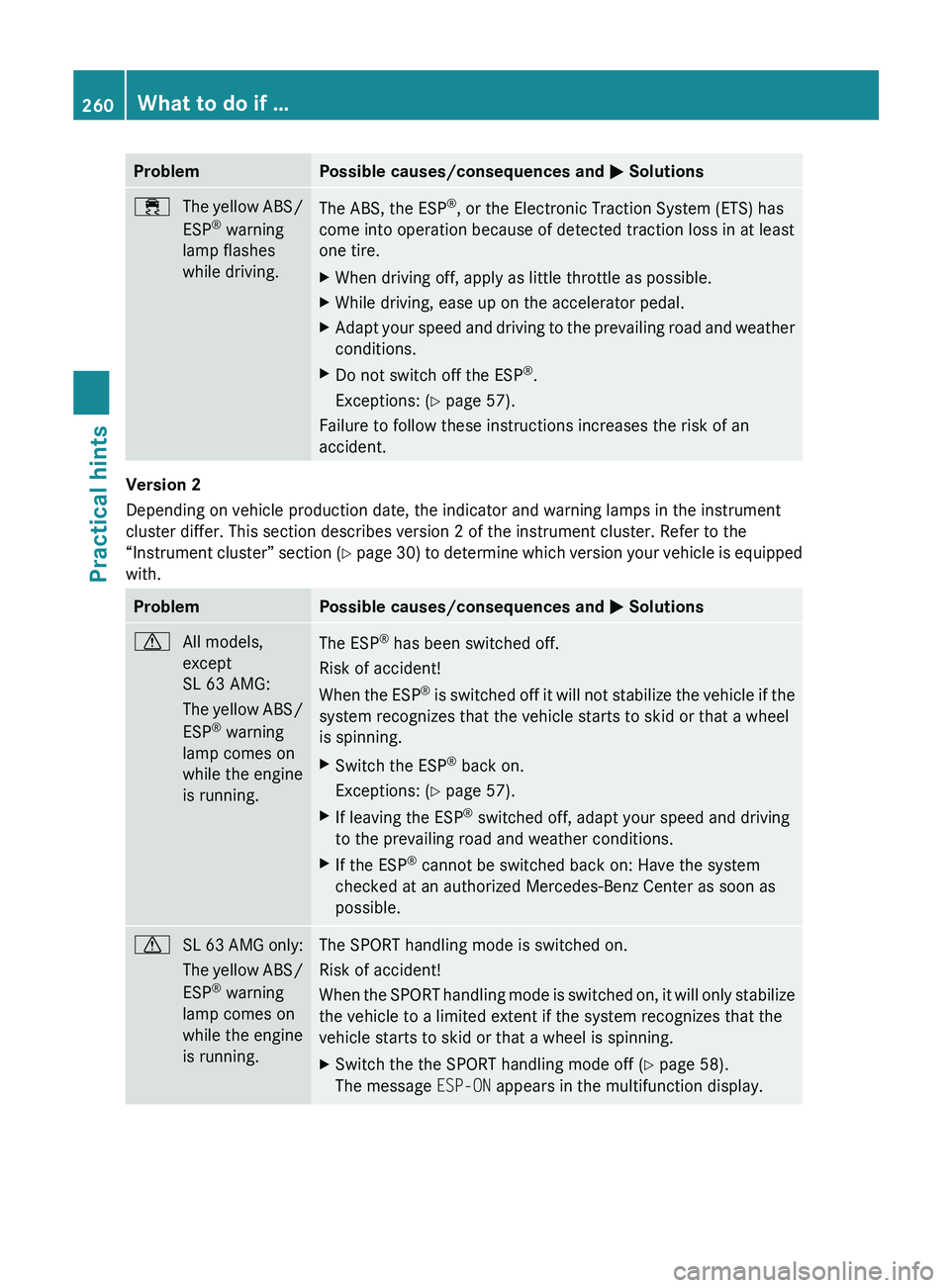
ProblemPossible causes/consequences and 0050 Solutions00F2The yellow ABS/
ESP ®
warning
lamp flashes
while driving.The ABS, the ESP ®
, or the Electronic Traction System (ETS) has
come into operation because of detected traction loss in at least
one tire.XWhen driving off, apply as little throttle as possible.XWhile driving, ease up on the accelerator pedal.XAdapt your speed and driving to the prevailing road and weather
conditions.XDo not switch off the ESP ®
.
Exceptions: ( Y page 57).
Failure to follow these instructions increases the risk of an
accident.
Version 2
Depending on vehicle production date, the indicator and warning lamps in the instrument
cluster differ. This section describes version 2 of the instrument cluster. Refer to the
“Instrument cluster” section (Y page 30) to determine which version your vehicle is equipped
with.ProblemPossible causes/consequences and 0050 Solutions0067All models,
except
SL 63 AMG:
The yellow ABS/
ESP ®
warning
lamp comes on
while the engine
is running.The ESP ®
has been switched off.
Risk of accident!
When the ESP ®
is switched off it will not stabilize the vehicle if the
system recognizes that the vehicle starts to skid or that a wheel
is spinning.XSwitch the ESP ®
back on.
Exceptions: ( Y page 57).XIf leaving the ESP ®
switched off, adapt your speed and driving
to the prevailing road and weather conditions.XIf the ESP ®
cannot be switched back on: Have the system
checked at an authorized Mercedes-Benz Center as soon as
possible.0067SL 63 AMG only:
The yellow ABS/
ESP ®
warning
lamp comes on
while the engine
is running.The SPORT handling mode is switched on.
Risk of accident!
When the SPORT handling mode is switched on, it will only stabilize
the vehicle to a limited extent if the system recognizes that the
vehicle starts to skid or that a wheel is spinning.XSwitch the the SPORT handling mode off ( Y page 58).
The message ESP-ON appears in the multifunction display.260What to do if …Practical hints
230_AKB; 6; 22, en-USd2ureepe,Version: 2.11.8.12009-07-28T18:49:58+02:00 - Seite 260
Page 302 of 316
Using tires other than those approved by
Mercedes-Benz may result in damage that
is not covered by the Mercedes-Benz
Limited Warranty.
For information on driving with MOExtended
tires, see the “Practical hints” section
( Y page 283).
! Using tires other than those approved by
Mercedes-Benz can have detrimental
effects, such as
R poor handling characteristics
R increased noise
R increased fuel consumption
Moreover, tires and rims not approved by
Mercedes-Benz may, under load, exhibit
dimensional variations and different tire
deformation characteristics that could
cause them to come into contact with the
vehicle body or axle parts. Damage to the
tires or the vehicle may be the result.
i Further information on tires and rims is
available at any authorized Mercedes-Benz
Center. The Tire and Loading Information
placard with the recommended tire
inflation pressures for cold tires is located
on the driver’s door B-pillar. Supplemental
tire inflation pressure information for
driving at high speeds or for vehicle loads
less than the maximum loaded vehicle
condition can be found on the tire inflation
pressure label. The tire inflation pressure
label is located on the inside of the fuel fillerflap. The tire inflation pressure should be
checked regularly and should only be
adjusted on cold tires. Follow tire
manufacturer’s maintenance
recommendation included with the vehicle.
For information on recommended tire
inflation pressure and supplemental tire
inflation pressure information for special
driving situations, see ( Y page 187).
i Please keep in mind that the vehicle must
be equipped
R with wheels of identical dimensions on
each axle (left and right)
R with tires of identical characteristics all
around, i.e. summer tires, winter tires,
all-season tires, or MOExtended tires etc.
i The following pages also list the approved
rim and tire sizes for equipping your vehicle
with winter tires. Winter tires are not
available as standard or optional factory
equipment, but can be purchased from an
authorized Mercedes-Benz Center.
Equipping your vehicle with winter tires
approved for your vehicle model may
require the purchase of rims of the
recommended size for use with these
winter tires. This depends on vehicle model
and the standard or optional factory-
equipped wheel rim/tire configuration on
your vehicle. For more information contact
an authorized Mercedes-Benz Center.300Rims and tiresTechnical data
230_AKB; 6; 22, en-USd2ureepe,Version: 2.11.8.12009-07-28T18:49:58+02:00 - Seite 300
Page 307 of 316
![MERCEDES-BENZ SL CLASS 2011 Owners Manual ModelCapacityFuels, coolants,
lubricants, etc.Fuel tankAll models21.1 US gal (80.0 l)Premium unleaded
gasoline (Minimum
Posted Octane 91
[Avg. of
96 RON/86 MON])Fuel tank
reserveSL 550
SL 600approx.](/img/4/59123/w960_59123-306.png "MERCEDES-BENZ SL CLASS 2011 Owners Manual ModelCapacityFuels, coolants,
lubricants, etc.Fuel tankAll models21.1 US gal (80.0 l)Premium unleaded
gasoline (Minimum
Posted Octane 91
[Avg. of
96 RON/86 MON])Fuel tank
reserveSL 550
SL 600approx.")
ModelCapacityFuels, coolants,
lubricants, etc.Fuel tankAll models21.1 US gal (80.0 l)Premium unleaded
gasoline (Minimum
Posted Octane 91
[Avg. of
96 RON/86 MON])Fuel tank
reserveSL 550
SL 600approx. 2.6 US gal (10.0 l)SL 63 AMG
SL 65 AMGapprox. 3.7 US gal (14.0 l)Air
conditioning
systemAll models—R134a refrigerant
and special
PAG lubricant oil
(never R 12)Hydraulic
system for
retractable
hardtopAll models0.42 US qt (0.4 l)MB Hydraulic OilWasher system
and headlamp
cleaning
systemAll models7.4 US qt (7.0 l)MB Windshield
Washer
Concentrate 42
( Y page 309)
Washer fluid mixing
ratio ( Y page 309)Approved engine oils
Engine oils are specifically tested for their
suitability in our engines and durability for our
service intervals. Therefore, only use
approved engine oils and oil filters required
for vehicles with the Maintenance System.
For a listing of approved engine oils and oil
filters, contact an authorized Mercedes-Benz
Center or visit www.mbusa.com (USA only).
! Using engine oils and oil filters of a
specification other than those expressly
required for the Maintenance System, or
changing of oil and oil filter at change
intervals longer than those called for by the
Maintenance System will result in engine or
emission control system damage notcovered by the Mercedes-Benz Limited
Warranty.
Please follow Maintenance System
recommendations for scheduled oil
changes. Failure to do so will result in
engine or emission control system damage
not covered by the Mercedes-Benz Limited
Warranty.
Mercedes-Benz recommends MOBIL OIL.
Use the table below to determine the
MB sheet number.ModelEngine,
typeMB sheet
numberSL 550273229.5SL 600275229.542 Mixed with water or commercially available premixed washer solvent/antifreeze.Fuels, coolants, lubricants, etc.305Technical data230_AKB; 6; 22, en-USd2ureepe,Version: 2.11.8.12009-07-28T18:49:58+02:00 - Seite 305Z
Page 308 of 316
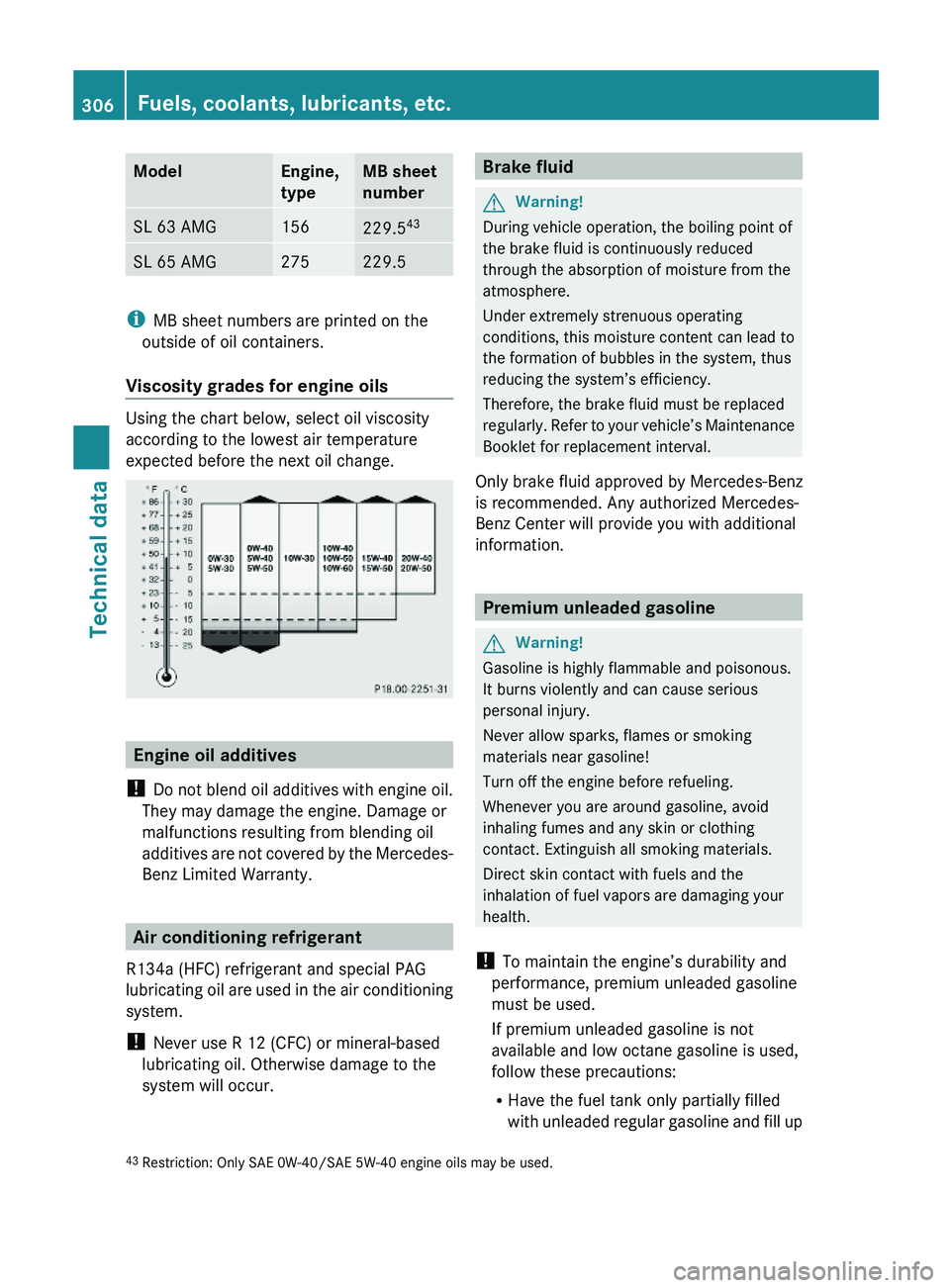
ModelEngine,
type
MB sheet
number
SL 63 AMG156229.543SL 65 AMG275229.5
iMB sheet numbers are printed on the
outside of oil containers.
Viscosity grades for engine oils
Using the chart below, select oil viscosity
according to the lowest air temperature
expected before the next oil change.
Engine oil additives
! Do not blend oil additives with engine oil.
They may damage the engine. Damage or
malfunctions resulting from blending oil
additives are not covered by the Mercedes-
Benz Limited Warranty.
Air conditioning refrigerant
R134a (HFC) refrigerant and special PAG
lubricating oil are used in the air conditioning
system.
! Never use R 12 (CFC) or mineral-based
lubricating oil. Otherwise damage to the
system will occur.
Brake fluidGWarning!
During vehicle operation, the boiling point of
the brake fluid is continuously reduced
through the absorption of moisture from the
atmosphere.
Under extremely strenuous operating
conditions, this moisture content can lead to
the formation of bubbles in the system, thus
reducing the system’s efficiency.
Therefore, the brake fluid must be replaced
regularly. Refer to your vehicle’s Maintenance
Booklet for replacement interval.
Only brake fluid approved by Mercedes-Benz
is recommended. Any authorized Mercedes-
Benz Center will provide you with additional
information.
Premium unleaded gasoline
GWarning!
Gasoline is highly flammable and poisonous.
It burns violently and can cause serious
personal injury.
Never allow sparks, flames or smoking
materials near gasoline!
Turn off the engine before refueling.
Whenever you are around gasoline, avoid
inhaling fumes and any skin or clothing
contact. Extinguish all smoking materials.
Direct skin contact with fuels and the
inhalation of fuel vapors are damaging your
health.
! To maintain the engine’s durability and
performance, premium unleaded gasoline
must be used.
If premium unleaded gasoline is not
available and low octane gasoline is used,
follow these precautions:
RHave the fuel tank only partially filled
with unleaded regular gasoline and fill up
43Restriction: Only SAE 0W-40/SAE 5W-40 engine oils may be used.306Fuels, coolants, lubricants, etc.Technical data
230_AKB; 6; 22, en-USd2ureepe,Version: 2.11.8.12009-07-28T18:49:58+02:00 - Seite 306