warning MERCEDES-BENZ SL CLASS 2011 Owner's Guide
[x] Cancel search | Manufacturer: MERCEDES-BENZ, Model Year: 2011, Model line: SL CLASS, Model: MERCEDES-BENZ SL CLASS 2011Pages: 316, PDF Size: 6.55 MB
Page 58 of 316
If the ABS malfunctions, the wheels may lock
during hard braking, reducing steering
capability and extending the braking distance.
BAS
GObserve Safety notes, see page 55.
The Brake Assist System (BAS) operates in
emergency situations. If you apply the brakes
very quickly, the BAS provides full brake
boost automatically, thereby potentially
reducing the braking distance.
XApply continuous full braking pressure until
the emergency braking situation is over.
The ABS will prevent the wheels from
locking.
When you release the brake pedal, the brakes
function again as normal. The BAS is then
deactivated.
GWarning!
If the BAS malfunctions, the brake system still
functions, but without the additional brake
boost available that the BAS would normally
provide in an emergency braking maneuver.
Therefore, the braking distance may increase.
ESP ®
GObserve Safety notes, see page 55.
The Electronic Stability Program (ESP
®
) is
operational as soon as the engine is running.
It monitors the vehicle’s traction (force of
adhesive friction between the tires and the
road surface) and handling.
The ESP ®
recognizes that the vehicle deviates
from the direction of travel as intended by the
driver. By applying brakes to individual
wheels and by limiting the engine output, the
ESP ®
works to stabilize the vehicle. The
ESP ®
is especially useful while driving off and
on wet or slippery road surfaces. The ESP ®
also stabilizes the vehicle during braking and
steering maneuvers.
The ABS/ESP ®
warning lamp 00F2 or 0067 8
in the instrument cluster comes on when you
switch on the ignition. It goes out when the
engine is running.
The ABS/ESP ®
warning lamp 00F2 or 0067 8
in the instrument cluster flashes when the
ESP ®
is engaged.GWarning!
Never switch off the ESP ®
when you see the
ABS/ESP ®
warning lamp 00F2 or 0067 9
flashing in the instrument cluster. In this case
proceed as follows:
R When driving off, apply as little throttle as
possible.
R While driving, ease up on the accelerator
pedal.
R Adapt your speed and driving style to the
prevailing road conditions.
Failure to observe these guidelines could
cause the vehicle to skid. The ESP ®
cannot
prevent accidents resulting from excessive
speed.
! Because the ESP ®
operates
automatically, the engine and ignition must
be shut off (SmartKey in starter switch
position 0 or 1 or KEYLESS-GO start/stop
button in position 0 or 1) when the parking
brake is being tested on a brake test
dynamometer or when the vehicle is being
towed with the front axle raised.
Active braking action through the ESP ®
may otherwise seriously damage the brake
system which is not covered by the
Mercedes-Benz Limited Warranty.
! The ESP ®
will only function properly if you
use wheels of the recommended tire size
8 Depending on vehicle production date.
9 Depending on vehicle production date.56Driving safety systemsSafety and security
230_AKB; 6; 22, en-USd2ureepe,Version: 2.11.8.12009-07-28T18:49:58+02:00 - Seite 56
Page 59 of 316
as specified in the “Technical data” section
of this Operator’s Manual.
iThe Distronic system and cruise control
switch off automatically when the ESP®
engages.
Electronic Traction System (ETS)
GObserve Safety notes, see page 55.
The ETS (Electronic Traction System) is a
component of the ESP®. The ETS improves
the vehicle’s ability to utilize available
traction, especially under slippery road
conditions by applying the brakes to a
spinning wheel.
When you switch off the ESP®, the ETS is still
enabled.
Switching the ESP® off or on (except
SL 63 AMG)
GWarning!
The ESP® should not be switched off during
normal driving other than in the
circumstances described below. Disabling
the system will reduce vehicle stability in
driving maneuvers.
Do not switch off the ESP® when a spare
wheel is mounted.
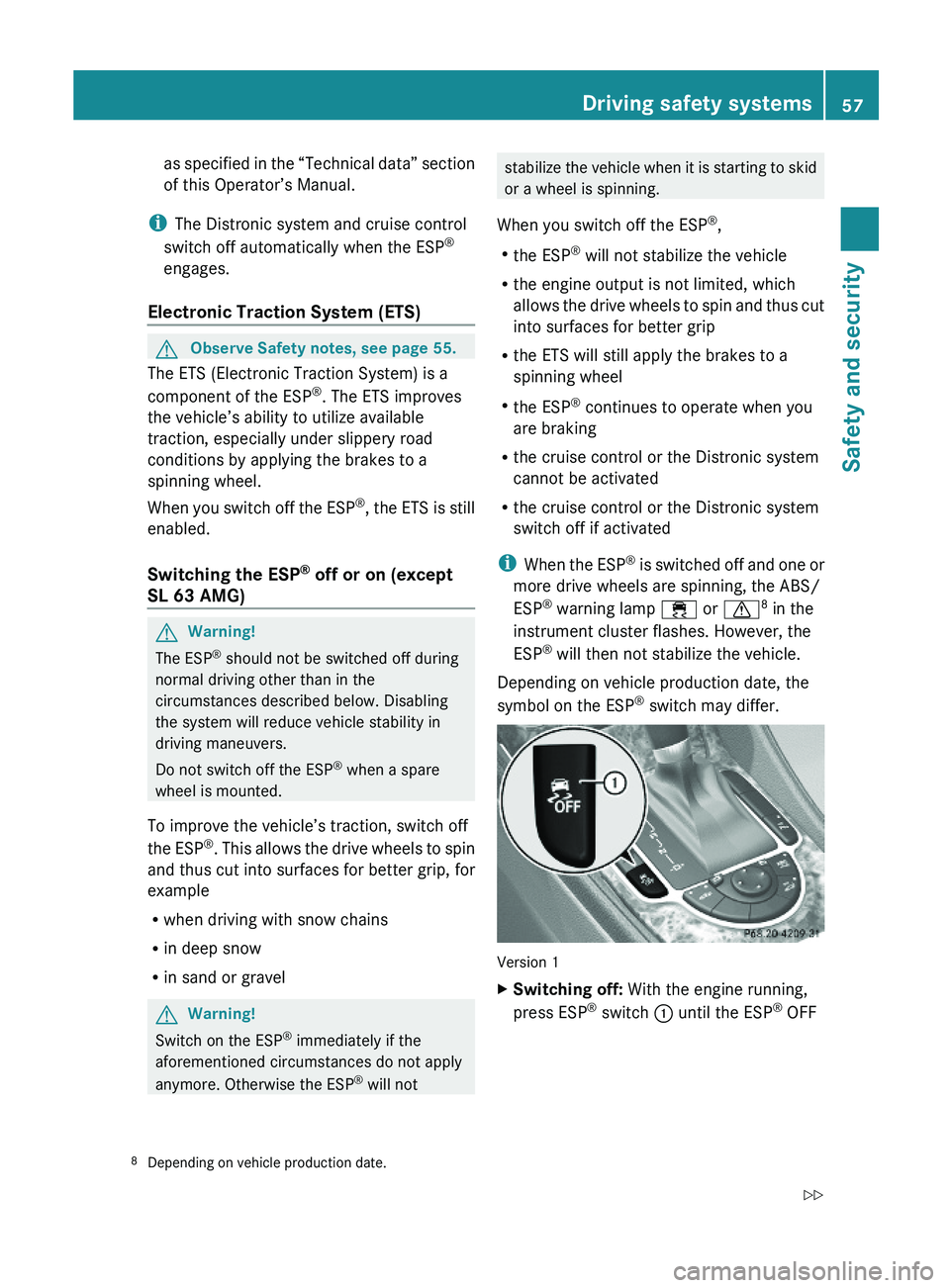
To improve the vehicle’s traction, switch off
the ESP®. This allows the drive wheels to spin
and thus cut into surfaces for better grip, for
example
Rwhen driving with snow chains
Rin deep snow
Rin sand or gravel
GWarning!
Switch on the ESP® immediately if the
aforementioned circumstances do not apply
anymore. Otherwise the ESP® will not
stabilize the vehicle when it is starting to skid
or a wheel is spinning.
When you switch off the ESP®,
Rthe ESP® will not stabilize the vehicle
Rthe engine output is not limited, which
allows the drive wheels to spin and thus cut
into surfaces for better grip
Rthe ETS will still apply the brakes to a
spinning wheel
Rthe ESP® continues to operate when you
are braking
Rthe cruise control or the Distronic system
cannot be activated
Rthe cruise control or the Distronic system
switch off if activated
iWhen the ESP® is switched off and one or
more drive wheels are spinning, the ABS/
ESP® warning lamp \000
Page 60 of 316
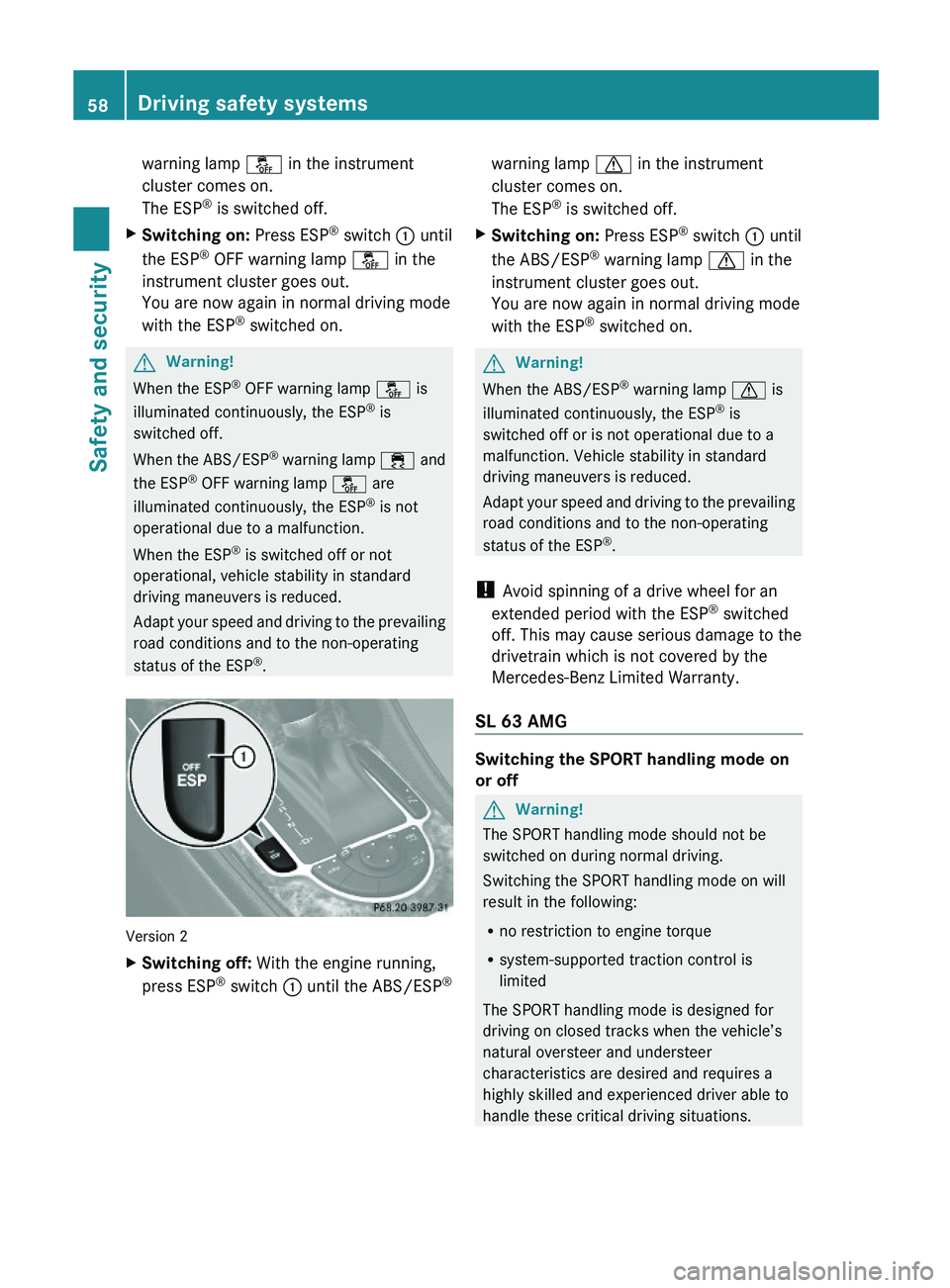
warning lamp \000
Page 61 of 316
You could lose control of your vehicle and
cause an accident.
Please be aware of these limits when you
switch on the SPORT handling mode.
Do not switch on the SPORT handling mode
when a spare wheel is mounted.
To improve the vehicle’s traction, switch on
the SPORT handling mode. This allows the
drive wheels to spin and thus cut into
surfaces for better grip, for example
Rwhen driving with snow chains
Rin deep snow
Rin sand or gravel
GWarning!
Switch off the SPORT handling mode and
switch on the ESP® immediately if the
aforementioned circumstances do not apply
anymore. Otherwise the SPORT handling
mode will only stabilize the vehicle to a limited
extent when it is starting to skid or a wheel is
spinning.
When you switch on the SPORT handling
mode
Rthe ESP® stabilizes the vehicle only to a
limited extent
Rthe engine output is limited, but only to the
extent that allows the drive wheels to spin
and thus cut into surfaces for better grip
Rthe ETS will still apply the brakes to a
spinning wheel
Rthe ESP® continues to operate when you
are braking hard
Rthe cruise control or the Distronic system
cannot be activated
Rthe cruise control or the Distronic system
switch off if activated
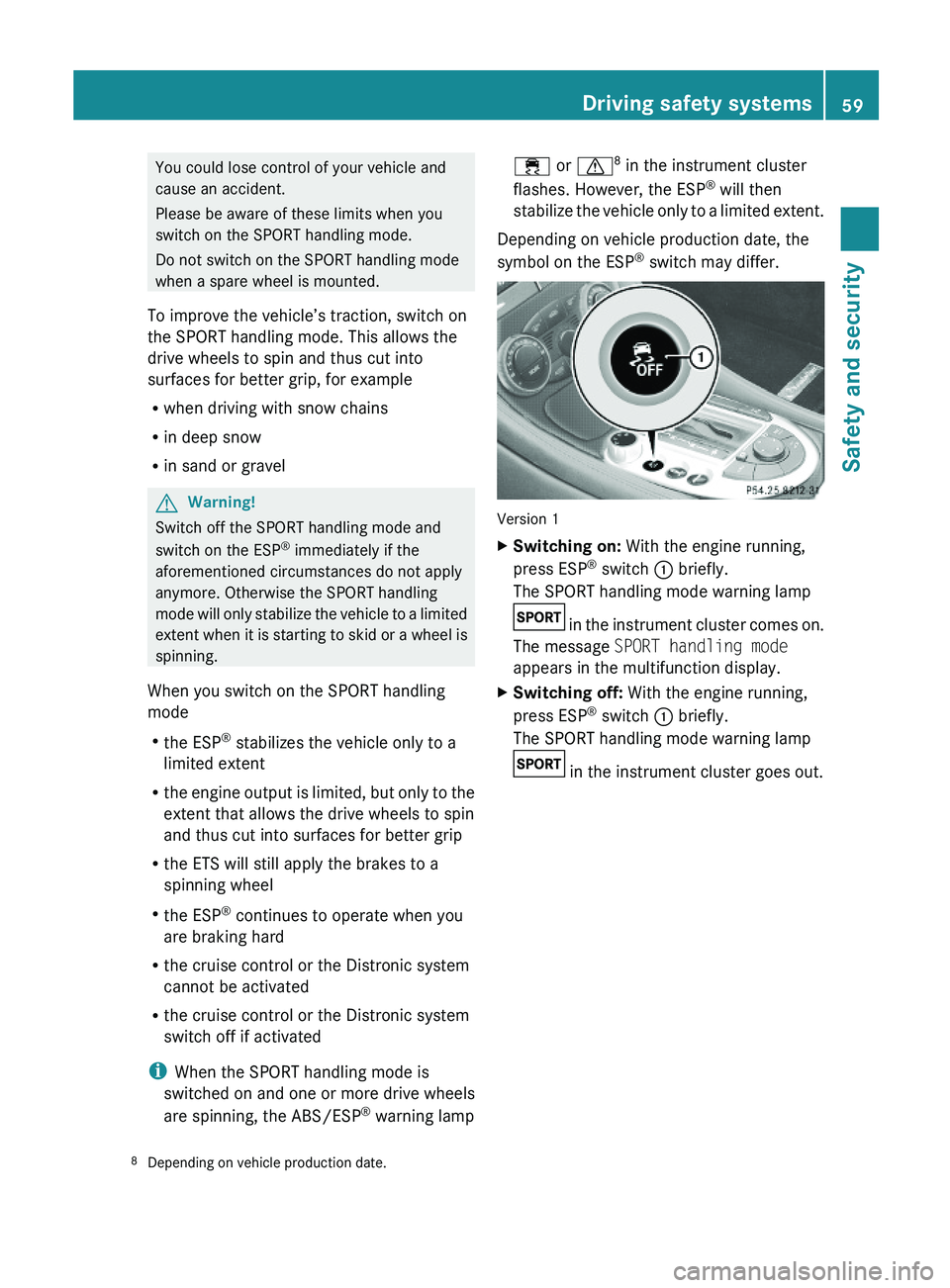
iWhen the SPORT handling mode is
switched on and one or more drive wheels
are spinning, the ABS/ESP® warning lamp
\000
Page 62 of 316

Version 2
XSwitching on: With the engine running,
press ESP® switch \000F briefly.
The ABS/ESP® warning lamp \000g in the
instrument cluster comes on. The message
ESP-SPORT appears in the multifunction
display.
XSwitching off: With the engine running,
press ESP® SPORT switch \000F briefly.
The ABS/ESP® warning lamp \000g in the
instrument cluster goes out. The message
ESP-ON appears in the multifunction
display.
The SPORT handling mode switches off
automatically when you turn off the engine.
When starting the engine, the ESP® is
activated automatically.
Switching the ESP® off or on
GWarning!
The ESP® should not be switched off during
normal driving.
Disabling of the system will result in the
following:
Rno restriction to engine torque
Rloss of system-supported traction control
“ESP® OFF” is designed for driving on closed
tracks when the vehicle’s natural oversteer
and understeer characteristics are desired
and requires a highly skilled and experienced
driver able to handle these critical driving
situations.
You could lose control of your vehicle and
cause an accident.
Please be aware of these limits when you
switch off the ESP®.
Do not switch off the ESP® when a spare
wheel is mounted.
To improve the vehicle’s traction, switch off
the ESP®. This allows the drive wheels to spin
and thus cut into surfaces for better grip, for
example
Rwhen driving with snow chains
Rin deep snow
Rin sand or gravel
GWarning!
Switch on the ESP® immediately if the
aforementioned circumstances do not apply
anymore. Otherwise the ESP® will not
stabilize the vehicle when it is starting to skid
or a wheel is spinning.
When you switch off the ESP®,
Rthe ESP® will not stabilize the vehicle
Rthe engine output is not limited, which
allows the drive wheels to spin and thus cut
into surfaces for better grip
Rthe ETS will still apply the brakes to a
spinning wheel
Rthe ESP® continues to operate when you
are braking hard
Rthe cruise control or the Distronic system
cannot be activated
Rthe cruise control or the Distronic system
switch off if activated
iWhen the ESP® is switched off and one or
more drive wheels are spinning, the ABS/
ESP® warning lamp \000
Page 63 of 316

instrument cluster does not flash. The
ESP® will then not stabilize the vehicle.
Depending on vehicle production date, the
symbol on the ESP® switch may differ.
Version 1
XSwitching off: With the engine running,
press ESP® switch \000F until the ESP® OFF
warning lamp \000
Page 64 of 316

Electro-hydraulic brake system
The electro-hydraulic brake system combines
a hydraulic brake circuit with electronically
controlled brake servo assistance. You have
increased braking safety and improved
braking comfort.GWarning!
Never ignore a brake malfunction indicated in
the speedometer display, for example by the
0027 (USA only) or 004D (Canada only)
indicator lamp. Refer to the “Practical hints”
section. Also read and observe the messages
in the instrument cluster multifunction
display.
For information on warning and indicator
lamps, see the “Practical hints” section
( Y page 255). For information on the
messages that may appear in the
multifunction display, see the “Practical
hints” section ( Y page 227) and
( Y page 237).
GWarning!
The electro-hydraulic brake system requires
electrical power to operate.
A malfunction in the vehicle’s power supply or
electrical system may impair brake system
operation and switch it into its emergency
operation mode. In such a case, the red brake
warning lamp comes on and warning
messages appear in the multifunction display
while driving. To brake, the driver must then
apply significantly greater brake pedal
pressure and depress the pedal much further
to obtain the expected braking effect. If
necessary, apply full pressure to the brake
pedal. Brakes are only applied to the front
wheels. Stopping distance is increased!
If there is a malfunction in the electro-
hydraulic brake system, we recommend that
the vehicle be transported with all wheels off
the ground using flatbed or appropriate wheel
lift/dolly equipment.
A tow bar must be used if circumstances do
not permit the use of the recommended
towing methods and the vehicle requires
towing with all four wheels on the ground.
Towing the vehicle with all four wheels on the
ground is only permissible for distances up to
30 miles (50 km) and at a speed not to exceed
30 mph (50 km/h). For more information, see
the “Towing the vehicle” section in this
Operator’s Manual.
The electro-hydraulic brake system is
activated automatically when you
R unlock the vehicle with the SmartKey or
with KEYLESS-GO
R open the driver’s or passenger door
R turn the SmartKey in the starter switch to
position 1
R press the start/stop button on the gear
selector lever once (vehicles with
KEYLESS-GO)
R depress the brake pedal
R release the parking brake
If the electro-hydraulic brake system is
activated as the brake pedal is first
depressed, you may feel a reduced pedal
resistance and longer pedal travel than
normal. When releasing the pedal, you may
also feel the brake pedal pulsate and you may
hear a sound which is caused by the
activation of the electro-hydraulic brake
system pump. This is normal and not an
indication of a malfunction. Pedal travel
returns to normal when you release the brake
pedal and the sound soon ceases.
If you experience the above while driving and
the red brake warning lamp illuminates
and/or warning messages appear in the
multifunction display, the brake system is
malfunctioning. Follow the instructions of the
warning message(s) and have the brake
system checked immediately.GWarning!
Have brake pad replacement and other work
on the electro-hydraulic brake system carried
62Driving safety systemsSafety and security
230_AKB; 6; 22, en-USd2ureepe,Version: 2.11.8.12009-07-28T18:49:58+02:00 - Seite 62
Page 66 of 316

Ra door is opened from the inside
Rthe trunk is opened with the emergency
release button
To cancel the alarm after it has been
triggered, see “Canceling the alarm”
(Y page 65).
iIf the alarm stays on for more than
30 seconds, the Tele Aid system initiates a
call to the Customer Assistance Center
automatically. The Tele Aid system will
initiate the call provided that
Ryou have subscribed to the Tele Aid
service
Rthe Tele Aid service has been activated
properly
Rthe necessary mobile phone, power
supply and GPS coverage are available
XArming: Lock the vehicle with the
SmartKey or with KEYLESS-GO.
The turn signal lamps flash three times and
an acoustic warning sounds three times to
indicate that the vehicle is locked. Indicator
lamp \000F flashes to indicate that the alarm
system is armed.
iIf the turn signal lamps do not flash three
times and the acoustic warning does not
sound three times, a door or the trunk may
not be properly closed.
Close the respective element.XDisarming: Unlock the vehicle with the
SmartKey or with KEYLESS-GO.
The turn signal lamps flash once and an
acoustic warning sounds once to indicate
that the alarm system is disarmed.
iUnless you open a door or the trunk within
approximately 40 seconds after unlocking
the vehicle:
RThe vehicle will be locked again.
RThe anti-theft alarm system will be
rearmed.
Tow-away alarm
Once the tow-away alarm is armed, a visual
and audible alarm will be triggered when
someone attempts to raise the vehicle.
To cancel the alarm after it has been
triggered, see “Canceling the alarm”
(Y page 65).
iIf the alarm stays on for more than
30 seconds, a call to the Customer
Assistance Center is initiated automatically
by the Tele Aid system provided that you
have subscribed to the Tele Aid service and
that it has been activated properly, and that
the necessary mobile phone, power supply
and GPS coverage are available.
XArming: Lock the vehicle with the
SmartKey or with KEYLESS-GO.
The tow-away alarm is armed after about
30 seconds automatically.
XDisarming: Unlock the vehicle with the
SmartKey or with KEYLESS-GO.
The tow-away alarm remains disarmed until
you lock the vehicle again.
Disabling tow-away alarm
To prevent triggering the tow-away alarm,
disable the tow-away alarm feature before
towing the vehicle, or when parking on a
64Anti-theft systemsSafety and security
230_AKB; 6; 22, en-USd2ureepe,Version: 2.11.8.12009-07-28T18:49:58+02:00 - Seite 64
Page 75 of 316
Automatic central locking
You can switch the automatic central locking
on or off using the control system
(Y page 126).
The doors and the trunk lock automatically
when the vehicle is set into motion.
You can open a locked door from the inside.
Open door only when conditions are safe to
do so.
The doors are designed to unlock
automatically after an accident if the force of
the impact exceeds a preset threshold.
The vehicle locks automatically when the
ignition is switched on and the wheels are
turning at a vehicle speed of above 9 mph
(15 km/h). You could therefore lock yourself
out when the vehicle is pushed or towed or is
on a test stand.
Locking and unlocking from the inside
GObserve Safety notes, see page 51.
You can lock or unlock the vehicle from the
inside using the central locking or unlocking
switch. This can be useful, for example, if you
want to lock the vehicle before starting to
drive.
The central locking or unlocking switch does
not lock or unlock the fuel filler flap or the
interior storage compartments, such as the
glove box.
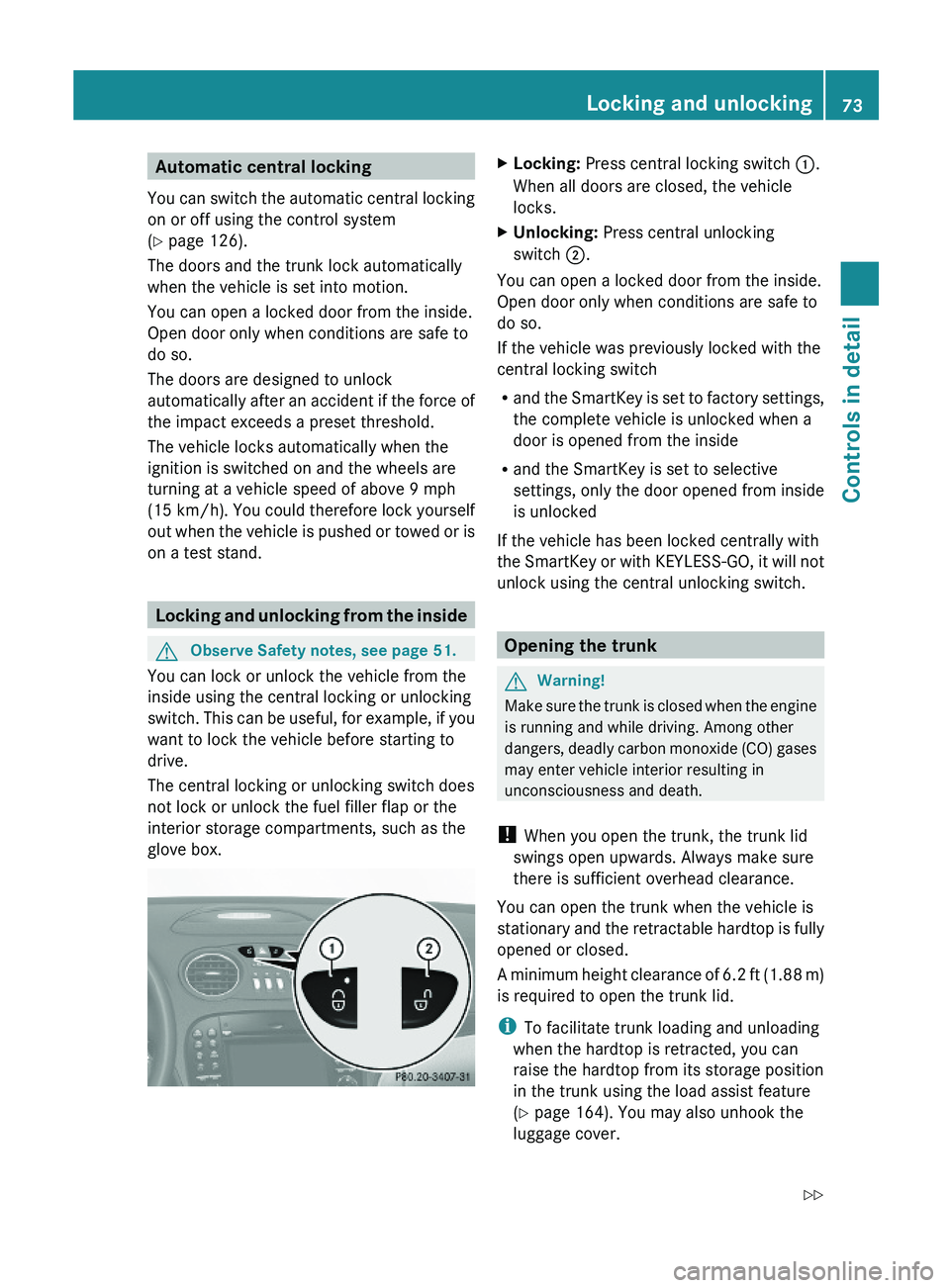
XLocking: Press central locking switch \000F.
When all doors are closed, the vehicle
locks.
XUnlocking: Press central unlocking
switch \000G.
You can open a locked door from the inside.
Open door only when conditions are safe to
do so.
If the vehicle was previously locked with the
central locking switch
Rand the SmartKey is set to factory settings,
the complete vehicle is unlocked when a
door is opened from the inside
Rand the SmartKey is set to selective
settings, only the door opened from inside
is unlocked
If the vehicle has been locked centrally with
the SmartKey or with KEYLESS-GO, it will not
unlock using the central unlocking switch.
Opening the trunk
GWarning!
Make sure the trunk is closed when the engine
is running and while driving. Among other
dangers, deadly carbon monoxide (CO) gases
may enter vehicle interior resulting in
unconsciousness and death.
! When you open the trunk, the trunk lid
swings open upwards. Always make sure
there is sufficient overhead clearance.
You can open the trunk when the vehicle is
stationary and the retractable hardtop is fully
opened or closed.
A minimum height clearance of 6.2 ft (1.88 m)
is required to open the trunk lid.
iTo facilitate trunk loading and unloading
when the hardtop is retracted, you can
raise the hardtop from its storage position
in the trunk using the load assist feature
(Y page 164). You may also unhook the
luggage cover.
Locking and unlocking73Controls in detail230_AKB; 6; 22, en-USd2ureepe,Version: 2.11.8.12009-07-28T18:49:58+02:00 - Seite 73Z
Page 77 of 316
Closing the trunkGWarning!
Make sure the trunk is closed when the engine
is running and while driving. Among other
dangers, deadly carbon monoxide (CO) gases
may enter vehicle interior resulting in
unconsciousness and death.
GWarning!
To prevent possible personal injury, always
keep hands and fingers away from the trunk
opening when closing the trunk lid. Be
especially careful when small children are
around.
GObserve Safety notes, see page 51.
Do not leave the SmartKey in the open trunk.
You may lock yourself out.
If the vehicle was previously locked centrally
with the SmartKey or KEYLESS-GO, the trunk
lid will lock automatically when closed. All
turn signal lamps flash three times and an
acoustic signal sounds three times to confirm
locking.
iWhen the hardtop is retracted, it must be
completely lowered in the trunk before the
trunk can be closed (Y page 155).
Closing the trunk from the outside
manually
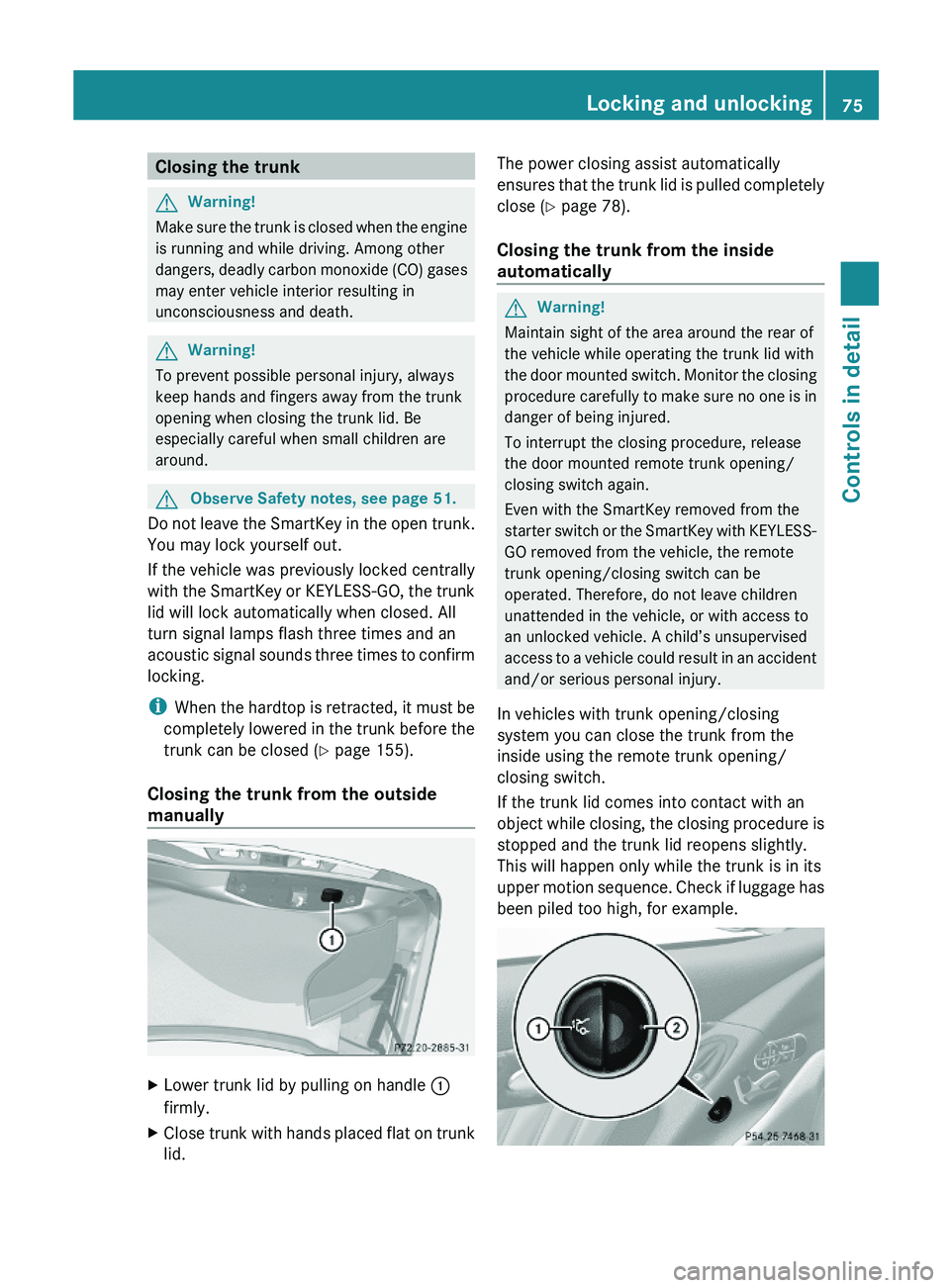
XLower trunk lid by pulling on handle \000F
firmly.
XClose trunk with hands placed flat on trunk
lid.
The power closing assist automatically
ensures that the trunk lid is pulled completely
close (Y page 78).
Closing the trunk from the inside
automatically
GWarning!
Maintain sight of the area around the rear of
the vehicle while operating the trunk lid with
the door mounted switch. Monitor the closing
procedure carefully to make sure no one is in
danger of being injured.
To interrupt the closing procedure, release
the door mounted remote trunk opening/
closing switch again.
Even with the SmartKey removed from the
starter switch or the SmartKey with KEYLESS-
GO removed from the vehicle, the remote
trunk opening/closing switch can be
operated. Therefore, do not leave children
unattended in the vehicle, or with access to
an unlocked vehicle. A child’s unsupervised
access to a vehicle could result in an accident
and/or serious personal injury.
In vehicles with trunk opening/closing
system you can close the trunk from the
inside using the remote trunk opening/
closing switch.
If the trunk lid comes into contact with an
object while closing, the closing procedure is
stopped and the trunk lid reopens slightly.
This will happen only while the trunk is in its
upper motion sequence. Check if luggage has
been piled too high, for example.
Locking and unlocking75Controls in detail230_AKB; 6; 22, en-USd2ureepe,Version: 2.11.8.12009-07-28T18:49:58+02:00 - Seite 75Z