light MERCEDES-BENZ SL CLASS 2011 Workshop Manual
[x] Cancel search | Manufacturer: MERCEDES-BENZ, Model Year: 2011, Model line: SL CLASS, Model: MERCEDES-BENZ SL CLASS 2011Pages: 316, PDF Size: 6.55 MB
Page 275 of 316
GObserve Safety notes, see page 271.
ROnly use 12-volt bulbs of the same type and
with the specified watt rating.
RSwitch the lights off before changing a bulb
to prevent short circuits.
RAlways use a clean lint-free cloth when
handling bulbs.
RYour hands should be dry and free of oil and
grease.
RIf the newly installed bulb does not come
on, contact an authorized Mercedes-Benz
Center.
iMercedes-Benz recommends using
Longlife (LL) bulbs.
Replacing bulbs for front lamps
GWarning!
Do not remove the cover for the Bi-Xenon
headlamp. Because of high voltage in Xenon
lamps, it is dangerous to replace the bulb or
repair the lamp and its components. It is
recommended to have such work done by a
qualified technician.
Before you start to replace a bulb for a front
lamp, do the following:
XSwitch off the ignition.XTurn the exterior lamp switch to position
\000'.
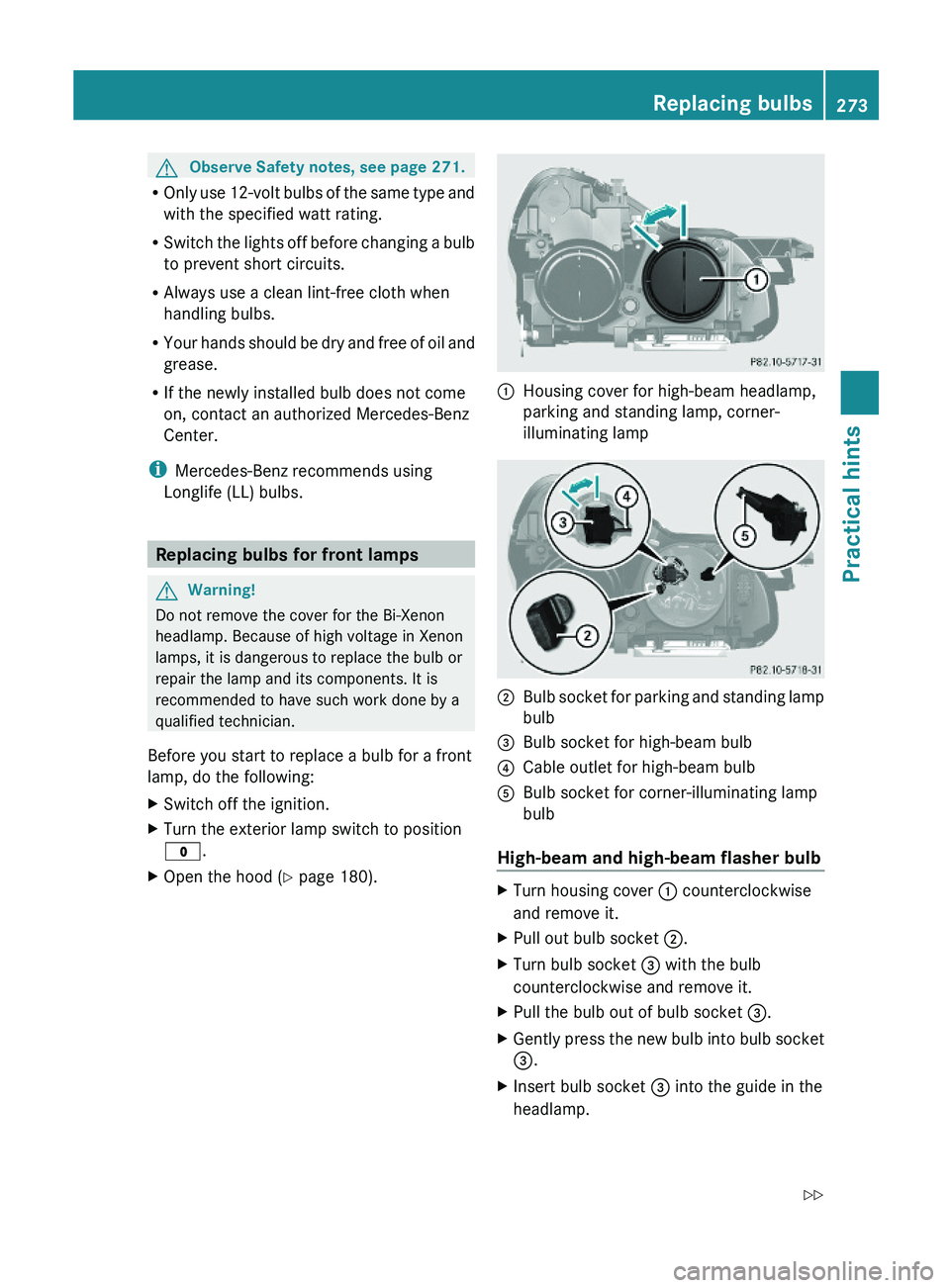
XOpen the hood (Y page 180).\000FHousing cover for high-beam headlamp,
parking and standing lamp, corner-
illuminating lamp
\000GBulb socket for parking and standing lamp
bulb
\000
Page 280 of 316
XPress on both clips \000G simultaneously to
release buckle \000F.
XStore the tensioning straps in a safe place.
You will need them to store the spare wheel
in the trunk after use (Y page 225).
Lifting the vehicle
GWarning!
When jacking up the vehicle, only use the jack
which has been specifically approved by
Mercedes-Benz for your vehicle.
The jack is designed exclusively for jacking up
the vehicle at the jack tubes built into both
sides of the vehicle. Make sure the jack arm
is fully inserted in the jack tube. The jack must
always be vertical when in use, especially on
inclines or declines.
The jack is intended only for lifting the vehicle
briefly for wheel changes. It is not suited for
performing maintenance work under the
vehicle. To help avoid personal injury, use the
jack only to lift the vehicle during a wheel
change.
Never get beneath the vehicle while it is
supported by the jack. Keep hands and feet
away from the area under the lifted vehicle.
Always lower the vehicle onto sufficient
capacity jackstands before working under the
vehicle.
Always engage the parking brake firmly and
block the wheels with wheel chocks or other
sizeable objects before raising the vehicle
with the jack. Do not disengage the parking
brake while the vehicle is raised.
Make sure that the ground on which the
vehicle is standing and where you place the
jack is solid, level and not slippery. If
necessary, use a large underlay. On slippery
surfaces, such as tiled floors, you should use
a non-slip underlay, for example a rubber mat.
Do not use wooden blocks or similar objects
to support the jack. Otherwise the jack may
not be able to achieve its load-bearing
capacity if it is not at its full height.
Never start the engine when the vehicle is
raised.
Also observe the notes on the jack.
XPrevent the vehicle from rolling away by
blocking wheels with wheel chocks (not
included) or other sizeable objects.
When changing a wheel on a level surface:
XPlace a wheel chock or other sizeable
object in front of and another wheel chock
or other sizeable object behind the wheel
that is diagonally opposite to the wheel
being changed.
Always try lifting the vehicle using the jack on
a level surface. However, should
circumstances require you to do so on a hill:
XPlace wheel chocks or other sizeable
objects on the downhill side in front of both
wheels on the side opposite to the side on
which the wheel is to be changed.
GWarning!
Only jack up the vehicle on level ground or on
slight inclines/declines. Otherwise, the
vehicle could fall off the jack and injure you or
others.
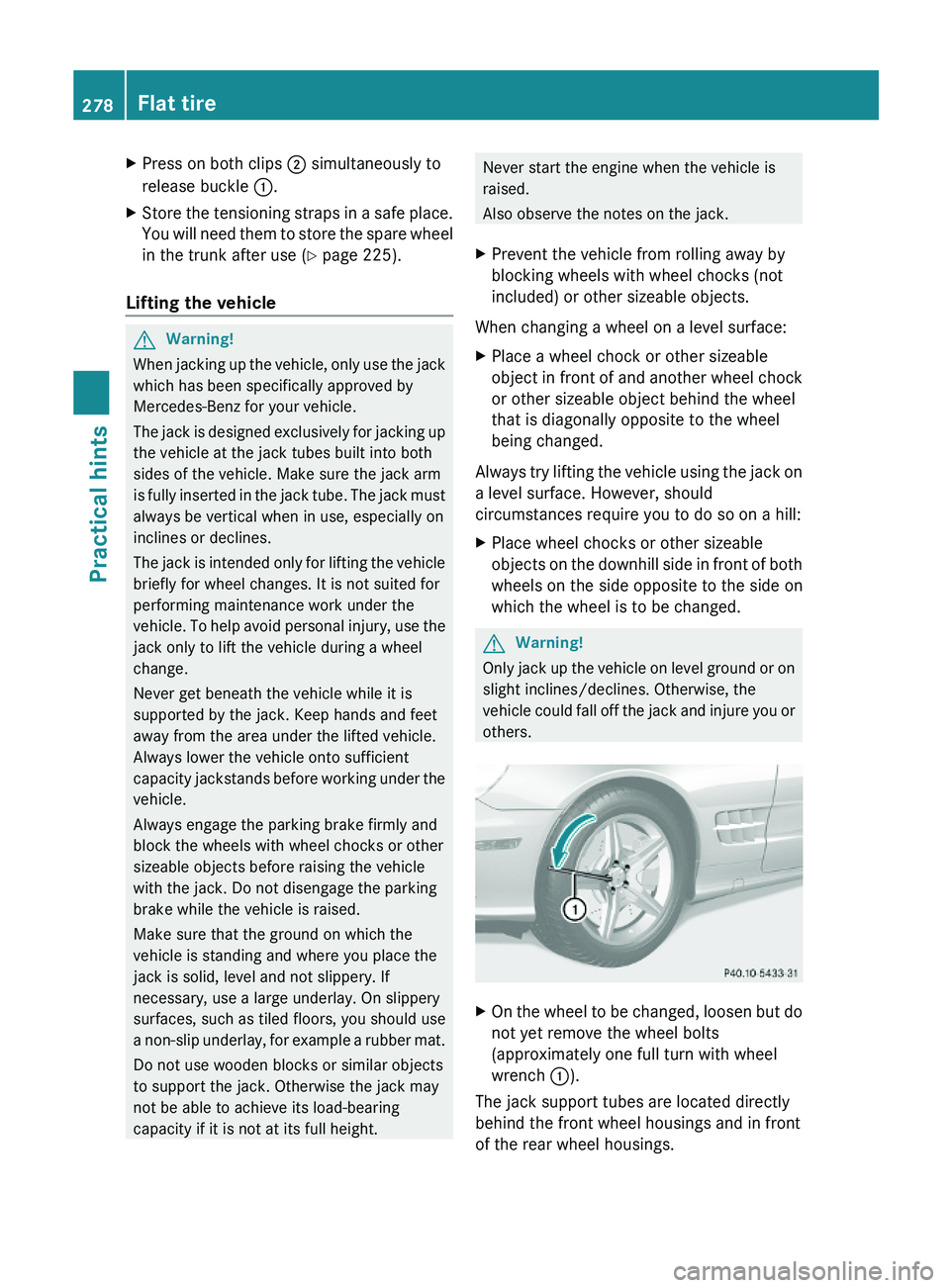
XOn the wheel to be changed, loosen but do
not yet remove the wheel bolts
(approximately one full turn with wheel
wrench \000F).
The jack support tubes are located directly
behind the front wheel housings and in front
of the rear wheel housings.
278Flat tirePractical hints
230_AKB; 6; 22, en-USd2ureepe,Version: 2.11.8.12009-07-28T18:49:58+02:00 - Seite 278
Page 282 of 316
! Do not place wheel bolts in sand or dirt.
This could result in damage to the wheel
bolts and wheel hub threads.
XRemove the wheel.
Attaching the spare wheel
GWarning!
Inflate collapsible tire only after the wheel is
properly attached.
Inflate the collapsible tire using the electric
air pump before lowering the vehicle.
GWarning!
Always replace wheel bolts that are damaged
or rusted.
Never apply oil or grease to wheel bolts.
Damaged wheel hub threads should be
repaired immediately. Do not continue to
drive under these circumstances! Contact an
authorized Mercedes-Benz Center or call
Roadside Assistance.
Incorrect wheel bolts or improperly tightened
wheel bolts can cause the wheel to come off.
This could cause an accident. Make sure to
use the correct wheel bolts.
GWarning!
Only use genuine Mercedes-Benz wheel bolts.
Other wheel bolts may come loose.
Do not tighten the wheel bolts when the
vehicle is raised. Otherwise the vehicle could
fall off the jack.
XClean contact surfaces of wheel and wheel
hub.
! To avoid paint damage, place wheel flat
against hub and hold it there while
installing first wheel bolt.
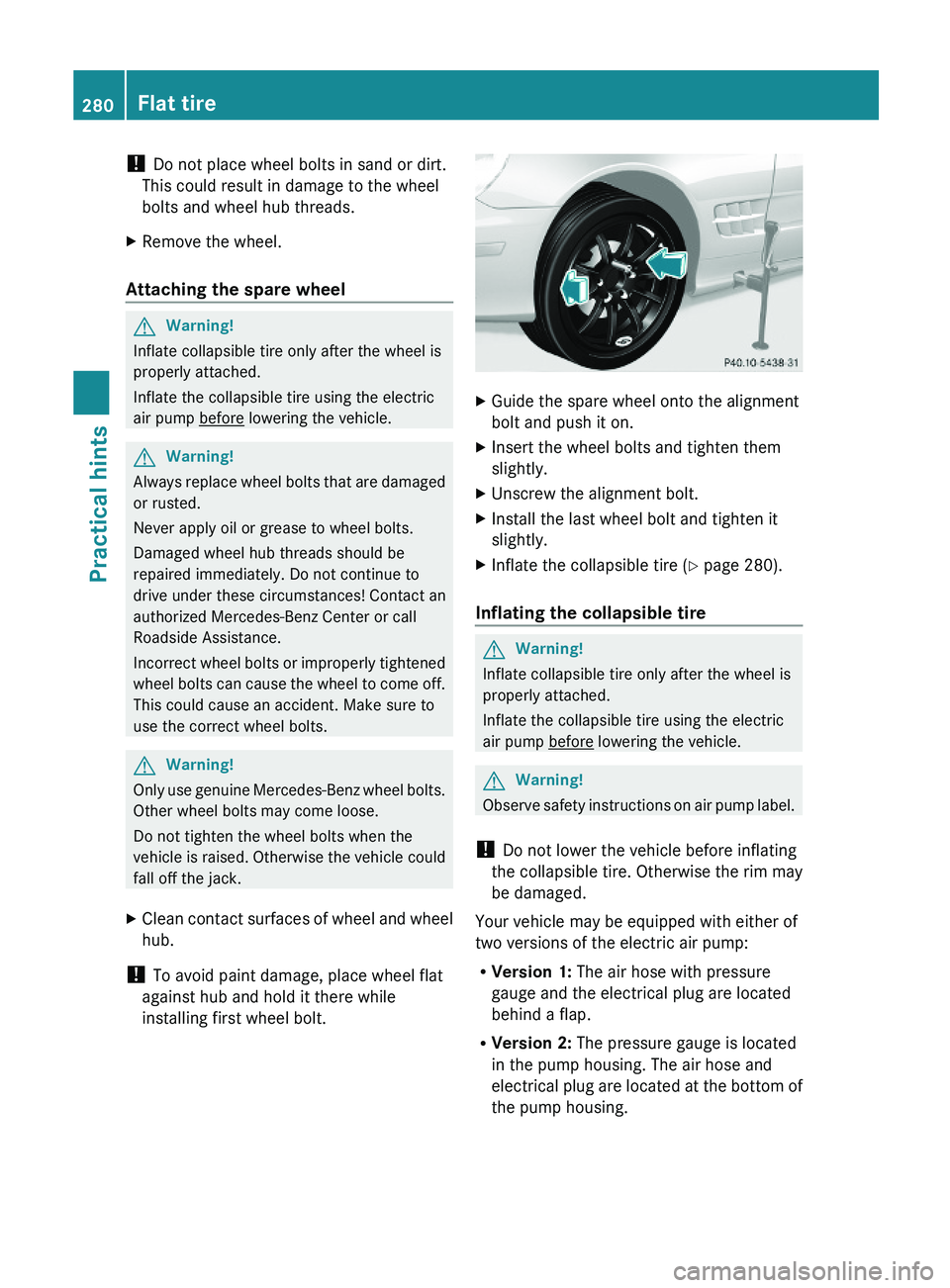
XGuide the spare wheel onto the alignment
bolt and push it on.
XInsert the wheel bolts and tighten them
slightly.
XUnscrew the alignment bolt.XInstall the last wheel bolt and tighten it
slightly.
XInflate the collapsible tire (Y page 280).
Inflating the collapsible tire
GWarning!
Inflate collapsible tire only after the wheel is
properly attached.
Inflate the collapsible tire using the electric
air pump before lowering the vehicle.
GWarning!
Observe safety instructions on air pump label.
! Do not lower the vehicle before inflating
the collapsible tire. Otherwise the rim may
be damaged.
Your vehicle may be equipped with either of
two versions of the electric air pump:
RVersion 1: The air hose with pressure
gauge and the electrical plug are located
behind a flap.
RVersion 2: The pressure gauge is located
in the pump housing. The air hose and
electrical plug are located at the bottom of
the pump housing.
280Flat tirePractical hints
230_AKB; 6; 22, en-USd2ureepe,Version: 2.11.8.12009-07-28T18:49:58+02:00 - Seite 280
Page 291 of 316
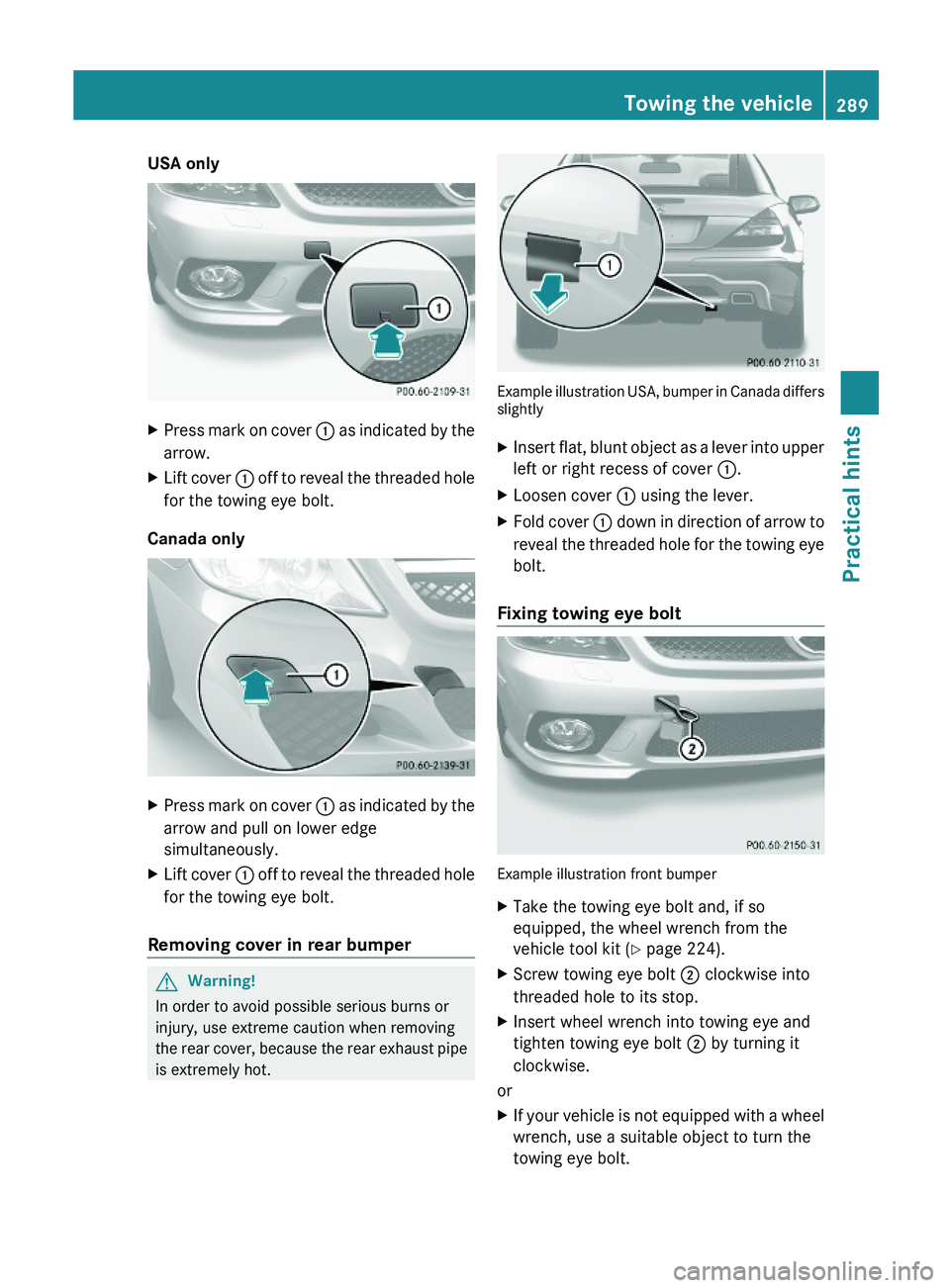
USA onlyXPress mark on cover \000F as indicated by the
arrow.
XLift cover \000F off to reveal the threaded hole
for the towing eye bolt.
Canada only
XPress mark on cover \000F as indicated by the
arrow and pull on lower edge
simultaneously.
XLift cover \000F off to reveal the threaded hole
for the towing eye bolt.
Removing cover in rear bumper
GWarning!
In order to avoid possible serious burns or
injury, use extreme caution when removing
the rear cover, because the rear exhaust pipe
is extremely hot.
Example illustration USA, bumper in Canada differsslightly
XInsert flat, blunt object as a lever into upper
left or right recess of cover \000F.
XLoosen cover \000F using the lever.XFold cover \000F down in direction of arrow to
reveal the threaded hole for the towing eye
bolt.
Fixing towing eye bolt
Example illustration front bumper
XTake the towing eye bolt and, if so
equipped, the wheel wrench from the
vehicle tool kit (Y page 224).
XScrew towing eye bolt \000G clockwise into
threaded hole to its stop.
XInsert wheel wrench into towing eye and
tighten towing eye bolt \000G by turning it
clockwise.
or
XIf your vehicle is not equipped with a wheel
wrench, use a suitable object to turn the
towing eye bolt.
Towing the vehicle289Practical hints230_AKB; 6; 22, en-USd2ureepe,Version: 2.11.8.12009-07-28T18:49:58+02:00 - Seite 289Z
Page 303 of 316
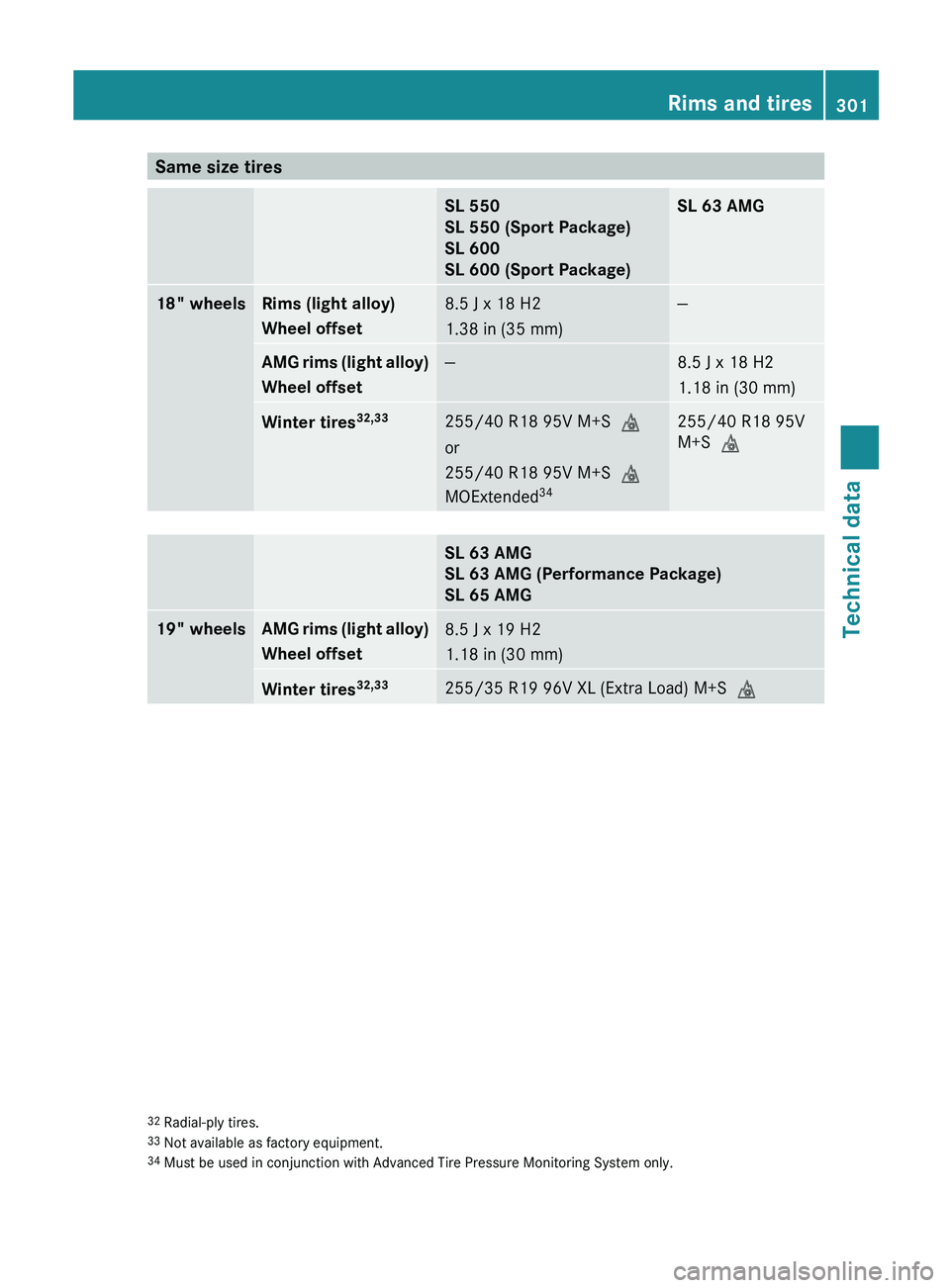
Same size tiresSL 550
SL 550 (Sport Package)
SL 600
SL 600 (Sport Package)SL 63 AMG18" wheelsRims (light alloy)
Wheel offset8.5 J x 18 H2
1.38 in (35 mm)—AMG rims (light alloy)
Wheel offset—8.5 J x 18 H2
1.18 in (30 mm)Winter tires 32,33255/40 R18 95V M+S
004D
or
255/40 R18 95V M+S 004D
MOExtended 34255/40 R18 95V
M+S 004DSL 63 AMG
SL 63 AMG (Performance Package)
SL 65 AMG19" wheelsAMG rims (light alloy)
Wheel offset8.5 J x 19 H2
1.18 in (30 mm)Winter tires 32,33255/35 R19 96V XL (Extra Load) M+S
004D32
Radial-ply tires.
33 Not available as factory equipment.
34 Must be used in conjunction with Advanced Tire Pressure Monitoring System only.Rims and tires301Technical data230_AKB; 6; 22, en-USd2ureepe,Version: 2.11.8.12009-07-28T18:49:58+02:00 - Seite 301Z
Page 304 of 316
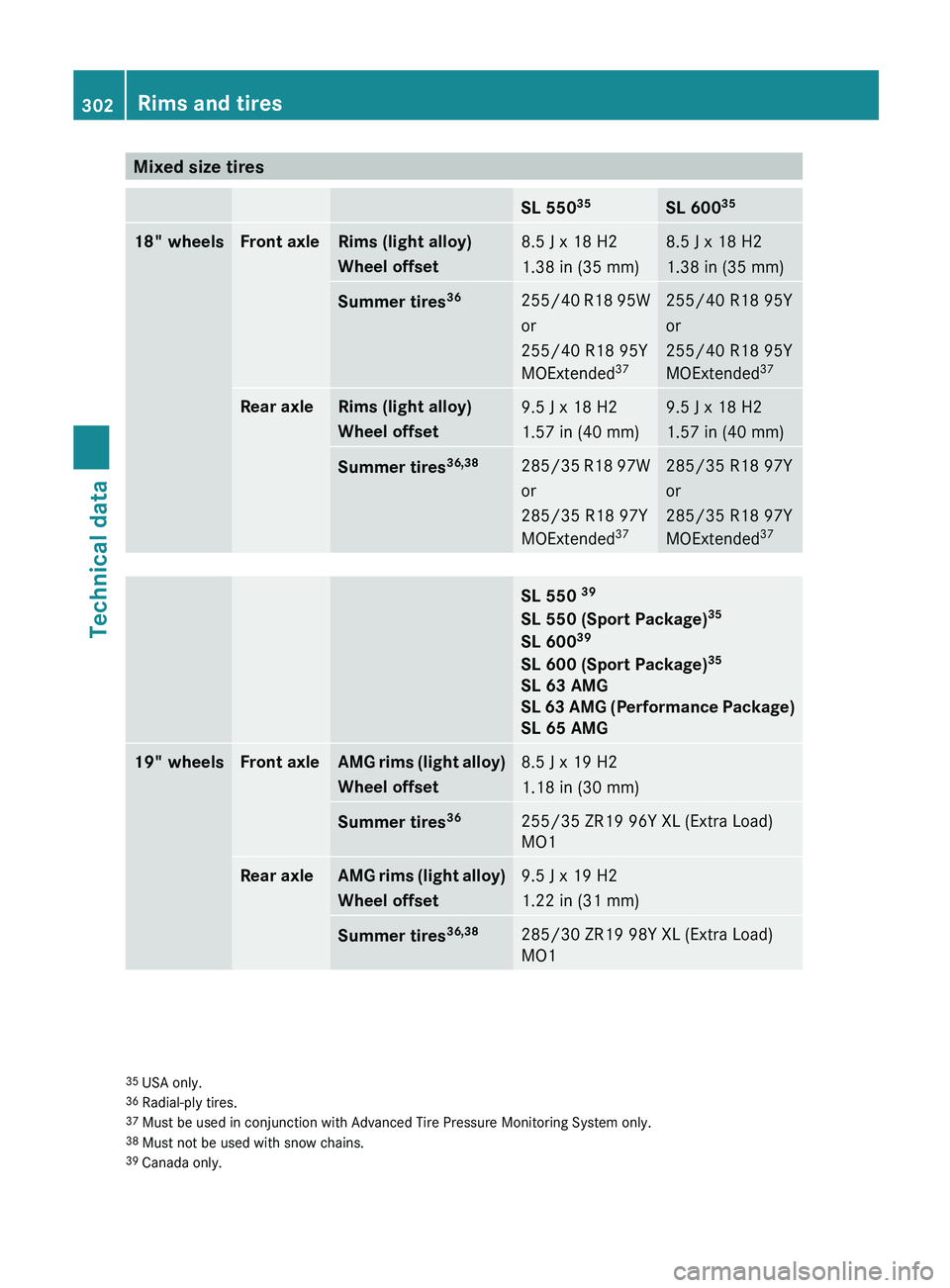
Mixed size tiresSL 55035SL 6003518" wheelsFront axleRims (light alloy)
Wheel offset8.5 J x 18 H2
1.38 in (35 mm)8.5 J x 18 H2
1.38 in (35 mm)Summer tires 36255/40 R18 95W
or
255/40 R18 95Y
MOExtended 37255/40 R18 95Y
or
255/40 R18 95Y
MOExtended 37Rear axleRims (light alloy)
Wheel offset9.5 J x 18 H2
1.57 in (40 mm)9.5 J x 18 H2
1.57 in (40 mm)Summer tires 36,38285/35 R18 97W
or
285/35 R18 97Y
MOExtended 37285/35 R18 97Y
or
285/35 R18 97Y
MOExtended 37SL 550 39
SL 550 (Sport Package) 35
SL 600 39
SL 600 (Sport Package) 35
SL 63 AMG
SL 63 AMG (Performance Package)
SL 65 AMG19" wheelsFront axleAMG rims (light alloy)
Wheel offset8.5 J x 19 H2
1.18 in (30 mm)Summer tires 36255/35 ZR19 96Y XL (Extra Load)
MO1Rear axleAMG rims (light alloy)
Wheel offset9.5 J x 19 H2
1.22 in (31 mm)Summer tires 36,38285/30 ZR19 98Y XL (Extra Load)
MO135 USA only.
36 Radial-ply tires.
37 Must be used in conjunction with Advanced Tire Pressure Monitoring System only.
38 Must not be used with snow chains.
39 Canada only.302Rims and tiresTechnical data
230_AKB; 6; 22, en-USd2ureepe,Version: 2.11.8.12009-07-28T18:49:58+02:00 - Seite 302
Page 309 of 316
with premium unleaded gasoline as soon
as possible.
R Avoid full throttle driving and abrupt
acceleration.
R Do not exceed an engine speed of
3 000 rpm if the vehicle is loaded with a
light load such as two persons and no
luggage.
R Do not exceed 2
/ 3 of maximum
accelerator pedal position if the vehicle
is fully loaded or operating in
mountainous terrain.
Fuel requirements
Only use premium unleaded gasoline. The
octane number (posted at the pump) must be
91 min. It is an average of both the Research
Octane Number (RON) and the Motor Octane
Number (MON): (RON+MON)/2. This is also
known as the ANTI-KNOCK INDEX.
Reformulated gasolines (RFG) and/or
unleaded gasoline containing oxygenates
such as ethanol, TAME, ETBE, IPA, IBA, and
TBA can be used provided the ratio of any one
of these oxygenates to gasoline does not
exceed 10%; MTBE must not exceed 15%.
The ratio of methanol to gasoline must not
exceed 3% plus additional cosolvents.
Using mixtures of ethanol and methanol is not
allowed. Gasohol, which contains 10%
ethanol and 90% unleaded gasoline, can be
used.
These blends must also meet all other fuel
requirements, such as resistance to spark
knock, boiling range, vapor pressure, etc.
Gasoline additives
A major concern among engine
manufacturers is carbon build-up caused by
gasoline. Mercedes-Benz recommends only
the use of quality gasoline containing
additives that prevent the build-up of carbon
deposits.
After an extended period of using fuels
without such additives carbon deposits can
build up, especially on the intake valves and
in the combustion area, leading to engine
performance problems such as:
R Warm-up hesitation
R Unstable idle
R Knocking/pinging
R Misfire
R Power loss
In areas where carbon deposits may be
encountered due to lack of availability of
gasoline which contains these additives, the
use of Mercedes-Benz approved additives is
recommended.
Contact an authorized Mercedes-Benz Center
or visit www.mbusa.com (USA only) for a
listing of approved products. Follow
directions on the product label.
Do not blend other fuel additives with fuel.
This only results in unnecessary cost and may
be harmful to the engine operation.
! Damage or malfunction resulting from
poor fuel quality or from blending additional
fuel additives other than those tested and
approved by us for use on Mercedes-Benz
vehicles are not covered by the Mercedes-
Benz Limited Warranty or by any pre-owned
or Extended Limited Warranties.
Coolants
The engine coolant is a mixture of water and
anticorrosion/antifreeze, which provides:
R Corrosion protection
R Freeze protection
R Boiling protection (by increasing the boiling
point)
The cooling system was filled at the factory
with a coolant providing freeze protection to
Fuels, coolants, lubricants, etc.307Technical data230_AKB; 6; 22, en-USd2ureepe,Version: 2.11.8.12009-07-28T18:49:58+02:00 - Seite 307Z