steering MERCEDES-BENZ SL CLASS 2011 Repair Manual
[x] Cancel search | Manufacturer: MERCEDES-BENZ, Model Year: 2011, Model line: SL CLASS, Model: MERCEDES-BENZ SL CLASS 2011Pages: 316, PDF Size: 6.55 MB
Page 285 of 316
Be careful not to damage the locking tabs
or clamp the plastic retaining strap.
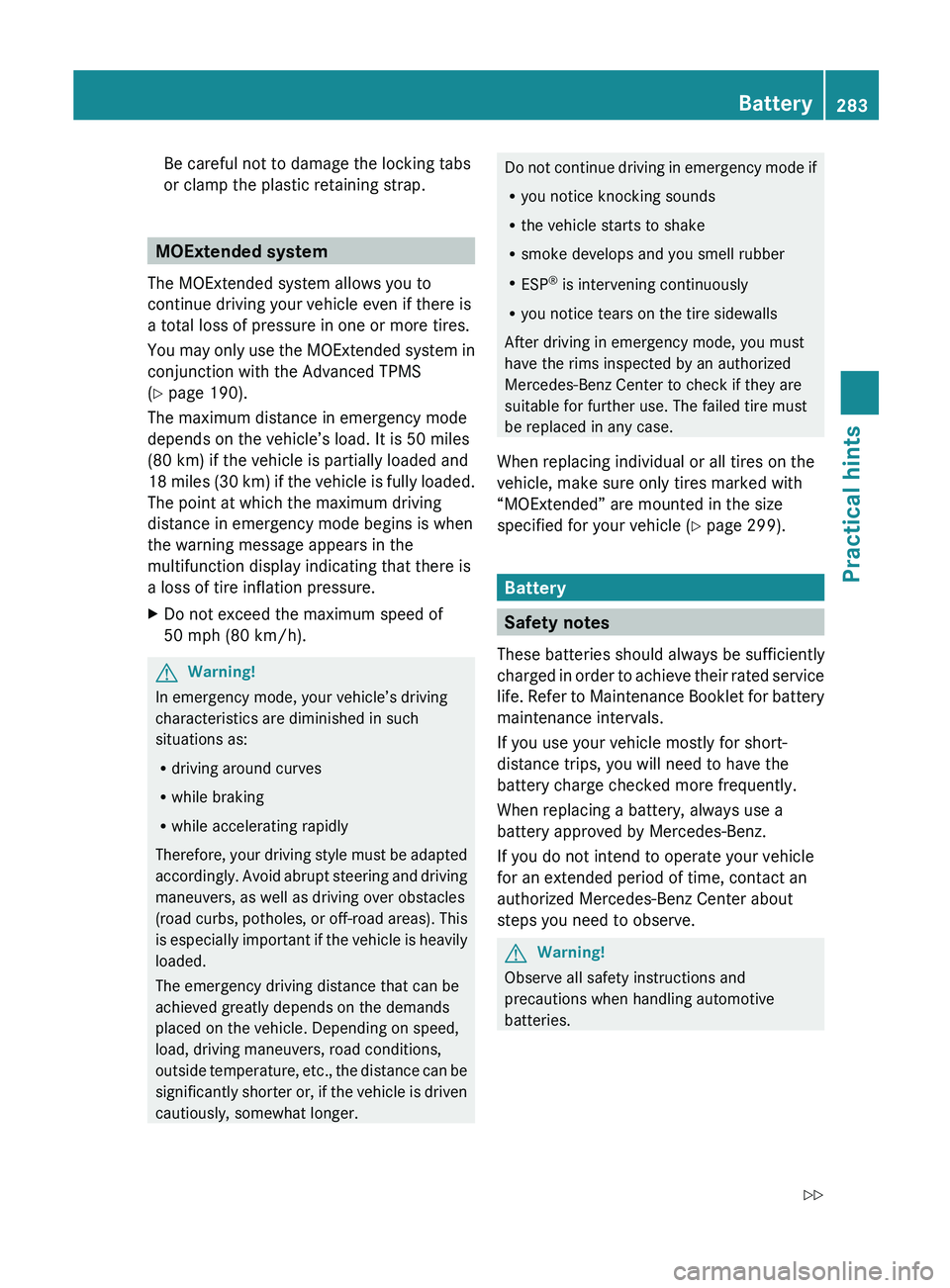
MOExtended system
The MOExtended system allows you to
continue driving your vehicle even if there is
a total loss of pressure in one or more tires.
You may only use the MOExtended system in
conjunction with the Advanced TPMS
( Y page 190).
The maximum distance in emergency mode
depends on the vehicle’s load. It is 50 miles
(80 km) if the vehicle is partially loaded and
18 miles (30 km) if the vehicle is fully loaded.
The point at which the maximum driving
distance in emergency mode begins is when
the warning message appears in the
multifunction display indicating that there is
a loss of tire inflation pressure.
XDo not exceed the maximum speed of
50 mph (80 km/h).GWarning!
In emergency mode, your vehicle’s driving
characteristics are diminished in such
situations as:
R driving around curves
R while braking
R while accelerating rapidly
Therefore, your driving style must be adapted
accordingly. Avoid abrupt steering and driving
maneuvers, as well as driving over obstacles
(road curbs, potholes, or off-road areas). This
is especially important if the vehicle is heavily
loaded.
The emergency driving distance that can be
achieved greatly depends on the demands
placed on the vehicle. Depending on speed,
load, driving maneuvers, road conditions,
outside temperature, etc., the distance can be
significantly shorter or, if the vehicle is driven
cautiously, somewhat longer.
Do not continue driving in emergency mode if
R you notice knocking sounds
R the vehicle starts to shake
R smoke develops and you smell rubber
R ESP ®
is intervening continuously
R you notice tears on the tire sidewalls
After driving in emergency mode, you must
have the rims inspected by an authorized
Mercedes-Benz Center to check if they are
suitable for further use. The failed tire must
be replaced in any case.
When replacing individual or all tires on the
vehicle, make sure only tires marked with
“MOExtended” are mounted in the size
specified for your vehicle ( Y page 299).
Battery
Safety notes
These batteries should always be sufficiently
charged in order to achieve their rated service
life. Refer to Maintenance Booklet for battery
maintenance intervals.
If you use your vehicle mostly for short-
distance trips, you will need to have the
battery charge checked more frequently.
When replacing a battery, always use a
battery approved by Mercedes-Benz.
If you do not intend to operate your vehicle
for an extended period of time, contact an
authorized Mercedes-Benz Center about
steps you need to observe.
GWarning!
Observe all safety instructions and
precautions when handling automotive
batteries.
Battery283Practical hints230_AKB; 6; 22, en-USd2ureepe,Version: 2.11.8.12009-07-28T18:49:58+02:00 - Seite 283Z
Page 290 of 316
warning lamp comes on and warning
messages appear in the multifunction display
while driving. To brake, the driver must then
apply significantly greater brake pedal
pressure and depress the pedal much further
to obtain the expected braking effect. If
necessary, apply full pressure to the brake
pedal. Brakes are only applied to the front
wheels. Stopping distance is increased! For
more information, see “Electro-hydraulic
brake system” in this in this Operator’s
Manual.
If there is a malfunction in the electro-
hydraulic brake system, we recommend that
the vehicle be transported with all wheels off
the ground using flatbed or appropriate wheel
lift/dolly equipment.
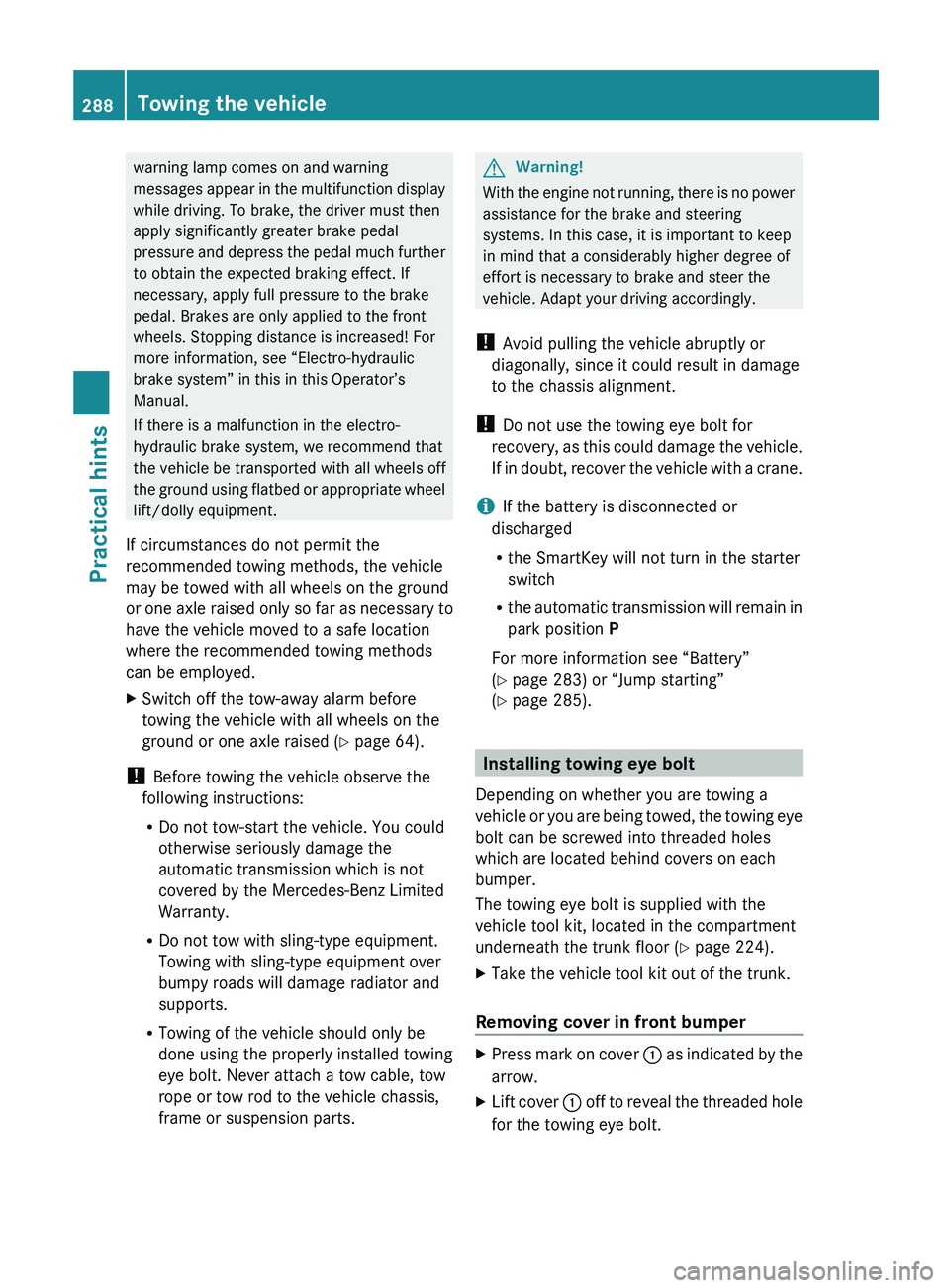
If circumstances do not permit the
recommended towing methods, the vehicle
may be towed with all wheels on the ground
or one axle raised only so far as necessary to
have the vehicle moved to a safe location
where the recommended towing methods
can be employed.XSwitch off the tow-away alarm before
towing the vehicle with all wheels on the
ground or one axle raised ( Y page 64).
!
Before towing the vehicle observe the
following instructions:
R Do not tow-start the vehicle. You could
otherwise seriously damage the
automatic transmission which is not
covered by the Mercedes-Benz Limited
Warranty.
R Do not tow with sling-type equipment.
Towing with sling-type equipment over
bumpy roads will damage radiator and
supports.
R Towing of the vehicle should only be
done using the properly installed towing
eye bolt. Never attach a tow cable, tow
rope or tow rod to the vehicle chassis,
frame or suspension parts.
GWarning!
With the engine not running, there is no power
assistance for the brake and steering
systems. In this case, it is important to keep
in mind that a considerably higher degree of
effort is necessary to brake and steer the
vehicle. Adapt your driving accordingly.
! Avoid pulling the vehicle abruptly or
diagonally, since it could result in damage
to the chassis alignment.
! Do not use the towing eye bolt for
recovery, as this could damage the vehicle.
If in doubt, recover the vehicle with a crane.
i If the battery is disconnected or
discharged
R the SmartKey will not turn in the starter
switch
R the automatic transmission will remain in
park position P
For more information see “Battery”
( Y page 283) or “Jump starting”
( Y page 285).
Installing towing eye bolt
Depending on whether you are towing a
vehicle or you are being towed, the towing eye
bolt can be screwed into threaded holes
which are located behind covers on each
bumper.
The towing eye bolt is supplied with the
vehicle tool kit, located in the compartment
underneath the trunk floor ( Y page 224).
XTake the vehicle tool kit out of the trunk.
Removing cover in front bumper
XPress mark on cover 0046 as indicated by the
arrow.XLift cover 0046 off to reveal the threaded hole
for the towing eye bolt.288Towing the vehiclePractical hints
230_AKB; 6; 22, en-USd2ureepe,Version: 2.11.8.12009-07-28T18:49:58+02:00 - Seite 288
Page 292 of 316
Removing towing eye boltXLoosen towing eye bolt 0047 by turning it
counterclockwise.XUnscrew towing eye bolt 0047.XReinstalling front cover: Fit locking tabs
of cover 0046 (Y page 288) under the lower
edge of the opening in the bumper.XApply even pressure on the upper part of
the cover until it snaps into place.XReinstalling rear cover: Fit cover 0046
( Y page 288) and snap it into place.XStore the towing eye bolt 0047 and wheel
wrench back into the vehicle tool kit.
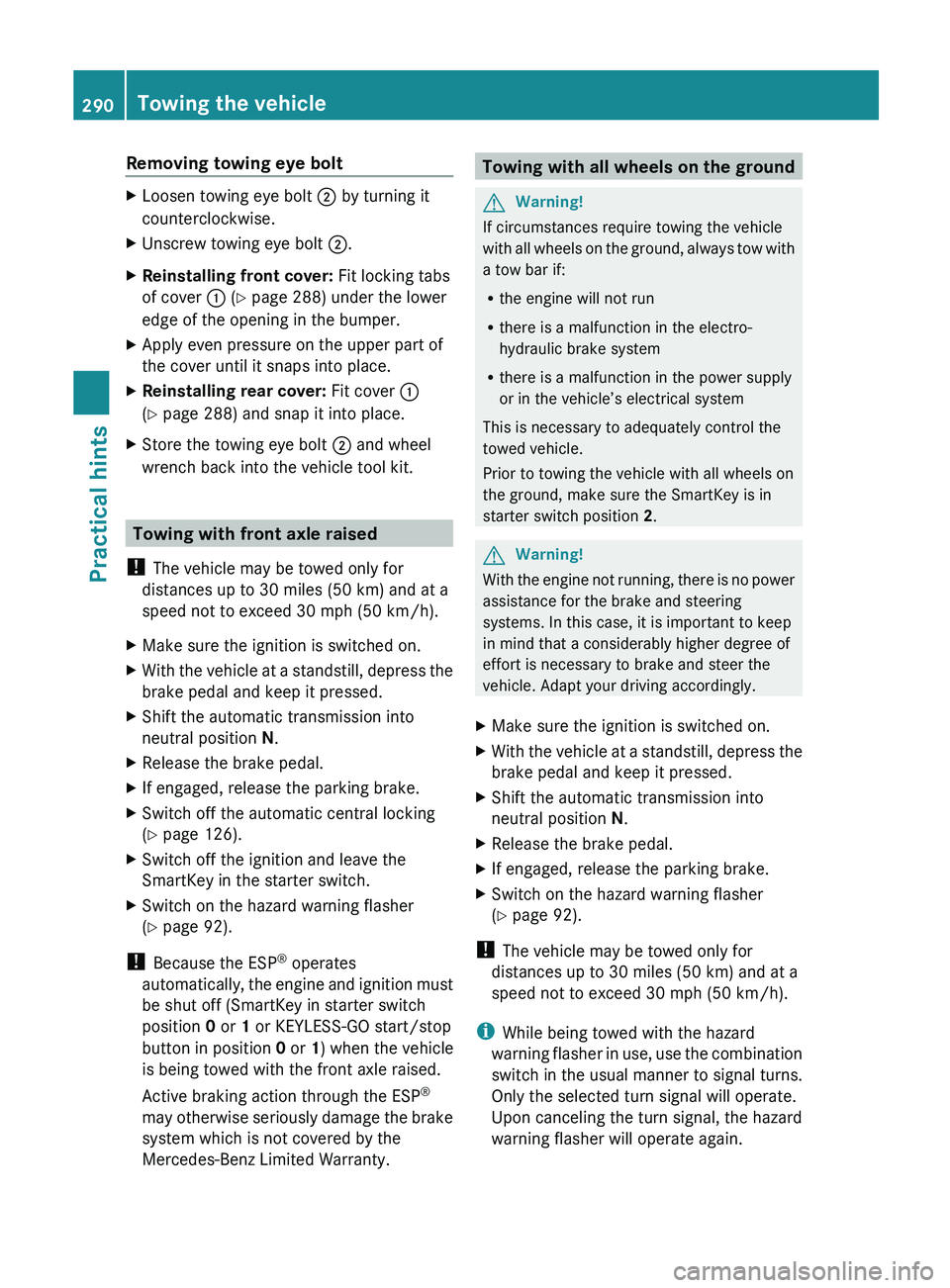
Towing with front axle raised
! The vehicle may be towed only for
distances up to 30 miles (50 km) and at a
speed not to exceed 30 mph (50 km/h).
XMake sure the ignition is switched on.XWith the vehicle at a standstill, depress the
brake pedal and keep it pressed.XShift the automatic transmission into
neutral position N.XRelease the brake pedal.XIf engaged, release the parking brake.XSwitch off the automatic central locking
( Y page 126).XSwitch off the ignition and leave the
SmartKey in the starter switch.XSwitch on the hazard warning flasher
( Y page 92).
!
Because the ESP ®
operates
automatically, the engine and ignition must
be shut off (SmartKey in starter switch
position 0 or 1 or KEYLESS-GO start/stop
button in position 0 or 1) when the vehicle
is being towed with the front axle raised.
Active braking action through the ESP ®
may otherwise seriously damage the brake
system which is not covered by the
Mercedes-Benz Limited Warranty.
Towing with all wheels on the groundGWarning!
If circumstances require towing the vehicle
with all wheels on the ground, always tow with
a tow bar if:
R the engine will not run
R there is a malfunction in the electro-
hydraulic brake system
R there is a malfunction in the power supply
or in the vehicle’s electrical system
This is necessary to adequately control the
towed vehicle.
Prior to towing the vehicle with all wheels on
the ground, make sure the SmartKey is in
starter switch position 2.
GWarning!
With the engine not running, there is no power
assistance for the brake and steering
systems. In this case, it is important to keep
in mind that a considerably higher degree of
effort is necessary to brake and steer the
vehicle. Adapt your driving accordingly.
XMake sure the ignition is switched on.XWith the vehicle at a standstill, depress the
brake pedal and keep it pressed.XShift the automatic transmission into
neutral position N.XRelease the brake pedal.XIf engaged, release the parking brake.XSwitch on the hazard warning flasher
( Y page 92).
!
The vehicle may be towed only for
distances up to 30 miles (50 km) and at a
speed not to exceed 30 mph (50 km/h).
i While being towed with the hazard
warning flasher in use, use the combination
switch in the usual manner to signal turns.
Only the selected turn signal will operate.
Upon canceling the turn signal, the hazard
warning flasher will operate again.
290Towing the vehiclePractical hints
230_AKB; 6; 22, en-USd2ureepe,Version: 2.11.8.12009-07-28T18:49:58+02:00 - Seite 290
Page 306 of 316
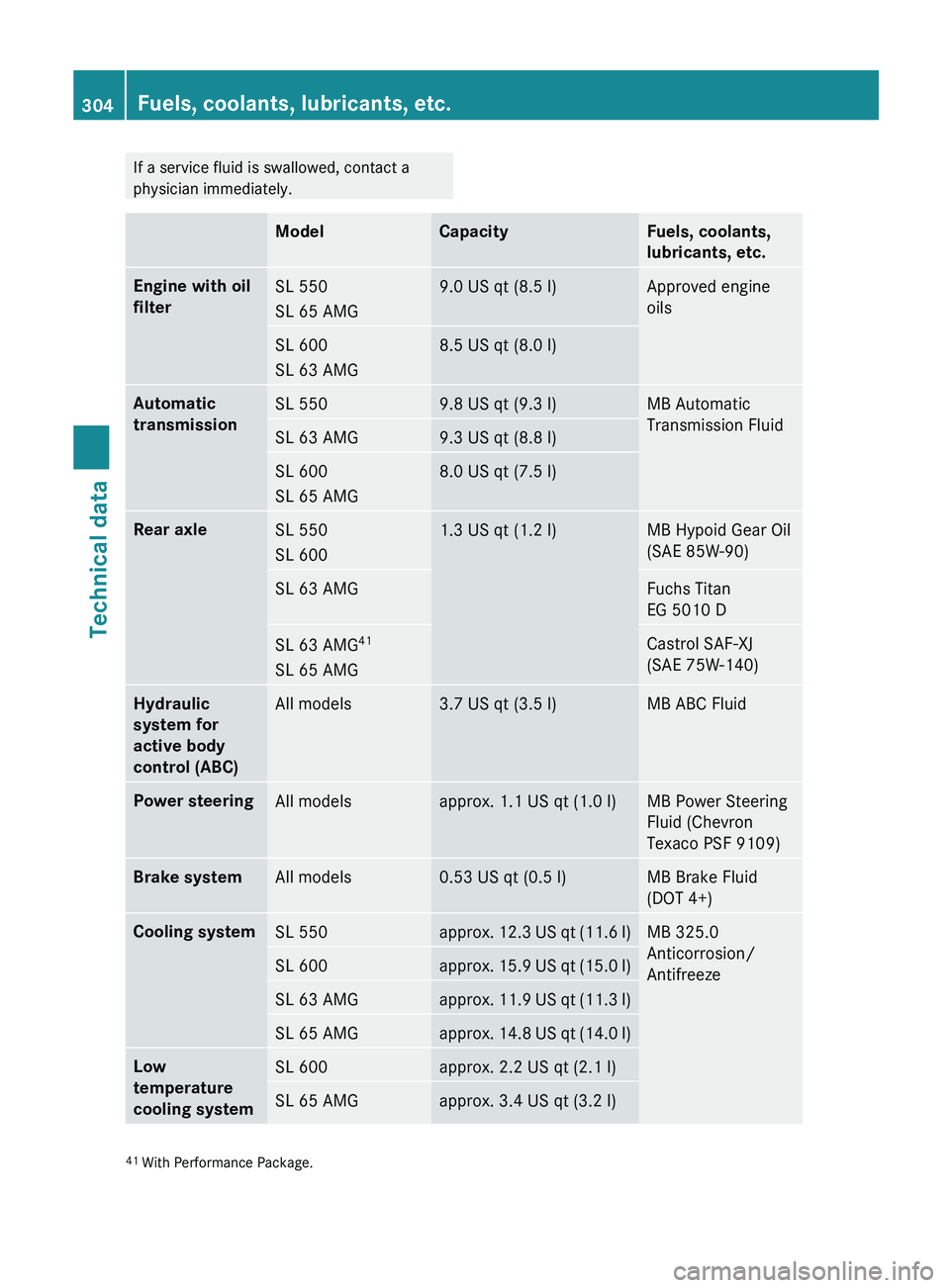
If a service fluid is swallowed, contact a
physician immediately.ModelCapacityFuels, coolants,
lubricants, etc.Engine with oil
filterSL 550
SL 65 AMG9.0 US qt (8.5 l)Approved engine
oilsSL 600
SL 63 AMG8.5 US qt (8.0 l)Automatic
transmissionSL 5509.8 US qt (9.3 l)MB Automatic
Transmission FluidSL 63 AMG9.3 US qt (8.8 l)SL 600
SL 65 AMG8.0 US qt (7.5 l)Rear axleSL 550
SL 6001.3 US qt (1.2 l)MB Hypoid Gear Oil
(SAE 85W-90)SL 63 AMGFuchs Titan
EG 5010 DSL 63 AMG 41
SL 65 AMGCastrol SAF-XJ
(SAE 75W-140)Hydraulic
system for
active body
control (ABC)All models3.7 US qt (3.5 l)MB ABC FluidPower steeringAll modelsapprox. 1.1 US qt (1.0 l)MB Power Steering
Fluid (Chevron
Texaco PSF 9109)Brake systemAll models0.53 US qt (0.5 l)MB Brake Fluid
(DOT 4+)Cooling systemSL 550approx. 12.3 US qt (11.6 l)MB 325.0
Anticorrosion/
AntifreezeSL 600approx. 15.9 US qt (15.0 l)SL 63 AMGapprox. 11.9 US qt (11.3 l)SL 65 AMGapprox. 14.8 US qt (14.0 l)Low
temperature
cooling systemSL 600approx. 2.2 US qt (2.1 l)SL 65 AMGapprox. 3.4 US qt (3.2 l)41 With Performance Package.304Fuels, coolants, lubricants, etc.Technical data
230_AKB; 6; 22, en-USd2ureepe,Version: 2.11.8.12009-07-28T18:49:58+02:00 - Seite 304