length MERCEDES-BENZ SL CLASS 2011 Owners Manual
[x] Cancel search | Manufacturer: MERCEDES-BENZ, Model Year: 2011, Model line: SL CLASS, Model: MERCEDES-BENZ SL CLASS 2011Pages: 316, PDF Size: 6.55 MB
Page 108 of 316
Working on the vehicleGWarning!
When working on the vehicle, engage the
parking brake and shift the automatic
transmission into park position P. Otherwise
the vehicle could roll away which could result
in an accident and/or serious personal injury.
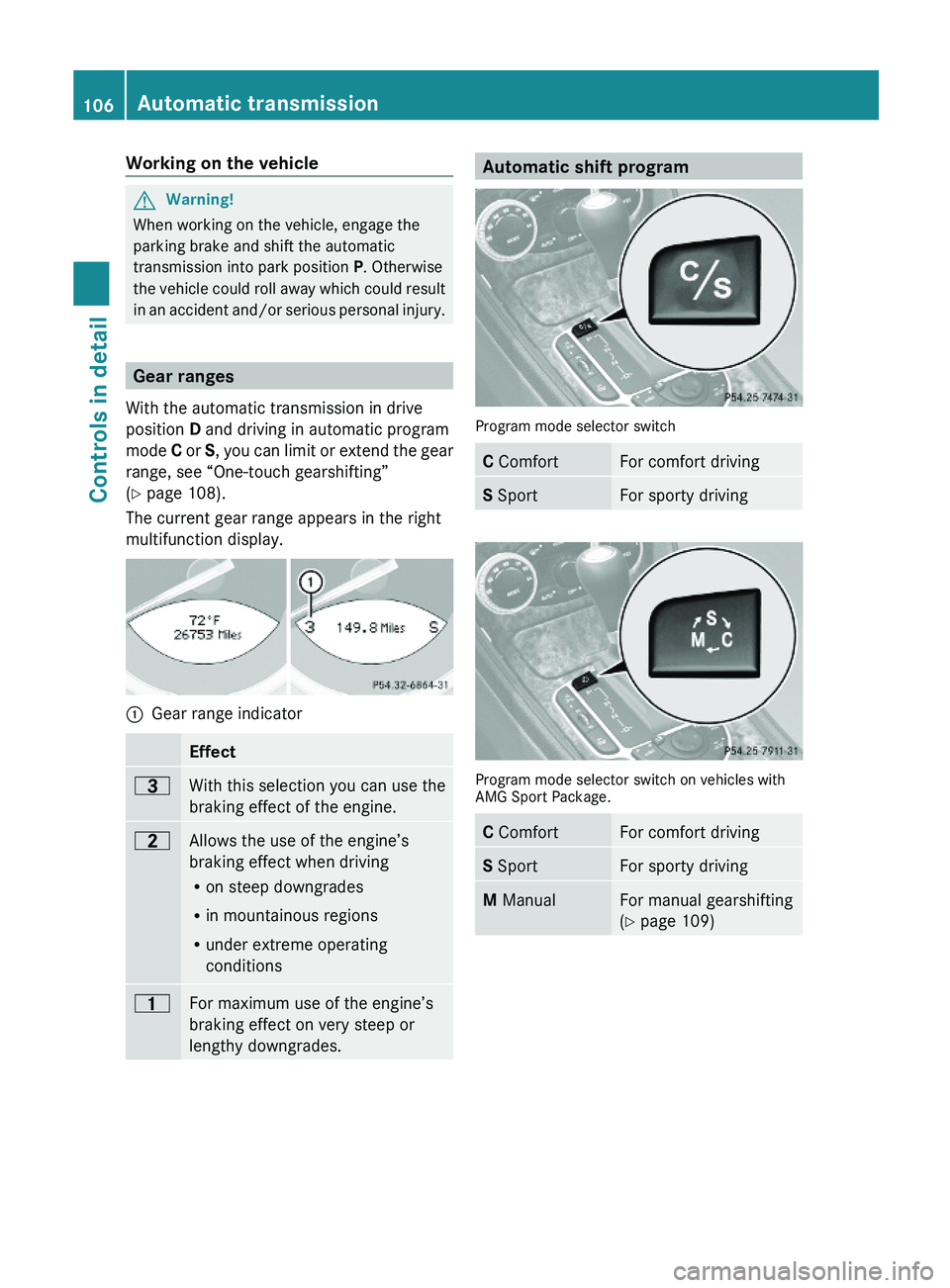
Gear ranges
With the automatic transmission in drive
position D and driving in automatic program
mode C or S, you can limit or extend the gear
range, see “One-touch gearshifting”
(Y page 108).
The current gear range appears in the right
multifunction display.
\000FGear range indicator Effect\000@With this selection you can use the
braking effect of the engine.
\0008Allows the use of the engine’s
braking effect when driving
Ron steep downgrades
Rin mountainous regions
Runder extreme operating
conditions
\0007For maximum use of the engine’s
braking effect on very steep or
lengthy downgrades.
Automatic shift program
Program mode selector switch
C ComfortFor comfort drivingS SportFor sporty driving
Program mode selector switch on vehicles withAMG Sport Package.
C ComfortFor comfort drivingS SportFor sporty drivingM ManualFor manual gearshifting
(Y page 109)
106Automatic transmissionControls in detail
230_AKB; 6; 22, en-USd2ureepe,Version: 2.11.8.12009-07-28T18:49:58+02:00 - Seite 106
Page 177 of 316
Programming tips
If you are having difficulty programming the
integrated remote control, here are some
helpful tips:
R Check the frequency of hand-held remote
control 0086 (typically located on the reverse
side of the remote). The integrated remote
control is compatible with radio-frequency
devices operating between 280-390 MHz.
R Put a new battery in hand-held remote
control 0086. This will increase the likelihood
of the hand-held remote control sending a
stronger and more accurate signal to the
integrated remote control.
R While performing step 3, hold hand-held
remote control 0086 at different lengths and
angles from the signal transmitter button
( 0047 , 008A or 0088) you are programming.
Attempt varying angles at the distance of 2
to 12 inches (5 to 30 cm) away or the same
angle at varying distances.
R If another hand-held remote control is
available for the same device, try the
programming steps again using that other
hand-held remote control. Make sure new
batteries are in the hand-held remote
control before beginning the procedure.
R Straighten the antenna wire from the
garage door opener assembly. This may
help improve transmitting and/or receiving
signals.
i Certain types of garage door openers are
incompatible with the integrated remote
control. If you should experience further
difficulties with programming the
integrated remote control, contact an
authorized Mercedes-Benz Center, or call
the Mercedes-Benz Customer Assistance
Center (USA only) at
1-800-FOR-MERCedes (1-800-367-6372),
or the HomeLink ®
Hotline (USA only) at
1-800-355-3515, or the Customer Service
(Canada only) at 1-800-387-0100.
i USA only:
This device complies with Part 15 of the
FCC Rules. Operation is subject to the
following two conditions:
1. This device may not cause harmful interference, and
2. this device must accept any interference received, including
interference that may cause undesired
operation.
Any unauthorized modification to this
device could void the user’s authority to
operate the equipment.
i Canada only:
This device complies with RSS-210 of
Industry Canada. Operation is subject to
the following two conditions:
1. This device may not cause interference,
and
2. this device must accept any interference received, including
interference that may cause undesired
operation of the device.
Any unauthorized modification to this
device could void the user’s authority to
operate the equipment.
Floormats
GWarning!
Whenever you are using floormats, make sure
there is enough clearance and that the
floormats are securely fastened.
Floormats should always be securely fastened
using the fastening equipment.
Before driving off, check that the floormats
are securely in place and adjust them if
necessary. A loose floormat could slip and
hinder proper functioning of the pedals.
Do not place several floormats on top of each
other as this may impair pedal movement.
Useful features175Controls in detail230_AKB; 6; 22, en-USd2ureepe,Version: 2.11.8.12009-07-28T18:49:58+02:00 - Seite 175Z
Page 211 of 316
GWarning!
The outside temperature indicator is not
designed to serve as an ice-warning device
and is therefore unsuitable for that purpose.
Indicated temperatures just above the
freezing point do not guarantee that the road
surface is free of ice. The road may still be icy,
especially in wooded areas or on bridges.
GWarning!
On slippery road surfaces, never downshift in
order to obtain braking action. This could
result in drive wheel slip and reduced vehicle
control. Your vehicle’s ABS will not prevent
this type of loss of control.
The most important rule for slippery or icy
roads is to drive sensibly and to avoid abrupt
acceleration, braking and steering
maneuvers. Do not use the cruise control
system under such conditions.
When the vehicle is in danger of skidding, shift
the automatic transmission to neutral
position N. Try to keep the vehicle under
control by corrective steering action.
i For information on driving with snow
chains, see “Snow chains” ( Y page 208).
Road salts and chemicals can adversely
affect braking efficiency. Increased pedal
force may become necessary to produce the
normal brake effect.
Depressing the brake pedal periodically when
traveling at length on salt-strewn roads can
bring road-salt-impaired braking efficiency
back to normal.
If the vehicle is parked after being driven on
salt-treated roads, the braking efficiency
should be tested as soon as possible after
driving is resumed.
GWarning!
Make sure not to endanger any other road
users when carrying out these braking
maneuvers.
Driving instructions
Drive sensibly – save fuel
To save fuel you should:
R Keep tires at the recommended inflation
pressures.
R Remove unnecessary loads.
R Allow engine to warm up under low load
use.
R Avoid frequent acceleration and
deceleration.
R Have all maintenance work performed at
the intervals specified in the Maintenance
Booklet and as required by the
Maintenance system. Contact an
authorized Mercedes-Benz Center.
Fuel consumption is also increased by driving
in cold weather, in stop-and-go traffic, on
short trips and in mountainous areas.
Drinking and driving
GWarning!
Drinking and driving and/or taking drugs and
driving are very dangerous combinations.
Even a small amount of alcohol or drugs can
affect your reflexes, perceptions and
judgment.
The possibility of a serious or even fatal
accident are greatly increased when you drink
or take drugs and drive.
Do not drink or take drugs and drive or allow
anyone to drive who has been drinking or
taking drugs.
Pedals
GWarning!
Make sure absolutely no objects are
obstructing the pedals’ range of movement.
Keep the driver’s footwell clear of all
obstacles. If there are any floormats or
Driving instructions209Operation230_AKB; 6; 22, en-USd2ureepe,Version: 2.11.8.12009-07-28T18:49:58+02:00 - Seite 209Z
Page 288 of 316
flush affected area with water, and seek
medical help if necessary.
A battery will also produce hydrogen gas,
which is flammable and explosive. Keep
flames or sparks away from battery, avoid
improper connection of jumper cables,
smoking, etc.
Attempting to jump start a frozen battery can
result in it exploding, causing personal injury.
Read all instructions before proceeding.
! Do not tow-start the vehicle. You could
otherwise seriously damage the automatic
transmission which is not covered by the
Mercedes-Benz Limited Warranty.
! Jump starting should only be performed
on the starter battery installed in the engine
compartment.
Avoid repeated and lengthy starting
attempts.
Do not attempt to start the engine using a
battery quick-charge unit.
If the engine does not run after several
unsuccessful starting attempts, have it
checked at the nearest authorized
Mercedes-Benz Center.
Excessive unburned fuel generated by
repeated failed starting attempts may
damage the catalytic converter and may
present a fire risk.
Make sure the jumper cables do not have
loose or missing insulation.
Make sure the cable clamps do not touch
any other metal part while the other end is
still attached to a battery.
If the starter battery is discharged, the engine
can be started with jumper cables and the
fully charged battery of another vehicle or an
equivalent starter pack. Observe the
following:
R Access to the battery is not possible on all
vehicles. If you cannot access the batteryof the other vehicle, provide jump start
power by an external battery or starter
pack.
R Jump starting should only be performed
when the engine and catalytic converter
are cold.
R Do not jump start the engine or charge the
battery if the battery is frozen. Let the
battery thaw out first.
R Only jump start from batteries with the
same voltage rating (12 V). Jump starting
with a more powerful battery could damage
the vehicle’s electrical system, which is not
covered by the Mercedes-Benz Limited
Warranty.
R Only use jumper cables with sufficient
cross-section and insulated terminal
clamps.
R Always make sure the jumper cables are
not on or near pulleys, fans or other parts
that move when an engine is started or
running.
R Should the battery be drained completely,
let the donating power source charge the
vehicle for several minutes before
reattempting the starting process.
Jump starting should only be performed on
the starter battery. The starter battery is
located in the engine compartment on the
passenger side.XMake sure the two vehicles do not touch.XSwitch off all electrical consumers.XEngage the parking brake.XMake sure the automatic transmission is in
park position P.XOpen the hood ( Y page 180).286Jump startingPractical hints
230_AKB; 6; 22, en-USd2ureepe,Version: 2.11.8.12009-07-28T18:49:58+02:00 - Seite 286
Page 298 of 316
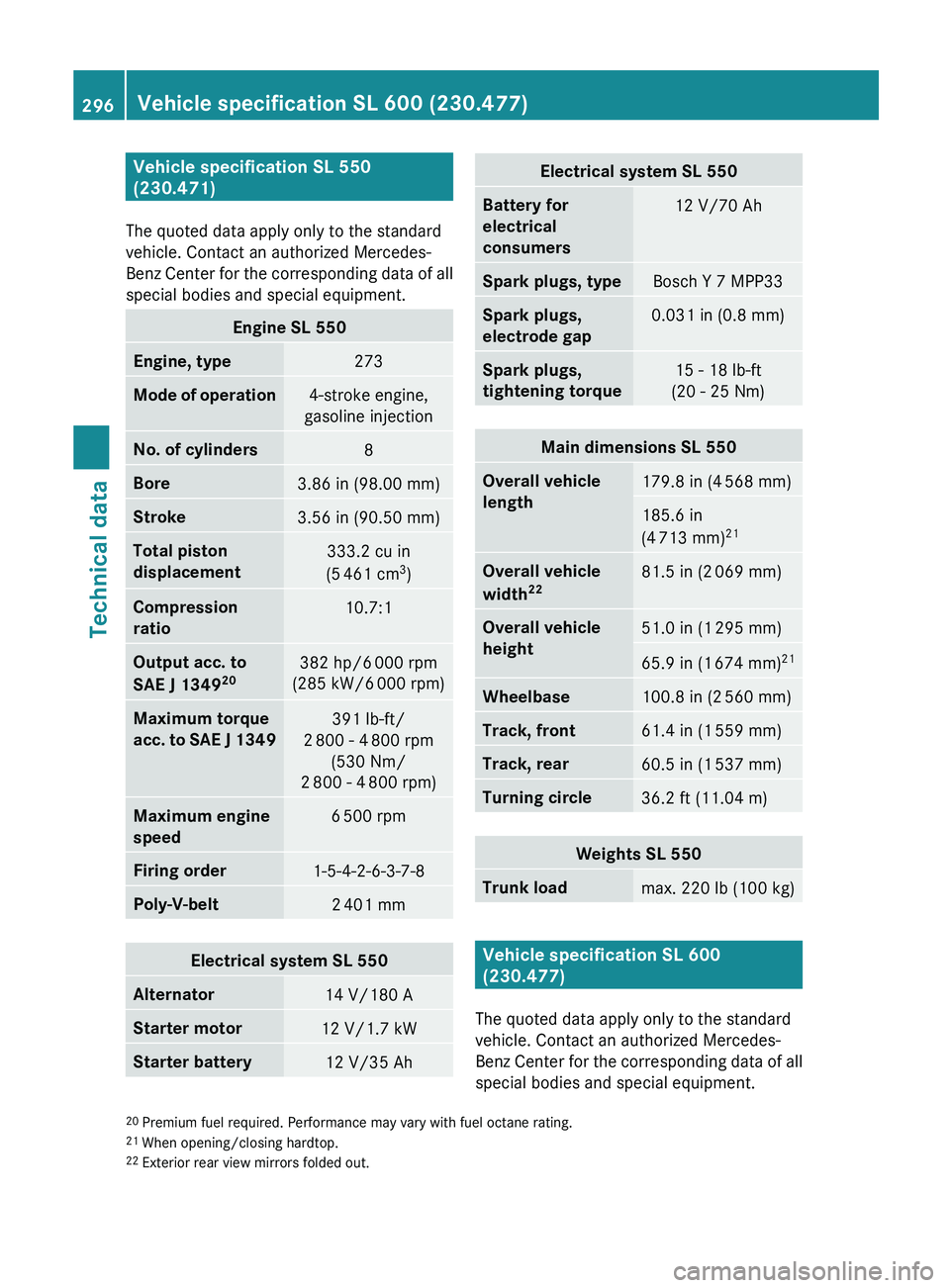
Vehicle specification SL 550
(230.471)
The quoted data apply only to the standard
vehicle. Contact an authorized Mercedes-
Benz Center for the corresponding data of all
special bodies and special equipment.Engine SL 550Engine, type273Mode of operation4-stroke engine,
gasoline injectionNo. of cylinders8Bore3.86 in (98.00 mm)Stroke3.56 in (90.50 mm)Total piston
displacement333.2 cu in
(5 461 cm 3
)Compression
ratio10.7:1Output acc. to
SAE J 1349 20382 hp/6
000 rpm
(285 kW/6 000 rpm)Maximum torque
acc. to SAE J 1349391 lb-ft/
2 800 - 4 800 rpm
(530 Nm/
2 800 - 4 800 rpm)Maximum engine
speed6 500 rpmFiring order1-5-4-2-6-3-7-8Poly-V-belt2 401 mmElectrical system SL 550Alternator14 V/180 AStarter motor12 V/1.7 kWStarter battery12 V/35 AhElectrical system SL 550Battery for
electrical
consumers12 V/70 AhSpark plugs, typeBosch Y 7 MPP33Spark plugs,
electrode gap0.031 in (0.8 mm)Spark plugs,
tightening torque15 - 18 lb-ft
(20 - 25 Nm)Main dimensions SL 550Overall vehicle
length179.8 in (4 568 mm)185.6 in
(4 713 mm) 21Overall vehicle
width 2281.5 in (2
069 mm)Overall vehicle
height51.0 in (1 295 mm)65.9 in (1 674 mm) 21Wheelbase100.8 in (2
560 mm)Track, front61.4 in (1 559 mm)Track, rear60.5 in (1 537 mm)Turning circle36.2 ft (11.04 m)Weights SL 550Trunk loadmax. 220 lb (100 kg)
Vehicle specification SL 600
(230.477)
The quoted data apply only to the standard
vehicle. Contact an authorized Mercedes-
Benz Center for the corresponding data of all
special bodies and special equipment.
20 Premium fuel required. Performance may vary with fuel octane rating.
21 When opening/closing hardtop.
22 Exterior rear view mirrors folded out.296Vehicle specification SL 600 (230.477)Technical data
230_AKB; 6; 22, en-USd2ureepe,Version: 2.11.8.12009-07-28T18:49:58+02:00 - Seite 296
Page 299 of 316
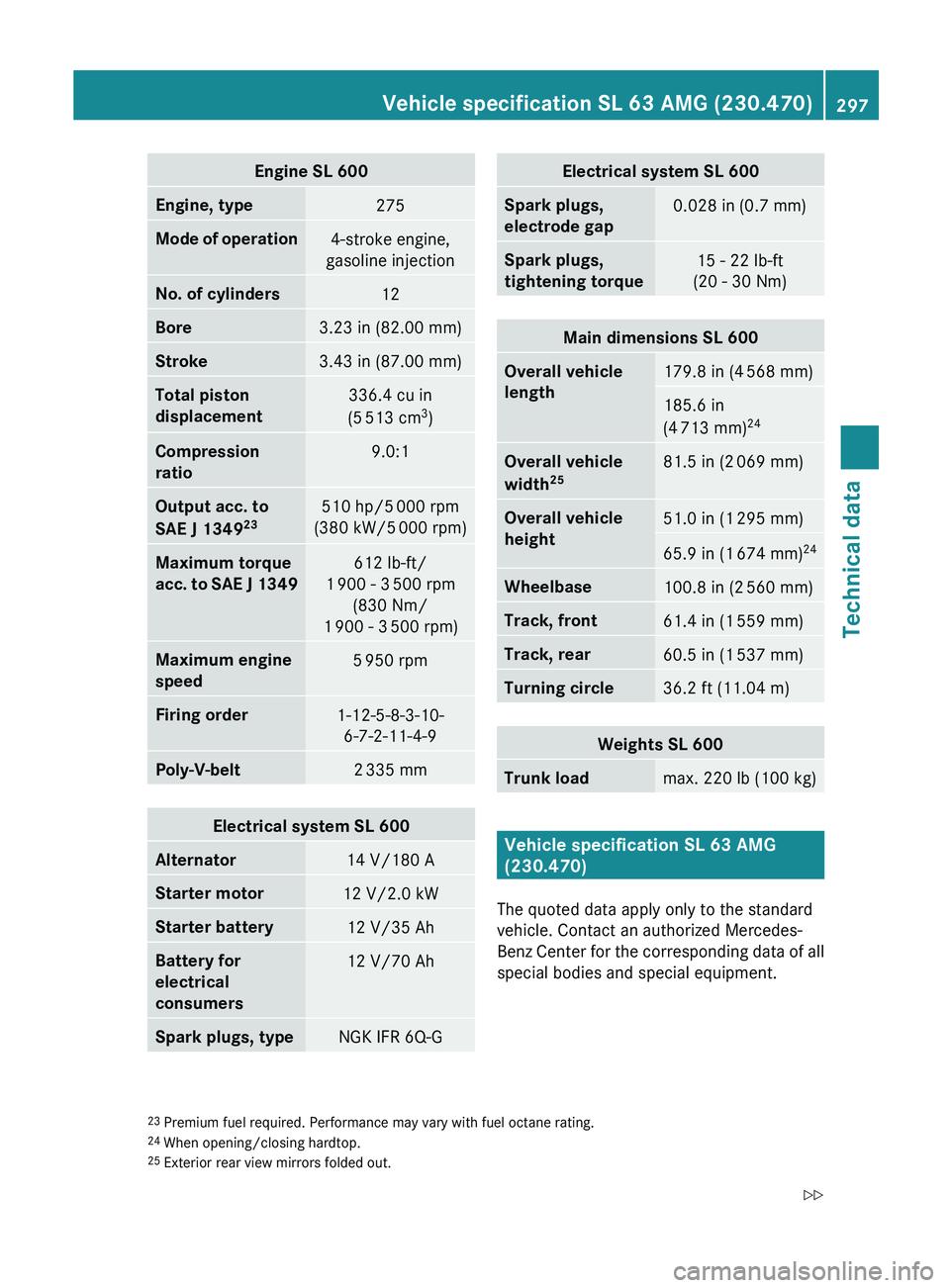
Engine SL 600Engine, type275Mode of operation4-stroke engine,
gasoline injectionNo. of cylinders12Bore3.23 in (82.00 mm)Stroke3.43 in (87.00 mm)Total piston
displacement336.4 cu in
(5 513 cm 3
)Compression
ratio9.0:1Output acc. to
SAE J 1349 23510 hp/5
000 rpm
(380 kW/5 000 rpm)Maximum torque
acc. to SAE J 1349612 lb-ft/
1 900 - 3 500 rpm
(830 Nm/
1 900 - 3 500 rpm)Maximum engine
speed5 950 rpmFiring order1-12-5-8-3-10-
6-7-2-11-4-9Poly-V-belt2 335 mmElectrical system SL 600Alternator14 V/180 AStarter motor12 V/2.0 kWStarter battery12 V/35 AhBattery for
electrical
consumers12 V/70 AhSpark plugs, typeNGK IFR 6Q-GElectrical system SL 600Spark plugs,
electrode gap0.028 in (0.7 mm)Spark plugs,
tightening torque15 - 22 lb-ft
(20 - 30 Nm)Main dimensions SL 600Overall vehicle
length179.8 in (4 568 mm)185.6 in
(4 713 mm) 24Overall vehicle
width 2581.5 in (2
069 mm)Overall vehicle
height51.0 in (1 295 mm)65.9 in (1 674 mm) 24Wheelbase100.8 in (2
560 mm)Track, front61.4 in (1 559 mm)Track, rear60.5 in (1 537 mm)Turning circle36.2 ft (11.04 m)Weights SL 600Trunk loadmax. 220 lb (100 kg)
Vehicle specification SL 63 AMG
(230.470)
The quoted data apply only to the standard
vehicle. Contact an authorized Mercedes-
Benz Center for the corresponding data of all
special bodies and special equipment.
23 Premium fuel required. Performance may vary with fuel octane rating.
24 When opening/closing hardtop.
25 Exterior rear view mirrors folded out.Vehicle specification SL 63 AMG (230.470)297Technical data230_AKB; 6; 22, en-USd2ureepe,Version: 2.11.8.12009-07-28T18:49:58+02:00 - Seite 297Z
Page 300 of 316
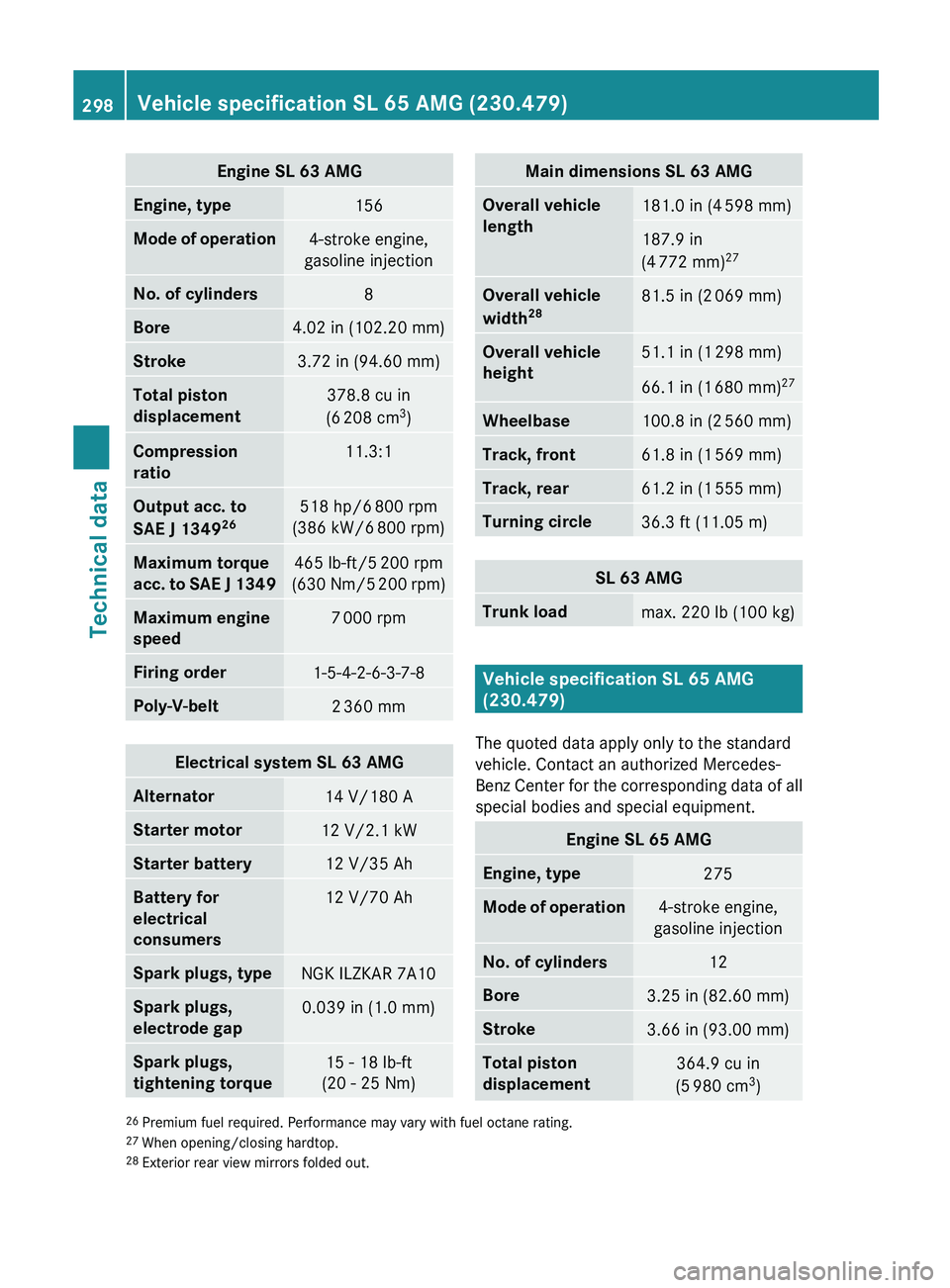
Engine SL 63 AMGEngine, type156Mode of operation4-stroke engine,
gasoline injectionNo. of cylinders8Bore4.02 in (102.20 mm)Stroke3.72 in (94.60 mm)Total piston
displacement378.8 cu in
(6 208 cm 3
)Compression
ratio11.3:1Output acc. to
SAE J 1349 26518 hp/6
800 rpm
(386 kW/6 800 rpm)Maximum torque
acc. to SAE J 1349465 lb-ft/5 200 rpm
( 630 Nm/5 200 rpm)Maximum engine
speed7 000 rpmFiring order1-5-4-2-6-3-7-8Poly-V-belt2 360 mmElectrical system SL 63 AMGAlternator14 V/180 AStarter motor12 V/2.1 kWStarter battery12 V/35 AhBattery for
electrical
consumers12 V/70 AhSpark plugs, typeNGK ILZKAR 7A10Spark plugs,
electrode gap0.039 in (1.0 mm)Spark plugs,
tightening torque15 - 18 lb-ft
(20 - 25 Nm)Main dimensions SL 63 AMGOverall vehicle
length181.0 in (4 598 mm)187.9 in
(4 772 mm) 27Overall vehicle
width 2881.5 in (2
069 mm)Overall vehicle
height51.1 in (1 298 mm)66.1 in (1 680 mm) 27Wheelbase100.8 in (2
560 mm)Track, front61.8 in (1 569 mm)Track, rear61.2 in (1 555 mm)Turning circle36.3 ft (11.05 m)SL 63 AMGTrunk loadmax. 220 lb (100 kg)
Vehicle specification SL 65 AMG
(230.479)
The quoted data apply only to the standard
vehicle. Contact an authorized Mercedes-
Benz Center for the corresponding data of all
special bodies and special equipment.
Engine SL 65 AMGEngine, type275Mode of operation4-stroke engine,
gasoline injectionNo. of cylinders12Bore3.25 in (82.60 mm)Stroke3.66 in (93.00 mm)Total piston
displacement364.9 cu in
(5 980 cm 3
)26 Premium fuel required. Performance may vary with fuel octane rating.
27 When opening/closing hardtop.
28 Exterior rear view mirrors folded out.298Vehicle specification SL 65 AMG (230.479)Technical data
230_AKB; 6; 22, en-USd2ureepe,Version: 2.11.8.12009-07-28T18:49:58+02:00 - Seite 298
Page 301 of 316
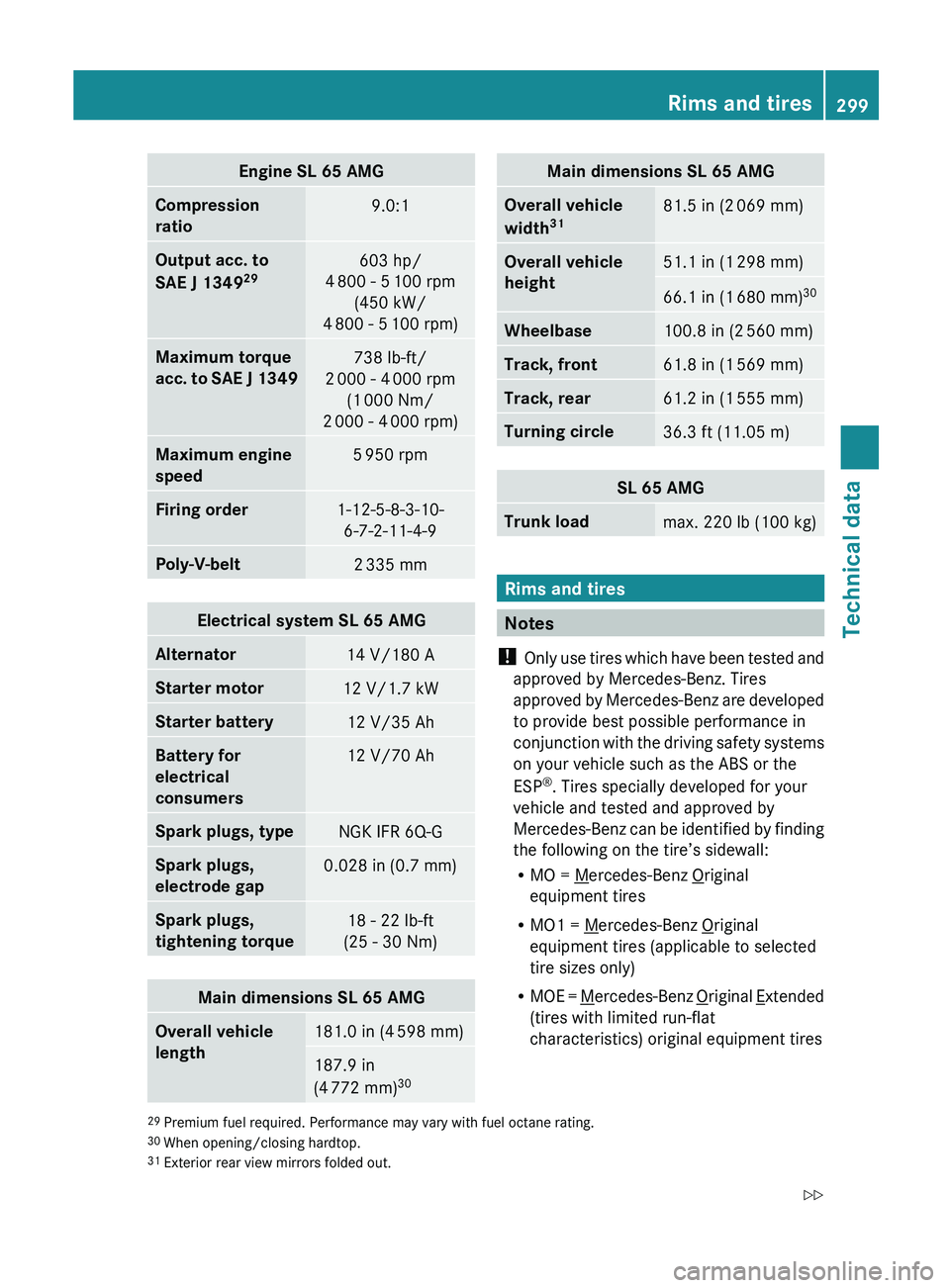
Engine SL 65 AMGCompression
ratio9.0:1Output acc. to
SAE J 1349 29603 hp/
4 800 - 5 100 rpm
(450 kW/
4 800 - 5 100 rpm)Maximum torque
acc. to SAE J 1349738 lb-ft/
2 000 - 4 000 rpm
(1 000 Nm/
2 000 - 4 000 rpm)Maximum engine
speed5 950 rpmFiring order1-12-5-8-3-10-
6-7-2-11-4-9Poly-V-belt2 335 mmElectrical system SL 65 AMGAlternator14 V/180 AStarter motor12 V/1.7 kWStarter battery12 V/35 AhBattery for
electrical
consumers12 V/70 AhSpark plugs, typeNGK IFR 6Q-GSpark plugs,
electrode gap0.028 in (0.7 mm)Spark plugs,
tightening torque18 - 22 lb-ft
(25 - 30 Nm)Main dimensions SL 65 AMGOverall vehicle
length181.0 in (4 598 mm)187.9 in
(4 772 mm) 30Main dimensions SL 65 AMGOverall vehicle
width 3181.5 in (2
069 mm)Overall vehicle
height51.1 in (1 298 mm)66.1 in (1 680 mm) 30Wheelbase100.8 in (2
560 mm)Track, front61.8 in (1 569 mm)Track, rear61.2 in (1 555 mm)Turning circle36.3 ft (11.05 m)SL 65 AMGTrunk loadmax. 220 lb (100 kg)
Rims and tires
Notes
! Only use tires which have been tested and
approved by Mercedes-Benz. Tires
approved by Mercedes-Benz are developed
to provide best possible performance in
conjunction with the driving safety systems
on your vehicle such as the ABS or the
ESP ®
. Tires specially developed for your
vehicle and tested and approved by
Mercedes-Benz can be identified by finding
the following on the tire’s sidewall:
R MO =
Mercedes-Benz Original
equipment tires
R MO1 =
Mercedes-Benz Original
equipment tires (applicable to selected
tire sizes only)
R MOE =
Mercedes-Benz Original Extended
(tires with limited run-flat
characteristics) original equipment tires
29 Premium fuel required. Performance may vary with fuel octane rating.
30 When opening/closing hardtop.
31 Exterior rear view mirrors folded out.Rims and tires299Technical data230_AKB; 6; 22, en-USd2ureepe,Version: 2.11.8.12009-07-28T18:49:58+02:00 - Seite 299Z