ESP MERCEDES-BENZ SL CLASS 2020 User Guide
[x] Cancel search | Manufacturer: MERCEDES-BENZ, Model Year: 2020, Model line: SL CLASS, Model: MERCEDES-BENZ SL CLASS 2020Pages: 334, PDF Size: 17.43 MB
Page 39 of 334
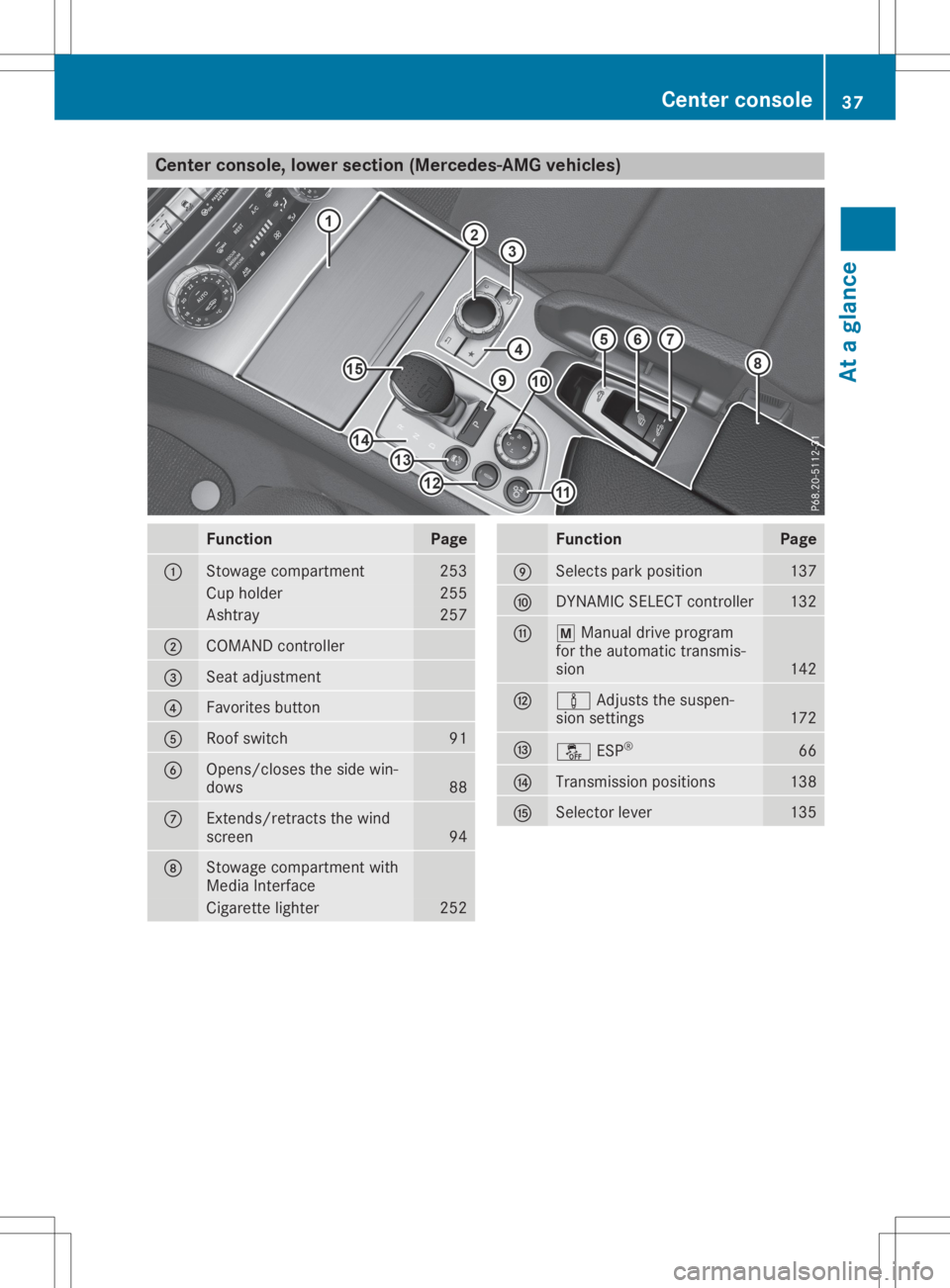
Cent
erconsole, lowersection(Mer cedes -AMGvehi cles) Funct
ion Pag
e 0043
St
owage compartmen t 25
3 Cup
holder 25
5 As
htray 25
7 0044
COMA
NDcontroller 0087
Seat
adjust men t 0085
Fav
oritesbut ton 0083
Roof
switch 91
0084
Open
s/clo ses theside win-
dows 88
006B
Ex
tends /retrac tsthewind
sc ree n 94
006C
St
owage compartmen twit h
Media Inte rface Cigare
tte light er 25
2 Funct
ion Pag
e 006D
Sel
ect spark position 13
7 006E
DYN
AMICSELECT con troller 13
2 006F
0063
Man ualdriv epro gram
for theauto matictrans mis -
sion 14
2 0070
00CC
Adjus tsthesuspe n-
sion settings 17
2 0071
00BB
ESP® 66
0072
Tran
smissio nposi tions 13
8 0073
Sel
ect orleve r 13
5 Cent
erconsole
37Ataglan ce
Page 47 of 334
passenger
seatbelts arenot fasten ed,awarn-
ing tonesounds. Awarning tonealso sounds
with increasing intensit yfor 60secon dsor
until thedriver orfron tpassenger havefas-
ten edtheir seatbelts.
If the driver orfron tpassenger unfastentheir
seat belts during thejourn ey,the seat belt
warning isactiv ated again. Air
bags
Introd uction The
installation pointofan airbag canberec-
ogniz edbythe AIRB AGmarkin g.
An airbag complem entsthe corr ectlyfasten ed
seat belt. Itis no substit uteforthe seat belt.
When deployed, anairbag canincrease the
prote ction provided forthe respect ivevehicle
occ upant.
Not allairbags aredeployed inan acciden t.
The various airbags workindepen dentlyof
each other (Ypage 53).
However ,no system available todaycancom-
pletely eliminate injuries andfatalities .
It is also notpossible torule outarisk ofinjury
caused byan airbag duetothe high speed at
which theairbag mustbedeployed.
Impor tantsafet ynotes G
WARN
ING
If the fron tpassenger airbag hasbeen acti-
vated, achild onthe fron tpassenger seat
may behit bythe fron tpassenger airbag in
the event ofan acciden t.There isarisk of
inj ury orfatal injury.
NEV ERuse arearward-f acingchildrestraint
system onaseat prote cted byan ACTIVE
FRONT AIRBAG;DEATH orSERIOUS INJURY
to the CHILD canoccur.
When installing achild restraint system onthe
fron tpassenger seatobserve thevehicle- spe-
cific notes(Y page 59).Youmust observe
the noteson rearward andforward- facingchild
rest raint systems onthe fron t-passenger seat. G
WARN
ING
If you deviate fromthecorr ectseat position ,
the airbag cann otperfor mits intended pro- tec
tive func tion anddeployment mayeven
cause furtherinjuries. Thisposes an
incr eased riskofinjury oreven fatalinjury.
To avoid anyrisks ,each vehicle occupant
must always makesureofthe following:
R Faste nthe seat beltcorrectly.Inthe case
of pregnan twomen inpartic ular,make
sure thatthelapbelt isnever routed
across thestom achorabdomen.
R Adopt thecorr ectseat position andkeep
as far away aspossible fromtheairbags.
R Observe thefollowing notes.
Always makesurethatthereare noobjec ts
between theairbag and vehicle occupant.
All vehicle occupants mustobserve thefollow-
ing notestoavoid risksposed bythe airbag
when itdeploys.
R Adj ust the seats properly beforebeginning
your journ ey.Always makesurethatthe
seat isin an almost upright position .The
cen terofthe head restraint must support
the head atabout eyelevel.
R Move thedriver' sand front-passenger seats
as far back aspossible. Thedriver' sseat
position mustallow thevehicle tobe driven
safely.
R Only holdthesteer ingwheel onthe outside.
This allows theairbag tobe fully deployed.
R Always leanagainst thebackr estwhile driv-
ing. Donot lean forward orlean against the
door orside window. Youmay other wisebe
in the deployment areaofthe airbags.
R Always keepyourfeetinthe foot well in
fron tof the seat. Donot putyour feetonthe
dashboard, forexample. Yourfeetmay oth-
erwise beinthe deployment areaofthe air
bag.
R For this reason, alwayssecurepersonsless
than 5ft (1.5 0m) tall insuitable restraint
systems .Up tothis height, theseat belt
cann otbe worn correctly.
If achild istraveling inyour vehicle, also
observe thefollowing notes:
R Always securechildren undertwelve years
of age and less than 5ft (1.5 0m) tall insuit-
able child restraint systems .
R Secur eachild tothe fron t-passenger seat
only when thefron t-passenger frontair bag
is disabled, andthen onlyinarearward- Occupant
safety
45Safet y Z
Page 48 of 334
facing
childrestrai ntsystem .The front-
pas senger frontairbag isdisa bledwhen the
PASSENGER AIRBAG OFFindica torlam pis
lit continuou sly(Ypag e41).
R Alwa ysobse rvethe instructions andsafety
notes onthe "Occu pantClassifi cation Sys-
tem (OCS)"(Ypag e48) and on"Children
in the vehicl e"(Y pag e57) inadd ition to
the child restrai ntsystem manufacturer's
instal lation and opera tinginstructions.
Objec tsinthe vehi cleinteri ormay restrict
the airbag from functi oningcorrectly. To
avoi drisks resulting from thespee dof the air
bag asitdepl oys,vehicl eoccupa ntsmust
ensure thefollowi ngpoints.
Before commencing yourjourney ,ensure that:
R there arenopeop le,anima lsor objects
betwe enthe vehicl eoccupa ntsand anair
bag
R there arenoobjects betweenthe seat,door
and B-pill ar
R there arenohard objects, e.g.coat hange rs,
hangi ngon the grab handl esorcoat hooks
R no accesso ries,such ascup hold ers, are
attached tothe vehicl ewithi nthe depl oy-
ment areaofan air bag ,e.g. todoors orside
wind ows
R no hea vy,sharp -edged orfragi leobjects are
in the pockets ofyou rclothing. Storesuch
objects inasui tabl epla ce G
WARNING
If you modi fythe cover ofan air bag oraffix
objects suchasstickers toit,the airbag
can nolonge rperform itsintended function.
There isan increas edrisk ofinjury .
Never modifythe cover ofan air bag oraffix
objects toit. G
WARNING
Sensors tocontrol theairbag sare loca ted
in the doors .Modi ficatio nsorwork notper-
formed correctly tothe doors ordoor panel -
ing, aswel las dama geddoors ,can leadto
the function ofthe sensors being impa ired.
The airbag smight therefore notfunction
prope rlyanymo re.Conse quently, theair
bag scannot protect vehicleoccupa ntsas
they aredesi gned todo. There isan
increas edrisk ofinjury . Never
modifythe doors orparts ofthe
doors .Alwa yshave work onthe doors or
door panel ingcarrie dout ataqua lified spe-
cial istworksho p.
Fron tair bags !
Do
not placehea vyobjects onthe front-
pas senger seat.This couldcaus ethe sys-
tem toide ntify theseatas bei ng occupi ed.
In the event ofan accid ent,therestrai nt
system son the front-passe ngersidemay be
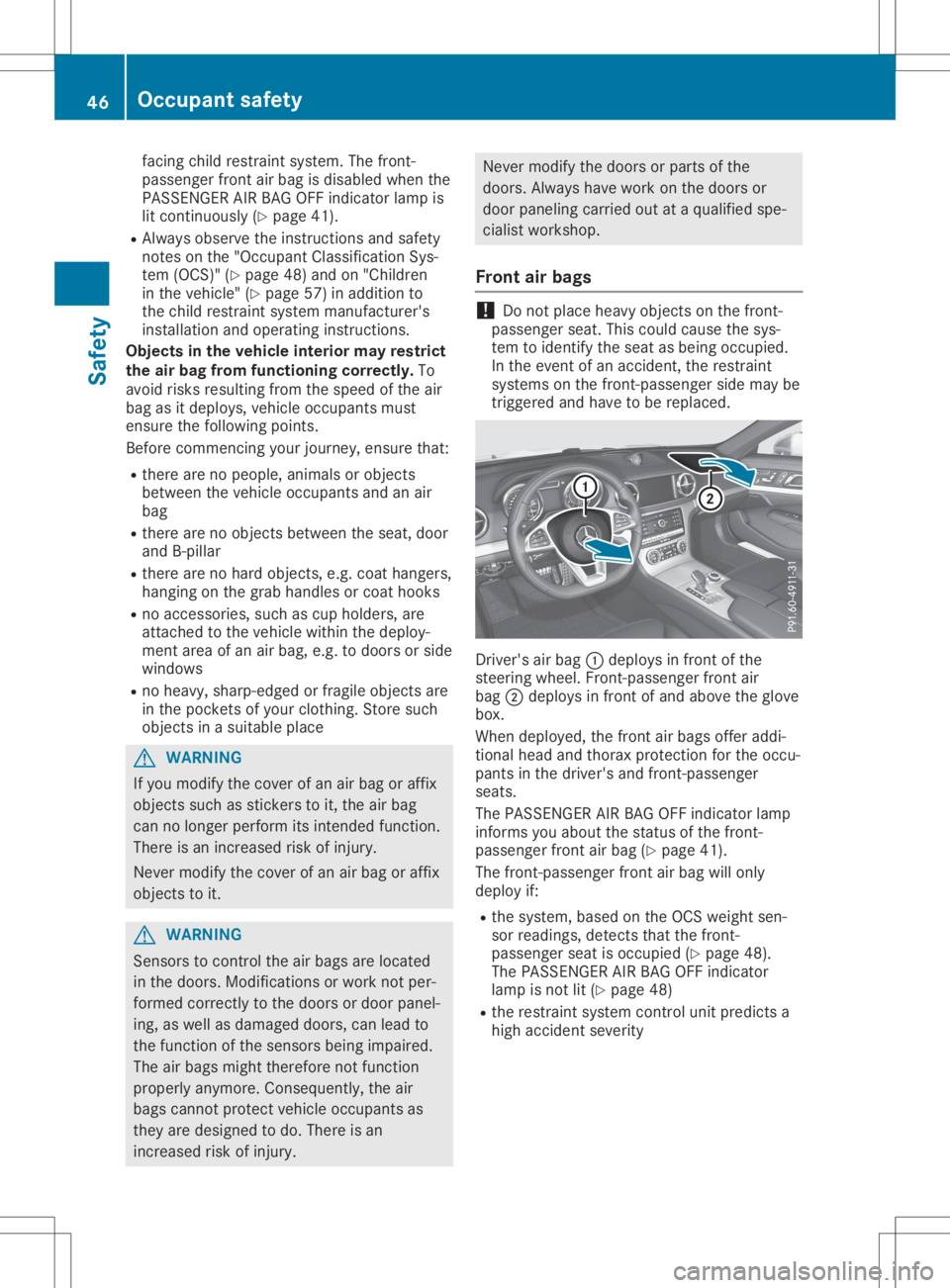
trigger edand have tobe repl aced . Driver's
airbag 0043depl oysinfront ofthe
steering wheel.Front-passeng erfront air
bag 0044depl oysinfront ofand abovethe glove
box.
When deployed,the front airbag soffer addi-
tional headand thorax protection forthe occu-
pants inthe drive r'sand front-passe nger
sea ts.
The PASSENGER AIRBAG OFFindica torlam p
informs youaboutthe status ofthe front-
pas senger frontairbag (Ypag e41).
The front-passe ngerfront airbag willonly
depl oyif:
R the system ,bas edon the OCS weight sen-
sor read ings, detects thatthefront-
pas senger seatis occupi ed(Ypag e48).
The PASSENGER AIRBAG OFFindica tor
lam pis not lit(Y pag e48)
R the restrai ntsyste mcontrol unitpredi ctsa
high accid entseveri ty 46
Oc
cupant safetySafety
Page 51 of 334
OFF):
thefront -passenger frontairbag is
able todeploy inthe event ofan accident.
R PASSE NGERAIRBAG OFFlights up:the
front passenger frontairbag isdeactivated.
It will then notbedeploy edinthe event of
an accident.
If the PASSE NGERAIRBAG ONindicator lamp
is off, only thePASSE NGERAIRBAG OFFindi-
cator lampshows thestatus ofthe front -
passenger frontairbag. ThePASSE NGERAIR
BAG OFFindicator lampmaybelitcont inu-
ously orbe off.
If the status ofthe front -passenger frontair
bag changes whilethevehicle isin motion, an
air bag displa ymessage appearsinthe instru-
ment cluster (Ypage 218). When thefront -
passenger seatisoccupied, alwayspay atten-
tion tothe PASSE NGERAIRBAG OFFindicator
lamp. Beawa reofthe status ofthe front -
passenger frontairbag both before andduring
the journey. G
WARNING
If the PASSE NGERAIRBAG OFFindicator
lamp islit, the front -passenger frontairbag
is disabl ed.Itwill notbedeploy edinthe
event ofan accident andcannot perform its
intended protective function.Aperson inthe
front -passenger seatcould then,forexam-
ple, come intocontactwith thevehicle's
interior, especiallyifthe person issitting too
close tothe dashboa rd.This poses an
increased riskofinjury oreven fatalinjury.
When thefront -passenger seatisoccupied,
alwa ysensure that:
R the classification ofthe person inthe
front -passenger seatiscorrect andthe
front -passenger frontairbag isenabled or
disabl edinaccordance withtheperson in
the front -passenger seat
R the front -passenger seathasbeen moved
back asfar back aspossible .
R the person isseated correctly.
Make sure,bothbefore andduring thejour-
ney, thatthestatus ofthe front -passenger
front airbag iscorrect . G
WARNING
If you secure achild inarearward-facing
child restraint systemonthe front -
passenger seatandthePASSE NGERAIR
BAG OFFindicator lampisoff, thefront -
passenger frontairbag candeploy inthe
event ofan accident. Thechild could be
struck bythe airbag. Thisposes an
increased riskofinjury oreven fatalinjury.
Make surethatthefront -passenger frontair
bag hasbeen deactivated. ThePASSE NGER
AIR BAG OFFindicator lampmust belit.
NEVER usearearward-facing childrestraint
on aseat protected byan ACTIVE FRONT
AIRBAG infront ofit;DEA THorSERIOUS
INJURY tothe child canoccur.
If the PASSE NGERAIRBAG OFFindicator lamp
stays off,donot install arearward-facing child
restraint systemonthe front -passenger seat.
You canfind more information onOCS under
"Proble mswith theOccupant Classification
System" (Ypage 51). G
WARNING
If you secure achild inaforward-facing child
restraint systemonthe front -passenger seat
and youposition thefront -passenger seat
too close tothe dashboa rd,inthe event of
an accident, thechild could:
R come intocontactwith thevehicle's inte-
rior ifthe PASSE NGERAIRBAG OFFindi-
cator lampislit, for example
R be struck bythe airbag ifthe
PASSE NGERAIRBAG OFFindicator lamp
is off
This poses anincreased riskofinjury or
even fatalinjury.
Alway smove thefront -passenger seatasfar
back aspossible andfully retract theseat
cushion length.Alwaysmake surethatthe
shoulde rbelt strap iscorrect lyrouted from
the vehicle seatbeltguide tothe shoulde r
belt guide onthe child restraint system.The
shoulde rbelt strap mustberouted forwards
and downwards fromtheseat beltguide . Occ
upant safety
49Safety
Z
Page 52 of 334
Alw
aysob ser vethe childres trai ntsystem
ma nuf actu rer'sins tallatio nins truc tions.
If OC Sde term inestha t:
R The front-p asseng ersea tis uno ccup ied, the
PASSENG ERAIR BAG OFFindicator lamp
li ghts upafte rthe self-tes tand remains lit.
Thi sind icates thatthe front-p asseng erfront
ai rba gis de acti vated .
R The front-p asseng ersea tis occu pied bya
chi ldof up totwe lvemonth sol d, inasta nd-
ar dchi ldres trai ntsystem ,the PASSENG ER
AIR BAG OFFindicator lamp lights upafte r
the self-tes tand remains lit. Thi sind icates
tha tthe front-p asseng erfront airba gis
de acti vated .
But evenin the caseof atwe lve-month -old
chi ld,in asta nda rdchi ldres trai ntsystem ,
the PASSENG ERAIR BAG OFFindicator
la mp can gooutafte rthe self-tes t.Thi sind i-
cate stha tthe front-p asseng erfront airba g
is ena bled .The resultof the classifica tionis
de pende nton, among othe rfac tors ,the
chi ldres trai ntsystem andthechild's sta t-
ur e. Ma kesure tha tthe cond itions foracor-
rect classifica tionar emet. Ifthe
PASSENG ERAIR BAG OFFindicator lamp
rem ains off, donot installa chi ldres trai nt
sy stem onthe front-p asseng ersea t.
R The front-p asseng ersea tis occu pied bya
pe rso nof sma ller sta ture (e.g. atee nag eror
sma llad ult), the PASSENG ERAIR BAG OFF
ind icator lamp either lights upand remains
li t afte rthe self-tes tde pendi ng on the result
of the classifica tionor, alterna tively,goe s
ou t.
- Ifthe PASSENG ERAIR BAG OFFindicator
la mp isoff, move thefront-p asseng ersea t
as far back aspossi ble.
- Ifthe PASSENG ERAIR BAG OFFindicator
la mp islit, ape rso nof sma ller sta ture
sho uld not usethe front-p asseng ersea t.
R The front-p asseng ersea tis occu pied byan
ad ultor ape rso nof corr espond ingstature ,
the PASSENG ERAIR BAG OFFindicator
la mp goesou tafte rthe self-tes t.Thi sind i-
cate stha tthe front-p asseng erfront airba g
is ena bled .
If chi ldren aretrav eling inthe vehicle, be sure
to obser vethe notes on"Child ren inthe vehi-
cle "(Y page 57) .
Whe nthe Occu pant Clas sifica tionSys tem
(OC S)isma lfunctio ning,the red 0075 restrai nt sy
stem warning lamp onthe instrum entclus-
ter and thePASSENG ERAIR BAG OFFindica-
tor lamp light upsimu ltaneo usly.The front-
pa sse nge rfront airba gis de acti vated inthi s
cas eand does not deploy during anacci dent.
Hav ethe Occu pant Clas sifica tionSys tem
(OC S)che cked andrepaired imm ediatel yat a
qu alifi ed spe cialist wo rksh op.Mer cedes-B enz
reco mme ndsthatyo uus ean author ized
Mer cedes-B enzCenter forthispu rpo se.
If the front-p asseng ersea t,the seatcove ror
the seatcus hion areda ma ged, have the nec-
ess aryrep airwo rkcar riedou tat aqu alifi ed
spe cialist wo rksh op.Mer cedes-B enzreco m-
mend stha tyo uus ean author izedMer cedes-
Benz Center forthispu rpo se.
For safety reasons ,Mer cedes-B enzreco m-
mend stha tyo uonl yus esea tacce ssoriestha t
ha ve been appro ved byMer cedes-B enz.
Dep loym ent ofthe driver 'sairba gdo es not
mea ntha tthe front-p asseng erfront airba g
de ploy sas well. The Occu pant Clas sifica tion
Sys tem (OCS)cate gorizesthe occu pant on the
front-p asseng ersea t.Dep endingontha t
res ult, the front-p asseng erfront airba gis
ei ther enabled ordeacti vated .
Se lf-ch eckof the Occupant Class ifica-
tio nSys tem (OCS ) G
DA
NGER
If the PASSENG ERAIR BAG OFFand
PASSENG ERAIR BAG ONindicator lamps do
not both light upduring theself-tes t,the
sy stem isma lfunctio ning.The front-
pa sse nge rfront airba gmig htbe trig gered
uni ntenti onally or mig htnot betrig geredat
al lin the eventofan acci dent with high
de cel era tion.Thi spo ses anincr eased riskof
inju ryor eve nfata linju ry.
In thi scas ethe front-p asseng ersea tma y
not beused .Do not installa chi ldres trai nt
sy stem onthe front-p asseng ersea t.Hav e
the Occu pant Clas sifica tionSys tem (OCS)
che cked andrepaired imm ediatel yat a
qu alifi ed spe cialist wo rksh op. G
WA
RNING
If the PASSENG ERAIR BAG OFFindicator
la mp rem ains lit afte rthe self-tes t,the front- 50
Oc
cupant safetySafe ty
Page 53 of 334
passenger
frontair bag isdeactiv ated.Itwill
not bedeployed inthe event ofan acciden t.
In this case, thefron t-passenger frontair
bag cann otperfor mits intended protective
func tion,e.g. when aperson isseated inthe
fron t-passenger seat.
That person could,forexample, comeinto
con tact with thevehicle's interior, especially
if the person issitt ing too close tothe dash-
board. Thisposes anincr eased riskofinjury
or even fatalinjury.
When thefron t-passenger seatisocc upied,
always ensure that:
R the classific ationofthe person inthe
fron t-passenger seatiscorr ectand the
fron t-passenger frontair bag isenabled or
deactiv atedinaccor dance withtheper-
son inthe fron t-passenger seat
R the person isseated properly withacor-
rect lyfasten edseatbelt
R the fron t-passenger seathasbeen moved
as far back aspossible
If the PAS SENGER AIRBAGOFF indicat or
lamp remains litwhen itshould not,the
fron t-passenger seatmust notbeused. Do
not installachild restraint system onthe
fron t-passenger seat.Have theOcc upant
Classification System(OCS)checkedand
repaired immediately ataqualified specialist
worksh op. G
WARN
ING
Objec tsbetween theseat surface andthe
child restraint system couldaffect OCS operation
.This could result inthe fron t-
passenger airbag notfunc tioningasinten-
ded during anacciden t.This poses an
incr eased riskofinjury oreven fatalinjury.
Do not place anyobjec tsbetween theseat
surface andthechild restraint system. The
ent irebase ofthe child restraint system
must always restonthe seat cushion ofthe
fron t-passenger seat.Thebackr estofthe
forward- facingchild restraint system must,
as far aspossible, berest ingonthe back-
rest ofthe fron t-passenger seat.Always
comply withthechild restraint system man-
ufactur er'sinstallation instruct ions.
Aft erthe self-t est,thePAS SENGER AIRBAG
OFF orthe PAS SENGER AIRBAGON indicat or
lamp displays thestatusofthe fron t-
passenger frontairbag (Ypage 48).Ifthe
fron t-passenger frontairbag isenabled, the
PAS SENGER AIRBAGON indicat orlamp lights
up for 60secon dsand then goes out.
If the PAS SENGER AIRBAGON indicat orlamp
is off, only thePAS SENGER AIRBAGOFF indi-
cator lampshows thestatusofthe fron t-
passenger frontairbag. ThePASSENGER AIR
BA GOFF indicat orlamp maybelitcon tinu-
ously orbe off.
For more information abouttheOCS, see
"Problems withtheOcc upant Classification
System "(Y page 51).
Problems withtheOccupant Classification System(OCS) Be
sure toobserve thenoteson "System self-test"(Ypage 50). Occupant
safety
51Safet y Z
Page 54 of 334
Problem
Possible
causes/co nsequences and0050 0050
Solutions The
PASS ENGER AIR
BAG OFFindicator lamp
lights upand remains
lit, even though the
front -passenger seatis
occupied byan adult or
a person ofastature
correspondin gto that of
an adult. The
classification ofthe person onthe front -passenger seatisincor-
rect.
X Make surethecondition sfor acorrect classification ofthe per-
son onthe front -passenger seataremet (Ypage 48).
X Ifthe PASS ENGER AIRBAG OFFindicator lampremains lit,the
front -passenger seatmaynotbeused.
X Have OCScheck edassoon aspossible atan authorized
Mercedes-Ben zCenter. The
PASS ENGER AIR
BAG OFFindicator lamp
does notlight up
and/or doesnotstay
on.
The front -passenger
seat is:
R unoccupied
R occupied bythe
weight ofachild up
to twelve monthsold
in achild restraint
system OCS
ismalfunctionin g.
X Make surethere isnothin gbetween theseat cushion andthe
child seat.
X Make surethattheentire baseofthe child restraint systemrests
on the seat cushion ofthe front -passenger seat.Thebackrest of
the forward-facing childrestraint systemmustlieasflat aspossi-
ble against thebackrest ofthe front passenger seat.Ifnecessary,
adjust theposition ofthe front -passenger seat.
X Make surethattheseat cushion lengthisfully retract ed.
X When installing thechild restraint system,makesurethatthe
seat beltistight. Donot pull theseat belttight using thefront -
passenger seatadjustment .This could result inthe seat beltand
the child restraint systembeingpulled tootightly.
X Check forcorrect installation ofthe child restraint system.
Make surethatthehead restraint doesnotapply aload tothe
child restraint system.Ifnecessary, adjustthehead restraint
accordingly.
X Make surethatnoobject sare apply ingadditional weightontothe
seat.
X Ifthe PASS ENGER AIRBAG OFFindicator lampremains off
and/or thePASS ENGER AIRBAG ONindicator lamplights up,do
not install achild restraint systemonthe front -passenger seat.
X Have OCScheck edassoon aspossible atan authorized
Mercedes-Ben zCenter. Roll
bar G
DANGER
If the rollbar has developed amalfunction, it
may notfunct ion,e.g. inthe event ofan
accident. Therollbars maythen notprotect
the vehicle occupants asinten ded.This
poses anincreased riskofinjury oreven
fatal injury.
Have rollbars check edimmediately ata
quali fiedspecialist workshop. G
WARNING
If you place object sor clothing onthe roll
bar covers, thesecouldimpair rollbar exten -
sion. Therollbars maythen notprotect the
vehicle occupants asinten ded.Inaddition,
object scould endanger thevehicle occu-
pants whentherollbar isexten ding.This
poses anincreased riskofinjury oreven
fatal injury.
Ensure thatthemovement areaofthe roll
bar covers iskept clear. Always stowall
object sin the vehicle correctly. 52
Occ
upantsafetySafety
Page 55 of 334
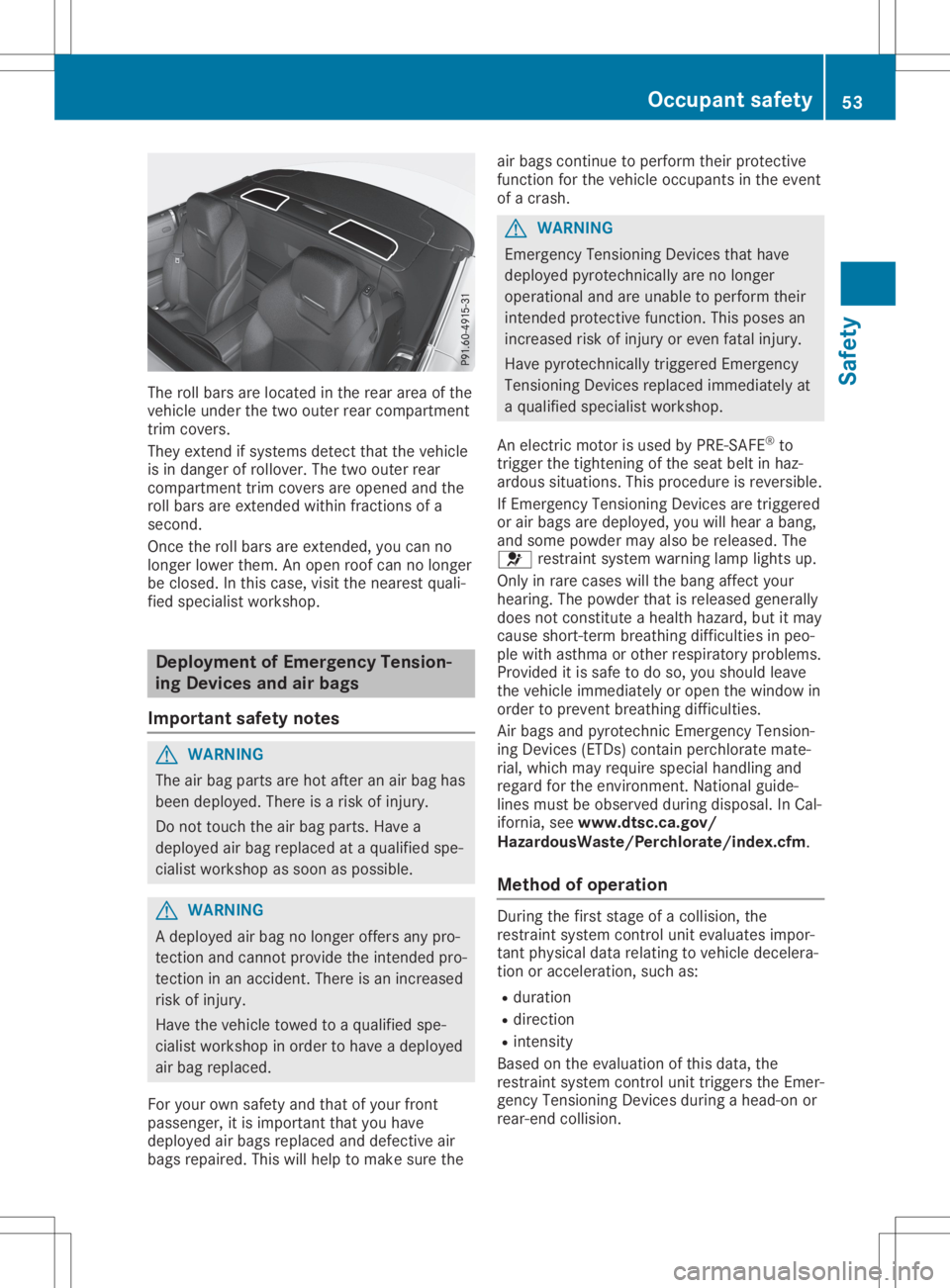
The
rollbars arelocated inthe rear area ofthe
vehicle underthetwo outer rearcompart ment
trim covers.
They exten difsystems detectthatthevehicle
is in danger ofrollover. Thetwo outer rear
compart menttrimcovers areopened andthe
roll bars areexten dedwithin fractions ofa
second.
Once therollbars areexten ded,youcan no
longer lowerthem. Anopen roofcannolonger
be closed. Inthis case, visitthenearest quali-
fied specialist workshop. Deployment
ofEmergency Tension-
ing Devic esand airbags
Import antsafety notes G
WARNIN
G
The airbag parts arehot after anair bag has
been deployed. Thereisarisk ofinjury.
Do not touch theairbag parts. Havea
deployed airbag replaced ataqualified spe-
cialist workshop assoon aspossible. G
WARNIN
G
A deployed airbag nolonger offersanypro-
tect ionand cann otprovide theinten dedpro-
tect ioninan accident .There isan increased
risk ofinjury.
Have thevehicle towedtoaqualified spe-
cialist workshop inorder tohave adeployed
air bag replaced.
For your ownsafety andthat ofyour front
passenger, itis important thatyouhave
deployed airbags replaced anddefect iveair
bags repaired. Thiswillhelp tomake surethe air
bags continue toperform theirprotec tive
funct ionforthe vehicle occupant sin the event
of acrash. G
WARNIN
G
Emergen cyTensionin gDevices thathave
deployed pyrotechn icallyarenolonger
operational andareunable toperform their
inten dedprotec tivefunct ion.This poses an
increased riskofinjury oreven fatalinjury.
Have pyrotechn icallytriggered Emergency
Tensionin gDevices replaced immediately at
a qualified specialist workshop.
An electric motorisused byPRE-S AFE®
to
trigger thetighten ingofthe seat beltinhaz-
ardous situations. Thisprocedure isreversible.
If Emergen cyTensionin gDevices aretriggered
or air bags aredeployed, youwillhear abang,
and some powder mayalsobereleased. The
0075 restraintsystem warning lamplights up.
Only inrare cases willthebang affect your
hearing. Thepowder thatisreleased generally
does notconst ituteahealth hazard, butitmay
cause short-termbreathing difficulties inpeo-
ple with asthma orother respiratory problems.
Provided itis safe todo so, you should leave
the vehicle immediately oropen thewindow in
order toprevent breathing difficulties.
Air bags andpyrotechn icEmergen cyTension-
ing Devices (ETDs)cont ainperchlorate mate-
rial, which mayrequire specialhandling and
regard forthe environ ment.National guide-
lines must beobserved duringdisposal. InCal-
ifornia, seewww .dtsc.ca.gov/
Haza rdousW aste/Perchlora te/index.cfm.
Method ofoperat ion During
thefirst stage ofacollision, the
restr aintsystem controlunit evaluates impor-
tant physical datarelating tovehicle decelera-
tion oracceleration ,such as:
R duration
R direction
R inten sity
Based onthe evaluation ofthis data, the
restr aintsystem controlunit triggers theEmer-
gency Tensionin gDevices duringahead-on or
rear-en dcollision. Occupant
safety
53Safety Z
Page 56 of 334
An
Emer gencyTensi oni ng Devi cecan onlybe
trig gered,if:
R the igniti onissw itch edon
R the comp onents ofthe restrai ntsystem are
op era tional .Yo ucan find furthe rinfo rma tion
und er"Restr aint system warning lamp"
(Y page 41)
R the seatbe ltbu ckle tongu eha seng aged in
the beltbu ckle ofthe respective seat
If the restrai ntsystem contro luni tde tects a
more severe acci dent, furthe rcomp onents of
the restrai ntsystem areacti vated independ -
entl yof each othe rin certa infronta lcol lisi on
si tua tions:
R Front airba gs aswellas driver 'sand front-
pa sse nge rknee bags
Dep endingonthe perso nin the front-
pa sse nge rsea t,the front-p asseng erfront air
ba gis either enabled ordisa bled .The front-
pa sse nge rfront airba gcan bedeploy ed inan
acci dent onl yif the PASSENG ERAIR BAG OFF
ind icator lamp isoff. Obs ervethe informa tion
on the PASSENG ERAIR BAG indicator lamps
(Y page 41).
Yo ur veh icleha stwo -sta gefront airba gs.
The activatio nthre sholdof the Emer gency
Te nsi oni ng Devi cesand theairba gs isde ter-
mine dby eva luati ng the rate ofveh iclede cel -
era tionor acce lera tio nwh ich occu rsat vario us
po ints inthe vehicle. Thi spro ces sis pre -emp -
tive innatu re.Dep loym ent should take place
in goo dtime atthe startof the collisi on.
The rate ofveh iclede cel era tionor acce lera -
tio nand thedirecti onofthe forc ear eess en-
tia lly de term inedby :
R the distri butio nof forc esduring thecollisi on
R the collisi on ang le
R the deform ation cha racteri stics ofthe vehi-
cle
R the characteri stics ofthe object with wh ich
the vehicleha scol lide d
Facto rswh ich can onlybe see nand measured
afte ra col lisi on hasoccu rreddo not play a
de cis ive rolein the deploy ment ofan airba g.
Nor dothey providean ind icationof airba g
de ploy ment.
The vehiclecan bedeform edconsi derably,
wi thou tan airba gbe ing deploy ed .Thi sis the
cas eif onl ypa rts which arerel ativel yea sily
de form edareaff ecte dand therate ofdecel er-
ati on isnot high. Conver sely,airba gs ma ybe
de ploy ed eve nthou ghthe vehiclesu ffer sonl y mino
rde form ation. Thisis the caseif, for
exa mpl e,ver yrig idveh iclepa rts such aslongi -
tud inalbo dy mem bers arehit, and sufficie nt
de cel era tionoccu rsas ares ult.
If the restrai ntsystem contro luni tde tects a
si de imp act orifthe vehiclerol lsove r,the
ap plica ble comp onents ofthe restrai ntsystem
ar ede ploy ed independ entl yof each othe r
de pendi ng on the apparent typeof acci dent.
R Sid eimp act airba gon the side ofimp act,
ind epend entl yof the Emer gency Tensi oni ng
Devi ceand theuseof the seatbe lton the
dri ver 'ssea t
The side imp act airba gon the front
pa sse nge rsi de deploy sund erthe followi ng
cond itions:
- the OCSsy stem detects thatthe front
pa sse nge rsea tis occu pied or
- the seatbe ltbu ckle tongu eis eng aged in
the beltbu ckle ofthe front passe nge r
sea t
R Hea dba gon the side ofimp act, independ -
entl yof the useof the seatbe ltand inde-
pe nde ntly ofwh ethe rthe front-p asseng er
sea tis occu pied
R Emer gency Tensi oni ng Devi ces,if the sys-
tem determ inestha tde ploy ment canoffer
ad ditio nal protecti oninthi ssitua tion
R Hea dba gs on the driver 'sand front-
pa sse nge rsi de incerta insitua tions when
the vehiclerol lsove r,ifthe system deter-
mine stha tde ploy ment canofferad ditio nal
pro tecti ontotha tpro vided bythe seatbe lt
i Not
allai rba gs arede ploy ed inan acci -
de nt. The vario us airba gs workind epend -
entl yof each othe r.
How theairba gwo rks isde term inedby the
sev erityof the acci dent detecte d,esp ecially
the vehiclede cel era tionor acce lera tio nand
the apparent typeof acci dent:
R Hea d-oncol lisi on
R Sid eimp act
R Ro llove r 54
Oc
cupant safetySafe ty
Page 59 of 334
Child
reninthevehi cle Imp
ortant safety notes
If ach ild youn gerthan twe lveyears oldand
unde r5 ft (1. 50 m)inheig htistraveli nginthe
veh icle:
R always secure thech ild inach ild res traint
syst emsuitable forMer cedes-Ben zveh icles.
The child res traint systemmust beappro pri-
ate totheage, weigh tand sizeof thech ild.
R be sure toobse rveth eins truct ionsand
safe tyno tesin this sec tionin addit iontothe
ch ild res traint systemman ufacturer'sins tal-
lati on instruct ions.
R always observeth eins truct ionsand safety
no teson the"Oc cupan tClassi ficatio nSys -
te m (OCS )"(Y page 48) G
WAR
NING
If ch ildre nare left unsuperv isedintheveh i-
cle ,th ey coul d,inpart icular :
R Open doors,there byendan gering other
pers onsor road users
R Get outand bestruc kby oncom ingtraff ic
R Oper atevehicle equipm entand become
tr apped, forexample
In addit ion,ch ildre ncoul dset theveh icle in
mot ion,for example ,if th ey:
R Release thepark ingbrak e.
R Chan gethetrans mis sion position
R Start theveh icle
Ther eis aris kof acc iden tand injury.
Nev erleave childre nuns uperv isedinthe
veh icle.
When leavingtheveh icle,always taketh e
Sm artKey withyou and lockth eveh icle.
Keep theSm artKey outofthereac hof chil-
dren . G
WAR
NING
If pers ons,part icular lych ildre nare subj ec-
te dto pro longed exposur eto extreme heat
or col d,there isaris kof injury, poss ibly
eve nfat al. Nev erleave childre nunat tende d
in theveh icle. G
WAR
NING
If th ech ild res traint systemissubj ectedto
dire ctsun light ,part smay getveryhot .Chil-
dren mayburn thems elveson these parts,
part icular lyon themet alpart sof thech ild
res traint system. Ther eis aris kof injury.
If you leave theveh icle,tak ing thech ild with
you, always ensure that thech ild res traint
syst emisno tex pose dto dire ctsun light .
Pro tect itwit hablan ket,for example .If th e
ch ild res traint systemhas been expose dto
dire ctsun light ,let itcoo ldown before secur-
ing thech ild init. Nev erleave childre nunat -
te nde din theveh icle.
Always ensure that all veh icle occupan tshave
th eir seat beltsfast ened cor rectlyand aresit-
tin gpro perl y.Part icular attentio nmust bepaid
to childre n.
Obse rveth esafe tyno teson theseat belt
(Y page 42)and theno teson cor rectuse of
seat belts(Y page 43).
A boos terseat maybeneces sary toach ieve
pro per seat beltpositionin gfor childre nove r
40 lbs (18 kg)unt ilth ey reac haheig htwher e
a th ree -point seat beltcanbepro perlyfas-
te ne dwit hout aboos terseat . Sp
ecial seatbelt retractor G
WAR
NING
If th eseat beltisrele ased while driving,th e
ch ild res traint systemwill nolonger be
sec ured properly.The spec ialseat belt
ret rac toris disabl edand theine rtia real
draws inapor tionof theseat belt.The seat
belt cannotbe imm ediat elyrefast ened.
Ther eis an increas edriskof injury, poss ibly
eve nfat al.
St op theveh icle imm ediat ely,payin gatt en-
tio nto road andtraff icco nd ition s.React i-
vat eth espec ialseat beltretrac torand
sec ure thech ild res traint systemproperly.
The seat beltonthefron t-pass enger 'sside is
equipp edwithaspec ialseat beltretrac tor.
When activat ed, thespec ialseat beltretrac tor Child
reninthevehi cle
57Safety Z