lock MERCEDES-BENZ SL CLASS 2020 User Guide
[x] Cancel search | Manufacturer: MERCEDES-BENZ, Model Year: 2020, Model line: SL CLASS, Model: MERCEDES-BENZ SL CLASS 2020Pages: 334, PDF Size: 17.43 MB
Page 34 of 334

Cockp
it Funct
ion Pag
e 0043
St
eer ing wheel paddle shift-
ers 14
2 0044
Comb
inationswit ch 11
0 0087
Adj
uststh est eer ing wheel
elec tricall y 10
3 0085
Hor
n 0083
In
st rum entclus ter 33
0084
Park
ingAssist PARKTRO NIC
warn ingdispl ay 17
4 006B
Ove
rheadcon trol pan el 38 Funct
ion Pag
e 006C
Climat
econ trol syst ems 11
6 006D
Ign
ition lock 12
6 St
art /S topbut ton 12
6 006E
Cruis
econ trol leve r 15
6 006F
Ele
ctric park ingbrak e 14
8 0070
Ligh
tswit ch 10
9 0071
Diag
nostics con nection 28
0072
Open
sth ehood 26
8 32
Cockp
itAtaglan ce
Page 41 of 334

Door
controlpa nel Fun
ction Pa
ge 0043
Ope
nsthedoo r 80
0044
00360037Unlocks/lock
s
the vehicle 80
0087
Adjusts
theseats 97
0085
008D
003700380040
Stores seat,exteri ormirr or
and steering column adjust-
ment settings 107
0096
Adjuststhe front-
pa sse nger seatfrom the
dri ver’ ssea t 99 Fun
ction Pag
e 0083
008A
Opens/clo sesthe
trunk lid 85
0084
006200700071
Adjuststhe
exteri ormirr orselectri cally 105
006B
0062
Opens/clo sestheside
wi ndow s 87Do
orcontrol panel
39Atagl anc e
Page 42 of 334

Panic
alarm X
To activate: press0033button 0043for at
least onesecond.
A visual andaudib lealarm istriggered ifthe
alarm system isarmed.
X To deactivat e:press 0033button 0043again.
or X Insert theSmartK eyinto theignition lock.
or X Press theKEYLE SS-GO Start /Stopbutton.
The KEYLE SS-GO key must beinthe vehicle. Occupant
safety Introduct
iontothe restr aintsystem
The restraint systemcanreduce therisk of
vehicle occupants comingintocontactwith
parts ofthe vehicle's interiorinthe event ofan
accident. Inthe event ofan accident, the
restraint systemcanalso reduce theforces to
which thevehicle occupants aresubjected.
The restraint systemincludes thefollowing
componen ts:
R Seat beltsystem
R Air bags
The componen tsof the restraint systemwork
in conj unction witheach other. Theycanonly
deploy theirprotect ivefunct ionif,at all times,
all vehicle occupants:
R have fastened theirseatbelts correct ly
(Y page 43)
R have theseat andhead restraint adjusted
properly (Ypage 97)
As the driver, youalso have tomake surethat
the steering wheelisadjusted correctly. Observe
theinformation relatingtothe correct
driver's seatposition (Ypage 97).
You also have tomake surethatanair bag can
inflate properly ifdeploye d(Y page 45).
An airbag supplements acorrect lyworn seat
belt. Asanadditional safetydevice, theairbag
increases thelevel ofprotect ionforvehicle
occupants inthe event ofan accident. For
example, if,inthe event ofan accident, the
protect ionoffered bythe seat beltissufficient,
the airbags arenot deploye d.When anacci-
dent occurs, onlytheairbags thatincrease
protect ioninthat particular accidentsituation
are deploye d.However, seatbelts andairbags
generally donot protect againstobjectspene-
tratin gthe vehicle fromtheoutside.
Inform ationonrestraint systemoperation can
be found under "Triggering ofthe Emergen cy
Tensioning Devicesandairbags"
(Y page 53).
See "Chil dren inthe vehicle" forinformation
on children traveling withyouinthe vehicle as
well ason child restraint systems
(Y page 57). Import
antsafety notes G
WARNING
Modifications tothe restraint systemmay
cause itto no longer workasinten ded.The
restraint systemmaythen notperform its
inten dedprotect ivefunct ionand may failin
an accident ortrigger unexpect edly,for
example. Thisposes anincreased riskof
injury oreven fatalinjury.
Never modify partsofthe restraint system.
Never tamper withthewiring, theelectron ic
componen tsor their software.
If it is necessary tomodify componen tsof the
restraint systemtoaccommodate aperson
with disabil ities,contactanauthorized
Mercedes-B enzCenter fordetails. USAonly:
for further information contactour Customer
Assistanc eCenter at1-80 0FOR-MERCED ES
(1‑800‑3 67‑6372).
Mercedes-B enzrecommen dsthat youonly use
driving aidswhich havebeen approved specifi-
cally foryour vehicle byMercedes-B enz. 40
Occ
upantsafetySafety
Page 50 of 334
seat
belt, ahead bagmay bedeploy edinother
accident situations (Ypage 53).
The head bagonthe front -passenger side
deploy sunder thefollowi ngconditions:
R the OCS system detects thatthefront -
passenger seatisoccupied or
R the seat beltbuckle tongue isengaged in
the belt buckle ofthe front -passenger seat
If the belt tongue isengaged inthe belt
buckle, thehead bagonthe front -passenger
side deploy sif an appropria teaccident situa-
tion occurs. Inthis case, deploy mentisinde-
pendent ofwhether thefront -passenger seatis
occupied ornot. Occupant
ClassificationSystem
(OCS)
Introduction The
Occupant Classification System(OCS)cat-
egorizes theperson inthe front -passenger
seat. Depending onthat result, thefront -
passenger frontairbag and front -passenger
knee bagareeither enabled ordeactivated.
The system doesnotdeactivate:
R the side impact airbag
R the headba g
R the Emergenc yTensioning Devices
Requirements To
be classified correctly,the front passenger
must sit:
R with theseat beltfastened correctly
R in an almost upright position withtheir back
agai nstthe seat backrest
R with their feetresting onthe floor, ifpossi-
ble
If the front passenger doesnotobserve these
conditions, OCSmayproduce afalse classifi-
cation, e.g.because thefront passenger:
R transfers theirweight bysupporting them-
selves onavehicle armrest
R sits insuch away that their weight israised
from theseat cushion
If you install achild restraint systemonthe
front -passenger seat,besure toobserve the
correct positioning ofthe child restraint sys-
tem. Never placeobjects underorbehind the child
restraint system,e.g.acushion. Fully
retract theseat cushion length.Theentire
base ofthe child restraint systemmustalways
rest onthe seat cushion ofthe front -
passenger seat.Thebackrest ofthe forward-
facing childrestraint systemmustlieasflat as
possible againstthe backrest ofthe front -
passenger seat.
The child restraint systemmustnottouch the
roof orbe subjected toaload bythe head
restraint. Adjusttheangle ofthe seat backrest
and thehead restraint positionaccordingly.
Only thencanOCS beguara nteed tofunction
correct ly.Always observe thechild restraint
system manufacturer's installationandoperat-
ing instruct ions.
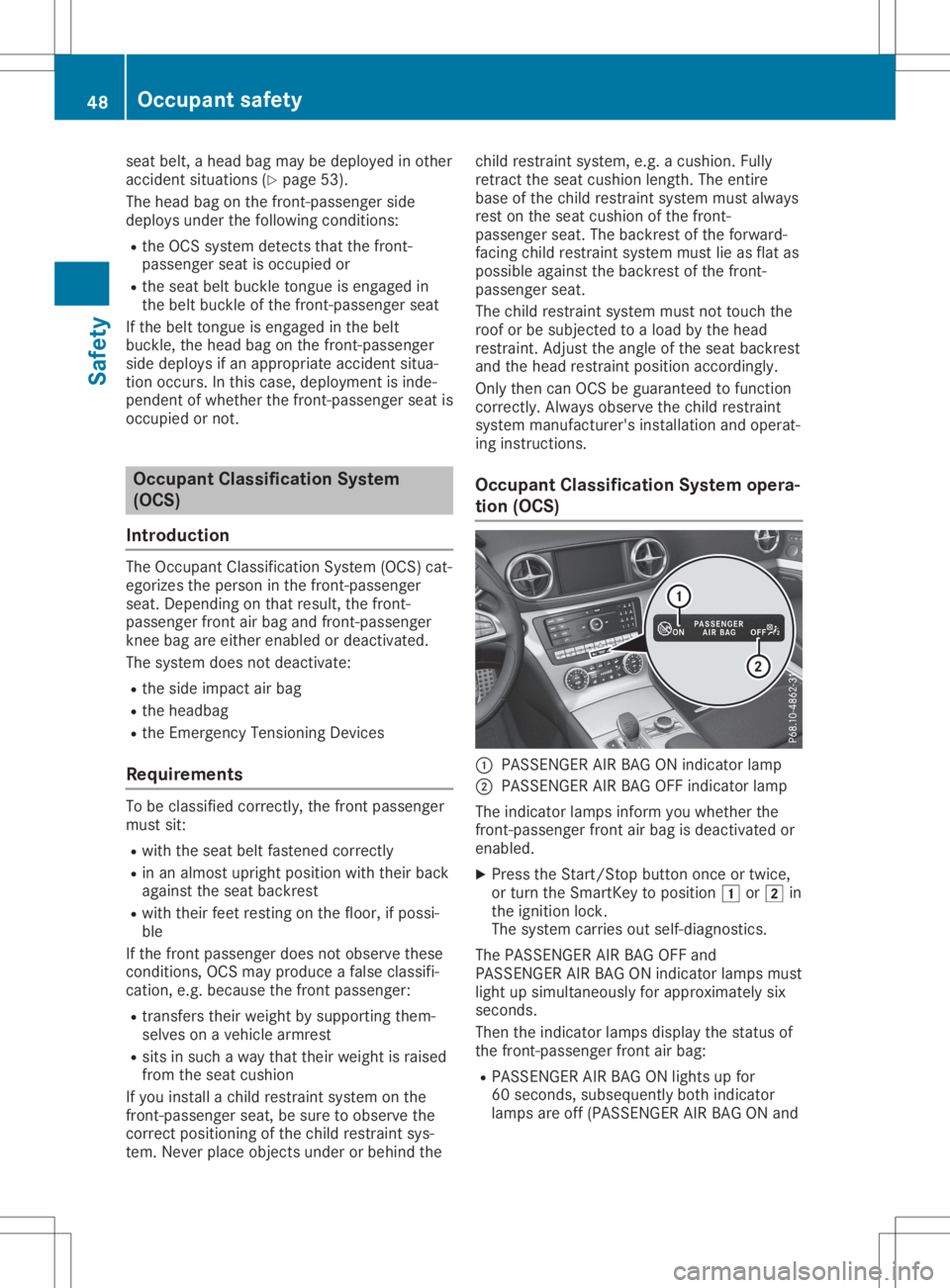
Occupant ClassificationSystem opera-
tion (OCS) 0043
PASSE NGERAIRBAG ONindicator lamp
0044 PASSE NGERAIRBAG OFFindicator lamp
The indicator lampsinform youwhether the
front -passenger frontairbag isdeactivated or
enabled.
X Press theStart/ Stopbutton onceortwice,
or turn theSmartKey toposition 0047or0048 in
the ignition lock.
The system carriesout<00560048004F004900100047004C0044004A0051005200560057004C00460056
0011[
The PASSE NGERAIRBAG OFFand
PASSE NGERAIRBAG ONindicator lampsmust
light upsimultaneousl yfor approximately six
seconds.
Then theindicator lampsdisplaythe status of
the front -passenger frontairbag:
R PASSE NGERAIRBAG ONlights upfor
60 seconds, subsequentlybothindicator
lamps areoff(PASSE NGERAIRBAG ONand 48
Occ
upant safetySafety
Page 58 of 334
R
setting amore favorable seatposition for
the front -passenger seat.
R vehicles withamulticontour seat:increasing
the airpressure inthe side bolsters ofthe
seat backrest.
! Make
surethatthere arenoobjects inthe
footwell orbehind theseats. Thereisadan-
ger that theseats and/or objects couldbe
damaged whenPRE-SA FE®
is activated.
Should anaccident notoccur, thepreventative
measures takenarereversed. Certainsettings
must bemade yoursel f.
X Ifthe seat beltpre-tensionin gis not
reduced, movetheseat backrest back
slightly.
Seat beltpre-tensionin gis released . PRE-SAFE
®
PLUS (anticipatory occu-
pant protection systemPLUS)
Introduction PRE-SA
FE®
PLUS isonly available invehicles
with theDriving Assistance package.
Using theradar sensor system, PRE-SAFE®
PLUS isable todetect thatahead-on orrear-
end collision isimminent. Incertain hazardous
situations, PRE-SAFE®
PLUS takes pre-emptive
measures toprotect thevehicle occupants.
Importa ntsafety notes The
intervent ionofPRE-SA FE®
PLUS cannot
prevent animminent collision.
The driver isnot warned abouttheintervent ion
of PRE-SA FE®
PLUS.
PRE-SA FE®
PLUS doesnotintervene ifthe
vehicle isbacking up.
When driving, orwhen parking orexiting a
parking spaceusingActive Parking Assist,
PRE-SA FE®
PLUS willnotapply thebrakes.
Function PRE-SA
FE®
PLUS intervenes incertain situa-
tions ifthe radar sensor system detects an
imminent head-onorrear-end collision. PRE-SA
FE®
PLUS takes thefollowi ngmeas-
ures depending onthe hazardous situation
detected:
R ifthe radar sensor system detects thata
head-on collision isimminent, theseat belts
are pre-tensioned.
R ifthe radar sensor system detects thata
rear-end collisionisimminent:
- the brake pressure isincreased ifthe
driver appliesthe brakes whenthevehicle
is stationary.
- the seat belts arepre-tensioned.
The PRE-SA FE®
PLUS braking application is
canceled:
R ifthe accelerator pedalisdepressed whena
gear isengaged
R ifthe risk ofacollision passesorisno lon-
ger detected
R ifAct ive Distance AssistDISTRONIC indi-
cates anintent iontointervene
If the hazardous situationpasseswithout
resulting inan accident, theoriginal settings
are restored. Automatic
measuresafteranacci-
dent
Immediately afteranaccident, thefollowi ng
measures areimplemented, dependingonthe
type andseverity ofthe impact:
R the hazard warning lampsareswitched on
R the emergency lightingisactivated
R the vehicle doorsareunlocked
R the front sidewindows arelowered
R the electrically adjustablesteeringwheelis
raised whenthedriver's doorisopened
R the engine isswitched offand thefuel sup-
ply iscut off
R vehicles withMercedes meconn ect:auto-
matic emergency call 56
Occ
upant safetySafety
Page 59 of 334
Child
reninthevehi cle Imp
ortant safety notes
If ach ild youn gerthan twe lveyears oldand
unde r5 ft (1. 50 m)inheig htistraveli nginthe
veh icle:
R always secure thech ild inach ild res traint
syst emsuitable forMer cedes-Ben zveh icles.
The child res traint systemmust beappro pri-
ate totheage, weigh tand sizeof thech ild.
R be sure toobse rveth eins truct ionsand
safe tyno tesin this sec tionin addit iontothe
ch ild res traint systemman ufacturer'sins tal-
lati on instruct ions.
R always observeth eins truct ionsand safety
no teson the"Oc cupan tClassi ficatio nSys -
te m (OCS )"(Y page 48) G
WAR
NING
If ch ildre nare left unsuperv isedintheveh i-
cle ,th ey coul d,inpart icular :
R Open doors,there byendan gering other
pers onsor road users
R Get outand bestruc kby oncom ingtraff ic
R Oper atevehicle equipm entand become
tr apped, forexample
In addit ion,ch ildre ncoul dset theveh icle in
mot ion,for example ,if th ey:
R Release thepark ingbrak e.
R Chan gethetrans mis sion position
R Start theveh icle
Ther eis aris kof acc iden tand injury.
Nev erleave childre nuns uperv isedinthe
veh icle.
When leavingtheveh icle,always taketh e
Sm artKey withyou and lockth eveh icle.
Keep theSm artKey outofthereac hof chil-
dren . G
WAR
NING
If pers ons,part icular lych ildre nare subj ec-
te dto pro longed exposur eto extreme heat
or col d,there isaris kof injury, poss ibly
eve nfat al. Nev erleave childre nunat tende d
in theveh icle. G
WAR
NING
If th ech ild res traint systemissubj ectedto
dire ctsun light ,part smay getveryhot .Chil-
dren mayburn thems elveson these parts,
part icular lyon themet alpart sof thech ild
res traint system. Ther eis aris kof injury.
If you leave theveh icle,tak ing thech ild with
you, always ensure that thech ild res traint
syst emisno tex pose dto dire ctsun light .
Pro tect itwit hablan ket,for example .If th e
ch ild res traint systemhas been expose dto
dire ctsun light ,let itcoo ldown before secur-
ing thech ild init. Nev erleave childre nunat -
te nde din theveh icle.
Always ensure that all veh icle occupan tshave
th eir seat beltsfast ened cor rectlyand aresit-
tin gpro perl y.Part icular attentio nmust bepaid
to childre n.
Obse rveth esafe tyno teson theseat belt
(Y page 42)and theno teson cor rectuse of
seat belts(Y page 43).
A boos terseat maybeneces sary toach ieve
pro per seat beltpositionin gfor childre nove r
40 lbs (18 kg)unt ilth ey reac haheig htwher e
a th ree -point seat beltcanbepro perlyfas-
te ne dwit hout aboos terseat . Sp
ecial seatbelt retractor G
WAR
NING
If th eseat beltisrele ased while driving,th e
ch ild res traint systemwill nolonger be
sec ured properly.The spec ialseat belt
ret rac toris disabl edand theine rtia real
draws inapor tionof theseat belt.The seat
belt cannotbe imm ediat elyrefast ened.
Ther eis an increas edriskof injury, poss ibly
eve nfat al.
St op theveh icle imm ediat ely,payin gatt en-
tio nto road andtraff icco nd ition s.React i-
vat eth espec ialseat beltretrac torand
sec ure thech ild res traint systemproperly.
The seat beltonthefron t-pass enger 'sside is
equipp edwithaspec ialseat beltretrac tor.
When activat ed, thespec ialseat beltretrac tor Child
reninthevehi cle
57Safety Z
Page 62 of 334
Alw
ayssec ureani ma lspro perly when driv-
ing ,for instance with asu ita ble pe tcar rier. Dri
ving safe tysys tems Ove
rviewof driv ingsafe tysys tems
In thi ssec tion,youwi llfind informa tionab ou t
the followi ng driving safety system s:
R ABS (Anti -lock Bra king Syste m)
(Y page 60)
R BAS (Bra keAssist Sy stem )(Y page 61)
R Bra keAssi stwith cros s-tra fficfu nctio n
(Y page 61)
R Active BrakeAssi st(Y page 63)
R Ada ptive bra kelights (Ypage 65)
R ESP ®
(El ectro nicStability Pro gram)
(Y page 65)
R EBD (El ectro nicBrake forceDi stri butio n)
(Y page 69)
R ADAPTI VEBRAK E(Y page 70)
R Active BrakeAssi stwith cros s-tra fficfu nc-
tio n(Y page 70)
R STEER CONTR OL(Ypage 72) Impo
rtant safetynotes
If yo ufai lto adap tyo ur driving styleor ifyo u
ar eina ttenti ve,the driving safety system scan
nei ther reduce theriskof an acci dent nor
ove rride the laws ofphy sics. Driv ingsafety
sy stem sar emer elyai ds designe dto assist
dri ving .
Yo uar eres ponsi ble for mainta ining the dis-
tance tothe vehiclein front, forveh iclespe ed,
for braking ingoo dtime ,and forstaying in
la ne. Alwaysad aptyo ur driving styleto suit
the prevailing roadand weath ercond itions and
ma inta inasa fe dista nce from thevehiclein
front. Drivecar efully.
The driving safety system sde scri bedonl y
wo rkas effe ctive lyas possi ble wh en ther eis
ad eq uate conta ctbetwe enthe tiresand the
roa dsu rfa ce. Paypa rticu laratte ntionto the
info rma tionreg arding tire s,reco mme nded
mini mumtire trea dde pths etc.inthe "Whee ls
and tires"sec tion(Y page 296 ).
In wintry driving cond itions, alwa ysusewi nter
tire s(M +S tire s)and ifnece ssary,snow cha
ins.Onl yin thi swa ywi llthe driving safety
sy stem sde scri bedin thi ssec tionwo rkas
effe ctive lyas possi ble. ABS
(Anti -lock Braki ngSys tem)
Ge neral info rmatio n ABS
regulate sbra kepre ssu reinsuch awa y
tha tthe wheelsdo not lock when youbra ke.
Thi sal lo ws youto conti nuesteering thevehi-
cle when bra king .
The 0025 ABSwarning lamp inthe instrum ent
clu ster lights upwhen the igniti onissw itch ed
on. Itgoe sou twh en the engineisrunning .
ABS works from aspe edofabou t5 mph
(8 km/h ),reg ardless ofroa d-su rface cond i-
tio ns. ABS works onslip pe ry surfa ces ,eve n
wh en youonl ybra kegently .
Impo rtant safetynotes i
Obs
ervethe "Impo rtant safety notes "sec -
tio n(Y page 60). G
WA
RNING
If ABS isma lfunctio ning,the wheelscou ld
lo ck when bra king .The stee rability and
bra king characteri stics wo uld be sev erely
aff ecte d.The reisan incr eased dange rof
ski dding and accidents.
Driv eon car efully. Hav eABS checked imme-
di ate lyat aqu alifi ed spe cialist wo rksh op.
Whe nABS isma lfunctio ning,othe rsy stem s,
incl uding driving safety system s,willal so
be come inoperative .Obs ervethe informa tion
on the ABS warning lamp (Ypage 239 )and
di spl aymes sages which maybe sho wninthe
ins trum entcluster (Ypage 209 ).
Brake s X
IfABS interv enes:conti nuetodepre ssthe
bra kepedalvig oro uslyunti lthe braking sit-
ua tio nis ove r.
X To make aful lbrake application:de pre ss
the brakepedalwi th fullforc e.
If ABS intervenes when bra king ,yo uwi llfee la
pu lsing inthe brakepedal. 60
Dri
ving safe tysys temsSafe ty
Page 63 of 334

The
pulsating brakepedalcanbeanindication
of hazardous roadcondit ions,andfunct ionsas
a reminder totake extracare while driving. BAS
(BrakeAssist System)
General information BAS
operates inemergenc ybraking situations.
If you depress thebrake pedalquickly, BAS
automatically booststhebraking force,thus
shorten ingthe stopping distance.
Import antsafety notes i
Observe
the"Importan tsafety notes" sec-
tion (Ypage 60). G
WARNIN
G
If BAS ismalfunct ioning,thebraking dis-
tanc ein an emergenc ybraking situation is
increased. Thereisarisk ofan accident .
In an emergenc ybraking situation, depress
the brake pedalwithfullforce. ABSprevent s
the wheels fromlockin g.
Br aking X
Keep thebrake pedalfirmly depressed until
the emergenc ybraking situation isover.
ABS prevent sthe wheels fromlockin g.
The brakes willfunct ionasusual onceyou
release thebrake pedal. BASisdeactivated. Br
ake Assist withcross-tr afficfunc-
tion
General information Brake
Assist withcross- trafficfunct ioncan
help youtominimize therisk ofacollision with
a vehicle orapedestrian andreduce the
effect sof such acollision. IfBrake Assist with
cross- trafficfunct iondetect sa danger ofcolli-
sion, youareassisted whenbraking.
i Observe
the"Importan tsafety notes" sec-
tion (Ypage 60).
Brake Assist withcross- trafficfunct ionisonly
availabl ein vehicles withtheDrivin gAssis-
tanc epackage. For
Brake Assist withcross- trafficfunct ionto
assist youwhen driving, theradar sensor sys-
tem andthecamera systemmustbeopera-
tional.
The sensor system andcamera systemhelp
Brake Assist withcross- trafficfunct iondetect
obstacles:
R that areinthe path ofyour vehicle foran
exten dedperiod oftime
R that cross thepath ofyour vehicle
In addition, pedestrians inthe path ofyour
vehicle canbedetect ed.
Brake Assist withcross- trafficfunct iondetect s
pedestrians usingtypical charact eristics such
as body contours andtheposture ofaperson
standin gupright.
If the radar sensor system orthe camera sys-
tem ismalfunct ioning,BrakeAssist withcross-
traff icfunct ionisrestr icted orno longer availa-
ble. Thebrake system isstill availab lewith
complete brakeboosting effectandBAS.
i Observe
therestr iction sdescribed inthe
"Importan tsafety notes" section
(Y page 61).
Import antsafety notes G
WARNIN
G
Act ive Brake Assist withcross- trafficfunc-
tion cann otalway sclearly identify objects
and complex trafficsituations.
In such cases, Active Brake Assist with
cross- trafficfunct ionmight:
R issue anunneces sarywarning orbrake
R issue nowarning ornot brake
Always paycareful attentiontothe traff ic
situation; donot rely onthe Active Brake
Assist withcross- trafficfunct ionalone.
Always beready tobrake andpossibly take
evasive action. G
WARNIN
G
Brake Assist withcross- trafficfunct ioncan-
not alway sclearly identify people,particu-
larly ifthey aremoving. BrakeAssist with
cross- trafficfunct ioncann otinter vene in
these cases. Thereisarisk ofan accident . Driving
safetysystems
61Safety
Z
Page 65 of 334

Up
toaspeed ofapproximately 44mph
(70 km/h), BrakeAssist withcross-t raffic
function mayreact to:
R stationary objectsinthe path ofyour vehi-
cle, e.g. stopped orparked vehicles
R pedestrians inthe path ofyour vehicle
R obstacles crossingyourpath which movein
the detection rangeofthe sensors andare
detected
i If
Brake Assist withcross-t rafficfunction
requires aparticularl yhigh braking force,
preventative passengerprotectionmeasures
(PRE-SAF E®
)are activated atthe same time
(Y page 55).
X Keep thebrake pedaldepressed untilthe
emergency brakingsituation isover.
ABS prevents thewheels fromlocking.
Brake Assist withcross-t rafficfunction is
deactivated andthebrakes function asusua l
agai nif:
R you release thebrake pedal
R there isno longer arisk ofcollision
R no obstacle isdetected infront ofyour vehi-
cle
R you depress theaccelerator pedal
R you activate kickdown Active
BrakeAssis t
General information i
Observe
the"Important safetynotes" sec-
tion (Ypage 60).
Act ive Brake Assist consists ofadistance
warning function withanautonomous braking
function andAdaptive BrakeAssist.
Act ive Brake Assist canhelp youtominimize
the risk ofacollision withthevehicle infront
or reduce theeffects ofsuch acollision.
If Act ive Brake Assist detects thatthere isa
risk ofcollision, youwillbewarned visually
and acousticall y.Ifyou donot react tothe vis-
ual collision warningorthe warning tone,
autonomous brakingcanbeinitiated incritical
situations. Ifyou apply thebrake yoursel fin a
critical situation, AdaptiveBrakeAssist ofthe
Act ive Brake Assist system supports you. Importa
ntsafety notes In
particular, thedetection ofobstacles canbe
impaired if:
R there isdirt onthe sensors oranything else
covering thesensors
R there issnow orheavy rain
R there isinterferenc eby other radarsources
R there arestrong radarreflections, forexam-
ple inparking garages
R anarrow vehicle istraveling infront ,e.g. a
motorbike
R avehicle istraveling infront onadifferent
line
R you aredriving anew vehicle orservicing on
the Active Brake Assist system hasjust
been carried out
Observe theimportant safetynotesinthe
"Breaking-in notes"section (Ypage 125).
Followi ngdamage tothe front endofthe vehi-
cle, have theconfiguration andoperation of
the radar sensor checked ataqual ified spe-
cialist workshop. Thisalso appli estocollisions
at slow speeds wherethereisno visible dam-
age tothe front ofthe vehicle.
Activating/ deactivating Act
ive Brake Assist isautomaticall yactive
after switching onthe ignition.
You canactivate ordeactivate Active Brake
Assist usingtheon-board computer
(Y page 200). When deactivated, thedistance
warning function andtheautonomous braking
function arealso deactivated.
If Act ive Brake Assist isdeactivated, the00D4
symbol appearsinthe assistance graphicdis-
play .
Distance warningfunction General
information
The distance warningfunction canhelp youto
minimize therisk ofafront -end collision witha
vehicle aheadorreduce theeffects ofsuch a
collision. Ifthe distance warningfunction
detects thatthere isarisk ofacollision, you
will bewarned visuallyand acousticall y. Driving
safetysystems
63Safety Z
Page 67 of 334
Ada
ptive Bra keAssi stpro vides bra king assis-
tance inha zard oussitua tions atspe edsab ove
4 mph (7km/h ).It us es rada rsens ortech nol-
ogy toasses sthe trafficsitua tion.
Up toaspe edofappro xima tely155 mph
(25 0km/h ),Ada ptive Bra keAssi stiscap able
of rea cting tomovi ngobjects thatha ve
al rea dybeen detecte das such atleas tonce
ove rthe perio dof obser vatio n.
Up toaspe edofappro xima tely44 mph
(70 km/h ),Ada ptive Bra keAssi strea cts to
sta tionar yob sta cles.
If Ada ptive Bra keAssi stdema nds particu larly
hi gh bra king force,pre venta tivepasse nge r
pro tecti onmea sures (PRE-SAFE ®
)ar eacti va-
ted simu ltaneo usly(Y page 55).
X Kee pthe brakepedalde pre sse dunti lthe
eme rgency braking situa tionis ove r.
ABS prevents thewheelsfrom locking .
The brakes willwo rknorma lly ag ain if:
R yourel ease the brakepedal
R ther eis no longe rany dange rof acol lisi on
R no obsta cle isde tecte din front ofyour veh i-
cle
Ada ptive Bra keAssi stisthen deacti vated .
Impo rtant safetynotes G
WA
RNING
Ada ptive Bra keAssi stcanno tal wa yscle arly
id enti fyob jects andcomp lextraf ficsitua -
tio ns.
In such cas es, Ada ptive Bra keAssi stcan:
R inte rveneunne cessarily
R not intervene
The reisaris kof an acci dent.
Alw ayspa ycar efulatte ntionto the traffic
si tua tionand berea dytobra ke. Termi nate
the interventio nin anon-cri ticaldri ving sit-
ua tio n. G
WA
RNING
Ada ptive Bra keAssi stdo es not react:
R to peop leor ani ma ls
R to onco ming vehicles
R to cros sing traf fic
R wh en corne ring As
ares ult, the Adaptive Bra keAssi stma y
not interveneinallcriti calcond itions. There
is aris kof an acci dent.
Alw ayspa ycar efulatte ntionto the traffic
si tua tionand berea dytobra ke.
Alw aysad aptyo ur spe edtosuitthe prevail-
ing roadand trafficcond itions.
Due tothe natu reofthe system ,pa rticu larly
comp licate dbu tnon-cri ticaldri ving cond itions
ma yal so cau seAda ptive Bra keAssi stto inte r-
vene .
If Ada ptive Bra keAssi stisnot availa bl e du eto
a ma lfunctio nin the rada rsens orsystem ,the
bra kesystem remains availa bl e wi th fullbra ke
bo osti ngeffe ctand BAS. Ada
ptiv ebrake lights
i Obs
ervethe "Impo rtant safety notes "sec -
tio n(Y page 60).
If yo ubra kesha rplyfrom aspe edofmore than
50 km/h orifbra king isas sisted byBAS or
Bra keAssi stwith Cross -Tra fficAssi st,the
bra kelamps flash rapidly. In thi swa y,traf fic
trav eling behind youis wa rned inan eve n
more noticeable ma nner.
If yo ubra kesha rplyfrom aspe edofmore than
70 km/h toasta ndsti ll, the hazard warning
la mps areacti vated automa tically. Ifthe
bra kes areap plied ag ain, the brakelamps light
up conti nuously.The hazard warning lamps
sw itch offautoma tically if yo utrav elfas ter
tha n10 km/h .Yo ucan also switch offthe
ha zard warning lamps using the hazard warn-
ing button (Ypage 111 ). ES
P®
(E lectro nicStab ility Pro gram)
Ge neral notes i
Obs
ervethe "Impo rtant safety notes "sec -
tio n(Y page 60) .
ESP ®
moni torsdriving stability and traction,
i.e .po we rtrans mission betwe enthe tiresand
the roadsu rfa ce.
If ESP ®
de tects thatthe vehicleis de via ting
from thedirecti ondesired bythe driver ,one or
more wheelsarebra ked tosta bilize the vehi-
cle .The engineoutpu tis also mod ified tokee p Dri
ving safe tysys tems
65Safety Z