battery MERCEDES-BENZ SL CLASS 2020 Owner's Guide
[x] Cancel search | Manufacturer: MERCEDES-BENZ, Model Year: 2020, Model line: SL CLASS, Model: MERCEDES-BENZ SL CLASS 2020Pages: 334, PDF Size: 17.43 MB
Page 277 of 334
Observe
thelegal requirements ineach coun-
try.
X Do not use hotwater anddonot wash the
vehicle indirect sunlight.
X Use asoft sponge toclean.
X Use amild cleaning agent,suchasacar
shampoo approved byMercedes-Benz .
X Thoroughly hosedown thevehicle witha
gentle jetofwater.
X Do not point thewater jetdirectly towards
the airinlet orthe edges ofdecorative foils.
X Use plenty ofwater andrinse outthe
sponge frequently.
X Rinse thevehicle withclean water anddry
thoroughly withachamois.
X Do not letthe cleaning agentdryonthe
paintwork orthe decorative foils.
Careful lyremove alldeposits ofroad saltas
soon aspossible whendriving inwinter.
Powe rwashers G
WARNING
The water jetfrom acircular jetnozz le(dirt
blasters) cancause invisible exteriordam-
age tothe tires orchassis component s.
Components damagedinthis way may fail
unexpectedly. Thereisarisk ofan accident.
Do not use power washers withcircular jet
nozz lestoclean thevehicle. Havedamaged
tires orchassis component sreplaced imme-
diately .
! Vehicles
withdecorative film:parts ofyour
vehicle arecovered withdecorative film.
Maintain adistance ofat least 27.5in
(70 cm) between thefilm-covered partsof
the vehicle andthenozz leof the power
washer.
Information aboutthe correct distance is
avail able from theequip ment manufacturer.
Move thepower washer nozzlearound when
cleaning yourvehicle.
The water temperature ofthe power washer
must notexceed 140‡(60 †).
! Alway
smaintain adistance ofat least
12 in(30 cm) between thevehicle andthe
power washer nozzle.Information aboutthe
correct distance isavail able from theequip -
ment manufacturer. Move
thepower washer nozzlearound when
cleaning yourvehicle.
Do not aim directly atany ofthe followi ng:
R Tires
R Door gaps, roofgaps, joints, etc.
R Electrical component s
R Battery
R Plug-type couplings
R Light bulbs
R Seals
R Trim elements
R Ventilation slots
Damaged sealsorelectrical component s
can lead toleaks orfailu res.
! Vehicles
withHAND S-FREE ACCESS: ifa
key with KEYLES S-GOiswithin thedetec-
tion range ofthe KEYLES S-GOantenn as,the
trunk lidcould openunintent ionallyinthe
followi ngsituations, forexample:
R when usinganautomatic carwash
R when usingapower washer
Make surethatthekey isat least 6.5ft
(2 m) awa yfrom thevehicle.
Cleani ngthe paintwork !
Do
not affix:
R stickers
R films
R magnetic platesorsimila ritems
to painted surfaces. Youcould otherwise
damage thepaintwork.
Scratc hes,corrosive deposits,areasaffected
by corrosion anddamage causedbyinade-
quate carecannot alwaysbe completely
repaired. Insuch cases, visitaqual ified spe-
cialist workshop.
X Remove dirtimmediately ,where possible ,
while avoidi ngrubbing toohard.
X Soak insect remains withinsect remover
and rinse offthe treated areasafterwards.
X Soak birddroppings withwater andrinse off
the treated areasafterwards.
X Remove treeresin, oils,fuels andgreases by
rubbing gentlywithacloth soaked inpetro-
leum ether orlighter fluid
X Remove coolantandbrake fluidwithamoist
cloth andclear water. Care
275Maintenance andcare Z
Page 287 of 334
H
Envir
onme ntalnote
Hav eth eused tiresealan tbot tledispo sed
of prof essio nally, e.g.at aqualifie dspec ial-
ist work shop.
If atir epres sure of18 0kPa (1.8 bar/26 psi)
ha sbe en achiev ed after ama xim um perio dof
ten minute s:
X Swi tch offthe tire inflatio ncomp ressor .
X Unsc rewthefillerhos efro mthe valve ofthe
fa ulty tire .
X Stow thetire sealant bottle and thetire
inf latio ncomp ressor .
X Pul law ayimme diately.
X Stop after drivin gfor appro xim atelyten
mi nute sand checkthe tire pressu rewith
the tire inflatio ncomp ressor .
The tirepressu remu stnow beatleas t
130 kPa(1.3 bar/19 psi). G
WA
RNING
If the required tire pressu reisnot reache d
af ter drivin gfor asho rtpe rio d,the tire istoo
ba dlyda ma ged. The tiresealant cann ot
rep airthe tire inthi sins tance .Dam aged
tire sand atire pressu retha tis too low can
si gni ficantl yim pairthe vehicle'sbra king and
dri vin gcha racteri stics. The reisaris kof
acc ident.
Do not conti nuedrivin g.Co ntact aqu alifi ed
sp eci alistwo rksh op.
i In
cas essuch asthe one menti oned
ab ove ,conta ctan author izedMe rced es-
Benz Center. Orcall1-800 -FOR-MER Cedes
(i n the USA) or1-800 -387-0 100(in Ca nad a).
X Co rre ctthe tire pressu reifit is sti llat leas t
130 kPa(1.3 bar/19 psi). See theTire and
Loa ding Info rma tionplaca rdon the driver 's
si de B-pi llar or the tire pressu retab lein the
fu el fillerfla pfor values .
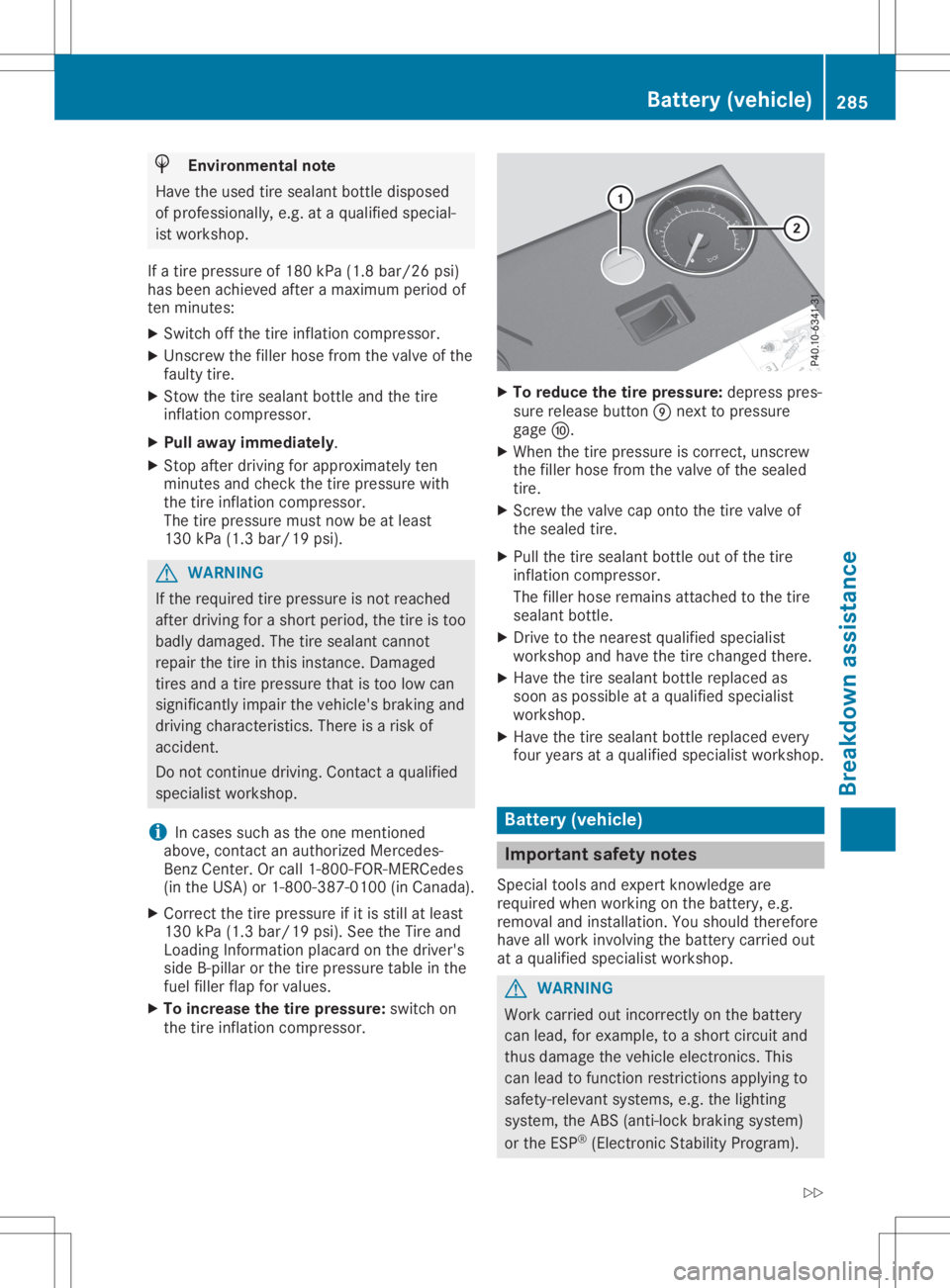
X To incre ase thetire pres sure :sw itch on
the tire inflatio ncomp ressor . X
To redu cethe tire pres sure :de pre sspre s-
su re release button 006Dnext topre ssu re
ga ge 006E.
X Wh enthe tire pressu reiscorr ect, unscrew
the fillerhos efro mthe valve ofthe sealed
tire .
X Scre wthe valve cap onto thetire valve of
the sealed tire .
X Pu llthe tire sealant bottle outof the tire
inf latio ncomp ressor .
The fillerhos erem ains atta chedto the tire
se alant bottle .
X Driv eto the nearestqu alifi ed speci alist
wo rksh opand have the tire change dthe re.
X Hav ethe tire sealant bottle replaced as
soo nas possi ble at aqu alifi ed speci alist
wo rksh op.
X Hav ethe tire sealant bottle replaced every
fou rye arsat aqu alifi ed speci alistwo rksh op. Batte
ry(veh icle ) Impo
rtant safety notes
Spe cialtoo lsand expertknow ledg ear e
req uired when working on the battery ,e.g .
rem ovaland installatio n.Yo usho uld the refore
ha ve allwo rkinv olvin gthe battery carriedou t
at aqu alifi ed speci alistwo rksh op. G
WA
RNING
Wo rkcar riedou tinco rrectly onthe battery
can lead ,for exa mpl e,to asho rtcir cui tand
thu sda ma gethe vehicleelectro nics.Thi s
can lead tofunctio nres tric tions applying to
sa fety -releva ntsyste ms, e.g.the lighti ng
sy ste m, the ABS (anti-l ock braking syste m)
or the ESP ®
(El ectro nicStab ility Pro gram). Battery
(veh icle )
285Break downass istanc e
Z
Page 288 of 334

The
operating safetyofyour vehicle maybe
restr icted.
You could losecontrolofthe vehicle, for
example:
R when braking
R in the event ofabrupt steeringmaneuvers
and/or whenthevehicle's speedisnot
adapted tothe road condit ions
There isarisk ofan accident .
In the event ofashort circuit orasimilar
incident ,cont actaqualified specialist work-
shop immediately. Donot drive anyfurther.
You should haveallwork involving thebat-
tery carried outataqualified specialist
workshop.
For further informationabout ABSandESP®
,
see (Ypage 60)and (Ypage 65). G
WARNIN
G
Elect rostat icbuild-up canlead tothe crea-
tion ofsparks, whichcouldignite thehighly
explosive gasesofabattery. Thereisarisk
of an explosion.
Before handling thebattery, touchthevehi-
cle body toremove anyexistin gelectrost atic
build-up.
The highly flammable gasmixt ureforms when
charging thebattery aswell aswhen jump-
start ing.
Always makesurethatneither younorthebat-
tery iselectrost aticallycharged. Abuild-up of
electrost aticcharge canbecaused, forexam-
ple:
R by wearing clothingmade fromsynthet ic
fibers
R due tofrict ionbetween clothingand seats
R ifyou push orpull thebattery acrossthe
carpet orother synthet icmaterials
R ifyou wipe thebattery withacloth G
WARNIN
G
During thecharging process,abattery pro-
duces hydrogen gas.Ifashort circuit occurs
or sparks arecreated, thehydrogen gascan
ignite. Thereisarisk ofan explosion. R
Make surethatthepositive terminalof a
conn ected battery doesnotcome into
cont actwith vehicle parts.
R Never placemetal object sor tools ona
battery.
R Itis important thatyouobserve the
described orderofthe battery terminals
when connectin gand disconn ectingabat-
tery.
R When jump-st arting,makesurethatthe
battery poleswithidentical polarityare
conn ected.
R Itis particularly importanttoobserve the
described orderwhen connectin gand dis-
conn ectin gthe jumper cables.
R Never connectordisconn ectthe battery
termin alswhile theengine isrunnin g. G
WARNIN
G
Batt eryacid iscaustic. Thereisarisk of
injury.
Avoid contactwith skin, eyesorclothin g.Do
not inhale anybattery gases.Donot lean
over thebattery. Keepchildren awayfrom
batteries. Washawaybattery acidimmedi-
ately withplenty ofclean water andseek
medical attention. H
Environmental
note Batt
eries containpollutants.
It is illegal todispose of
them withthehousehold
rubbish. Theymust becol-
lected separately anddis-
posed ofinan environ men-
tally responsible recycling
system. Dispose
ofbatteries inan
environ mentallyresponsible
manner .Take discharged
batteries toaqualified spe-
cialist workshop ortoacol-
lection pointforused bat-
teries. 286
Bat
tery (vehicl e)Breakdown assistance
Page 289 of 334
!
Have
thebattery regularlychecked ata
qual ified speciali stworkshop.
Comply withtheservice intervals inthe
Maintenance Booklet,orcont actaqual ified
speciali stworkshop formore information.
! Alway
shave work onbatteries carriedout
at aqual ified speciali stworkshop.
Should it,inexceptional circumstances, be
absolu telynecessary todisconnect the12-
volt battery yourself,please observe thefol-
lowing:
R Secure thevehicle toprevent itfrom roll-
ing awa y.
R Switch offthe ignition.
R Disconn ectthe negative terminalfirstand
then thepositive terminal.
After thework hasbeen done, install the
battery andreplace thecover ofthe positive
terminal clampfirmly.
Comply withsafety precautions andtake pro-
tect ivemeasures whenhandling batteries. Risk
ofexplosion. Fire,
open flames andsmoking are
prohibited whenhandling thebat-
tery. Avoid creating sparks. Battery
acidiscaustic. Avoidcon-
tact with skin, eyesorclothing.
Wear suitabl eprotective clothing,
especial lygloves, apronandface-
guard.
Rinse anyacid spills immediately
with clear water. Contact aphysi-
cian ifnecessary. Wear
eyeprotection. Keep
children away. Observe
thisOperator's Manual.
For safety reasons, Mercedes-Benz recom-
mends thatyouonly usebatteries whichhave been
tested andapproved foryour vehicle by
Mercedes-Benz .These batteries provide
increased impactprotection toprevent vehicle
occupants fromsuffering acidburns should
the battery bedamage din the event ofan
accident.
In order forthe battery toachieve themaxi-
mum possible servicelife,itmust alwaysbe
sufficiently charged.
Like other batteries, thevehicle battery may
discharge overtime ifyou donot use thevehi-
cle. Inthis case, havethebattery disconnec-
ted ataqual ified speciali stworkshop. Youcan
also charge thebattery withacharger recom-
mended byMercedes-Benz .Contact aqual i-
fied speciali stworkshop forfurther informa-
tion.
Have thebattery condition ofcharge checked
more frequently ifyou usethevehicle mainly
for short tripsorifyou leave itstanding idle
for alengthy period.Consult aqual ified spe-
cialist workshop ifyou wish toleave yourvehi-
cle parked foralong period oftime.
Remove theSmartKey ifyou park thevehicle
and donot require anyelectrical consumers.
The vehicle willthen usevery little energy,
thus conserving batterypower.
After aninterruption tothe power supply,e.g.
due toadischarged battery,youmust reset
the clock (seetheDigital Operator's Manual). Charging
thebattery G
WARNING
During charging andjump-startin g,explosive
gases canescape fromthebattery. Thereis
a risk ofan explosion.
Particularl yavoid fire,open flames, creating
sparks andsmoking. Ensurethereissuffi-
cient ventilation whilecharging andjump-
starting. Donot lean over abattery. G
WARNING
Battery acidiscaustic. Thereisarisk of
injury.
Avoid contactwith skin, eyesorclothing. Do
not inhale anybattery gases.Donot lean
over thebattery. Keepchildren awayfrom
batteries. Washawaybattery acidimmedi- Bat
tery (vehic le)
287Breakdown assistance
Z
Page 290 of 334
ate
lywith plentyof cle an wate rand seek
medi calattent ion. G
WAR
NING
A disc harg edbat tery can freez eat temper a-
tur es below freez ing poin t.When jump-start-
ing theveh icle orchargin gth ebat tery,
gases canescape from thebat tery. Ther eis
a risk ofan exp losio n.
Allo wthefroz en bat tery to thaw out befo re
ch argin git or jum p-starting.
! On
lyuse battery charge rswith amax imum
ch argin gvolt age of14 .8V.
! On
lych arge thebat tery usin gth ejum p-
st art ing con nectionpoin t.
The jump-startingcon nectionpoin tis in the
eng inecom partmen t.
If th eind icat or/warn inglamps donotlight up
at low temper atures,itis ver ylike lythat the
disc harg edbat tery has froz en. Inthis cas e,
you may neither charge thebat tery norjum p-
st art theveh icle.The servicelife ofath awed-
out battery may beshor ter. The start ing char-
act eris ticscan beimpair ed,part icular lyat low
te mper atures.Hav eth eth awed- outbattery
ch eck edataqualifi edspec ialist workshop.
Read thebat tery charge r'soper atingins truc-
tio ns befo rechargin gth ebat tery.
X Open thehood .
X Con nectth ebat tery charge rto theposit ive
te rm inal and ground pointin thesame order as
when connectingth edon orbat tery inthe
jum p-startingproc edure (Ypage 288). Rep
lacing the12 Vbat tery
Obse rveth eno teson the12 Vbat tery
(Y page 285).
Mer cedes-Ben zrec omm endsth at you have
th e12 Vbat tery repl aced ataqualifi edspe-
cialis twork shop,e.g .at an auth orized
Mer cedes-Ben zCent er.
If you want torepl ace thebat tery yours elf,
obse rveth efoll owin gno tes:
R Always replace adefe ctive battery with a
bat tery whic hmeet sth espec ificrequi re-
men tsof theveh icle.
The vehicle isequippe dwith anAGM
(Ab sorben tGlass Mat)te ch no logy battery.
Full vehicle function alit yis on lyguaran teed
with anAGM battery. For safe tyreas ons,
Mer cedes-Ben zrec omm endsth at you only
use batteries whic hhave been tested and
appro vedforyour vehicle byMer cedes-
Ben z.
R Use detach able partssuc has breat her
hose s,ang led con nectingpiec esorterm inal
cov ers from thebat tery whic his to be
repl aced .
R Mak esure that theven those isalways con-
nec tedto theorig inal open ingonthebat -
te ry side.
R Inst all existing orsupplie dcel lcaps topre-
ven tgases orbat tery acid from escapin g.
R Mak esure that thedet ach able partsare
con nectedagain inthesame way. Jum
p-st ar tin g
For thejum p-startingproc edure ,use onlythejum p-startingcon nectionpoin tin theeng inecom -
part men t,con sisting ofaposit iveterm inal and agro und point. G
WAR
NING
Bat tery acid iscaus tic.Ther eis arisk ofinjury.
Av oid contactwith skin, eyes orclo thing .Do notinh ale any battery gases .Do notlean overth e
bat tery. Keep childre naway from batteries .Wash awaybattery acid immediat elywith plentyof
cle an wate rand seek medicalattent ion. 288
Jum
p-st ar tin gBreak down assistance
Page 291 of 334

G
WARNING
During chargingand jump-starting, explosivegase scan escap efrom thebattery .There isa
risk ofan explo sion.
Particu larlyavoi dfire, open flames,creating sparksand smoking. Ensurethereissuffi cient
ventila tionwhilechargi ngand jump-starting. Donot leanover abattery . G
WARNING
During thechargi ngprocess ,a battery produceshydrogen gas.Ifashort circuitoccurs or
spar ksare created ,the hydrogen gascan ignite. Thereisarisk ofan explo sion.
R Make surethattheposi tive terminal ofaconnected batterydoesnotcome intocontact with
vehicl eparts.
R Never placemetal objects ortools onabattery .
R Itis impor tantthatyouobse rvethe descri bedorder ofthe battery terminal swhen connect-
ing and disconnecting abattery .
R When jump-starting, makesurethatthebattery poleswith identical polarityareconnected.
R Itis particu larlyimpor tanttoobse rvethe descri bedorder whenconnecting anddisconnect-
ing the jumper cables.
R Never connect ordisconnect thebattery terminal swhi lethe engine isrunning. G
WARNING
A discha rgedbattery canfreeze attempera turesbelow freezing point.Whenjump-starting the
vehicl eor chargi ngthe battery ,gase scan escap efrom thebattery .There isarisk ofan explo -
sion.
Allow thefrozen battery tothaw outbefore chargingitor jump-starting.
! Avoid
repeatedand lengthy starting attempts. Otherwise,the catal yticconverter couldbe
dama gedbythe non-combusted fuel.
If the indica tor/warni nglamp sdo not light up atlow tempera tures,itis very likelythat thedis-
charge dbattery hasfrozen. Inthis case, youmay neither chargethebattery norjump-start the
vehicl e.The service lifeofathawe d-outbattery maybeshorter. Thestarting characteristics can
be impa ired,particu larlyat low tempera tures.Havethethawe d-outbattery checked ataqua li-
fied speci alist worksho p.
Do not start thevehicl eusi ng arapi dchargi ngdevi ce.Ifyou rvehicl e'sbattery isdischa rged,the
engine canbejump-started fromanother vehicleor from adonor battery using jumper cables.
Observe thefollowi ngpoints:
R The battery isnot accessi bleinall vehicl es.Ifthe other vehicle'sbattery isnot accessi ble,
jump-start thevehicl eusi ng adonor battery orajump-starting device.
R You may onlyjump-start thevehicl ewhen theengine andexhau stsystem arecold.
R Do not start theengine ifthe battery isfrozen. Letthe battery thawfirst.
R Only jump-start frombatterie swith a12 Vvoltag erating.
R Only usejumper cableswhi chhave asuffi cient cross-section andinsul ated terminal clamps.
R Ifthe battery isfull ydischa rged,leavethe battery thatisbei ng used tojump-start connected
for afew minutes beforeattempting tostart. Thischarge sthe battery slightly.
R Make surethatthetwo vehicl esdo not touch. Jump-star
ting
289Breakdown assistance Z
Page 292 of 334

Make
surethat:
R The jumper cablesarenot damaged.
R Bare parts ofthe terminal clampdonot come intocontactwith other metal partswhile the
jumper cablesareconn ected tothe battery.
R The jumper cablescannot comeintocontactwith parts which canmove whentheengine is
running, suchasthe V-belt pulleyor the fan.
X Secure thevehicle byapply ingthe electric parking brake.
X Shift thetransmission toposition 005D.
X Make surethattheignition isswitched off.Allindicator lampsinthe instrumen tcluster must
be off. When usingtheSmartK ey,turn theSmartK eytoposition 0092inthe ignition lockand
remove it(Y page 126).
X Switch offallelectrical consumers, e.g.rear window defroster, lighting,etc.
X Open thehood. Position
number0084identifies thecharged batteryofthe other vehicle oran equival entjump-
startin gdevice.
X Press cover0043ofpositive terminal 0044down (inthe direction ofthe arrow) andturn itclock-
wise. Toexpose positive terminal 0044,press cover 0043down further.
X Connect positiveterminal 0044onyour vehicle topositive terminal 0087ofdonor battery 0084using
the jumper cable,alwaysbegin withpositive terminal 0044onyour ownvehicle first.
X Start theengine ofthe donor vehicle andrunitat idling speed.
X Connect negative terminal0085ofdonor battery 0084toground point0083ofyour vehicle usingthe
jumper cable,beginning withdonor battery 0084first.
X Start theengine.
X Before disconnec tingthejumper cables,letthe engine runforseveral minutes.
X First, remove thejumper cablesfromground point0083and negative terminal0085,then from
positive terminal 0044and positive terminal 0087.Begin eachtimeatthe cont acts onyour own
vehicle first.
X Aft erthe jumper cableisremoved, returncover0043ofpositive terminal 0044tothe original posi-
tion. Positive terminal 0044iscovered upand thus insulated again.
X Have thebattery checkedataqual ified specialist workshop.
Jump-starting isnot considered tobe anormal operating condition. 290
Jump
-startingBr eakdown assistance
Page 293 of 334
i
Jumper
cablesand further inform ationregar dingjum p-startingcan beobt aine dat any quali-
fied spec ialist workshop. Towing
andtow- star tin g Imp
ortant safety notes G
WAR
NING
When towing ortow-s tartingano ther veh icle
and itsweight isgreat erthan theperm issi-
ble grossweight ofyour vehicle,th e:
R theto wing eyecould detach itself
R theveh icle/trailer combinatio ncould roll-
over .
Ther eis arisk ofan acc iden t.
When towing ortow-s tartingano ther veh i-
cle, itsweight shouldno tbe great erthan
th eperm issiblegro ssweight ofyour vehicle.
Det ails ontheperm issiblegro ssveh icle weight
of your vehicle can befoun don theveh icle
iden tificat ion plat e(Y page 323).
! When
ActiveBr ake Assist ,Ac tiveDis tan ce
As sist DISTRO NICortheHOL Dfun ction is
act ivat ed, theveh icle brak esauto matically
in cer tain situatio ns.
To avoid damage totheveh icle,deac tivate
th ese systems inthefollo wing orsimi larsit-
uatio ns:
R when towing theveh icle
R in thecar wash
! On
lysec ure theto w rope ortow bar atthe
to wing eyes. Other wise, theveh icle could be
damage d.
! Do
notuse theto wing eyeforrecover y,
th is could damage theveh icle.If in doubt ,
rec over theveh icle with acr ane.
! When
towing ,pull away slowly and
smo othly. Ifth etract ive power istoohigh ,
th eveh iclescould bedamage d.
! Do
notto w with sling-type equipm ent.This
could damage theveh icle.
! When
towing away vehicleswith KEYLE SS-
GO, usethekey instead oftheSt art /S top
butt on.The auto matictrans miss ionmay
ot her wise shiftto posit ion005Dwhen you open
thedriv er'sor fron t-passe nger door ,
whic hcoul ddamage thetrans miss ion.
! Mak
esure that theelec tric park ingbrak e
is rele ased. Ifth eelec tric park ingbrak eis
fault y,visi ta qualifie dspec ialist workshop.
! You
may tow theveh icle foramax imum
dist anceof 30 miles (50kilomet ers). Ato w-
ing speed of30 mph (50km/h) must notbe
exc eeded .
For towing distancesover 30miles
(50 kilomet ers), theent ireveh icle must be
raise dand trans port ed.
! When
youaretow-s tartingor towing
ano ther veh icle,its weight mustnotexc eed
th emax imum permissiblegro ssweight of
your vehicle.
It is bet terto have theveh icle trans port ed
th an tohave itto wed away.
The auto matictrans miss ionmust beinposi-
tio n005C when theveh icle isbein gto wed away.
The batterymust becon nectedand char ged.
Ot her wise, you:
R can nottur nth eSm artKey toposit ion0048in
th eign itio nloc k
R can notshif tth eauto matictrans miss ionto
posit ion005C
De act ivat eth eauto maticloc kin gfeat ure
befo retheveh icle istowed (Ypage 203). You
coul dot her wise belocked outwhen pushin g
or towing theveh icle. Inst
allin g/rem ovingthetowing eye
Inst allin gth etowing eye G
WAR
NING
The exhaust tailpipe maybeveryhot .Ther e
is arisk ofburn swhen removin gth erear
cov er.
Do notto uch theexh aust pipe. Takepart icu-
lar carewhen removin gth erear cover. Towing
andtow- star tin g
291Break down assistance Z
Page 317 of 334
Maximum
loadedvehi cleweight
The maximu mwei ght isthe sum of:
R the curb weight ofthe vehicl e
R the weight ofthe accesso ries
R the loadlimi t
R the weight ofthe factory installedoptiona l
equ ipme nt
Kil opasc al(kPa)
Metric unitfortire pressu re.6.9 kPa corre-
sponds to1psi. Another unitfortire pressu re
is bar. 100 kilop ascals(kPa) arethe equivalent
of 1bar.
Load index
In add ition tothe load-bea ringindex, theload
index mayalsobe impri nted onthe side wallof
the tire. This speci fiestheload-bea ringcapa -
city more precis ely.
Curb weight
The weight ofavehicl ewith standard equip-
ment includ ingthe maximu mcapa cityoffuel ,
oil and coola nt.Itals oinclud esthe air-condi -
tioning system andoptiona lequ ipme ntifthese
are install edinthe vehicl e,but does not
includ epass engers orlug gage .
Maximum loadrating
The maximu mloa drating isthe maximu mper-
missi bleweight inkilog rams orlbs forwhi cha
tire isapp roved.
Maximum permissibletire pressure
Maximu mpermi ssibletire pressu refor one
tire.
Maximum loadonone tire
Maximu mloa don one tire. This iscalcu lated
by divi ding themaximu maxle loadof one axle
by two.
PSI (poun dsper square inch)
A standar dunit ofmeasu refor tire pressu re.
Aspe ctratio
Rel ationshi pbetwe entire heig htand tirewidth
in percent.
Tire pressure
This ispressu reinsid ethe tire applying anout-
ward force toeach square inch ofthe tire's
surfa ce.The tirepressu reisspeci fiedin pou
nds persquare inch (psi),in kilop ascal
(kPa) orinbar. Thetirepressu reshou ldonly
be corrected whenthetires arecold.
Col dtire pressure
The tires arecold:
R ifthe vehicl ehas been parked withthetires
out ofdire ctsunli ghtforatlea stthree hours
and
R ifthe vehicl ehas notbeen drivenfurther
than 1mile (1.6km)
Tread The part ofthe tire that comes intocontact
with theroad .
Bead
The tirebeadensure sthat thetire sits
secure lyon the whee l.There aresevera lsteel
wire sin the beadto prevent thetire from com-
ing loos efrom thewhee lrim.
Sidew all
The part ofthe tire betwe enthe tread andthe
bea d.
Weig htofoption alextras
The combined weight ofthose optiona lextras
that weighmore thanthereplaced standard
parts andmore than2.3kg(5lbs) .These
optiona lextras, suchashigh -performa nce
brakes ,level control, aroof rack orahigh -per-
formance battery,are not includ edinthe curb
wei ght and theweight ofthe accesso ries.
TIN (Tire Identification Number)
This isauniq ueidentifier whichcan beused
by atire manufa cturertoide ntify tires, for
exampl efor aprodu ctrecal l,and thus identify
the purcha sers.TheTINismade upofthe
manufa cturer's identity code, tiresize, tire
type code andthemanufa cturing date.
Load bearin gindex
The loadbea ring index (also loa dindex) isa
code thatcontains themaximu mloa dbea ring
capa cityofatire.
Traction Traction isthe resul tof friction betweenthe
tires andtheroad surface. Al
labout wheelsand tires
315Wheelsand tires Z