engine MERCEDES-BENZ SL-CLASS ROADSTER 2012 User Guide
[x] Cancel search | Manufacturer: MERCEDES-BENZ, Model Year: 2012, Model line: SL-CLASS ROADSTER, Model: MERCEDES-BENZ SL-CLASS ROADSTER 2012Pages: 316, PDF Size: 7.21 MB
Page 32 of 316
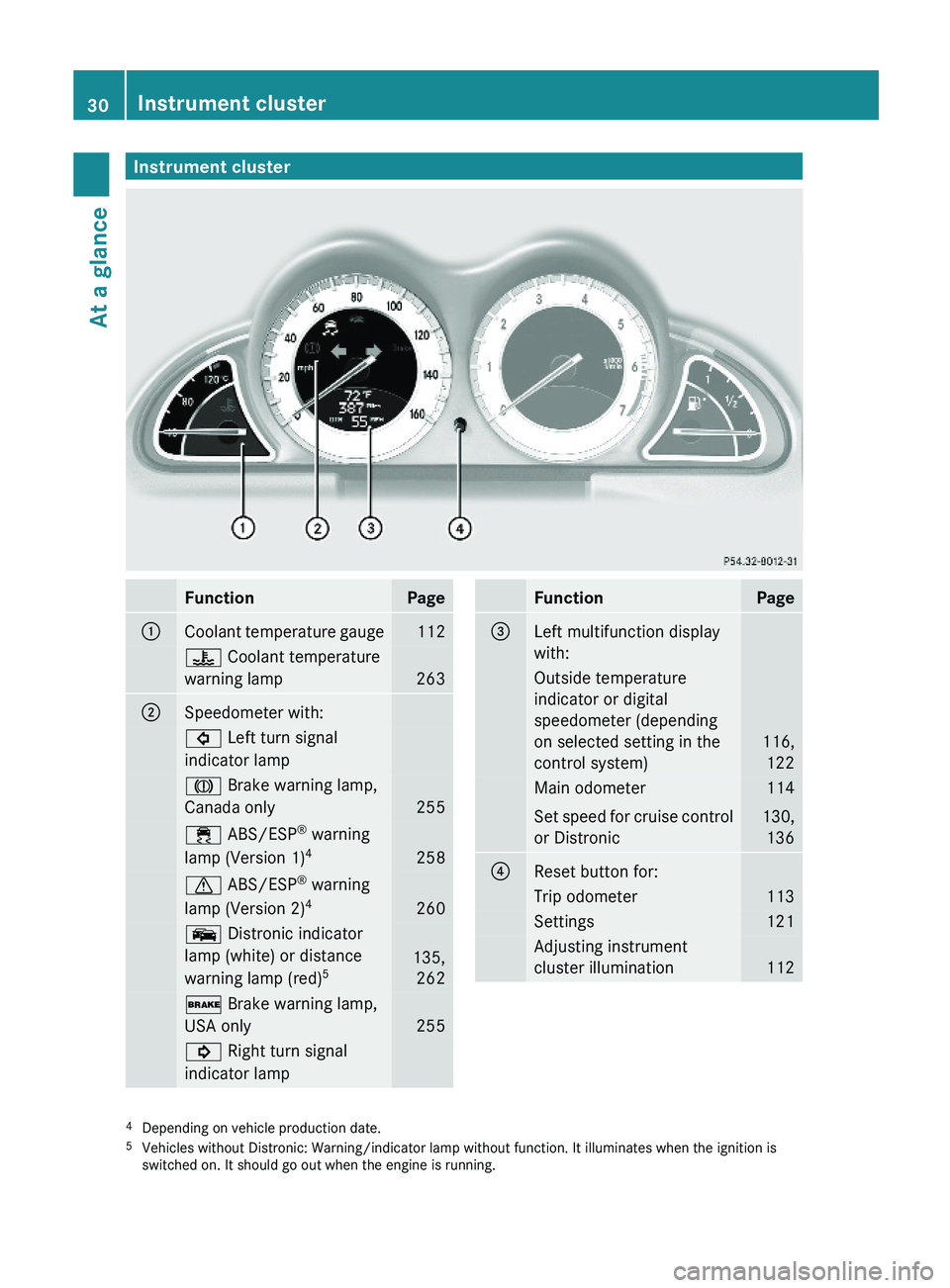
Instrument clusterFunctionPage:Coolant temperature gauge112? Coolant temperature
warning lamp263
;Speedometer with:# Left turn signal
indicator lamp
J Brake warning lamp,
Canada only255
÷ ABS/ESP® warning
lamp (Version 1)4 258
d ABS/ESP® warning
lamp (Version 2)4260
Ò Distronic indicator
lamp (white) or distance
warning lamp (red)5135,
262
$ Brake warning lamp,
USA only 255
! Right turn signal
indicator lamp
FunctionPage=Left multifunction display
with:
Outside temperature
indicator or digital
speedometer (depending
on selected setting in the
control system)
116,
122
Main odometer114Set speed for cruise control
or Distronic
130,
136
?Reset button for: Trip odometer113Settings121Adjusting instrument
cluster illumination1124Depending on vehicle production date.5Vehicles without Distronic: Warning/indicator lamp without function. It illuminates when the ignition isswitched on. It should go out when the engine is running.
30Instrument clusterAt a glance
230_AKB; 6; 22, en-USd2ureepe,Version: 2.11.8.12009-07-28T18:49:58+02:00 - Seite 30
Page 33 of 316
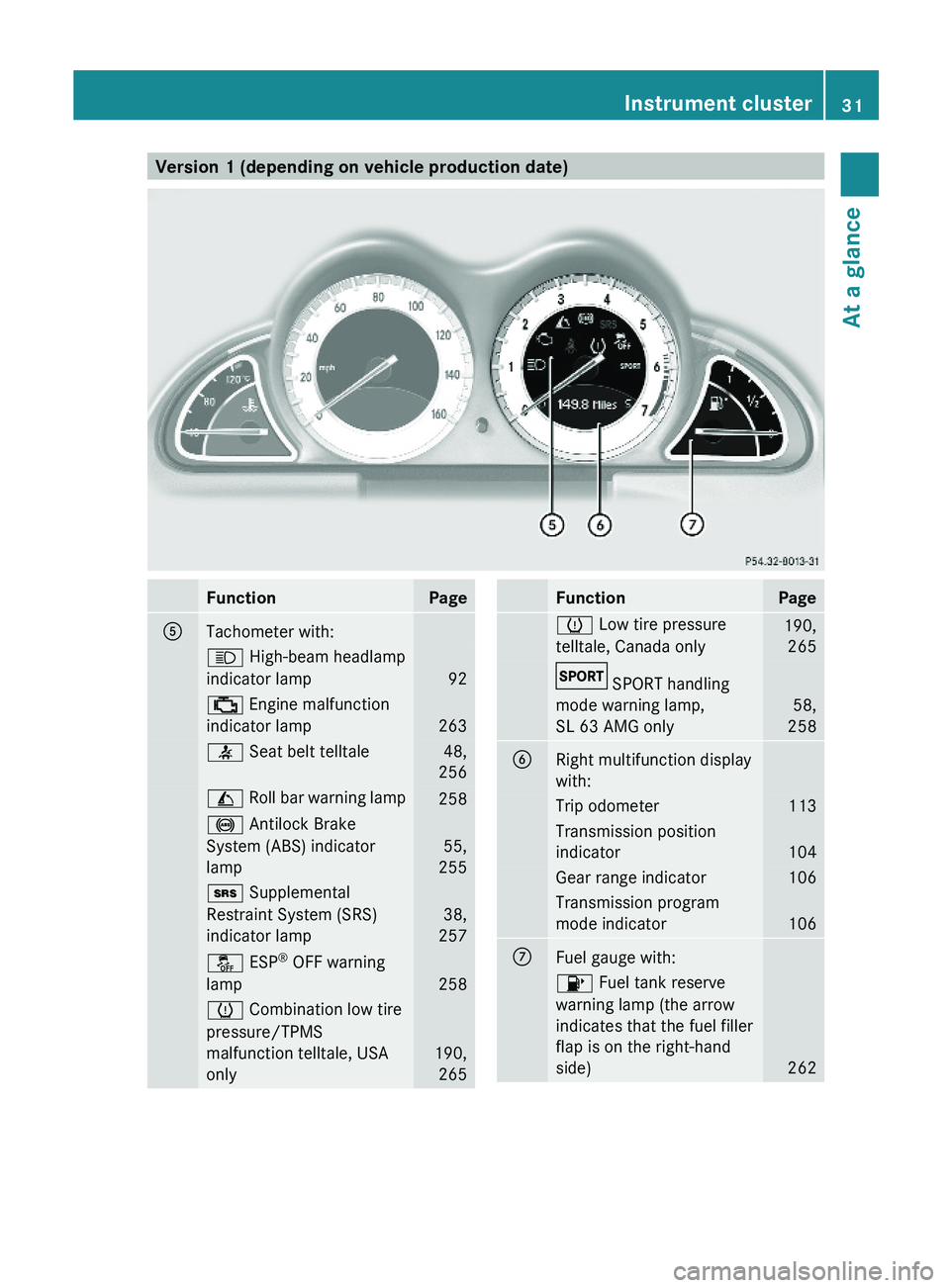
Version 1 (depending on vehicle production date)FunctionPageATachometer with:K High-beam headlamp
indicator lamp 92
; Engine malfunction
indicator lamp 263
7 Seat belt telltale 48,
256
I Roll bar warning lamp258! Antilock Brake
System (ABS) indicator
lamp
55,
255
+ Supplemental
Restraint System (SRS)
indicator lamp
38,
257
å ESP® OFF warning
lamp 258
h Combination low tire
pressure/TPMS
malfunction telltale, USA
only
190,
265
FunctionPageh Low tire pressure
telltale, Canada only
190,
265 SPORT handling
mode warning lamp,
SL 63 AMG only
58,
258
BRight multifunction display
with:
Trip odometer113Transmission position
indicator104
Gear range indicator106Transmission program
mode indicator106
CFuel gauge with:8 Fuel tank reserve
warning lamp (the arrow
indicates that the fuel filler
flap is on the right-hand
side) 262
Instrument cluster31At a glance230_AKB; 6; 22, en-USd2ureepe,Version: 2.11.8.12009-07-28T18:49:58+02:00 - Seite 31Z
Page 34 of 316
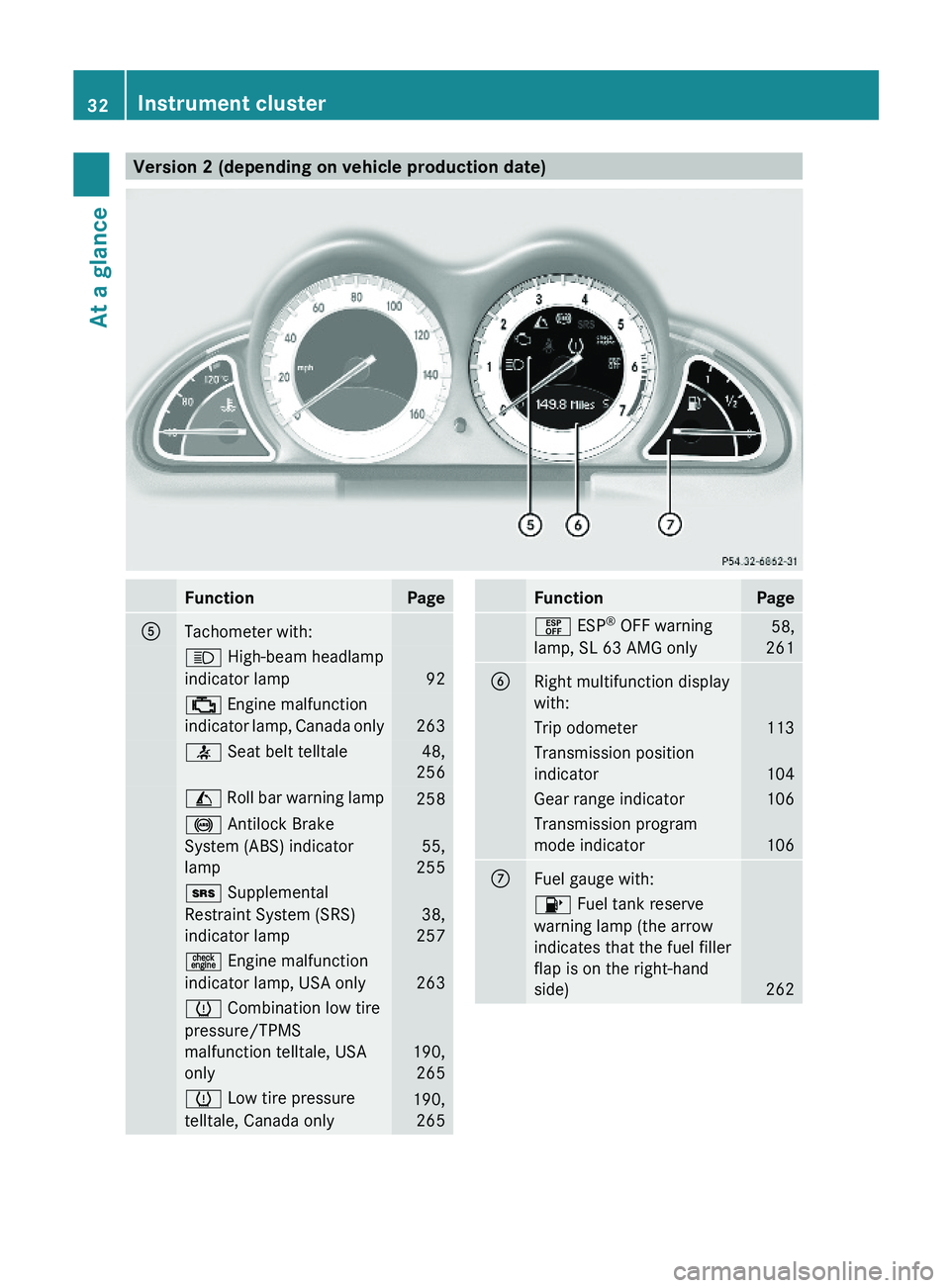
Version 2 (depending on vehicle production date)FunctionPageATachometer with:K High-beam headlamp
indicator lamp 92
; Engine malfunction
indicator lamp, Canada only263
7 Seat belt telltale 48,
256
I Roll bar warning lamp258! Antilock Brake
System (ABS) indicator
lamp
55,
255
+ Supplemental
Restraint System (SRS)
indicator lamp
38,
257
= Engine malfunction
indicator lamp, USA only 263
h Combination low tire
pressure/TPMS
malfunction telltale, USA
only
190,
265
h Low tire pressure
telltale, Canada only
190,
265
FunctionPage% ESP® OFF warning
lamp, SL 63 AMG only
58,
261
BRight multifunction display
with:
Trip odometer113Transmission position
indicator104
Gear range indicator106Transmission program
mode indicator106
CFuel gauge with:8 Fuel tank reserve
warning lamp (the arrow
indicates that the fuel filler
flap is on the right-hand
side) 262
32Instrument clusterAt a glance
230_AKB; 6; 22, en-USd2ureepe,Version: 2.11.8.12009-07-28T18:49:58+02:00 - Seite 32
Page 40 of 316
Vehicle equipment
i This Operator’s Manual describes all
features, standard or optional, potentially
available for your vehicle at the time of
purchase. Please be aware that your
vehicle might not be equipped with all
features described in this manual.
Occupant safety
Introduction
In this section you will learn the most
important facts about the restraint system
components of the vehicle.
The restraint systems are:
R Seat belts
R Child restraints
Additional protection potential is provided by:
R
Supplemental Restraint System (SRS) with
- Air bags
- Air bag control unit (with crash sensors)
-
Emergency Tensioning Device (ETD) for
seat belts
- Seat belt force limiter
R Roll bar
R Air bag system components with
- Passenger front air bag off indicator lamp
- Passenger seat with
Occupant
Classification System (OCS)
Although the systems are independent, their
protective functions work in conjunction with
each other.
GWarning!
Modifications to or work improperly
conducted on restraint system components
or their wiring, as well as tampering with
interconnected electronic systems, can lead
to the restraint systems no longer functioning
as intended.
Air bags or Emergency Tensioning Devices
(ETDs), for example, could deploy
inadvertently or fail to deploy in accidents
although the deceleration threshold for air
bag deployment is exceeded. Therefore,
never modify the restraint systems. Do not
tamper with electronic components or their
software.
i See “Children in the vehicle”
( Y page 51) for information on
R infants and children traveling with you in
the vehicle
R restraint systems for infants and children
SRS indicator lamp
The SRS system conducts a self-test when
the ignition is switched on and in regular
intervals while the engine is running. This
facilitates detection of system malfunctions.
The SRS indicator lamp + in the
instrument cluster comes on when the
ignition is switched on. It goes out no later
than a few seconds after the engine has been
started.
The SRS components are in operational
readiness when the SRS indicator lamp
+ is not lit while the engine is running.
GWarning!
The SRS self-check has detected a
malfunction when the SRS indicator lamp
+
R does not come on at all
R fails to go out after approximately
4 seconds after the engine was started
R comes on after the engine was started or
while driving
For your safety, we strongly recommend that
you contact an authorized Mercedes-Benz
Center immediately to have the system
checked. Otherwise the SRS may not be
activated when needed in an accident, which
38Occupant safetySafety and security
230_AKB; 6; 22, en-USd2ureepe,Version: 2.11.8.12009-07-28T18:49:58+02:00 - Seite 38
Page 45 of 316
passenger seat is occupied and the impact
exceeds a preset deployment threshold.
Head-thorax air bags : are not deployed in
side impacts which do not exceed the
system’s deployment threshold.
Occupant Classification System
The Occupant Classification System (OCS)
activates or deactivates the passenger front
air bag automatically. The respective status
is based on the classified occupant weight
category determined by weight sensor
readings from the passenger seat.
The system does not deactivate the
passenger head-thorax air bag and the
Emergency Tensioning Devices (ETDs).
To be classified correctly, the passenger must
sit
R with the seat belt properly fastened
R in a position that is as upright as possible
with the back against the seat backrest
R with the feet on the floor
If the occupant’s weight is transferred to
another object in the vehicle (e.g. by leaning
on armrests), the OCS may not be able to
properly approximate the occupant’s weight
category.
If your seat, including the trim cover and
cushion, needs to be serviced in any way, take
the vehicle to an authorized Mercedes-Benz
Center.
Only seat accessories approved by
Mercedes-Benz may be used.
Both the driver and the passenger should
always use the 45 indicator lamp as
an indication of whether or not the passenger
is properly positioned.
GWarning!
If the 45 indicator lamp illuminates
when an adult or someone larger than a small
individual is in the passenger seat, have the
passenger reposition himself or herself in the
seat until the 45 indicator lamp goes
out.
In the event of a collision, the air bag control
unit will not allow passenger front air bag
deployment when the OCS has classified the
passenger seat occupant as weighting as
much as or less than a typical 12-month-old
child in a standard child restraint or if the
passenger seat is classified as being empty.
When the OCS senses that the passenger seat
occupant is classified as being up to or less
than the weight of a typical 12-month-old
child in a standard child restraint, the
45 indicator lamp will illuminate when
the engine is started and remain illuminated,
indicating that the passenger front air bag is
deactivated.
When the OCS senses that the passenger seat
is classified as being empty, the 45
indicator lamp will illuminate when the engine
is started and remain illuminated, indicating
that the passenger front air bag is
deactivated.
When the OCS senses that the passenger seat
occupant is classified as being heavier than
the weight of a typical 12-month-old child
seated in a standard child restraint or as being
a small individual (such as a young teenager
or a small adult), the 45 indicator lamp
will illuminate for approximately 6 seconds
when the engine is started and then,
depending on occupant weight sensor
readings from the seat, remain illuminated or
go out. With the 45 indicator lamp
illuminated, the passenger front air bag is
deactivated. With the 45 indicator
lamp out, the passenger front air bag is
activated.
When the OCS senses that the passenger seat
occupant is classified as an adult or someone
larger than a small individual, the 45
indicator lamp will illuminate for
approximately 6 seconds when the engine is
started and then goes out, indicating that the
passenger front air bag is activated.Occupant safety43Safety and security230_AKB; 6; 22, en-USd2ureepe,Version: 2.11.8.12009-07-28T18:49:58+02:00 - Seite 43Z
Page 50 of 316
Never attempt to make modifications to seat
belts. This could impair the effectiveness of
the seat belts.
Fastening the seat belts
GWarning!
Children 12 years old and under must be
seated and properly secured in an
appropriately sized infant restraint, toddler
restraint, or booster seat recommended for
the size and weight of the child. For additional
information, see section “Children in the
vehicle”.
A child’s risk of serious or fatal injuries is
significantly increased if the child restraints
are not properly secured in the vehicle and/
or the child is not properly secured in the child
restraint.
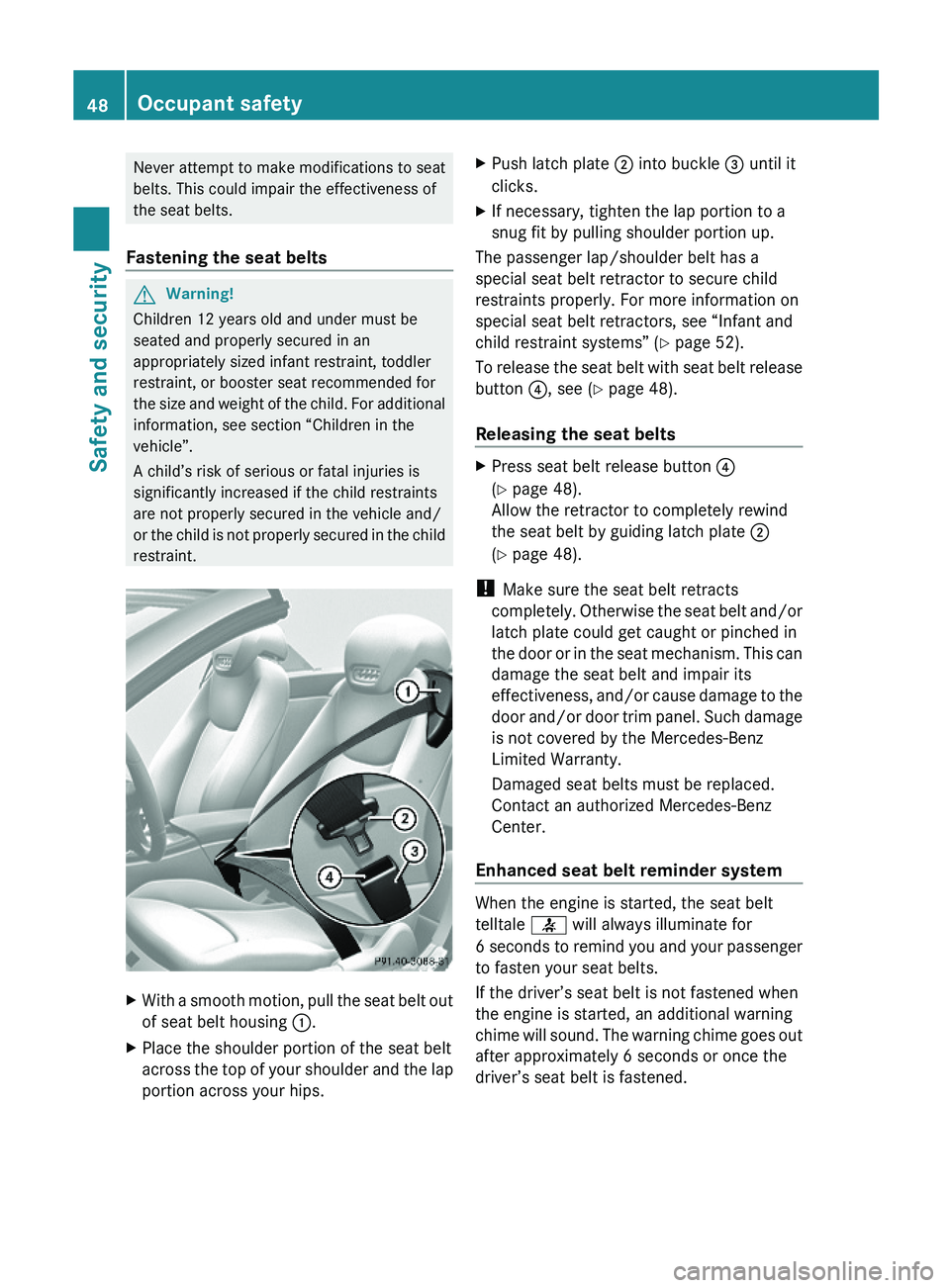
XWith a smooth motion, pull the seat belt out
of seat belt housing :.
XPlace the shoulder portion of the seat belt
across the top of your shoulder and the lap
portion across your hips.
XPush latch plate ; into buckle = until it
clicks.
XIf necessary, tighten the lap portion to a
snug fit by pulling shoulder portion up.
The passenger lap/shoulder belt has a
special seat belt retractor to secure child
restraints properly. For more information on
special seat belt retractors, see “Infant and
child restraint systems” (Y page 52).
To release the seat belt with seat belt release
button ?, see (Y page 48).
Releasing the seat belts
XPress seat belt release button ?
(Y page 48).
Allow the retractor to completely rewind
the seat belt by guiding latch plate ;
(Y page 48).
! Make sure the seat belt retracts
completely. Otherwise the seat belt and/or
latch plate could get caught or pinched in
the door or in the seat mechanism. This can
damage the seat belt and impair its
effectiveness, and/or cause damage to the
door and/or door trim panel. Such damage
is not covered by the Mercedes-Benz
Limited Warranty.
Damaged seat belts must be replaced.
Contact an authorized Mercedes-Benz
Center.
Enhanced seat belt reminder system
When the engine is started, the seat belt
telltale 7 will always illuminate for
6 seconds to remind you and your passenger
to fasten your seat belts.
If the driver’s seat belt is not fastened when
the engine is started, an additional warning
chime will sound. The warning chime goes out
after approximately 6 seconds or once the
driver’s seat belt is fastened.
48Occupant safetySafety and security
230_AKB; 6; 22, en-USd2ureepe,Version: 2.11.8.12009-07-28T18:49:58+02:00 - Seite 48
Page 53 of 316
Roll barGWarning!
This vehicle is a two occupant vehicle. The
rear storage area is not equipped to properly
seat or restrain occupants and therefore is
not permitted for use by any persons.
Make sure that the roll bar’s path of motion is
clear and no persons are injured by the
moving roll bar. Raising or lowering of the roll
bar could injure someone in it’s proximity.
For your own safety, we recommend to drive
with the roll bar raised if the outside
temperature is below +5‡ (-15†).
! If the outside temperature falls below
+5‡ (-15†), the roll bar must be raised
manually using the buttons provided to
avoid damaging the hydraulics.
The roll bar raises automatically in an
accident or in a critical driving situation.
iWhen the roll bar is raised automatically,
you will hear a ratcheting sound.
You can also raise and lower the roll bar
manually using the buttons provided.
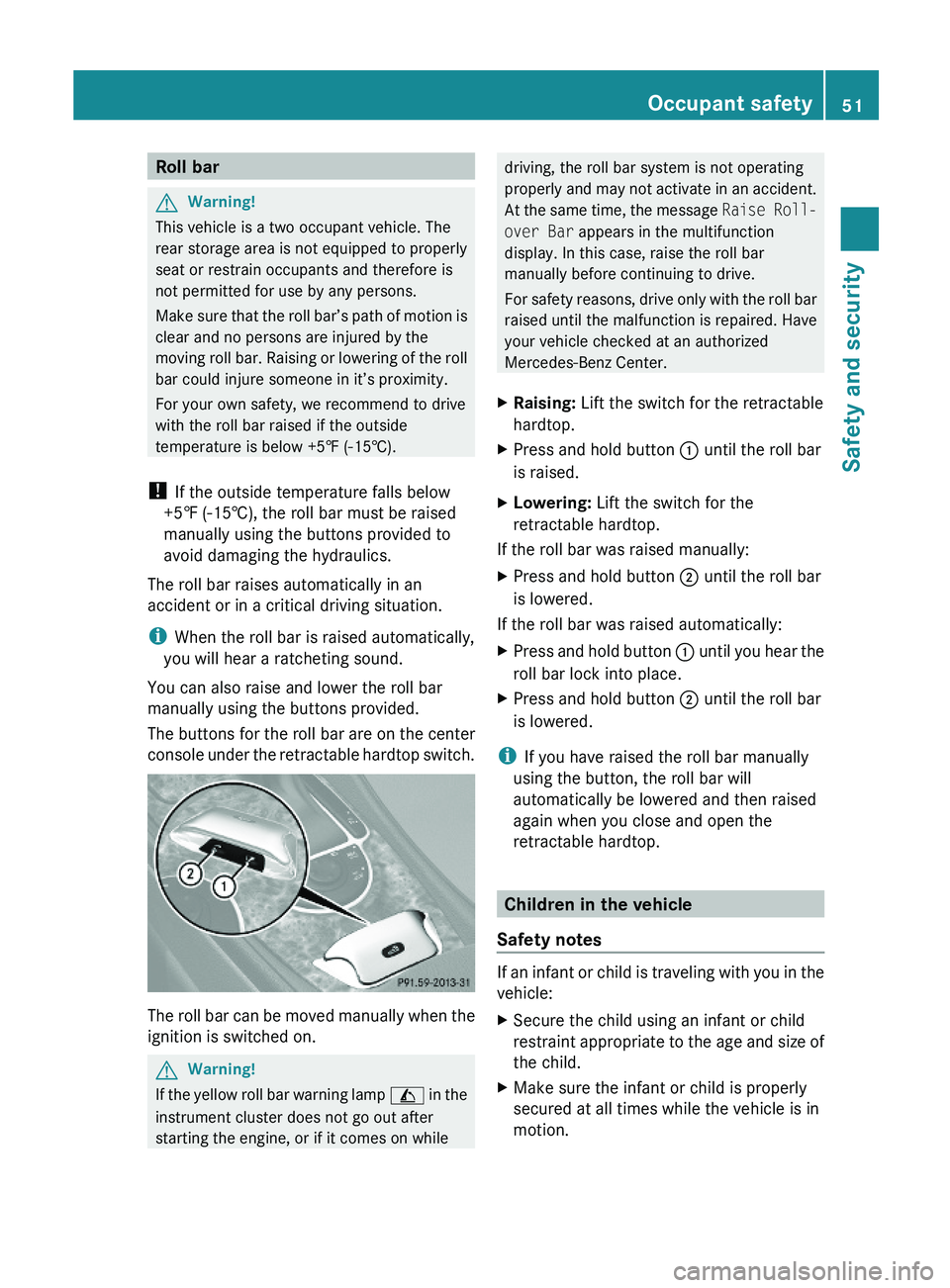
The buttons for the roll bar are on the center
console under the retractable hardtop switch.
The roll bar can be moved manually when the
ignition is switched on.
GWarning!
If the yellow roll bar warning lamp I in the
instrument cluster does not go out after
starting the engine, or if it comes on while
driving, the roll bar system is not operating
properly and may not activate in an accident.
At the same time, the message Raise Roll-
over Bar appears in the multifunction
display. In this case, raise the roll bar
manually before continuing to drive.
For safety reasons, drive only with the roll bar
raised until the malfunction is repaired. Have
your vehicle checked at an authorized
Mercedes-Benz Center.
XRaising: Lift the switch for the retractable
hardtop.
XPress and hold button : until the roll bar
is raised.
XLowering: Lift the switch for the
retractable hardtop.
If the roll bar was raised manually:
XPress and hold button ; until the roll bar
is lowered.
If the roll bar was raised automatically:
XPress and hold button : until you hear the
roll bar lock into place.
XPress and hold button ; until the roll bar
is lowered.
iIf you have raised the roll bar manually
using the button, the roll bar will
automatically be lowered and then raised
again when you close and open the
retractable hardtop.
Children in the vehicle
Safety notes
If an infant or child is traveling with you in the
vehicle:
XSecure the child using an infant or child
restraint appropriate to the age and size of
the child.
XMake sure the infant or child is properly
secured at all times while the vehicle is in
motion.
Occupant safety51Safety and security230_AKB; 6; 22, en-USd2ureepe,Version: 2.11.8.12009-07-28T18:49:58+02:00 - Seite 51Z
Page 57 of 316
Safety notesGWarning!
The following factors increase the risk of
accidents:
R Excessive speed, especially in turns
R Wet and slippery road surfaces
R Following another vehicle too closely
The driving safety systems described in this
section cannot reduce these risks or prevent
the natural laws of physics from acting on the
vehicle. They cannot increase braking or
steering efficiency beyond that afforded by
the condition of the vehicle brakes and tires
or the traction afforded.
Only a safe, attentive, and skillful driver can
prevent accidents.
The capabilities of a vehicle equipped with the
driving safety systems described in this
section must never be exploited in a reckless
or dangerous manner which could jeopardize
the user’s safety or the safety of others.
Always adjust your driving style to the
prevailing road and weather conditions and
keep a safe distance to other road users and
objects on the street.
If a driving system malfunctions, other driving
safety systems may also switch off. Observe
indicator and warning lamps that may come
on as well as messages in the multifunction
display that may appear.
ABS
GObserve Safety notes, see page 55.GWarning!
Do not pump the brake pedal. Use firm, steady
brake pedal pressure instead. Pumping the
brake pedal defeats the purpose of the ABS
and significantly reduces braking
effectiveness.
The Antilock Brake System (ABS) regulates
the brake pressure so that the wheels do not
lock during braking. This allows you to
maintain the ability to steer your vehicle.
The ABS is functional above a speed of
approximately 5 mph (8 km/h) independent
of road surface conditions.
On slippery road surfaces, the ABS will
respond even to light brake pressure.
The ABS indicator lamp ! in the
instrument cluster comes on when you switch
on the ignition. It goes out when the engine
is running.
Braking
If the ABS activates during braking, the ABS/
ESP ®
warning lamp ÷ or d 7
in the
instrument cluster flashes. Because of the
electro-hydraulic brake system, you will not
feel any pulsation in the brake pedal.
XKeep firm and steady pressure on the brake
pedal.
Continuous, steady brake pedal pressure
yields the advantages provided by the ABS,
namely braking power and the ability to steer
the vehicle.
The ABS/ESP ®
warning lamp ÷ or d 7
flashes whenever the ABS is activated. It can
be an indication for hazardous road
conditions and functions as a reminder to
take extra care while driving.
Emergency brake maneuver
XKeep continuous full pressure on the brake
pedal.GWarning!
If the ABS malfunctions, other driving safety
systems such as the BAS or the ESP ®
are also
switched off. Observe indicator and warning
lamps that may come on as well as messages
in the multifunction display that may appear.
7 Depending on vehicle production date.Driving safety systems55Safety and security230_AKB; 6; 22, en-USd2ureepe,Version: 2.11.8.12009-07-28T18:49:58+02:00 - Seite 55Z
Page 58 of 316
If the ABS malfunctions, the wheels may lock
during hard braking, reducing steering
capability and extending the braking distance.
BAS
GObserve Safety notes, see page 55.
The Brake Assist System (BAS) operates in
emergency situations. If you apply the brakes
very quickly, the BAS provides full brake
boost automatically, thereby potentially
reducing the braking distance.
XApply continuous full braking pressure until
the emergency braking situation is over.
The ABS will prevent the wheels from
locking.
When you release the brake pedal, the brakes
function again as normal. The BAS is then
deactivated.
GWarning!
If the BAS malfunctions, the brake system still
functions, but without the additional brake
boost available that the BAS would normally
provide in an emergency braking maneuver.
Therefore, the braking distance may increase.
ESP ®
GObserve Safety notes, see page 55.
The Electronic Stability Program (ESP
®
) is
operational as soon as the engine is running.
It monitors the vehicle’s traction (force of
adhesive friction between the tires and the
road surface) and handling.
The ESP ®
recognizes that the vehicle deviates
from the direction of travel as intended by the
driver. By applying brakes to individual
wheels and by limiting the engine output, the
ESP ®
works to stabilize the vehicle. The
ESP ®
is especially useful while driving off and
on wet or slippery road surfaces. The ESP ®
also stabilizes the vehicle during braking and
steering maneuvers.
The ABS/ESP ®
warning lamp ÷ or d 8
in the instrument cluster comes on when you
switch on the ignition. It goes out when the
engine is running.
The ABS/ESP ®
warning lamp ÷ or d 8
in the instrument cluster flashes when the
ESP ®
is engaged.GWarning!
Never switch off the ESP ®
when you see the
ABS/ESP ®
warning lamp ÷ or d 9
flashing in the instrument cluster. In this case
proceed as follows:
R When driving off, apply as little throttle as
possible.
R While driving, ease up on the accelerator
pedal.
R Adapt your speed and driving style to the
prevailing road conditions.
Failure to observe these guidelines could
cause the vehicle to skid. The ESP ®
cannot
prevent accidents resulting from excessive
speed.
! Because the ESP ®
operates
automatically, the engine and ignition must
be shut off (SmartKey in starter switch
position 0 or 1 or KEYLESS-GO start/stop
button in position 0 or 1) when the parking
brake is being tested on a brake test
dynamometer or when the vehicle is being
towed with the front axle raised.
Active braking action through the ESP ®
may otherwise seriously damage the brake
system which is not covered by the
Mercedes-Benz Limited Warranty.
! The ESP ®
will only function properly if you
use wheels of the recommended tire size
8 Depending on vehicle production date.
9 Depending on vehicle production date.56Driving safety systemsSafety and security
230_AKB; 6; 22, en-USd2ureepe,Version: 2.11.8.12009-07-28T18:49:58+02:00 - Seite 56
Page 59 of 316
as specified in the “Technical data” section
of this Operator’s Manual.
iThe Distronic system and cruise control
switch off automatically when the ESP®
engages.
Electronic Traction System (ETS)
GObserve Safety notes, see page 55.
The ETS (Electronic Traction System) is a
component of the ESP®. The ETS improves
the vehicle’s ability to utilize available
traction, especially under slippery road
conditions by applying the brakes to a
spinning wheel.
When you switch off the ESP®, the ETS is still
enabled.
Switching the ESP® off or on (except
SL 63 AMG)
GWarning!
The ESP® should not be switched off during
normal driving other than in the
circumstances described below. Disabling
the system will reduce vehicle stability in
driving maneuvers.
Do not switch off the ESP® when a spare
wheel is mounted.
To improve the vehicle’s traction, switch off
the ESP®. This allows the drive wheels to spin
and thus cut into surfaces for better grip, for
example
Rwhen driving with snow chains
Rin deep snow
Rin sand or gravel
GWarning!
Switch on the ESP® immediately if the
aforementioned circumstances do not apply
anymore. Otherwise the ESP® will not
stabilize the vehicle when it is starting to skid
or a wheel is spinning.
When you switch off the ESP®,
Rthe ESP® will not stabilize the vehicle
Rthe engine output is not limited, which
allows the drive wheels to spin and thus cut
into surfaces for better grip
Rthe ETS will still apply the brakes to a
spinning wheel
Rthe ESP® continues to operate when you
are braking
Rthe cruise control or the Distronic system
cannot be activated
Rthe cruise control or the Distronic system
switch off if activated
iWhen the ESP® is switched off and one or
more drive wheels are spinning, the ABS/
ESP® warning lamp ÷ or d8 in the
instrument cluster flashes. However, the
ESP® will then not stabilize the vehicle.
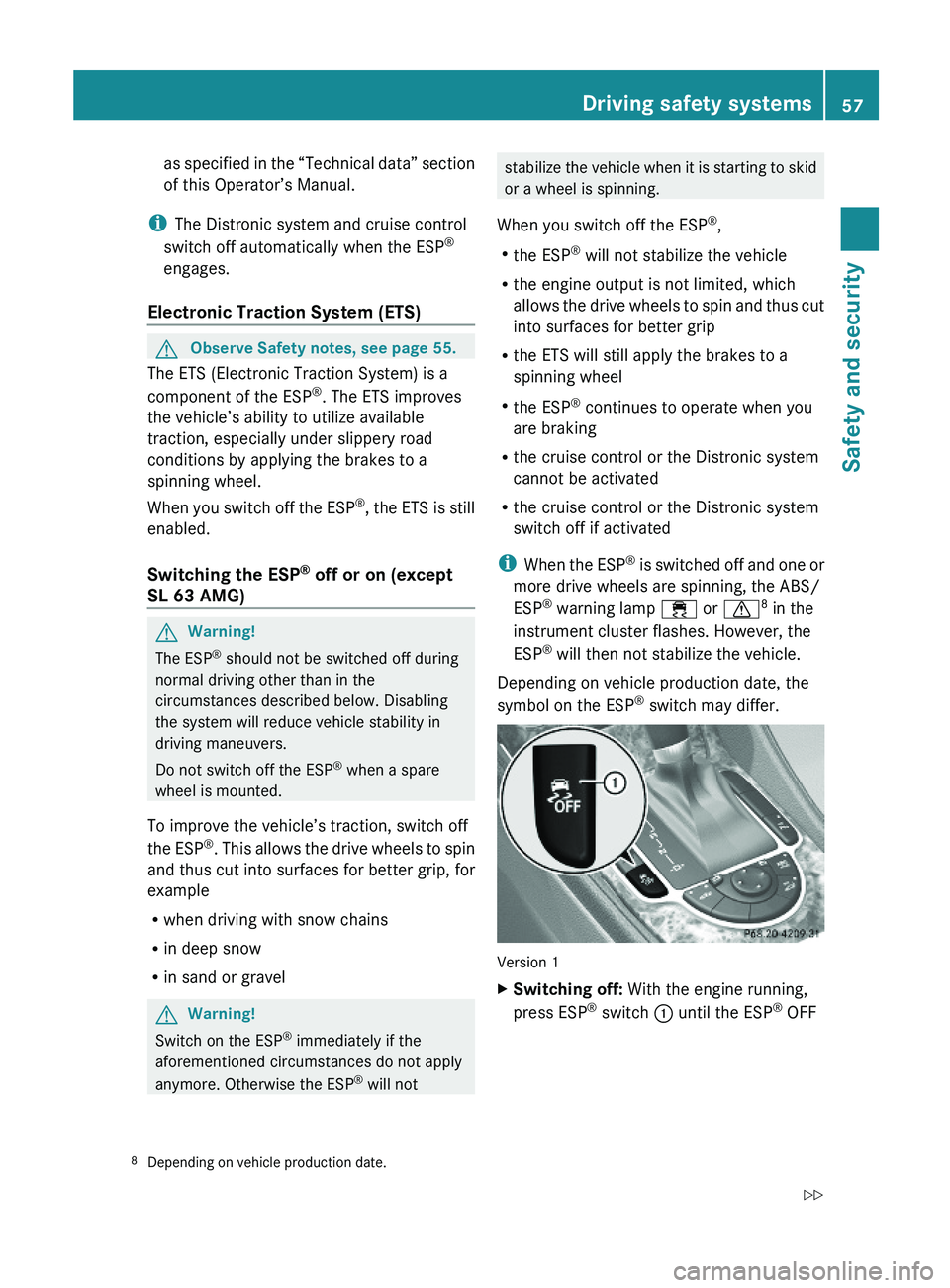
Depending on vehicle production date, the
symbol on the ESP® switch may differ.
Version 1
XSwitching off: With the engine running,
press ESP® switch : until the ESP® OFF8Depending on vehicle production date.Driving safety systems57Safety and security230_AKB; 6; 22, en-USd2ureepe,Version: 2.11.8.12009-07-28T18:49:58+02:00 - Seite 57Z