tow MERCEDES-BENZ SL600 2002 R129 User Guide
[x] Cancel search | Manufacturer: MERCEDES-BENZ, Model Year: 2002, Model line: SL600, Model: MERCEDES-BENZ SL600 2002 R129Pages: 302, PDF Size: 7.21 MB
Page 174 of 302
170 Automatic transmission
Te ch n ica l
data Instruments
and controlsOperationDrivingInstrument
cluster displayPractical hints Car care Index
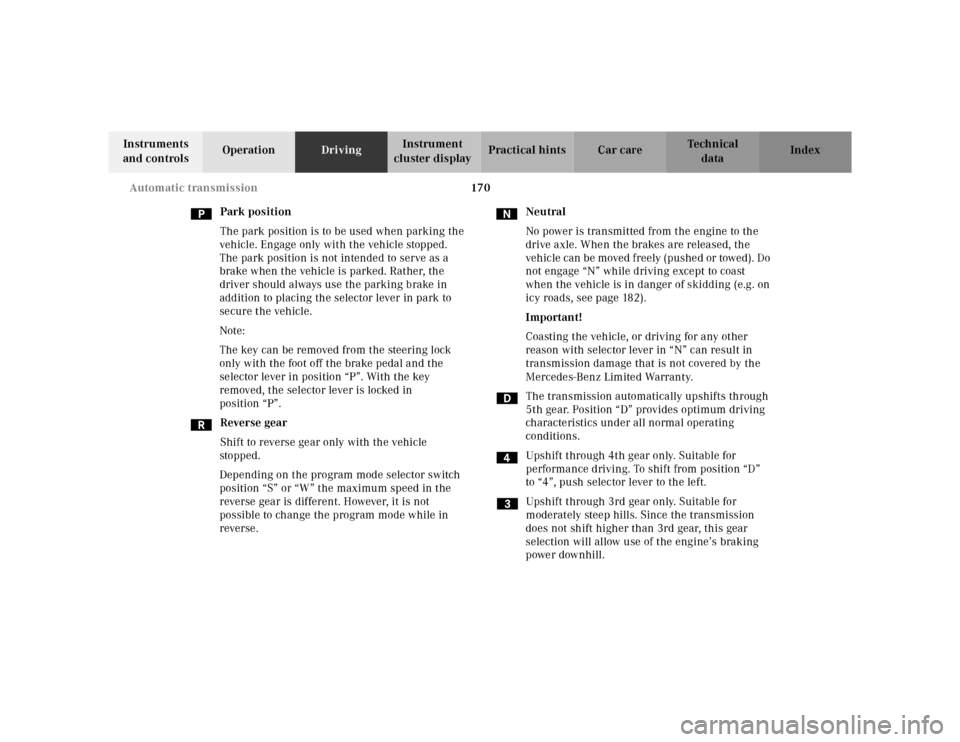
Park position
The park position is to be used when parking the
vehicle. Engage only with the vehicle stopped.
The park position is not intended to serve as a
brake when the vehicle is parked. Rather, the
driver should always use the parking brake in
addition to placing the selector lever in park to
secure the vehicle.
Note:
The key can be removed from the steering lock
only with the foot off the brake pedal and the
selector lever in position “P”. With the key
removed, the selector lever is locked in
position “P”.
Reverse gear
Shift to reverse gear only with the vehicle
sto pp ed.
Depending on the program mode selector switch
position “S” or “W” the maximum speed in the
reverse gear is different. However, it is not
possible to change the program mode while in
reverse.Neutral
No power is transmitted from the engine to the
drive axle. When the brakes are released, the
vehicle can be moved freely (pushed or towed). Do
not engage “N” while driving except to coast
when the vehicle is in danger of skidding (e.g. on
icy roads, see page 182).
Important!
Coasting the vehicle, or driving for any other
reason with selector lever in “N” can result in
transmission damage that is not covered by the
Mercedes-Benz Limited Warranty.
The transmission automatically upshifts through
5th gear. Position “D” provides optimum driving
characteristics under all normal operating
conditions.
Upshift through 4th gear only. Suitable for
performance driving. To shift from position “D”
to “4”, push selector lever to the left.
Upshift through 3rd gear only. Suitable for
moderately steep hills. Since the transmission
does not shift higher than 3rd gear, this gear
selection will allow use of the engine’s braking
power downhill.
Page 176 of 302
172 Automatic transmission
Te ch n ica l
data Instruments
and controlsOperationDrivingInstrument
cluster displayPractical hints Car care Index
Maneuvering
To maneuver in tight areas, e.g. when pulling into a
parking space, control the vehicle speed by gradually
releasing the brakes. Accelerate gently and never
abruptly step on the accelerator.
To rock a vehicle out of soft ground (mud or snow),
alternately shift from forward to reverse, while applying
only slight partial throttle.
Rocking a vehicle free in this manner may cause the
ABS malfunction indicator lamp to come on. Turn off
and restart the engine to clear the malfunction
indication.
Stopping
For brief stops, e.g. at traffic lights, leave the
transmission in gear and hold vehicle with the service
brake.
For longer stops with the engine idling, shift into “N”
or “P” and hold the vehicle with the service brake.
When stopping the vehicle on an uphill gradient, do not
hold it with the accelerator, use the brake. This avoids
unnecessary transmission heat build up.
Wa r n i n g !
Getting out of your vehicle with the selector lever
not fully engaged in position “P” is dangerous.
Also, when parked on an incline, position “P” alone
may not prevent your vehicle from moving,
possibly hitting people or objects.Always set the parking brake in addition to shifting
to position “P”.When parked on an incline, also turn front wheel
towards the road curb.When leaving the vehicle always remove the key
from the steering lock, and lock the vehicle. Do not
leave children unattended in the vehicle, or with
access to an unlocked vehicle. Children could move
the selector lever from position “P”, which could
result in an accident or serious injury.
Page 182 of 302
178 Driving instructions
Te ch n ica l
data Instruments
and controlsOperationDrivingInstrument
cluster displayPractical hints Car care Index
Caution!
When driving down long and steep grades, relieve the
load on the brakes by shifting into a lower gear to use
the engine’s braking power. This helps prevent
overheating of the brakes and reduces brake pad wear.
After hard braking, it is advisable to drive on for some
time, rather than immediately parking, so the air stream
will cool down the brakes faster.
Driving off
Apply the service brakes to test them briefly after
driving off. Perform this procedure only when the road
is clear of other traffic.
Warm up the engine smoothly. Do not place full load on
the engine until the operating temperature has been
reached.
When starting off on a slippery surface, do not allow one
drive wheel to spin for an extended period with the ESP
switched off. Doing so may cause serious damage to the
drive train which is not covered by the Mercedes-Benz
Limited Warranty.Parking
Important!
Always engage the parking brake whenever parking or
leaving the vehicle. In addition, move selector lever to
position “P”.
When parking on hills, always set the parking brake.
Wa r n i n g !
To reduce the risk of personal injury as a result of
vehicle movement, before
turning off the engine
and leaving the vehicle, always:
1. Keep right foot on the service brake pedal.
2. Firmly engage parking brake.
3. Move the selector lever to position “P”
4. Slowly release the service brake pedal.
5. Turn front wheels towards the road curb.
6. Turn the key to steering lock position 0 and
remove.
7. Take the key and lock vehicle when leaving.
Page 183 of 302
179 Driving instructions
Te ch n ica l
data Instruments
and controlsOperationDrivingInstrument
cluster displayPractical hints Car care Index Tires
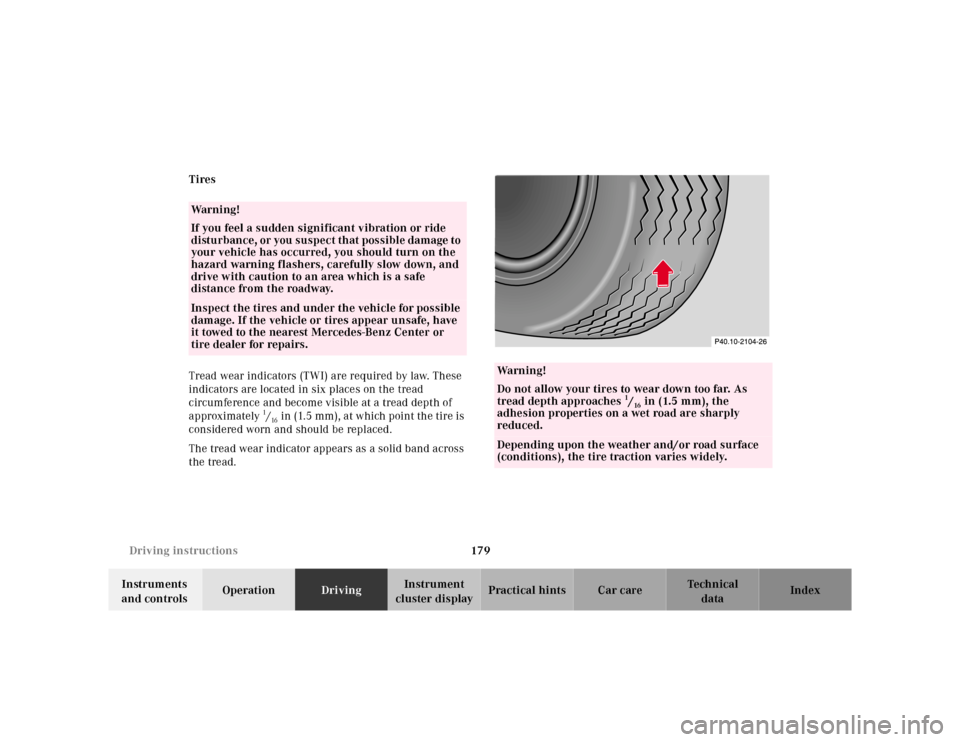
Tread wear indicators (TWI) are required by law. These
indicators are located in six places on the tread
circumference and become visible at a tread depth of
approximately
1/16 in (1.5 mm), at which point the tire is
considered worn and should be replaced.
The tread wear indicator appears as a solid band across
the tread.
Wa r n i n g !
If you feel a sudden significant vibration or ride
disturbance, or you suspect that possible damage to
your vehicle has occurred, you should turn on the
hazard warning f lashers, carefully slow down, and
drive with caution to an area which is a safe
distance from the roadway.Inspect the tires and under the vehicle for possible
damage. If the vehicle or tires appear unsafe, have
it towed to the nearest Mercedes-Benz Center or
tire dealer for repairs.
Wa r n i n g !
Do not allow your tires to wear down too far. As
tread depth approaches
1/16 in (1.5 mm), the
adhesion properties on a wet road are sharply
reduced.
Depending upon the weather and/or road surface
(conditions), the tire traction varies widely.
Page 196 of 302
192 Driving systems
Te ch n ica l
data Instruments
and controlsOperationDrivingInstrument
cluster displayPractical hints Car care Index
Electronic stability program (ESP)
The ESP enhances directional control and reduces
driving wheel spin of the vehicle under various driving
conditions.
Over/understeering of the vehicle is counteracted by
applying brakes to the appropriate wheel to create a
countervailing vehicle movement. Engine torque is also
limited. The ESP warning lamp, located in the
speedometer dial, starts to flash when ESP is in
operation.Important!
If the ESP warning lampv flashes:
• During take-off apply as little throttle as possible.
• While driving ease up on the accelerator.
• Adapt your speed and driving to the prevailing road
conditions.
• Do not switch off the ESP.
Caution!
If the vehicle is towed with the front axle raised
(see page 241), the engine must be shut off (key in
steering lock position 0 or 1). Otherwise, the ESP will
immediately be engaged and will apply the rear wheel
brakes.
Wa r n i n g !
ESP cannot prevent the natural laws of physics
from acting on the vehicle, nor can it increase the
traction afforded. The ESP cannot prevent
accidents, including those resulting from excessive
speed in turns, or aquaplaning. Only a safe,
attentive, and skillful driver can prevent accidents.
The capabilities of an ESP equipped vehicle must
never be exploited in a reckless or dangerous
manner which could jeopardize the user’s safety or
the safety of others.
Page 219 of 302

215 Contents - Practical hints
Te ch n ica l
data Instruments
and controlsOperation DrivingInstrument
cluster displayPractical hintsCar care Index
Practical hints First aid kit ..................................... 216
Stowing things in the vehicle ...... 216
Vehicle tools .................................... 217
Vehicle jack ..................................... 218
Fuses ................................................ 219
Hood .................................................220
Automatic transmission
fluid level ...................................222
Checking engine oil level .............222
Coolant level ...................................224
Adding coolant ...............................225Windshield and
headlamp washer
fluid mixing ratio ..................... 226
Wheels ............................................ 227
Tire replacement ........................... 227
Rotating wheels ............................. 228
Spare wheel .................................... 229
Changing wheels ........................... 231
Tire inflation pressure ................. 235
Battery ............................................. 237
Battery Recycling ....................... 238
Jump starting ................................. 239
Towing the vehicle ........................ 241Exterior lamps ................................243
Headlamp assembly
(Halogen) .....................................244
Taillamp assemblies ..................250
Changing batteries in the
remote control ...........................252
Synchronizing ............................253
Raising soft top manually .............254
Replacing wiper blade .................258
Manual release of
fuel filler flap .............................260
Trunk lamp .....................................260
Page 220 of 302
216 First aid kit
Te ch n ica l
data Instruments
and controlsOperation DrivingInstrument
cluster displayPractical hintsCar care Index
First aid kit
The first aid kit is located in the storage compartment
behind the seats.Stowing things in the vehicle
Wa r n i n g !
To help avoid personal injury during a collision or
sudden maneuver, exercise care when stowing
things. Put luggage or cargo in the trunk if
possible.
Page 245 of 302
241 Towing the vehicle
Te ch n ica l
data Instruments
and controlsOperation DrivingInstrument
cluster displayPractical hintsCar care Index Tow in g t h e ve hic l e
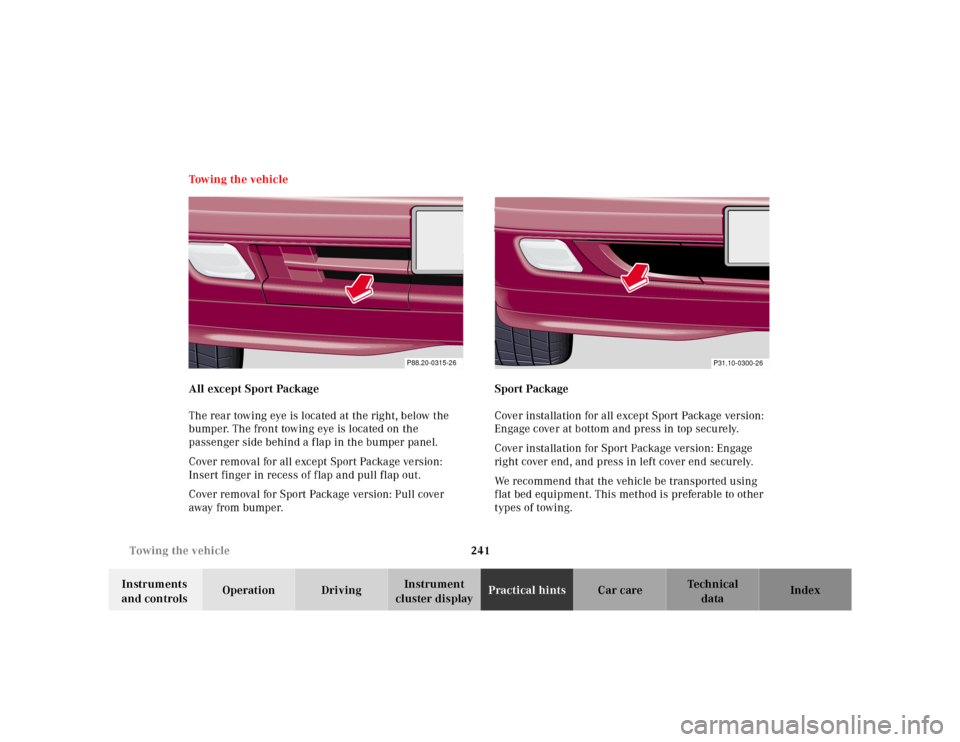
All except Sport Package
The rear towing eye is located at the right, below the
bumper. The front towing eye is located on the
passenger side behind a flap in the bumper panel.
Cover removal for all except Sport Package version:
Insert finger in recess of flap and pull flap out.
Cover removal for Sport Package version: Pull cover
away from bumper.Sport Package
Cover installation for all except Sport Package version:
Engage cover at bottom and press in top securely.
Cover installation for Sport Package version: Engage
right cover end, and press in left cover end securely.
We recommend that the vehicle be transported using
flat bed equipment. This method is preferable to other
types of towing.
P88.20-0315-26
P31.10-0300-26
Page 246 of 302
242 Towing the vehicle
Te ch n ica l
data Instruments
and controlsOperation DrivingInstrument
cluster displayPractical hintsCar care Index
The vehicle may be towed with all wheels on the ground
and the selector lever in position “N” for distances up to
30 miles (50 km) and at a speed not to exceed 30 mph
(50 km/h). The key must be in steering lock position 2.
To be certain to avoid a possibility of damage to the
transmission, however, we recommend the drive shaft
be disconnected at the rear axle drive f lange for any
towing beyond a short tow to a nearby garage.
Do not tow with sling-type equipment. Towing with
sling-type equipment over bumpy roads will damage
radiator and supports.
The use of wheel lift equipment will damage engine oil
pan.
Important!
When towing the vehicle, please, note the following:
With the automatic central locking activated and the
key in steering lock position 2, the vehicle doors lock if
the left front wheel as well as the right rear wheel are
turning at vehicle speeds of approx. 9 mph (15 km/h) or
more.
To prevent the vehicle door locks from locking,
deactivate the automatic central locking.When transporting vehicle on flat bed equipment, the
front end of the vehicle must be loaded first. Additional
ramping may be required for loading to protect bumper
fascia.
Note:
To signal turns while being towed with hazard warning
flasher in use, turn key in steering lock to position 2 and
activate combination switch for left or right turn signal
in usual manner – only the selected turn signal will
operate.
Upon canceling the turn signal, the hazard warning
flasher will operate again.
Wa r n i n g !
With the engine not running, there is no power
assistance for the braking and steering systems. In
this case, it is important to keep in mind that a
considerably higher degree of effort in necessary to
brake and steer the vehicle.
Page 258 of 302
254 Raising soft top manually
Te ch n ica l
data Instruments
and controlsOperation DrivingInstrument
cluster displayPractical hintsCar care Index
Raising soft top manually
In case of malfunction, the power soft top can also be
raised manually. This procedure should be performed
with great care by 2 persons.
A combination open-end/Allenhead wrench in the
vehicle tool kit is required for this job.
1. Open doors or lower windows.
2. Lower roll bar with roll bar switch. If the roll bar
cannot be lowered, the soft top can be carefully
guided over the roll bar.
3. For safety reasons, remove key from steering lock.
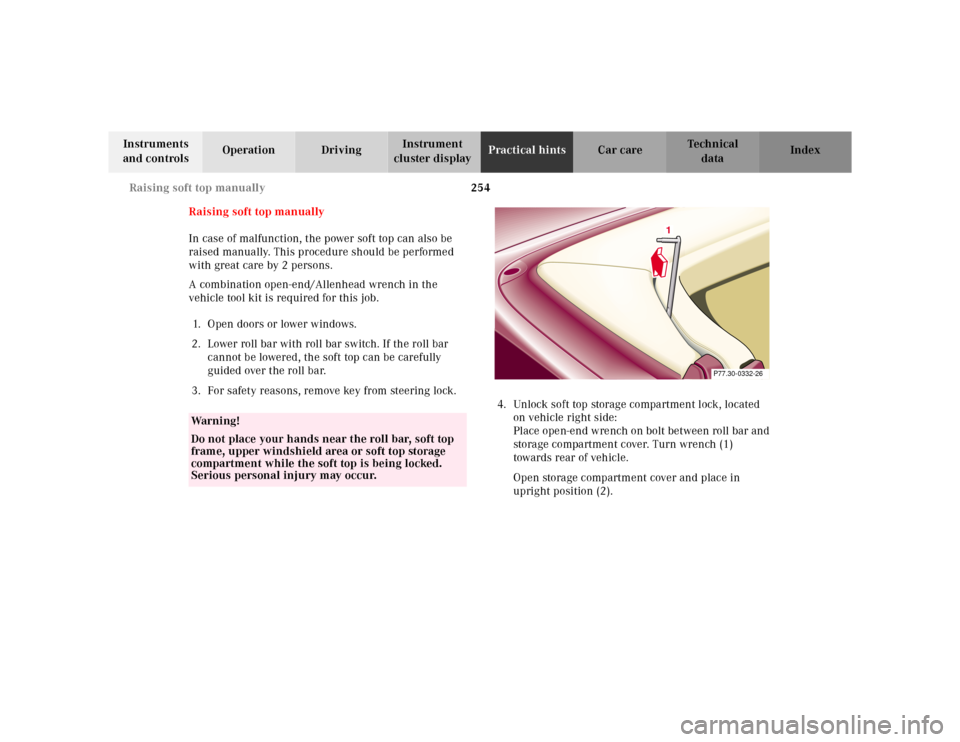
4. Unlock soft top storage compartment lock, located
on vehicle right side:
Place open-end wrench on bolt between roll bar and
storage compartment cover. Turn wrench (1)
towards rear of vehicle.
Open storage compartment cover and place in
upright position (2).
Wa r n i n g !
Do not place your hands near the roll bar, soft top
frame, upper windshield area or soft top storage
compartment while the soft top is being locked.
Serious personal injury may occur.
P77.30-0332-26
1