height MERCEDES-BENZ SL600 2011 R230 User Guide
[x] Cancel search | Manufacturer: MERCEDES-BENZ, Model Year: 2011, Model line: SL600, Model: MERCEDES-BENZ SL600 2011 R230Pages: 316, PDF Size: 7.21 MB
Page 161 of 316
! To prevent damage to the retractable
hardtop or luggage/cargo when lowering
the retractable hardtop:
RLoad trunk only to the height of the
luggage cover.
RDo not permit luggage/cargo to push up
the closed luggage cover.
RDo not place anything on top of or in front
of the luggage cover.
RDo not place anything on the shelf behind
the roll bar.
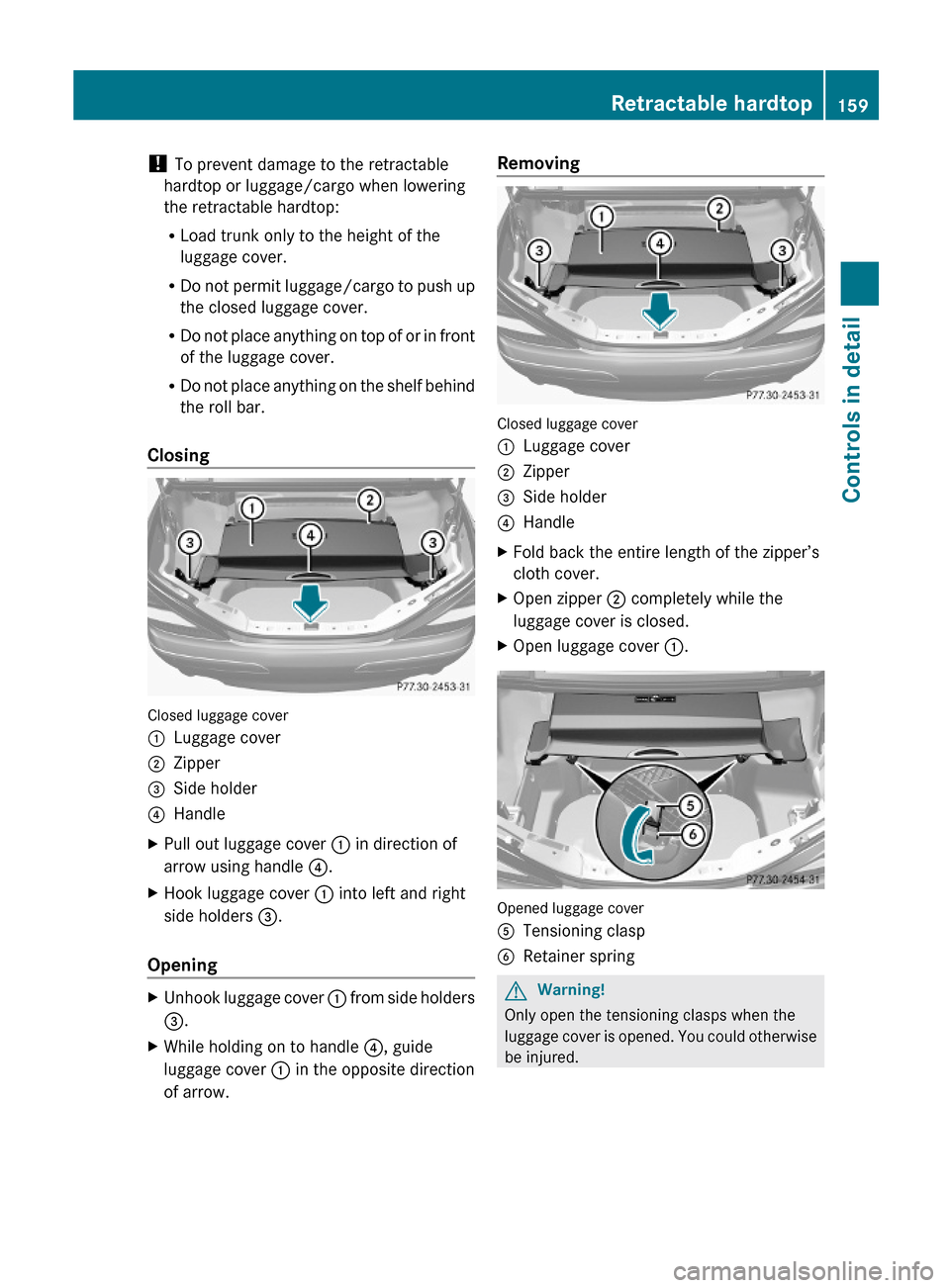
Closing
Closed luggage cover
:Luggage cover;Zipper=Side holder?HandleXPull out luggage cover : in direction of
arrow using handle ?.
XHook luggage cover : into left and right
side holders =.
Opening
XUnhook luggage cover : from side holders
=.
XWhile holding on to handle ?, guide
luggage cover : in the opposite direction
of arrow.
Removing
Closed luggage cover
:Luggage cover;Zipper=Side holder?HandleXFold back the entire length of the zipper’s
cloth cover.
XOpen zipper ; completely while the
luggage cover is closed.
XOpen luggage cover :.
Opened luggage cover
ATensioning claspBRetainer springGWarning!
Only open the tensioning clasps when the
luggage cover is opened. You could otherwise
be injured.
Retractable hardtop159Controls in detail230_AKB; 6; 22, en-USd2ureepe,Version: 2.11.8.12009-07-28T18:49:58+02:00 - Seite 159Z
Page 166 of 316
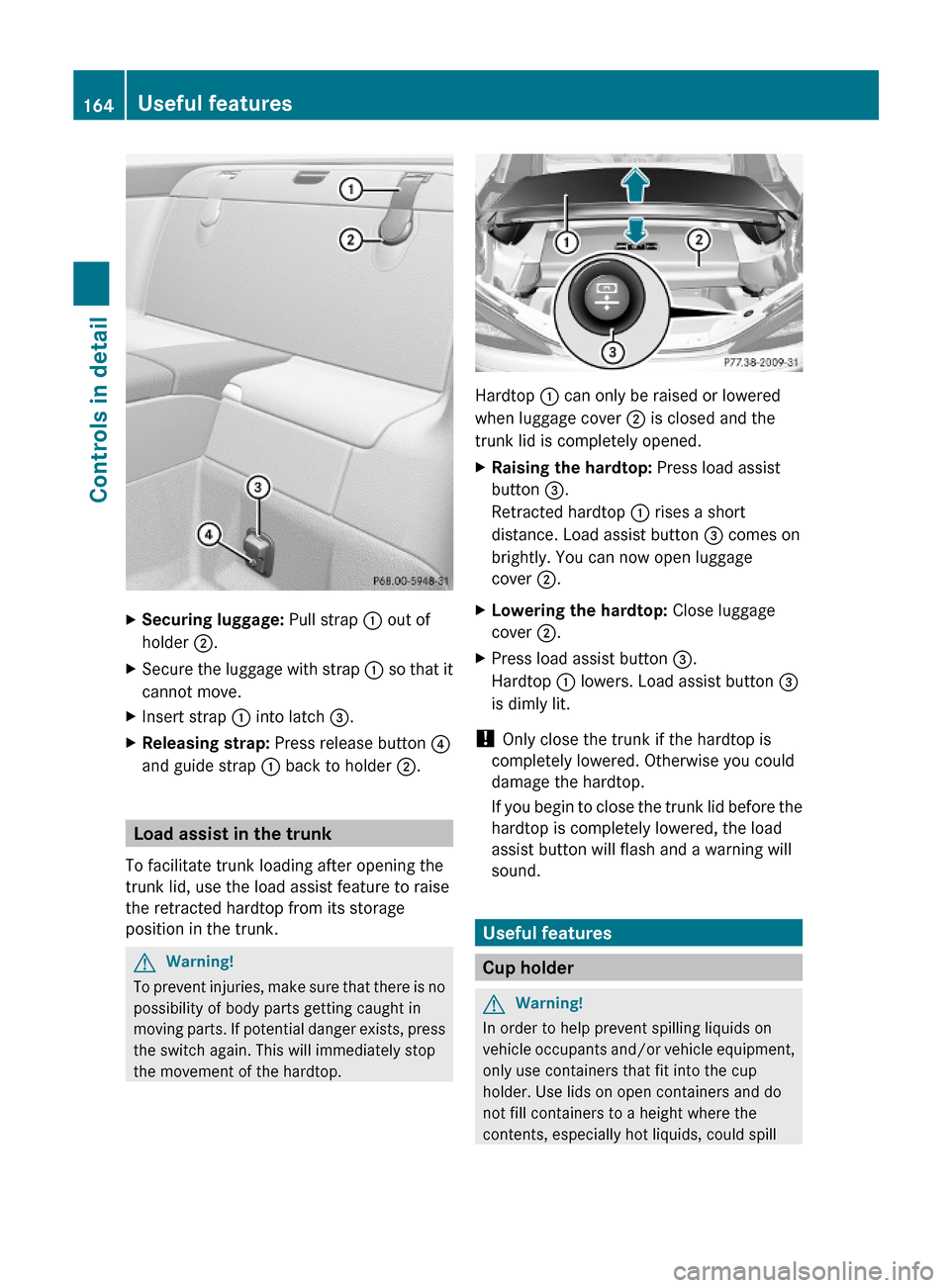
XSecuring luggage: Pull strap : out of
holder ;.
XSecure the luggage with strap : so that it
cannot move.
XInsert strap : into latch =.XReleasing strap: Press release button ?
and guide strap : back to holder ;.
Load assist in the trunk
To facilitate trunk loading after opening the
trunk lid, use the load assist feature to raise
the retracted hardtop from its storage
position in the trunk.
GWarning!
To prevent injuries, make sure that there is no
possibility of body parts getting caught in
moving parts. If potential danger exists, press
the switch again. This will immediately stop
the movement of the hardtop.
Hardtop : can only be raised or lowered
when luggage cover ; is closed and the
trunk lid is completely opened.
XRaising the hardtop: Press load assist
button =.
Retracted hardtop : rises a short
distance. Load assist button = comes on
brightly. You can now open luggage
cover ;.
XLowering the hardtop: Close luggage
cover ;.
XPress load assist button =.
Hardtop : lowers. Load assist button =
is dimly lit.
! Only close the trunk if the hardtop is
completely lowered. Otherwise you could
damage the hardtop.
If you begin to close the trunk lid before the
hardtop is completely lowered, the load
assist button will flash and a warning will
sound.
Useful features
Cup holder
GWarning!
In order to help prevent spilling liquids on
vehicle occupants and/or vehicle equipment,
only use containers that fit into the cup
holder. Use lids on open containers and do
not fill containers to a height where the
contents, especially hot liquids, could spill
164Useful featuresControls in detail
230_AKB; 6; 22, en-USd2ureepe,Version: 2.11.8.12009-07-28T18:49:58+02:00 - Seite 164
Page 183 of 316
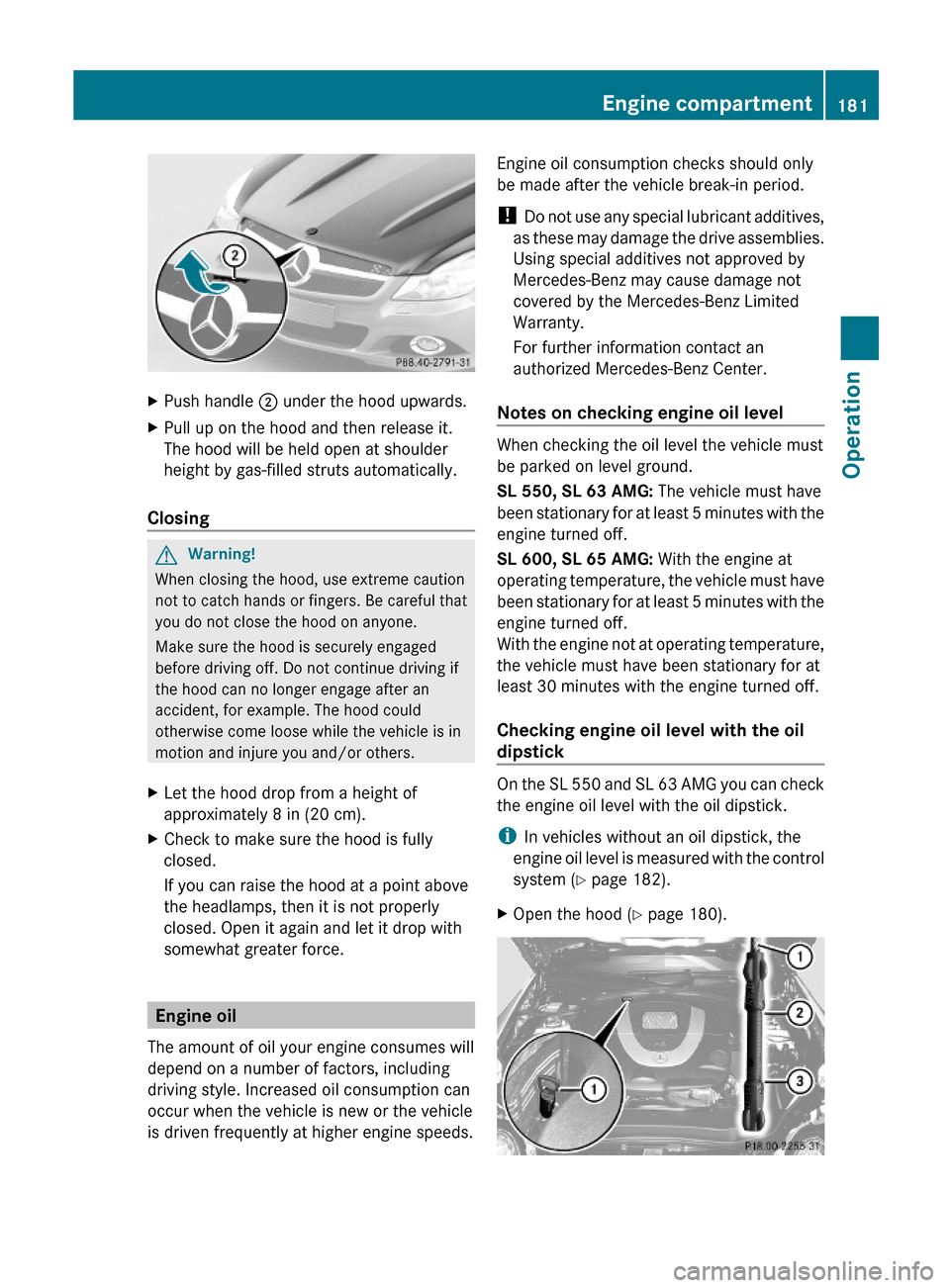
XPush handle ; under the hood upwards.XPull up on the hood and then release it.
The hood will be held open at shoulder
height by gas-filled struts automatically.
Closing
GWarning!
When closing the hood, use extreme caution
not to catch hands or fingers. Be careful that
you do not close the hood on anyone.
Make sure the hood is securely engaged
before driving off. Do not continue driving if
the hood can no longer engage after an
accident, for example. The hood could
otherwise come loose while the vehicle is in
motion and injure you and/or others.
XLet the hood drop from a height of
approximately 8 in (20 cm).
XCheck to make sure the hood is fully
closed.
If you can raise the hood at a point above
the headlamps, then it is not properly
closed. Open it again and let it drop with
somewhat greater force.
Engine oil
The amount of oil your engine consumes will
depend on a number of factors, including
driving style. Increased oil consumption can
occur when the vehicle is new or the vehicle
is driven frequently at higher engine speeds.
Engine oil consumption checks should only
be made after the vehicle break-in period.
! Do not use any special lubricant additives,
as these may damage the drive assemblies.
Using special additives not approved by
Mercedes-Benz may cause damage not
covered by the Mercedes-Benz Limited
Warranty.
For further information contact an
authorized Mercedes-Benz Center.
Notes on checking engine oil level
When checking the oil level the vehicle must
be parked on level ground.
SL 550, SL 63 AMG: The vehicle must have
been stationary for at least 5 minutes with the
engine turned off.
SL 600, SL 65 AMG: With the engine at
operating temperature, the vehicle must have
been stationary for at least 5 minutes with the
engine turned off.
With the engine not at operating temperature,
the vehicle must have been stationary for at
least 30 minutes with the engine turned off.
Checking engine oil level with the oil
dipstick
On the SL 550 and SL 63 AMG you can check
the engine oil level with the oil dipstick.
iIn vehicles without an oil dipstick, the
engine oil level is measured with the control
system (Y page 182).
XOpen the hood (Y page 180).Engine compartment181Operation230_AKB; 6; 22, en-USd2ureepe,Version: 2.11.8.12009-07-28T18:49:58+02:00 - Seite 181Z
Page 204 of 316
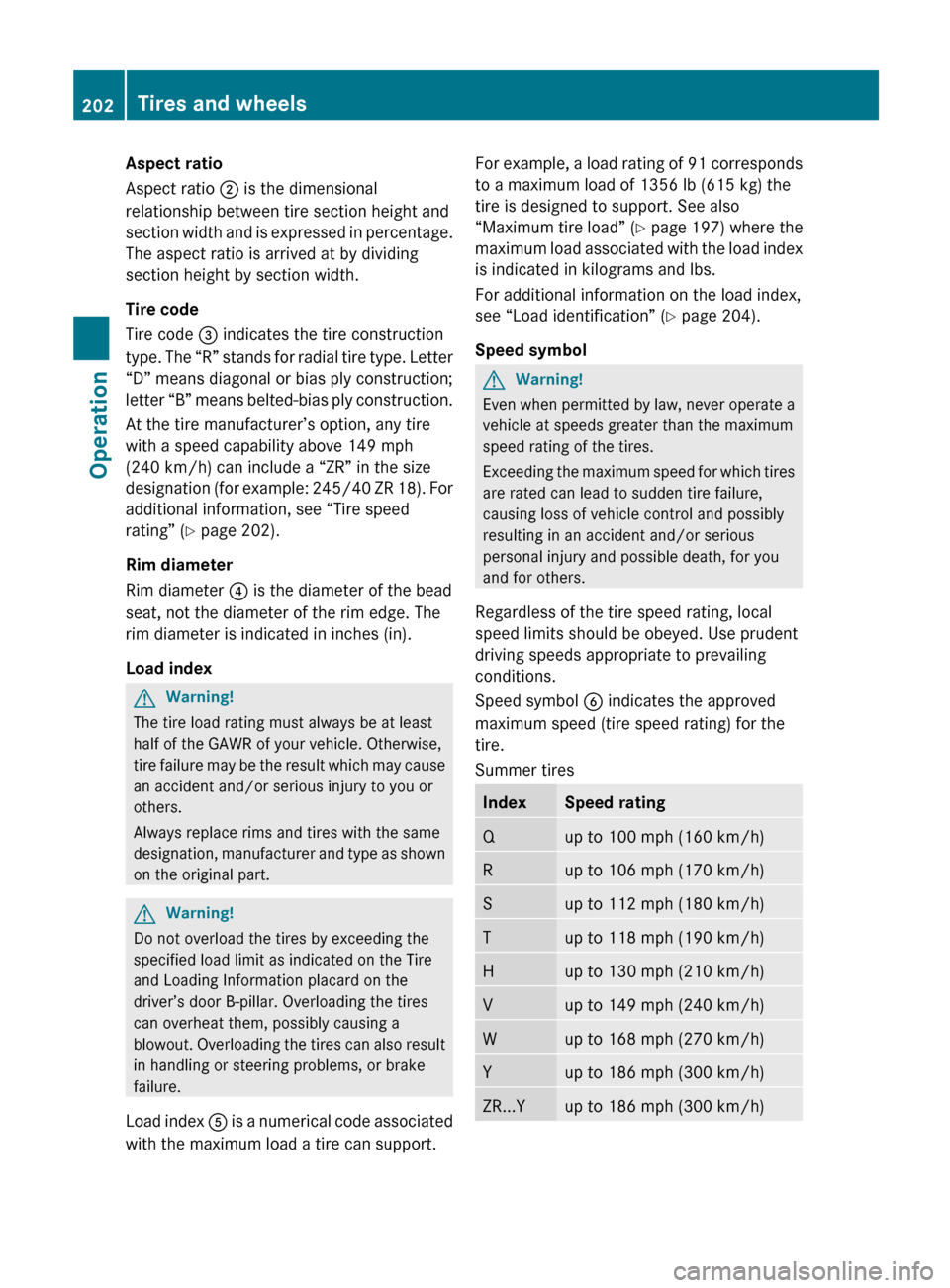
Aspect ratio
Aspect ratio ; is the dimensional
relationship between tire section height and
section width and is expressed in percentage.
The aspect ratio is arrived at by dividing
section height by section width.
Tire code
Tire code = indicates the tire construction
type. The “R” stands for radial tire type. Letter
“D” means diagonal or bias ply construction;
letter “B” means belted-bias ply construction.
At the tire manufacturer’s option, any tire
with a speed capability above 149 mph
(240 km/h) can include a “ZR” in the size
designation (for example: 245/40 ZR 18). For
additional information, see “Tire speed
rating” ( Y page 202).
Rim diameter
Rim diameter ? is the diameter of the bead
seat, not the diameter of the rim edge. The
rim diameter is indicated in inches (in).
Load indexGWarning!
The tire load rating must always be at least
half of the GAWR of your vehicle. Otherwise,
tire failure may be the result which may cause
an accident and/or serious injury to you or
others.
Always replace rims and tires with the same
designation, manufacturer and type as shown
on the original part.
GWarning!
Do not overload the tires by exceeding the
specified load limit as indicated on the Tire
and Loading Information placard on the
driver’s door B-pillar. Overloading the tires
can overheat them, possibly causing a
blowout. Overloading the tires can also result
in handling or steering problems, or brake
failure.
Load index A is a numerical code associated
with the maximum load a tire can support.
For example, a load rating of 91 corresponds
to a maximum load of 1356 lb (615 kg) the
tire is designed to support. See also
“Maximum tire load” (Y page 197) where the
maximum load associated with the load index
is indicated in kilograms and lbs.
For additional information on the load index,
see “Load identification” ( Y page 204).
Speed symbol GWarning!
Even when permitted by law, never operate a
vehicle at speeds greater than the maximum
speed rating of the tires.
Exceeding the maximum speed for which tires
are rated can lead to sudden tire failure,
causing loss of vehicle control and possibly
resulting in an accident and/or serious
personal injury and possible death, for you
and for others.
Regardless of the tire speed rating, local
speed limits should be obeyed. Use prudent
driving speeds appropriate to prevailing
conditions.
Speed symbol B indicates the approved
maximum speed (tire speed rating) for the
tire.
Summer tires
IndexSpeed ratingQup to 100 mph (160 km/h)Rup to 106 mph (170 km/h)Sup to 112 mph (180 km/h)Tup to 118 mph (190 km/h)Hup to 130 mph (210 km/h)Vup to 149 mph (240 km/h)Wup to 168 mph (270 km/h)Yup to 186 mph (300 km/h)ZR...Yup to 186 mph (300 km/h)202Tires and wheelsOperation
230_AKB; 6; 22, en-USd2ureepe,Version: 2.11.8.12009-07-28T18:49:58+02:00 - Seite 202
Page 207 of 316
Tire type code
Tire type code ? may, at the option of the
manufacturer, be used as a descriptive code
for identifying significant characteristics of
the tire.
Date of manufacture
The date of manufacture A identifies the
week and year of manufacture.
The first two figures identify the week,
starting with “01” to represent the first full
week of the calendar year. The second two
figures represent the year.
For example, “3208” represents the 32nd
week of 2008.
Tire ply material
iFor illustration purposes only. Actual data
on tires are specific to each vehicle and
may vary from data shown in above
illustration.
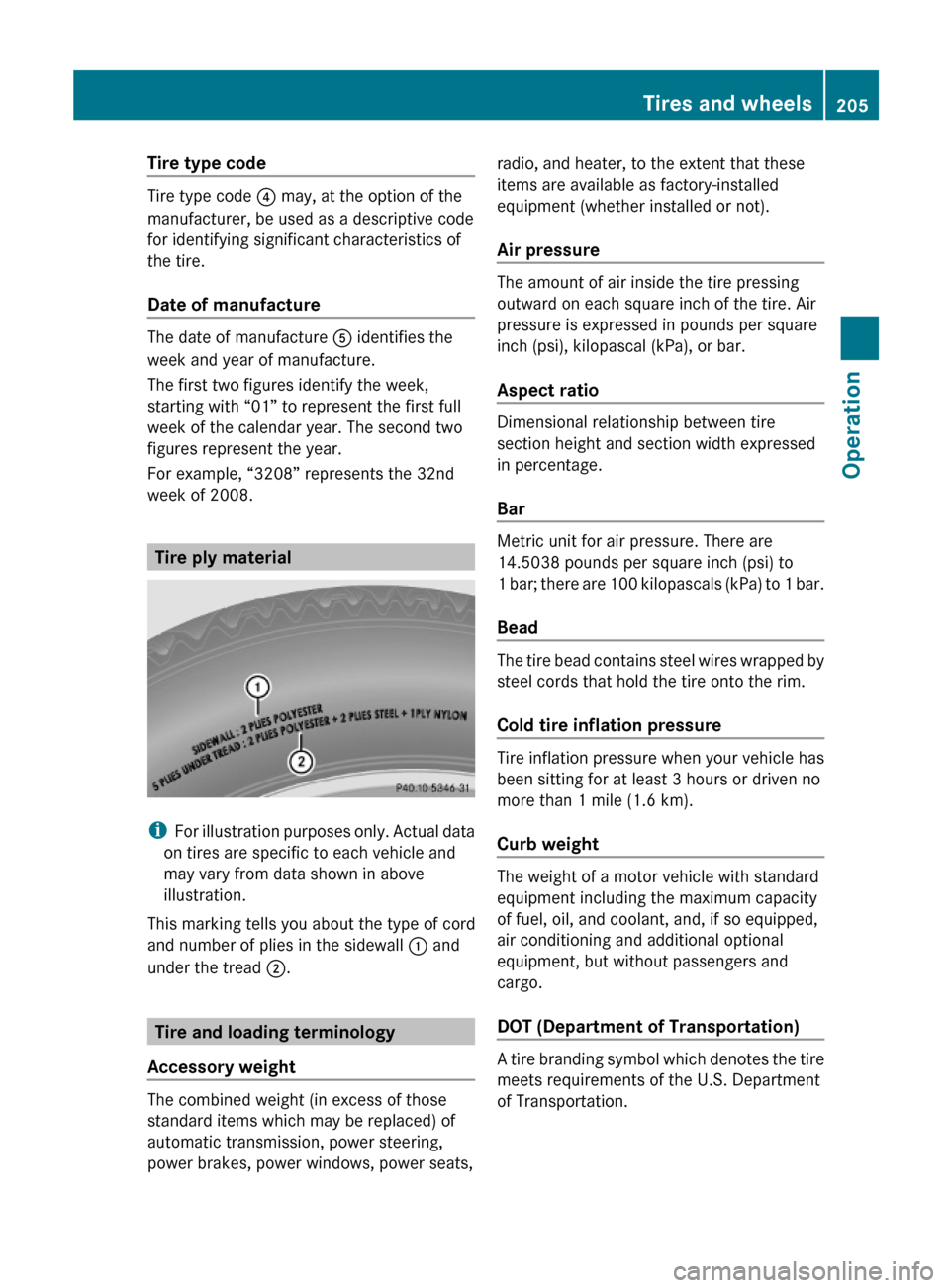
This marking tells you about the type of cord
and number of plies in the sidewall : and
under the tread ;.
Tire and loading terminology
Accessory weight
The combined weight (in excess of those
standard items which may be replaced) of
automatic transmission, power steering,
power brakes, power windows, power seats,
radio, and heater, to the extent that these
items are available as factory-installed
equipment (whether installed or not).
Air pressure
The amount of air inside the tire pressing
outward on each square inch of the tire. Air
pressure is expressed in pounds per square
inch (psi), kilopascal (kPa), or bar.
Aspect ratio
Dimensional relationship between tire
section height and section width expressed
in percentage.
Bar
Metric unit for air pressure. There are
14.5038 pounds per square inch (psi) to
1 bar; there are 100 kilopascals (kPa) to 1 bar.
Bead
The tire bead contains steel wires wrapped by
steel cords that hold the tire onto the rim.
Cold tire inflation pressure
Tire inflation pressure when your vehicle has
been sitting for at least 3 hours or driven no
more than 1 mile (1.6 km).
Curb weight
The weight of a motor vehicle with standard
equipment including the maximum capacity
of fuel, oil, and coolant, and, if so equipped,
air conditioning and additional optional
equipment, but without passengers and
cargo.
DOT (Department of Transportation)
A tire branding symbol which denotes the tire
meets requirements of the U.S. Department
of Transportation.
Tires and wheels205Operation230_AKB; 6; 22, en-USd2ureepe,Version: 2.11.8.12009-07-28T18:49:58+02:00 - Seite 205Z
Page 270 of 316
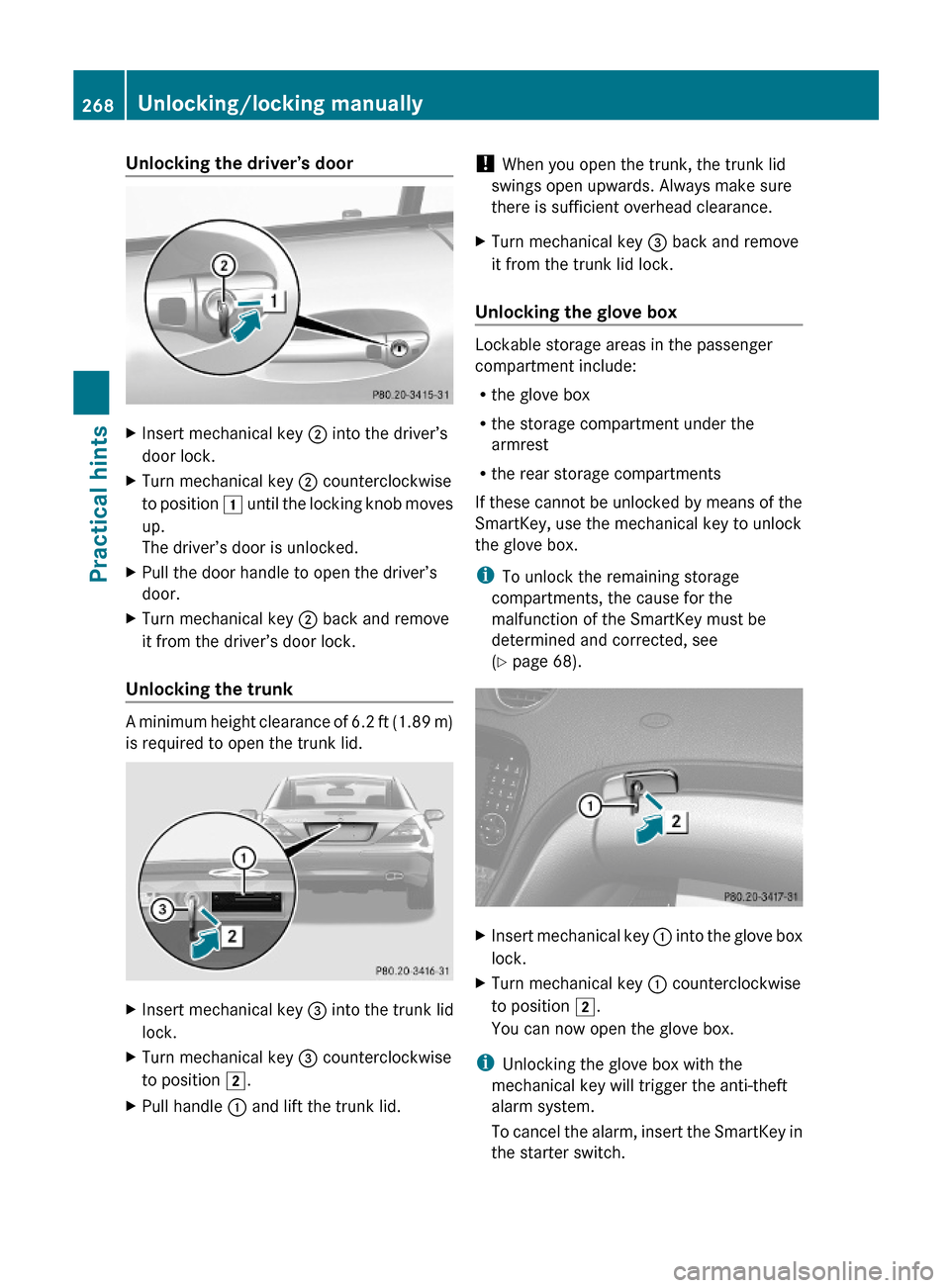
Unlocking the driver’s doorXInsert mechanical key ; into the driver’s
door lock.
XTurn mechanical key ; counterclockwise
to position 1 until the locking knob moves
up.
The driver’s door is unlocked.
XPull the door handle to open the driver’s
door.
XTurn mechanical key ; back and remove
it from the driver’s door lock.
Unlocking the trunk
A minimum height clearance of 6.2 ft (1.89 m)
is required to open the trunk lid.
XInsert mechanical key = into the trunk lid
lock.
XTurn mechanical key = counterclockwise
to position 2.
XPull handle : and lift the trunk lid.! When you open the trunk, the trunk lid
swings open upwards. Always make sure
there is sufficient overhead clearance.
XTurn mechanical key = back and remove
it from the trunk lid lock.
Unlocking the glove box
Lockable storage areas in the passenger
compartment include:
Rthe glove box
Rthe storage compartment under the
armrest
Rthe rear storage compartments
If these cannot be unlocked by means of the
SmartKey, use the mechanical key to unlock
the glove box.
iTo unlock the remaining storage
compartments, the cause for the
malfunction of the SmartKey must be
determined and corrected, see
(Y page 68).
XInsert mechanical key : into the glove box
lock.
XTurn mechanical key : counterclockwise
to position 2.
You can now open the glove box.
iUnlocking the glove box with the
mechanical key will trigger the anti-theft
alarm system.
To cancel the alarm, insert the SmartKey in
the starter switch.
268Unlocking/locking manuallyPractical hints
230_AKB; 6; 22, en-USd2ureepe,Version: 2.11.8.12009-07-28T18:49:58+02:00 - Seite 268
Page 280 of 316
XPress on both clips ; simultaneously to
release buckle :.
XStore the tensioning straps in a safe place.
You will need them to store the spare wheel
in the trunk after use (Y page 225).
Lifting the vehicle
GWarning!
When jacking up the vehicle, only use the jack
which has been specifically approved by
Mercedes-Benz for your vehicle.
The jack is designed exclusively for jacking up
the vehicle at the jack tubes built into both
sides of the vehicle. Make sure the jack arm
is fully inserted in the jack tube. The jack must
always be vertical when in use, especially on
inclines or declines.
The jack is intended only for lifting the vehicle
briefly for wheel changes. It is not suited for
performing maintenance work under the
vehicle. To help avoid personal injury, use the
jack only to lift the vehicle during a wheel
change.
Never get beneath the vehicle while it is
supported by the jack. Keep hands and feet
away from the area under the lifted vehicle.
Always lower the vehicle onto sufficient
capacity jackstands before working under the
vehicle.
Always engage the parking brake firmly and
block the wheels with wheel chocks or other
sizeable objects before raising the vehicle
with the jack. Do not disengage the parking
brake while the vehicle is raised.
Make sure that the ground on which the
vehicle is standing and where you place the
jack is solid, level and not slippery. If
necessary, use a large underlay. On slippery
surfaces, such as tiled floors, you should use
a non-slip underlay, for example a rubber mat.
Do not use wooden blocks or similar objects
to support the jack. Otherwise the jack may
not be able to achieve its load-bearing
capacity if it is not at its full height.
Never start the engine when the vehicle is
raised.
Also observe the notes on the jack.
XPrevent the vehicle from rolling away by
blocking wheels with wheel chocks (not
included) or other sizeable objects.
When changing a wheel on a level surface:
XPlace a wheel chock or other sizeable
object in front of and another wheel chock
or other sizeable object behind the wheel
that is diagonally opposite to the wheel
being changed.
Always try lifting the vehicle using the jack on
a level surface. However, should
circumstances require you to do so on a hill:
XPlace wheel chocks or other sizeable
objects on the downhill side in front of both
wheels on the side opposite to the side on
which the wheel is to be changed.
GWarning!
Only jack up the vehicle on level ground or on
slight inclines/declines. Otherwise, the
vehicle could fall off the jack and injure you or
others.
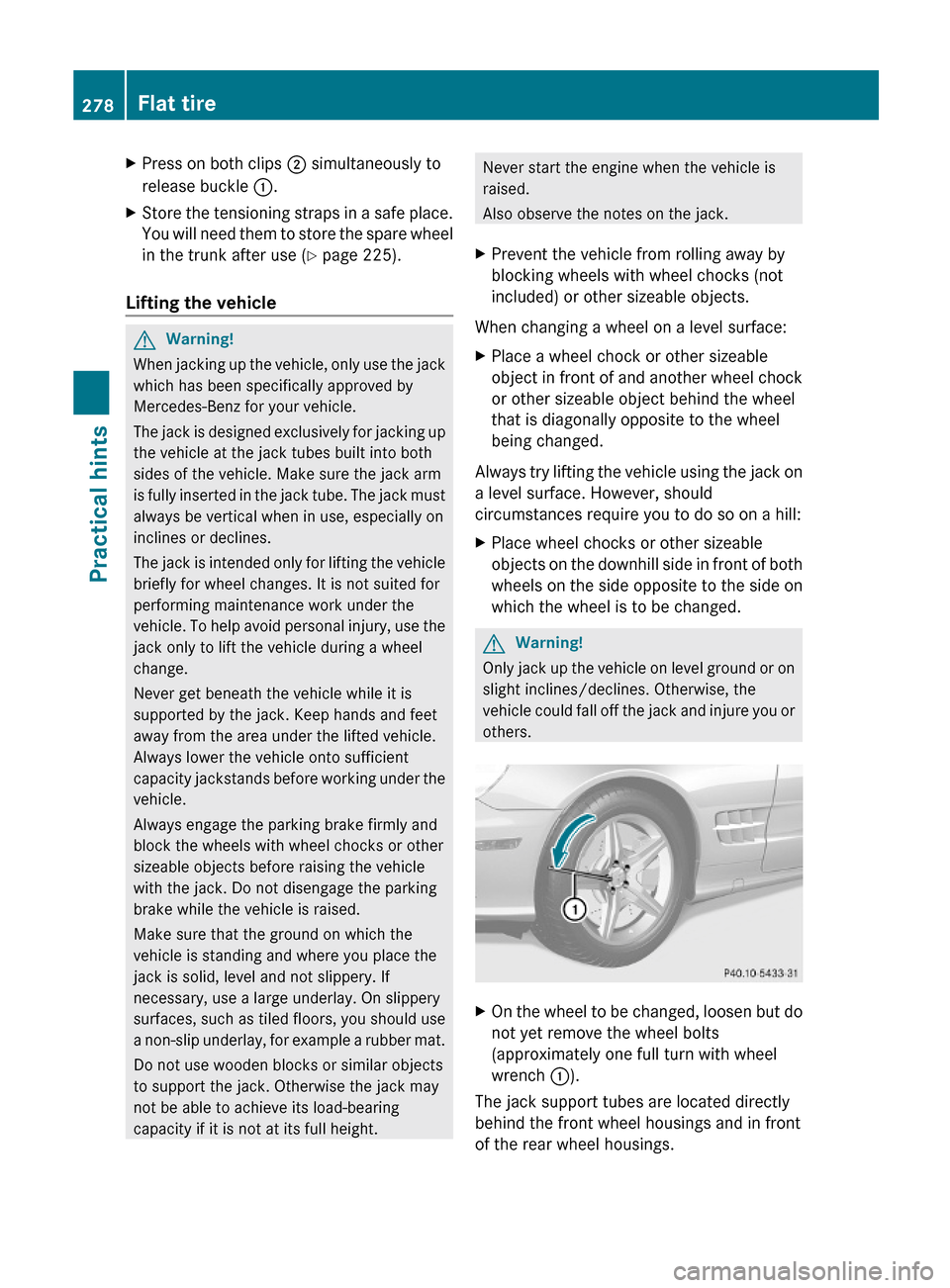
XOn the wheel to be changed, loosen but do
not yet remove the wheel bolts
(approximately one full turn with wheel
wrench :).
The jack support tubes are located directly
behind the front wheel housings and in front
of the rear wheel housings.
278Flat tirePractical hints
230_AKB; 6; 22, en-USd2ureepe,Version: 2.11.8.12009-07-28T18:49:58+02:00 - Seite 278
Page 298 of 316
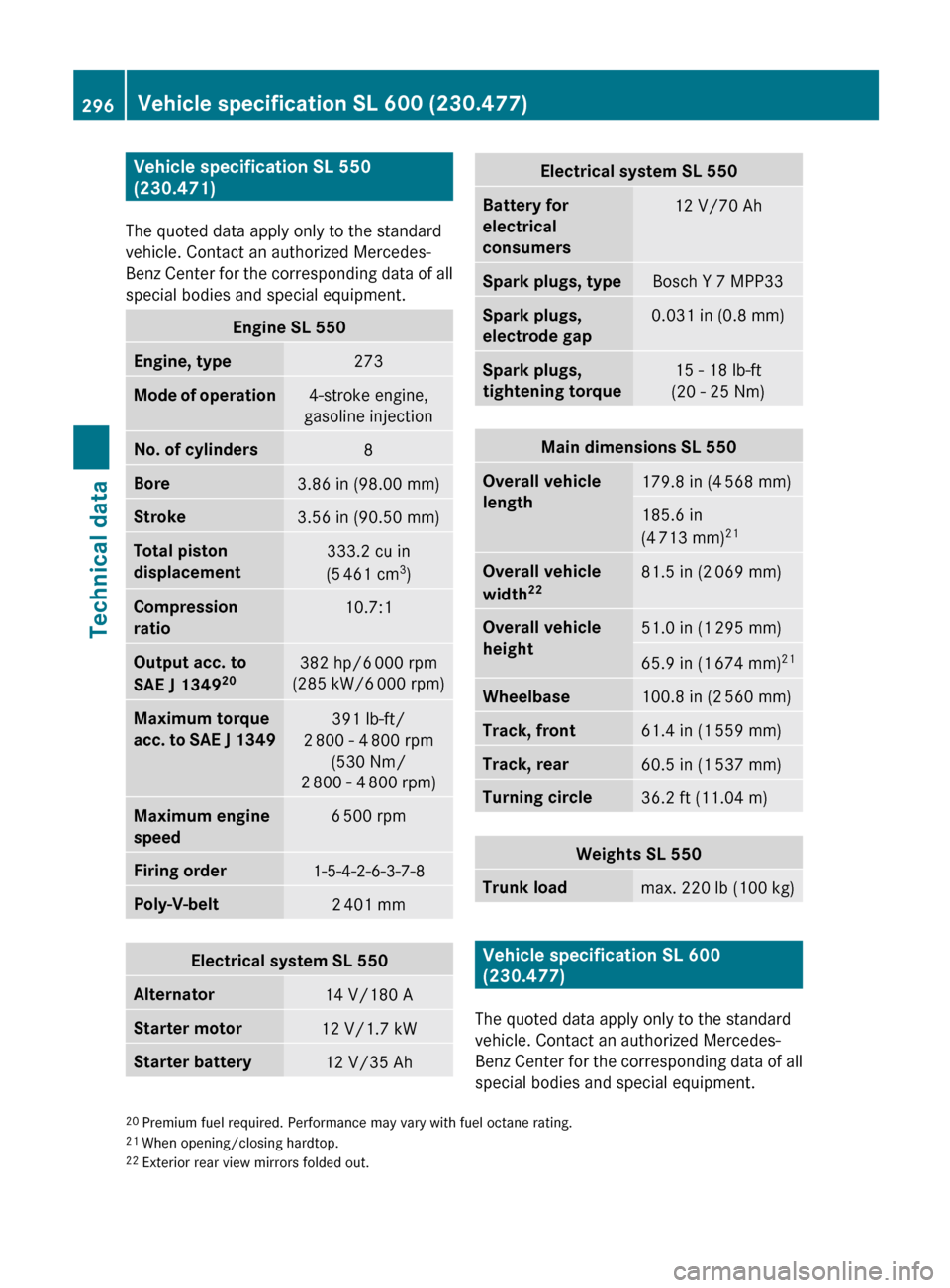
Vehicle specification SL 550
(230.471)
The quoted data apply only to the standard
vehicle. Contact an authorized Mercedes-
Benz Center for the corresponding data of all
special bodies and special equipment.Engine SL 550Engine, type273Mode of operation4-stroke engine,
gasoline injectionNo. of cylinders8Bore3.86 in (98.00 mm)Stroke3.56 in (90.50 mm)Total piston
displacement333.2 cu in
(5 461 cm 3
)Compression
ratio10.7:1Output acc. to
SAE J 1349 20382 hp/6
000 rpm
(285 kW/6 000 rpm)Maximum torque
acc. to SAE J 1349391 lb-ft/
2 800 - 4 800 rpm
(530 Nm/
2 800 - 4 800 rpm)Maximum engine
speed6 500 rpmFiring order1-5-4-2-6-3-7-8Poly-V-belt2 401 mmElectrical system SL 550Alternator14 V/180 AStarter motor12 V/1.7 kWStarter battery12 V/35 AhElectrical system SL 550Battery for
electrical
consumers12 V/70 AhSpark plugs, typeBosch Y 7 MPP33Spark plugs,
electrode gap0.031 in (0.8 mm)Spark plugs,
tightening torque15 - 18 lb-ft
(20 - 25 Nm)Main dimensions SL 550Overall vehicle
length179.8 in (4 568 mm)185.6 in
(4 713 mm) 21Overall vehicle
width 2281.5 in (2
069 mm)Overall vehicle
height51.0 in (1 295 mm)65.9 in (1 674 mm) 21Wheelbase100.8 in (2
560 mm)Track, front61.4 in (1 559 mm)Track, rear60.5 in (1 537 mm)Turning circle36.2 ft (11.04 m)Weights SL 550Trunk loadmax. 220 lb (100 kg)
Vehicle specification SL 600
(230.477)
The quoted data apply only to the standard
vehicle. Contact an authorized Mercedes-
Benz Center for the corresponding data of all
special bodies and special equipment.
20 Premium fuel required. Performance may vary with fuel octane rating.
21 When opening/closing hardtop.
22 Exterior rear view mirrors folded out.296Vehicle specification SL 600 (230.477)Technical data
230_AKB; 6; 22, en-USd2ureepe,Version: 2.11.8.12009-07-28T18:49:58+02:00 - Seite 296
Page 299 of 316
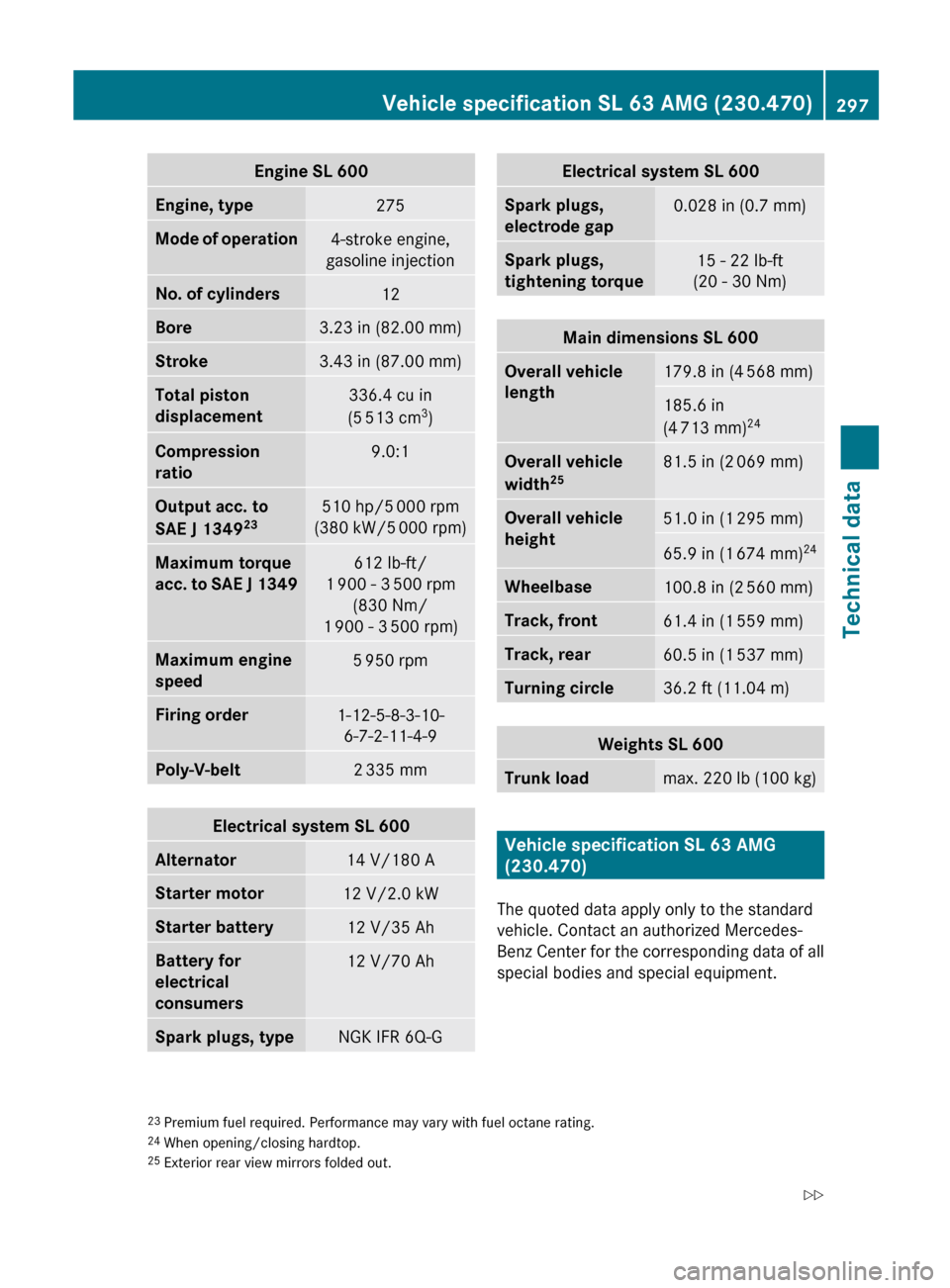
Engine SL 600Engine, type275Mode of operation4-stroke engine,
gasoline injectionNo. of cylinders12Bore3.23 in (82.00 mm)Stroke3.43 in (87.00 mm)Total piston
displacement336.4 cu in
(5 513 cm 3
)Compression
ratio9.0:1Output acc. to
SAE J 1349 23510 hp/5
000 rpm
(380 kW/5 000 rpm)Maximum torque
acc. to SAE J 1349612 lb-ft/
1 900 - 3 500 rpm
(830 Nm/
1 900 - 3 500 rpm)Maximum engine
speed5 950 rpmFiring order1-12-5-8-3-10-
6-7-2-11-4-9Poly-V-belt2 335 mmElectrical system SL 600Alternator14 V/180 AStarter motor12 V/2.0 kWStarter battery12 V/35 AhBattery for
electrical
consumers12 V/70 AhSpark plugs, typeNGK IFR 6Q-GElectrical system SL 600Spark plugs,
electrode gap0.028 in (0.7 mm)Spark plugs,
tightening torque15 - 22 lb-ft
(20 - 30 Nm)Main dimensions SL 600Overall vehicle
length179.8 in (4 568 mm)185.6 in
(4 713 mm) 24Overall vehicle
width 2581.5 in (2
069 mm)Overall vehicle
height51.0 in (1 295 mm)65.9 in (1 674 mm) 24Wheelbase100.8 in (2
560 mm)Track, front61.4 in (1 559 mm)Track, rear60.5 in (1 537 mm)Turning circle36.2 ft (11.04 m)Weights SL 600Trunk loadmax. 220 lb (100 kg)
Vehicle specification SL 63 AMG
(230.470)
The quoted data apply only to the standard
vehicle. Contact an authorized Mercedes-
Benz Center for the corresponding data of all
special bodies and special equipment.
23 Premium fuel required. Performance may vary with fuel octane rating.
24 When opening/closing hardtop.
25 Exterior rear view mirrors folded out.Vehicle specification SL 63 AMG (230.470)297Technical data230_AKB; 6; 22, en-USd2ureepe,Version: 2.11.8.12009-07-28T18:49:58+02:00 - Seite 297Z
Page 300 of 316
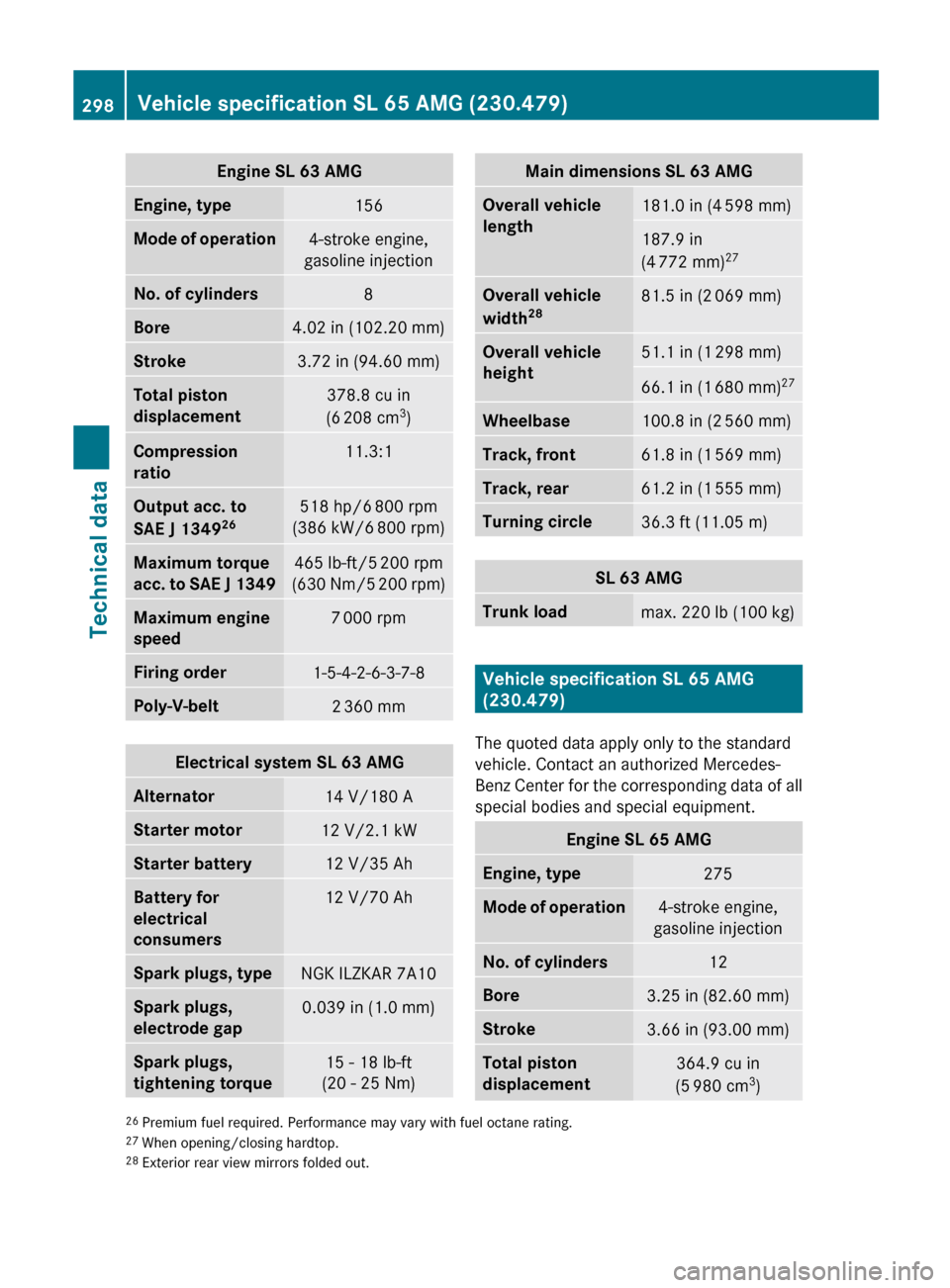
Engine SL 63 AMGEngine, type156Mode of operation4-stroke engine,
gasoline injectionNo. of cylinders8Bore4.02 in (102.20 mm)Stroke3.72 in (94.60 mm)Total piston
displacement378.8 cu in
(6 208 cm 3
)Compression
ratio11.3:1Output acc. to
SAE J 1349 26518 hp/6
800 rpm
(386 kW/6 800 rpm)Maximum torque
acc. to SAE J 1349465 lb-ft/5 200 rpm
( 630 Nm/5 200 rpm)Maximum engine
speed7 000 rpmFiring order1-5-4-2-6-3-7-8Poly-V-belt2 360 mmElectrical system SL 63 AMGAlternator14 V/180 AStarter motor12 V/2.1 kWStarter battery12 V/35 AhBattery for
electrical
consumers12 V/70 AhSpark plugs, typeNGK ILZKAR 7A10Spark plugs,
electrode gap0.039 in (1.0 mm)Spark plugs,
tightening torque15 - 18 lb-ft
(20 - 25 Nm)Main dimensions SL 63 AMGOverall vehicle
length181.0 in (4 598 mm)187.9 in
(4 772 mm) 27Overall vehicle
width 2881.5 in (2
069 mm)Overall vehicle
height51.1 in (1 298 mm)66.1 in (1 680 mm) 27Wheelbase100.8 in (2
560 mm)Track, front61.8 in (1 569 mm)Track, rear61.2 in (1 555 mm)Turning circle36.3 ft (11.05 m)SL 63 AMGTrunk loadmax. 220 lb (100 kg)
Vehicle specification SL 65 AMG
(230.479)
The quoted data apply only to the standard
vehicle. Contact an authorized Mercedes-
Benz Center for the corresponding data of all
special bodies and special equipment.
Engine SL 65 AMGEngine, type275Mode of operation4-stroke engine,
gasoline injectionNo. of cylinders12Bore3.25 in (82.60 mm)Stroke3.66 in (93.00 mm)Total piston
displacement364.9 cu in
(5 980 cm 3
)26 Premium fuel required. Performance may vary with fuel octane rating.
27 When opening/closing hardtop.
28 Exterior rear view mirrors folded out.298Vehicle specification SL 65 AMG (230.479)Technical data
230_AKB; 6; 22, en-USd2ureepe,Version: 2.11.8.12009-07-28T18:49:58+02:00 - Seite 298