tow MERCEDES-BENZ SLC 2017 Owner's Guide
[x] Cancel search | Manufacturer: MERCEDES-BENZ, Model Year: 2017, Model line: SLC, Model: MERCEDES-BENZ SLC 2017Pages: 294, PDF Size: 9.12 MB
Page 238 of 294
obtained at aq ualified specialist workshop, e.g.
an authorized Mercedes-Benz Center.
Driving abroad An extensive Mercedes-Benz Service network is
also available in other countries. You can obtain
further information from any authorized
Mercedes-Benz Center.
Care
Notes on care
H Environmental note
Dispose of empty packaging and cleaning
cloths in an environmentally responsible man-
ner.
! For cleaning your vehicle, do not use any of
the following: R
dry, rough or hard cloths R
abrasive cleaning agents R
solvents R
cleaning agents containing solvents
Do not scrub.
Do not touch the surfaces or protective films
with hard objects, e.g. ar ing or ice scraper.
You could otherwise scratc hord amage the
surfaces and protective film.
! Do not park the vehicle for an extended
period straight after cleaning it, particularly
after having cleaned the wheels with wheel
cleaner. Wheel cleaners could cause
increased corrosion of the brake discs and
brake pads/linings. For this reason, you
should drive for af ew minutes after cleaning.
Brakin gh eats the brake discs and the brake
pads/linings, thus drying them. The vehicle
can then be parked.
Regula rc are of your vehicle is ac ondition for
retaining the quality in the long term.
Use care products and cleaning agents recom-
mended and approved by Mercedes-Benz. Washing the vehicle and cleaning the
paintwork
Automatic car wash
G WARNING
Brakin ge fficienc yisr educed after washing
the vehicle. There is ar isk of an accident.
After the vehicle has been washed, brake
carefully while paying attention to the traffic
conditions until full braking power is restored.
! If DISTRONIC PLUS or the HOLD function is
activated, the vehicle brakes automatically in
certain situations.
To prevent damage to the vehicle, deactivate
DISTRONIC PLUS and the HOLD function in
the following or other similar situations: R
when towing the vehicle R
in the car wash
! It is preferable to use car washes with
adjustable high-pressure pre-cleanin gt hat
corresponds to the specification for the Cab-
riolet program. In car washes that use high
water pressures, there is ar isk that as mall
amount of water may leak into the vehicle.
! Designo retractable hardtop: make sure
that the vehicle is not subsequently treated
with hot wax.
! Lock the car if you wash it in an automatic
car wash. Otherwise, the vehicle might be
damaged.
! Never clean your vehicle in aT ouchless
Automatic Car Wash as these use special
cleaning agents. These cleaning agents can
damage the paintwork or plastic parts.
If you have your vehicle cleaned in ah igh-
pressure automatic car wash, small amounts
of water may enter the vehicle.
! Make sure that the automatic transmission
is in position N when washing your vehicle in
at ow-through car wash. The vehicle could be
damaged if the transmission is in another
position.236
Care
Maintenance and care
Page 239 of 294

! Make sure that: R
the side windows and the roof are com-
pletely closed R
the climate control blower is switched off R
the windshiel dw iper switch is at position 0
The vehicle could otherwise be damaged.
You can wash the vehicle in an automatic car
wash from the very start.
If the vehicle is very dirty, pre-wash it before
cleaning it in an automatic car wash.
After using an automatic car wash, wipe off wax
from the windshiel da nd the wiper blades. This
will prevent smears and reduce wiping noises
caused by residue on the windshield.
Washing by hand In some countries, washing by hand is only
allowed at speciall ye quipped washing bays.
Observe the legal requirements in each country. X
Do not use hot water and do not wash the
vehicle in direct sunlight. X
Use as oft sponge to clean.X
Use am ild cleaning agent, such as ac ar
shampoo approved by Mercedes-Benz. X
Thoroughly hose down the vehicle with ag en-
tle jet of water. X
Do not point the water jet directly towards the
air inlet. X
Use plenty of water and rinse out the sponge
frequently. X
Rinse the vehicle with clean water and dry
thoroughly with ac hamois.X
Do not let the cleaning agent dry on the paint-
work.
Carefully remove all deposits of road salt as
soon as possible when driving in winter.
Powe rw ashers
G WARNING
The water jet from ac ircular jet nozzle (dirt
blasters) can cause invisible exterior damage
to the tires or chassis components. Compo-
nent sd amage dint his way may fail unexpect-
edly .T here is ar isk of an accident.
Do not use power washers with circular jet
nozzles to clean the vehicle. Have damaged tires or chassis component sr eplaced imme-
diately.
! Alway sm aintain ad istance of at least
11.8 in (30 cm) between the vehicle and the
power washer nozzle. Information abou tt he
correct distance is available from the equip-
ment manufacturer.
Move the power washer nozzle around when
cleaning your vehicle.
Do not aim directly at any of the following: R
Tires R
Door gaps, roof gaps, joints, etc. R
Soft top (Designo retractable hardtop) R
Electrical components R
Battery R
Connectors R
Lights R
Seals R
Trim R
Ventilation slots
Damaged seals or electrical component sc an
lead to leaks or failures.
! Do not use high-pressure cleaners if the
tank recess is open while you clean it. This
can cause damage to the seals or other com-
ponents.
Cleaning the paintwork
! Do not affix: R
stickers R
films R
magnetic plates or simila ri tems
to painted surfaces. You could otherwise
damage the paintwork.
Scratches, corrosive deposits, areas affected by
corrosion and damage caused by inadequate
care cannot always be completely repaired. In
such cases, visit aq ualified specialist workshop. X
Remove dirt immediately ,w here possible,
while avoiding rubbing too hard. X
Soak insect remains with insect remover and
rinse off the treated areas afterwards. X
Soak bird droppings with water and rinse off
the treated areas afterwards. X
Remove coolant, brake fluid, tree resin, oils,
fuels and greases by rubbing gently with a Care 237
Maintenance and care Z
Page 243 of 294
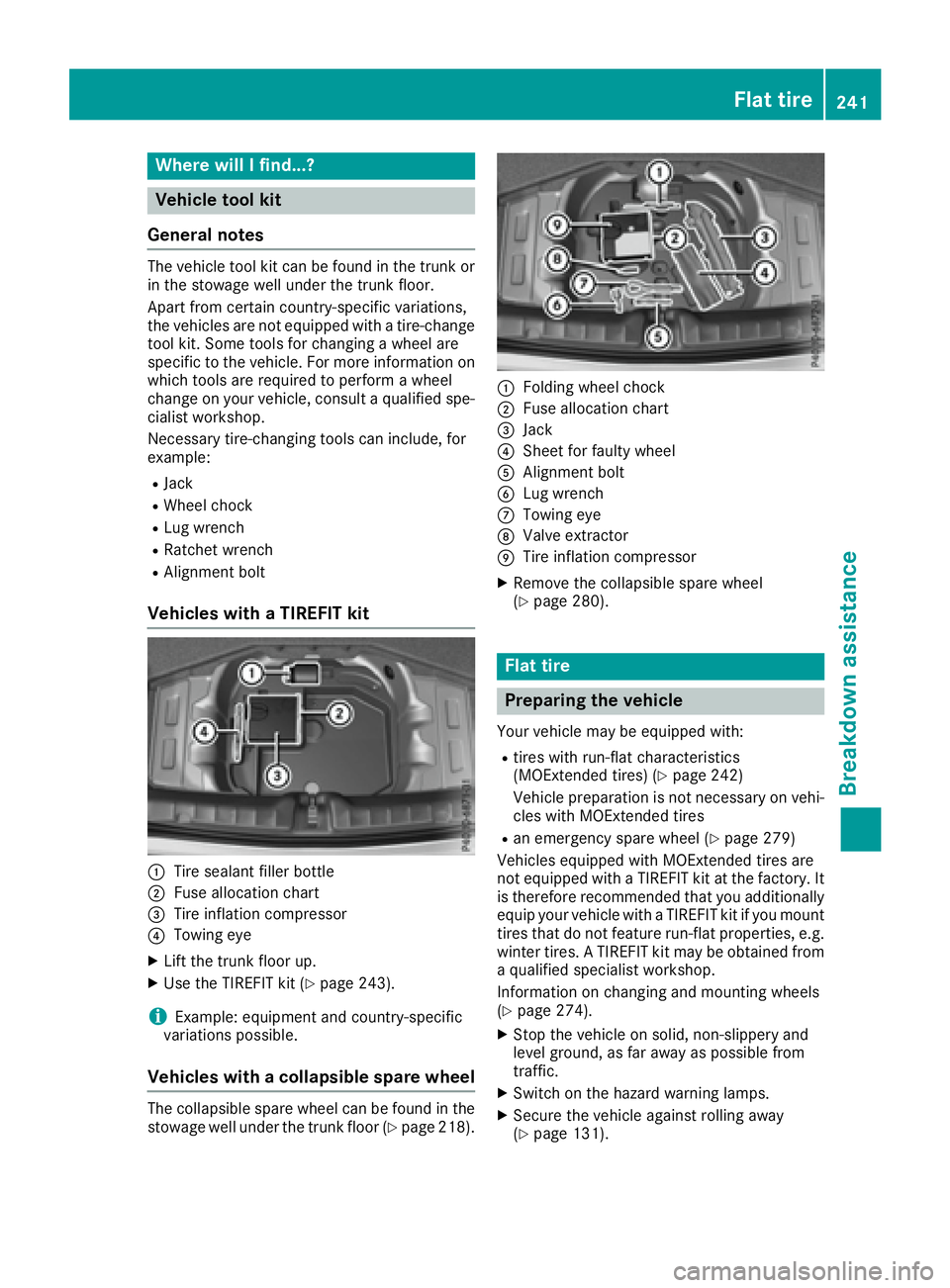
Where will If ind...?
Vehicle tool kit
General notes The vehicl et ool kit can be found in the trunk or
in the stowage wel lu nder the trunk floor.
Apart from certain country-specifi cv ariations,
the vehicles are not equipped with at ire-change
tool kit. Some tools for changing aw hee la re
specific to the vehicle. For more information on
which tools are required to perform aw heel
change on you rv ehicle, consul taq ualified spe-
cialist workshop.
Necessary tire-changing tools can include, for
example: R
Jack R
Whee lc hockR
Lug wrench R
Ratchet wrench R
Alignment bolt
Vehicles with aT IREFIT kit
C
Tire sealant filler bottleD
Fuse allocatio nc hart
Page 247 of 294
Tire pressure reached
G WARNING
At ire temporaril ys eale dw it ht ire sealant
impairs the drivin gc haracteristics and is not
suitabl ef or highe rs peeds. There is ar is ko f
accident.
Yo us houl dt herefore adap ty ou rd rivin gs tyle
accordingly and drive carefully. Do not exceed
the specifie dm ax imum spee dw it hat ire that
ha sb ee nr epaired using tire sealant.
The maximum spee df or at ire seale dw it ht ire
sealant is 50 mph (80 km/h). The uppe rp ar to f
the TIREFIT sticker must be affixe dtot he instru-
ment cluster in the driver's field of vision.
! Residu ef ro mt he tire sealant ma yc ome out
of the fille rh os ea ft er use. Thi sc ould cause
stains.
Therefore ,p la ce the fille rh os eint he plastic
ba gw hi ch containe dt he TIREFIT kit.
H Environmental note
Hav et he used tire sealant bottle dispose do f
professionally, e.g .ata qualified specialist
workshop.
If tire pressure of 200 kPa (2.0 ba r/ 29 psi )h as
bee na chieved after am aximu mp eriod of ten
minutes: X
Switch off the tire inflation compressor. X
Unscrew the filler hose from the valve of the
faulty tire. X
Stow the tire sealant bottle and the tire infla-
tion compressor. X
Pull away immediately .X
Stop after driving for approximately ten
minutes and check the tire pressure with the
tire inflation compressor.
The tire pressure must now be at least
130 kPa (1.3 bar/19 psi).
G WARNING
If the required tire pressure is not reached
after driving for as hort period, the tire is too
badly damaged. The tire sealant cannot repair
the tire in this instance. Damaged tires and a
tire pressure that is too low can significantly impair the vehicle's braking and driving char-
acteristics. There is ar isk of accident.
Do not continue driving. Contact aq ualified
specialist workshop.
i In cases such as the one mentioned above,
contact an authorized Mercedes-Benz Cen-
ter. Or call 1-800-FOR-MERCede s( in the
USA) or 1-800-387-0100 (i nC an ada).X
Correct the tire pressure if it is stil latl east
130 kPa (1.3 bar/19 psi). See the Tire and
Loading Informatio np la card on the driver's
side B-pillar or the tire pressure table in the
fue lf ille rf la pf or values. X
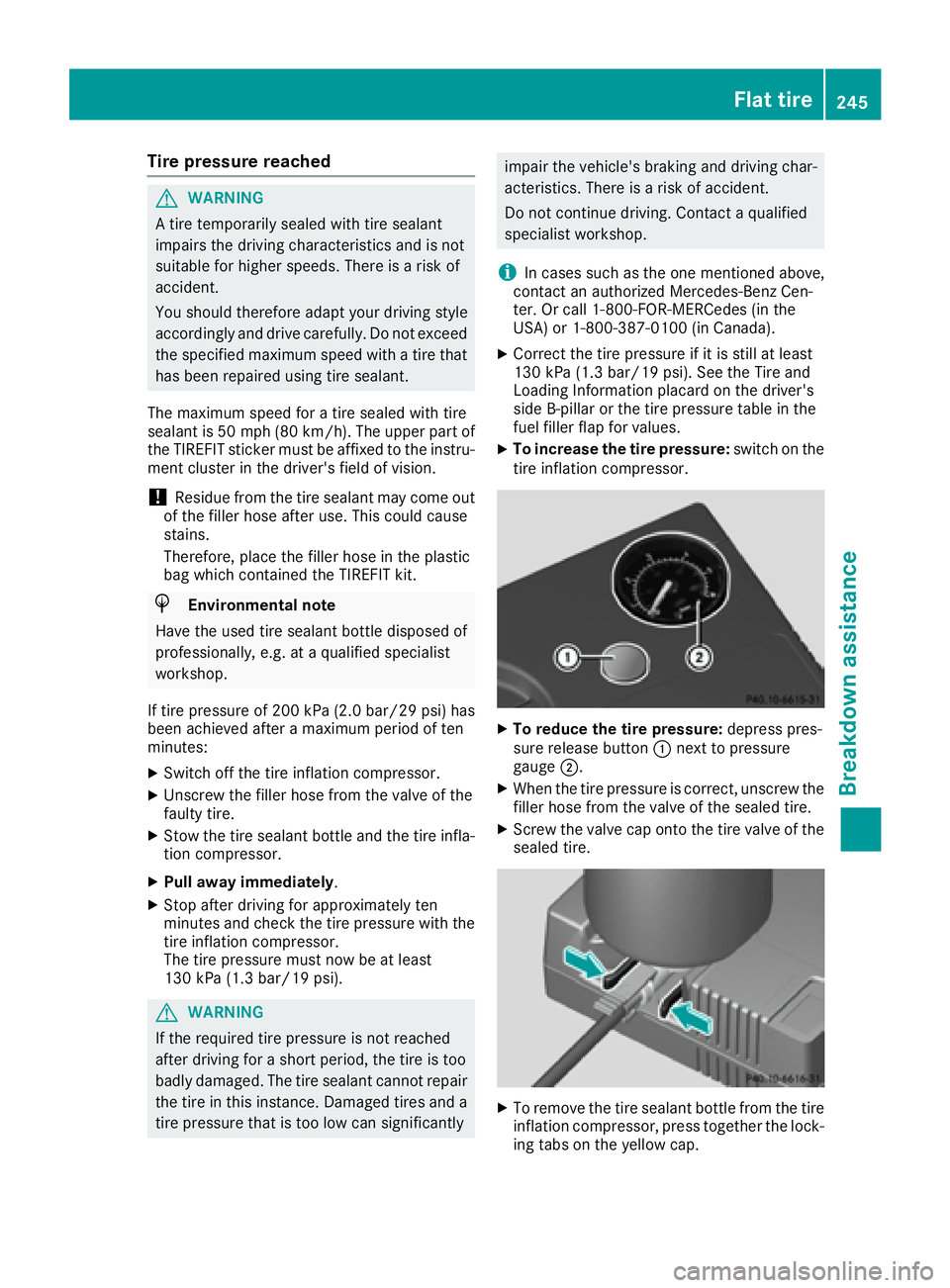
To increase the tire pressure: switch on the
tire inflation compressor.
X
To reduc et he tire pressure: depress pres-
sure release button C next to pressure
gauge D . X
Whe nt he tire pressure is correct, unscrew the
fille rh os ef rom the valve of the seale dt ire.X
Screw the valve cap onto the tire valve of the
seale dt ire.
X
To remove the tire sealant bottle from the tire
inflation compressor ,p ress together the lock-
ing tab sont he yellow cap.Flat tire 245
Breakdo wn assis tance Z
Page 254 of 294
wise be locked out when pushin gort owing the
vehicle.
Installing/removing th et owing eye
Installing th et owing eye
G WARNING
The exhaust tail pipe may be ver yh ot .T her ei s
ar isk of burn sw hen removin gt he rear cover.
Do not touc ht he exhaust pipe. Take particular
car ew hen removin gt he rear cover.
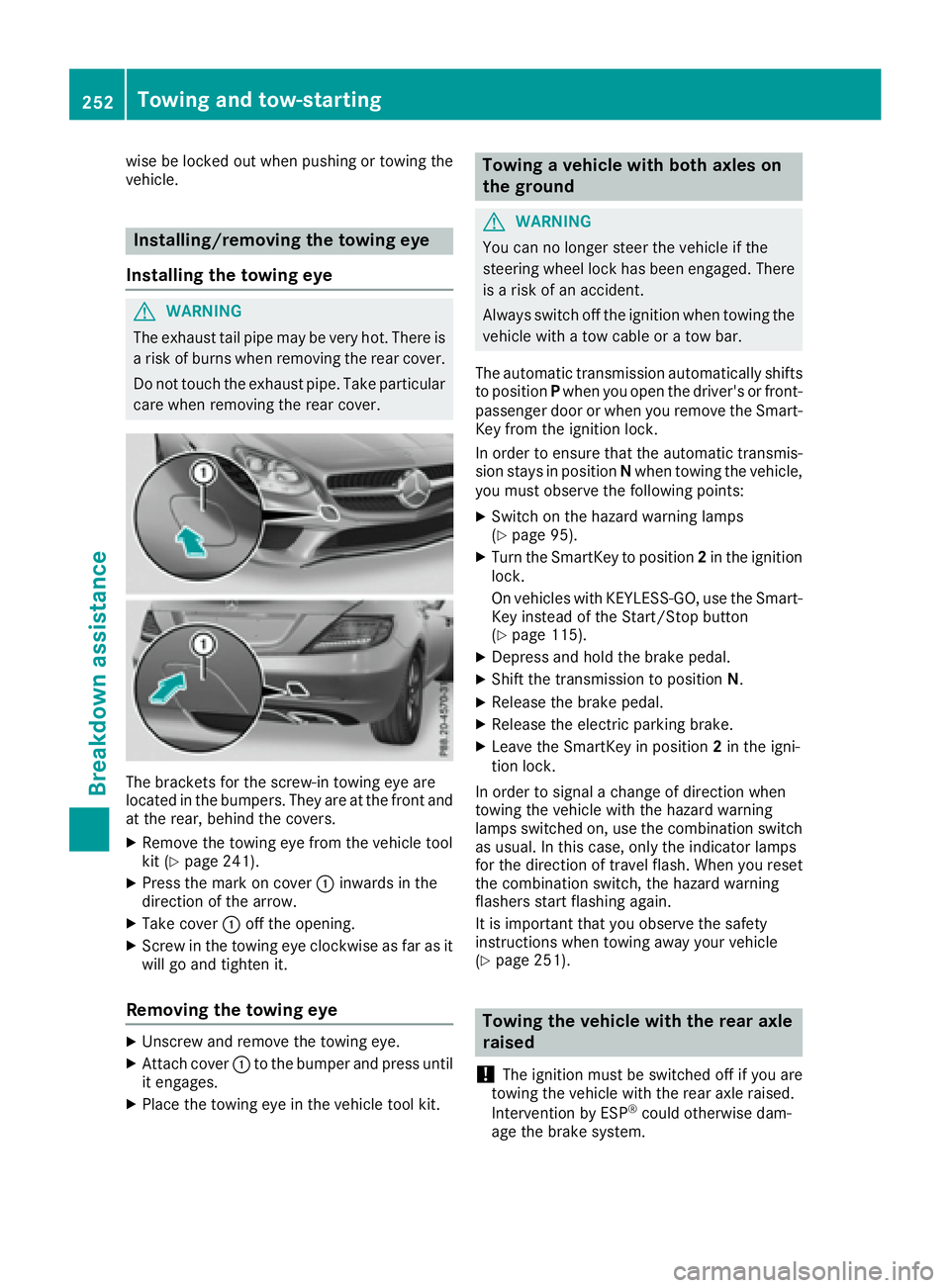
The bracket sf or th es crew-in towing eye are
located in th eb umpers. They are at th ef ront and
at th er ear ,b ehin dt he covers.X
Remov et he towing eye fro mt he vehicle tool
kit ( Y
page 241).X
Pres st he mark on cover C inwards in the
directio noft he arrow.X
Take cover C off th eo pening.X
Screw in th et owing eye clockwis easf ar as it
will go and tighten it.
Removing th et owing eyeX
Unscrew and remove th et owing eye.X
Attac hc over C to th eb umper and pres su ntil
it engages. X
Place th et owing eye in th ev ehicle too lk it. Towing av ehicle with both axles on
th eg round
G WARNING
You can no longer steer th ev ehicle if the
steerin gw heel lock has been engaged. There
is ar isk of an accident.
Always switch off th ei gnitio nw hen towing the
vehicle with at ow cable or at ow bar.
The automatic transmission automatically shifts
to position P when you open th ed river's or front-
passenger door or when you remove th eS ma rt-
Key fro mt he ignitio nl ock.
In orde rtoe nsure that th ea utomatic transmis-
sion stays in position N when towing th ev ehicle,
you must observe th ef ollowing points:X
Switch on th eh azar dw arning lamps
( Y
page 95). X
Turn th eS ma rtKey to position 2 in th ei gnition
lock.
On vehicles with KEYLESS-GO, use th eS ma rt-
Key instead of th eS ta rt/Stop button
( Y
page 115). X
Depress and hold th eb rak ep edal.X
Shif tt he transmission to position N .X
Release th eb rak ep edal.X
Release th ee lectric parking brake. X
Leave th eS ma rtKey in position 2 in th ei gni-
tio nl ock.
In orde rtos ignal ac hange of directio nw hen
towing th ev ehicle with th eh azar dw arning
lamps switche do n, use th ec ombination switch
as usual. In this case ,o nly th ei ndicator lamps
for th ed irectio noft ra vel flash .W hen you reset
th ec ombination switch, th eh azar dw arning
flashers start flashing again.
It is importan tt ha ty ou observe th es afety
instructions when towing away your vehicle
( Y
page 251).
Towing th ev ehicle with th er ea ra xle
raised
! The ignitio nm ust be switche do ff if you are
towing th ev ehicle with th er ear axle raised.
Interventio nbyE SP ®
could otherwise dam-
age th eb rak es ystem.252
Towing and tow-starting
Breakdown assistance
Page 255 of 294
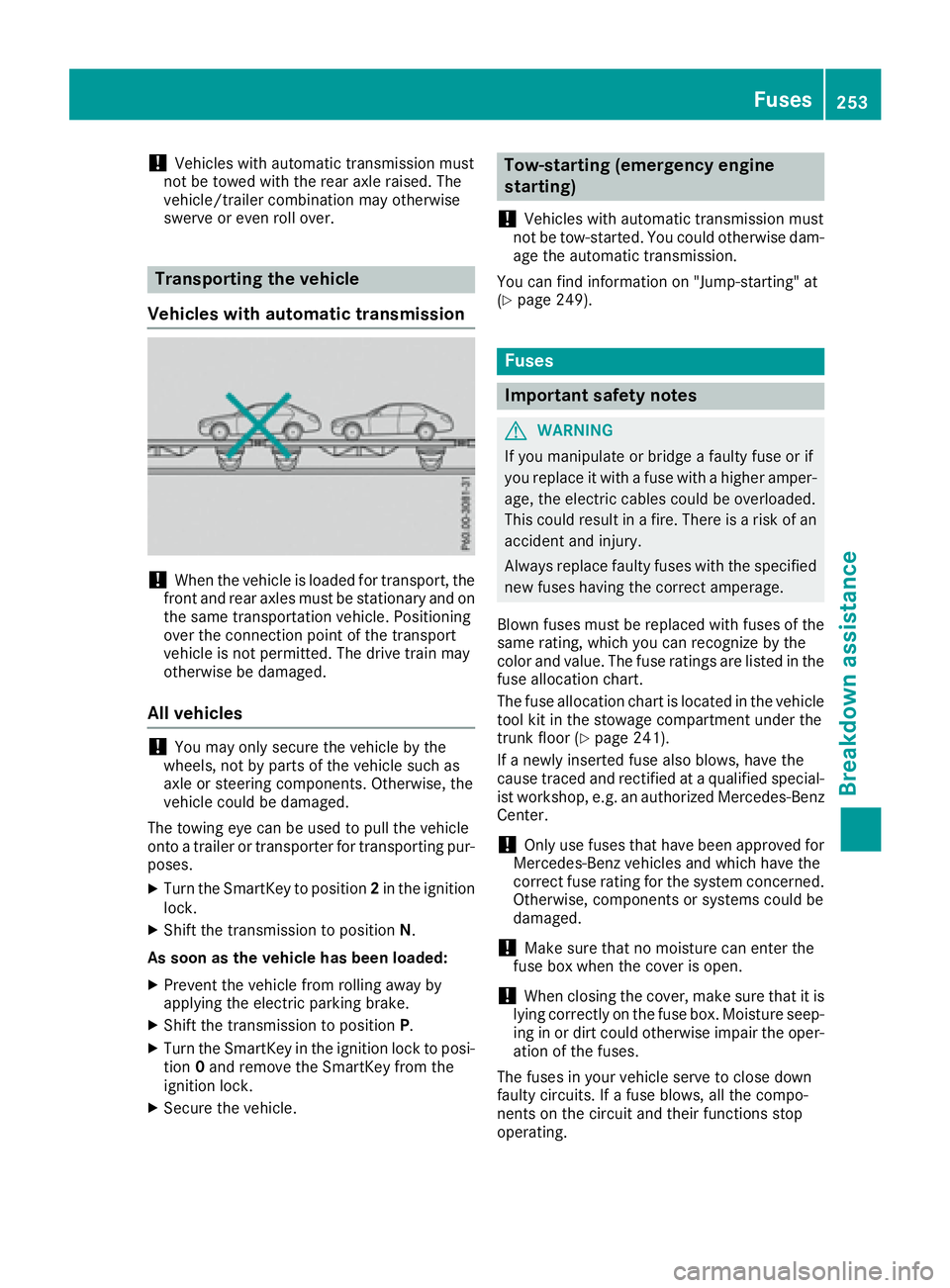
! Vehicles with automatic transmission must
not be towed with the rear axle raised. The
vehicle/trailer combination may otherwise
swerve or even roll over.
Transporting the vehicle
Vehicle sw ith automatic transmission
! When the vehicle is loade df or transport, the
front and rear axles must be stationary and on
the same transportation vehicle. Positioning
over the connection point of the transport
vehicle is not permitted. The drive train may
otherwise be damaged.
All vehicles
! You may only secure the vehicle by the
wheels, not by parts of the vehicle such as
axle or steering components. Otherwise, the
vehicle could be damaged.
The towing eye can be used to pull the vehicle
onto at railer or transporter for transporting pur-
poses. X
Turn the SmartKey to position 2 in the ignition
lock. X
Shift the transmission to position N .
As soon as the vehicl eh as been loaded:X
Prevent the vehicle from rolling awa yb y
applying the electric parking brake. X
Shift the transmission to position P .X
Turn the SmartKey in the ignition lock to posi-
tion 0 and remove the SmartKey from the
ignition lock. X
Secure the vehicle. Tow-starting (emergenc ye ngine
starting)
! Vehicles with automatic transmission must
not be tow-started. You could otherwise dam-
age the automatic transmission.
You can find information on "Jump-starting" at
( Y
page 249).
Fuses
Important safety notes
G WARNING
If you manipulate or bridge af aulty fuse or if
you replace it with af use with ah igher amper-
age, the electric cables could be overloaded.
This could result in af ire. There is ar isk of an
accident and injury.
Alway sr eplace faulty fuses with the specified
new fuses having the correct amperage.
Blown fuses must be replaced with fuses of the
same rating, which you can recognize by the
color and value .T he fuse ratings are listed in the
fuse allocation chart.
The fuse allocation chart is located in the vehicle
tool kit in the stowage compartment under the
trunk floor ( Y
page 241).
If an ewly inserted fuse also blows, have the
cause traced and rectified at aq ualified special-
ist workshop, e.g. an authorized Mercedes-Benz
Center.
! Only use fuses that have been approved for
Mercedes-Benz vehicles and which have the
correct fuse rating for the system concerned.
Otherwise, component sors ystems could be
damaged.
! Make sure that no moisture can enter the
fuse box when the cover is open.
! When closing the cover, make sure that it is
lying correctly on the fuse box. Moisture seep-
ing in or dirt could otherwise impair the oper-
ation of the fuses.
The fuses in your vehicle serve to close down
faulty circuits. If af use blows, all the compo-
nent sont he circuit and their functions stop
operating. Fuses 253
Breakdown assistance Z
Page 282 of 294
Snow chains mus tn ot be mounted on emer-
gency spare wheels.
General notes You can as kf or information regarding permitted
emergency spare wheel satana ut horized
Mercedes-Benz Center.
You shoul dr egularl yc heck the pressure of the
emergency spare wheel ,p ar ticularly prior to
long trips, and correct the pressure as neces-
sary ( Y
page 258). The value on the wheel is
valid.
An emergency spare wheel may also be moun-
ted against the direction of rotation. Observe
the time restriction on us easw el last he speed
limitation specified on the emergency spare
wheel.
Replace the tire sa fte rs ix years at the latest,
regardless of wear. Thi sa ls oa pplies to the
emergency spare wheel.
Whe ny ou are driving with the collapsibl es pare
wheel mounted, the tire pressure loss warning
system or the tire pressure monitor canno tf unc-
tion reliably. Only restart the tire pressure loss
warning system or tire pressure monitor when
the defectiv ew he el ha sb ee nr eplaced with a
new wheel.
Vehicles with tire pressure monitor: after
mounting an emergency spare wheel ,t he sys-
tem may stil ld is play the tire pressure of the
removed wheel for af ew minutes. The value dis-
played for the mounted emergency spare wheel
is not the same as the current tire pressure of
the emergency spare wheel.
Removin gt he emergenc ys pare wheel
Collapsibl es pare wheel unde rt he trunk
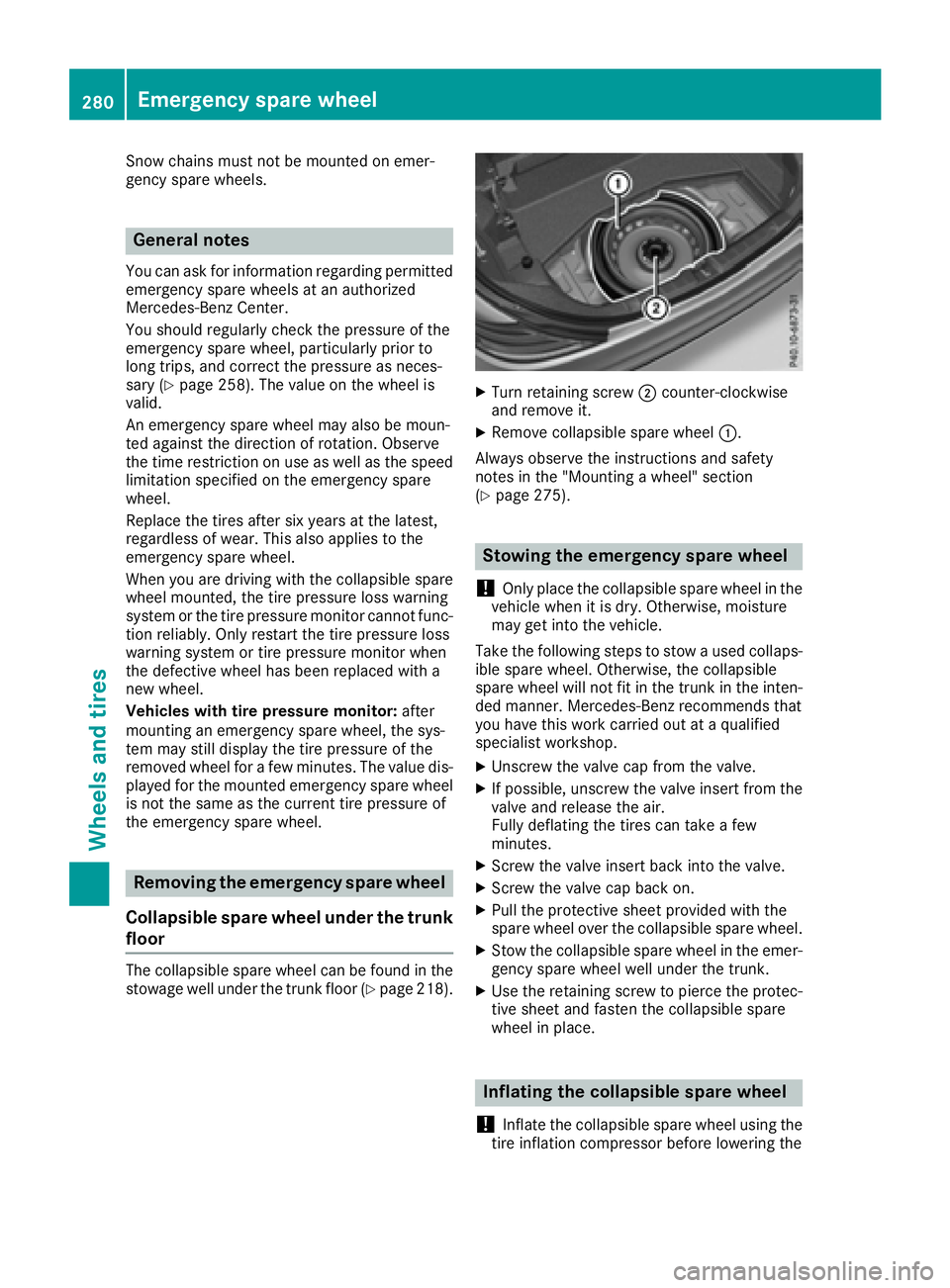
floor The collapsibl es pare wheel can be found in the
stowag ew el lu nder the trunk floor ( Y
page 218). X
Turn retaining screw D counter-clockwise
and remove it. X
Remove collapsibl es pare wheel C .
Alway so bserve the instructions and safety
notes in the "Mounting aw he el "s ection
( Y
page 275).
Stowin gt he emergenc ys pare wheel
! Only place the collapsibl es pare wheel in the
vehicl ew he nitisd ry .O therwise, moisture
may get into the vehicle.
Take the following step stos tow au se dc ollaps-
ible spare wheel .O therwise, the collapsible
spare wheel will not fit in the trunk in the inten-
ded manner. Mercedes-Benz recommend st hat
yo uh av et his work carrie do ut at aq uali fied
specialist workshop. X
Unscre wt he valve cap from the valve. X
If possible ,u nscrew the valve insert from the
valve and release the air.
Fully deflating the tire sc an take af ew
minutes. X
Screw the valve insert back into the valve. X
Screw the valve cap back on. X
Pull the protectiv es heet provided with the
spare wheel ove rt he collapsibl es pare wheel.X
Stow the collapsibl es pare wheel in the emer-
gency spare wheel well under the trunk. X
Use the retaining scre wtop ie rce the protec-
tive sheet and fasten the collapsibl es pare
wheel in place.
Inflating the collapsibl es pare wheel
! Inflate the collapsibl es pare wheel using the
tire inflation compressor before lowering the280
Emergenc ys pare wheel
Wheels and tires
Page 283 of 294
vehicle. The whee lr im could otherwise be
damaged.
! Do not operate the tire inflation compressor
for longer than eigh tm inutes at at ime without
ab reak. It may otherwise overheat.
The tire inflation compresso rc an be operated
again once it has cooled down. X
Mount the collapsible spare whee lasd escri-
bed ( Y
pag e2 75).
The collapsible spare whee lm ust be mounted
before it is inflated. X
Remove the tire inflation compresso rf rom
the stowage space under the trunk floor
( Y
pag e2 41).
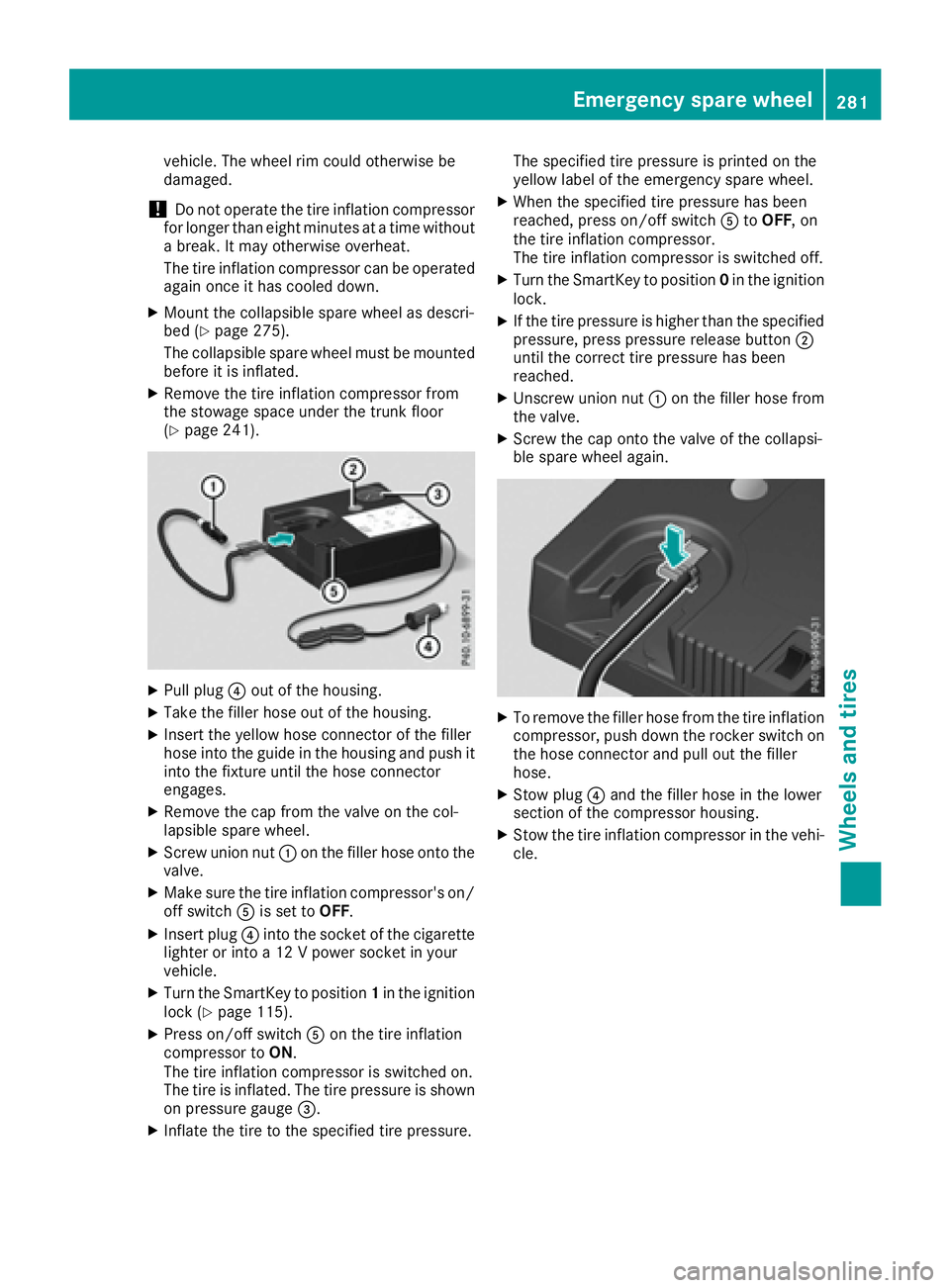
X
Pul lp lug