oil pressure MERCEDES-BENZ SLC 2017 Owners Manual
[x] Cancel search | Manufacturer: MERCEDES-BENZ, Model Year: 2017, Model line: SLC, Model: MERCEDES-BENZ SLC 2017Pages: 294, PDF Size: 9.12 MB
Page 19 of 294
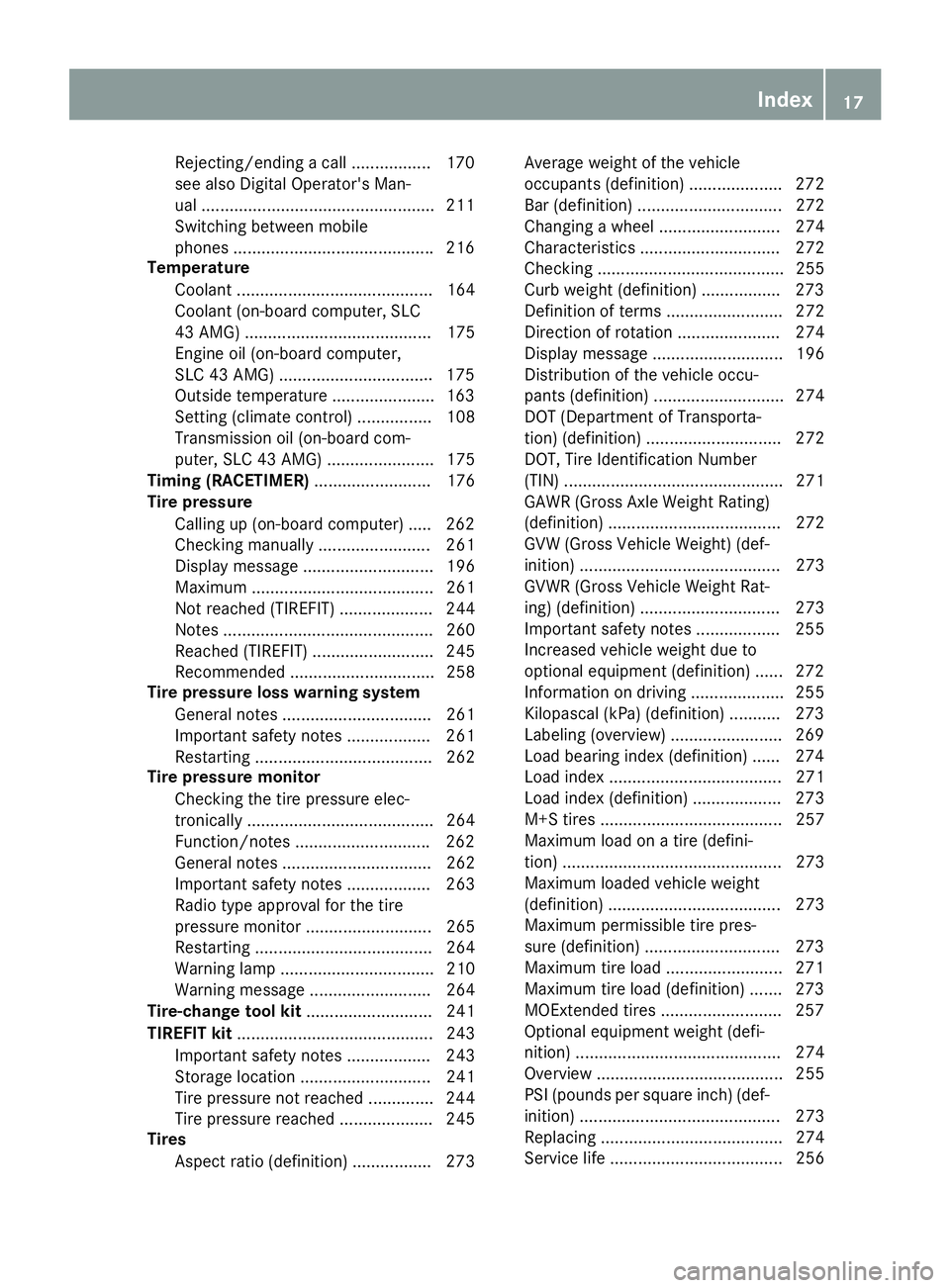
Rejecting/endin gac all ................ .1 70
see also Digita lO perator's Man-
ua l. ................................................ .2 11
Switching between mobile
phone s. ......................................... .2 16
Temperature
Coolant .......................................... 164
Coolant (on-board computer, SLC
43 AMG) ...................................... 175
Engine oil (on-board computer,
SLC 43 AMG) ............................... 175
Outside temperature ..................... .1 63
Setting (climate control) ................ 108
Transmissio no il (on-board com-
puter, SLC 43 AMG) ..................... 175
Timing (RACETIMER) ......................... 176
Tire pressure
Calling up (on-board computer) ..... 262
Checking manually ........................ 261
Display message ............................ 196
Maximum ....................................... 261
Not reached (TIREFIT) .................... 244
Notes ............................................. 260
Reached (TIREFIT) .......................... 245
Recommended ............................... 258
Tire pressure los sw arning system
General notes ................................ 261
Important safety notes .................. 261
Restarting ...................................... 262
Tire pressure monitor
Checking the tire pressure elec-
tronically ........................................ 264
Function/notes ............................ .2 62
General notes ................................ 262
Important safety notes .................. 263
Radio type approval for the tire
pressure monitor ........................... 265
Restarting ...................................... 264
Warning lamp ................................. 210
Warning message .......................... 264
Tire-change tool kit ........................... 241
TIREFIT kit .......................................... 243
Important safety notes .................. 243
Storage location ............................ 241
Tire pressure not reached .............. 244
Tire pressure reached .................... 245
Tires
Aspect ratio (definition) ....... .......... 273 Avera g ew ei
ght of the vehicle
occupants (definition) .................... 272
Bar (definition) ............................... 272
Changing aw heel .......................... 274
Characteristics .............................. 272
Checking ........................................ 255
Curb weight (definition) ................. 273
Definition of terms ......................... 272
Direction of rotatio n. ..................... 274
Displa ym essage ............................ 196
Distribution of the vehicl eo ccu-
pants (definition) ............................ 274
DOT (Department of Transporta-
tion) (definition) ............................. 272
DOT, Tire Identification Number
(TIN) ............................................... 271
GAW R( Gr os sA xle Weight Rating)
(definition) ..................................... 272
GV W( Gr os sV ehicl eW eight) (def-
inition) ........................................... 273
GVWR (Gros sV ehicl eW eight Rat-
ing )( de finition) .............................. 273
Important safety notes .................. 255
Increased vehicl ew eigh td ue to
optiona le quipment (definition) ...... 272
Information on driving .................... 255
Kilopasca l( kPa )( de finition) ........... 273
Labeling (overview) ........................ 269
Loa db ea ring index (definition) ...... 274
Loa di ndex ..................................... 271
Loa di ndex (definition) ................... 273
M+S tire s. ...................................... 257
Maximu ml oa dona tire (defini-
tion) ............................................... 273
Maximu ml oaded vehicl ew eigh t
(definition) ..................................... 273
Maximu mp er missibl et ire pres-
sure (definition) ............................. 273
Maximu mt ire load ......................... 271
Maximu mt ire load (definition) ....... 273
MOExtended tire s. ......................... 257
Optiona le quipment weight (defi-
nition) ............................................ 274
Overview ........................................ 255
PSI (pounds pe rs quare inch )( de f-
inition) ........................................... 273
Repl acing ....................................... 274
Servi
ce life ..................................... 256 Index 17
......
Page 235 of 294

G WARNING
If engine oil comes into contact with hot com-
ponents in the engine compartment, it may
ignite. There is ar isk of fire and injury.
Make sure that engine oil is not spilled next to
the filler neck. Let the engine cool dow na nd
thoroughly clea nt he engine oil off the com-
ponents before starting the engine.
H Environmental note
When adding oil ,t ake care not to spil la ny. If
oil enters the soil or waterways, it is harmfu lt o
the environment.
! Only use engine oil sa nd oil filters that have
been approved for vehicles with as ervice sys-
tem. You can obtai nal ist of the engine oils
and oil filters tested and approved in accord-
ance with the Mercedes-Benz Specifications
for Service Products at any Mercedes-Benz
Service center.
Damag etot he engine or exhaust system is
caused by the following: R
using engine oil sa nd oil filters that have not
been specifically approved for the service
system R
replacing engine oil and oil filters after the
interval for replacement specified by the
service system has been exceeded R
using engine oil additives.
! Do not add too much oil .Ift he oil leve li s
above the "max" mark on the dipstick, too
much oil has been added. This can lea dt o
damage to the engine or the catalytic con-
verter. Have excess oil siphoned off.
Example :e ngine oil cap X
Turn cap C counter-clockwise and remove it. X
Add engine oil.
If the oil leve lisatorb elow the MIN mark on
the oil dipstick, add 1.1 US qt (1.0 liter) of
engine oil. X
Replace cap C on the filler neck and turn
clockwise.
Ensure that the cap locks into place securely. X
Check the oil leve la gain with the oil dipstick
( Y
pag e2 32).
Further information on engine oil ( Y
pag e2 86).
Checkin ga nd adding other service
products
Checkin gc oo lan tl evel
G WARNING
Certain components in the engine compart-
ment, such as the engine, radiator and parts
of the exhaust system, can become very hot.
Working in the engine compartment poses a
risk of injury.
Where possible ,l et the engine cool dow na nd
touch only the components described in the
following.
G WARNING
The cooling system is pressurized, particularly
when the motor is warm .Ify ou open the cap,
you coul dbes calded if hot coolant sprays out.
There is ar isk of injury.
Let the engine cool dow nb efore you open the
cap. Wea rg love sa nd eye protection. Slowly
open the cap to relieve pressure.
ExampleEngine compartment 233
Maintenance and care Z
Page 239 of 294

! Make sure that: R
the side windows and the roof are com-
pletely closed R
the climate control blower is switched off R
the windshiel dw iper switch is at position 0
The vehicle could otherwise be damaged.
You can wash the vehicle in an automatic car
wash from the very start.
If the vehicle is very dirty, pre-wash it before
cleaning it in an automatic car wash.
After using an automatic car wash, wipe off wax
from the windshiel da nd the wiper blades. This
will prevent smears and reduce wiping noises
caused by residue on the windshield.
Washing by hand In some countries, washing by hand is only
allowed at speciall ye quipped washing bays.
Observe the legal requirements in each country. X
Do not use hot water and do not wash the
vehicle in direct sunlight. X
Use as oft sponge to clean.X
Use am ild cleaning agent, such as ac ar
shampoo approved by Mercedes-Benz. X
Thoroughly hose down the vehicle with ag en-
tle jet of water. X
Do not point the water jet directly towards the
air inlet. X
Use plenty of water and rinse out the sponge
frequently. X
Rinse the vehicle with clean water and dry
thoroughly with ac hamois.X
Do not let the cleaning agent dry on the paint-
work.
Carefully remove all deposits of road salt as
soon as possible when driving in winter.
Powe rw ashers
G WARNING
The water jet from ac ircular jet nozzle (dirt
blasters) can cause invisible exterior damage
to the tires or chassis components. Compo-
nent sd amage dint his way may fail unexpect-
edly .T here is ar isk of an accident.
Do not use power washers with circular jet
nozzles to clean the vehicle. Have damaged tires or chassis component sr eplaced imme-
diately.
! Alway sm aintain ad istance of at least
11.8 in (30 cm) between the vehicle and the
power washer nozzle. Information abou tt he
correct distance is available from the equip-
ment manufacturer.
Move the power washer nozzle around when
cleaning your vehicle.
Do not aim directly at any of the following: R
Tires R
Door gaps, roof gaps, joints, etc. R
Soft top (Designo retractable hardtop) R
Electrical components R
Battery R
Connectors R
Lights R
Seals R
Trim R
Ventilation slots
Damaged seals or electrical component sc an
lead to leaks or failures.
! Do not use high-pressure cleaners if the
tank recess is open while you clean it. This
can cause damage to the seals or other com-
ponents.
Cleaning the paintwork
! Do not affix: R
stickers R
films R
magnetic plates or simila ri tems
to painted surfaces. You could otherwise
damage the paintwork.
Scratches, corrosive deposits, areas affected by
corrosion and damage caused by inadequate
care cannot always be completely repaired. In
such cases, visit aq ualified specialist workshop. X
Remove dirt immediately ,w here possible,
while avoiding rubbing too hard. X
Soak insect remains with insect remover and
rinse off the treated areas afterwards. X
Soak bird droppings with water and rinse off
the treated areas afterwards. X
Remove coolant, brake fluid, tree resin, oils,
fuels and greases by rubbing gently with a Care 237
Maintenance and care Z
Page 275 of 294
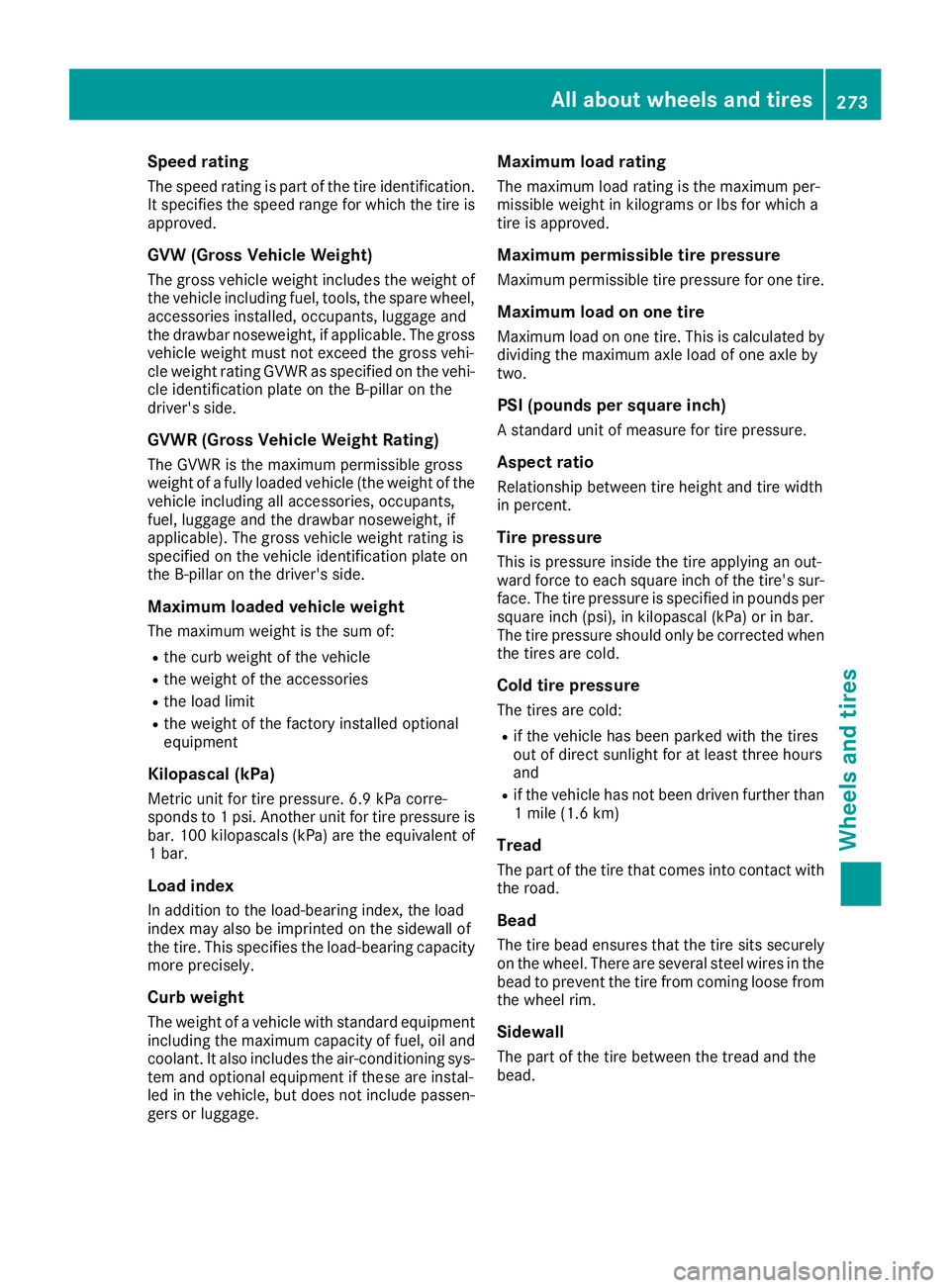
Speed rating The speed rating is part of the tire identification.
It specifies the speed range for which the tire is
approved.
GVW (Gross Vehicle Weight) The gross vehicle weight includes the weight of
the vehicle including fuel, tools, the spare wheel,
accessories installed, occupants, luggage and
the drawbar noseweight, if applicable. The gross
vehicle weight must not exceed the gross vehi-
cle weight rating GVWR as specified on the vehi-
cle identification plate on the B-pillar on the
driver's side.
GVWR (Gross Vehicle Weight Rating) The GVWR is the maximum permissible gross
weight of af ully loaded vehicle (the weight of the
vehicle including all accessories, occupants,
fuel, luggage and the drawbar noseweight, if
applicable). The gross vehicle weight rating is
specified on the vehicle identification plate on
the B-pillar on the driver's side.
Maximu ml oaded vehicle weightThe maximum weight is the sum of: R
the curb weight of the vehicle R
the weight of the accessories R
the load limit R
the weight of the factory installed optional
equipment
Kilopascal (kPa) Metric unit for tire pressure. 6.9 kPa corre-
sponds to 1p si. Another unit for tire pressure is
bar. 100 kilopascals (kPa) are the equivalent of
1b ar.
Load index
In addition to the load-bearing index, the load
index may also be imprinted on the sidewal lo f
the tire. This specifies the load-bearing capacity
more precisely.
Curb weight
The weight of av ehicle with standard equipment
including the maximum capacity of fuel, oil and
coolant. It also includes the air-conditioning sys-
tem and optional equipment if these are instal-
led in the vehicle, but does not include passen-
gers or luggage. Maximu ml oad ratingThe maximum load rating is the maximum per-
missible weight in kilograms or lbs for which a
tire is approved.
Maximu mp ermissible tire pressureMaximum permissible tire pressure for one tire.
Maximu ml oad on one tireMaximum load on one tire. This is calculated by
dividing the maximum axle load of one axle by
two.
PSI (pounds per squar ei nch)As tandard unit of measure for tire pressure.
Aspect ratio Relationship between tire height and tire width
in percent.
Tire pressure This is pressure inside the tire applying an out-
ward force to each square inch of the tire's sur-
face. The tire pressure is specified in pounds per
square inch (psi), in kilopascal (kPa) or in bar.
The tire pressure should only be corrected when
the tires are cold.
Cold tire pressure The tires are cold: R
if the vehicle has been parked with the tires
out of direct sunlight for at least three hours
and R
if the vehicle has not been driven further than
1m ile (1.6 km)
Tread
The part of the tire that comes into contact with
the road.
Bead
The tire bead ensures that the tire sits securely
on the wheel. There are several steel wires in the
bead to prevent the tire from coming loose from
the wheel rim.
Sidewall
The part of the tire between the tread and the
bead.All about wheel sa nd tires 273
Wheels and tires Z