ABS MERCEDES-BENZ SLC 2018 User Guide
[x] Cancel search | Manufacturer: MERCEDES-BENZ, Model Year: 2018, Model line: SLC, Model: MERCEDES-BENZ SLC 2018Pages: 298, PDF Size: 4.54 MB
Page 252 of 298
H Environmenta ln ote
Hav et he used tir es ealan tb ottle disposed of
professionally, e.g .ataq ualifie ds pecialist
workshop.
If tir ep ressure of 20 0k Pa (2.0 ba r/ 29 psi )h as
bee na chieved after am aximu mp eriod of ten
minutes: X
Switch off the tire inflation compressor. X
Unscrew the filler hose from the valve of the
faulty tire. X
Stow the tire sealant bottle and the tire infla-
tion compressor. X
Pull away immediately .X
Stop after driving for approximately ten
minutes and check the tire pressure with the
tire inflation compressor.
The tire pressure must now be at least
130 kPa (1.3 bar/19 psi).
G WARNING
If the required tire pressure is not reached
after driving for as hort period, the tire is too
badly damaged. The tire sealant cannot repair
the tire in this instance. Damaged tires and a
tire pressure that is too low can significantly
impair the vehicle's braking and driving char-
acteristics. There is ar isk of accident.
Do not continue driving. Contact aq ualified
specialist workshop.
i In cases such as the one mentioned above,
contact an authorized Mercedes-Benz Cen-
ter. Or call 1-800-FOR-MERCede s( in the
USA) or 1-800-387-0100 (in Canada). X
Correct the tire pressure if it is still at least
130 kPa (1.3 bar/19 psi) .S ee the Tire and
Loading Information placard on the driver's
side B-pillar or the tire pressure tabl eint he
fuel filler fla pf or values.X
To increase the tire pressure: switch on the
tire inflation compressor. X
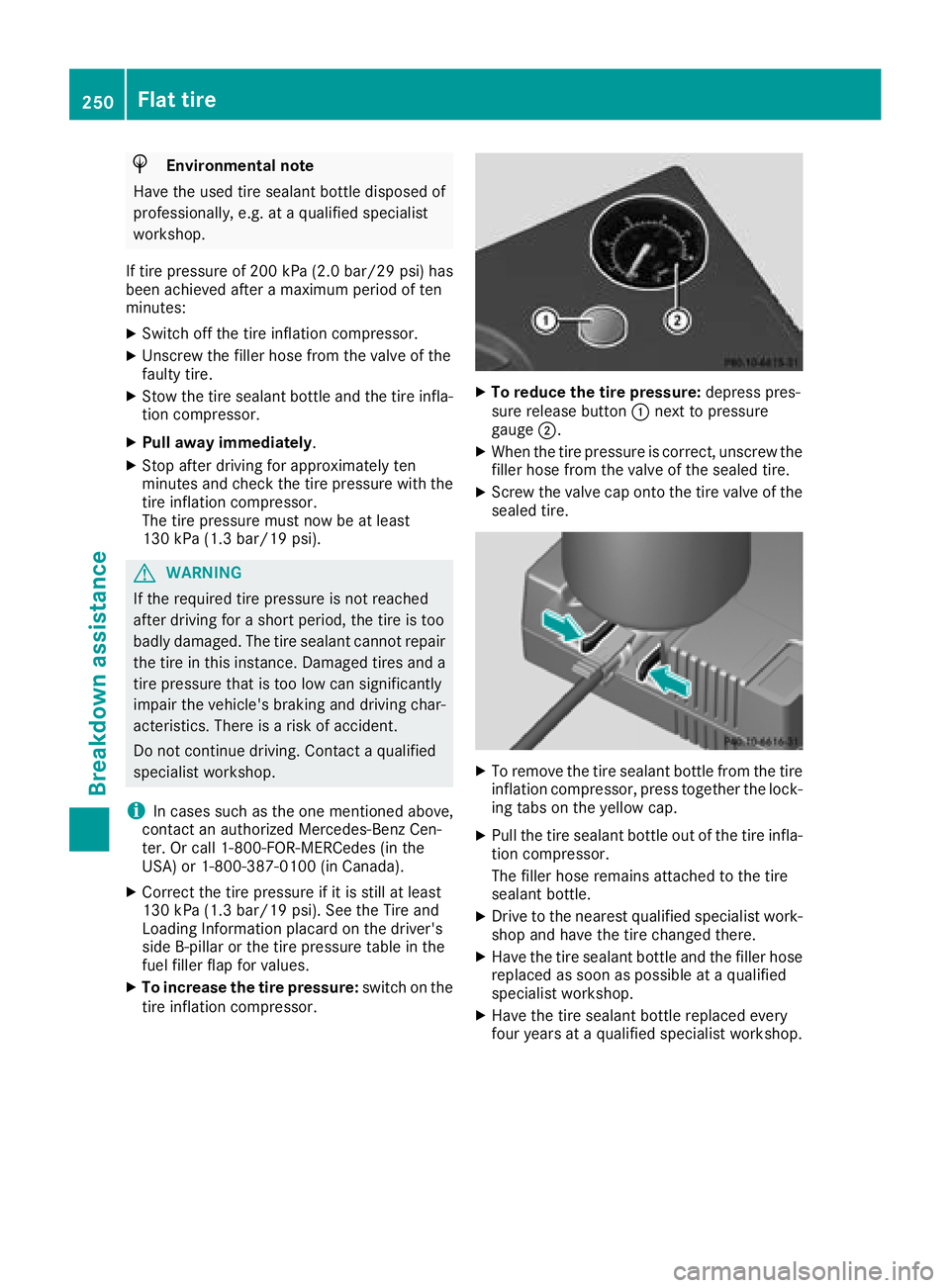
To reduce the tire pressure: depress pres-
sure release button C next to pressure
gauge D . X
When the tire pressure is correct, unscrew the
filler hose from the valve of the sealed tire. X
Screw the valve cap onto the tire valve of the
sealed tire.
X
To remove the tire sealant bottle from the tire
inflation compressor, press together the lock-
ing tabs on the yellow cap. X
Pul lt he tire sealant bottle out of the tire infla-
tion compressor.
The filler hose remains attache dtot he tire
sealant bottle. X
Drive to the nearest qualified specialist work-
shop and have the tire change dt here.X
Have the tire sealant bottle and the filler hose
replaced as soon as possibl eataq ualified
specialist workshop. X
Have the tire sealant bottle replaced every
four years at aq ualified specialist workshop.250
Flat tire
Breakdow na ssistance
Page 253 of 298
Battery (vehicle)
Important safety notes Specia lt ool sa nd expert knowledg ea re required
when working on the battery ,e .g .r emova la nd
installation. Yo us houl dt herefore have al lw or k
involving the battery carrie do ut at aq uali fied
specialist workshop.
G WARNING
Wor kc arrie do ut incorrectly on the battery
can lead ,f or example, to as hort circui ta nd
thu sd amag et he vehicl ee le ctronics .T hi sc an
lead to functio nr estrictions applying to
safety-relevant systems, e.g .t he lighting sys-
tem, the ABS (anti-lock braking system )ort he
ESP ®
(Electronic Stability Program). The oper-
ating safety of your vehicl em ay be restricted.
Yo uc ould lose contro loft he vehicle, for
example: R
when braking R
in the event of abrupt steering maneuvers
and/or when the vehicle's speed is not
adapted to the roa dc onditions
There is ar is kofana ccident.
In the event of as hort circui tora similar inci-
dent, contact aq uali fied specialist workshop
immediately. Do not drive any further .Y ou
shoul dh av ea ll work involving the battery car-
rie do ut at aq uali fied specialist workshop.
For further informatio na bout ABS and ESP ®
,
see ( Y
page 57 )a nd ( Y
page 60).
G WARNING
Electrostati cb uild -u pc an lead to the creation
of sparks, which could ignite the highl ye xplo-
sive gases of ab at tery .T here is ar is kofa n
explosion.
Before handling the battery ,t ouch the vehicle
body to remove any existing electrostatic
build-up.
The highl yf lammabl eg as mixture form sw he n
charging the battery as well as when jump-start-
ing. Alway sm ak es ur et ha tn either yo un or the bat-
tery is electrostaticall yc harged. Ab uild -u po f
electrostatic charge can be caused ,f or exam-
ple: R
by wearing clothing made from synthetic
fibers R
du etof rictio nb et ween clothing and seats R
if yo up us horp ul lt he battery across the car-
pe toro the rs yn theti cm at erialsR
if yo uw ip et he battery with ac loth
G WARNING
During the charging process ,ab at tery produ-
ces hydrogen gas. If as hort circui to ccurs or
sparks are created ,t he hydrogen ga sc an
ignite .T here is ar is kofane xplosion.R
Make sure tha tt he positive terminal of a
connected battery does not come into con-
tact with vehicl ep ar ts.R
Never place meta lo bj ects or tool sonab at -
tery. R
It is important tha ty ou observe the descri-
be do rder of the battery terminal sw he n
connecting and disconnecting ab at tery.R
Whe nj ump-starting ,m ak es ur et ha tt he
battery pole sw it hi de ntical polarity are
connected. R
It is particularly important to observe the
describe do rder when connecting and dis-
connecting the jumper cables. R
Never connect or disconnect the battery
terminal sw hile the engine is running.
G WARNING
Battery aci disc austic .T here is ar is kofi njury.
Avoi dc ontact with skin, eyes or clothing. Do
not inhal ea ny battery gases .Don ot lean over
the battery .K ee pc hildren away from batter-
ies. Wash away battery aci di mmediatel yw it h
plenty of clean water and see km edica la tten-
tion.
H Environmental note
Batterie sc ontain pollu-
tants .Itisi llegal to dispose
of them with the householdBattery (vehicle) 251
Breakdo wn assis tance Z
Page 254 of 298
rubbish. They must be col-
lected separately and dis-
posed of in an environmen-
tall yr esponsible recycling
system.
Dispose of batterie sina n
environmentally responsi-
ble manner. Take dis-
charge db atterie stoaq uali-
fied specialist workshop or
to ac ollection point for
used batteries.
! Have the battery checked regularl yata
qualified specialist workshop.
Observe the service interval sint he Mainte-
nance Booklet or contact aq ualified specialist
workshop for more information.
! Always have work on batterie sc arrie do ut at
aq ualified specialist workshop.
Shoul di t, in exceptiona lc ircumstances, be
absolutel yn ecessary to disconnect the 12-
volt battery yourself, please observe the fol-
lowing: R
Secure the vehicl etop revent it from rolling
away. R
Switch off the ignition. R
Disconnect the negative terminal first and
then the positive terminal.
The transmission is locked in position ]
after disconnecting the battery.
After the work has been done, install the bat-
tery and replace the cover of the positive ter-
minal clamp firmly.
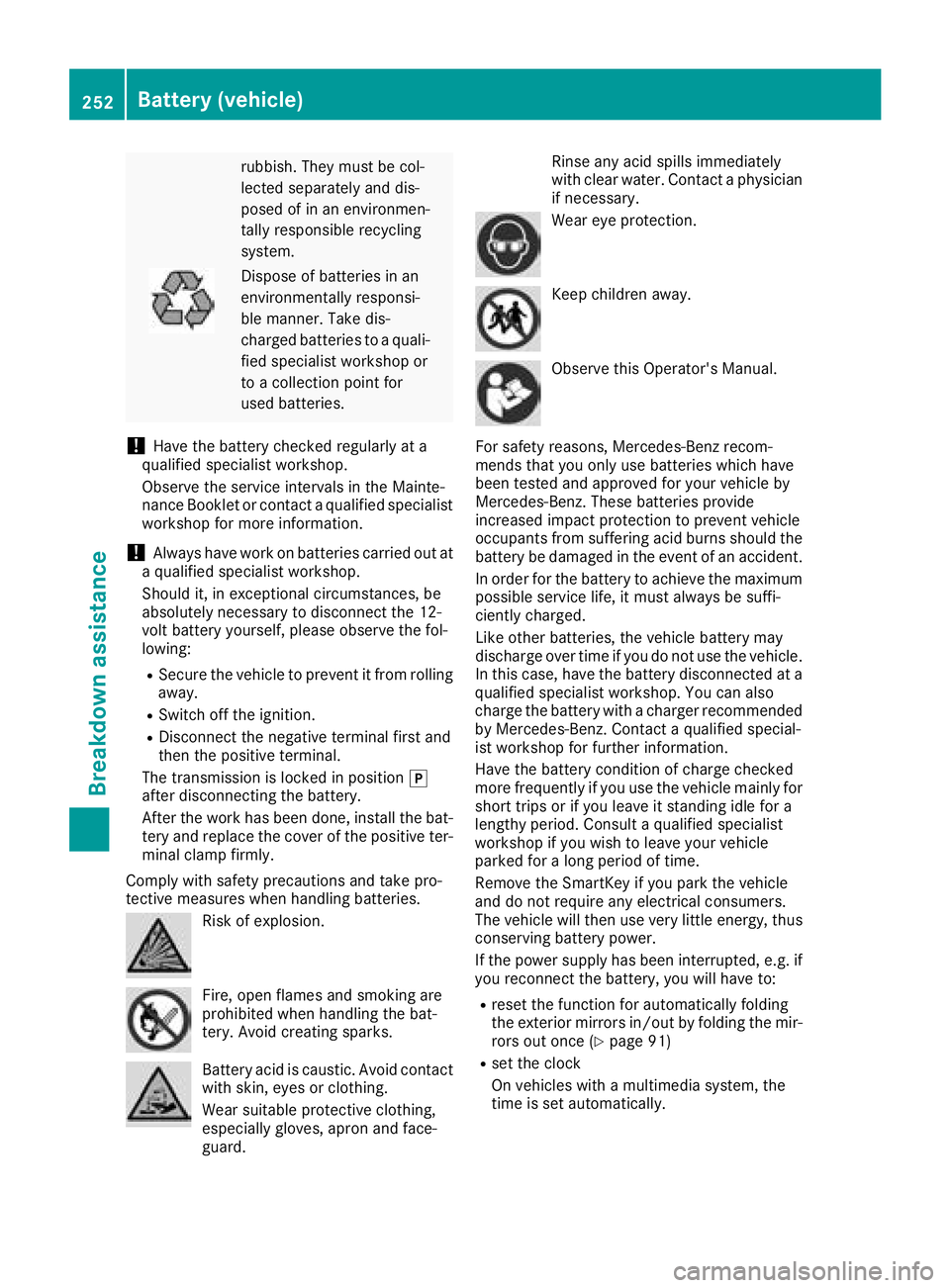
Comply with safety precautions and take pro-
tective measures when handling batteries.
Ris kofe xplosion.
Fire, open flame sa nd smoking are
prohibited when handling the bat-
tery. Avoid creating sparks.
Battery acid is caustic. Avoid contact
with skin, eye sorc lothing.
Wea rs uitable protective clothing,
especially gloves, apro na nd face-
guard. Rinse any acid spills immediately
with clea rw ater. Contact ap hysician
if necessary.
Wea re ye protection.
Keep children away.
Observe this Operator's Manual.
For safety reasons, Mercedes-Benz recom-
mends that you only use batterie sw hich have
been tested and approved for you rv ehicl eb y
Mercedes-Benz. These batterie sp rovide
increase di mpact protection to prevent vehicle
occupants from suffering acid burns should the
battery be damaged in the event of an accident.
In order for the battery to achieve the maximum
possible service life ,itm ust alway sbes uffi-
ciently charged.
Like other batteries, the vehicl eb attery may
discharge over time if you do not use the vehicle.
In this case, have the battery disconnected at a
qualified specialist workshop .Y ou can also
charge the battery with ac harge rr ecommended
by Mercedes-Benz. Contact aq ualified special-
ist workshop for further information.
Have the battery condition of charge checked
more frequently if you use the vehicl em ainl yf or
short trips or if you leave it standing idl ef or a
lengthy period. Consult aq ualified specialist
workshop if you wis htol eave you rv ehicle
parked for al ong perio doft ime.
Remove the SmartKey if you park the vehicle
and do not require any electrica lc onsumers.
The vehicl ew il lt hen use very little energy ,t hus
conserving battery power.
If the powe rs upply has been interrupted ,e .g. if
you reconnect the battery ,y ou wil lh ave to:R
reset the function for automatically folding
the exterior mirrors in/out by folding the mir-
rors out once ( Y
pag e9 1)R
set the clock
On vehicles with am ultimedia system, the
time is set automatically.252
Battery (vehicle)
Breakdown assistance
Page 287 of 298
These tires have been specially adapted for
use with the control systems, such as ABS or
ESP ®
,a nd are marked as follows:R
MO = M ercedes-Benz OriginalR
MOE = M ercedes-Benz Original Extended
(tires featuring run-flat characteristics) R
MO1 = M ercedes-Benz Original (only cer-
tain AMG tires)
Mercedes-Benz Original Extended tires may
only be used on wheels that have been spe-
cifically approved by Mercedes-Benz.
Only use tires, wheels or accessories tested
and approved by Mercedes-Benz .C ertain
characteristics, e.g. handling, vehicle noise
emissions or fuel consumption, may other-
wise be adversely affected. In addition, when
driving with al oad, tire dimension variations
could cause the tires to come into contact
with the bodywork and axle components .T his
could result in damage to the tires or the vehi-
cle.
Mercedes-Benz accepts no liability for dam-
age resulting from the use of tires, wheels or
accessories other than those tested and
approved.
Information on tires, wheels and approved
combinations can be obtained from any quali-
fied specialist workshop.
! Retreaded tires are neither tested nor rec-
ommended by Mercedes-Benz ,s ince previ-
ous damage cannot alway sbed etected on
retreaded tires. As ar esult, Mercedes-Benz
cannot guarantee vehicle safety if retreaded
tires are mounted. Do not mount used tires if
you have no information about their previous
usage.
The recommended pressures for various oper-
ating conditions can be found: R
on the Tire and Loading Information placard
on the B-pillar on the driver's side R
in the tire pressure table on the fuel filler flap
Observe the notes on recommended tire pres-
sures under various operating conditions
( Y
page 263).
Check tire pressures regularly, and only when
the tires are cold. Comply with the maintenance
recommendations of the tire manufacturer in
the vehicle document wallet. Notes on the vehicle equipment –a lway se quip
the vehicle: R
with tires of the same size on ag iven axle (left
and right) R
with the same type of tires at ag iven time
(summer tires, winter tires, MOExtended
tires)
Exception: it is permissible to mount ad iffer-
ent type or make in the event of af lat tire.
Observe t he
"MOExtended tires (tires with
run-flat characteristics)" section
( Y
page 247).
Vehicles equipped with MOExtended tires are
not equipped with aT IREFIT kit at the factory. It
is therefor er ecommended that you additionally
equip your vehicle with aT IREFIT kit if you mount
tires that do not feature run-flat characteristics,
e.g. winter tires. AT IREFIT kit may be obtained
from aq ualified specialist workshop.
Emergency spar ew heel
Important safety notes
G WARNING
The wheel or tire size as well as the tire type of
the spare wheel or emergenc ys pare wheel
and the wheel to be replaced may differ.
Mountin gane mergenc ys pare wheel may
severely impair the driving characteristics.
There is ar isk of an accident.
To avoid hazardous situations: R
adapt your driving style accordingly and
drive carefully. R
never mount more than one spare wheel or
emergenc ys pare wheel that differs in size. R
only use as pare wheel or emergenc ys pare
wheel of ad ifferent size briefly. R
do not switch ESP ®
off.R
have as pare wheel or emergenc ys pare
wheel of ad ifferent size replaced at the
nearest qualified specialist workshop.
Observe that the wheel and tire dimensions
as well as the tire type must be correct.
When using an emergenc ys pare wheel or spare
wheel of ad ifferent size, you must not exceed
the maximum speed of 50 mph (80 km/h).Emergency spar ew heel 285
Wheels and tires Z
Page 295 of 298
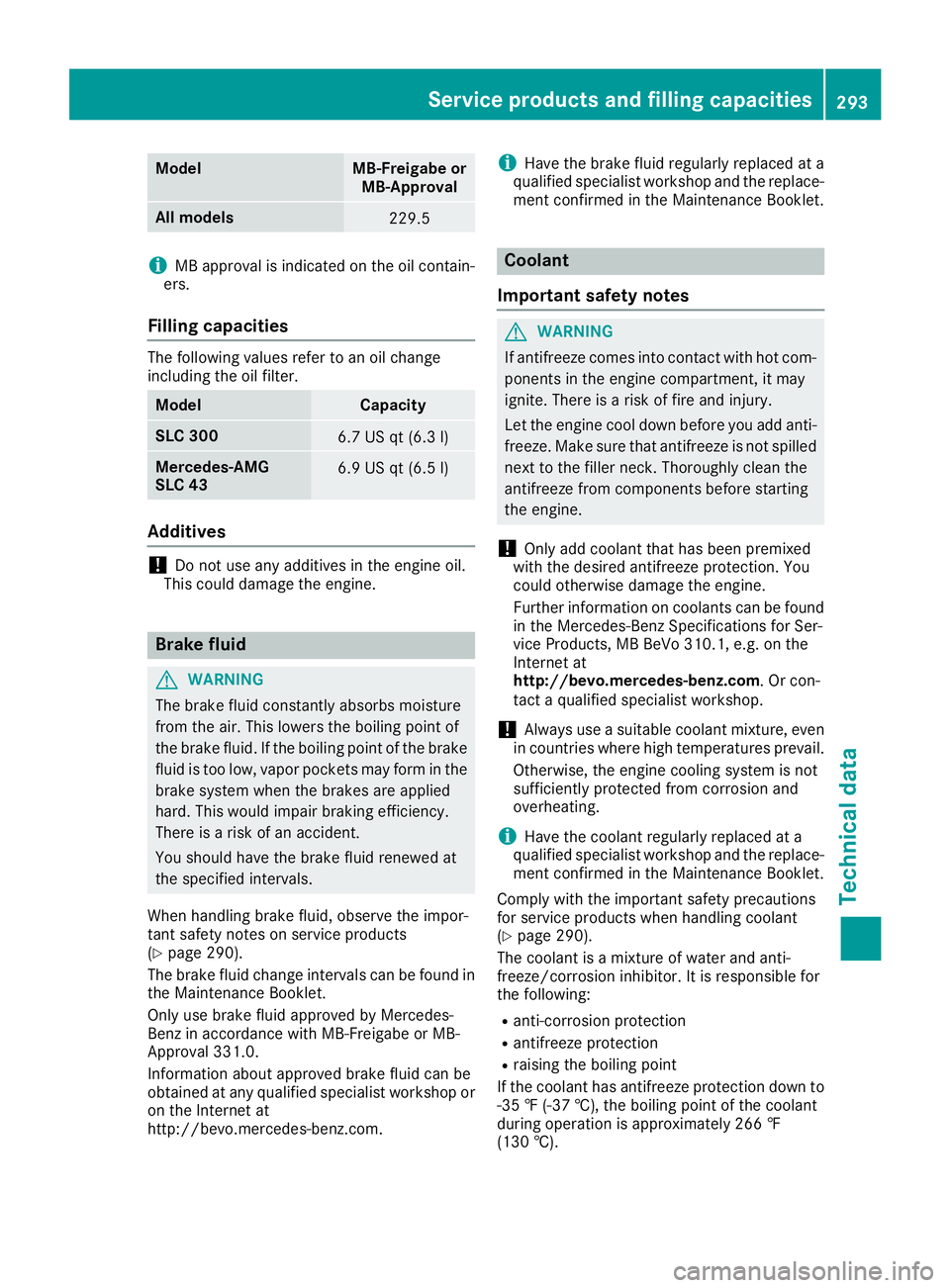
Model MB-Freigabe or
MB-Approval
All models
229.5
i MB approval is indicated on the oil contain-
ers.
Fillin gc apacitiesThe following values refer to an oil change
including the oil filter.
Model Capacity
SLC 300
6.7 US qt (6.3 l)
Mercedes-AMG
SLC 43 6.9 US qt (6.5 l)
Ad ditives
! Do not us ea ny additive sint he engine oil.
Thi sc ould damag et he engine.
Brake fluid
G WARNING
The brake fluid constantly absorb sm oisture
from the air. Thi sl owers the boiling point of
the brake fluid .Ift he boiling point of the brake
fluid is too low, vapor pockets may form in the
brake system when the brakes are applied
hard. Thi sw ould impai rb raking efficiency.
There is ar is kofana ccident.
Yo us houl dh av et he brake fluid renewe da t
the specified intervals.
Whe nh an dling brake fluid ,o bserve the impor-
tant safety notes on service products
( Y
page 290).
The brake fluid change interval sc an be found in
the Maintenance Booklet.
Only us eb rake fluid approved by Mercedes-
Benz in accordance with MB-Freigab eorM B-
Approva l3 31.0.
Information abou ta pp roved brake fluid can be
obtaine data ny qualified specialist worksho po r
on the Interne ta t
http://bevo.mercedes-benz.co m. i Have the brake fluid regularly replaced at a
qualified specialist workshop and the replace-
ment confirmed in the Maintenance Booklet.
Coolant
Importan ts afety notes
G WARNING
If antifreeze comes into contact with hot com-
ponents in the engine compartment, it may
ignite. There is ar isk of fire and injury.
Let the engine cool dow nb efore yo ua dd anti-
freeze .M ake sur et hat antifreeze is not spilled
next to the filler neck. Thoroughly clea nt he
antifreeze from components before starting
the engine.
! Only ad dc oolant that has bee np remixed
with the desire da ntifreeze protection. You
coul do therwise damag et he engine.
Furthe ri nformatio nonc oolants can be found
in the Mercedes-Benz Specifications for Ser-
vice Products, MB BeVo 310.1, e.g. on the
Internet at
http://bevo.mercedes-benz.com .Orc on-
tact aq ualifie ds pecialist workshop.
! Always use as uitabl ec oolant mixture, even
in countries where hig ht emperatures prevail.
Otherwise ,t he engine cooling system is not
sufficiently protected from corrosion and
overheating.
i Have the coolant regularly replaced at a
qualified specialist workshop and the replace-
ment confirmed in the Maintenance Booklet.
Comply with the important safety precautions
for service products whe nh andling coolant
( Y
page 290).
The coolant is am ixture of water and anti-
freeze/corrosion inhibitor. It is responsible for
the following: R
anti-corrosion protection R
antifreeze protection R
raising the boiling point
If the coolant has antifreeze protection dow nt o
-35 ‡( -3 7† ), the boiling point of the coolant
during operation is approximatel y2 66 ‡
(130 †).Service products and filling capacities 293
Technical data Z