warning MERCEDES-BENZ SLC 2019 Owners Manual
[x] Cancel search | Manufacturer: MERCEDES-BENZ, Model Year: 2019, Model line: SLC, Model: MERCEDES-BENZ SLC 2019Pages: 306, PDF Size: 15 MB
Page 280 of 306
Radio type approval for the tire pres-
sure monitor
CountryRadio type approval number
USAFCC ID: MRXMW2433A
FCCIC ID:MRXGG4 This devicecomplies with part 15 of theFCC rules and with licenseexempt RSS standards of Indus-try Canada. Operation is subjectto the following conditions. (1)This device may not causeharmful interference, and (2)This device must accept anyinterference received, includinginterference that may causeundesired operation. Le presentappareil est conforme d'indus-trie Canada applicables auxappareils radio exempts delicence. L'exploitation estauthorisee aux deux conditionssuivantes. (1) L'appareil ne doitpas produire de brouillage, et(2) L'autisatuer de l'appareildoit accepter tout brouillageradioelectrique subi, meme si lebrouillage est susceptible d'encompromettre le fonctionne-ment. WARNING: Changes ormodifications not expresslyapproved by the party responsi-ble for compliance could voidthe user's authority to operatethe equipment. The term "IC:"before the radio certificationnumber only signifies Canadatechnical specifications weremet.
FCC ID:MRXMC34MA4 Thisdevice complies with part 15 ofthe FCC rules and with licenseexempt RSS standards of Indus-try Canada. Operation is subjectto the following conditions. (1)This device may not causeharmful interference, and (2)This device must accept anyinterference received, includinginterference that may causeundesired operation. Le presentappareil est conforme d'indus-trie Canada applicables auxappareils radio exempts de
CountryRadio type approval number
licence. L'exploitation estauthorisee aux deux conditionssuivantes. (1) L'appareil ne doitpas produire de brouillage, et(2) L'autisatuer de l'appareildoit accepter tout brouillageradioelectrique subi, meme si lebrouillage est susceptible d'encompromettre le fonctionne-ment. WARNING: Changes ormodifications not expresslyapproved by the party responsi-ble for compliance could voidthe user's authority to operatethe equipment. The term "IC:"before the radio certificationnumber only signifies Canadatechnical specifications weremet.
CanadaIC: 2546A-MW2433A
IC:2546A-GG4 This device com-plies with part 15 of the FCCrules and with license exemptRSS standards of Industry Can-ada. Operation is subject to thefollowing conditions. (1) Thisdevice may not cause harmfulinterference, and (2) This devicemust accept any interferencereceived, including interferencethat may cause undesired oper-ation. Le present appareil estconforme d'industrie Canadaapplicables aux appareils radioexempts de licence. L'exploita-tion est authorisee aux deuxconditions suivantes. (1) L'ap-pareil ne doit pas produire debrouillage, et (2) L'autisatuer del'appareil doit accepter toutbrouillage radioelectrique subi,meme si le brouillage est sus-ceptible d'en compromettre lefonctionnement. WARNING:Changes or modifications notexpressly approved by the partyresponsible for compliancecould void the user's authorityto operate the equipment. Theterm "IC:" before the radio cer-tification number only signifiesCanada technical specificationswere met.
278Tire pressure
Wheels and tires
Page 281 of 306
CountryRadio type approval number
IC: 2546A-MC34MA4
Loading the vehicle
Instruction labels for tires and loads
GWARNING
Overloaded tires can overheat, causing a
blowout. Overloaded tires can also impair
the steering and driving characteristics and
lead to brake failure. There is a risk of acci-
dent.
Observe the load rating of the tires. The load
rating must be at least half of the GAWR of
your vehicle. Never overload the tires by
exceeding the maximum load.
Two instruction labels on your vehicle showthe maximum possible load.
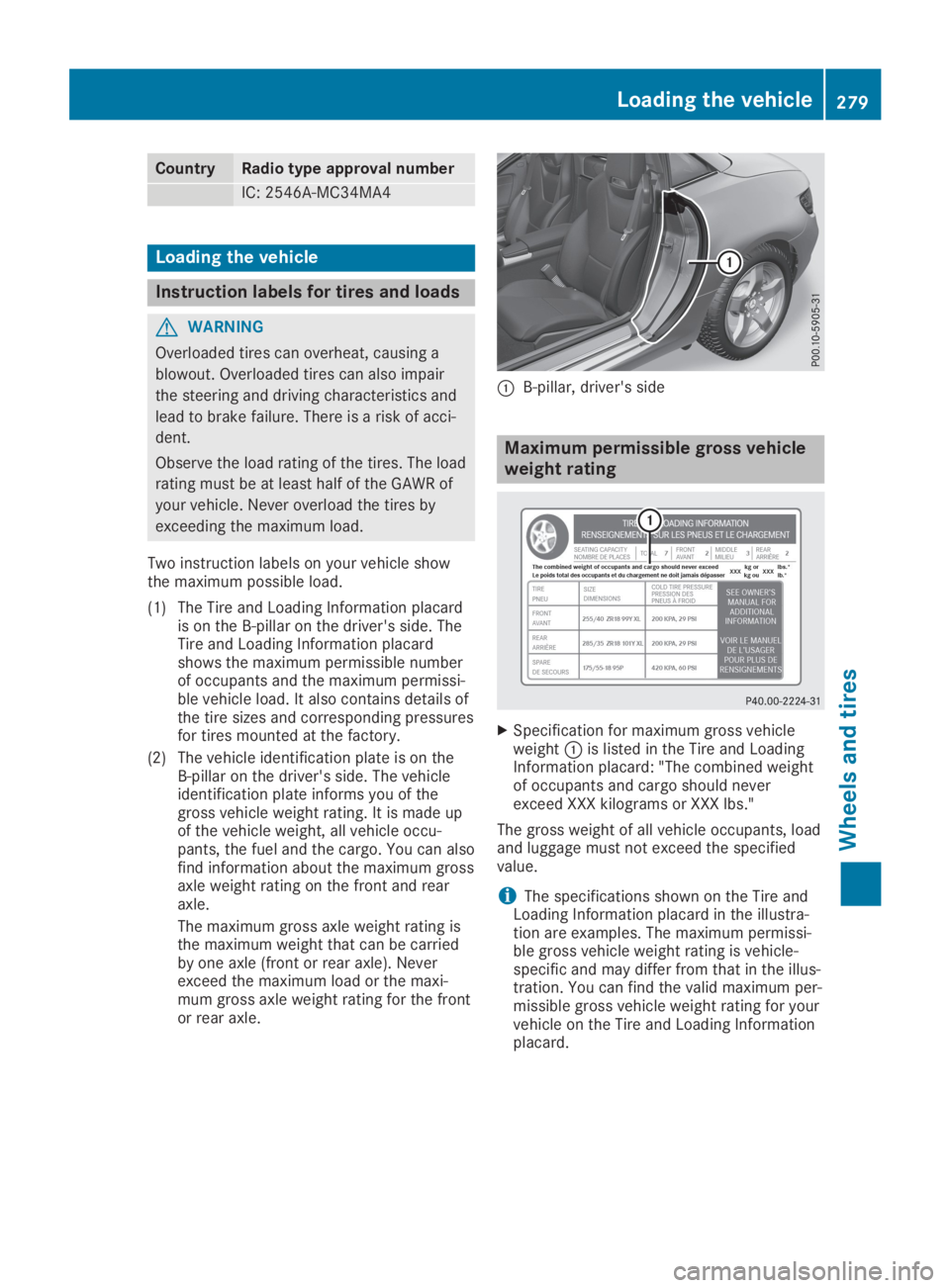
(1) The Tire and Loading Information placardis on the B-pillar on the driver's side. TheTire and Loading Information placardshows the maximum permissible numberof occupants and the maximum permissi-ble vehicle load. It also contains details ofthe tire sizes and corresponding pressuresfor tires mounted at the factory.
(2) The vehicle identification plate is on theB-pillar on the driver's side. The vehicleidentification plate informs you of thegross vehicle weight rating. It is made upof the vehicle weight, all vehicle occu-pants, the fuel and the cargo. You can alsofind information about the maximum grossaxle weight rating on the front and rearaxle.
The maximum gross axle weight rating isthe maximum weight that can be carriedby one axle (front or rear axle). Neverexceed the maximum load or the maxi-mum gross axle weight rating for the frontor rear axle.
CB-pillar, driver's side
Maximum permissible gross vehicle
weight rating
XSpecification for maximum gross vehicleweightCis listed in the Tire and LoadingInformation placard: "The combined weightof occupants and cargo should neverexceed XXX kilograms or XXX lbs."
The gross weight of all vehicle occupants, loadand luggage must not exceed the specifiedvalue.
iThe specifications shown on the Tire andLoading Information placard in the illustra-tion are examples. The maximum permissi-ble gross vehicle weight rating is vehicle-specific and may differ from that in the illus-tration. You can find the valid maximum per-missible gross vehicle weight rating for yourvehicle on the Tire and Loading Informationplacard.
Loading the vehicle279
Wheels and tires
Z
Page 284 of 306
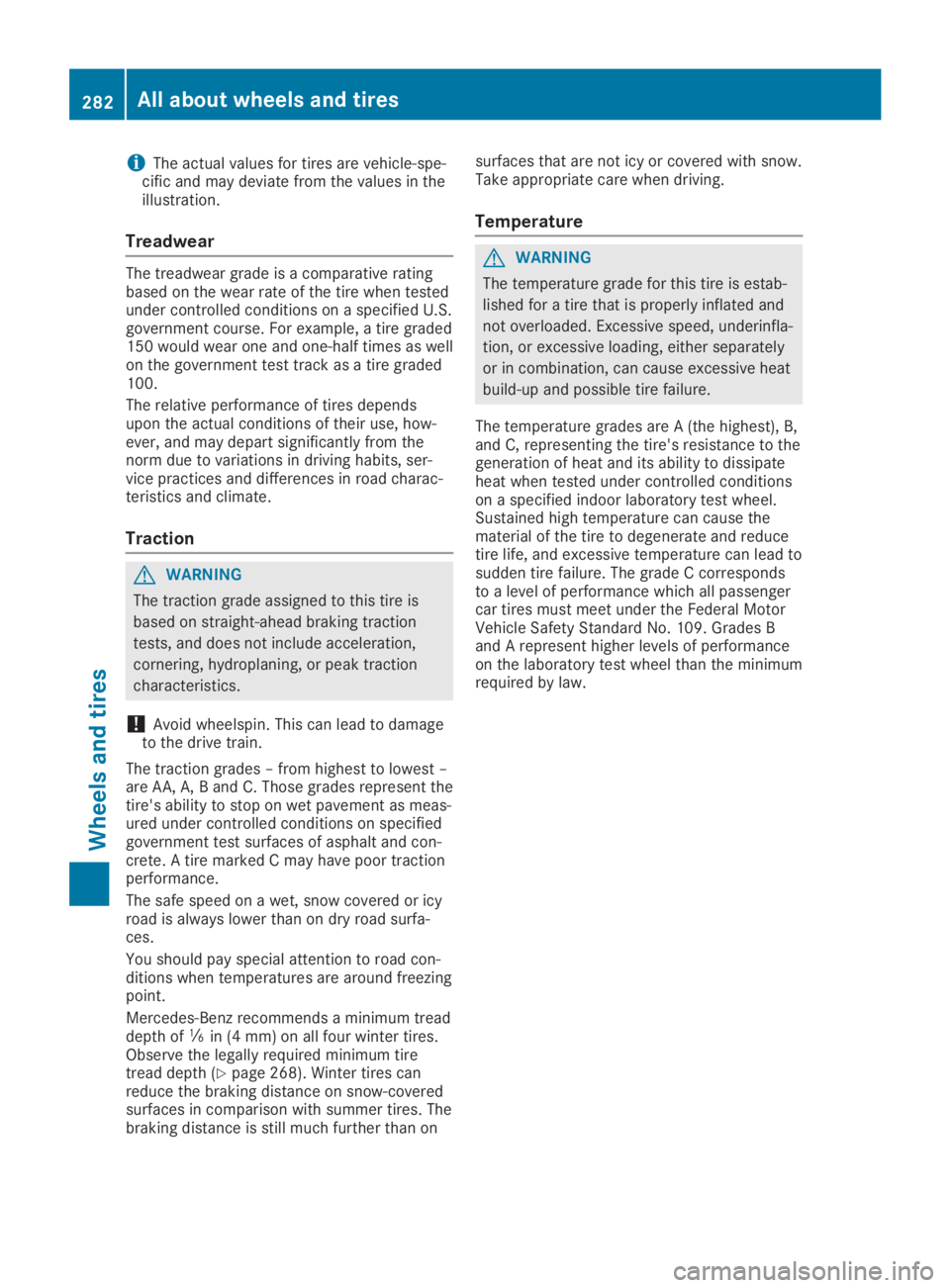
iThe actual values for tires are vehicle-spe-cific and may deviate from the values in theillustration.
Treadwear
The treadwear grade is a comparative ratingbased on the wear rate of the tire when testedunder controlled conditions on a specified U.S.government course. For example, a tire graded150 would wear one and one-half times as wellon the government test track as a tire graded100.
The relative performance of tires dependsupon the actual conditions of their use, how-ever, and may depart significantly from thenorm due to variations in driving habits, ser-vice practices and differences in road charac-teristics and climate.
Traction
GWARNING
The traction grade assigned to this tire is
based on straight-ahead braking traction
tests, and does not include acceleration,
cornering, hydroplaning, or peak traction
characteristics.
!Avoid wheelspin. This can lead to damageto the drive train.
The traction grades – from highest to lowest –are AA, A, B and C. Those grades represent thetire's ability to stop on wet pavement as meas-ured under controlled conditions on specifiedgovernment test surfaces of asphalt and con-crete. A tire marked C may have poor tractionperformance.
The safe speed on a wet, snow covered or icyroad is always lower than on dry road surfa-ces.
You should pay special attention to road con-ditions when temperatures are around freezingpoint.
Mercedes-Benz recommends a minimum treaddepth of
Page 291 of 306
Clean the contact surfaces of the wheel andthe brake disc thoroughly every time a wheelis rotated. Check the tire pressure and, if nec-essary, restart the tire pressure loss warningsystem or the tire pressure monitor.
Direction of rotation
Tires with a specified direction of rotation haveadditional benefits, e.g. if there is a risk ofhydroplaning. These advantages can only begained if the tires are installed correspondingto the direction of rotation.
An arrow on the sidewall of the tire indicatesits correct direction of rotation.
Storing wheels
Store wheels that are not being used in a cool,dry and preferably dark place. Protect the tiresfrom oil, grease, gasoline and diesel.
Mounting a wheel
Preparing the vehicle
XStop the vehicle on solid, non-slippery andlevel ground.
XApply the electric parking brake manually.
XBring the front wheels into the straight-ahead position.
XShift the transmission to position].
XSwitch off the engine.
XVehicles without KEYLESS-GO:removethe SmartKey from the ignition lock.
XVehicles with KEYLESS-GO:open the driv-er's door.The vehicle electronics now have status0.This is the same as the SmartKey havingbeen removed.
XVehicles with KEYLESS-GO:remove theStart/Stop button from the ignition lock(Ypage 118).
XIf included in the vehicle equipment, removethe tire-change tool kit from the vehicle.
XSafeguard the vehicle against rolling away.
iDue to differences in vehicle equipment,not all vehicles are equipped with a tire-change tool kit. For information on which
tools are required to perform a wheelchange on your vehicle, consult an author-ized Mercedes-Benz Center.
Necessary tire-changing tools can include,for example:
RJack
RWheel chock
RLug wrench
Securing the vehicle to prevent it from
rolling away
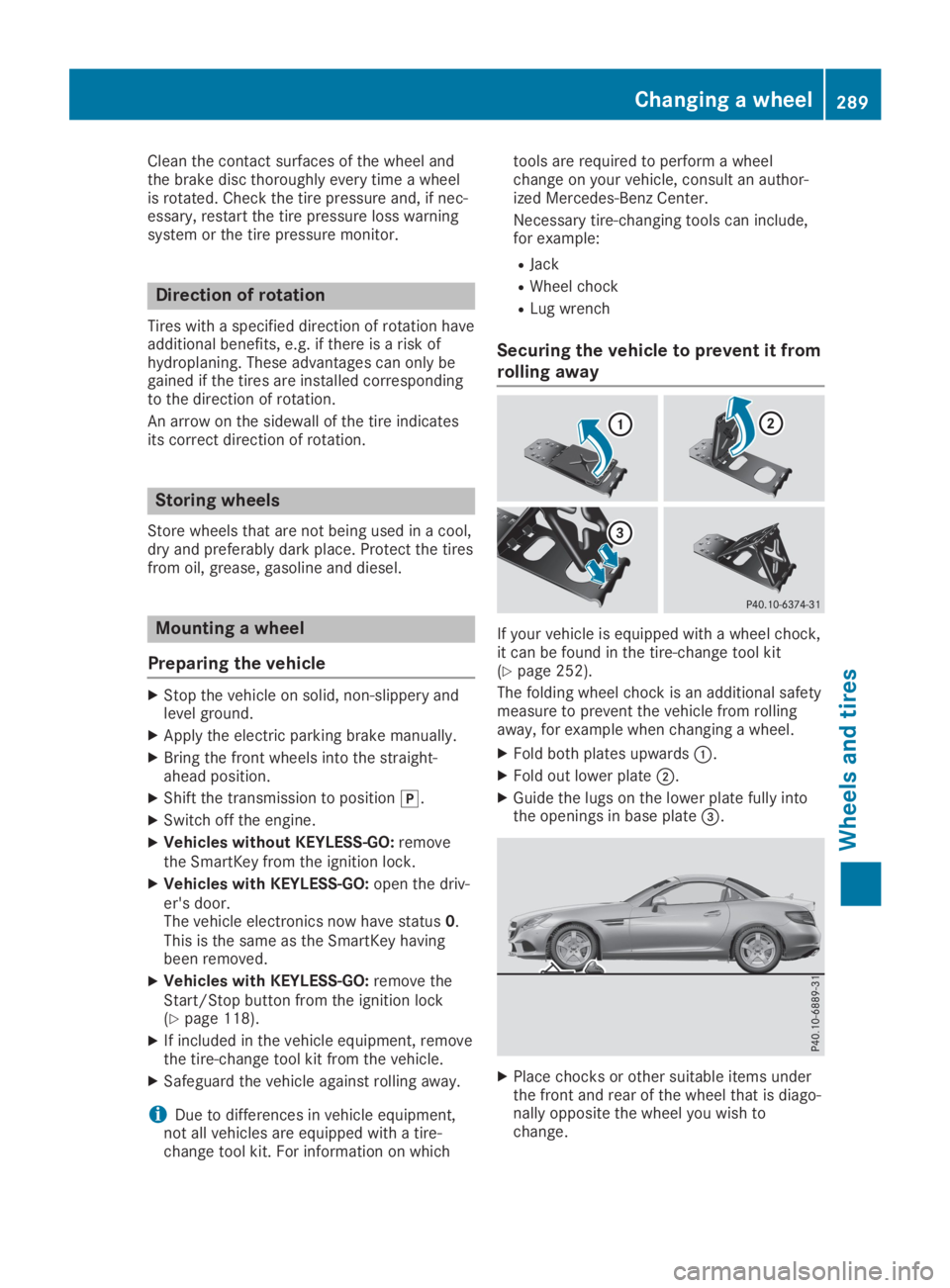
If your vehicle is equipped with a wheel chock,it can be found in the tire-change tool kit(Ypage 252).
The folding wheel chock is an additional safetymeasure to prevent the vehicle from rollingaway, for example when changing a wheel.
XFold both plates upwardsC.
XFold out lower plateD.
XGuide the lugs on the lower plate fully intothe openings in base plate
Page 292 of 306
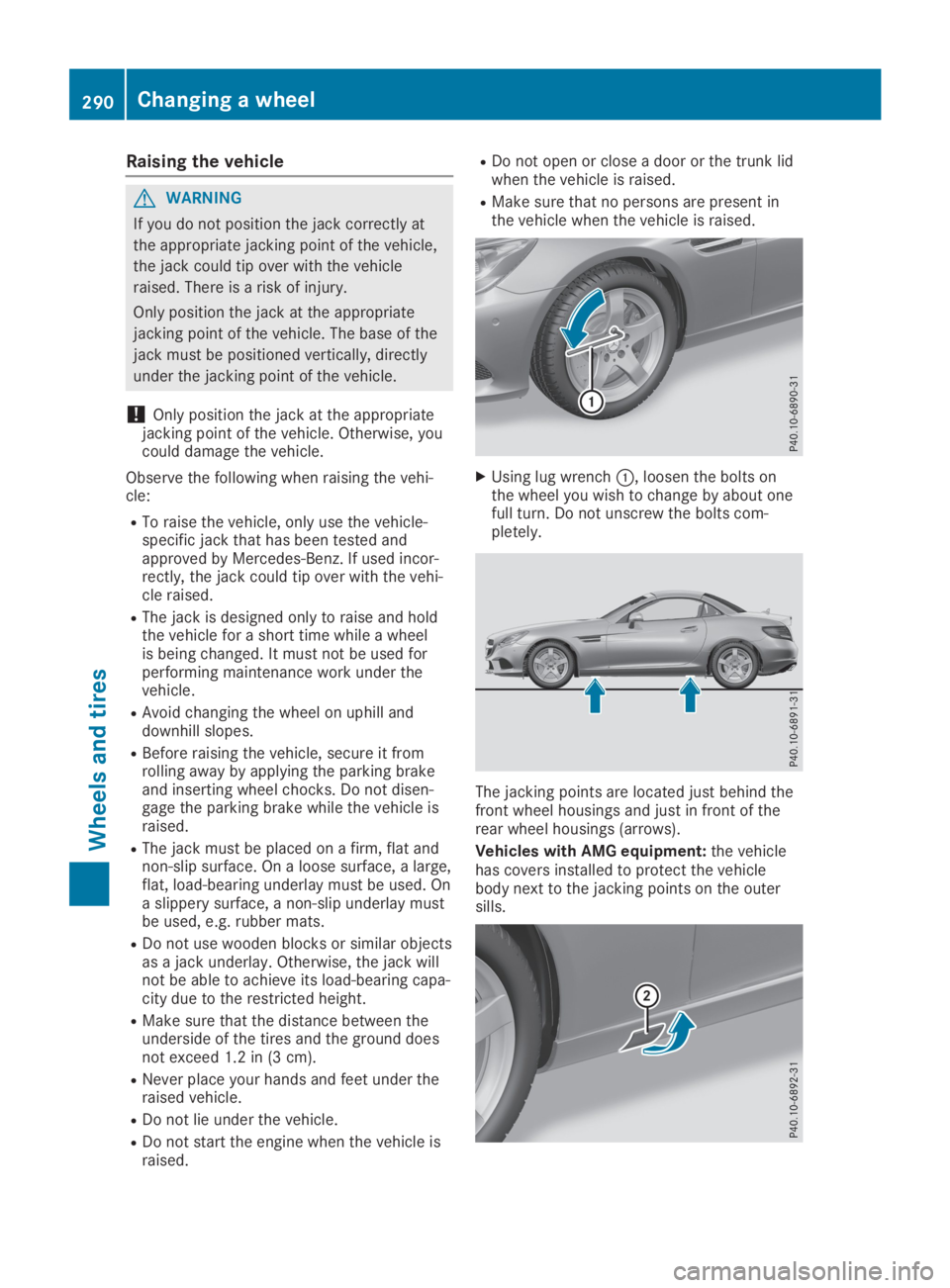
Raising the vehicle
GWARNING
If you do not position the jack correctly at
the appropriate jacking point of the vehicle,
the jack could tip over with the vehicle
raised. There is a risk of injury.
Only position the jack at the appropriate
jacking point of the vehicle. The base of the
jack must be positioned vertically, directly
under the jacking point of the vehicle.
!Only position the jack at the appropriatejacking point of the vehicle. Otherwise, youcould damage the vehicle.
Observe the following when raising the vehi-cle:
RTo raise the vehicle, only use the vehicle-specific jack that has been tested andapproved by Mercedes-Benz. If used incor-rectly, the jack could tip over with the vehi-cle raised.
RThe jack is designed only to raise and holdthe vehicle for a short time while a wheelis being changed. It must not be used forperforming maintenance work under thevehicle.
RAvoid changing the wheel on uphill anddownhill slopes.
RBefore raising the vehicle, secure it fromrolling away by applying the parking brakeand inserting wheel chocks. Do not disen-gage the parking brake while the vehicle israised.
RThe jack must be placed on a firm, flat andnon-slip surface. On a loose surface, a large,flat, load-bearing underlay must be used. Ona slippery surface, a non-slip underlay mustbe used, e.g. rubber mats.
RDo not use wooden blocks or similar objectsas a jack underlay. Otherwise, the jack willnot be able to achieve its load-bearing capa-city due to the restricted height.
RMake sure that the distance between theunderside of the tires and the ground doesnot exceed 1.2 in (3 cm).
RNever place your hands and feet under theraised vehicle.
RDo not lie under the vehicle.
RDo not start the engine when the vehicle israised.
RDo not open or close a door or the trunk lidwhen the vehicle is raised.
RMake sure that no persons are present inthe vehicle when the vehicle is raised.
XUsing lug wrenchC, loosen the bolts onthe wheel you wish to change by about onefull turn. Do not unscrew the bolts com-pletely.
The jacking points are located just behind thefront wheel housings and just in front of therear wheel housings (arrows).
Vehicles with AMG equipment:the vehiclehas covers installed to protect the vehiclebody next to the jacking points on the outersills.
290Changing a wheel
Wheels and tires
Page 294 of 306
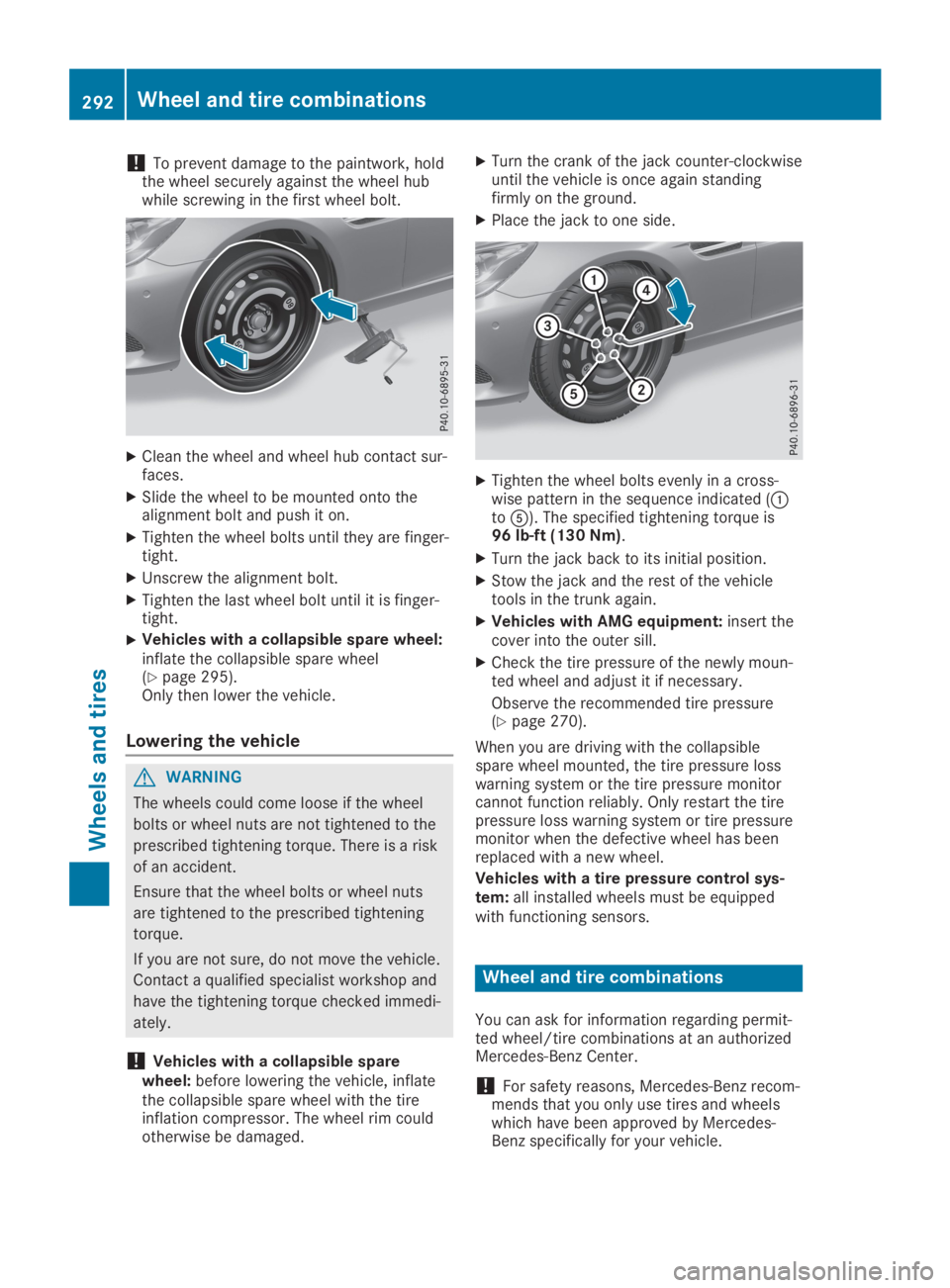
!To prevent damage to the paintwork, holdthe wheel securely against the wheel hubwhile screwing in the first wheel bolt.
XClean the wheel and wheel hub contact sur-faces.
XSlide the wheel to be mounted onto thealignment bolt and push it on.
XTighten the wheel bolts until they are finger-tight.
XUnscrew the alignment bolt.
XTighten the last wheel bolt until it is finger-tight.
XVehicles with a collapsible spare wheel:inflate the collapsible spare wheel(Ypage 295).Only then lower the vehicle.
Lowering the vehicle
GWARNING
The wheels could come loose if the wheel
bolts or wheel nuts are not tightened to the
prescribed tightening torque. There is a risk
of an accident.
Ensure that the wheel bolts or wheel nuts
are tightened to the prescribed tightening
torque.
If you are not sure, do not move the vehicle.
Contact a qualified specialist workshop and
have the tightening torque checked immedi-
ately.
!Vehicles with a collapsible sparewheel:before lowering the vehicle, inflatethe collapsible spare wheel with the tireinflation compressor. The wheel rim couldotherwise be damaged.
XTurn the crank of the jack counter-clockwiseuntil the vehicle is once again standingfirmly on the ground.
XPlace the jack to one side.
XTighten the wheel bolts evenly in a cross-wise pattern in the sequence indicated (Cto
Page 295 of 306
These tires have been specially adapted foruse with the control systems, such as ABS
or ESP®, and are marked as follows:
RMO = Mercedes-Benz Original
RMOE = Mercedes-Benz Original Extended(tires featuring run-flat characteristics)
RMO1 = Mercedes-Benz Original (only cer-tain AMG tires)
Mercedes-Benz Original Extended tires mayonly be used on wheels that have been spe-cifically approved by Mercedes-Benz.
Only use tires, wheels or accessories testedand approved by Mercedes-Benz. Certaincharacteristics, e.g. handling, vehicle noiseemissions or fuel consumption, may other-wise be adversely affected. In addition,when driving with a load, tire dimension var-iations could cause the tires to come intocontact with the bodywork and axle compo-nents. This could result in damage to thetires or the vehicle.
Mercedes-Benz accepts no liability for dam-age resulting from the use of tires, wheelsor accessories other than those tested andapproved.
Information on tires, wheels and approvedcombinations can be obtained from anyqualified specialist workshop.
!Retreaded tires are neither tested nor rec-ommended by Mercedes-Benz, since previ-ous damage cannot always be detected onretreaded tires. As a result, Mercedes-Benzcannot guarantee vehicle safety if retreadedtires are mounted. Do not mount used tiresif you have no information about their previ-ous usage.
The recommended pressures for various oper-ating conditions can be found:
Ron the Tire and Loading Information placardon the B-pillar on the driver's side
Rin the tire pressure table on the fuel fillerflap
Observe the notes on recommended tire pres-sures under various operating conditions(Ypage 270).
Check tire pressures regularly, and only whenthe tires are cold. Comply with the mainte-nance recommendations of the tire manufac-turer in the vehicle document wallet.
Notes on the vehicle equipment – alwaysequip the vehicle:
Rwith tires of the same size on a given axle(left and right)
Rwith the same type of tires at a given time(summer tires, winter tires, MOExtendedtires)
Exception: it is permissible to mount a dif-ferent type or make in the event of a flattire. Observe the "MOExtended tires (tireswith run-flat characteristics)" section(Ypage 253).
Vehicles equipped with MOExtended tires arenot equipped with a TIREFIT kit at the factory.It is therefore recommended that you addition-ally equip your vehicle with a TIREFIT kit if youmount tires that do not feature run-flat charac-teristics, e.g. winter tires. A TIREFIT kit may beobtained from a qualified specialist workshop.
Emergency spare wheel
Important safety notes
GWARNING
The wheel or tire size as well as the tire type
of the spare wheel or emergency spare
wheel and the wheel to be replaced may dif-
fer. Mounting an emergency spare wheel
may severely impair the driving characteris-
tics. There is a risk of an accident.
To avoid hazardous situations:
Radapt your driving style accordingly and
drive carefully.
Rnever mount more than one spare wheel
or emergency spare wheel that differs in
size.
Ronly use a spare wheel or emergency
spare wheel of a different size briefly.
Rdo not switch ESP®off.
Rhave a spare wheel or emergency spare
wheel of a different size replaced at the
nearest qualified specialist workshop.
Observe that the wheel and tire dimen-
sions as well as the tire type must be cor-
rect.
Emergency spare wheel293
Wheels and tires
Z
Page 296 of 306
When using an emergency spare wheel orspare wheel of a different size, you must notexceed the maximum speed of 50 mph(80 km/h).
Snow chains must not be mounted on emer-gency spare wheels.
General notes
You can ask for information regarding permit-ted emergency spare wheels at an authorizedMercedes-Benz Center.
You should regularly check the pressure of theemergency spare wheel, particularly prior tolong trips, and correct the pressure as neces-sary (Ypage 270). The value on the wheel isvalid.
An emergency spare wheel may also be moun-ted against the direction of rotation. Observethe time restriction on use as well as thespeed limitation specified on the emergencyspare wheel.
Replace the tires after six years at the latest,regardless of wear. This also applies to theemergency spare wheel.
When you are driving with the collapsiblespare wheel mounted, the tire pressure losswarning system or the tire pressure monitorcannot function reliably. Only restart the tirepressure loss warning system or tire pressuremonitor when the defective wheel has beenreplaced with a new wheel.
Vehicles with tire pressure monitor:aftermounting an emergency spare wheel, the sys-tem may still display the tire pressure of theremoved wheel for a few minutes. The valuedisplayed for the mounted emergency sparewheel is not the same as the current tire pres-sure of the emergency spare wheel.
Removing the emergency spare
wheel
Vehicles with a collapsible spare
wheel
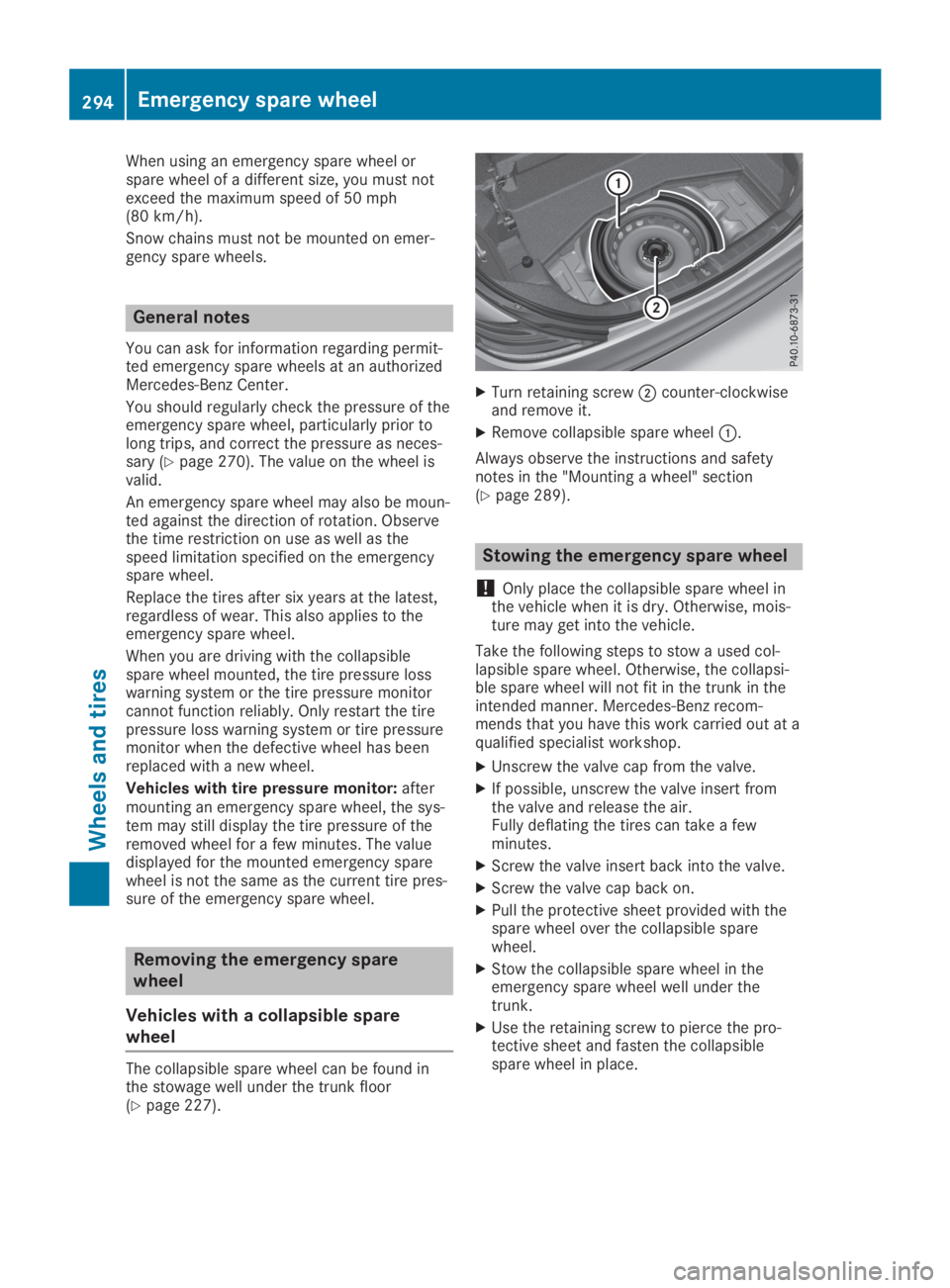
The collapsible spare wheel can be found inthe stowage well under the trunk floor(Ypage 227).
XTurn retaining screwDcounter-clockwiseand remove it.
XRemove collapsible spare wheelC.
Always observe the instructions and safetynotes in the "Mounting a wheel" section(Ypage 289).
Stowing the emergency spare wheel
!Only place the collapsible spare wheel inthe vehicle when it is dry. Otherwise, mois-ture may get into the vehicle.
Take the following steps to stow a used col-lapsible spare wheel. Otherwise, the collapsi-ble spare wheel will not fit in the trunk in theintended manner. Mercedes-Benz recom-mends that you have this work carried out at aqualified specialist workshop.
XUnscrew the valve cap from the valve.
XIf possible, unscrew the valve insert fromthe valve and release the air.Fully deflating the tires can take a fewminutes.
XScrew the valve insert back into the valve.
XScrew the valve cap back on.
XPull the protective sheet provided with thespare wheel over the collapsible sparewheel.
XStow the collapsible spare wheel in theemergency spare wheel well under thetrunk.
XUse the retaining screw to pierce the pro-tective sheet and fasten the collapsiblespare wheel in place.
294Emergency spare wheel
Wheels and tires
Page 298 of 306
Information regarding technical data
iThe data stated here specifically refers toa vehicle with standard equipment. Consultan authorized Mercedes-Benz Center for thedata for all vehicle variants and trim levels.
Vehicle electronics
Tampering with the engine electron-
ics
!Have the engine electronics and associ-ated parts, such as control units, sensors,actuating components or electric cablesserviced only at a qualified specialist work-shop. Vehicle components may otherwisewear more quickly and the vehicle's operat-ing permit may be invalidated.
Installing two-way radios and mobile
phones (RF transmitters)
GWARNING
The electromagnetic radiation from two-way
radios can interfere with the vehicle elec-
tronics if two-way radios are manipulated or
retrofitted incorrectly. This could jeopardize
the operating safety of the vehicle. There is
a risk of an accident.
You should have all work on electrical and
electronic components carried out at a
qualified specialist workshop.
GWARNING
If you incorrectly operate two-way radios in
the vehicle, the electromagnetic radiation
may interfere with the vehicle electronics,
for example if:
Rthe two-way radio is not connected to an
exterior antenna
Rthe exterior antenna is not correctly
mounted or is not low-reflection
This could jeopardize the operating safety of
the vehicle. There is a risk of an accident.
Have the low-reflection exterior antenna
installed at a qualified specialist workshop.
Always connect two-way radios to the low-
reflection exterior antenna when operating
in the vehicle.
!The operating permit may be invalidated ifthe instructions for installation and use oftwo-way radios are not observed.
In particular, the following requirementsmust be complied with:
Ronly approved wavebands may be used
Robserve the maximum permissible outputin these wavebands
Ronly approved antenna positions may beused
Excessive levels of electromagnetic radiationmay cause damage to your health and thehealth of others. Using an exterior antennatakes into account current scientific discus-sions relating to the possible health hazardsthat may result from electromagnetic fields.
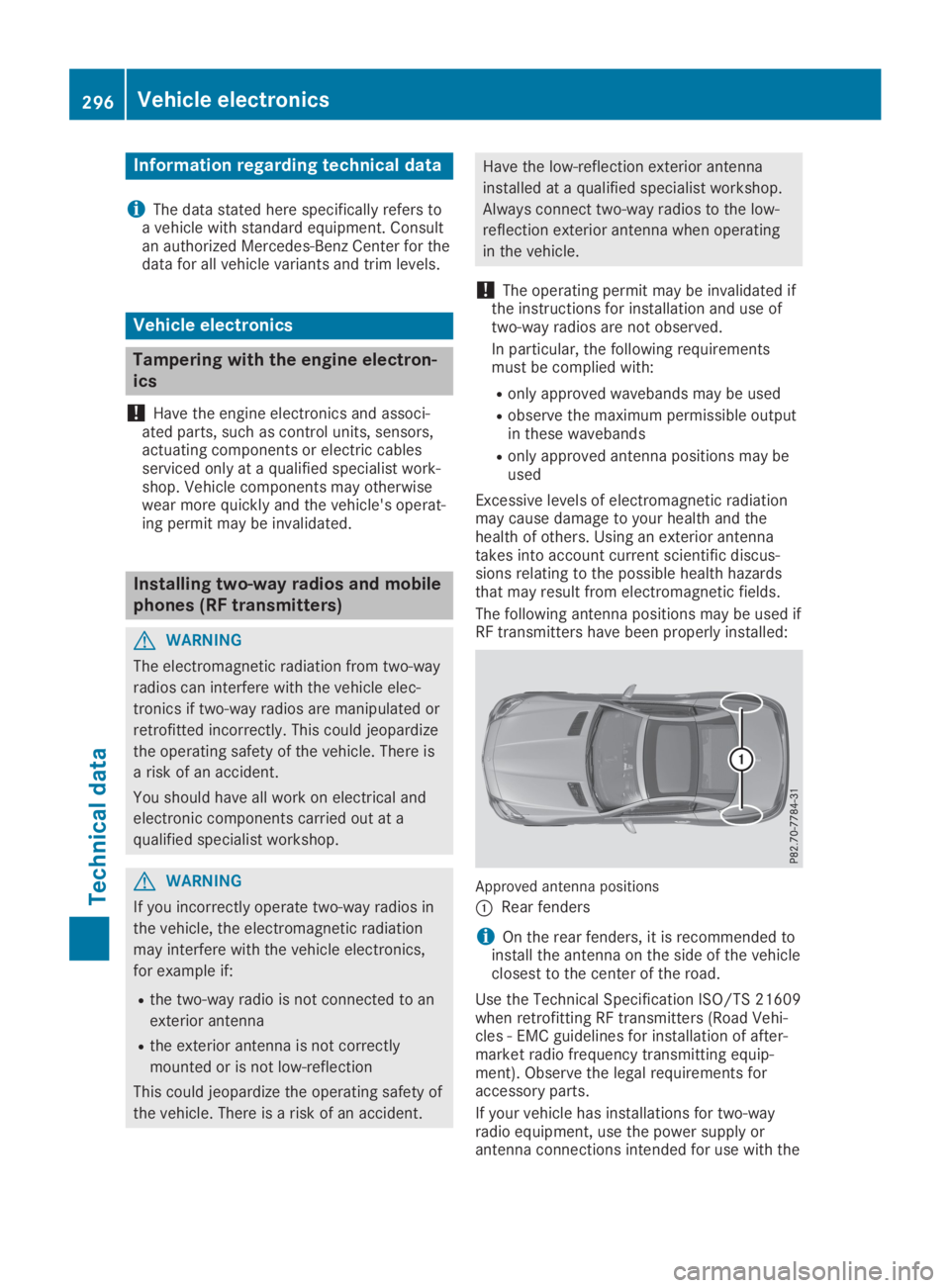
The following antenna positions may be used ifRF transmitters have been properly installed:
Approved antenna positions
CRear fenders
iOn the rear fenders, it is recommended toinstall the antenna on the side of the vehicleclosest to the center of the road.
Use the Technical Specification ISO/TS 21609when retrofitting RF transmitters (Road Vehi-cles - EMC guidelines for installation of after-market radio frequency transmitting equip-ment). Observe the legal requirements foraccessory parts.
If your vehicle has installations for two-wayradio equipment, use the power supply orantenna connections intended for use with the
296Vehicle electronics
Technical data
Page 301 of 306
Other identifications, for example:
R0 W-30
R5 W-30
R5 W-40
Fuel
Important safety notes
GWARNING
Fuel is highly flammable. Improper handling
of fuel creates a risk of fire and explosion.
Avoid fire, open flames, smoking and creat-
ing sparks under all circumstances. Switch
off the engine and, if applicable, the auxiliary
heating before refueling.
GWARNING
Fuels are toxic and harmful to health. There
is a risk of injury.
You must avoid fuels coming into contact
with skin, eyes and clothes or being swal-
lowed.
Do not inhale the fuel vapors. Keep children
away from fuels.
Keep doors and windows closed during the
refueling process.
If you or others come into contact with fuel,
observe the following points:
RImmediately rinse the fuel off your skin
with soap and water.
RIf you get fuel into your eyes, immediately
rinse your eyes throughly with clean
water. Seek medical attention immedi-
ately.
RSeek medical attention immediately if fuel
has been swallowed. Do not induce vomit-
ing.
RImmediately change out of clothing which
has come into contact with fuel.
Tank capacity
ModelTotal capa-city
SLC 30018.5 US gal(70.0l)
Mercedes‑AMG vehicles15.8 US gal(60.0l)
ModelOf whichreserve
SLC 300Approx.2.4 US gal(9.0 l)
Mercedes‑AMG vehiclesApprox.2.1 US gal(8.0 l)
Gasoline
Fuel grade
!Do not use diesel to refuel vehicles with agasoline engine. Do not switch on the igni-tion if you accidentally refuel with the wrongfuel. Otherwise, the fuel will enter the fuelsystem. Even small amounts of the wrongfuel could result in damage to the fuel sys-tem and the engine. Notify a qualified spe-cialist workshop and have the fuel tank andfuel lines drained completely.
!Only refuel using unleaded premium gradegasoline with at least 91 AKI/95 RON.
iE10 fuel contains up to 10% bioethanol.Your vehicle is E10-compatible. You canrefuel your vehicle using E10 fuel.
!Only use the fuel recommended. Operatingthe vehicle with other fuels can lead to dam-age to the fuel system, engine and exhaustsystem.
!Do not use the following:
RGasoline with more than 10% ethanol
RE100 (100% ethanol)
RGasoline with methanol
RM100(100% methanol)
RGasoline with metalliferous additives
RDiesel
Service products and filling capacities299
Technical data
Z