display MERCEDES-BENZ SLC 2019 Service Manual
[x] Cancel search | Manufacturer: MERCEDES-BENZ, Model Year: 2019, Model line: SLC, Model: MERCEDES-BENZ SLC 2019Pages: 306, PDF Size: 15 MB
Page 143 of 306
driving and braking accordingly during thisbreak-in period.
Excessive heavy braking results in correspond-ingly high brake wear. Observe the brake sys-tem warning lamp in the instrument clusterand note any brake status messages in themultifunction display. Especially for high per-formance driving, it is important to maintainand have the brake system checked regularly.
Driving on wet roads
Hydroplaning
If water has accumulated to a certain depth onthe road surface, there is a danger of hydro-planing occurring.
For this reason, in the event of heavy rain or inconditions in which hydroplaning may occur,you must drive in the following manner:
Rlower your speed
Ravoid ruts
Ravoid sudden steering movements
Rbrake carefully
Driving on flooded roads
!Do not drive through flooded areas. Checkthe depth of any water before drivingthrough it. Drive slowly through standingwater. Otherwise, water could enter thevehicle interior or engine compartment. Itcan then damage the engine's or automatictransmission's electronic components. Itcan also be sucked in by the engine's airintake connection and cause engine dam-age.
Winter driving
GWARNING
If you shift down on a slippery road surface
in an attempt to increase the engine's brak-
ing effect, the drive wheels could lose their
grip. There is an increased danger of skid-
ding and accidents.
Do not shift down for additional engine brak-
ing on a slippery road surface.
GDANGER
If the exhaust pipe is blocked or adequate
ventilation is not possible, poisonous gases
such as carbon monoxide (CO) may enter
the vehicle. This is the case, e.g. if the vehi-
cle becomes trapped in snow. There is a risk
of fatal injury.
If you leave the engine or the auxiliary heat-
ing running, make sure the exhaust pipe and
area around the vehicle are clear of snow.
To ensure an adequate supply of fresh air,
open a window on the side of the vehicle
that is not facing into the wind.
Have your vehicle winter-proofed at a qualifiedspecialist workshop at the onset of winter.
Drive particularly carefully on slippery roadsurfaces. Avoid sudden acceleration, steeringand braking maneuvers. Do not use cruisecontrol.
If the vehicle threatens to skid or cannot bestopped when moving at low speed:
XShift the transmission to position\\.
The outside temperature indicator is notdesigned to serve as an ice-warning deviceand is therefore unsuitable for that purpose.Changes in the outside temperature are dis-played after a short delay.
Indicated temperatures just above the freezingpoint do not guarantee that the road surface isfree of ice. The road may still be icy, especiallyin wooded areas or on bridges. The vehiclecould skid if you fail to adapt your drivingstyle. Always adapt your driving style and driveat a speed to suit the prevailing weather condi-tions.
You should pay special attention to road con-ditions when temperatures are around freezingpoint.
For more information on driving with snowchains, see (Ypage 270).
For more information on driving with summertires, see (Ypage 269).
Observe the notes in the "Winter operation"section (Ypage 269).
Driving tips141
Driving and parking
Z
Page 150 of 306
Rif the battery is disconnected
Rif the vehicle is accelerated, e.g. by a vehi-
cle occupant
There is a risk of an accident.
Always deactivate Active Distance Assist
DISTRONIC and secure the vehicle against
rolling away before you leave it.
Further information on deactivating Active Dis-tance Assist DISTRONIC (Ypage 149).
If Active Distance Assist DISTRONIC detectsthat the vehicle in front is stopping, it brakesyour vehicle until it is stationary.
Once your vehicle is stationary, it remains sta-tionary and you do not need to depress thebrake.
iAfter a time, the electric parking brakesecures the vehicle and relieves the servicebrake.
iDepending on the specified minimum dis-tance, your vehicle will come to a standstillat a sufficient distance behind the vehicle infront. The specified minimum distance is setusing the control on the cruise control lever.
When Active Distance Assist DISTRONIC isactivated, the transmission is shifted automati-cally to position]if:
Rthe driver's seat belt is not fastened and thedriver's door is open
Rthe engine is switched off, unless it is auto-matically switched off by the ECO start/stop function.
The electric parking brake is applied automati-cally if Active Distance Assist DISTRONIC isactive when the vehicle is stationary and:
Ra system malfunction occurs
Rthe power supply is not sufficient
If a malfunction occurs, the transmission mayalso shift to position]automatically.
Setting a speed
Keep in mind that it may take a brief momentuntil the vehicle has accelerated or braked tothe speed set.
XTo adjust the set speed in 1 mph incre-ments (1 km/h increments):briefly pressthe cruise control lever upCto the pres-
sure point for a higher speed, or downDfor a lower speed.Every time the cruise control lever ispressed up or down, the last speed stored isincreased or reduced.
XTo adjust the set speed in 5 mph incre-ments (10 km/h increments):brieflypress the cruise control lever upCpast thepressure point for a higher speed, ordownDfor a lower speed.Every time the cruise control lever ispressed up or down, the last speed stored isincreased or reduced.
Setting a specified minimum distance
You can set the specified minimum distancefor Active Distance Assist DISTRONIC by vary-ing the time span between one and two sec-onds. This determines the distance that ActiveDistance Assist DISTRONIC is to maintain fromthe vehicle in front, depending on the roadspeed. You can see this distance in the multi-function display (Ypage 149).
The specified minimum distance can bechanged while Active Distance AssistDISTRONIC is switched on or off.
Make sure that you maintain a sufficiently safedistance from the vehicle in front. Adjust thedistance to the vehicle in front if necessary.
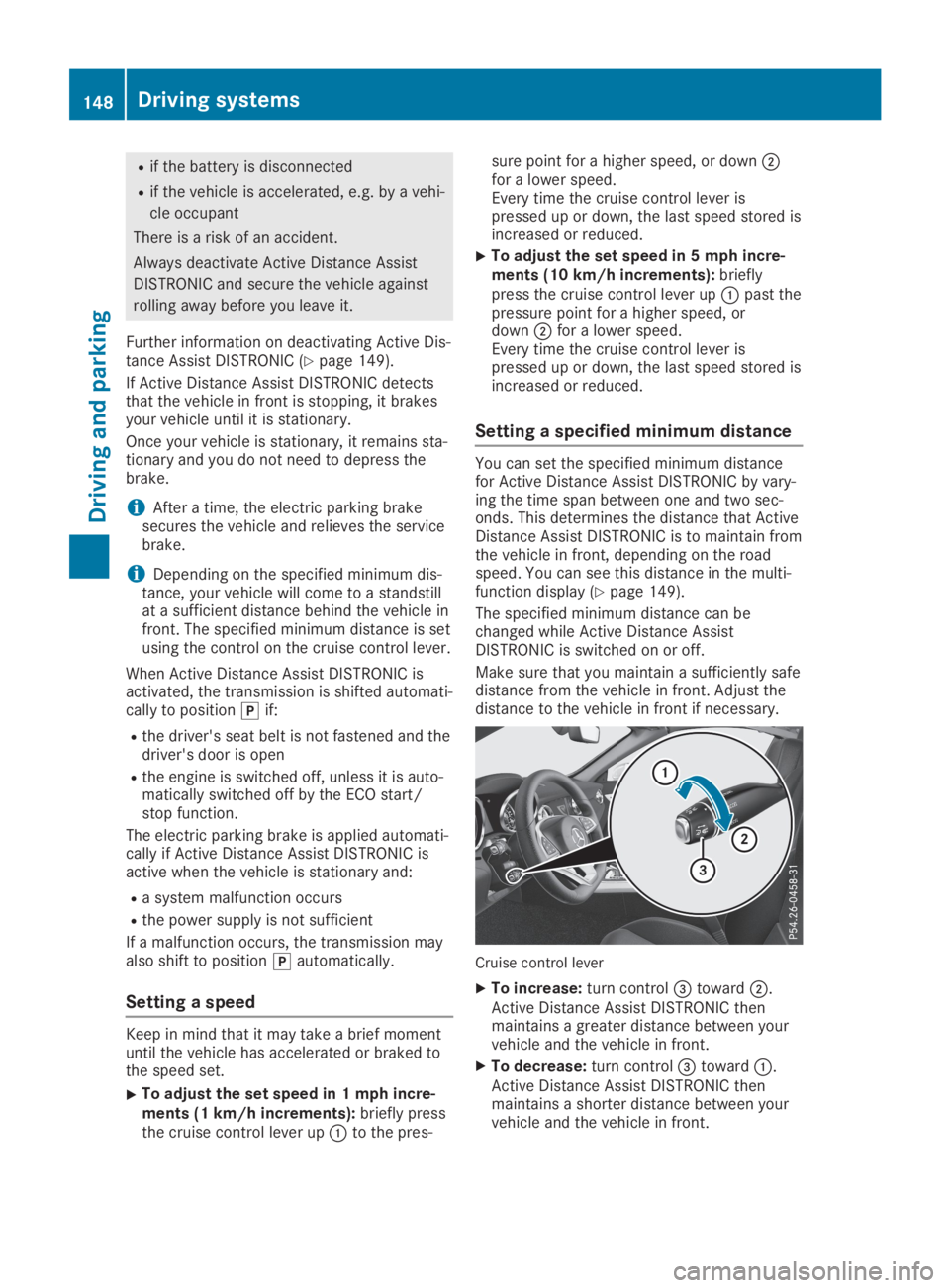
Cruise control lever
XTo increase:turn control
Page 151 of 306
Active Distance Assist DISTRONIC dis-
plays in the instrument cluster
Displays in the speedometer
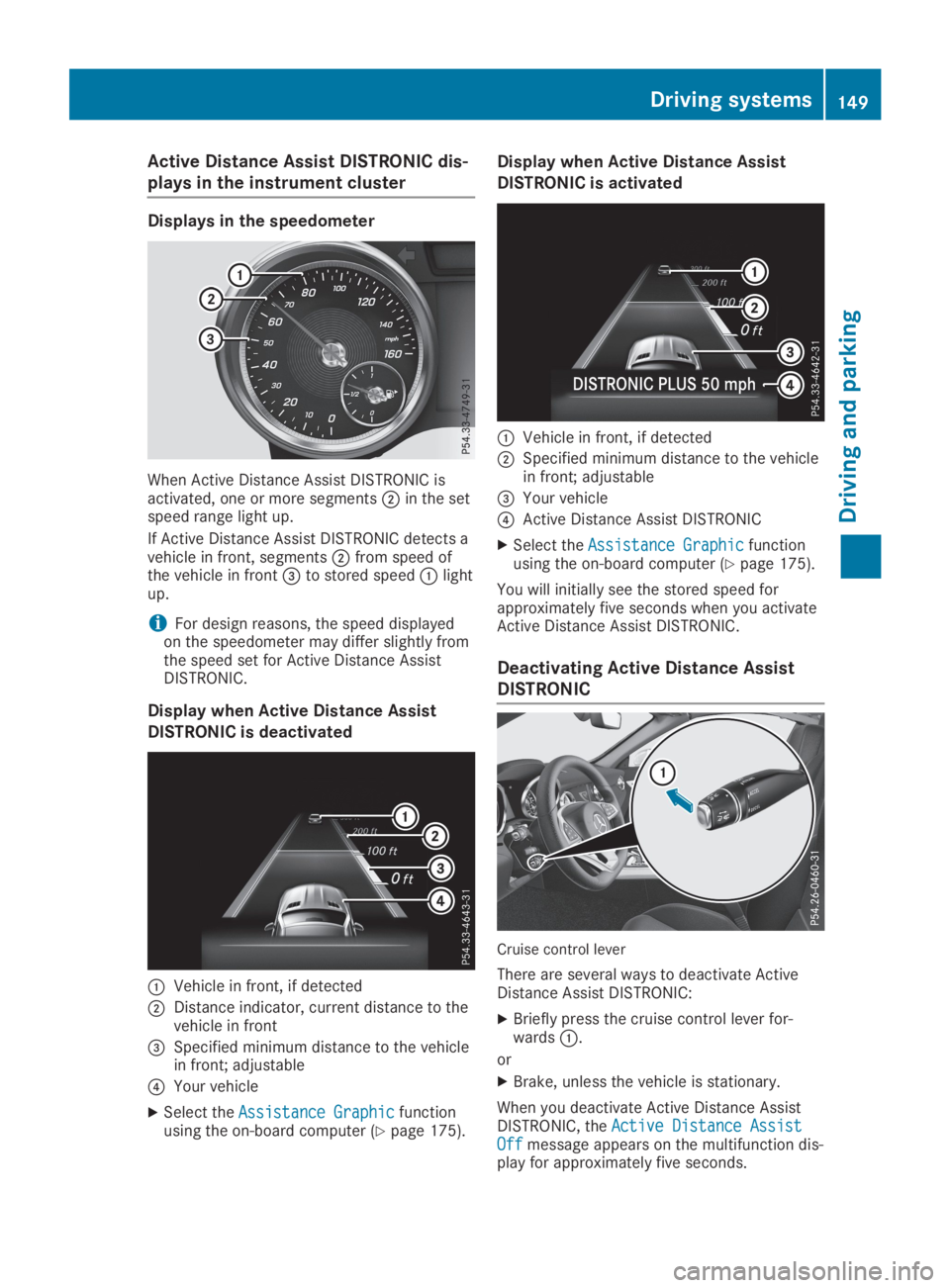
When Active Distance Assist DISTRONIC isactivated, one or more segmentsDin the setspeed range light up.
If Active Distance Assist DISTRONIC detects avehicle in front, segmentsDfrom speed ofthe vehicle in front
Page 154 of 306
Activation conditions
You can activate the HOLD function if all of thefollowing conditions are fulfilled:
Rthe vehicle is stationary.
Rthe engine is running or if it has been auto-matically switched off by the ECO start/stop function.
Rthe driver's door is closed or your seat beltis fastened.
Rthe electric parking brake is released.
Rthe transmission is in position[,^or\\.
RActive Distance Assist DISTRONIC is deacti-vated
Activating the HOLD function
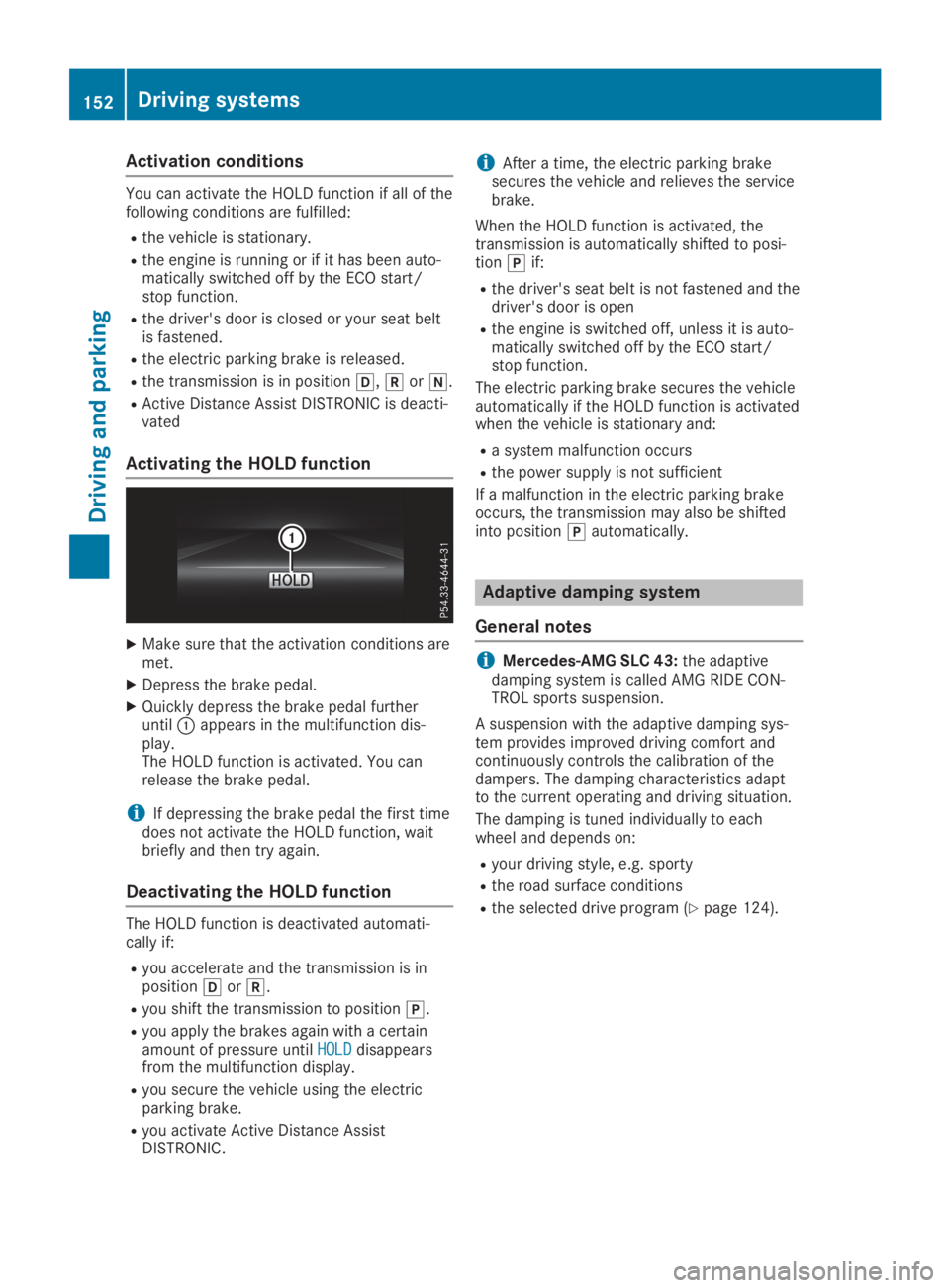
XMake sure that the activation conditions aremet.
XDepress the brake pedal.
XQuickly depress the brake pedal furtheruntilCappears in the multifunction dis-play.The HOLD function is activated. You canrelease the brake pedal.
iIf depressing the brake pedal the first timedoes not activate the HOLD function, waitbriefly and then try again.
Deactivating the HOLD function
The HOLD function is deactivated automati-cally if:
Ryou accelerate and the transmission is inposition[or^.
Ryou shift the transmission to position].
Ryou apply the brakes again with a certainamount of pressure untilHOLDHOLDdisappearsfrom the multifunction display.
Ryou secure the vehicle using the electricparking brake.
Ryou activate Active Distance AssistDISTRONIC.
iAfter a time, the electric parking brakesecures the vehicle and relieves the servicebrake.
When the HOLD function is activated, thetransmission is automatically shifted to posi-tion]if:
Rthe driver's seat belt is not fastened and thedriver's door is open
Rthe engine is switched off, unless it is auto-matically switched off by the ECO start/stop function.
The electric parking brake secures the vehicleautomatically if the HOLD function is activatedwhen the vehicle is stationary and:
Ra system malfunction occurs
Rthe power supply is not sufficient
If a malfunction in the electric parking brakeoccurs, the transmission may also be shiftedinto position]automatically.
Adaptive damping system
General notes
iMercedes-AMG SLC 43:the adaptivedamping system is called AMG RIDE CON-TROL sports suspension.
A suspension with the adaptive damping sys-tem provides improved driving comfort andcontinuously controls the calibration of thedampers. The damping characteristics adaptto the current operating and driving situation.
The damping is tuned individually to eachwheel and depends on:
Ryour driving style, e.g. sporty
Rthe road surface conditions
Rthe selected drive program (Ypage 124).
152Driving systems
Driving and pa rking
Page 156 of 306
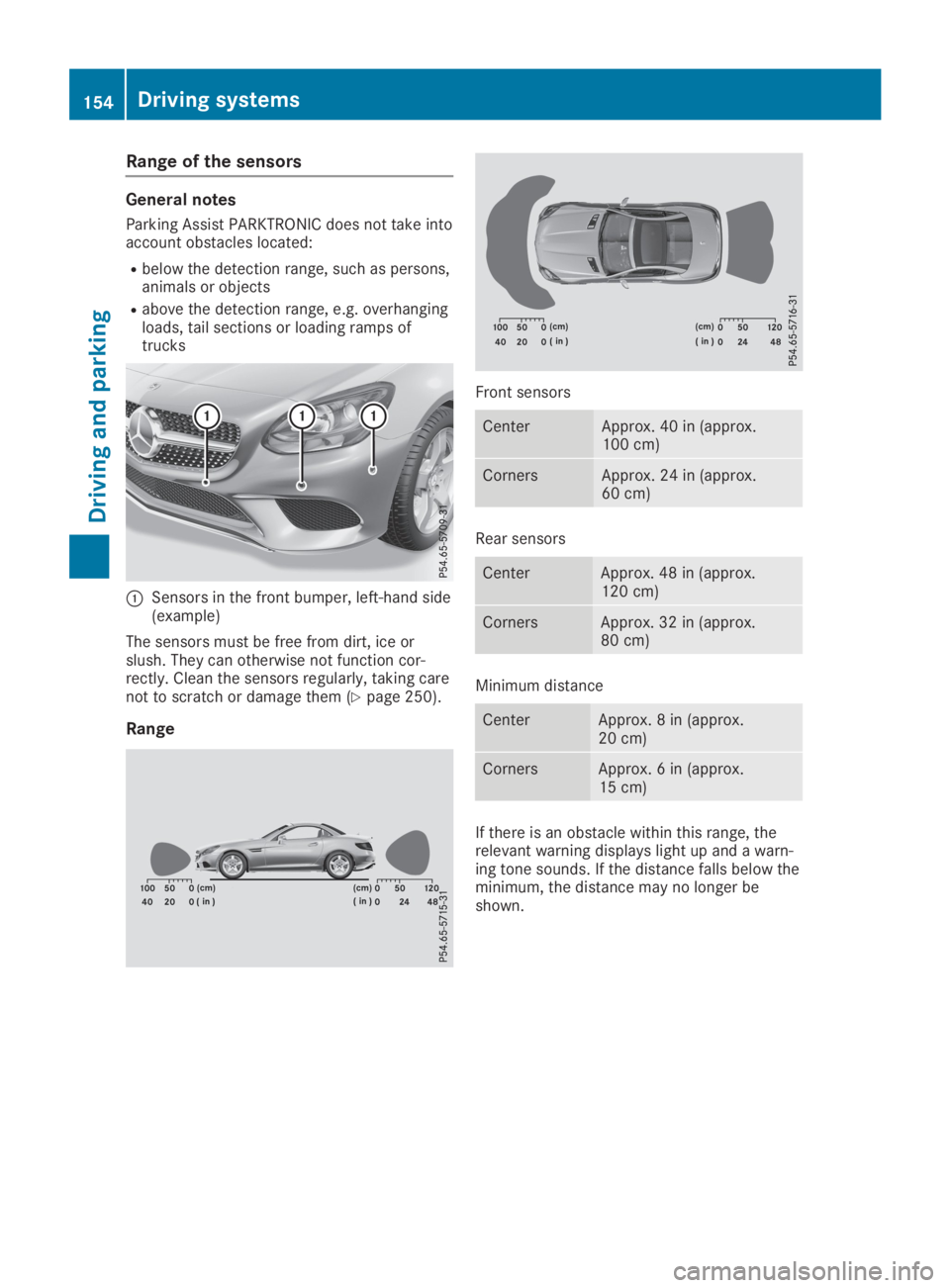
Range of the sensors
General notes
Parking Assist PARKTRONIC does not take intoaccount obstacles located:
Rbelow the detection range, such as persons,animals or objects
Rabove the detection range, e.g. overhangingloads, tail sections or loading ramps oftrucks
CSensors in the front bumper, left-hand side(example)
The sensors must be free from dirt, ice orslush. They can otherwise not function cor-rectly. Clean the sensors regularly, taking carenot to scratch or damage them (Ypage 250).
Range
Front sensors
CenterApprox. 40 in (approx.100 cm)
CornersApprox. 24 in (approx.60 cm)
Rear sensors
CenterApprox. 48 in (approx.120 cm)
CornersApprox. 32 in (approx.80 cm)
Minimum distance
CenterApprox. 8 in (approx.20 cm)
CornersApprox. 6 in (approx.15 cm)
If there is an obstacle within this range, therelevant warning displays light up and a warn-ing tone sounds. If the distance falls below theminimum, the distance may no longer beshown.
154Driving systems
Driving and parking
Page 157 of 306
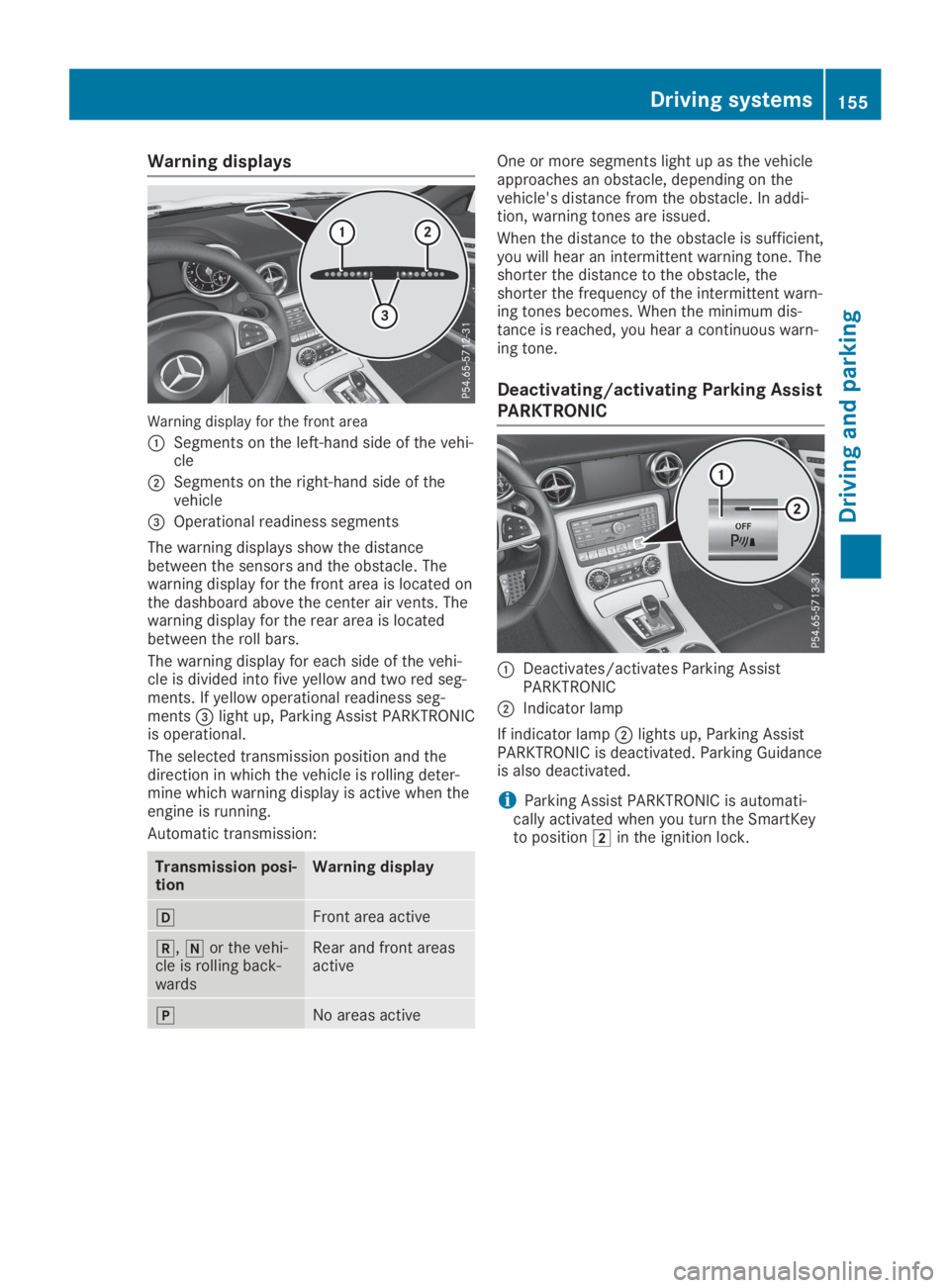
Warning displays
Warning display for the front area
CSegments on the left-hand side of the vehi-cle
DSegments on the right-hand side of thevehicle
Page 158 of 306
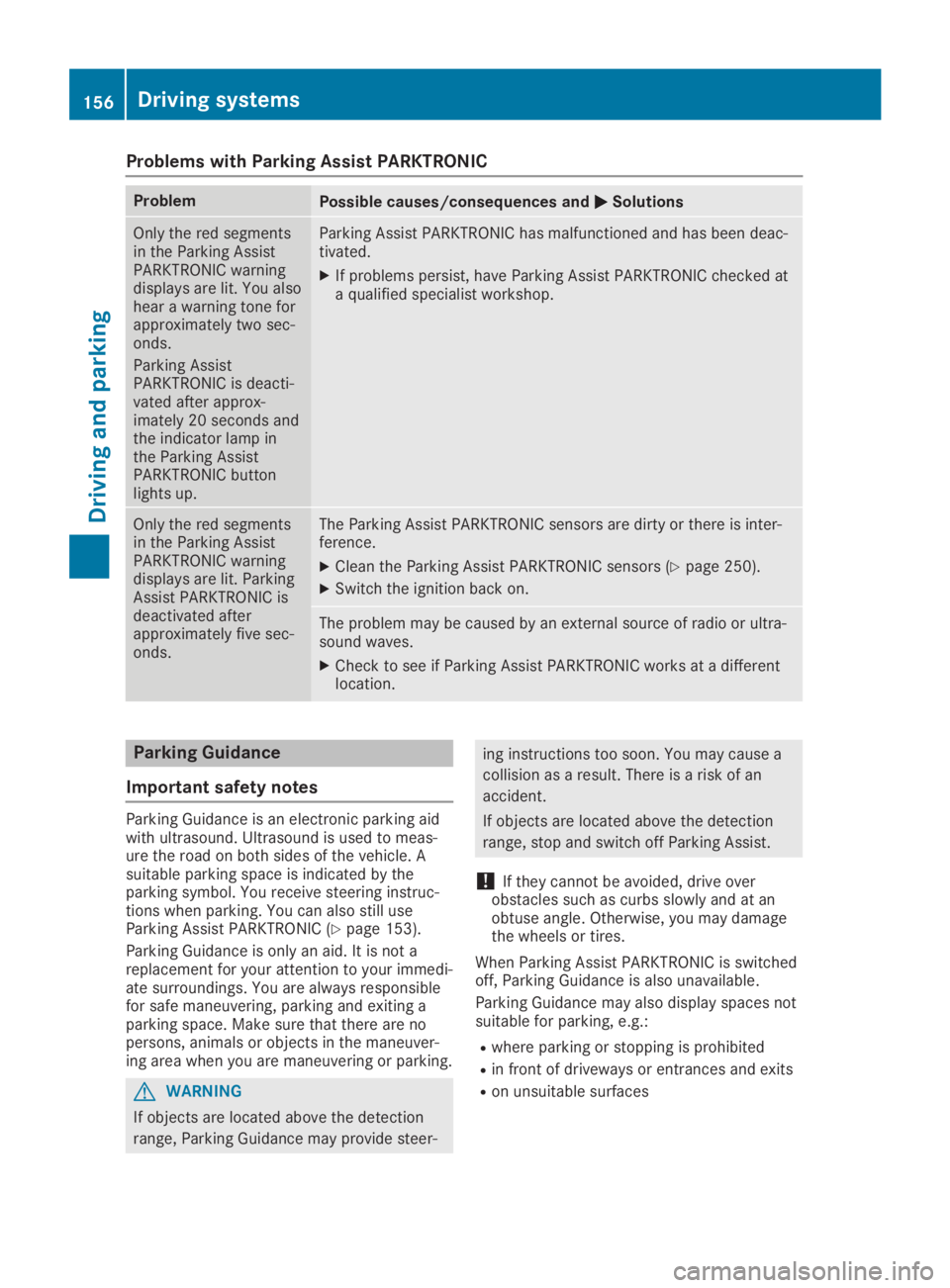
Problems with Parking Assist PARKTRONIC
ProblemPossible causes/consequences andPPSolutions
Only the red segmentsin the Parking AssistPARKTRONIC warningdisplays are lit. You alsohear a warning tone forapproximately two sec-onds.
Parking AssistPARKTRONIC is deacti-vated after approx-imately 20 seconds andthe indicator lamp inthe Parking AssistPARKTRONIC buttonlights up.
Parking Assist PARKTRONIC has malfunctioned and has been deac-tivated.
XIf problems persist, have Parking Assist PARKTRONIC checked ata qualified specialist workshop.
Only the red segmentsin the Parking AssistPARKTRONIC warningdisplays are lit. ParkingAssist PARKTRONIC isdeactivated afterapproximately five sec-onds.
The Parking Assist PARKTRONIC sensors are dirty or there is inter-ference.
XClean the Parking Assist PARKTRONIC sensors (Ypage 250).
XSwitch the ignition back on.
The problem may be caused by an external source of radio or ultra-sound waves.
XCheck to see if Parking Assist PARKTRONIC works at a differentlocation.
Parking Guidance
Important safety notes
Parking Guidance is an electronic parking aidwith ultrasound. Ultrasound is used to meas-ure the road on both sides of the vehicle. Asuitable parking space is indicated by theparking symbol. You receive steering instruc-tions when parking. You can also still useParking Assist PARKTRONIC (Ypage 153).
Parking Guidance is only an aid. It is not areplacement for your attention to your immedi-ate surroundings. You are always responsiblefor safe maneuvering, parking and exiting aparking space. Make sure that there are nopersons, animals or objects in the maneuver-ing area when you are maneuvering or parking.
GWARNING
If objects are located above the detection
range, Parking Guidance may provide steer-
ing instructions too soon. You may cause a
collision as a result. There is a risk of an
accident.
If objects are located above the detection
range, stop and switch off Parking Assist.
!If they cannot be avoided, drive overobstacles such as curbs slowly and at anobtuse angle. Otherwise, you may damagethe wheels or tires.
When Parking Assist PARKTRONIC is switchedoff, Parking Guidance is also unavailable.
Parking Guidance may also display spaces notsuitable for parking, e.g.:
Rwhere parking or stopping is prohibited
Rin front of driveways or entrances and exits
Ron unsuitable surfaces
156Driving systems
Driving and parking
Page 160 of 306
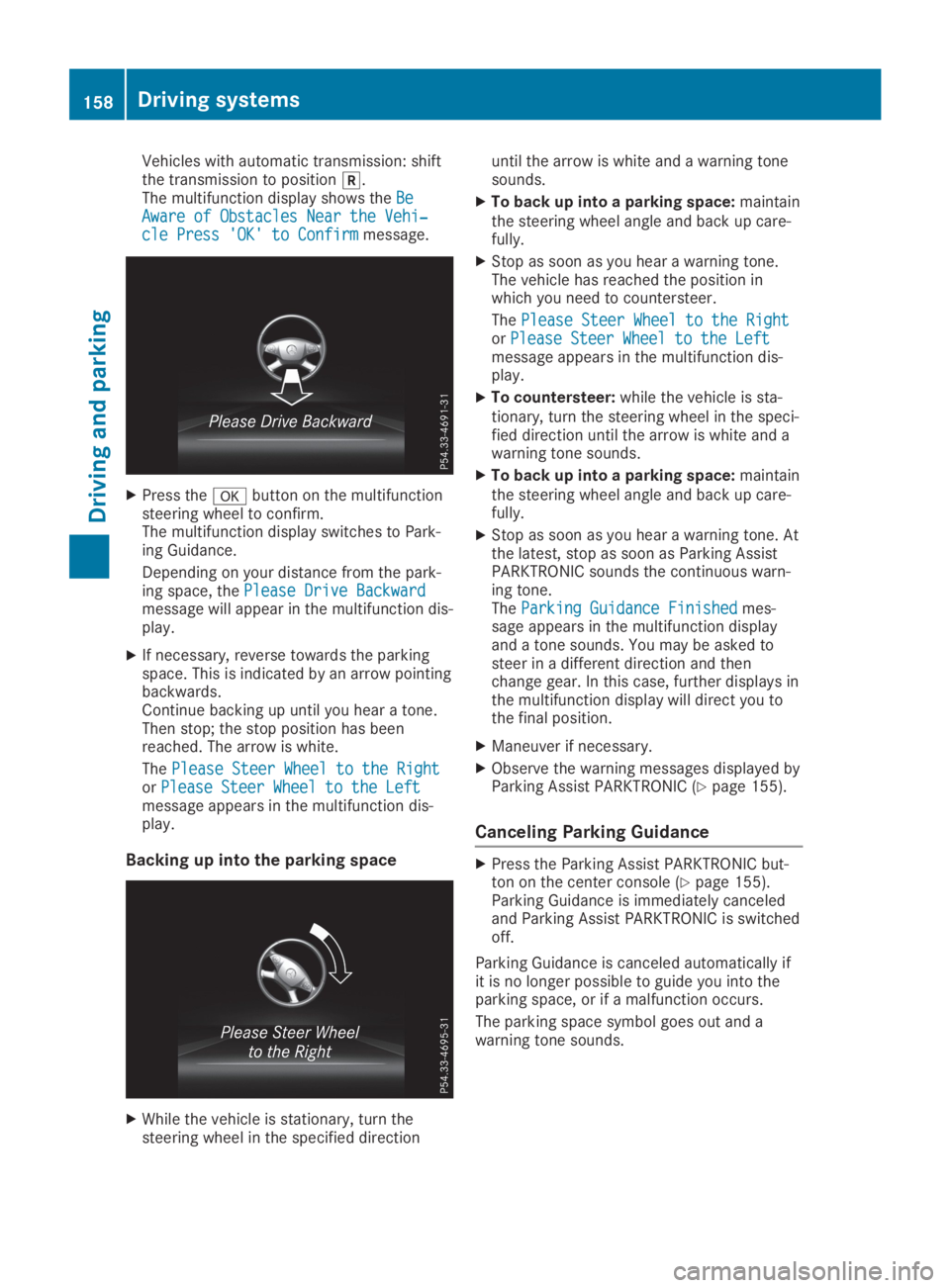
Vehicles with automatic transmission: shiftthe transmission to position^.The multifunction display shows theBeBeAware of Obstacles Near the Vehi‐Aware of Obstacles Near the Vehi‐cle Press 'OK' to Confirmcle Press 'OK' to Confirmmessage.
XPress thevbutton on the multifunctionsteering wheel to confirm.The multifunction display switches to Park-ing Guidance.
Depending on your distance from the park-ing space, thePlease Drive BackwardPlease Drive Backwardmessage will appear in the multifunction dis-play.
XIf necessary, reverse towards the parkingspace. This is indicated by an arrow pointingbackwards.Continue backing up until you hear a tone.Then stop; the stop position has beenreached. The arrow is white.
ThePlease Steer Wheel to the RightPlease Steer Wheel to the RightorPlease Steer Wheel to the LeftPlease Steer Wheel to the Leftmessage appears in the multifunction dis-play.
Backing up into the parking space
XWhile the vehicle is stationary, turn thesteering wheel in the specified direction
until the arrow is white and a warning tonesounds.
XTo back up into a parking space:maintainthe steering wheel angle and back up care-fully.
XStop as soon as you hear a warning tone.The vehicle has reached the position inwhich you need to countersteer.
ThePlease Steer Wheel to the RightPlease Steer Wheel to the RightorPlease Steer Wheel to the LeftPlease Steer Wheel to the Leftmessage appears in the multifunction dis-play.
XTo countersteer:while the vehicle is sta-tionary, turn the steering wheel in the speci-fied direction until the arrow is white and awarning tone sounds.
XTo back up into a parking space:maintainthe steering wheel angle and back up care-fully.
XStop as soon as you hear a warning tone. Atthe latest, stop as soon as Parking AssistPARKTRONIC sounds the continuous warn-ing tone.TheParking Guidance FinishedParking Guidance Finishedmes-sage appears in the multifunction displayand a tone sounds. You may be asked tosteer in a different direction and thenchange gear. In this case, further displays inthe multifunction display will direct you tothe final position.
XManeuver if necessary.
XObserve the warning messages displayed byParking Assist PARKTRONIC (Ypage 155).
Canceling Parking Guidance
XPress the Parking Assist PARKTRONIC but-ton on the center console (Ypage 155).Parking Guidance is immediately canceledand Parking Assist PARKTRONIC is switchedoff.
Parking Guidance is canceled automatically ifit is no longer possible to guide you into theparking space, or if a malfunction occurs.
The parking space symbol goes out and awarning tone sounds.
158Driving systems
Driving and parking
Page 161 of 306
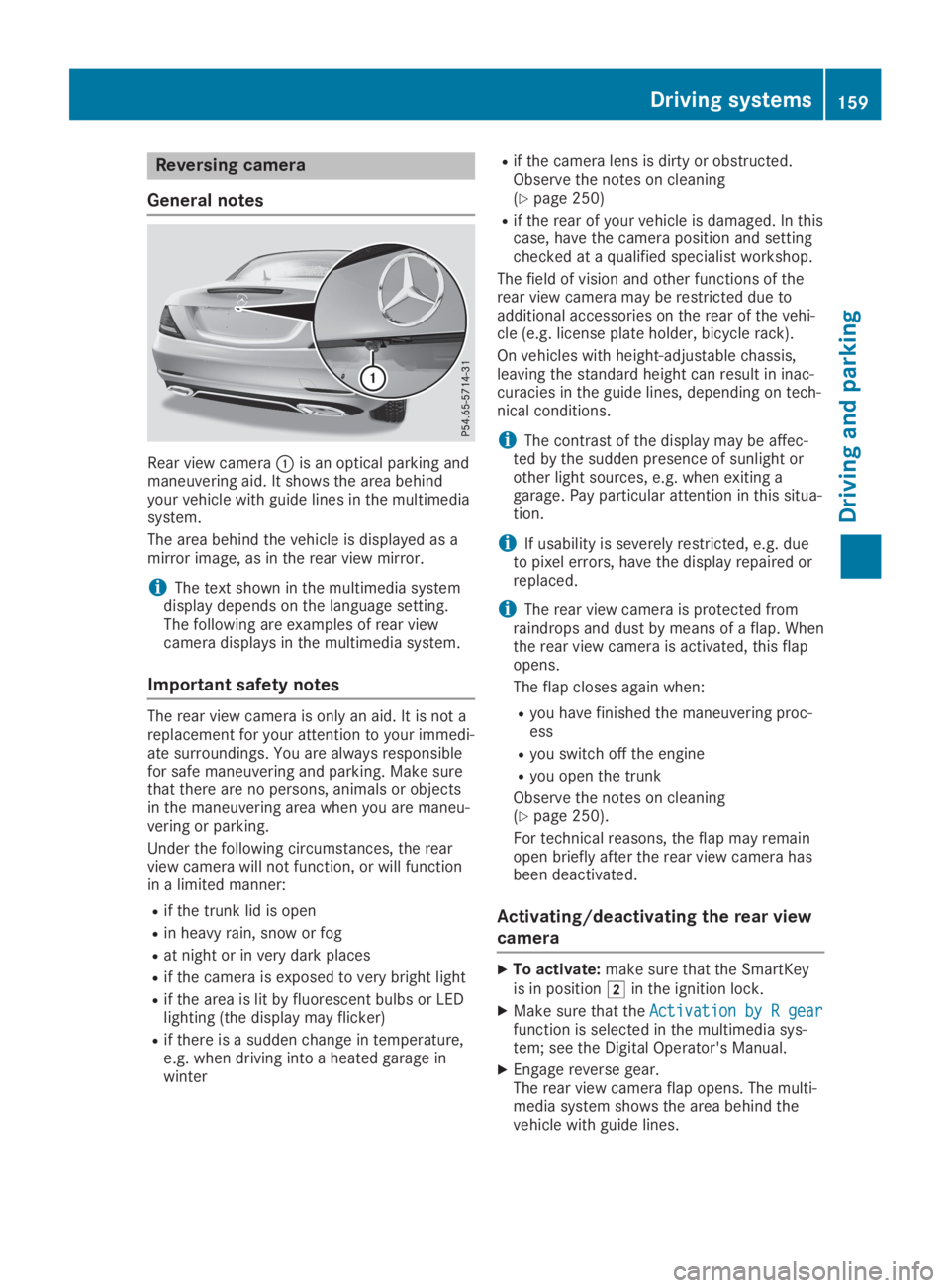
Reversing camera
General notes
Rear view cameraCis an optical parking andmaneuvering aid. It shows the area behindyour vehicle with guide lines in the multimediasystem.
The area behind the vehicle is displayed as amirror image, as in the rear view mirror.
iThe text shown in the multimedia systemdisplay depends on the language setting.The following are examples of rear viewcamera displays in the multimedia system.
Important safety notes
The rear view camera is only an aid. It is not areplacement for your attention to your immedi-ate surroundings. You are always responsiblefor safe maneuvering and parking. Make surethat there are no persons, animals or objectsin the maneuvering area when you are maneu-vering or parking.
Under the following circumstances, the rearview camera will not function, or will functionin a limited manner:
Rif the trunk lid is open
Rin heavy rain, snow or fog
Rat night or in very dark places
Rif the camera is exposed to very bright light
Rif the area is lit by fluorescent bulbs or LEDlighting (the display may flicker)
Rif there is a sudden change in temperature,e.g. when driving into a heated garage inwinter
Rif the camera lens is dirty or obstructed.Observe the notes on cleaning(Ypage 250)
Rif the rear of your vehicle is damaged. In thiscase, have the camera position and settingchecked at a qualified specialist workshop.
The field of vision and other functions of therear view camera may be restricted due toadditional accessories on the rear of the vehi-cle (e.g. license plate holder, bicycle rack).
On vehicles with height-adjustable chassis,leaving the standard height can result in inac-curacies in the guide lines, depending on tech-nical conditions.
iThe contrast of the display may be affec-ted by the sudden presence of sunlight orother light sources, e.g. when exiting agarage. Pay particular attention in this situa-tion.
iIf usability is severely restricted, e.g. dueto pixel errors, have the display repaired orreplaced.
iThe rear view camera is protected fromraindrops and dust by means of a flap. Whenthe rear view camera is activated, this flapopens.
The flap closes again when:
Ryou have finished the maneuvering proc-ess
Ryou switch off the engine
Ryou open the trunk
Observe the notes on cleaning(Ypage 250).
For technical reasons, the flap may remainopen briefly after the rear view camera hasbeen deactivated.
Activating/deactivating the rear view
camera
XTo activate:make sure that the SmartKeyis in positionHin the ignition lock.
XMake sure that theActivation by R gearActivation by R gearfunction is selected in the multimedia sys-tem; see the Digital Operator's Manual.
XEngage reverse gear.The rear view camera flap opens. The multi-media system shows the area behind thevehicle with guide lines.
Driving systems159
Driving and parking
Z
Page 162 of 306
![MERCEDES-BENZ SLC 2019 Service Manual The image from the rear view camera isavailable throughout the maneuvering proc-ess.
To deactivate:the rear view camera deacti-vates if you shift the transmission to position], or after driving forwa](/img/4/59131/w960_59131-161.png "MERCEDES-BENZ SLC 2019 Service Manual The image from the rear view camera isavailable throughout the maneuvering proc-ess.
To deactivate:the rear view camera deacti-vates if you shift the transmission to position], or after driving forwa")
The image from the rear view camera isavailable throughout the maneuvering proc-ess.
To deactivate:the rear view camera deacti-vates if you shift the transmission to position], or after driving forwards a short distance.
The inner segments of the warning indicatorare displayed in red if there is a complete sys-tem failure. The indicator lamp in thePARKTRONIC button lights up.
If the system fails at the rear of the vehicle:
Rthe rear segments are shown in red whenbacking up.
Rthe rear segments are hidden when drivingforwards.
Displays in the multimedia system
The rear view camera may show a distortedview of obstacles, show them incorrectly ornot at all. The rear view camera does not showobjects in the following positions:
Rvery close to the rear bumper
Runder the rear bumper
Rin close range above the handle on the trunklid
!Objects not at ground level may appear tobe further away than they actually are, e.g.:
Rthe bumper of a parked vehicle
Rthe drawbar of a trailer
Rthe ball coupling of a trailer tow hitch
Rthe rear section of an HGV
Ra slanted post
Use the guidelines only for orientation.Approach objects no further than the bot-tom-most guideline.
CYellow guide line at a distance of approx-imately 13 ft (4.0 m) from the rear area
DWhite guide line without steering input –vehicle width including the exterior mirrors(static)