light MERCEDES-BENZ SLC 2020 User Guide
[x] Cancel search | Manufacturer: MERCEDES-BENZ, Model Year: 2020, Model line: SLC, Model: MERCEDES-BENZ SLC 2020Pages: 310, PDF Size: 16.05 MB
Page 20 of 310
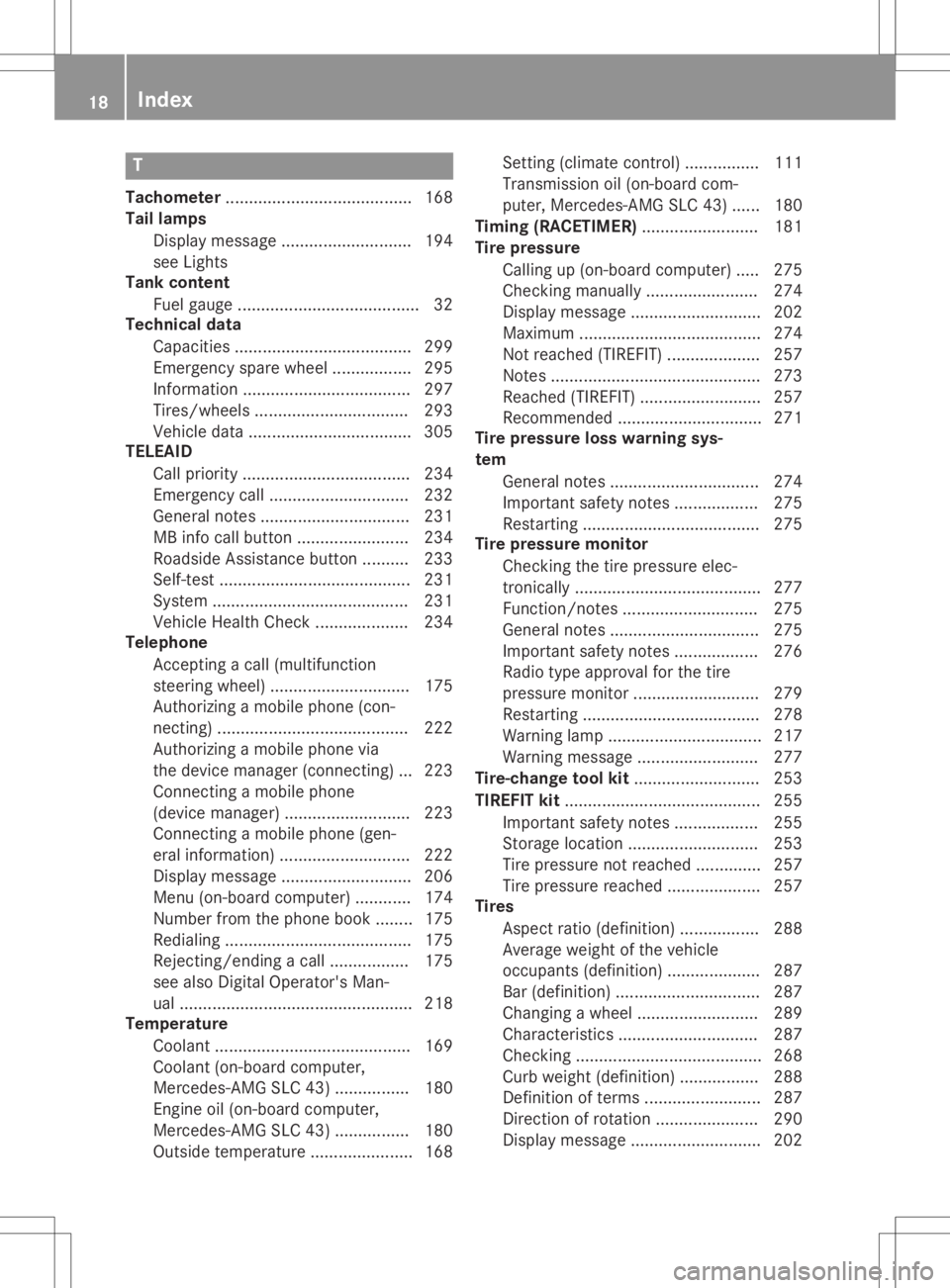
T
Tach ometer<0011001100110011001100110011001100110011001100110011001100110011
0011001100110011001100110011[ <0011001100110011001100110011001100110011001100110011001100110011
0011[168
Tail lamps
Dis play mes sage <0011001100110011001100110011001100110011001100110011001100110011
0011001100110011001100110011[ .....194
see Lights
Tank conte nt
Fue lgau ge <0011001100110011001100110011001100110011001100110011001100110011
0011001100110011001100110011[ ................32
Tec hnical data
Ca paciti es<0011001100110011001100110011001100110011001100110011001100110011
0011001100110011001100110011[ ...............299
Emer gency sparewh eel................. 295
Info rma tion.<0011001100110011001100110011001100110011001100110011001100110011
001100110011001100110011[ .............297
Ti res /wh eels<0011001100110011001100110011001100110011001100110011001100110011
0011001100110011001100110011[ ..........293
Veh icled ata. <0011001100110011001100110011001100110011001100110011001100110011
001100110011001100110011[ ............305
TEL EAID
Ca llpri ority<0011001100110011001100110011001100110011001100110011001100110011
0011001100110011001100110011[ .............234
Emer gency call.<0011001100110011001100110011001100110011001100110011001100110011
001100110011001100110011[ .......232
Ge nera lnotes <0011001100110011001100110011001100110011001100110011001100110011
0011001100110011001100110011[ .........231
MB info callbutton <0011001100110011001100110011001100110011001100110011001100110011
0011001100110011001100110011[ .234
Roa dside Assista ncebutton ..........233
Self-test ......................................... 231
System .......................................... 231
Vehi cleHeal thChe ck....... ............. 234
Tele phone
Accepting acall(mu ltifunction
steeri ngwhe el)....... .......................175
Authori zingamobilephone (con-
necting) ......................................... 222
Authori zingamobilephone via
the devi cemana ger(connecting) ...223
Connecting amobilephone
(de vice mana ger)........................... 223
Connecting amobilephone (gen-
eral informa tion)............................ 222
Displ aymessa ge....... ..................... 206
Menu (on-boa rdcompu ter)....... ..... 174
Numb erfrom thephone book........175
Red ialing ....... ................................. 175
Reje cting/endi ngacall....... ..........175
see also Digita lOpera tor's Man-
ua l....... ....... .............. ......................218
Temperature
Coo lant ....... ................................... 169
Coo lant (on-boa rdcompu ter,
Merced es-AMG SLC43)....... .........180
Engine oil(on-boa rdcompu ter,
Merced es-AMG SLC43)....... .........180
Outsi detempera ture......................168 Setting
(climate control) ................111
Transmi ssionoil(on-boa rdcom-
pute r,Merced es-AMG SLC43)...... 180
Timing (RACETIME R)....... .................. 181
Tire pressure
Ca lling up (on-boa rdcompu ter)..... 275
Che cking manually ....... .................274
Displ aymessa ge....... ..................... 202
Maxi mum .......................................274
Not reach ed(TIR EFIT) .................... 257
Notes .............................................273
Rea ched (TIREFIT) .......................... 257
Reco mmended ...............................271
Tire pressure lossw arni ngsys-
tem
Gene ralnotes ................................ 274
Importa ntsafe tynotes .................. 275
Res tarting ......................................275
Tire pressure monitor
Che cking thetire press ureelec-
tronical ly....... ................................. 277
Function/notes .............................275
Gene ralnotes ................................ 275
Importa ntsafe tynotes .................. 276
Ra dio type approval forthe tire
press uremonitor ........................... 279
Res tarting ......................................278
Warni nglamp ....... .......................... 217
Warni ngmessa ge....... ................... 277
Tire-c hange toolkit....... .................... 253
TIREF ITkit ....... ................................... 255
Importa ntsafe tynotes .................. 255
Storage location ............................ 253
Tire press urenot reach ed....... ....... 257
Tire press urereach ed....... ............. 257
Tires
Aspect ratio(definitio n)....... ..........288
Averag eweight ofthe vehi cle
occup ants(definitio n)....... ............. 287
Bar (definitio n)....... ........................287
Cha nging awheel....... ................... 289
Cha racteri stics..............................287
Che cking ........................................ 268
Cu rbwei ght (definitio n)....... ..........288
Definiti onofterms .........................287
Direction ofrotatio n.<0011001100110011001100110011001100110011001100110011001100110011
00110011001100110011[ 290
Disp laym essage <0011001100110011001100110011001100110011001100110011001100110011
001100110011001100110011001100110011001100110011[ 20218
In
dex
Page 31 of 310
R
malfu nctions anddefects inimporta ntsys-
tem components, e.g.lights,brakes
R vehicl ereactions andopera tingconditions
in specia ldrivi ng situa tions, e.g.airbag
depl oyme nt,intervention ofstabi litycontrol
systems
R ambi entconditions, e.g.outsid etempera -
ture
This data isof an exclusi velytechnical nature
and canbeused to:
R assi stinrecognizing andrectifyi ngmalfu nc-
tions anddefects
R anal yzevehicl efunctions, e.g.after anacci-
dent
R optimize vehiclefunctions
The data cannot beused totrace thevehicl e's
movements.
When yourvehicl eiss erviced ,technical infor-
mation canberead from theevent datamem-
ory and malfu nction datamemory .
Services include,for exampl e:
R repa irservices
R service processe s
R warra nties
R qua lityassu rance
The vehicl eisr ead outbyemplo yeesofthe
service network (includingthemanufa cturer)
usi ng specia ldiagnostic testers. Moredetailed
informatio niso btai ned from it,ifrequ ired.
After amalfunction hasbeen rectified ,the
informatio nisd eleted from themalfu nction
memory oriscontinual lyoverwri tten.
When operatingthevehicl e,situa tions are
conceivab lein whi chthis technical data,in
connection withother informatio n(ifneces-
sary ,under consulta tionwith anauthorized
expert), couldbetraced toap erson.
Examples include:
R accide ntreports
R dama getothe vehicl e
R witness statements
Further additional functions thathave been
contractuall yagree duponw iththe customer
all ow certain vehicledata tobe conveyed by
the vehicl easw ell. The additional functions
includ e,for exampl e,vehicl elocati onincase
of an emergency . COMA
ND/Me rcedesmeconne ct
(Can ada: TELE AID)
If the vehicl eise quippe dwithCOMAND or
Mercede smeconnect, additional dataabout
the vehicl e'sopera tion,theuse ofthe vehicl e
in certain situations, andthelocatio nofthe
vehicl eisc ompil edthrough COMAND orthe
Mercede smeconnect system.
For additional informatio n,plea serefer tothe
COMAND UserManua lorD igital Opera tor's
Manua land/or theMercede smeconnect
Terms andCondi tions. Eve
ntdata recorders
USA only:
This vehicl eise quippe dwithanevent data
recorder (EDR).Thisvehicl eise quippe dwith
an event datarecorder (EDR).Themain pur-
pose ofan EDR isto record, incertain crashor
near crash-li kesitua tions, suchasan air bag
depl oyme ntor hitting aroad obstacl e,data
that willassi stinundersta ndinghowavehi-
cle's systems performed .The EDR isdesi gned
to record datarelated tovehicl edyna mics and
safety systems forashort perio doftime, typi-
call y30seconds orless.
The EDR inthis vehicl eisd esigned torecord
such dataas:
R How varioussystems inyou rvehicl ewere
opera ting
R Whether ornot thedriver andpass enger
safety beltswerebuckle d/fastened
R How far(ifat all)the driver wasdepre ssing
the accele ratorand/or brakepedal;and,
R How fastthevehicl ewastraveli ng
These datacanhelp provid eabetter under-
standing ofthe circumstances inwhich
crashes andinjurie soccur. NOTE: EDRdata
are recorded byyou rvehicl eonly ifan on-triv-
ial crash situationoccurs; nodata arerecor-
ded bythe EDR under normal drivingcondi-
tions andnopersona ldata (e.g. name, gender,
age and crash location)are recorded .How-
ever, other parties,such aslaw enforcement
could combine theEDR data withthetype of
persona llyidentify ingdata routinel yacqu ired
duri ngacrash investiga tion.
Access tothe vehicl eand/or theEDR isnee-
ded toread datathatisrecorded byan EDR,
and specia lequ ipment isrequ ired. Inadd ition Data
storage
29Introductio n Z
Page 38 of 310
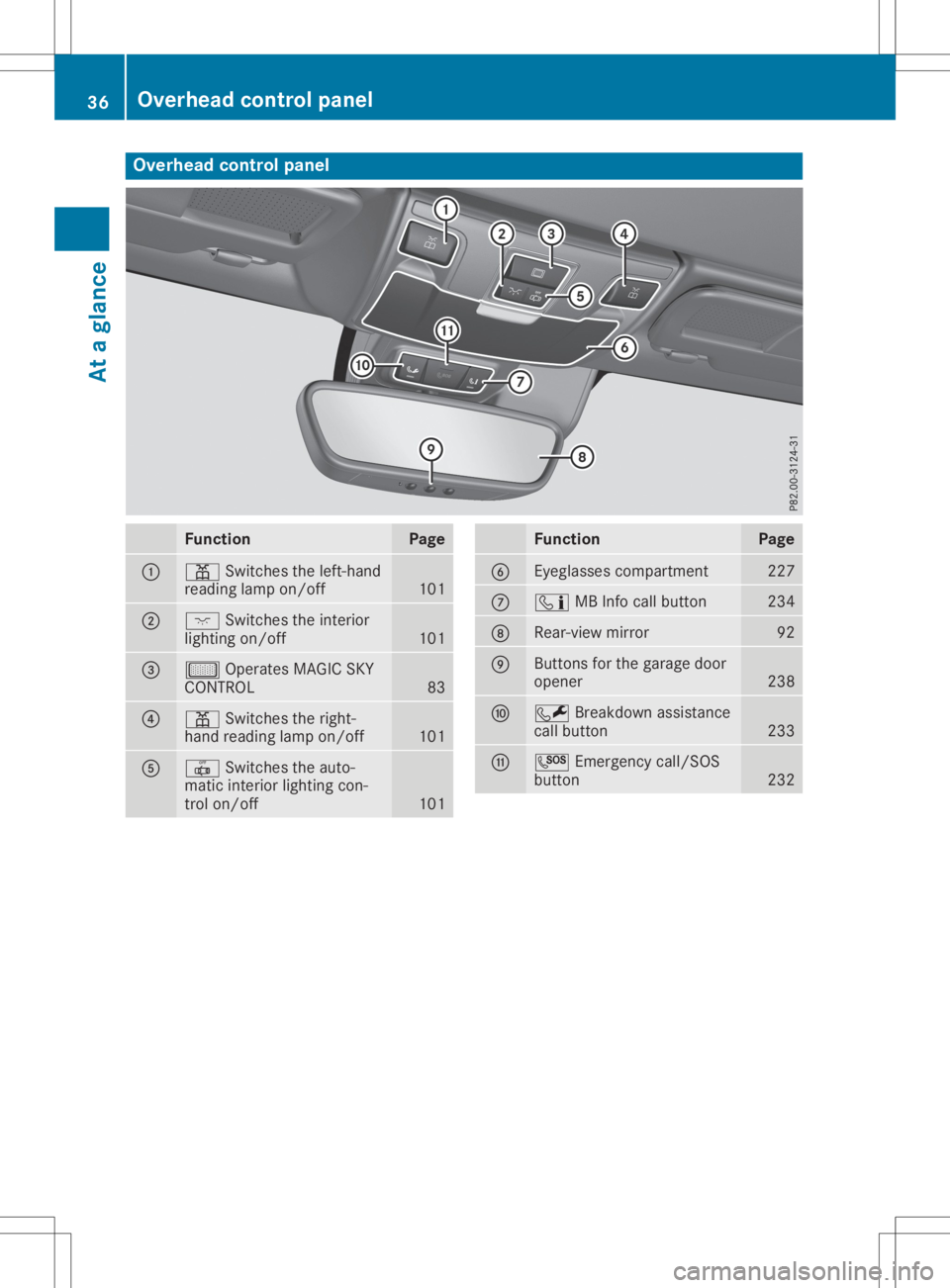
Overhea
dcontrol panel Function Page
0043
003D
Switchestheleft- hand
reading lampon/off 101
0044
004A
Switchestheinter ior
lighting on/off 101
0087
00B7
Operates MAGICSKY
CONTROL 83
0085
003D
Switchestheright-
hand reading lampon/off 101
0083
0033
Switchestheauto-
matic interiorlighting con-
trol on/off 101 Function Page
0084
Eyeglasses
compartment 227
006B
00D9
MBInfoc allbutton 234
006C
Rear-view
mirror 92
006D
Butt
ons forthe garage door
opener 238
006E
0052
Breakdown assistanc e
call button 233
006F
0053
Emergencycall/SO S
button 23236
Overhea
dcontrol panelAtag lance
Page 41 of 310
Res
traint system warn ingl amp
The functi onsofthe restrai ntsystem are
checke dafterthe igniti onisswi tched onand
at reg ular inter valsw hile the engi neisrunni ng.
The refo re,mal functi onscanbedete cted in
goo dtime .
The 0075 restrai ntsystem warning lamp on
the instru ment cluster lights upwhen the igni-
tion isswi tched on.Itgoe soutno later than a
few seco ndsafterthe veh iclei ss tarted. The
res trai ntsystem isope rationa l.
Am alfuncti onhaso ccu rred ifthe 0075
res trai ntsystem warning lamp:
R doe snotlight upafte rthe igniti onis
swi tched on
R doe snotgo outa fte raf ewseco ndswith the
engi nerunni ng
R lights upagainw hile the engi neisrunni ng G
WARNI
NG
If the restrai ntsystem ismal functi oning,
res trai ntsystem components maybetrig -
ger edunintentio nallyor may notbetrig -
ger edasintend edinthe eventofan acci -
dent. Thism ayaffect the Emerg encyTen-
sio ning Devicesorairb ags,for exa mpl e.
The reisar isko finju ry.
Have therestrai ntsystem checke dand
rep aired imm ediate lyat aq ualifi ed spe cialist
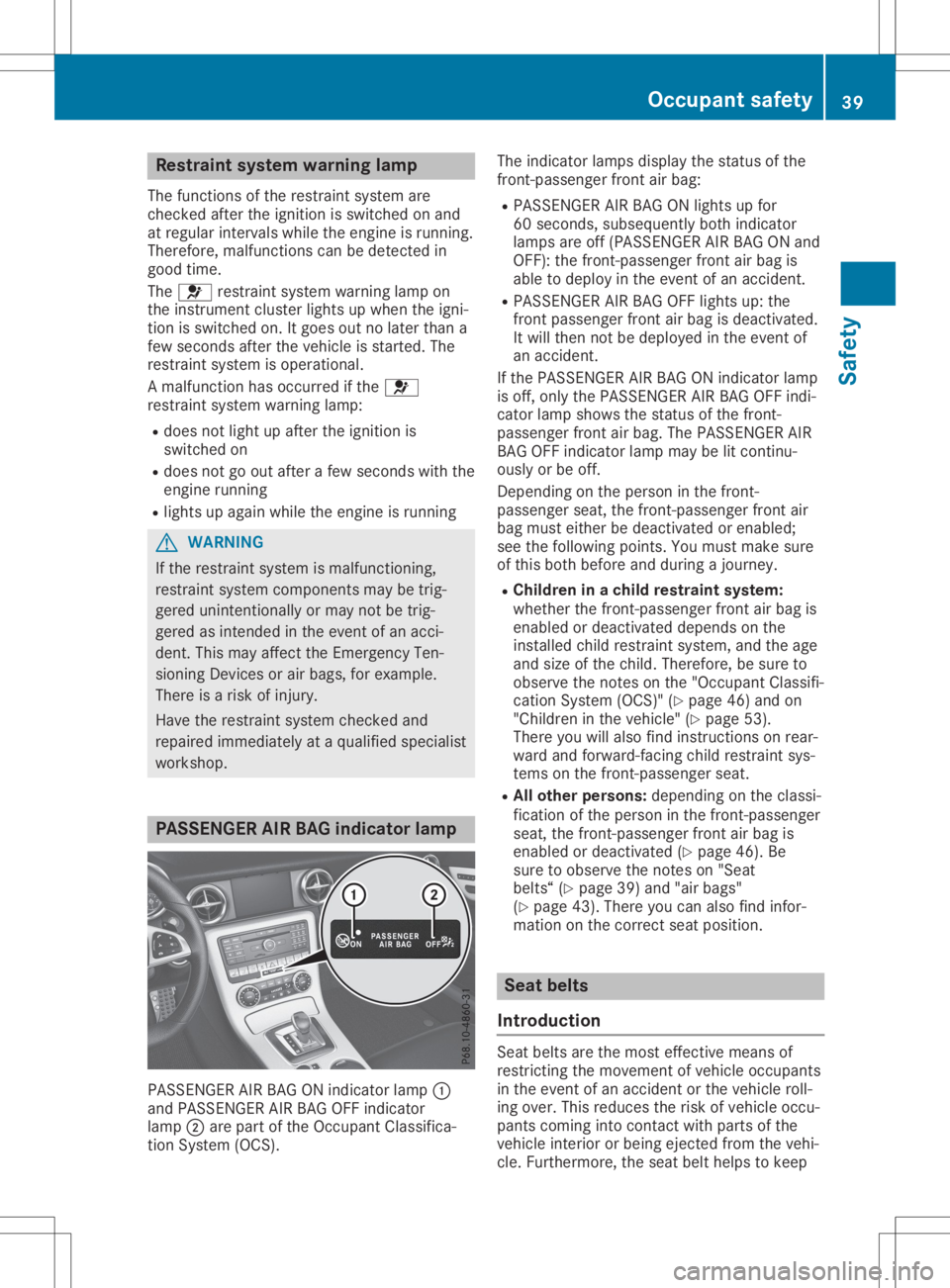
wo rksho p. PA
SSE NGER AIRB AG indic ator lamp PASSENG
ERAIR BAG ONindicator lamp 0043
and PASSENG ERAIR BAG OFFindicator
la mp 0044are partof the Occu pant Clas sif ica -
tion System (OCS). The
indicator lamps displ aythe statu softhe
front-p asseng erfront airb ag:
R PASSENG ERAIR BAG ONlights upfor
60 seco nds, subse quently bothindicator
la mps areoff(PASSEN GERAIRBAG ONand
OFF): thefront-p asseng erfront airb ag is
ab leto dep loyi nt he eve ntofan acci dent.
R PASSENG ERAIR BAG OFFlights up:the
front passe nger front airb ag isdea ctiva ted.
It wi llthen notbedep loye di nt he eve ntof
an acci dent.
If the PASSENG ERAIR BAG ONindicator lamp
is off, only thePASSENG ERAIR BAG OFFindi-
cato rlam pshows the statu softhe front-
pa sse nger front airb ag.T he PASSENG ERAIR
BAG OFFindicator lamp may belitc ontinu -
ou sly orbe off.
Depe nding on the person inthe front-
pa sse nger seat,the front-p asseng erfront air
ba gm uste ither bedea ctiva tedorena bled;
see thefollowi ng points. Youm ustm ake sure
of this both before and during ajou rney .
R Chi ldre ninac hild res train tsystem:
wh ethe rthe front-p asseng erfront airb ag is
ena bled ordea ctiva teddepends onthe
insta lled childres trai ntsystem, andtheage
and size ofthe child.T he refo re,besure to
obs erve thenotes onthe "Occup antClas sif i-
cati onSys tem (OCS)"(Ypage 46)and on
"C hildre nint he veh icle" (Y page 53).
The reyouw illa lsof ind instr uctions onrea r-
wa rdand forw ard-faci ngchildres trai ntsys-
tems onthe front-p asseng ersea t.
R Allo the rpers ons:dep endi ngon the classi-
fica tion ofthe person inthe front-p asseng er
sea t,the front-p asseng erfront airb ag is
ena bled ordea ctiva ted(Ypage 46).Be
su re to obs erve thenotes on"Se at
bel ts“ (Ypage 39) and "airba gs"
(Y page 43).The reyouc an also find infor-
mati ononthe corre ctsea tposition. Se
at belts
In troduc tion Sea
tbelts are the most effective meansof
res tricti ngthe move ment ofveh icleo ccu pants
in the eventofan acci dent orthe vehicler oll-
ing over.Thi sreduce sthe risko fveh icleo ccu -
pa nts comi nginto conta ctwith parts ofthe
veh iclei nter ioro rb eing ejecte dfrom thevehi-
cle .Furth ermo re,the seatbelth elps tokeep Oc
cupan tsafe ty
39Safety Z
Page 44 of 310
section
forsecuring objects,luggageorloads
(Y page 226).
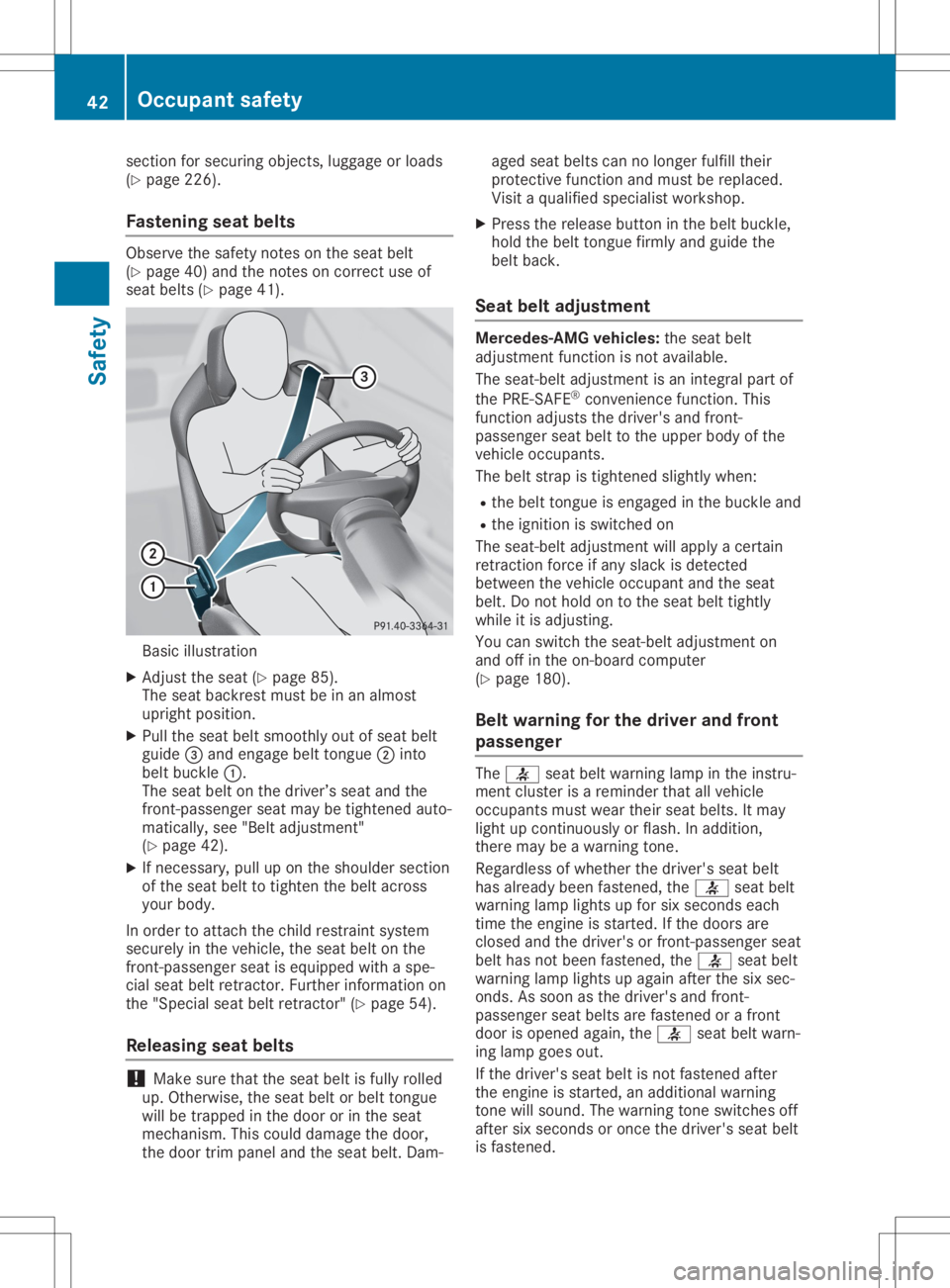
Fastening seatbelts Observe
thesafety notesonthe seat belt
(Y page 40)and thenotes oncorrect useof
seat belts (Ypage 41). Basic
illustration
X Adjust theseat (Ypage 85).
The seat backrest mustbeinan almost
upright position.
X Pull theseat beltsmoothly outofseat belt
guide 0087and engage belttongue 0044into
belt buckle 0043.
The seat beltonthe driver’s seatandthe
front -passenger seatmaybetightened auto-
matically ,see "Belt adjustment"
(Y page 42).
X Ifnecessary, pullupon the shoulde rsection
of the seat belttotighten thebelt across
your body.
In order toattach thechild restraint system
securely inthe vehicle, theseat beltonthe
front -passenger seatisequip pedwith aspe-
cial seat beltretractor .Further information on
the "Special seatbeltretractor "(Ypage 54).
Releasing seatbelts !
Make
surethattheseat beltisfully rolled
up. Otherwise, theseat beltorbelt tongue
will betrapped inthe door orinthe seat
mechanism. Thiscould damage thedoor,
the door trimpanel andtheseat belt. Dam- aged
seatbelts cannolonger fulfilltheir
protective functionandmust bereplaced.
Visit aqualified speciali stworkshop.
X Press therelease buttoninthe belt buckle,
hold thebelt tongue firmlyandguide the
belt back.
Seat beltadjustment Mercedes-AMG
vehicles:the seat belt
adjustment functionisnot avail able.
The seat-belt adjustment isan integral partof
the PRE-SA FE®
conven iencefunction. This
function adjuststhedriver's andfront -
passenger seatbelttothe upper bodyofthe
vehicle occupants.
The belt strap istightened slightlywhen:
R the belt tongue isengaged inthe buckle and
R the ignition isswitched on
The seat-belt adjustment willapply acertain
retraction forceifany slack isdetected
between thevehicle occupant andtheseat
belt. Donot hold ontothe seat belttightly
while itis adjusting.
You canswitch theseat-belt adjustment on
and offinthe on-board computer
(Y page 180).
Belt warning forthe driver andfront
passenger The
0076 seatbeltwarning lampinthe instru-
ment cluster isar eminder thatallvehicle
occupants mustweartheirseatbelts. Itmay
light upcont inuously orflash. Inaddition,
there maybeaw arning tone.
Regard lessofwhether thedriver's seatbelt
has alread ybeen fastened, the0076 seatbelt
warning lamplights upfor sixseconds each
time theengine isstarted. Ifthe doors are
closed andthedriver's orfront -passenger seat
belt hasnotbeen fastened, the0076 seatbelt
warning lamplights upagai nafter thesixsec-
onds. Assoon asthe driver's andfront -
passenger seatbelts arefastened orafront
door isopened again,the 0076 seatbeltwarn-
ing lamp goesout.
If the driver's seatbeltisnot fastened after
the engine isstarted, anadditional warning
tone willsound. Thewarning toneswitches off
after sixseconds oronce thedriver's seatbelt
is fastened. 42
Occ
upant safetySafety
Page 48 of 310
seat
belt, ahead bagmay bedeploy edinother
accident situations (Ypage 50).
The head bagonthe front -passenger side
deploy sunder thefollowi ngconditions:
R the OCS system detects thatthefront -
passenger seatisoccupied or
R the seat beltbuckle tongue isengaged in
the belt buckle ofthe front -passenger seat
If the belt tongue isengaged inthe belt
buckle, thehead bagonthe front -passenger
side deploy sifa na ppropria teaccident situa-
tion occurs. Inthis case, deploy mentisinde-
pendent ofwhether thefront -passenger seatis
occupied ornot. Occupant
ClassificationSystem
(OCS)
Introduction The
Occupant Classification System(OCS)cat-
egorizes theperson inthe front -passenger
seat. Depending onthat result, thefront -
passenger frontairbag and front -passenger
knee bagareeither enabled ordeactivated.
The system doesnotdeactivate:
R the side impact airbag
R the headba g
R the Emergenc yTensioning Devices
Requirements To
be classified correctly,the front passenger
must sit:
R with theseat beltfastened correctly
R in an almost upright position withtheir back
agai nstthe seat backrest
R with their feetresting onthe floor, ifpossi-
ble
If the front passenger doesnotobserve these
conditions, OCSmayproduce afalse classifi-
cation, e.g.because thefront passenger:
R transfers theirweight bysupporting them-
selves onavehicle armrest
R sits insuch awaythat their weight israised
from theseat cushion
If you install achild restraint systemonthe
front -passenger seat,besure toobserve the
correct positioning ofthe child restraint sys-
tem. Never placeobjects underorbehind the child
restraint system,e.g.acushion. The
entire baseofthe child restraint systemmust
alwa ysrest onthe seat cushion ofthe front -
passenger seat.Thebackrest ofthe forward-
facing childrestraint systemmustlieasflat as
possible againstthe backrest ofthe front -
passenger seat.
The child restraint systemmustnottouch the
roof orbe subjected toaload bythe head
restraint. Adjusttheangle ofthe seat backrest
and thehead restraint positionaccordingly.
Only thencanOCS beguara nteed tofunction
correct ly.Always observe thechild restraint
system manufacturer's installationandoperat-
ing instruct ions.
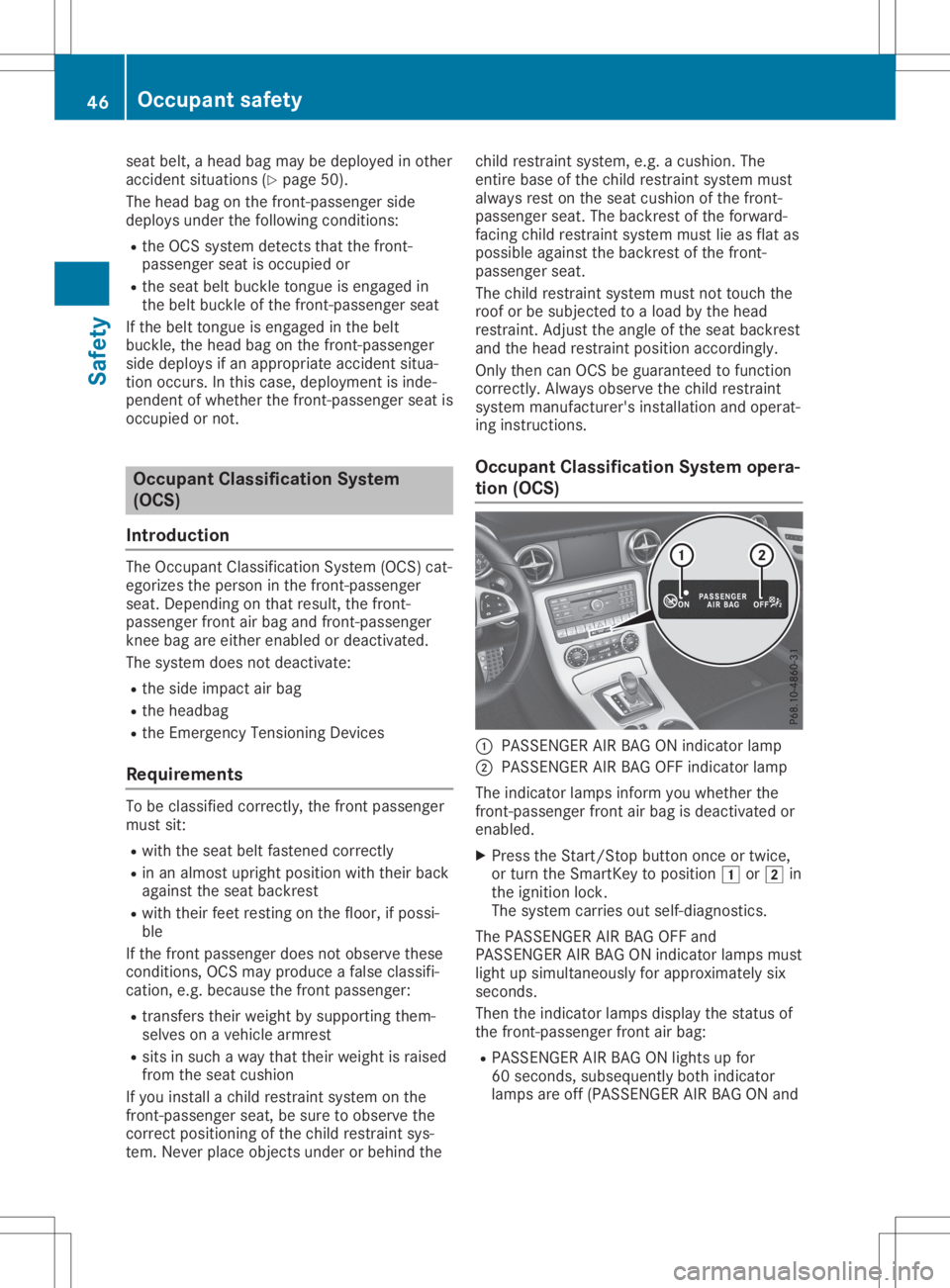
Occupant ClassificationSystem opera-
tion (OCS) 0043
PASSE NGERAIRBAG ONindicator lamp
0044 PASSE NGERAIRBAG OFFindicator lamp
The indicator lampsinform youwhether the
front -passenger frontairbag isdeactivated or
enabled.
X Press theStart/ Stopbutton onceortwice,
or turn theSmartKey toposition 0047or0048 in
the ignition lock.
The system carriesout<00560048004F004900100047004C0044004A0051005200560057004C00460056
0011[
The PASSE NGERAIRBAG OFFand
PASSE NGERAIRBAG ONindicator lampsmust
light upsimultaneousl yfor approximately six
seconds.
Then theindicator lampsdisplaythe status of
the front -passenger frontairbag:
R PASSE NGERAIRBAG ONlights upfor
60 seconds, subsequentlybothindicator
lamps areoff(PASSE NGERAIRBAG ONand 46
Occ
upant safetySafety
Page 49 of 310
OFF):
thefront -passenger frontairbag is
able todeploy inthe event ofan accident.
R PASSE NGERAIRBAG OFFlights up:the
front passenger frontairbag isdeactivated.
It will then notbedeploy edinthe event of
an accident.
If the PASSE NGERAIRBAG ONindicator lamp
is off, only thePASSE NGERAIRBAG OFFindi-
cator lampshows thestatus ofthe front -
passenger frontairbag. ThePASSE NGERAIR
BAG OFFindicator lampmaybelitcont inu-
ously orbe off.
If the status ofthe front -passenger frontair
bag changes whilethevehicle isin motion, an
air bag displa ymessage appearsinthe instru-
ment cluster (Ypage 192). When thefront -
passenger seatisoccupied, alwayspay atten-
tion tothe PASSE NGERAIRBAG OFFindicator
lamp. Beawa reofthe status ofthe front -
passenger frontairbag both before andduring
the journey. G
WARNING
If the PASSE NGERAIRBAG OFFindicator
lamp islit, the front -passenger frontairbag
is disabl ed.Itwill notbedeploy edinthe
event ofan accident andcannot perform its
intended protective function.Aperson inthe
front -passenger seatcould then,forexam-
ple, come intocontactwith thevehicle's
interior, especiallyifthe person issitting too
close tothe dashboa rd.This poses an
increased riskofinjury oreven fatalinjury.
When thefront -passenger seatisoccupied,
alwa ysensure that:
R the classification ofthe person inthe
front -passenger seatiscorrect andthe
front -passenger frontairbag isenabled or
disabl edinaccordance withtheperson in
the front -passenger seat
R the front -passenger seathasbeen moved
back asfar back aspossible .
R the person isseated correctly.
Make sure,bothbefore andduring thejour-
ney, thatthestatus ofthe front -passenger
front airbag iscorrect . G
WARNING
If you secure achild inar earward-facing
child restraint systemonthe front -
passenger seatandthePASSE NGERAIR
BAG OFFindicator lampisoff, thefront -
passenger frontairbag candeploy inthe
event ofan accident. Thechild could be
struck bythe airbag. Thisposes an
increased riskofinjury oreven fatalinjury.
Make surethatthefront -passenger frontair
bag hasbeen deactivated. ThePASSE NGER
AIR BAG OFFindicator lampmust belit.
NEVER usearearward-facing childrestraint
on aseat protected byan ACTIVE FRONT
AIRBAG infront ofit;DEA THorSERIOUS
INJURY tothe child canoccur.
If the PASSE NGERAIRBAG OFFindicator lamp
stays off,donot install arearward-facing child
restraint systemonthe front -passenger seat.
You canfind more information onOCS under
"Proble mswith theOccupant Classification
System" (Ypage 49). G
WARNING
If you secure achild inaf orward-facing child
restraint systemonthe front -passenger seat
and youposition thefront -passenger seat
too close tothe dashboa rd,inthe event of
an accident, thechild could:
R come intocontactwith thevehicle's inte-
rior ifthe PASSE NGERAIRBAG OFFindi-
cator lampislit, for example
R be struck bythe airbag ifthe
PASSE NGERAIRBAG OFFindicator lamp
is off
This poses anincreased riskofinjury or
even fatalinjury.
Move thefront -passenger seatasfar back
as possible .Alway smake sure thatthe
shoulde rbelt strap iscorrect lyrouted from
the vehicle beltguide tothe shoulde rbelt
guide onthe child restraint system.The
shoulde rbelt strap mustberouted forwards
and downwards fromthevehicle beltguide .
Alway sobserve thechild restraint system
manufacturer's installationinstructions. Occ
upant safety
47Safety Z
Page 50 of 310
If
OCS determines that:
R The front-passenger seatisunoccupi ed,the
PASSENGER AIRBAG OFFindicator lamp
lights upafter theself-test andremains lit.
This indicates thatthefront-passenger front
air bag isdeactiva ted.
R The front-passenger seatisoccupie dbya
child ofup totwelve months old,inas tand-
ard child restraint system,thePASSENGER
AIR BAG OFFindicator lamplights upafter
the self-test andremains lit.This indicates
that thefront-passenger frontairbag is
deactiva ted.
But even inthe case ofat welve-month-old
child, inas tandard childrestraint system,
the PASSENGER AIRBAG OFFindicator
lamp cangoout after theself-test. Thisindi-
cates thatthefront-passenger frontairbag
is enabled. Theresul tofthe classi fication is
depende nton, among otherfactors, the
child restraint systemandthechild's stat-
ure. Make surethattheconditions foracor-
rect classi fication aremet. Ifthe
PASSENGER AIRBAG OFFindicator lamp
remains off,donot install achild restraint
system onthe front-passenger seat.
R The front-passenger seatisoccupie dbya
person ofsmall erstature (e.g.ateenager or
small adult),the PASSENGER AIRBAG OFF
indicator lampeither lightsupand remains
lit after theself-test dependingon the resul t
of the classi fication or,alternativel y,goes
out.
- Ifthe PASSENGER AIRBAG OFFindicator
lamp isoff, move thefront-passenger seat
as far back aspossib le.
- Ifthe PASSENGER AIRBAG OFFindicator
lamp islit, aperson ofsmall erstature
shoul dnotuse thefront-passenger seat.
R The front-passenger seatisoccupie dbyan
adu ltor ap erson ofcorresponding stature,
the PASSENGER AIRBAG OFFindicator
lamp goesoutafter theself-test. Thisindi-
cates thatthefront-passenger frontairbag
is enable d.
If childre naretraveling inthe vehicle ,bes ure
to observe thenotes on"Ch ildre nint he vehi-
cle" (Ypage 53).
When theOccupant Classifica tionSystem
(OCS) ismalfu nctioning, thered 0075 restraint
system warning lamponthe instrument clus-
ter and thePASSENGER AIRBAG OFFindica-
tor lamp lightupsimul taneousl y.The front- passe
ngerfront airbag isdeactiva tedinthis
case anddoes notdepl oyduri nganaccident.
Have theOccupant Classifica tionSystem
(OCS) checked andrepai redimmedi atelyata
qua lifiedspecia listworkshop. Mercedes-Benz
recommends thatyouuseanauthori zed
Mercedes-Benz Centerforthis purpo se.
If the front-passenger seat,theseat cover or
the seat cushio naredama ged,have thenec-
essary repairwork carried outataq ualifie d
specia listworkshop. Mercedes-Benz recom-
mends thatyouuseanauthori zedMercedes-
Benz Center forthis purpo se.
For safety reasons, Mercedes-Benz recom-
mends thatyouonly useseat accessorie sthat
have been appro vedbyMercedes-Benz.
Deploy mentofthe driver's airbag does not
mean thatthefront-passenger frontairbag
depl oysaswell .The Occupant Classifica tion
System (OCS)categorizes theoccupant onthe
front-passenger seat.Depending onthat
resul t,the front-passenger frontairbag is
either enabledordeactiva ted.
Self-c heckofthe Occupant Classifica-
tion System (OCS) G
DA
NGER
If the PASSENGER AIRBAG OFFand
PASSENGER AIRBAG ONindicator lampsdo
not both lightupd uring the self-test, the
system ismalfu nctioning. Thefront-
passe ngerfront airbag might betriggered
unintentionally ormight notbetriggered at
all inthe event ofan accident withhigh
decele ration. Thisposes anincreased riskof
injury oreven fatalinjury.
In this case thefront-passenger seatmay
not beused .Don otinstall achild restraint
system onthe front-passenger seat.Have
the Occupant Classifica tionSystem (OCS)
checked andrepai redimmedi atelyata
qua lifiedspecia listworkshop. G
WARNING
If the PASSENGER AIRBAG OFFindicator
lamp remains litafter theself-test, thefront-
passe ngerfront airbag isdeactiva ted.Itwil l
not bedepl oyed inthe event ofan accident.
In this case, thefront-passenger frontair 48
Occ
upant safetySafety
Page 51 of 310
bag
cann otperfor mitsint ended protective
func tion,e.g. when aperson isseated inthe
fron t-passenger seat.
That person could,forexample, comeinto
con tact with thevehicle's interior, especially
if the person issitt ing too close tothe dash-
board. Thisposes anincr eased riskofinjury
or even fatalinjury.
When thefron t-passenger seatisocc upied,
always ensure that:
R the classific ationofthe person inthe
fron t-passenger seatiscorr ectand the
fron t-passenger frontairbag isenabled or
deactiv atedinaccor dance withtheper-
son inthe fron t-passenger seat
R the person isseated properly withacor-
rect lyfasten edseatbelt
R the fron t-passenger seathasbeen moved
as far back aspossible
If the PAS SENGER AIRBAGO FFindicat or
lamp remains litwhen itshould not,the
fron t-passenger seatmust notbeused. Do
not installac hild restraint system onthe
fron t-passenger seat.Have theOcc upant
Classification System(OCS)checkedand
repaired immediately ataq ualified specialist
worksh op. G
WARN
ING
Objec tsbetween theseat surface andthe
child restraint system couldaffect OCS operation
.This could result inthe fron t-
passenger airbag notfunc tioningasinten-
ded during anacciden t.This poses an
incr eased riskofinjury oreven fatalinjury.
Do not place anyobjec tsbetween theseat
surface andthechild restraint system. The
ent irebase ofthe child restraint system
must always restonthe seat cushion ofthe
fron t-passenger seat.Thebackr estofthe
forward- facingchild restraint system must,
as far aspossible, berest ingonthe back-
rest ofthe fron t-passenger seat.Always
comply withthechild restraint system man-
ufactur er'sinstallation instruct ions.
Aft erthe self-t est,thePAS SENGER AIRBAG
OFF orthe PAS SENGER AIRBAGO Nindicat or
lamp displays thestatusofthe fron t-
passenger frontairbag (Ypage 46).Ifthe
fron t-passenger frontairbag isenabled, the
PAS SENGER AIRBAGO Nindicat orlamp lights
up for 60secon dsand then goes out.
If the PAS SENGER AIRBAGO Nindicat orlamp
is off, only thePAS SENGER AIRBAGO FFindi-
cator lampshows thestatusofthe fron t-
passenger frontairbag. ThePASSENGER AIR
BA GO FFindicat orlamp maybelitcon tinu-
ously orbe off.
For more information abouttheOCS, see
"Problems withtheOcc upant Classification
System "(Ypage 49).
Problems withtheOccupant Classification System(OCS) Be
sure toobserve thenoteson "System self-test"(Ypage 48). Occupant
safety
49Safet y Z
Page 52 of 310
Problem
Possible
causes/co nsequences and0050 0050
Solutions The
PASS ENGER AIR
BAG OFFindicator lamp
lights upand remains
lit, even though the
front -passenger seatis
occupied byan adult or
ap erson ofas tature
correspondin gtot hat of
an adult. The
classification ofthe person onthe front -passenger seatisincor-
rect.
X Make surethecondition sfor ac orrect classification ofthe per-
son onthe front -passenger seataremet (Ypage 46).
X Ifthe PASS ENGER AIRBAG OFFindicator lampremains lit,the
front -passenger seatmaynotbeused.
X Have OCScheck edassoon aspossible atan authorized
Mercedes-Ben zCenter. The
PASS ENGER AIR
BAG OFFindicator lamp
does notlight up
and/or doesnotstay
on.
The front -passenger
seat is:
R unoccupied
R occupied bythe
weight ofac hild up
to twelve monthsold
in ac hild restraint
system OCS
ismalfunctionin g.
X Make surethere isnothin gbetween theseat cushion andthe
child seat.
X Make surethattheentire baseofthe child restraint systemrests
on the seat cushion ofthe front -passenger seat.Thebackrest of
the forward-facing childrestraint systemmustlieasflat aspossi-
ble against thebackrest ofthe front passenger seat.Ifnecessary,
adjust theposition ofthe front -passenger seat.
X When installing thechild restraint system,makesurethatthe
seat beltistight. Donot pull theseat belttight using thefront -
passenger seatadjustment .This could result inthe seat beltand
the child restraint systembeingpulled tootightly.
X Check forcorrect installation ofthe child restraint system.
Make surethatthehead restraint doesnotapply aload tothe
child restraint system.Ifnecessary, adjustthehead restraint
accordingly.
X Make surethatnoobject sareapply ingadditional weightontothe
seat.
X Ifthe PASS ENGER AIRBAG OFFindicator lampremains off
and/or thePASS ENGER AIRBAG ONindicator lamplights up,do
not install achild restraint systemonthe front -passenger seat.
X Have OCScheck edassoon aspossible atan authorized
Mercedes-Ben zCenter. Deployment
ofEmergency Tension-
ing Devic esand airbags
Import antsafety notes G
WARNING
The airbag parts arehot after anair bag has
been deploye d.There isar isk ofinjury.
Do not touch theairbag parts. Havea
deploye dairbag replaced ataq uali fied spe-
cialist workshop assoon aspossible. G
WARNING
Ad eploye dairbag nolonger offersanypro-
tect ionand cannot provide theinten dedpro-
tect ioninan accident. Thereisan increased
risk ofinjury.
Have thevehicle towedtoaq uali fied spe-
cialist workshop inorder tohave adeploye d
air bag replaced.
For your ownsafety andthat ofyour front
passenger, itis important thatyouhave
deploye dairbags replaced anddefective air
bags repaired. Thiswillhelp tomake surethe
air bags continue toperform theirprotect ive 50
Occ
upantsafetySafety