display MERCEDES-BENZ SLK CLASS 2000 Owners Manual
[x] Cancel search | Manufacturer: MERCEDES-BENZ, Model Year: 2000, Model line: SLK CLASS, Model: MERCEDES-BENZ SLK CLASS 2000Pages: 273, PDF Size: 15.92 MB
Page 186 of 273
183 Malfunction and indicator lamps
Te ch n ica l
data Instruments
and controlsOperation DrivingInstrument
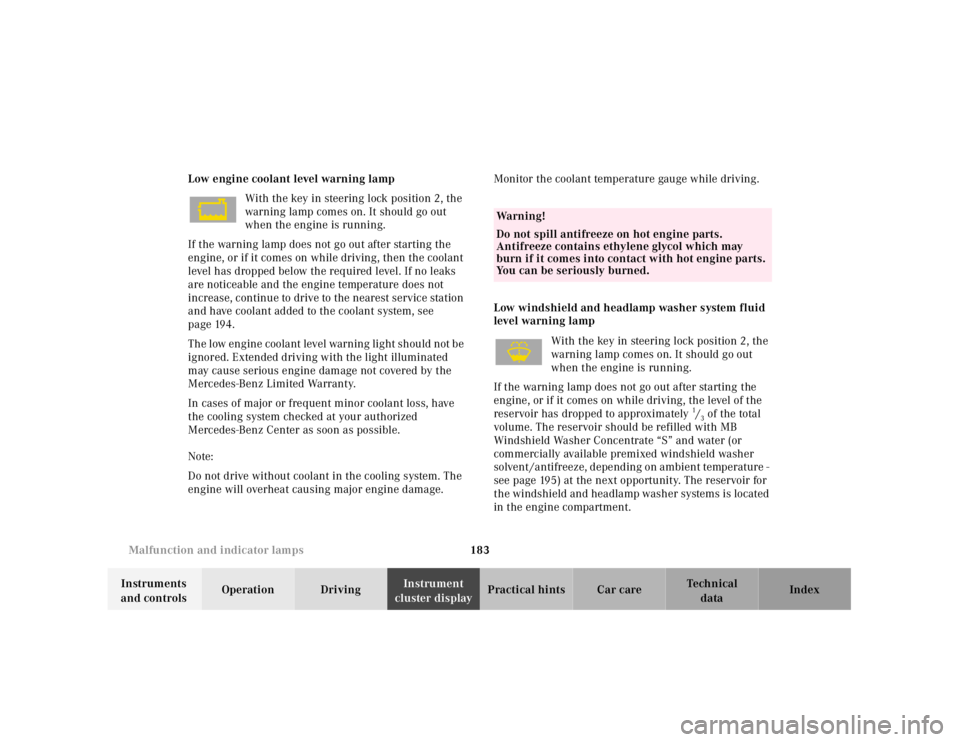
cluster displayPractical hints Car care Index Low engine coolant level warning lamp
With the key in steering lock position 2, the
warning lamp comes on. It should go out
when the engine is running.
If the warning lamp does not go out after starting the
engine, or if it comes on while driving, then the coolant
level has dropped below the required level. If no leaks
are noticeable and the engine temperature does not
increase, continue to drive to the nearest service station
and have coolant added to the coolant system, see
page 194.
The low engine coolant level warning light should not be
ignored. Extended driving with the light illuminated
may cause serious engine damage not covered by the
Mercedes-Benz Limited Warranty.
In cases of major or frequent minor coolant loss, have
the cooling system checked at your authorized
Mercedes-Benz Center as soon as possible.
Note:
Do not drive without coolant in the cooling system. The
engine will overheat causing major engine damage.Monitor the coolant temperature gauge while driving.
Low windshield and headlamp washer system fluid
level warning lamp
With the key in steering lock position 2, the
warning lamp comes on. It should go out
when the engine is running.
If the warning lamp does not go out after starting the
engine, or if it comes on while driving, the level of the
reservoir has dropped to approximately 1/3 of the total
volume. The reservoir should be refilled with MB
Windshield Washer Concentrate “S” and water (or
commercially available premixed windshield washer
solvent /antifreeze, depending on ambient temperature -
see page 195) at the next opportunity. The reservoir for
the windshield and headlamp washer systems is located
in the engine compartment.
Wa r n i n g !
Do not spill antifreeze on hot engine parts.
Antifreeze contains ethylene glycol which may
burn if it comes into contact with hot engine parts.
You can be seriously burned.
Page 187 of 273
184 Malfunction and indicator lamps
Te ch n ica l
data Instruments
and controlsOperation DrivingInstrument
cluster displayPractical hints Car care Index
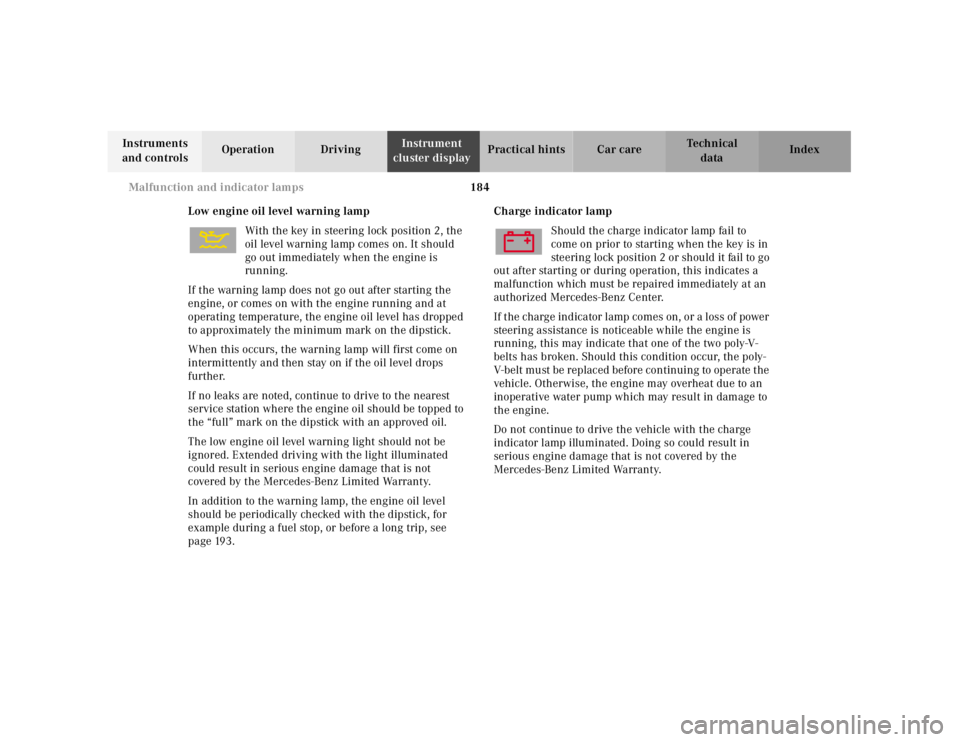
Low engine oil level warning lamp
With the key in steering lock position 2, the
oil level warning lamp comes on. It should
go out immediately when the engine is
running.
If the warning lamp does not go out after starting the
engine, or comes on with the engine running and at
operating temperature, the engine oil level has dropped
to approximately the minimum mark on the dipstick.
When this occurs, the warning lamp will first come on
intermittently and then stay on if the oil level drops
further.
If no leaks are noted, continue to drive to the nearest
service station where the engine oil should be topped to
the “full” mark on the dipstick with an approved oil.
The low engine oil level warning light should not be
ignored. Extended driving with the light illuminated
could result in serious engine damage that is not
covered by the Mercedes-Benz Limited Warranty.
In addition to the warning lamp, the engine oil level
should be periodically checked with the dipstick, for
example during a fuel stop, or before a long trip, see
page 193.Charge indicator lamp
Should the charge indicator lamp fail to
come on prior to starting when the key is in
ste ering lock position 2 or sh ou ld it fa il to g o
out after starting or during operation, this indicates a
malfunction which must be repaired immediately at an
authorized Mercedes-Benz Center.
If t he charg e ind ica tor l amp comes on, or a l oss of power
steering assistance is noticeable while the engine is
running, this may indicate that one of the two poly-V-
belts has broken. Should this condition occur, the poly-
V-belt mu st be replac ed before continuing to operate t he
vehicle. Otherwise, the engine may overheat due to an
inoperative water pump which may result in damage to
the engine.
Do not continue to drive the vehicle with the charge
indicator lamp illuminated. Doing so could result in
serious engine damage that is not covered by the
Mercedes-Benz Limited Warranty.
Page 188 of 273
185 Malfunction and indicator lamps
Te ch n ica l
data Instruments
and controlsOperation DrivingInstrument
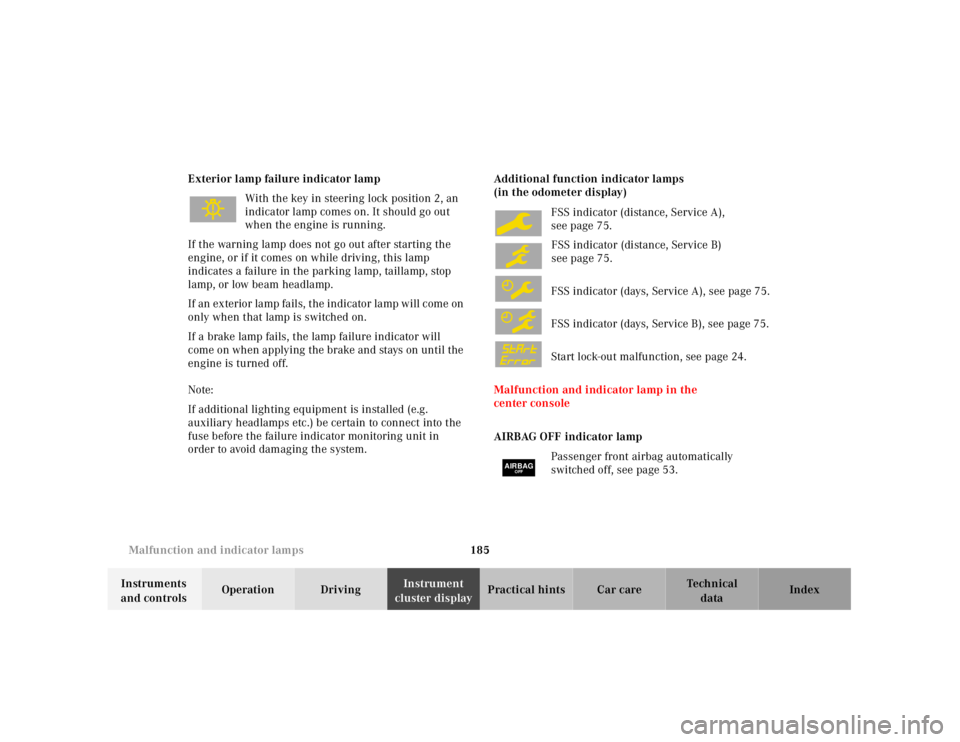
cluster displayPractical hints Car care Index Exterior lamp failure indicator lamp
With the key in steering lock position 2, an
indicator lamp comes on. It should go out
when the engine is running.
If the warning lamp does not go out after starting the
engine, or if it comes on while driving, this lamp
indicates a failure in the parking lamp, taillamp, stop
lamp, or low beam headlamp.
If an ex terior la mp fa il s, t he indicator la mp w ill c ome on
only when that lamp is switched on.
If a brake lamp fails, the lamp failure indicator will
come on when applying the brake and stays on until the
engine is turned off.
Note:
If additional lighting equipment is installed (e.g.
auxiliary headlamps etc.) be certain to connect into the
fuse before the failure indicator monitoring unit in
order to avoid damaging the system.Additional function indicator lamps
(in the odometer display)
FSS indicator (distance, Service A),
see page 75.
FSS indicator (distance, Service B)
see page 75.
FSS indicator (days, Service A), see page 75.
FSS indicator (days, Service B), see page 75.
Start lock-out malfunction, see page 24.
Malfunction and indicator lamp in the
center console
AIRBAG OFF indicator lamp
Passenger front airbag automatically
switched off, see page 53.
AIRBAGOFF
Page 190 of 273
187 Contents - Practical hints
Te ch n ica l
data Instruments
and controlsOperation DrivingInstrument
cluster displayPractical hintsCar care Index
Practical hintsFirst aid kit ..................................... 188
Stowing things in the vehicle ...... 188
Fuses ................................................ 188
Hood ................................................. 190
Automatic transmission
fluid level ................................... 192
Checking engine oil level ............. 193
Coolant level ................................... 194
Adding coolant ........................... 194
Windshield and headlamp
washer system ........................... 195
Air pump, spare wheel,
vehicle tools, storage
compartment ............................. 196Vehicle jack .....................................197
Wheels .............................................198
Tire replacement ........................198
Rotating wheels ..........................199
Spare wheel .................................... 200
Spare wheel bolts ...................... 201
Changing wheels ........................... 202
Inflating the collapsible
spare tire ..................................... 207
Storing spare wheel
in wheel well .............................. 208
Tire inflation pressure ................. 209
Battery ..............................................210
Jump starting ..................................212
Towing the vehicle .........................214Transmission selector lever,
manually unlocking .................. 217
Exterior lamps ................................ 218
Headlamp assembly ................... 219
Taillamp assemblies ..................222
Changing batteries
in the remote control ................224
Synchronizing
remote control ............................225
Emergency engine
shut-down ..................................226
Raising hardtop manually ............226
Replacing wiper blade insert ....... 231
Antenna ...........................................232
Manual release of
fuel filler flap .............................232
Page 191 of 273
188 First aid kit
Te ch n ica l
data Instruments
and controlsOperation DrivingInstrument
cluster displayPractical hintsCar care Index
First aid kit
The first aid kit is located in the left side panel of the
trunk.
Stowing things in the vehicleFuses
Before replacing a blown fuse, determine the cause of
the short circuit.
Spare fuses are supplied inside the main and auxiliary
fuse boxes. Observe amperage and color of fuse.
A special fuse puller is supplied with the vehicle tools.
Always use a new fuse for replacement. Never attempt to
repair or bridge a blown fuse.
After replacing a blown fuse, close fuse box cover.
A fu se ch art ca n be fou nd insid e t he correspond ing f use
box cover.
Wa r n i n g !
To help avoid personal injury during a collision or
sudden maneuver, exercise care when stowing
things. Put luggage or cargo in the trunk if
possible.
Page 192 of 273
189 Fuses
Te ch n ica l
data Instruments
and controlsOperation DrivingInstrument
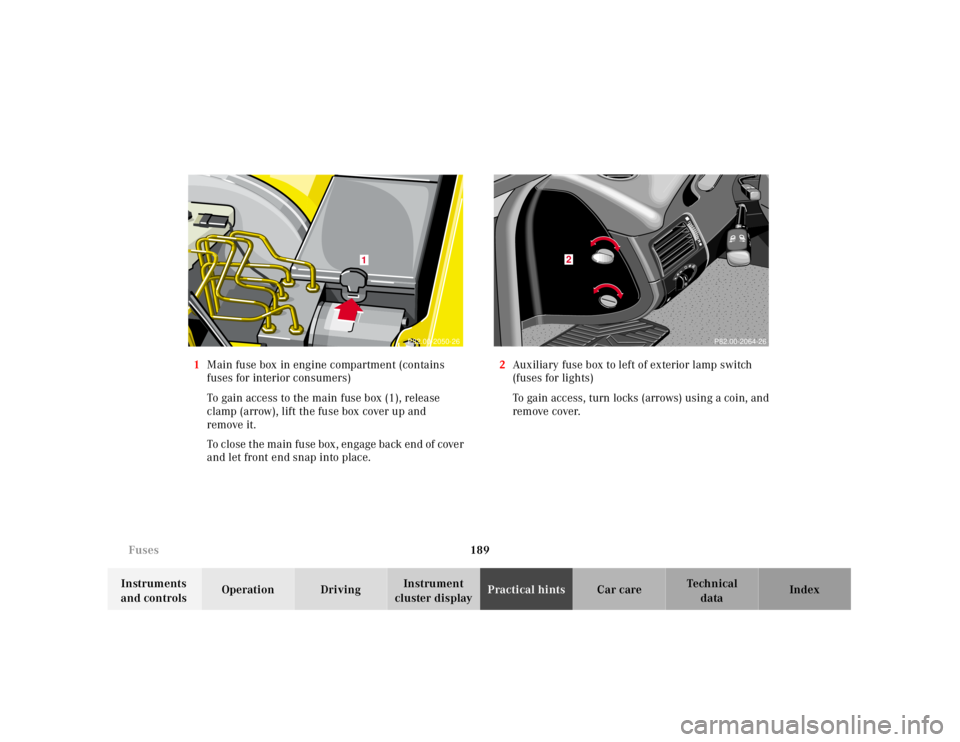
cluster displayPractical hintsCar care Index 1Main fuse box in engine compartment (contains
fuses for interior consumers)
To gain access to the main fuse box (1), release
clamp (arrow), lift the fuse box cover up and
remove it.
To c lose t he ma in fu se box , engage ba ck end of cove r
and let front end snap into place.2Auxiliary fuse box to left of exterior lamp switch
(fuses for lights)
To gain access, turn locks (arrows) using a coin, and
remove cover.
1
P82.00-2050-26
P82.00-2064-26
2
Page 193 of 273
190 Engine compartment
Te ch n ica l
data Instruments
and controlsOperation DrivingInstrument
cluster displayPractical hintsCar care Index
Hood
Wa r n i n g !
To help prevent personal injury, stay clear of
moving parts wh en t he hood is open and th e engine
is running. Be sure the hood is properly closed
before driving. When closing hood, use extreme
caution not to catch hands or fingers.The radiator fan may continue to run for
approximately 30 seconds or even restart after the
engine has been turned off. Stay clear from fan
blades.
The engine is equipped with a transistorized
ignition system. Because of the high voltage it is
dangerous to touch any components (ignition coils,
spark plug sockets, diagnostic socket) of the
ignition system
• with the engine running,
• while starting the engine,
• if ignition is “on” and the engine is turned
manually.If you see flames, steam or smoke coming from the
engine compartment, or if the coolant temperature
gauge indicates that the engine is overheated, do
not open the hood. Move away from vehicle and do
not open the hood until the engine has cooled. If
necessary, call a fire department.
Page 194 of 273
191 Engine compartment
Te ch n ica l
data Instruments
and controlsOperation DrivingInstrument
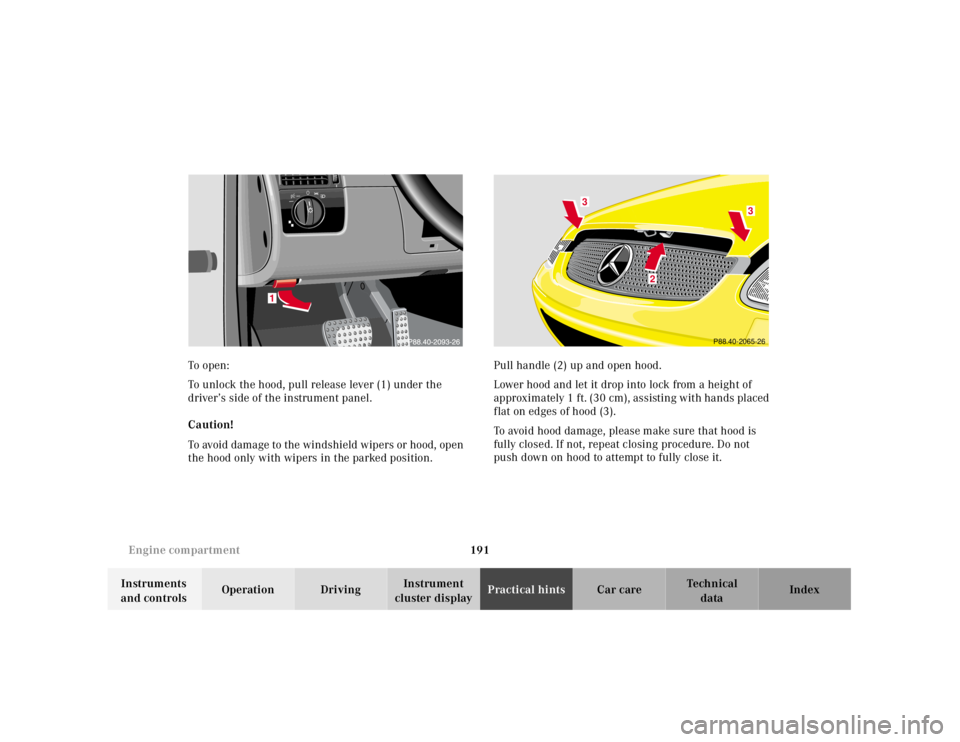
cluster displayPractical hintsCar care Index To o pen :
To unlock the hood, pull release lever (1) under the
driver’s side of the instrument panel.
Caution!
To avoid damage to the windshield wipers or hood, open
the hood only with wipers in the parked position.Pull handle (2) up and open hood.
Lower hood and let it drop into lock from a height of
approxima tely 1 f t. (30 cm), assisting w it h ha nds pl aced
flat on edges of hood (3).
To avoid hood damage, please make sure that hood is
fully closed. If not, repeat closing procedure. Do not
push down on hood to attempt to fully close it.
P88.40-2065-26
3
3
2
Page 195 of 273
192 Engine compartment
Te ch n ica l
data Instruments
and controlsOperation DrivingInstrument
cluster displayPractical hintsCar care Index
Automatic transmission fluid level
The transmission has a permanent fill of automatic
transmission fluid.
Regular automatic transmission fluid level checks and
changes are not required. For this reason the dipstick is
omitted.
If you notice f luid loss or gear shifting malfunctions,
have your authorized Mercedes-Benz Center check the
transmission fluid level.
Page 196 of 273
193 Checking engine oil level
Te ch n ica l
data Instruments
and controlsOperation DrivingInstrument
cluster displayPractical hintsCar care Index Checking engine oil level
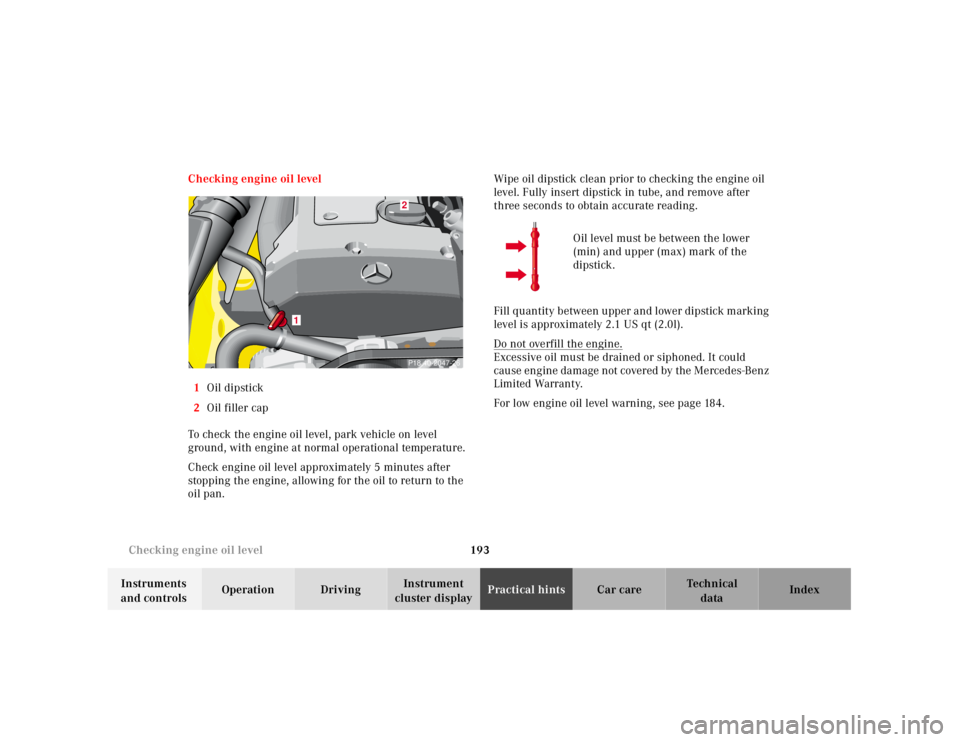
1Oil dipstick
2Oil filler cap
To check the engine oil level, park vehicle on level
ground, with engine at normal operational temperature.
Check engine oil level approximately 5 minutes after
stopping the engine, allowing for the oil to return to the
oil pan.Wipe oil dipstick clean prior to checking the engine oil
level. Fully insert dipstick in tube, and remove after
three seconds to obtain accurate reading.
Oil level must be between the lower
(min) and upper (max) mark of the
dipstick.
Fill qu antity b etween u pper a nd l ower dipstick m arking
level is approximately 2.1 US qt (2.0l).
Do not overfill the engine.
Excessive oil must be drained or siphoned. It could
cause engine damage not covered by the Mercedes-Benz
Limited Warranty.
For low engine oil level warning, see page 184.
P18.40-2047-262
1