air condition MERCEDES-BENZ SLK CLASS 2000 User Guide
[x] Cancel search | Manufacturer: MERCEDES-BENZ, Model Year: 2000, Model line: SLK CLASS, Model: MERCEDES-BENZ SLK CLASS 2000Pages: 273, PDF Size: 15.92 MB
Page 178 of 273
175 What you should know at the gas station
Te ch n ica l
data Instruments
and controlsOperationDrivingInstrument
cluster displayPractical hints Car care Index Engine oil
Engine oil level check, see page 193.
Fil l qua ntity between u pper a nd l owe r dipstick ma rking
level: 2.1 US qt (2.0 l).
Recommended engine oils, see Approved Service
Products sheet.
Coolant
For normal replenishing, use water (potable water
quality).
For further information (e.g. anticorrosion / antifreeze),
see page 256.
Spark plugs
Approved spark plugs, see page 251.
Tire pressure
For tire pressure, refer to tire pressure label inside the
fuel filler flap.Air conditioner
R-134a refrigerant and special PAG lubricant, see
page 252.
Bulbs
High and low beams (Halogen): H7 (55 W),
fog lamps: H1 (55 W),
turn signal lamps, parking and standing lamps, front:
2357 NA (28.5 / 8.3 W / 30 / 2.2 cp),
side marker lamps, front: 5 W / 4 cp
stop lamps: 1154 21 W / 32 cp,
backup lamps: 1154 21 W / 32 cp,
turn signal lamps, rear: 1156 NA 21 W / 24cp,
tail, parking and standing lamps: 67 5 W / 4cp,
rear fog lamp, driver´s side: 1155 21 W / 32 cp,
license plate lamps: 67 5 W / 4 cp
Xenon bulb for low beam: D2R (35W)
Wa r n i n g !
Because of high voltage in Xenon lamps, it is
dangerous to replace the bulb or repair the lamp
and its components. We recommend that you have
such work done by a qualified technician.
Page 187 of 273
184 Malfunction and indicator lamps
Te ch n ica l
data Instruments
and controlsOperation DrivingInstrument
cluster displayPractical hints Car care Index
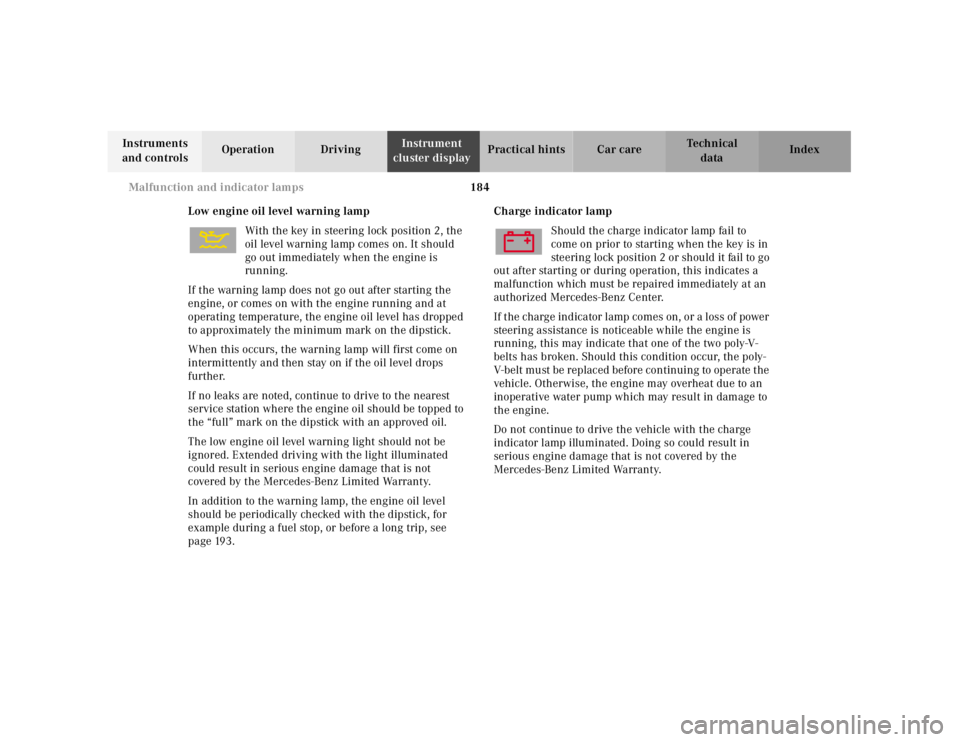
Low engine oil level warning lamp
With the key in steering lock position 2, the
oil level warning lamp comes on. It should
go out immediately when the engine is
running.
If the warning lamp does not go out after starting the
engine, or comes on with the engine running and at
operating temperature, the engine oil level has dropped
to approximately the minimum mark on the dipstick.
When this occurs, the warning lamp will first come on
intermittently and then stay on if the oil level drops
further.
If no leaks are noted, continue to drive to the nearest
service station where the engine oil should be topped to
the “full” mark on the dipstick with an approved oil.
The low engine oil level warning light should not be
ignored. Extended driving with the light illuminated
could result in serious engine damage that is not
covered by the Mercedes-Benz Limited Warranty.
In addition to the warning lamp, the engine oil level
should be periodically checked with the dipstick, for
example during a fuel stop, or before a long trip, see
page 193.Charge indicator lamp
Should the charge indicator lamp fail to
come on prior to starting when the key is in
ste ering lock position 2 or sh ou ld it fa il to g o
out after starting or during operation, this indicates a
malfunction which must be repaired immediately at an
authorized Mercedes-Benz Center.
If t he charg e ind ica tor l amp comes on, or a l oss of power
steering assistance is noticeable while the engine is
running, this may indicate that one of the two poly-V-
belts has broken. Should this condition occur, the poly-
V-belt mu st be replac ed before continuing to operate t he
vehicle. Otherwise, the engine may overheat due to an
inoperative water pump which may result in damage to
the engine.
Do not continue to drive the vehicle with the charge
indicator lamp illuminated. Doing so could result in
serious engine damage that is not covered by the
Mercedes-Benz Limited Warranty.
Page 212 of 273
209 Tires, wheels
Te ch n ica l
data Instruments
and controlsOperation DrivingInstrument
cluster displayPractical hintsCar care Index Tire inflation pressure
A table (see fuel filler f lap) lists the tire inflation
pressures specified for Mercedes-Benz recommended
tires as well as for the varying operating conditions.
Important!
Tire pressure changes by approximately 1.5 psi (0.1 bar)
per 18°F (10°C) of air temperature change. Keep this in
mind when checking tire pressure inside a garage -
especially in the winter.
Example:
If garage temperature = approximately +68°F (+20°C)
and ambient temperature = approximately +32°F (0°C)
then the adjusted air pressure = specified air pressure
+3psi (+0.2 bar).Tire pressures listed for light loads are minimum values
offering high driving comfort. Increased inflation
pressures for heavy loads produce favorable handling
characteristics with lighter loads and are perfectly
permissible. The ride of the vehicle, however, will
become somewhat harder.
Tire temperature and pressure increase with the vehicle
speed. Tire pressure should therefore only be checked
and corrected on cold tires. Correct tire pressure in
warm tires only if pressure has dropped below the
pressure listed in the table and the respective operating
conditions are taken into consideration.
An underinf lated tire due to a slow leak (e.g. due to a
nail in the tire) may cause damage such as tread
separation, bulging etc.. Regular tire pressure checks at
intervals of no more than 14 days are therefore
essential.
Page 213 of 273
210 Battery
Te ch n ica l
data Instruments
and controlsOperation DrivingInstrument
cluster displayPractical hintsCar care Index
If a tire constantly loses air, it should be inspected for
damage.
The spare tire should be checked periodically for
condition. Spare tire will age and become worn over
time even if never used, and thus should be inspected
and replaced when necessary.Battery
Important!
Battery replacement information:
The maintenance-free battery is located in the engine
compartment.
The service life of the battery is dependent on its
condition of charge. The battery should always be kept
sufficiently charged, in order to last an optimum length
of time.
Wa r n i n g !
Do not overinflate tires. Overinflating tires can
result in sudden deflation (blowout) because they
are more likely to become punctured or damaged
by road debris, potholes etc.. Follow recommended
inflation pressures.Do not overload the tires by exceeding the specified
vehicle capacity weight (as indicated by the label
on the driver’s door latch post). Overloading the
tires can overheat them, possibly causing a
blowout.
Wa r n i n g !
Failure to follow these instructions can result in
severe injury or death.Never lean over batteries while connecting, you
might get injured.Battery fluid contains sulfuric acid. Do not allow
this fluid to come in contact with eyes, skin or
cloth ing. In c ase it does, im mediately f lush affected
area with water and seek medical help.A battery will also produce hydrogen gas, which is
flammable and explosive. Keep flames or sparks
away from battery, avoid improper connection of
jumper cables, smoking etc..
Page 237 of 273
234 Cleaning and care of the vehicle
Te ch n ica l
data Instruments
and controlsOperation DrivingInstrument
cluster displayPractical hintsCar careIndex
Cleaning and care of the vehicle
In operation, your vehicle is subjected to varying
external inf luences which, if gone unchecked, can
attack the paintwork as well as the underbody and
cause lasting damage.
Such damage is caused not only by extreme and varying
climatic conditions, but also by air polution, road salt,
tar, gravel and stone chipping. Grease and oil, fuel,
coolant, brake fluid, bird droppings, insects, tree resins
etc. should be removed immediately to avoid paint
damage. Frequent washing reduces and/or eliminates
the aggressiveness and potency of the above adverse
influences.More frequent washings are necessary to deal with
unfavorable conditions; for example, near the ocean, in
industrial areas (smoke, exhaust emissions), or during
winter operation.
You should check your vehicle from time to time for
stone chipping or other damage. Any damage should be
repaired as soon as possible to prevent the start of
corrosion.
In doing so, do not neglect the underside of the vehicle.
A prerequisite for a thorough check is a washing of the
underbody followed by a thorough inspection. Damaged
areas need to be reundercoated.
Your vehicle has been treated at the factory with a wax-
base ru stproof ing in th e body cavities w hich will la st for
the lifetime of the vehicle. Post-production treatment is
neither necessary nor recommended by Mercedes-Benz
because of the possibility of incompatibility between
materials used in the production process and others
applied later.
We have selected car-care products and compiled
recommendations which are specially matched to our
vehicles and which always reflect the latest technology.
You can obtain Mercedes-Benz approved car-care
products at your authorized Mercedes-Benz Center.
Wa r n i n g !
Many cleaning products can be hazardous. Some
are poisonous, others are flammable. Always follow
the instructions on the particular container.
Always open your vehicle’s doors or windows when
cleaning the inside.Never use fluids or solvents that are not designed
for cleaning your vehicle.
Page 244 of 273
241 Contents - Technical data
Te ch n ica l
data Instruments
and controlsOperation DrivingInstrument
cluster displayPractical hints Car care Index
Technical dataSpare parts service ........................242
Warranty coverage .........................242
Identification labels .......................243
Layout of poly-V-belt drive ............245
Technical data ................................248
Fuels, coolants, lubricants
etc. – capacities .........................252Engine oils ...................................... 254
Engine oil additives ...................... 254
Air conditioner refrigerant .......... 254
Brake fluid ...................................... 254
Premium unleaded gasoline ........ 255
Fuel requirements ........................ 255
Gasoline additives ......................... 256
Coolants .......................................... 256
Consumer information ................. 258
Page 248 of 273
245 Technical data
Te ch n ica l
data Instruments
and controlsOperation DrivingInstrument
cluster displayPractical hints Car care Index Layout of poly-V-belt drive
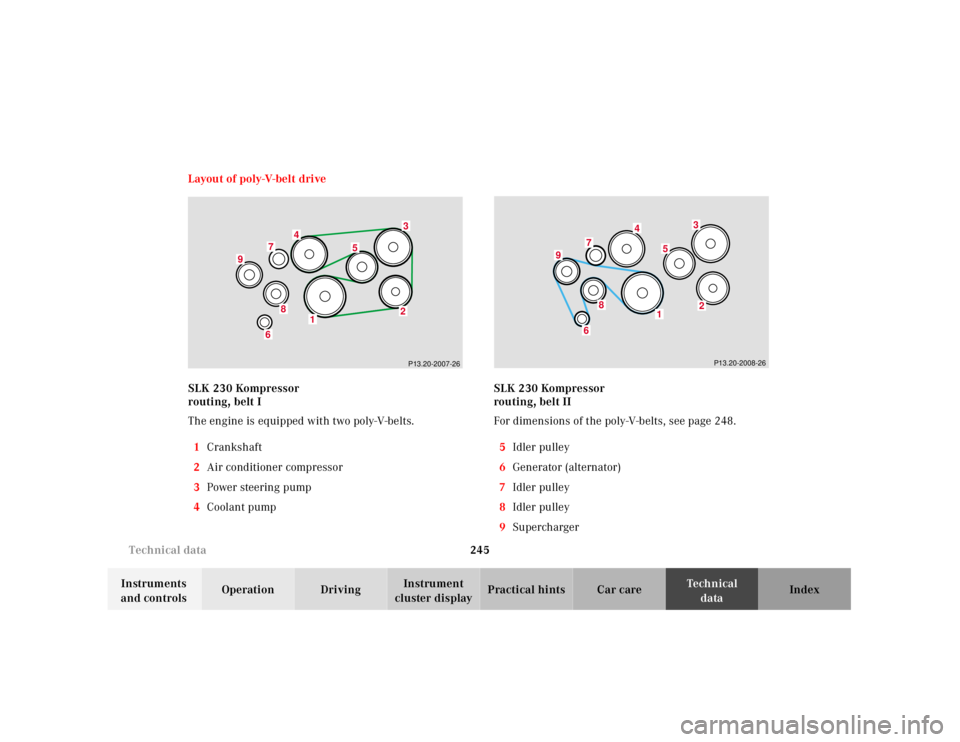
SLK 230 Kompressor
routing, belt I
The engine is equipped with two poly-V-belts.
1Crankshaft
2Air conditioner compressor
3Power steering pump
4Coolant pumpSLK 230 Kompressor
routing, belt II
For dimensions of the poly-V-belts, see page 248.
5Idler pulley
6Generator (alternator)
7Idler pulley
8Idler pulley
9Supercharger
P13.20-2007-26
9
6
8
7
4
1
5
32
5
32
9
6
8
4
1
7
P13.20-2008-26
Page 249 of 273
246 Technical data
Te ch n ica l
data Instruments
and controlsOperation DrivingInstrument
cluster displayPractical hints Car care Index
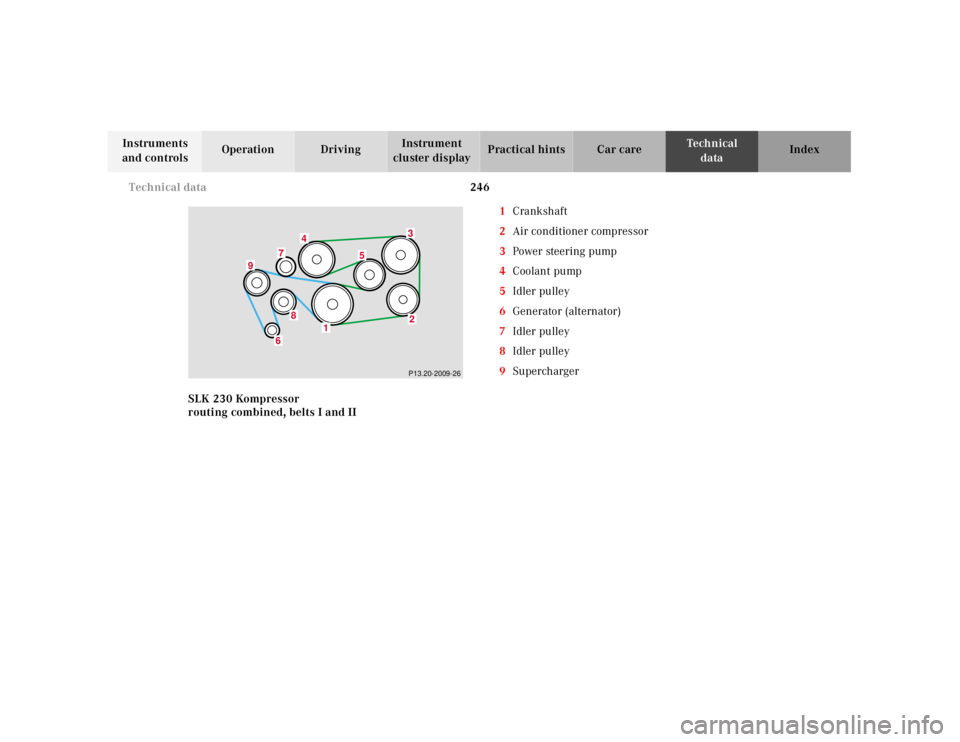
SLK 230 Kompressor
routing combined, belts I and II1Crankshaft
2Air conditioner compressor
3Power steering pump
4Coolant pump
5Idler pulley
6Generator (alternator)
7Idler pulley
8Idler pulley
9Supercharger
9
6
8
7
4
1
5
32P13.20-2009-26
Page 250 of 273
247 Technical data
Te ch n ica l
data Instruments
and controlsOperation DrivingInstrument
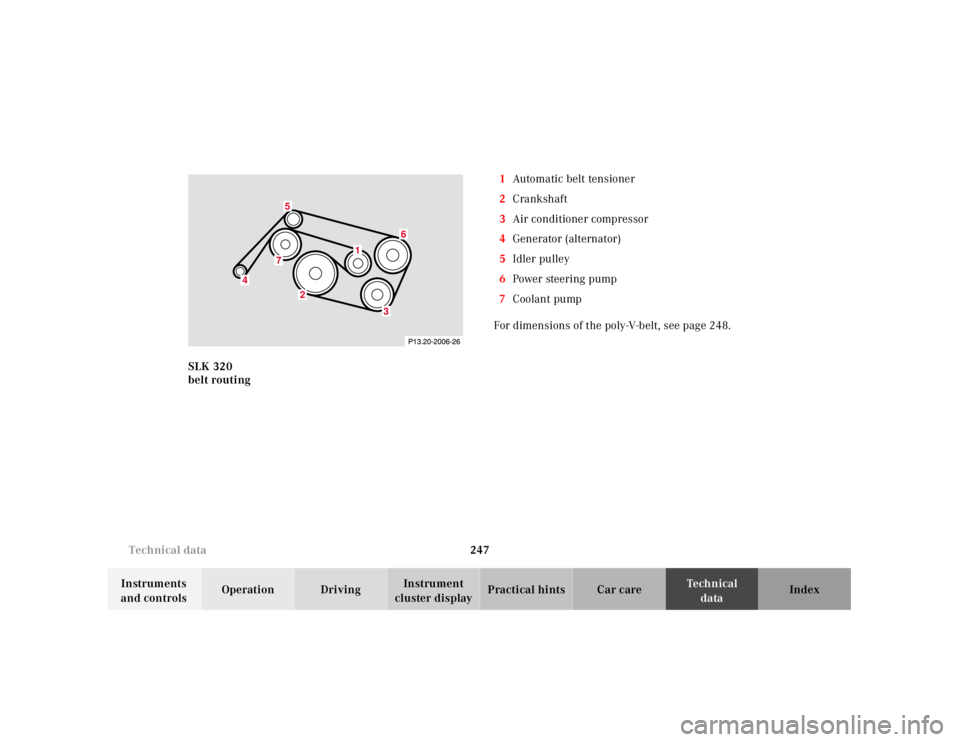
cluster displayPractical hints Car care Index SLK 320
belt routing1Automatic belt tensioner
2Crankshaft
3Air conditioner compressor
4Generator (alternator)
5Idler pulley
6Power steering pump
7Coolant pump
For dimensions of the poly-V-belt, see page 248.
6
5
1
2
3
7
4
Page 256 of 273
253 Fuels, coolants, lubricants etc. - capacities
Te ch n ica l
data Instruments
and controlsOperation DrivingInstrument
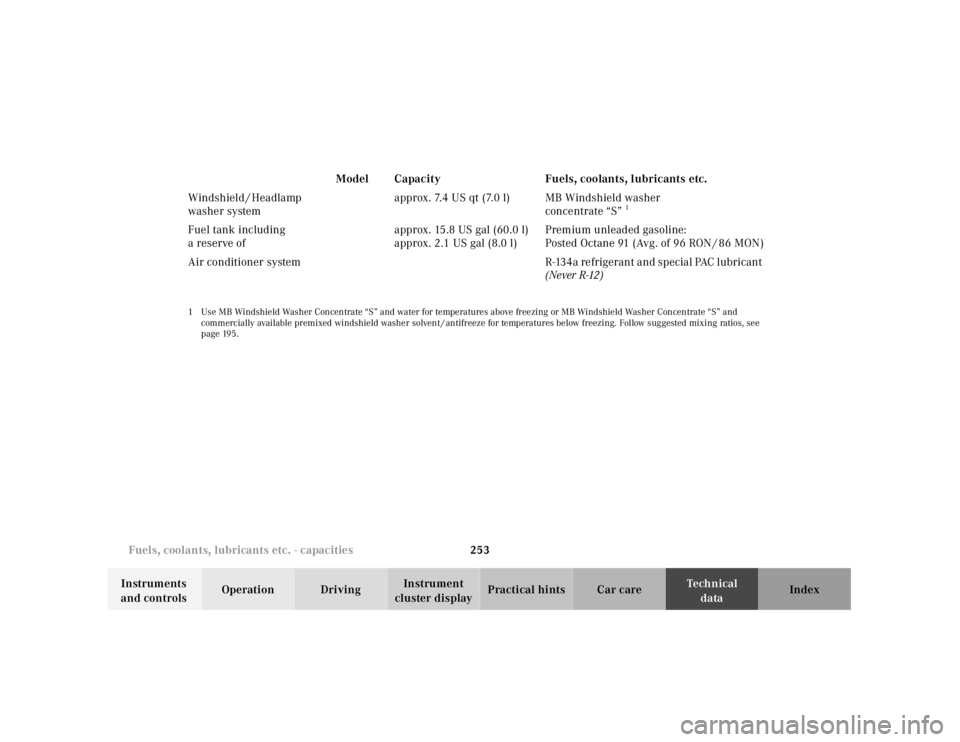
cluster displayPractical hints Car care Index Windshield / Headlamp
washer systemapprox. 7.4 US qt (7.0 l) MB Windshield washer
concentrate “S”
1
Fuel tank including
a reserve ofapprox. 15.8 US gal (60.0 l)
approx. 2.1 US gal (8.0 l)Premium unleaded gasoline:
Posted Octane 91 (Avg. of 96 RON / 86 MON)
Air conditioner system R-134a refrigerant and special PAC lubricant
(Never R-12)1 Use MB Windshield Washer Concentrate “S” and water for temperatures above freezing or MB Windshield Washer Concentrate “S” and
commercially available premixed windshield washer solvent / antifreeze for temperatures below freezing. Follow suggested mixing ratios, see
page 195.
Model Capacity Fuels, coolants, lubricants etc.