center console MERCEDES-BENZ SLK CLASS 2000 User Guide
[x] Cancel search | Manufacturer: MERCEDES-BENZ, Model Year: 2000, Model line: SLK CLASS, Model: MERCEDES-BENZ SLK CLASS 2000Pages: 273, PDF Size: 15.92 MB
Page 59 of 273
56 Restraint systems
Te ch n ica l
data Instruments
and controlsOperationDrivingInstrument
cluster displayPractical hints Car care Index
Front airbags
The driver and passenger front airbags are designed to
activate only in certain frontal impacts exceeding a
preset threshold.
The passenger front airbag deploys only if the
passenger seat is occupied, and the 7 indicator la mp
on the center console is not illuminated.
Note:
Heavy objects on the passenger seat can cause the
passenger front airbag to deploy in a crash.Side impact airbags
The side impact airbags are designed to activate only in
certain side impacts exceeding a preset threshold. Only
the side impact airbag on the impacted side of the
vehicle deploys.
The side impact airbag for the passenger deploys only if
the passenger seat is occupied.
Side impact airbags operate best in conjunction with a
properly positioned and fastened seat belt.
Note:
Heavy objects on the front passenger seat can appear to
the “SRS” to indicate the presence of an occupant in
that seat which causes the passenger front airbag to
deploy in a crash exceeding the appropriate threshold.
Page 69 of 273
66 Rear view mirrors
Te ch n ica l
data Instruments
and controlsOperationDrivingInstrument
cluster displayPractical hints Car care Index
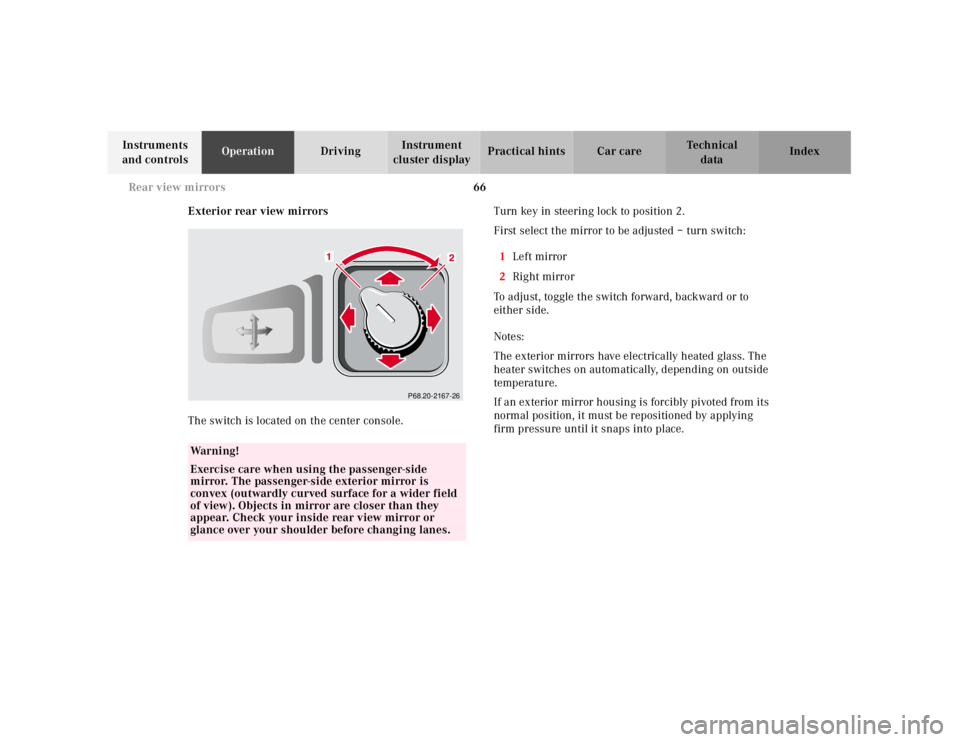
Exterior rear view mirrors
The switch is located on the center console.Turn key in steering lock to position 2.
First select the mirror to be adjusted – turn switch:
1Left mirror
2Right mirror
To adjust, toggle the switch forward, backward or to
either side.
Notes:
The exterior mirrors have electrically heated glass. The
heater switches on automatically, depending on outside
temperature.
If an exterior mirror housing is forcibly pivoted from its
normal position, it must be repositioned by applying
firm pressure until it snaps into place.
Wa r n i n g !
Exercise care when using the passenger-side
mirror. The passenger-side exterior mirror is
convex (outwardly curved surface for a wider field
of view). Objects in mirror are closer than they
appear. Check your inside rear view mirror or
glance over your shoulder before changing lanes.
P68.20-2167-26
Page 73 of 273
70 Instrument cluster
Te ch n ica l
data Instruments
and controlsOperationDrivingInstrument
cluster displayPractical hints Car care Index
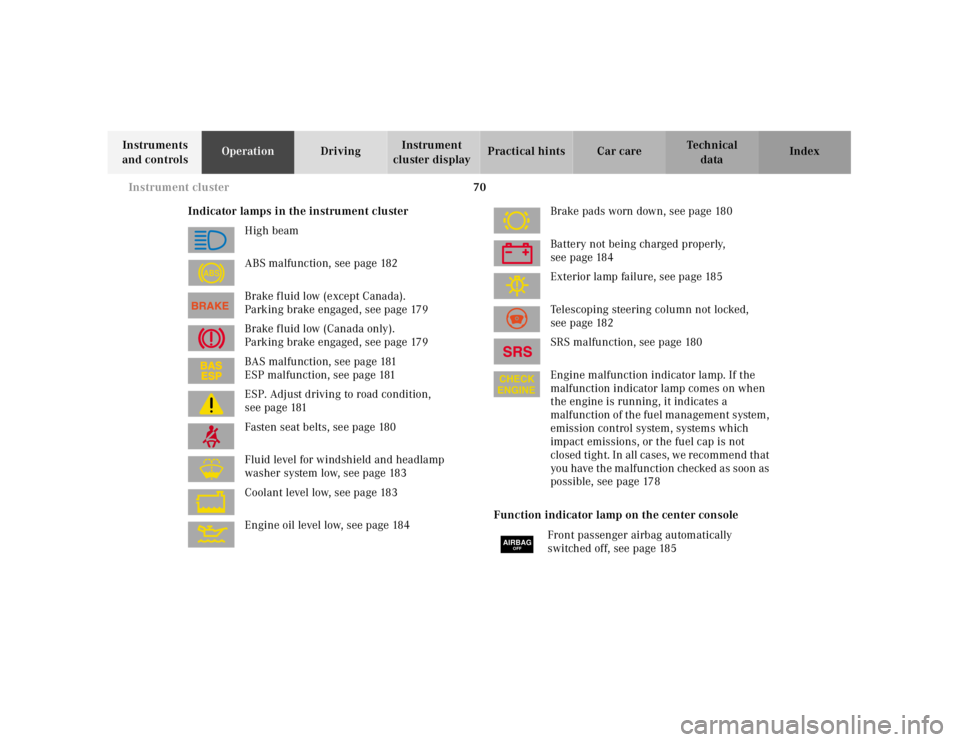
Indicator lamps in the instrument cluster
High beam
ABS malfunction, see page 182
Brake fluid low (except Canada).
Parking brake engaged, see page 179
Brake fluid low (Canada only).
Parking brake engaged, see page 179
BAS malfunction, see page 181
ESP malfunction, see page 181
ESP. Adjust driving to road condition,
see page 181
Fasten seat belts, see page 180
Fluid level for windshield and headlamp
washer system low, see page 183
Coolant level low, see page 183
Engine oil level low, see page 184Brake pads worn down, see page 180
Battery not being charged properly,
see page 184
Exterior lamp failure, see page 185
Telescoping steering column not locked,
see page 182
SRS malfunction, see page 180
Engine malfunction indicator lamp. If the
malfunction indicator lamp comes on when
the engine is running, it indicates a
malfunction of the fuel management system,
emission control system, systems which
impact emissions, or the fuel cap is not
c l o se d t i g h t. I n a l l c a se s, w e r e c o m m e n d t h a t
you have the malfunction checked as soon as
possible, see page 178
Function indicator lamp on the center console
Front passenger airbag automatically
switched off, see page 185
ABS
AIRBAGOFF
Page 83 of 273
80 Exterior lamp switch
Te ch n ica l
data Instruments
and controlsOperationDrivingInstrument
cluster displayPractical hints Car care Index
Fog lamps are automatically switched off when the
exterior lamp switch is turned to position D.
Daytime running lamps (Canada only)
Vehicles with automatic transmission:
When the engine is running and the selector lever is in
a driving position, the low beam headlamps (includes
parking lamps, side marker lamps, taillamps and
license plate lamps) are automatically switched on.
When shifting from a driving position to position “N”
or “P”, the low beam switches off (2 seconds delay).
Vehicles with manual transmission:
With the engine running, the low beam headlamps
(includes parking lamps, side marker lamps, taillamps
and license plate lamps) are automatically switched on.
For nighttime driving the exterior lamp switch should
be turned to position B to permit activation of the
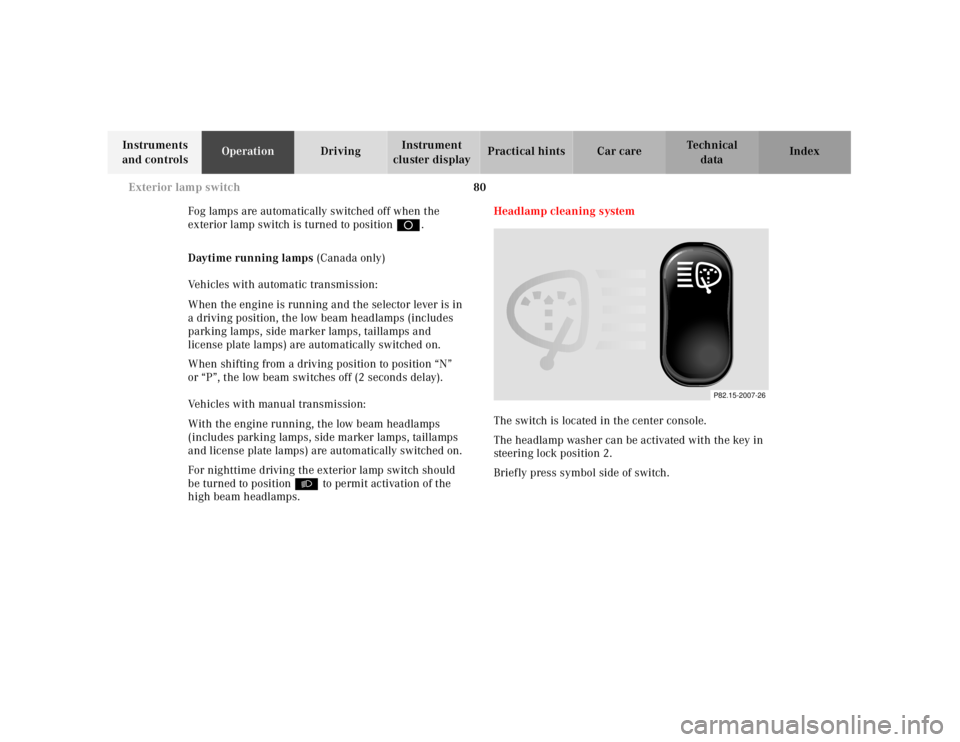
high beam headlamps.Headlamp cleaning system
The switch is located in the center console.
The headlamp washer can be activated with the key in
steering lock position 2.
Briefly press symbol side of switch.
P82.15-2007-26
Page 112 of 273
109 Interior equipment
Te ch n ica l
data Instruments
and controlsOperationDrivingInstrument
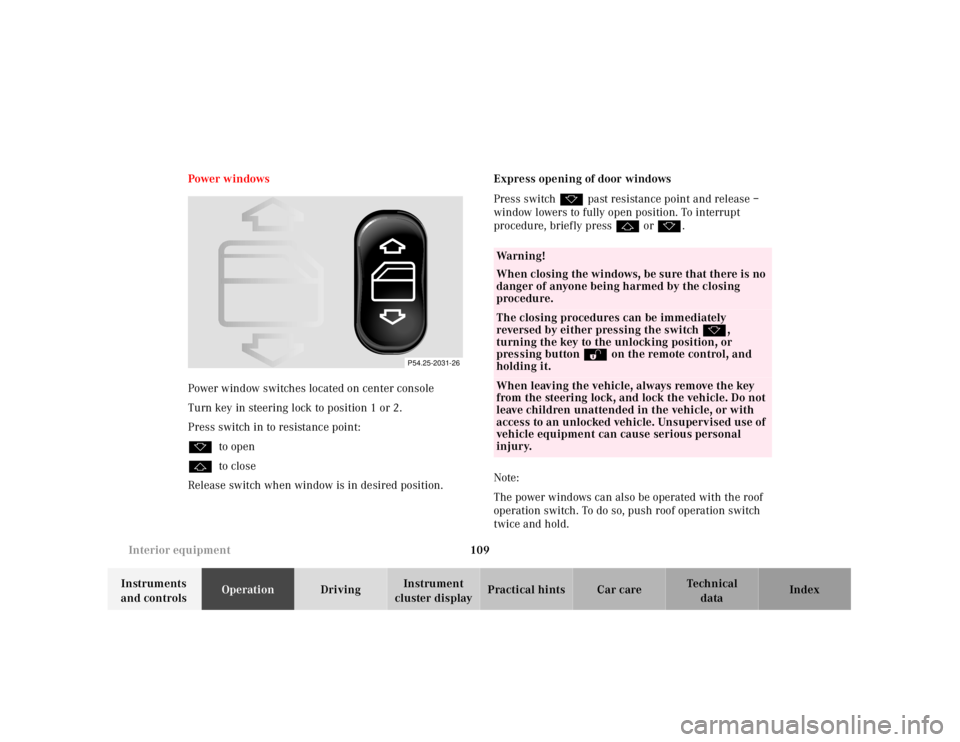
cluster displayPractical hints Car care Index Power w indows
Power window switches located on center console
Turn key in steering lock to position 1 or 2.
Press switch in to resistance point:
kto open
jto close
Release switch when window is in desired position.Express opening of door windows
Press switch k past resistance point and release –
window lowers to fully open position. To interrupt
procedure, briefly press j or k.
Note:
The power windows can also be operated with the roof
operation switch. To do so, push roof operation switch
twice and hold.
P54.25-2031-26
Wa r n i n g !
When closing the windows, be sure that there is no
danger of anyone being harmed by the closing
procedure.The closing procedures can be immediately
reversed by either pressing the switch k,
turning the key to the unlocking position, or
pressing button Πon the remote control, and
holding it.When leaving the vehicle, always remove the key
from the steering lock, and lock the vehicle. Do not
leave children unattended in the vehicle, or with
access to an unlocked vehicle. Unsupervised use of
vehicle equipment can cause serious personal
injury.
Page 116 of 273
113 Interior equipment
Te ch n ica l
data Instruments
and controlsOperationDrivingInstrument
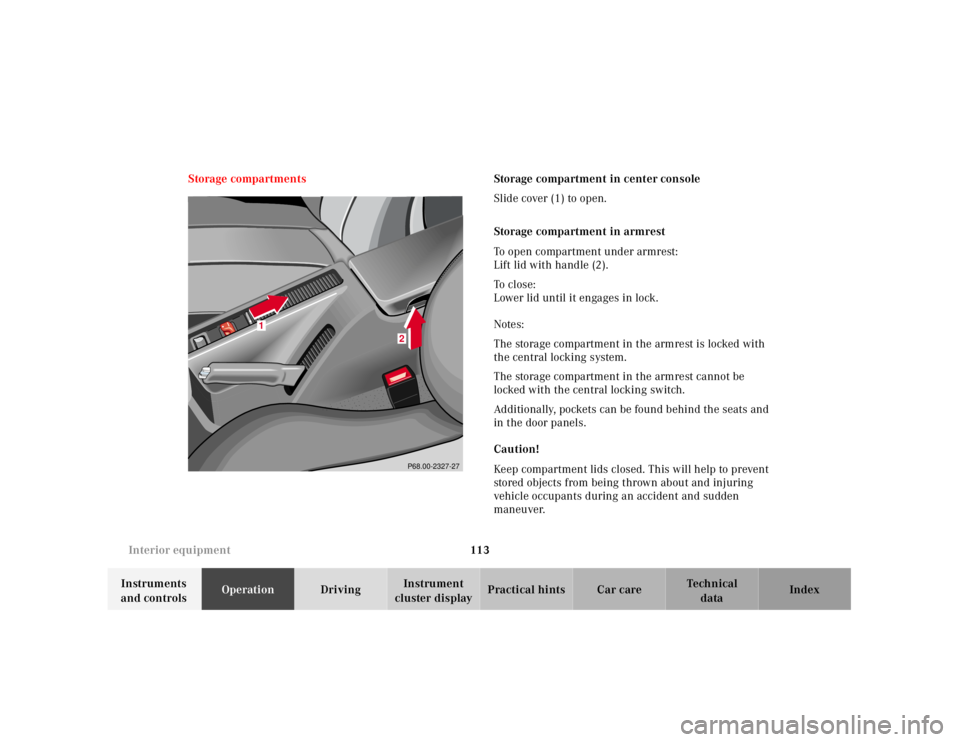
cluster displayPractical hints Car care Index Storage compartmentsStorage compartment in center console
Slide cover (1) to open.
Storage compartment in armrest
To open compartment under armrest:
Lift lid with handle (2).
To c l o s e :
Lower lid until it engages in lock.
Notes:
The storage compartment in the armrest is locked with
the central locking system.
The storage compartment in the armrest cannot be
locked with the central locking switch.
Additionally, pockets can be found behind the seats and
in the door panels.
Caution!
Keep compartment lids closed. This will help to prevent
stored objects from being thrown about and injuring
vehicle occupants during an accident and sudden
maneuver.
2P68.00-2327-27
1
Page 175 of 273
172 Driving systems
Te ch n ica l
data Instruments
and controlsOperationDrivingInstrument
cluster displayPractical hints Car care Index
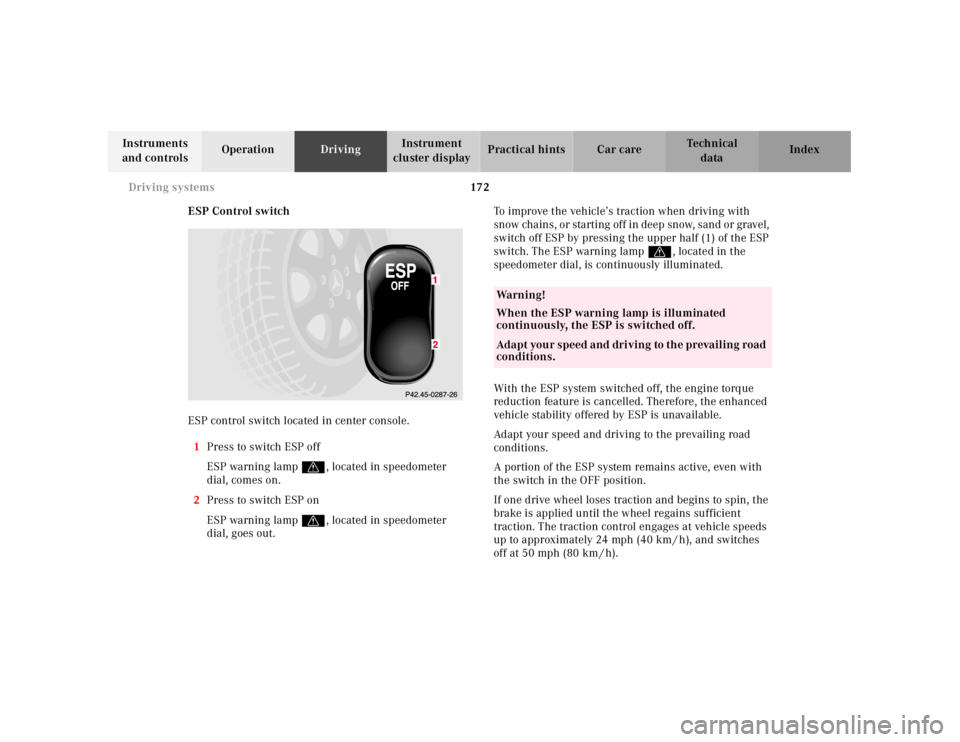
ESP Control switch
ESP control switch located in center console.
1Press to switch ESP off
ESP warning lampv, located in speedometer
dial, comes on.
2Press to switch ESP on
ESP warning lampv, located in speedometer
dial, goes out.To improve the vehicle’s traction when driving with
snow cha ins, or sta rting of f in deep snow, sand or gravel,
switch off ESP by pressing the upper half (1) of the ESP
switch. The ESP warning lampv, located in the
speedometer dial, is continuously illuminated.
With the ESP system switched off, the engine torque
reduction feature is cancelled. Therefore, the enhanced
vehicle stability offered by ESP is unavailable.
Adapt your speed and driving to the prevailing road
conditions.
A portion of the ESP system remains active, even with
the switch in the OFF position.
If one drive wheel loses traction and begins to spin, the
brake is applied until the wheel regains sufficient
traction. The traction control engages at vehicle speeds
up to approximately 24 mph (40 km / h), and switches
off at 50 mph (80 km / h).
Wa r n i n g !
When the ESP warning lamp is illuminated
continuously, the ESP is switched off. Adapt you r speed and dri ving to th e prevailing road
conditions.
Page 180 of 273
177 Contents - Instrument cluster display
Te ch n ica l
data Instruments
and controlsOperation DrivingInstrument
cluster displayPractical hints Car care Index
Instrument cluster displayMalfunction and indicator
lamps in the instrument
cluster ......................................... 178
On-board
diagnostic system ....................... 178
Check engine malfunction
indicator lamp ............................. 178
Brake warning lamp .................. 179
Brake pad wear
indicator lamp ............................. 180
Seat belt nonusage
warning lamp .............................. 180Supplemental restraint system
(SRS) indicator lamp ..................180
Fuel reserve and fuel cap
placement warning .................... 181
Electronic stability program
(ESP) — warning lamp ................181
BAS / ESP malfunction
indicator lamp ............................. 181
ABS malfunction
indicator lamp .............................182
Telescoping steering
column warning lamp ................182
Low engine coolant level
warning lamp ..............................183Low windshield and
headlamp washer system
fluid level warning lamp ........... 183
Low engine oil level
warning lamp .............................. 184
Charge indicator lamp ............... 184
Exterior lamp failure
indicator lamp ............................. 185
Additional function
indicator lamps
(in the odometer display) .......... 185
Malfunction and indicator
lamp in the
center console ........................... 185
AIRBAG OFF indicator lamp ..... 185
Page 188 of 273
185 Malfunction and indicator lamps
Te ch n ica l
data Instruments
and controlsOperation DrivingInstrument
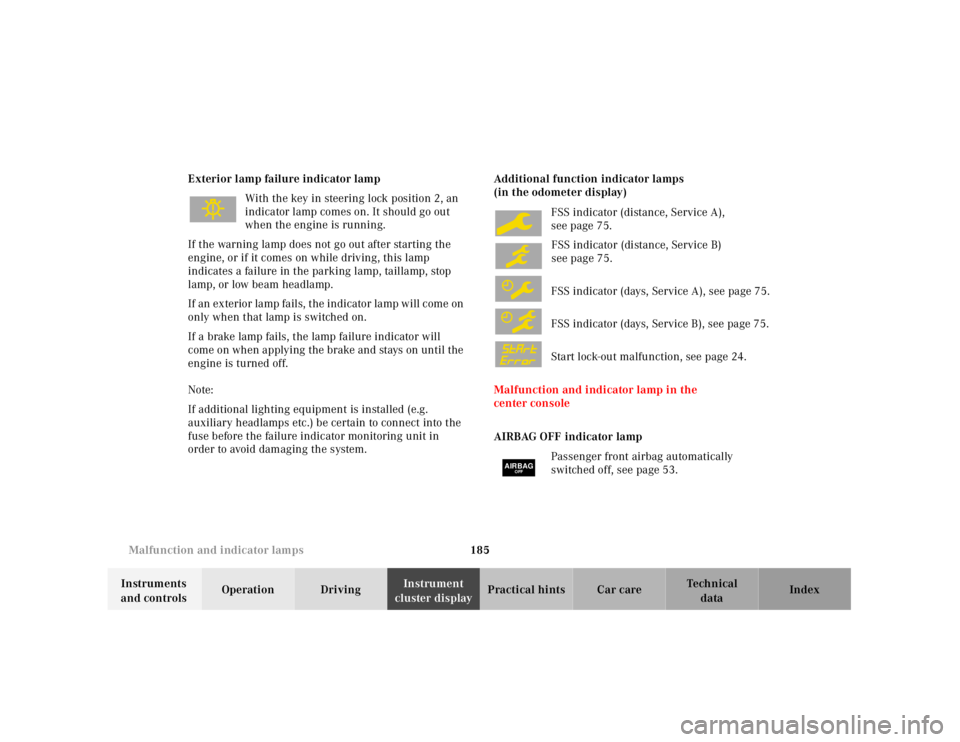
cluster displayPractical hints Car care Index Exterior lamp failure indicator lamp
With the key in steering lock position 2, an
indicator lamp comes on. It should go out
when the engine is running.
If the warning lamp does not go out after starting the
engine, or if it comes on while driving, this lamp
indicates a failure in the parking lamp, taillamp, stop
lamp, or low beam headlamp.
If an ex terior la mp fa il s, t he indicator la mp w ill c ome on
only when that lamp is switched on.
If a brake lamp fails, the lamp failure indicator will
come on when applying the brake and stays on until the
engine is turned off.
Note:
If additional lighting equipment is installed (e.g.
auxiliary headlamps etc.) be certain to connect into the
fuse before the failure indicator monitoring unit in
order to avoid damaging the system.Additional function indicator lamps
(in the odometer display)
FSS indicator (distance, Service A),
see page 75.
FSS indicator (distance, Service B)
see page 75.
FSS indicator (days, Service A), see page 75.
FSS indicator (days, Service B), see page 75.
Start lock-out malfunction, see page 24.
Malfunction and indicator lamp in the
center console
AIRBAG OFF indicator lamp
Passenger front airbag automatically
switched off, see page 53.
AIRBAGOFF
Page 264 of 273
261 Index
Te ch n ica l
data Instruments
and controlsOperation DrivingInstrument
cluster displayPractical hints Car careIndex Brake assist system (BAS) ............................................ 166
Malfunction indicator lamp ..................................... 181
Brake fluid ......................................................................254
Brake pad wear indicator lamp .................................... 180
Brake warning lamp ...................................................... 179
Brake fluid low .......................................................... 179
Brakes .....................................................155, 166, 168, 170
CCapacities
Fuels, coolants, lubricants etc. ...............................252
Catalytic converter ........................................................ 138
Cellular telephone ..........................................................116
Center console .................................................................. 18
Central locking switch .................................................... 30
Central locking system ................................................... 25
Automatic central locking ......................................... 31
Choosing global or selective mode ........................... 26
Emergency release for trunk lid ............................... 35
General notes ............................................................... 24
Locking and unlocking .............................................. 26
Remote control ............................................ 22, 25, 224
Vehicle keys ................................................................. 22Changing wheels ........................................................... 202
Inflating the collapsible spare tire ........................ 207
Storing spare wheel in wheel well ........................ 208
Charge indicator lamp ................................................... 184
Check engine malfunction indicator lamp .................178
Check regularly and before a long trip ....................... 176
Checking engine oil level
Via engine oil level .....................................................77
Via oil dipstick ........................................................... 193
Child restraint ...............................................44, 50, 51, 61
Cleaning and care of the vehicle ................................ 234
Climate control .................................................................84
Air Recirculation .........................................................89
Basic setting .................................................................86
Defogging windows .....................................................87
Defrosting .....................................................................87
Dust Filter .....................................................................90
Rear window defroster ............................................... 88
Residual Engine Heat Utilization (REST) ................ 89
Special settings ........................................................... 87
Clock, setting .................................................................... 74
Coin Holder ..................................................................... 114
Combination switch ......................................................... 81
Consumer information ................................................. 258
Control and operation of radio transmitters .............. 128