display MERCEDES-BENZ SLK CLASS 2000 Workshop Manual
[x] Cancel search | Manufacturer: MERCEDES-BENZ, Model Year: 2000, Model line: SLK CLASS, Model: MERCEDES-BENZ SLK CLASS 2000Pages: 273, PDF Size: 15.92 MB
Page 66 of 273
63 Restraint systems
Te ch n ica l
data Instruments
and controlsOperationDrivingInstrument
cluster displayPractical hints Car care IndexUSA Models only:
Since 1986 all U.S. child restraints comply with U.S.
regulations without the use of a tether strap.
Wa r n i n g !
Children 12 years old and under must never ride in
this vehicle, except in a Mercedes-Benz authorized
BabySmart
TM compatible child seat, which operates
with the BabySmart
TM system installed in the
vehicle to deactivate the passenger front airbag
when it is properly installed. Otherwise they will
be struck by the airbag when it inflates in a crash.
If this happens, serious or fatal injury can result.
Infants and small children must be seated in an
appropriate infant or child restraint system, which
is properly secured with the vehicle’s seat belt,
fully in accordance with the child seat
manufacturer’s instructions.Infants and small children should never share a
seat belt with another occupant. During an
accident, they could be crushed between the
occupant and seat belt.
Children too big for child restraint systems should
use regular seat belts. Position the shoulder belt
across chest and shoulder, not face or neck. A
booster seat may be necessary to achieve proper
belt positioning for children from 41 lbs. to the
point where a lap / shoulder belt fits properly
without one.When the child restraint is not in use, remove it
from the vehicle or secure it with the seat belt to
prevent the child restraint from becoming a
projectile in the event of an accident.
Page 67 of 273
64 Adjusting telescoping steering column
Te ch n ica l
data Instruments
and controlsOperationDrivingInstrument
cluster displayPractical hints Car care Index
Adjusting telescoping steering column
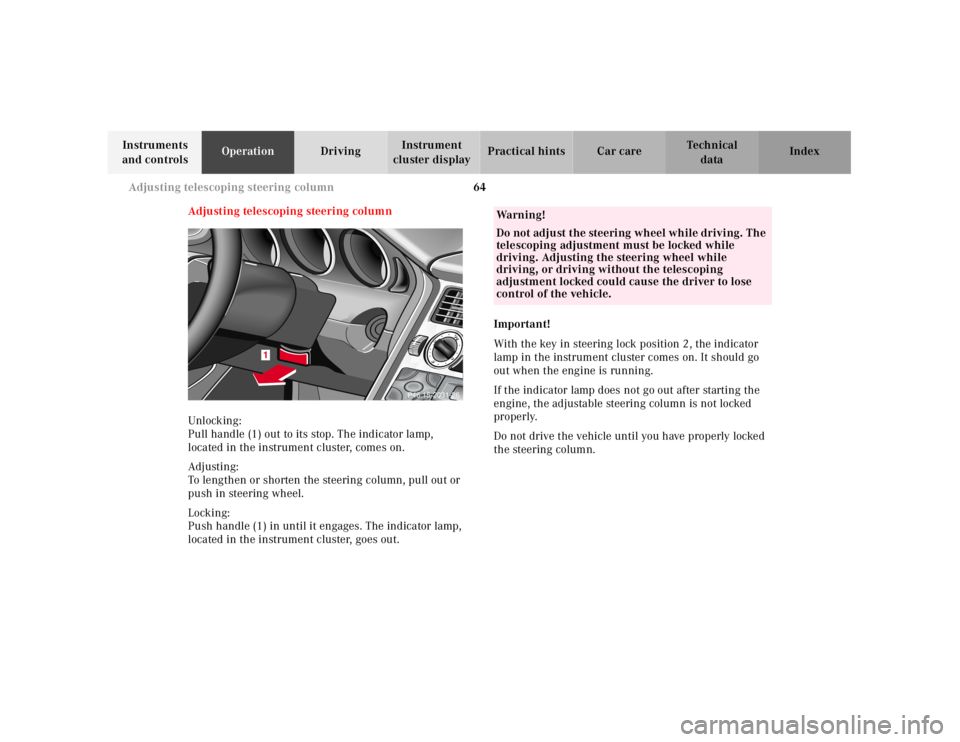
Unlocking:
Pull handle (1) out to its stop. The indicator lamp,
located in the instrument cluster, comes on.
Adjusting:
To lengthen or shorten the steering column, pull out or
push in steering wheel.
Locking:
Push handle (1) in until it engages. The indicator lamp,
located in the instrument cluster, goes out.Important!
With the key in steering lock position 2, the indicator
lamp in the instrument cluster comes on. It should go
out when the engine is running.
If the indicator lamp does not go out after starting the
engine, the adjustable steering column is not locked
properly.
Do not drive the vehicle until you have properly locked
the steering column.
AUDIO
TEL
AUDIO
TEL
1
AUDIO
TEL
AUDIO
TEL
P46.15-2031-26
Wa r n i n g !
Do not adjust the steering wheel while driving. The
telescoping adjustment must be locked while
driving. Adjusting the steering wheel while
driving, or driving without the telescoping
adjustment locked could cause the driver to lose
control of the vehicle.
Page 68 of 273
65 Rear view mirrors
Te ch n ica l
data Instruments
and controlsOperationDrivingInstrument
cluster displayPractical hints Car care Index Rear view mirrors
Inside rear view mirror
Manually adjust the mirror.
Use your inside mirror to determine the size and
distance of objects seen in the passenger-side convex
mirror.
Automatic antiglare
Antiglare mode:
With the key in steering lock position 2, the mirror
reflection brightness responds to changes in light
sensitivity.
W it h g e a r s e l e c t or l e ve r ( m a nu a l t ra ns m i s si o n: g e a rs h if t
l ever) in position “R”, or w it h t he interior la mp switch ed
on, the mirror brightness does not respond to changes
in light sensitivity.Note:
The automatic antiglare function does not react, if
incoming light is not aimed directly at sensors in the
mirror.
Wa r n i n g !
In the case of an accident liquid electrolyte may
escape the mirror housing when the mirror glass
breaks.Electrolyte has an irritating effect. Do not allow the
liquid come into contact with eyes, skin, clothing,
or respiratory system. In cases it does, imm edi ately
flush affected area with water, and seek medical
help if necessary.
Page 69 of 273
66 Rear view mirrors
Te ch n ica l
data Instruments
and controlsOperationDrivingInstrument
cluster displayPractical hints Car care Index
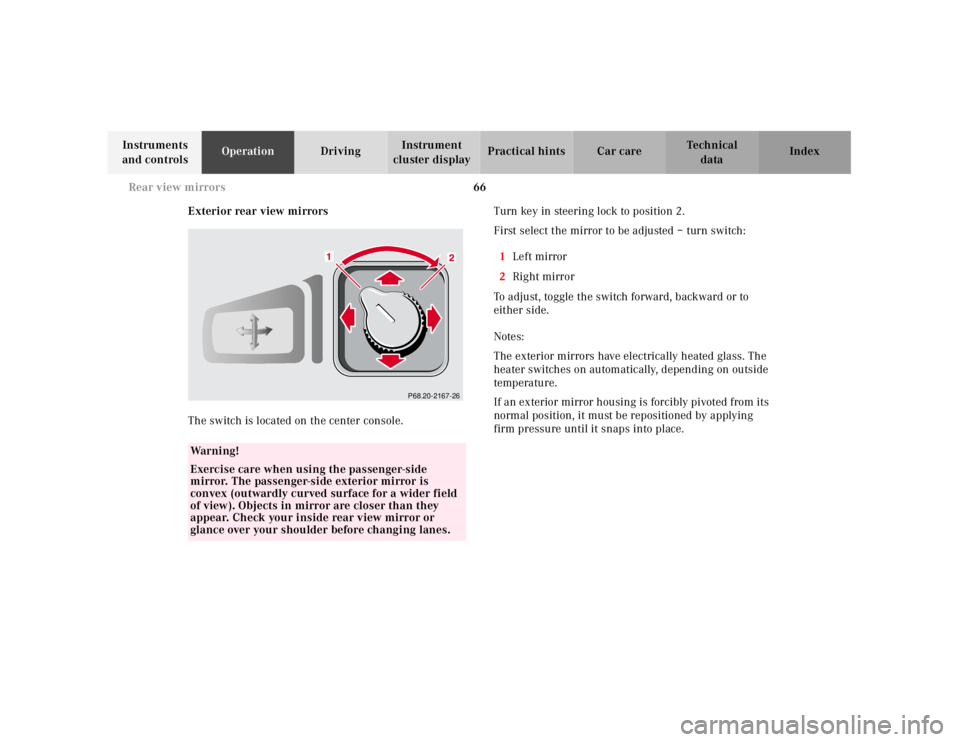
Exterior rear view mirrors
The switch is located on the center console.Turn key in steering lock to position 2.
First select the mirror to be adjusted – turn switch:
1Left mirror
2Right mirror
To adjust, toggle the switch forward, backward or to
either side.
Notes:
The exterior mirrors have electrically heated glass. The
heater switches on automatically, depending on outside
temperature.
If an exterior mirror housing is forcibly pivoted from its
normal position, it must be repositioned by applying
firm pressure until it snaps into place.
Wa r n i n g !
Exercise care when using the passenger-side
mirror. The passenger-side exterior mirror is
convex (outwardly curved surface for a wider field
of view). Objects in mirror are closer than they
appear. Check your inside rear view mirror or
glance over your shoulder before changing lanes.
P68.20-2167-26
Page 70 of 273
67 Rear view mirrors
Te ch n ica l
data Instruments
and controlsOperationDrivingInstrument
cluster displayPractical hints Car care Index With the key in steering lock position 2, the driver’s
side mirror reflection brightness responds to changes in
light sensitivity.
W it h g e a r s e l e c t or l e ve r ( m a nu a l t ra ns m i s si o n: g e a rs h if t
l ever) in position “R”, or w it h t he interior la mp switch ed
on, the driver’s side mirror brightness does not respond
to changes in light sensitivity.
Important!
Electrolyte drops coming into contact with the vehicle
paint finish can only be completely removed while in
their liquid state, by applying plenty of water.
Wa r n i n g !
In the case of an accident liquid electrolyte may
escape the mirror housing when the mirror glass
breaks.Electrolyte has an irritating effect. Do not allow the
liquid come into contact with eyes, skin, clothing,
or respiratory system. In cases it does, imm edi ately
flush affected area with water, and seek medical
help if necessary.
Page 71 of 273
68 Instrument cluster
Te ch n ica l
data Instruments
and controlsOperationDrivingInstrument
cluster displayPractical hints Car care Index
In strum en t clu ster
Page 72 of 273
69 Instrument cluster
Te ch n ica l
data Instruments
and controlsOperationDrivingInstrument
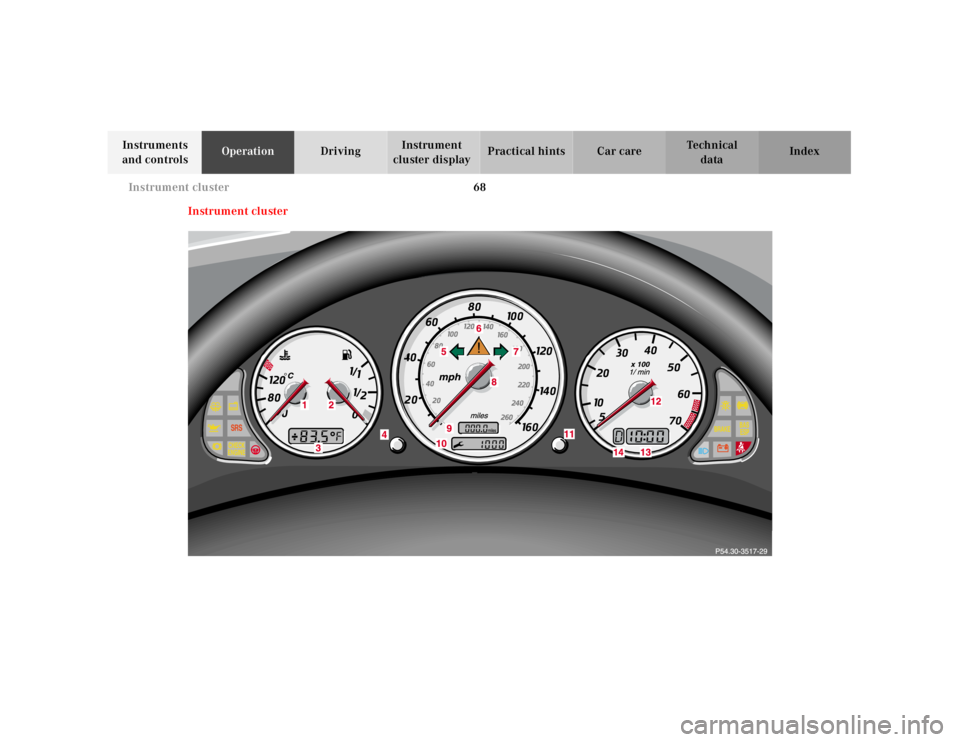
cluster displayPractical hints Car care Index 1Coolant temperature gauge, see page 73
2Fuel gauge with reserve and fuel cap placement
warning lamp, see page 181
3Outside temperature indicator, see page 73
4Push button for activating the instrument cluster,
intensity of instrument lamps, for trip odometer, and
for Flexible service system (FSS) indicator, see
pages 72, 74 and 75
5Left turn signal indicator lamp, see combination
switch on page 81
6Electronic stability program (ESP) warning lamp,
system is adjusting to road conditions, see page 1817Right turn signal indicator lamp, see combination
switch on page 81
8Speedometer
9Trip odometer, see page 74
10Main odometer, Flexible service system (FSS)
indicator, see page 75
11Push button for setting clock, see page 74
12Tachometer, see page 74
13Clock, see page 74
14Gear range indicator display, see selector lever
position, page 147
Page 73 of 273
70 Instrument cluster
Te ch n ica l
data Instruments
and controlsOperationDrivingInstrument
cluster displayPractical hints Car care Index
Indicator lamps in the instrument cluster
High beam
ABS malfunction, see page 182
Brake fluid low (except Canada).
Parking brake engaged, see page 179
Brake fluid low (Canada only).
Parking brake engaged, see page 179
BAS malfunction, see page 181
ESP malfunction, see page 181
ESP. Adjust driving to road condition,
see page 181
Fasten seat belts, see page 180
Fluid level for windshield and headlamp
washer system low, see page 183
Coolant level low, see page 183
Engine oil level low, see page 184Brake pads worn down, see page 180
Battery not being charged properly,
see page 184
Exterior lamp failure, see page 185
Telescoping steering column not locked,
see page 182
SRS malfunction, see page 180
Engine malfunction indicator lamp. If the
malfunction indicator lamp comes on when
the engine is running, it indicates a
malfunction of the fuel management system,
emission control system, systems which
impact emissions, or the fuel cap is not
c l o se d t i g h t. I n a l l c a se s, w e r e c o m m e n d t h a t
you have the malfunction checked as soon as
possible, see page 178
Function indicator lamp on the center console
Front passenger airbag automatically
switched off, see page 185
ABS
AIRBAGOFF
Page 74 of 273
71 Instrument cluster
Te ch n ica l
data Instruments
and controlsOperationDrivingInstrument
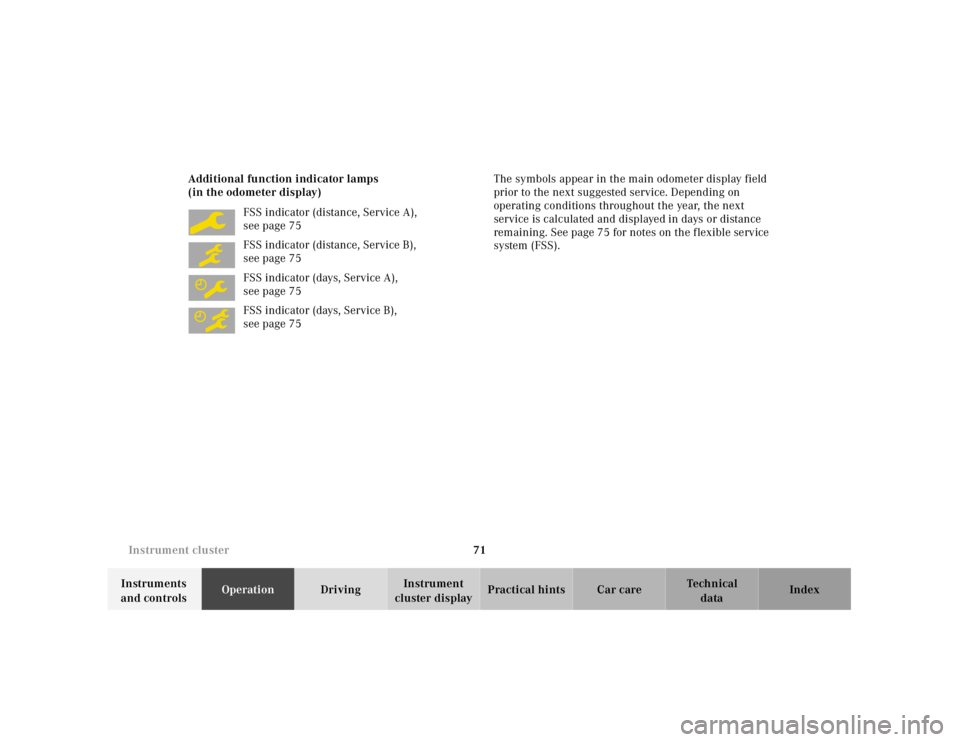
cluster displayPractical hints Car care Index Additional function indicator lamps
(in the odometer display)
FSS indicator (distance, Service A),
see page 75
FSS indicator (distance, Service B),
see page 75
FSS indicator (days, Service A),
see page 75
FSS indicator (days, Service B),
see page 75The symbols appear in the main odometer display field
prior to the next suggested service. Depending on
operating conditions throughout the year, the next
service is calculated and displayed in days or distance
remaining. See page 75 for notes on the flexible service
system (FSS).
Page 75 of 273
72 Instrument cluster
Te ch n ica l
data Instruments
and controlsOperationDrivingInstrument
cluster displayPractical hints Car care Index
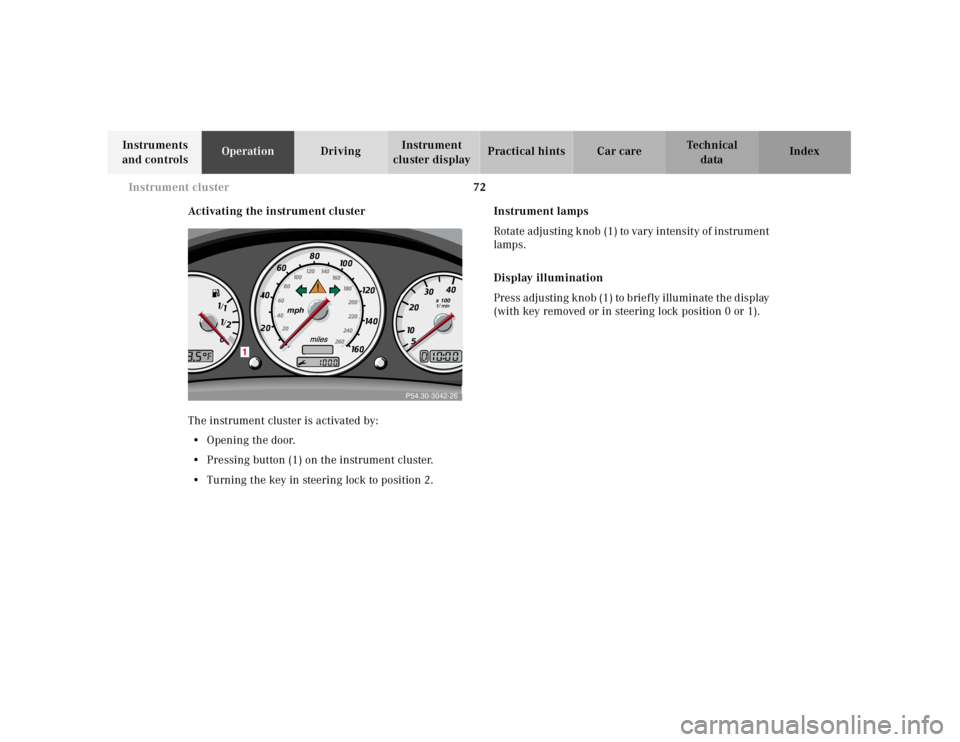
Activating the instrument cluster
The instrument cluster is activated by:
•Opening the door.
•Pressing button (1) on the instrument cluster.
•Turning the key in steering lock to position 2.Instrument lamps
Rotate adjusting knob (1) to vary intensity of instrument
lamps.
Display illumination
Pr e s s a d j u st in g k n o b ( 1 ) to b ri e f ly i llu m i n a te t h e d is p lay
(with key removed or in steering lock position 0 or 1).
P54.30-2722-26
mph
x 100
/ /
0
1
P54.30-3042-26