power steering MERCEDES-BENZ SLK CLASS 2002 Owners Manual
[x] Cancel search | Manufacturer: MERCEDES-BENZ, Model Year: 2002, Model line: SLK CLASS, Model: MERCEDES-BENZ SLK CLASS 2002Pages: 290, PDF Size: 18.21 MB
Page 4 of 290

1 Contents
IntroductionProduct information .......................... 5
Operator’s manual ............................. 6
Where to find it ................................ 11
Reporting Safety Defects ................ 13Instruments and controlsInstruments and controls ............... 16
Center console .............................. 18
Overhead control panel ............... 19OperationVehicle keys ...................................... 22
Remote control with
folding master key ...................... 22
Start lock-out .................................... 23
General notes on the
central locking system ............... 23
Central locking system ................... 24
Remote control ............................. 24
Panic button .................................. 26
Mechanical keys ........................... 27Doors ................................................. 28
Central locking switch .................... 30
Automatic central locking ...............31
Emergency unlocking in
case of accident .......................... 32
Trunk ................................................. 33
Emergency release
for trunk lid ................................. 35
Antitheft alarm system ................... 35
Tow-away alarm ............................... 37
Seats .................................................. 38
Seat heater ........................................ 42
Seat belts and
integrated restraint system ....... 44
Seat belts .......................................... 44
Seat belt nonusage
warning system ............................ 45
BabySmart
TM airbag
deactivation system ....................51
Self-test BabySmart
TM without
special child seat installed ..........51
Supplemental restraint system
(SRS) ............................................. 52Emergency tensioning retractor
(ETR) ............................................. 53
Airbags .............................................. 54
Safety guidelines for the
seat belt, emergency
tensioning retractor
and airbag .................................... 61
Infant and
child restraint systems ............... 63
Adjusting telescoping
steering column .......................... 65
Rear view mirrors ............................ 66
Instrument cluster ........................... 70
Flexible service system (FSS) ........ 77
Checking engine oil level .............. 79
Engine oil consumption .................. 80
Exterior lamp switch ....................... 81
Headlamp cleaning system ............ 82
Combination switch ........................ 83
Hazard warning flasher switch ..... 85
Climate control ................................. 86
Rear window defroster .................... 90
Audio and telephone, operation .... 93
Power windows ................................ 111
Page 5 of 290

2 Contents
Interior lighting ............................. 112
Night security illumination ......... 112
Sun visors with Vanity Mirror ......113
Interior .............................................113
Cup holder and glove box ..............114
Storage compartments ...................115
Ashtrays ...........................................116
Coin Holder ......................................116
Lighter ..............................................117
Parcel net in passenger footwell ..118
Shelf behind roll bars .....................118
Cellular telephone ..........................118
Garage door opener ........................119
Retractable hardtop ....................... 122
Wind screen .................................... 127
Luggage cover ................................. 128
DrivingControl and operation of
radio transmitters ..................... 130
The first 1 000 miles
(1 500 km) ................................. 131
Maintenance ................................... 131Tele Aid ............................................132
Catalytic converter ........................ 140
Emission control ............................. 141
Steering lock .................................. 142
Starting and turning off
the engine .................................. 144
Manual transmission .................... 145
Automatic transmission ............... 147
Parking brake .................................156
Driving instructions .......................157
Drive sensibly – Save Fuel ........157
Drinking and driving .................157
Pedals ...........................................157
Power assistance .........................158
Brakes ...........................................158
Driving off ....................................159
Parking .........................................159
Tires ..............................................160
Snow chains ................................163
Winter driving instructions ......163
Block heater .................................165
Deep water ...................................165
Passenger compartment ............165
Traveling abroad .........................165Cruise control ................................. 166
Brake assist system
(BAS) ........................................... 169
Antilock brake system
(ABS) ........................................... 171
Electronic stability program
(ESP) ........................................... 173
What you should know
at the gas station ....................... 177
Check regularly and
before a long trip ...................... 179
Instrument cluster displayMalfunction and
indicator lamps in the
instrument cluster .................... 182
On-board diagnostic system ..... 182
Check engine malfunction
indicator lamp ............................. 182
Brake warning lamp .................. 183
Brake pad wear
indicator lamp ............................. 184
Seat belt nonusage
warning lamp .............................. 184
Page 7 of 290

4 Contents
Changing batteries in
the remote control ....................236
Synchronizing
remote control ............................237
Raising hardtop manually ............238
Replacing wiper blade insert .......243
Antenna ...........................................244
Manual release
of fuel filler flap ........................244
Vehicle careCleaning and care of
the vehicle ..................................246
Power washer ..............................247
Paintwork, painted body
components .................................247
Tar stains .....................................247
Engine cleaning ..........................248
Vehicle washing .........................248
Headlamps, taillamps,
turn signal lenses ......................249
Window cleaning ........................249
Rear window cleaning ...............249
Wiper blades ...............................250Light alloy wheels ..................... 250
Instrument cluster ..................... 251
Steering wheel and
gear selector lever ..................... 251
Cup holder .................................. 251
Hard plastic trim items ............. 251
Plastic and rubber parts ........... 251
Headliner and
shelf behind roll bars ................ 252
Upholstery .................................. 252
Seat belts ..................................... 252
Technical dataSpare parts service ....................... 254
Warranty coverage ........................ 254
Identification labels ...................... 255
Layout of poly-V-belt drive ........... 257
Technical data ................................ 260
Fuels, coolants,
lubricants etc. – capacities ..... 266
Engine oils ...................................... 268
Engine oil additives ...................... 268
Air conditioner refrigerant .......... 268
Brake fluid ...................................... 268Premium unleaded gasoline ........269
Fuel requirements .........................269
Gasoline additives .........................270
Coolants ...........................................270
Consumer information ..................272
IndexIndex ................................................ 274
Page 41 of 290
38 Seats
Te ch n i c a l
data Instruments
and controlsOperationDrivingInstrument
cluster displayPractical hints Car care Index
Power seats
To operate the power seat adjustment switches, turn key
in steering lock to position 1 or 2 (with a door open, the
power seats can also be operated with the key removed
or in steering lock position 0).
Wa r n i n g !
Do not adjust the driver’s seat while driving.
Adjusting the seat while driving could cause the
driver to lose control of the vehicle.Never place hands under seat or near any moving
parts while a seat is being adjusted.For your protection, drive only with properly
positioned head restraints.Adjust head restraint to support the back of the
head approximately at ear level.
Do not drive the vehicle without the seat head
restraints. Head restraints are intended to help
reduce injuries during an accident.When leaving the vehicle always remove the key
from the steering lock, and lock your vehicle.The power seats can also be operated with driver’s
or passenger door open. Do not leave children
unattended in the vehicle, or with access to an
unlocked vehicle. Unsupervised use of vehicle
equipment may cause serious personal injury.
Page 93 of 290
90 Climate control
Te ch n i c a l
data Instruments
and controlsOperationDrivingInstrument
cluster displayPractical hints Car care Index
Windshield fogged up on outside.
Switch on windshield wipers.
Set air distribution control switch to position d
ora.
Economy
The function of this setting corresponds to the air
conditioning mode. However, because the air
conditioning compressor will not engage (fuel savings),
it is not possible to air condition in this setting.
Press S button to activate.
Press S button once again to return to previous
setting.
Climate control - OFF
To switch the climate control off, set air volume control
switch to position 0.
The fresh air supply to the vehicle interior is shut off.
While driving, use this setting only temporarily,
otherwise the windshield could fog up.Rear window defroster
Turn key in steering lock to position 2.
To s e l e c t , p r e s s F button.
To cancel, press F button again.
Note:
Heavy accumulation of snow and ice should be removed
before activating the defroster.
The rear window defroster uses a large amount of power.
To keep the battery drain to a minimum, turn off the
defroster as soon as the window is clear.
The defroster is automatically turned off after a
maximum of 12 minutes of operation.
If several power consumers are turned on
simultaneously, or the battery is only partially charged,
it is possible that the defroster will automatically turn
itself off. When this happens, the indicator lamp inside
the switch starts blinking.
As soon as the battery has sufficient voltage, the
defroster automatically turns itself back on.
Page 114 of 290
111 Interior equipment
Te ch n i c a l
data Instruments
and controlsOperationDrivingInstrument
cluster displayPractical hints Car care Index Power windows
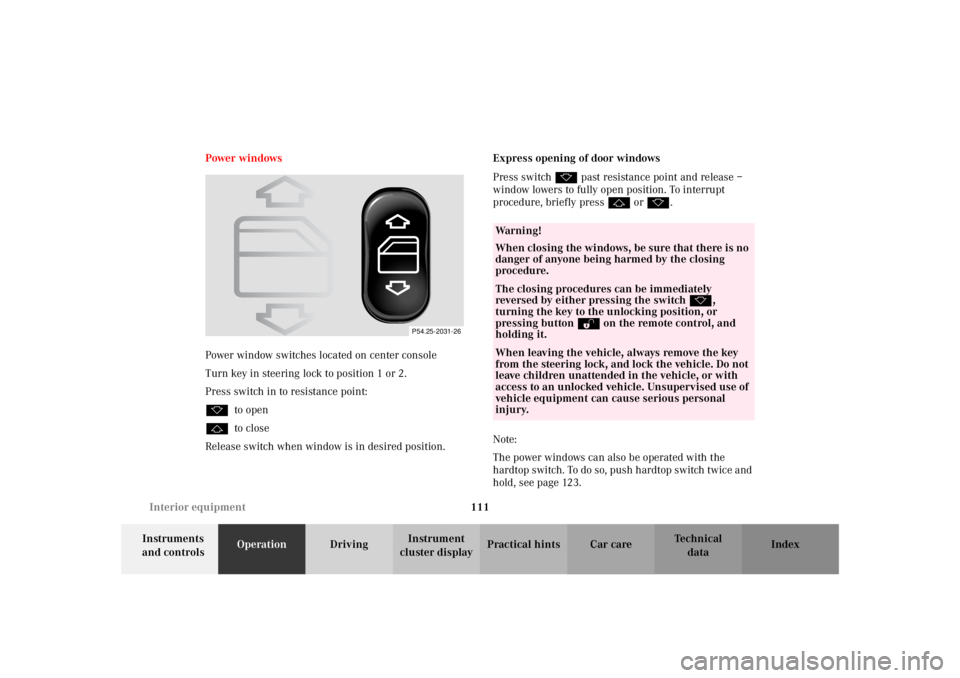
Power window switches located on center console
Turn key in steering lock to position 1 or 2.
Press switch in to resistance point:
kto open
jto close
Release switch when window is in desired position.Express opening of door windows
Press switch k past resistance point and release –
window lowers to fully open position. To interrupt
procedure, briefly press j or k.
Note:
The power windows can also be operated with the
hardtop switch. To do so, push hardtop switch twice and
hold, see page 123.
P54.25-2031-26
Wa r n i n g !
When closing the windows, be sure that there is no
danger of anyone being harmed by the closing
procedure.The closing procedures can be immediately
reversed by either pressing the switch k,
turning the key to the unlocking position, or
pressing button Πon the remote control, and
holding it.When leaving the vehicle, always remove the key
from the steering lock, and lock the vehicle. Do not
leave children unattended in the vehicle, or with
access to an unlocked vehicle. Unsupervised use of
vehicle equipment can cause serious personal
injury.
Page 132 of 290
129 Contents - Driving
Te ch n i c a l
data Instruments
and controlsOperationDrivingInstrument
cluster displayPractical hints Car care Index
DrivingControl and operation of
radio transmitters ..................... 130
The first 1 000 miles
(1 500 km) ................................. 131
Maintenance ................................... 131
Tele Aid ........................................... 132
Catalytic converter ........................ 140
Emission control ............................ 141
Steering lock ................................... 142
Starting and turning off
the engine .................................. 144
Manual transmission .................... 145
Automatic transmission ............... 147
Parking brake ................................. 156Driving instructions .......................157
Drive sensibly – Save Fuel ........157
Drinking and driving .................157
Pedals ...........................................157
Power assistance .........................158
Brakes ...........................................158
Driving off ....................................159
Parking .........................................159
Tires ..............................................160
Snow chains ................................163
Winter driving instructions ......163
Block heater .................................165
Deep water ...................................165
Passenger compartment ............165
Traveling abroad .........................165Cruise control ................................. 166
Brake assist system
(BAS) ........................................... 169
Antilock brake system
(ABS) ........................................... 171
Electronic stability program
(ESP) ........................................... 173
What you should know
at the gas station ....................... 177
Check regularly and
before a long trip ...................... 179
Page 146 of 290
143 Steering lock
Te ch n i c a l
data Instruments
and controlsOperationDrivingInstrument
cluster displayPractical hints Car care Index Notes:
A warning sounds when the driver’s door is opened
while the key is in steering lock position 1 or 0.
With the engine at idle speed, the charging rate of the
alternator (output) is limited.
It is therefore recommended that you turn off
unnecessary electrical consumers while driving in stop-
and-go traffic. This precaution helps to avoid draining of
the battery.
Unnecessary strain on the battery and charging system
may be minimized by turning off the following power
consumers, for example: Heated seats, rear window
defroster.Caution!
To prevent accelerated battery discharge and a possible
dead battery, always remove the key from the steering
lock. Do not leave the key in steering lock position 0.
Page 161 of 290
158 Driving instructions
Te ch n i c a l
data Instruments
and controlsOperationDrivingInstrument
cluster displayPractical hints Car care Index
Power assistance
BrakesThe condition of the parking brake system is checked
each time the vehicle is in the shop for the required
maintenance service.
If the parking brake is released and the brake warning
lamp in the instrument cluster stays on, the brake fluid
level in the reservoir is too low.
Brake pad wear or a leak in the system may be the
reason for low brake fluid in the reservoir.
Have the brake system inspected at an authorized
Mercedes-Benz Center immediately.
All checks and service work on the brake system should
be carried out by an authorized Mercedes-Benz Center.
Install only brake pads and brake fluid recommended by
Mercedes-Benz.
Wa r n i n g !
When the engine is not running, the brake and
steering systems are without power assistance.
Under these circumstances, a much greater effort is
necessary to stop or steer the vehicle.Wa r n i n g !
After driving in heavy rain for some time without
applying the brakes or through water deep enough
to wet brake components, the first braking action
may be somewhat reduced and increased pedal
pressure may be necessary to obtain expected
braking effect. Be sure to maintain a safe distance
from vehicles in front.Resting your foot on the brake pedal will cause
excessive and premature wear of the brake pads.It can also result in the brakes overheating thereby
significantly reducing their effectiveness. It may
not be possible to stop the vehicle in sufficient time
to avoid an accident.
Wa r n i n g !
If other than recommended brake pads are
installed, or other than recommended brake fluid
is used, the braking properties of the vehicle can be
degraded to an extent that safe braking is
substantially impaired. This could result in an
accident.
Page 162 of 290
159 Driving instructions
Te ch n i c a l
data Instruments
and controlsOperationDrivingInstrument
cluster displayPractical hints Car care Index Caution!
When driving down long and steep grades, relieve the
load on the brakes by shifting into a lower gear to use
the engine’s braking power. This helps prevent
overheating of the brakes and reduces brake pad wear.
After hard braking, it is advisable to drive on for some
time, rather than immediately parking, so the air stream
will cool down the brakes faster.
Driving off
Apply the service brakes to test them briefly after
driving off. Perform this procedure only when the road
is clear of other traffic.
Warm up the engine smoothly. Do not place full load on
the engine until the operating temperature has been
reached.
When starting off on a slippery surface, do not allow one
drive wheel to spin for an extended period with the ESP
switched off. Doing so may cause serious damage to the
drive train which is not covered by the Mercedes-Benz
Limited Warranty.Parking
Wa r n i n g !
To reduce the risk of personal injury as a result of
vehicle movement, before
turning off the engine
and leaving the vehicle, always:
1. Keep right foot on the service brake pedal.
2. Firmly engage parking brake.
3. Move the selector lever to position “P”
(manual transmission: first or reverse gear).
4. Slowly release the service brake pedal.
5. Turn front wheels towards the road curb.
6. Turn the key to steering lock position 0 and
remove.
7. Take the key and lock vehicle when leaving.