engine MERCEDES-BENZ SLK-Class 2013 R172 User Guide
[x] Cancel search | Manufacturer: MERCEDES-BENZ, Model Year: 2013, Model line: SLK-Class, Model: MERCEDES-BENZ SLK-Class 2013 R172Pages: 358, PDF Size: 4.61 MB
Page 19 of 358
Definition of term
s......................... 327
Direction of rotatio n...................... 330
Display message ............................ 234
Distributio nofthe vehicle
occupants (definition) ....................329
DOT, Tire Identification Number
(TIN) .............................................. .326
DOT (Department of
Transportation) (definition) ............327
GAWR (Gross Axle Weight Rating)
(definition) ..................................... 328
GVW (Gross Vehicle Weight)
(definition) ..................................... 328
GVWR (Gross Vehicle Weight
Rating) (definition) .........................328
Important safety notes ..................308
Increased vehicle weight due to
optional equipment (definition) ......328
Kilopascal (kPa) (definition) ...........328
Labeling (overview )........................ 323
Load bearing index (definition) ......329
Load index ..................................... 326
Load index (definition) ...................328
Maximum loaded vehicle weight
(definition) ..................................... 328
Maximum load on a tire (definition) 328
Maximum permissible tire
pressure (definition) ....................... 328
Maximum tire loa d......................... 326
Maximum tire load (definition) .......328
MOExtended tires ..........................310
Optional equipment weight
(definition) ..................................... 329
Overview ........................................ 308
PSI (pounds per square inch)
(definition) ..................................... 328
Replacing ....................................... 329
Service life ..................................... 310
Sidewall (definition) .......................329
Speed rating (definition) ................328
Storing ........................................... 330
Structure and characteristics
(definition) ..................................... 327
Temperature .................................. 323
TIN (Tire Identification Number)
(definition) ..................................... 329
Tire bea d(definition) ...................... 329
Tire pressure (definition) ................329Tire pressures (recommended
)...... 327
Tire size (data) ............................... 335
Tire size designation, load-bearing
capacity, speed rating .................... 323
Tire tread ....................................... 309
Tire tread (definition) .....................329
Total load limit (definition) .............329
Traction ......................................... 322
Traction (definition) .......................329
Trea dwear ..................................... 322
Uniform Tire Quality Grading
Standard s...................................... 322
Uniform Tire Quality Grading
Standard s(definition) .................... 327
Unladen weight (definition) ............328
Wea rindicato r(definition) .............329
Whee lrim (definition ).................... 328
see Flat tire
Towing
Important safety guidelines ...........301
Installing the towing eye ................302
Removing the towing eye. ..............302
With the rear axle raised ................302
Towing away
With both axles on the ground .......302
Tow-starting
Emergency engine starting ............303
Important safety notes ..................301
Installing the towing eye ................302
Removing the towing eye. ..............302
Transmission
Selector leve r................................ 145
see Automatic transmission
see Manual transmission
Transporting the vehicle ..................303
Trim pieces (cleaning instructions) .286
Trip computer (on-board computer) 196
Trip odometer Calling up ....................................... 196
Resetting (on-board computer) ......197
Trunk
Emergency release ..........................81
Important safety notes ....................79
Locking separatel y........................... 80
Opening/closing (manually from
outside) ............................................ 80 Index
17
Page 20 of 358
Opening (automatically from
outside) ............................................ 80
Overview .......................................... 79
Trunk lid
Display message ............................ 239
Opening/closing .............................. 79
Opening dimensions ......................353
Trunk load (maximum) ......................353
Trunk partition Display message ............................ 239
General notes .................................. 88
Opening/closing .............................. 88
Turn signals
Changing bulbs (front) ...................115
Display message ............................ 222
Switching on/off ........................... 108
Type identification plate
see Vehicle identification plate U
Unlocking Emergency unlocking .......................78
From inside the vehicle (central
unlocking button) ............................. 77V
Vanity mirror (in the sun visor) ........260
Vehicle Correct use ...................................... 23
Data acquisition ............................... 24
Display message ............................ 237
Equipment ....................................... 20
Individua lsettings .......................... 203
Limited Warranty ............................. 24
Loading .......................................... 319
Locking (in an emergency) ...............78
Locking (SmartKey) .......................... 71
Lowering ........................................ 334
Maintenance .................................... 21
Parking for a long period ................ 158
Pulling away ................................... 138
Raising ........................................... 331
Reporting problems .........................24
Securing from rolling away ............331
Towing away .................................. 301
Tow-starting ................................... 301Transporting
.................................. 303
Unlocking (in an emergency) ...........78
Unlocking (SmartKey) ......................71
Vehicle data ................................... 353
Vehicle battery
see Battery (vehicle)
Vehicle data ....................................... 353
Vehicle dimensions ...........................353
Vehicle emergency locking ................78
Vehicle identification number see VIN
Vehicle identification plate ..............347
Vehicle tool kit .................................. 291
Video Operating the DVD ......................... 200
VIN ...................................................... 347 W
Warning and indicator lamps ABS ................................................ 244
Brakes ........................................... 244
Check Engine ................................. 250
Coolant .......................................... 250
Distance warning ........................... 252
DISTRONI CPLUS ........................... 252
ESP ®
.............................................. 246
ESP ®
OFF ....................................... 247
Fuel tank ........................................ 250
Overview .......................................... 30
PASSENGER AIR BAG OFF
indicator lamp .................................. 45
Reserve fuel ................................... 250
Seat bel t........................................ 242
SPORT handling mode ...................247
SRS ................................................ 249
Tire pressure monitor ....................253
Warning triangle ................................ 290
Warranty ............................................ 346
Washer fluid Display message ............................ 240
Wheel bol ttightening torque ...........334
Wheel chock ...................................... 331
Wheels Changing awheel .......................... 329
Checking ........................................ 309
Cleaning ......................................... 284
Cleaning (warning) .........................33018
Index
Page 24 of 358
If you have purchased a used car, please send
us the "Notification of Used Car Purchase" in
the Service and Guarantee booklet or simply
call the Mercedes-Benz Customer Assistance
Center (USA) at the hotline number
1-800-FOR-MERCedes(1-800-367-6372) or
Customer Service (Canada) at
1-800-387-0100. Vehicle operation outside the USA
and Canada
If you plant o operate your vehicle in foreign
countries, please be aware that:
R service facilities or replacement parts may
not be readily available.
R unleaded fuel for vehicles with a catalytic
converter may not be available. Leaded fuel
may cause damage to the catalytic
converter.
R the fuel may have a considerably lower
octane rating. Unsuitable fuel can cause
engine damage.
Some Mercedes-Benz models are available
for delivery in Europe through our European
Delivery Program. For details, consult an
authorized Mercedes-Benz Center or write to
one of the following addresses.
In the USA
Mercedes-Benz USA, LLC
European Delivery Department
One Mercedes Drive
Montvale, NJ 07645-0350
In Canada
Mercedes-Benz Canada, Inc.
European Delivery Department
98 Vanderhoof Avenue
Toronto, Ontario M4G 4C9 Operating safety
Important safety notes
G
WARNING
Work improperly carried out on electronic
components and associated software could
cause them to cease functioning. Because the
vehicle's electronic components are
interconnected, any modifications made may
produce an undesired effect on other
systems. Electronic malfunctions could
seriously impair the operating safety of your
vehicle.
Contact an authorized Mercedes-Benz Center
for repairs or modifications to electronic
components.
Other improper work or modifications on the
vehicle could also have a negative impact on
the operating safety of the vehicle.
Some safety systems only function when the
engine is running. You should therefore never
turn off the engine while driving. G
WARNING
Heavy blows against the vehicle underbody or
tires/wheels may cause serious damage and
impair the operating safety of your vehicle.
Such blows can be caused, for example, by
running over an obstacle, road debris or a
pothole.
If you feel a sudden significant vibration or
ride disturbance, or you suspect that damage
to your vehicle has occurred:
R turn on your hazard warning flashers.
R slow down carefully.
R drive with caution to an area which is a safe
distance from the road.
Inspect the vehicle underbody and tires/
wheels for possible damage. If the vehicle
appears unsafe, have it towed to the nearest
authorized Mercedes-Benz Center or other
qualified maintenance or repair facility for
further inspection or repairs. 22
Introduction
Page 25 of 358
Declarations of conformity
Vehicle components which receive
and/or transmit radio waves USA:
"The wireless devices of this vehicle
comply with Par t15ofthe FCC Rules.
Operation is subject to the following two
conditions: 1) These devices may not cause
harmful interference, and 2) These devices
must accept any interference received,
including interference that may cause
undesired operation. Changes or
modifications not expressly approved by the
party responsible for compliance could void
the user’s authority to operate the
equipment."
Canada: "The wireless devices of this vehicle
comply with Industry Canada license-exempt
RSS standard(s). Operation is subject to the
following two conditions: (1) These devices
may not cause interference, and (2) These
devices must accept any interference,
including interference that may cause
undesired operation of the device." Diagnostics connection
G
WARNING
If you connect equipment to the on-board
diagnostics connection, it can affect the
operation of the vehicle systems. This can
impair the operating safety of your vehicle
while driving. There is a risk of an accident.
Do not connect any equipment to the on-
board diagnostics connection. G
WARNING
Loose equipment or equipment cables which
are connected to the on-board diagnostics
connection can obstruct the area around the
pedals. The equipment or the cables could
come between the pedals in the event of
sudden braking or acceleration. This may
affect the function of the pedals. There is a
risk of an accident. Do not attach any equipment or cables in the
driver's footwell.
! If the engine is switched off and
equipment on the diagnostics connection
is used, the starter battery may discharge.
The diagnostics connection is only intended
for the connection of diagnostic equipment at
a qualified specialist workshop.
Connecting equipment to the diagnostics
connection can, for example, lead to
emissions monitoring information being
reset. This may lead to the vehicle failing to
meet the requirements of the next emissions
test during the main inspection. Qualified specialist workshop
An authorized Mercedes-Ben zCenter is a
qualified specialist workshop. It has the
necessary specialist knowledge, tools and
qualifications to correctly carry out the work
required on your vehicle. This is especially the
case for work relevant to safety.
Observe the notes in the Maintenance
Booklet.
Always have the following work carried out at
an authorized Mercedes-BenzC enter:
R work relevant to safety
R service and maintenance work
R repair work
R alterations, installation work and
modifications
R work on electronic components Correct use
G
WARNING
There are various warning stickers affixed to
your vehicle. Their purpose is to alert you and
others to various dangers. Therefore, do not
remove any warning stickers unless the
sticker clearly states that you may do so. Introduction
23 Z
Page 32 of 358

Warning and indicator lamps
Function Page
0003
000A
Low-beam
headlamps 107
0004
0009
High-beam
headlamps 109
0024
000C
ESP® 246
0023
0005
Electric parking brake
(red) 244
0021
000A
Electric parking brake
(yellow) 244
0022
000C
Distance warning 252
0015
00070006
Turn signals 108
0016
0015
Tire pressure monitor 316
0017
001B
SRS 249 Function Page
0018
0011
Seat belt 242
0019
0002
SPORT handling
mode in AMG vehicles 247
001B
000F
Coolant 250
001C
000D
Rearfog lamp 108
001D
000B
Front fog lamps 108
001E
0011
Check Engine 250
001F
0013
Reserve fuel 250
0020
0014
ESP®
OFF 246
0025
0016
ABS 244
0026
000D
Brakes 24430
Instrument clusterAt a glance
Page 41 of 358
tamper with electronic components or their
software.
In this section, you will lear nthe most
important facts about the restraint system
components of the vehicle.
The restraint system consists of:
R seat belts
R child restraint systems
Additional protection is provided by:
R SRS (Supplemental Restraint System)
R NECK-PRO head restraints
R PRE-SAFE ®
R Air bag system components with:
-PASSENGER AIR BAG ON/OFF indicator
lamp 1
- Front-passenger seat with Occupant
Classification System (OCS)
The different air bag systems work
independently of each other. The protective
functions of the system work in conjunction
with each other. Not all air bags are always
deployed in an accident.
i See "Children in the vehicle" for
information on infants and children
traveling with you in the vehicle and
restraint systems for infants and children
(Y page 56). SRS (Supplemental Restraint System)
Introduction SRS consists of:
R
the 001B SRS warning lamp
R air bags
R the air bag control unit with crash sensors
R Emergency Tensioning Devices
R belt force limiters
SRS reduces the risk of occupants coming
into contact with the vehicle's interior in the event of an accident. It can also reduce the
effect of the forces to which occupants are
subjected during an accident.
SRS warning lamp G
WARNING
The SRS self-check has detected a
malfunction if the 001BSRS indicator lamp:
R does not light up at all
R does not go out after approximately four
seconds after the engine is started
R lights up after the engine is started or while
the vehicle is in motion
For your safety, Mercedes-Ben zstrongly
recommends tha tyou have the system
checked as soon as possible at a qualified
specialist workshop. SRS may otherwise fail
to activate when it is needed in the event of
an accident, which could lead to serious or
fatal injuries. SRS might also be activated
unexpectedly and unnecessarily, which could
also result in injury.
In addition, work carried out improperly on
SRS may render SRS inoperative or cause
unintended air bag deployment. Work on the
SRS system should only be carried out by
qualified specialist personnel. Consult a
qualified specialist workshop.
If it is necessary to modify an air bag system
to accommodate a person with disabilities,
contact an authorized Mercedes-Benz Center
for details. USA only: for further information,
contact our Customer Assistance Center at
1-800-FOR-MERCedes (1-800-367-6372).
The 001B SRS warning lamp in the instrument
cluster lights up when the ignition is switched
on. It goes out no later than a few seconds
after the engine is started.
SRS functions are checked regularly when the
engine is running. Therefore, malfunctions
can be detected in good time.
1 The PASSENGER AIR BAG ON indicator lamp has no function. When switching on the ignition, it lights up
briefly and then goes out again. Occupant safety
39Safety Z
Page 42 of 358
The SRS components are in operational
readiness when the SRS 001Bindicator lamp
goes out while the engine is running.
Safety guidelines for seat belts,
Emergency Tensioning Devices (ETDs)
and air bags G
WARNING
R Damaged seat belts or seat belts that have
been subjected to stress in an accident
must be replaced. Their anchoring points
must also be checked. Only use seat belts
installed or supplied by an authorized
Mercedes-Benz Center.
R Air bags and pyrotechnic Emergency
Tensioning Devices (ETDs) contain
perchlorate material, which may require
special handling and regard for the
environment.C heck your national disposal
guidelines. California residents, see
www.dtsc.ca.gov/HazardousWaste/
Perchlorate/index.cfm.
R Air bags and ETDs are designed to function
on a one-time-only basis. An air bag or ETD
that has deployed must be replaced.
R Do not pass seat belts over sharp edges.
They could tear.
R Do not make any modification that could
change the effectiveness of the seat belts.
R Do not bleach or dye seat belts as this may
severely weaken them. In a crash they may
not be able to provide adequate protection.
R No modifications of any kind may be made
to any components or wiring of the SRS.
R Do not change or remove any component
or part of the SRS.
R Do not install additional trim material, seat
covers, badges, etc. over the steering
wheel hub, front-passenger front air bag
cover, outer sides of the seat backrests,
door trim panels, or door frame trims.
R Do not install additional electrical/
electronic equipment on or near SRS
components and wiring. R
Keep area between air bags and occupants
free of objects (e.g. packages, purses,
umbrellas, etc.).
R Air bag system components will be hot after
an air bag has inflated. Do not touch them.
R Never place your feet on the instrument
panel, dashboard, or on the seat. Always
keep both feet on the floor in front of the
seat.
R Improper repair work on the SRS creates a
risk of rendering the SRS inoperative or
causing unintended air bag deployment.
Work on the SRS must therefore only be
performed by qualified technicians.
Contact an authorized Mercedes-Benz
Center.
R For your protection and the protection of
others, when scrapping the air bag unit or
ETD, our safety instructions must be
followed. These instructions are available
from any authorized Mercedes-Benz
Center.
R Given the considerable deployment speed,
required inflation volume, and the material
of the air bags, there is the possibility of
abrasions or other, potentially more serious
injuries resulting from air bag deployment.
If you sell your vehicle, Mercedes-Benz
strongly recommends that you inform the
subsequent owner that the vehicle is
equipped with SRS. Also, refer them to the
applicable section in the Operator's Manual. 40
Occupant safetySafety
Page 47 of 358
deployment thresholds for lateral
acceleration/deceleration. You will then be
protected by the fastened seat belt.
The head bag on the front-passenger side is
not deployed in the following situations:
R the OCS system detects that the front-
passenger seat is not occupied, and
R the front-passenger seat belt is not
fastened.
The head bag on the front-passenger side will
deploy if the front-passenger seat belt is
fastened, regardless of whether the front-
passenger seat is occupied or not. Occupant Classification System
(OCS)
Method of operation G
WARNING
If the 0017 PASSENGER AIR BAG OFF
indicator lamp illuminates when an adult or
someone larger than a small individual is in
the front-passenger seat, have the front
passenger reposition himself or herself in the
seat until the 0017PASSENGER AIR BAGO FF
indicator lamp goes out.
In the event of a collision, the air bag control
uni tw ill not allow front-passenge rfront air
bag and front-passenge rknee bag
deployment when the OC Shas classified the
front-passenger occupant as weighing as
much as or less than a typical 12 month old
child in a standard child restraint or if the
front-passenger seat is classified as being
unoccupied.
When the OCS senses that the front-
passenger seat occupant is classified as
being up to or less than the weigh tofatypical
12-month-old child in a standard child
restraint, the 0017PASSENGER AIR BAG OFF
indicator lamp will illuminate when the engine
is started and remai nilluminated. This
indicates that the front-passenger front air bag and the front-passenge
rknee bag are
deactivated.
When the OCS senses that the front-
passenger sea tis classified as being empty,
the 0017 PASSENGER AIR BAG OFF indicator
lamp will illuminate when the engine is started
and remain illuminated. This indicates that
the front-passenger front air bag and the
front-passenger knee bag are deactivated.
When the OCS senses that the front-
passenger seat occupant is classified as
being heavier than the weight of a typical 12-
month-old child seated in astandard child
restraint or as being a small individual (such
as a young teenager or asmall adult), the
0017 PASSENGER AIR BAG OFF indicator
lamp will illuminate for approximately 6
seconds when the engine is started.
Depending on occupant weight sensor
readings from the seat, it will then remain
illuminated or go out. If the 0017PASSENGER
AIR BAG OFF indicator lamp is illuminated, the
front-passenger front air bag and the front-
passenger knee bag are deactivated. If the
0017 PASSENGER AIR BAG OFF indicator
lamp is not illuminated, the front-passenger
front air bag and the front-passenger knee
bag are activated.
When the OCS senses that the front-
passenger seat occupant is classified as an
adult or someone larger than a small
individual, the 0017PASSENGER AIR BAG
OFF indicator lamp will illuminate for
approximately six seconds when the engine is
started and then go out. This indicates that
the front-passenger front air bag and the
front-passenger knee bag are activated.
If the 0017 PASSENGER AIR BAG OFF
indicator lamp is illuminated, the front-
passenger front air bag and the front-
passenger knee bag are deactivated and are
not deployed. Occupant safety
45Safety
Z
Page 57 of 358
X
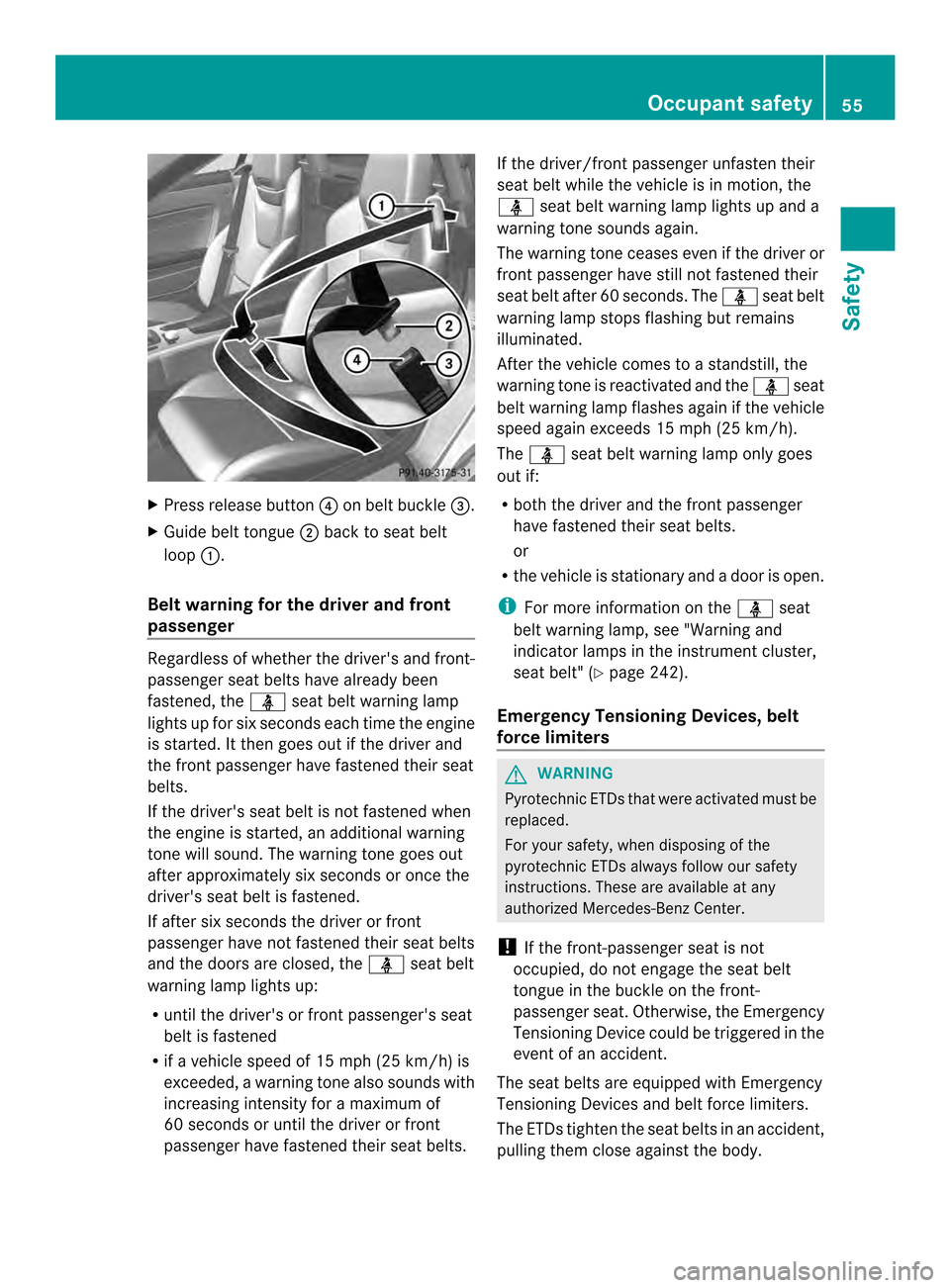
Press release button 0023on belt buckle 0024.
X Guide belt tongue 0004back to seat belt
loop 0003.
Belt warning for the driver and front
passenger Regardless of whether the driver's and front-
passenger seat belts have already been
fastened, the 0011seat belt warning lamp
lights up for six seconds each time the engine
is started. It then goes out if the driver and
the frontp assenger have fastened their seat
belts.
If the driver's seat belt is no tfastened when
the engine is started, an additional warning
tone will sound. The warning tone goes out
after approximately six seconds or once the
driver's seat belt is fastened.
If after six seconds the driver or front
passenger have no tfastened their seat belts
and the doors are closed, the 0011seat belt
warning lamp lights up:
R until the driver's or fron tpassenger's seat
belt is fastened
R if a vehicle speed of 15 mph (25 km/h) is
exceeded, a warning tone also sounds with
increasing intensity for a maximum of
60 seconds or until the driver or front
passenger have fastened their seat belts. If the driver/front passenger unfasten their
seat belt while the vehicle is in motion, the
0011
seat belt warning lamp lights up and a
warning tone sounds again.
The warning tone ceases eve nifthe driver or
front passenger have still not fastened their
seat belt after 60 seconds. The 0011seat belt
warning lamp stops flashing but remains
illuminated.
After the vehicle comes to a standstill, the
warning tone is reactivated and the 0011seat
belt warning lamp flashes again if the vehicle
speed again exceeds 15 mph (25 km/h).
The 0011 seat belt warning lamp only goes
out if:
R both the driver and the front passenger
have fastened their seat belts.
or
R the vehicle is stationary and a door is open.
i For more information on the 0011seat
belt warning lamp, see "Warning and
indicator lamps in the instrument cluster,
seat belt" (Y page 242).
Emergency Tensioning Devices, belt
force limiters G
WARNING
Pyrotechnic ETDs that were activated must be
replaced.
For your safety, when disposing of the
pyrotechnic ETDs always follow our safety
instructions. These are available at any
authorized Mercedes-Ben zCenter.
! If the front-passenger seat is not
occupied, do not engage the seat belt
tongue in the buckle on the front-
passenger seat. Otherwise, the Emergency
Tensioning Device could be triggered in the
event of an accident.
The seat belts are equipped with Emergency
Tensioning Devices and belt force limiters.
The ETDs tighten the seat belts in an accident,
pulling them close against the body. Occupant safety
55Safety Z
Page 62 of 358
is switched on. It goes out when the engine is
running.
Braking
X
If ABS intervenes: continue to depress the
brake pedal vigorously until the braking
situation is over.
X To make a full brake application:
depress the brake pedal with full force.
If AB Sintervenes when braking, you will feel
a pulsing in the brake pedal.
The pulsating brake pedal can be an
indicatio nofhazardous road conditions, and
functions as a reminder to take extra care
while driving. BAS (Brake Assist System)
i Observe the "Important safety notes"
sectio n(Ypage 59). G
WARNING
If BASi s malfunctioning, the braking distance
in an emergency braking situation is
increased. There is a risk of an accident.
In an emergency braking situation, depress
the brake pedal with full force. ABS prevents
the wheels from locking.
BAS operates in emergency braking
situations. If you depress the brake pedal
quickly, BAS automatically boosts the braking
force, thus shortening the stopping distance.
The brakes will function as usual once you
release the brake pedal.B AS is deactivated.BAS PLUS (Brake Assist System Plus)
i Observe the "Important safety notes"
sectio n(Ypage 59).
BASP LUS is only available in vehicles
equipped with DISTRONIC PLUS.
BAS PLUS provides braking assistance in
hazardous situations at speeds greater than 20 mph (30 km/h) and uses radar sensor
technology to assess the traffic situation.
With the help of the radars
ensor system, BAS
PLUS can detect obstacles that are in the
path of your vehicle for an extended period of
time.
At speeds up to 40 mph (70 km/h), BAS PLUS
may also detec tstationary obstacles, for
example, stopped or parked vehicles.
To prevent a front-end collision, BAS PLUS
calculates the brake force necessary if:
R you approach an obstacle, and
R BAS PLU Shas detected arisk of collision
Should you apply the brakes forcefully, BAS
PLUS will automatically increase the braking
force to a level suitable for the traffic
conditions.
If BAS PLUS demands particularly high
braking force, preventative passenger
protection measures (PRE-SAFE ®
) are
activated simultaneously.
X Keep the brake pedal depressed until the
emergency braking situation is over.
ABS prevents the wheels from locking.
BAS PLUS is deactivated and the brakes
function as usual, if:
R you release the brake pedal.
R there is no longer any dange rofarear-end
collision.
R no obstacle is detected in front of your
vehicle.
For BAS PLUS to assist you when driving, the
rada rsensor system must be:
R switched on (Y page 206)
R be operational (Y page 229)
If the radar sensor system is malfunctioning,
BASP LUS will not be available. The brake
system is still available with complete brake
boosting effect and BAS. G
WARNING
BAS PLUS cannot always clearly identify
objects and complex traffic situations. BAS 60
Driving safety systemsSafety