light MERCEDES-BENZ SLK-CLASS ROADSTER 2012 User Guide
[x] Cancel search | Manufacturer: MERCEDES-BENZ, Model Year: 2012, Model line: SLK-CLASS ROADSTER, Model: MERCEDES-BENZ SLK-CLASS ROADSTER 2012Pages: 336, PDF Size: 24.02 MB
Page 18 of 336
Stowage compartmentsArmrest (front) ............................... 243
Armrest (under) ............................. 243
Center console .............................. 243
Cup holders ................................... 245
Door ............................................... 244
Eyeglasses compartment ...............243
Glove box ....................................... 242
Important safety information .........242
Parcel net ...................................... 244
Rear wall ........................................ 244
Summer opening
see Convenience opening feature
Summer tires ..................................... 296
Sun visor ............................................ 246
Supplemental Restraint System see SRS (Supplemental Restraint
System)
Surround lighting (on-board
computer) .......................................... 193
Switching air-recirculation mode
on/off ................................................. 125
Switching off the alarm (ATA) ............ 65
T
Tachometer ........................................ 181
Tail lamps Display message ............................ 214
see Lights
Tank
see Fuel tank
Tank content
Fuel gauge ....................................... 27
Technical data
Notes ............................................. 322
Tires/wheels ................................. 316
Vehicle data ................................... 329
TELEAID
Call priority .................................... 252
Display message ............................ 207
Downloading destinations
(COMAND) ..................................... 252
Emergency call .............................. 249
Important safety notes ..................248
Locating a stolen vehicle ...............254
MB info call button ........................251
Remote vehicle locking ..................254
Roadside Assistance button ..........251
Search & Send ............................... 253
Self-test ......................................... 249
System .......................................... 249
Vehicle remote unlocking ..............253
Telephone
Accepting a call ............................. 189
Display message ............................ 225
Menu (on-board computer) ............189
Number from the phone book ........ 190
Redialing ........................................ 190
Rejecting/ending a call .................190
Temperature
Coolant .......................................... 181
Coolant (on-board computer) ......... 195
Engine oil (on-board computer) ...... 195
Outside temperature ...................... 181
Setting (climate control) ................122
Theft deterrent systems
ATA (Anti-Theft Alarm system) .........65
Immobilizer ...................................... 64
Time
see Separate Operator's Manual
Timing (RACETIMER) ......................... 196
Tiredness assistant see ATTENTION ASSIST
Tire pressure
Calling up (on-board computer) .....301
Checking manually ........................301
Display message ............................ 222
Maximum ....................................... 300
Notes ............................................. 299
Recommended ............................... 297
Tire pressure monitoring system
Function/notes ............................. 301
Restarting ...................................... 303
Warning lamp ................................. 238
Tires
Aspect ratio (definition) .................314
Average weight of the vehicle
occupants (definition) ....................313
Bar (definition) ............................... 312
Characteristics .............................. 312
Checking ........................................ 295
Definition of terms .........................312
Direction of rotation ......................316
Display message ............................ 22216Index
Page 28 of 336
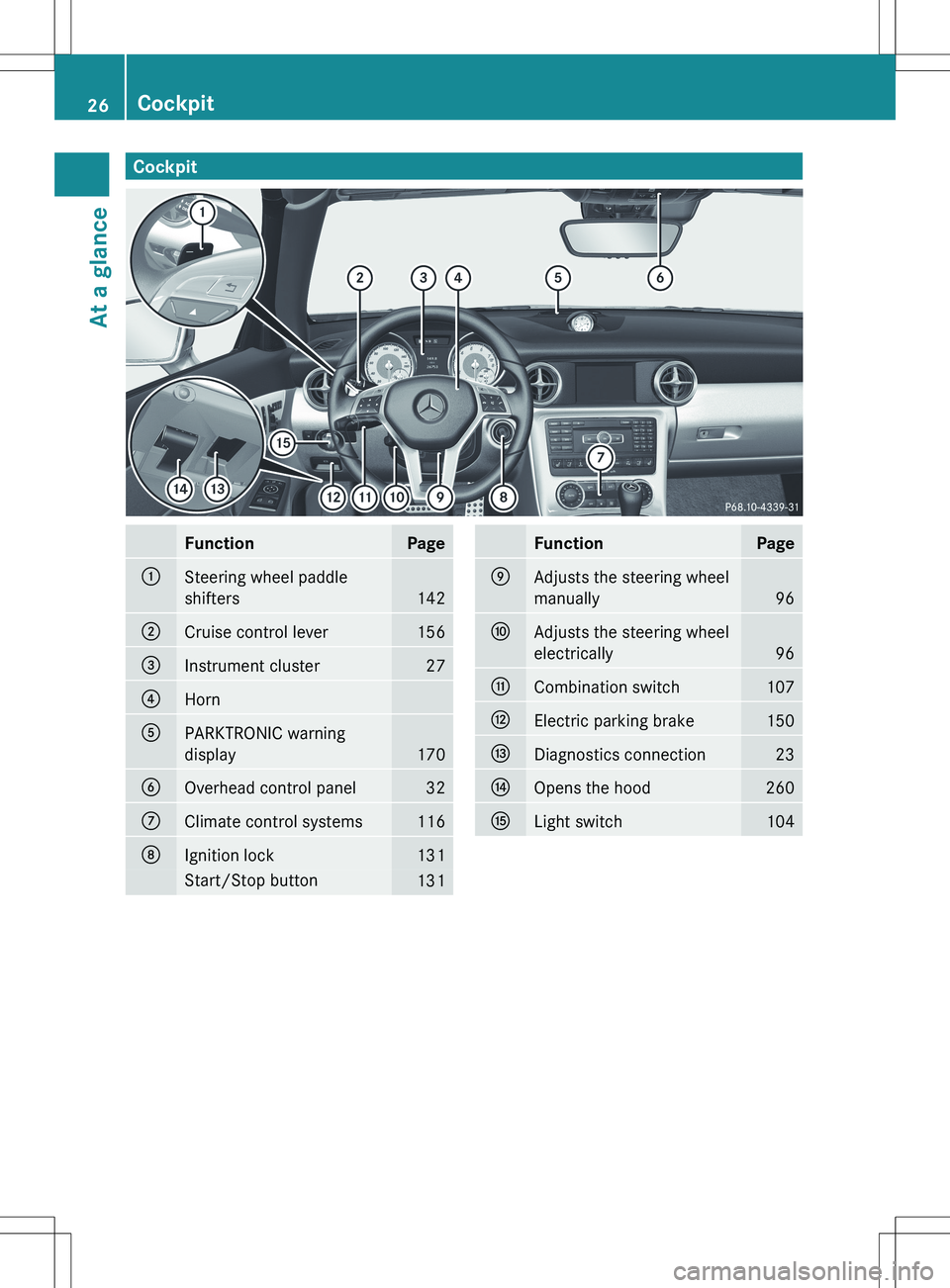
CockpitFunctionPage:Steering wheel paddle
shifters
142
;Cruise control lever156=Instrument cluster27?HornAPARKTRONIC warning
display
170
BOverhead control panel32CClimate control systems116DIgnition lock131Start/Stop button131FunctionPageEAdjusts the steering wheel
manually
96
FAdjusts the steering wheel
electrically
96
GCombination switch107HElectric parking brake150IDiagnostics connection23JOpens the hood260KLight switch10426CockpitAt a glance
Page 29 of 336
Instrument cluster
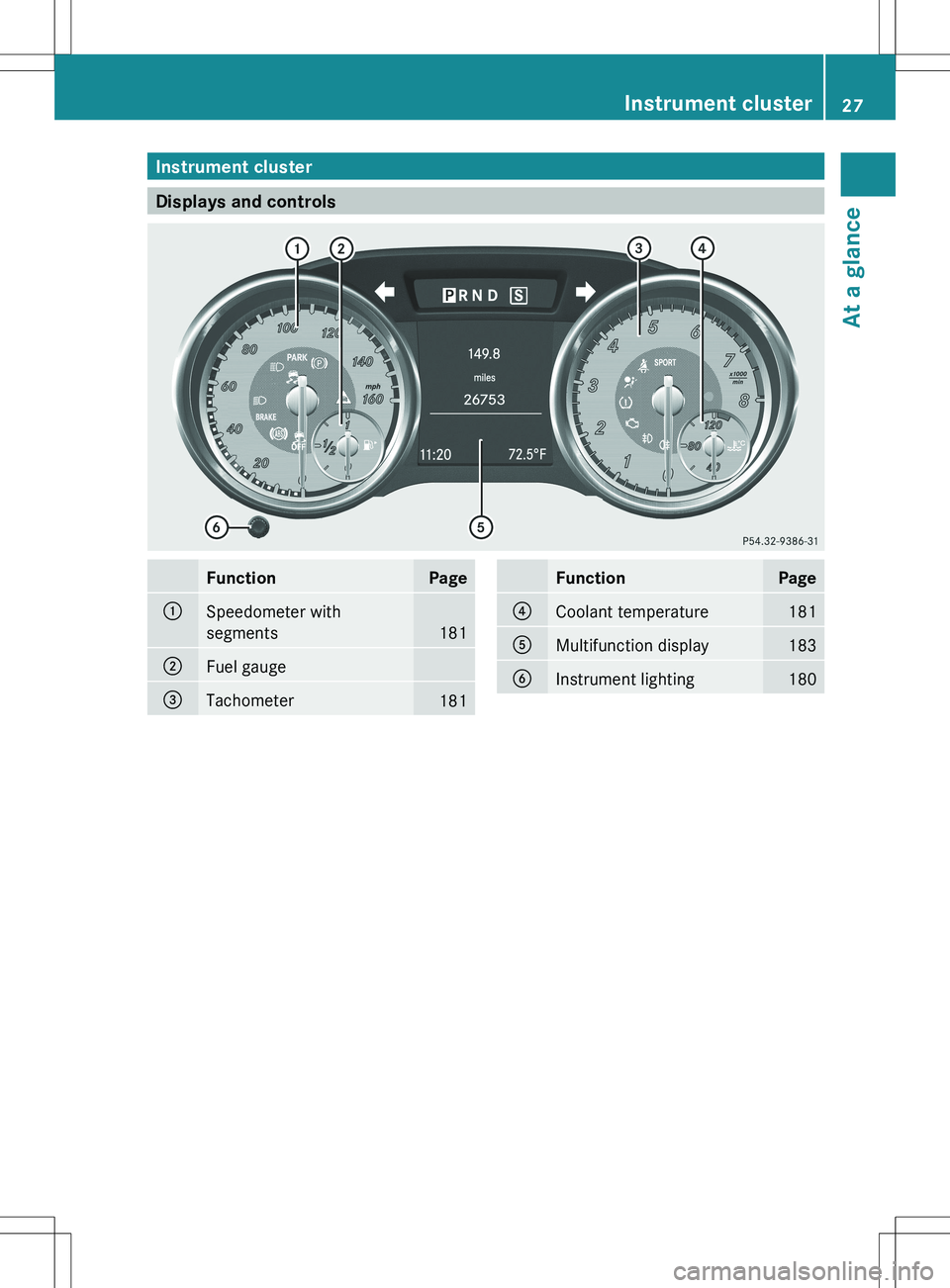
Displays and controls
FunctionPage:Speedometer with
segments
181
;Fuel gauge=Tachometer181FunctionPage?Coolant temperature181AMultifunction display183BInstrument lighting180Instrument cluster27At a glance
Page 33 of 336
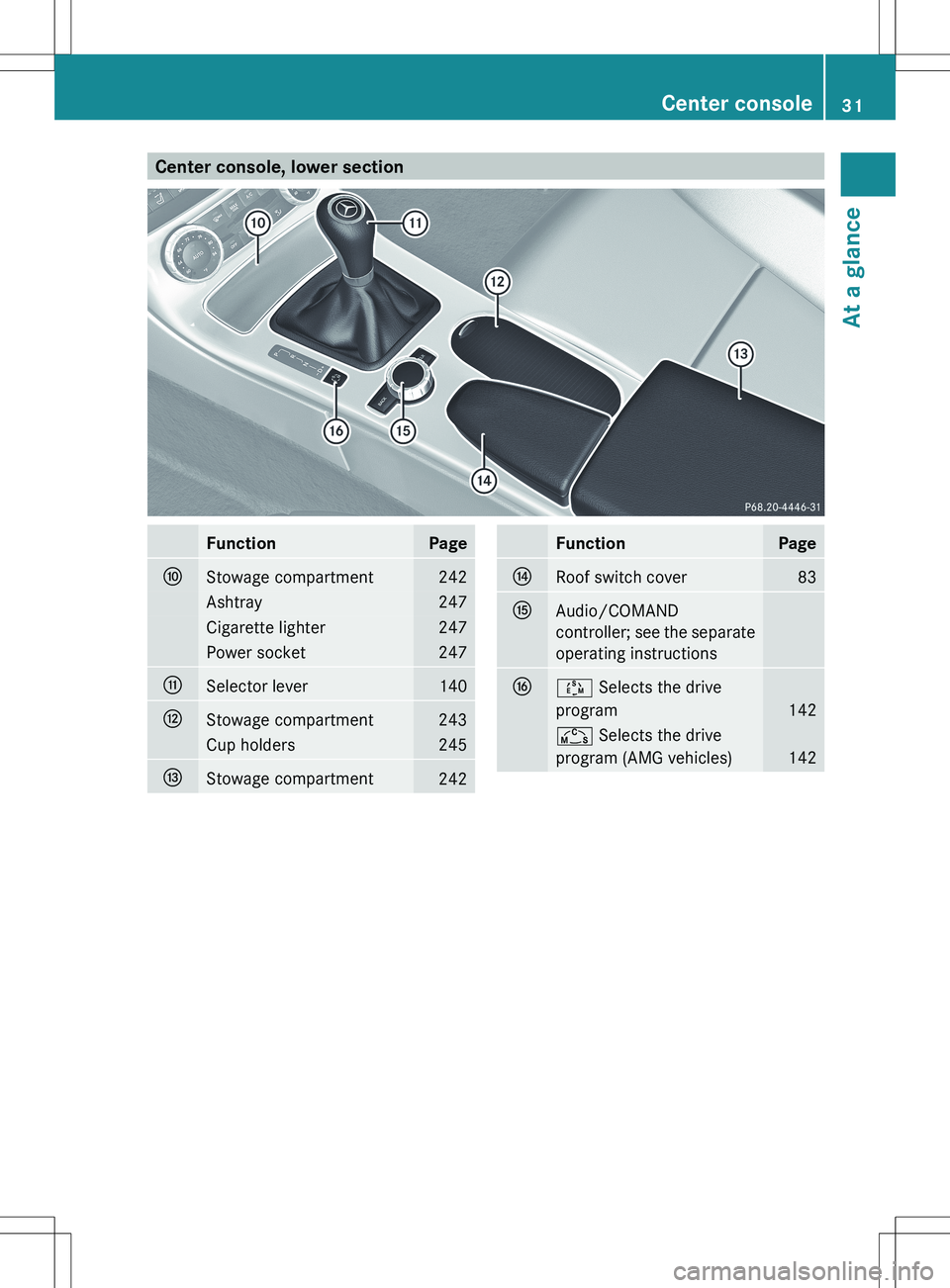
Center console, lower sectionFunctionPageFStowage compartment242Ashtray247Cigarette lighter247Power socket247GSelector lever140HStowage compartment243Cup holders245IStowage compartment242FunctionPageJRoof switch cover83KAudio/COMAND
controller; see the separate
operating instructionsLÚ Selects the drive
program
142
Ñ Selects the drive
program (AMG vehicles)
142
Center console31At a glance
Page 34 of 336
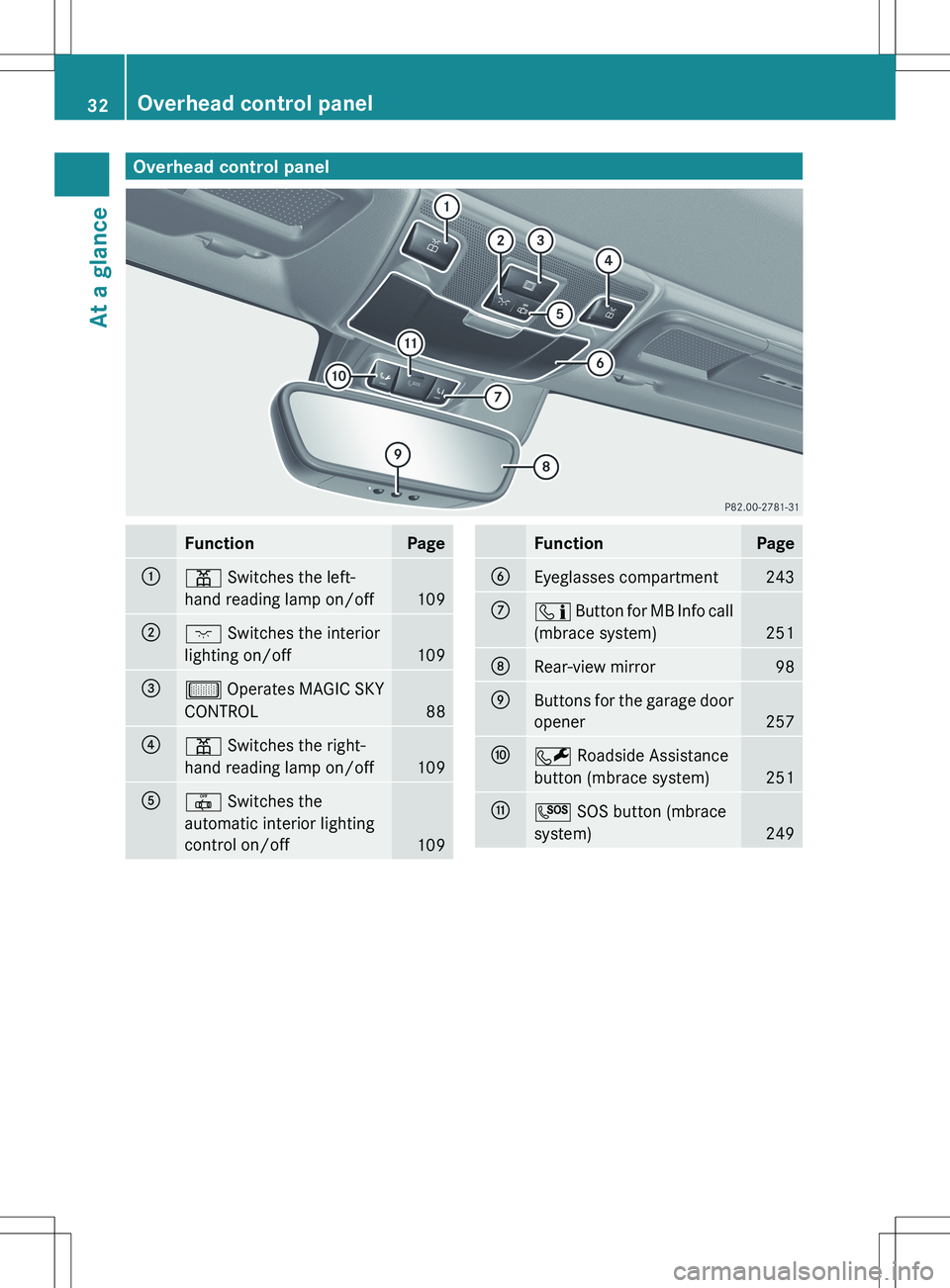
Overhead control panelFunctionPage:p Switches the left-
hand reading lamp on/off
109
;c Switches the interior
lighting on/off
109
=µ Operates MAGIC SKY
CONTROL
88
?p Switches the right-
hand reading lamp on/off
109
A| Switches the
automatic interior lighting
control on/off
109
FunctionPageBEyeglasses compartment243Cï Button for MB Info call
(mbrace system)
251
DRear-view mirror98EButtons for the garage door
opener
257
FF Roadside Assistance
button (mbrace system)
251
GG SOS button (mbrace
system)
249
32Overhead control panelAt a glance
Page 38 of 336
Useful information
i This Operator's Manual describes all
models and all standard and optional
equipment of your vehicle available at the
time of publication of the Operator's
Manual. Country-specific differences are
possible. Please note that your vehicle may
not be equipped with all features
described. This also applies to safety-
related systems and functions.
i Please read the information on qualified
specialist workshops ( Y page 23).
Occupant safety
Overview of occupant safety
In this section, you will learn the most
important facts about the restraint system
components of the vehicle.
The restraint system consists of:
R seat belts
R child restraint systems
Additional protection is provided by:
R SRS (Supplemental Restraint System)
R NECK-PRO head restraints
R Air bag system components with:
- PASSENGER AIR BAG ON/OFF indicator
lamp 2
- front-passenger seat with Occupant
Classification System (OCS)
The different air bag systems work
independently of each other. The protective
functions of the system work in conjunction
with each other. Not all air bags are deployed
in an accident.
GWARNING
Modifications to or work improperly
conducted on restraint system components
or their wiring, as well as tampering with
interconnected electronic systems, can lead
to the restraint systems no longer functioning
as intended.
Air bags or Emergency Tensioning Devices
(ETDs), for example, could deploy
inadvertently or fail to deploy in accidents
although the deceleration threshold for air
bag deployment is exceeded. Therefore,
never modify the restraint systems. Do not
tamper with electronic components or their
software.
i See "Children in the vehicle"
( Y page 53) for more information on
infants and children traveling with you in
the vehicle and restraints for infants and
children.
SRS (Supplemental Restraint System)
Introduction
SRS consists of:
R the 6 SRS warning lamp
R air bags
R air bag control unit (with crash sensors)
R Emergency Tensioning Devices
R belt force limiters
SRS reduces the risk of occupants coming
into contact with the vehicle's interior in the
event of an accident. It can also reduce the
effect of the forces to which occupants are
subjected during an accident.
SRS warning lamp
SRS functions are checked regularly when
you switch on the ignition and when the
engine is running. Therefore, malfunctions
can be detected in good time.
The 6 SRS warning lamp in the instrument
cluster lights up when the ignition is switched
on. It goes out no later than a few seconds
after the engine is started.
2 The PASSENGER AIR BAG ON indicator lamp has no function. When switching on the ignition, it lights up
briefly and then goes out again.36Occupant safetySafety
Page 39 of 336
The SRS components are in operational
readiness if the 6 SRS warning lamp is not
lit while the engine is running.GWARNING
The SRS self-check has detected a
malfunction if the 6 SRS indicator lamp:
R does not light up at all
R does not go out after approximately four
seconds after the engine is started
R comes on after the engine was started or
while driving.
For your safety, Mercedes-Benz strongly
recommends that you have the system
checked as soon as possible at an authorized
Mercedes-Benz Center. SRS may otherwise
fail to activate when it is needed in the event
of an accident, which could lead to serious or
fatal injuries. SRS might also be activated
unexpectedly and unnecessarily, which could
also result in injury.
In addition, work carried out improperly on
SRS may render SRS inoperative or cause
unintended air bag deployment. Work on the
SRS system should only be carried out by
qualified specialist personnel. Consult an
authorized Mercedes-Benz Center.
If it is necessary to modify an air bag system
to accommodate a person with disabilities,
contact an authorized Mercedes-Benz Center
for details. USA only: for further information
contact our Customer Assistance center at
1-800-FOR-MERCedes (1-800-367-6372).
Safety guidelines for seat belts,
Emergency Tensioning Devices (ETDs)
and air bags
GWARNING
R Damaged seat belts or seat belts that have
been subjected to stress in an accident
must be replaced. Their anchoring points
must also be checked. Only use seat belts
installed or supplied by an authorized
Mercedes-Benz Center.
R Air bags and pyrotechnic Emergency
Tensioning Devices (ETDs) contain
perchlorate material, which may require
special handling and regard for the
environment. Check your national disposal
guidelines. California residents, see
www.dtsc.ca.gov/HazardousWaste/
Perchlorate/index.cfm .
R Air bags and ETDs are designed to function
on a one-time-only basis. An air bag or ETD
that has deployed must be replaced.
R Do not pass seat belts over sharp edges.
They could tear.
R Do not make any modification that could
change the effectiveness of the seat belts.
R Do not bleach or dye seat belts as this may
severely weaken them. In a crash they may
not be able to provide adequate protection.
R No modifications of any kind may be made
to any components or wiring of the SRS.
R Do not change or remove any component
or part of the SRS.
R Do not install additional trim material, seat
covers, badges, etc. over the steering
wheel hub, front-passenger front air bag
cover, outer sides of the seat backrests,
door trim panels, or door frame trims.
R Do not install additional electrical/
electronic equipment on or near SRS
components and wiring.
R Keep area between air bags and occupants
free of objects (e.g. packages, purses,
umbrellas, etc.).
R Air bag system components will be hot after
an air bag has inflated. Do not touch them.
R Never place your feet on the instrument
panel, dashboard, or on the seat. Always
keep both feet on the floor in front of the
seat.
R Improper repair work on the SRS creates a
risk of rendering the SRS inoperative or
causing unintended air bag deployment.
Work on the SRS must therefore only beOccupant safety37SafetyZ
Page 42 of 336
They are deployed:
R in the event of certain frontal impacts
R if the system determines that air bag
deployment can offer additional protection
to that provided by the seat belt
R if the seat belt is fastened
R independently of other air bags in the
vehicle
If the vehicle overturns, the front air bags are
generally not deployed. If the system detects
high vehicle deceleration in a longitudinal
direction, the front air bags are deployed.
Your vehicle has adaptive, two-stage front air
bags. In the event of a collision, the air bag
control unit evaluates the vehicle
deceleration. In the first deployment stage,
the front air bag is filled with enough
propellant gas to reduce the risk of injuries.
The front air bag is fully deployed if a second
deployment threshold is exceeded within a
few milliseconds.
The deployment of the front-passenger front
air bag is also influenced by the weight
category of the front passenger, which is
determined by the Occupant Classification
System (OCS) ( Y page 42).
The lighter the passenger-side occupant, the
higher the vehicle deceleration rate required
(predicted at the start of the impact) for
second stage inflation of the front-passenger
front air bag. In the second stage, the front
air bags are inflated with the maximum
amount of propellant gas available.
The front air bags are not deployed in
situations where a low impact severity is
predicted. You will then be protected by the
fastened seat belt.The front-passenger front air bag will only
deploy if:
R the system, based on the OCS weight
sensor readings, detects that the front-
passenger seat is occupied.
R the ^a indicator lamp in the center
console is not lit, ( Y page 42).
R the air bag control unit predicts a high
impact severity.
Knee bagsGWARNING
Observe "Important safety notes"
( Y page 38).
Knee bags provide increased protection for
the driver and front passenger against the risk
of:
R knee injuries
R thigh injuries
R lower leg injuries
Driver's knee bag ?(Y page 39) deploys
underneath the steering column and front-
passenger knee bag =(Y page 39)
underneath the glove box. They deploy
together with the front air bags. They are
designed to operate together with the front
air bags in frontal impacts if certain
thresholds are exceeded. The knee bags
operate at best in conjunction with correctly
positioned and fastened seat belts.
Side impact air bags
GWARNING
The pressure sensors for side impact air bag
control are located in the doors. Do not
modify any components of the doors or door
trim panels including, for example, the
addition of door speakers.
Improper repair work on the doors or the
modification or addition of components to the
doors create a risk of rendering the side
impact air bags inoperative or causing
unintended air bag deployment. Work on the
40Occupant safetySafety
Page 46 of 336
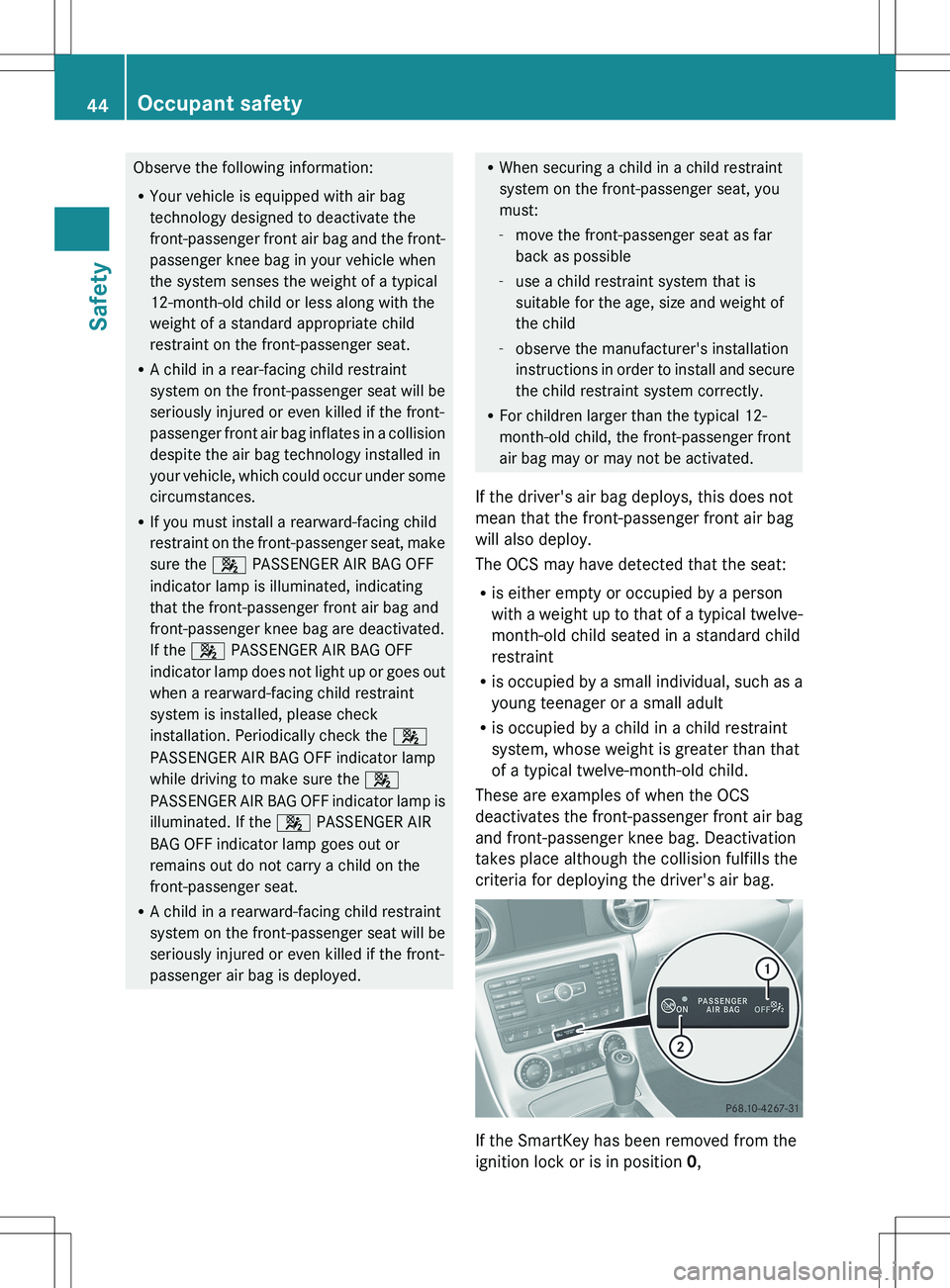
Observe the following information:
R Your vehicle is equipped with air bag
technology designed to deactivate the
front-passenger front air bag and the front-
passenger knee bag in your vehicle when
the system senses the weight of a typical
12-month-old child or less along with the
weight of a standard appropriate child
restraint on the front-passenger seat.
R A child in a rear-facing child restraint
system on the front-passenger seat will be
seriously injured or even killed if the front-
passenger front air bag inflates in a collision
despite the air bag technology installed in
your vehicle, which could occur under some
circumstances.
R If you must install a rearward-facing child
restraint on the front-passenger seat, make
sure the 4 PASSENGER AIR BAG OFF
indicator lamp is illuminated, indicating
that the front-passenger front air bag and
front-passenger knee bag are deactivated.
If the 4 PASSENGER AIR BAG OFF
indicator lamp does not light up or goes out
when a rearward-facing child restraint
system is installed, please check
installation. Periodically check the 4
PASSENGER AIR BAG OFF indicator lamp
while driving to make sure the 4
PASSENGER AIR BAG OFF indicator lamp is
illuminated. If the 4 PASSENGER AIR
BAG OFF indicator lamp goes out or
remains out do not carry a child on the
front-passenger seat.
R A child in a rearward-facing child restraint
system on the front-passenger seat will be
seriously injured or even killed if the front-
passenger air bag is deployed.R When securing a child in a child restraint
system on the front-passenger seat, you
must:
- move the front-passenger seat as far
back as possible
- use a child restraint system that is
suitable for the age, size and weight of
the child
- observe the manufacturer's installation
instructions in order to install and secure
the child restraint system correctly.
R For children larger than the typical 12-
month-old child, the front-passenger front
air bag may or may not be activated.
If the driver's air bag deploys, this does not
mean that the front-passenger front air bag
will also deploy.
The OCS may have detected that the seat:
R is either empty or occupied by a person
with a weight up to that of a typical twelve-
month-old child seated in a standard child
restraint
R is occupied by a small individual, such as a
young teenager or a small adult
R is occupied by a child in a child restraint
system, whose weight is greater than that
of a typical twelve-month-old child.
These are examples of when the OCS
deactivates the front-passenger front air bag
and front-passenger knee bag. Deactivation
takes place although the collision fulfills the
criteria for deploying the driver's air bag.
If the SmartKey has been removed from the
ignition lock or is in position 0,
44Occupant safetySafety
Page 47 of 336
^a indicator lamp : does not light
up.
The _^ indicator lamp has no
function. It lights up briefly when the ignition
is switched on and then goes out again.GWARNING
If the red 6 SRS warning lamp in the
instrument cluster and the 4 PASSENGER
AIR BAG OFF indicator lamp light up
simultaneously, the OCS is malfunctioning.
The front-passenger front air bag and the
front-passenger knee bag will be deactivated
in this case. Have the system checked as soon
as possible by qualified technicians. Consult
an authorized Mercedes-Benz Center.
Only have the seat repaired at an authorized
Mercedes-Benz Center.
In order to ensure correct operation of the air
bag system and OCS:
R sit with the seat belt fastened correctly and
in a position that is as upright as possible
with your back against the backrest.
R while seated, an occupant should not
position themselves in such a way as to
cause their weight to be lifted from the seat
cushion as this may result in OCS being
unable to correctly assess the occupant's
weight category.
R read and observe all warnings in this
section.
System self-test
The ^a indicator lamp illuminates
when you:
R turn the SmartKey to position 1 or 2 in the
ignition lock
R press the KEYLESS-GO Start/Stop button
once or twice
If an adult occupant is sitting properly on the
front-passenger seat and the OCS classifies
the occupant as an adult, the ^a
indicator lamp will illuminate and go out again
after approximately six seconds.
If the seat is not occupied and the OCS
classifies the front passenger seat as being
unoccupied, the ^a indicator lamp
will illuminate and not go out.GWARNING
If the 4 PASSENGER AIR BAG OFF
indicator lamp does not illuminate, the system
is not functioning. Consult an authorized
Mercedes-Benz Center before seating a child
on the front-passenger seat.
For more information, see "Problems with the
Occupant Classification System"
( Y page 46).
GWARNING
Never place anything between seat cushion
and child seat (e.g. a pillow), since it reduces
the effectiveness of the OCS. The underside
and rear side child restraint system must be
placed entirely on the seat cushion and the
backrest of the front-passenger seat
backrest.
If necessary, adjust the tilt of the passenger
seat backrest.
An incorrectly mounted child seat could cause
injuries to the child in case of an accident,
instead of increasing protection for the child.
Follow the manufacturer's instructions for
installation of child restraint systems.
Occupant safety45SafetyZ