esp MERCEDES-BENZ SLK500 2011 R170 Owner's Manual
[x] Cancel search | Manufacturer: MERCEDES-BENZ, Model Year: 2011, Model line: SLK500, Model: MERCEDES-BENZ SLK500 2011 R170Pages: 312, PDF Size: 5.64 MB
Page 279 of 312
Mounting the spare wheel
Introduction X
Prepare the vehicle as described
(Y page 273).
X Take the following out of the vehicle:
R
spare wheel
R jack
R wheel wrench
R collapsible wheel chock
R wheel bolts for spare wheel
R alignment bolt
R electric air pump
For information on where to find the
respective items, see “Where will I find ...?”
(Y page 234) and ( Y page 235).
i Vehicles without spare wheel are not
factory-equipped
with the tools required for
a wheel change such as a jack or a wheel
wrench. Some tools required for a wheel
change are specific to your vehicle.
Contact an authorized Mercedes-Benz
Center to obtain the tools approved for
your vehicle. This section describes the
wheel change using the tools approved and
recommended for your vehicle.
Lifting the vehicle G
Warning!
When jacking up the vehicle, only use the jack
which has been specifically approved by
Mercedes-Benz for your vehicle.
The
jack is designed exclusively for jacking up
the vehicle at the jack take-up brackets built
into both sides of the vehicle. Make sure the
jack arm is fully seated in the jack take-up
bracket. The jack must always be vertical
when in use, especially on inclines or
declines.
The jack is intended only for lifting the vehicle
briefly for wheel changes. It is not suited for
performing maintenance work under the vehicle. To help avoid personal injury, use the
jack only to lift the vehicle during a wheel
change.
Never get beneath the vehicle while it is
supported by the jack. Keep hands and feet
away from the area under the lifted vehicle.
Always lower the vehicle onto sufficient
capacity
jackstands before working under the
vehicle.
Always engage the parking brake firmly and
block the wheels with wheel chocks or other
sizeable objects before raising the vehicle
with the jack. Do not disengage the parking
brake while the vehicle is raised.
Make sure that the ground on which the
vehicle is standing and where you place the
jack is solid, level and not slippery. If
necessary, use a large underlay. On slippery
surfaces, such as tiled floors, you should use
a non-slip underlay, for example a rubber mat.
Do not use wooden blocks or similar objects
to support the jack. Otherwise the jack may
not be able to achieve its load-bearing
capacity if it is not at its full height.
Never start the engine when the vehicle is
raised.
Also observe the notes on the jack.
X Prevent the vehicle from rolling away by
blocking
wheels with wheel chocks or other
sizeable objects.
When your vehicle is equipped with a wheel
chock, it is included with the vehicle tool kit
(Y page 234). For information on setting up
the collapsible wheel chock, see
(Y page 234).
When changing a wheel on a level surface:
X Place a wheel chock or other sizeable
object
in front of and another wheel chock
or other sizeable object behind the wheel
that is diagonally opposite to the wheel
being changed. Flat tire
277
Practical hints
171_AKB; 3; 60, en-US
d2ureepe, Version: 2.11.8.1 2009-05-11T16:00:23+02:00 - Seite 277 Z
Page 284 of 312
loose if they are not tightened to a torque of
80 lb-ft (110 Nm).
X Fully collapse the jack, with handle folded
in (storage position), see ( Y page 235).
X Store the jack and the other vehicle tools
in the designated storage space.
X If so equipped, wrap the damaged wheel in
the protective wrap provided with the
vehicle tool kit and put the wheel in the
trunk.
The retractable hardtop must be closed.
For information on storing the spare wheel
after it has been replaced by a regular road
wheel, see ( Y page 235). Battery
Safety notes
A battery should always be sufficiently
charged in order to achieve its rated service
life. Refer to Maintenance Booklet for battery
maintenance intervals.
If you use your vehicle mostly for short-
distance trips, you will need to have the
battery charge checked more frequently.
When replacing a battery, always use a
battery approved by Mercedes-Benz.
If you do not intend to operate your vehicle
for an extended period of time, contact an
authorized Mercedes-Benz Center about
steps you need to observe. G
Warning!
Observe all safety instructions and
precautions when handling automotive
batteries.Risk of explosion.
Fire, open flames and
smoking are prohibited
when handling batteries.
Avoid creating sparks.
Battery acid is caustic. Do
not allow it to come into
contact with skin, eyes or
clothing.
Wear suitable protective
clothing, especially gloves,
apron and faceguard.
Wear eye protection.
Rinse any acid spills
immediately with clear
water. Contact a physician
if necessary.
Keep children away.
Follow the instructions in
this Operator’s Manual.
A battery contains materials that can harm
the environment if disposed of improperly. A
large 12 V storage battery contains lead.
Recycling of the battery is the preferred
method of disposal. Many states (USA only)
or provinces (Canada only) require sellers of
batteries to accept the old battery for
recycling.
G Warning!
Failure to follow these instructions can result
in severe injury or death.
Never lean over batteries while connecting.
You might get injured.
Battery fluid contains sulfuric acid. Do not
allow this fluid to come in contact with eyes,
skin or clothing. In case it does, immediately
flush affected area with water and seek
medical help if necessary.
A battery will also produce hydrogen gas,
which is flammable and explosive. Keep
flames or sparks away from battery, avoid
improper connection of jumper cables,
smoking etc.
282 Battery
Practical hints
171_AKB; 3; 60, en-US
d2ureepe,
Version: 2.11.8.1 2009-05-11T16:00:23+02:00 - Seite 282
Page 289 of 312
X
Press mark on cover : as indicated by the
arrow.
X Lift cover : off to reveal the threaded hole
for the towing eye bolt.
Fixing towing eye bolt Example illustration front bumper
X
Take the towing eye bolt and, if so
equipped, the wheel wrench from the
vehicle tool kit (Y page 234).
X Screw towing eye bolt ; clockwise into
threaded hole to its stop.
X Insert wheel wrench into towing eye and
tighten towing eye bolt ; by turning it
clockwise.
or
X If your vehicle is not equipped with a wheel
wrench, use a suitable object to turn the
towing eye bolt. Removing towing eye bolt X
Loosen towing eye bolt ; by turning it
counterclockwise.
X Unscrew towing eye bolt ;.
X Reinstalling cover: Fit cover :
(Y page 286) and snap it into place.
X Store the towing eye bolt ; and wheel
wrench back into the vehicle tool kit. Towing with front axle raised
! The vehicle may be towed only for
distances up to 30 miles (50 km) and at a
speed not to exceed 30 mph (50 km/h).
X Make sure the ignition is switched on.
X With the vehicle at a standstill, depress the
brake pedal and keep it pressed.
X Vehicles with manual transmission: Shift
the manual transmission into the neutral
position (no gear selected).
or
X Vehicles with automatic transmission: Shift
the automatic transmission into neutral
position N.
X Release the brake pedal.
X If engaged, release the parking brake.
X Switch off the automatic central locking
(Y page 108).
X Switch off the ignition and leave the
SmartKey in the starter switch.
X Switch on the hazard warning flasher
(Y page 74).
! Because the ESP ®
operates
automatically, the engine and ignition must
be shut off (SmartKey in starter switch
position 0 or 1) when the vehicle is being
towed with the front axle raised.
Active braking action through the ESP ®
may otherwise seriously damage the brake
system which is not covered by the
Mercedes-Benz Limited Warranty. Towing the vehicle
287Practical hints
171_AKB; 3; 60, en-US
d2ureepe, Version: 2.11.8.1 2009-05-11T16:00:23+02:00 - Seite 287 Z
Page 296 of 312
Vehicle specification SLK 300
(171.454)
The quoted data apply only to the standard
vehicle. Contact an authorized Mercedes-
Benz
Center for the corresponding data of all
special bodies and special equipment. Engine SLK 300
Engine, type
272
Mode of operation
4-stroke engine,
gasoline injection No. of cylinders
6
Bore
3.46 in (88.00 mm)
Stroke
3.23 in (82.10 mm)
Total piston
displacement
182.8 cu in
(2 996 cm 3
) Compression
ratio
11.3:1
Output acc. to
SAE J 1349
17 228 hp/6
100 rpm
(170 kW/6 100 rpm) Maximum torque
acc.
to SAE J 1349 221 lb-ft/
2 500 - 5 000 rpm
(300 Nm/
2 500 - 5 000 rpm) Maximum engine
speed
6 500 rpm
Firing order
1-4-3-6-2-5
Poly-V-belt
2 401 mm
Electrical system SLK 300
Alternator
14 V/150 A
Starter motor
12 V/1.4 kW
Battery
12 V/74 Ah Electrical system SLK 300
Spark plugs, type
Bosch Y 7 MPP33
Spark plugs,
electrode gap
0.031 in (0.8 mm)
Spark plugs,
tightening torque
15 - 18 lb-ft
(20 - 25 Nm) Main dimensions SLK 300
Overall vehicle
length
161.7 in (4
107 mm) Overall vehicle
width
18 79.2 in (2
012 mm) Overall vehicle
height
51.0 in (1
296 mm) 60.8 in (1
545 mm) 19 Wheelbase
95.7 in (2
430 mm) Track, front
60.2 in (1
530 mm) Track, rear
61.0 in (1
549 mm) Turning circle
34.5 ft (10.5 m)
Weights SLK 300
Roof load
max. 110 lb (50 kg)
Trunk load
max. 220 lb (100 kg)
!
This
vehicle is not designed to carry items
on its roof. Roof rails and any roof-mounted
devices, unless expressly approved by
Mercedes-Benz for use on this vehicle
model, must not be used as they will
damage the vehicle and retractable
hardtop.
At time of printing, Mercedes-Benz does
not offer any roof racks or any other roof-
mounted devices for use on this vehicle.
17 Premium fuel required. Performance may vary with fuel octane rating.
18 Exterior rear view mirrors folded out.
19 When opening/closing hardtop. 294
Vehicle specification SLK 300 (171.454)
Technical data
171_AKB; 3; 60, en-US
d2ureepe,
Version: 2.11.8.1 2009-05-11T16:00:23+02:00 - Seite 294
Page 297 of 312
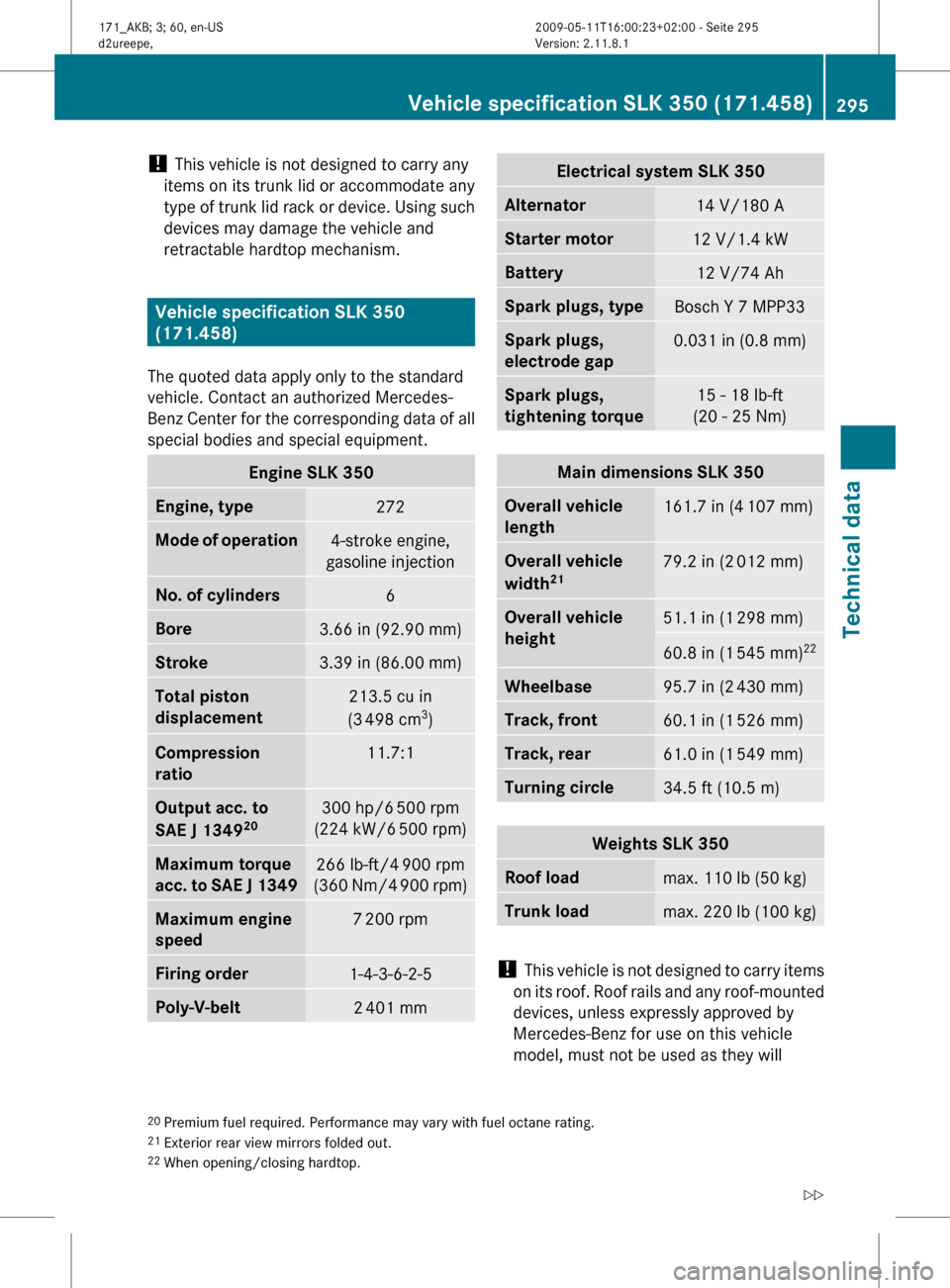
!
This vehicle is not designed to carry any
items on its trunk lid or accommodate any
type
of trunk lid rack or device. Using such
devices may damage the vehicle and
retractable hardtop mechanism. Vehicle specification SLK 350
(171.458)
The quoted data apply only to the standard
vehicle. Contact an authorized Mercedes-
Benz
Center for the corresponding data of all
special bodies and special equipment. Engine SLK 350
Engine, type
272
Mode of operation
4-stroke engine,
gasoline injection No. of cylinders
6
Bore
3.66 in (92.90 mm)
Stroke
3.39 in (86.00 mm)
Total piston
displacement
213.5 cu in
(3 498 cm 3
) Compression
ratio
11.7:1
Output acc. to
SAE J 1349
20 300 hp/6
500 rpm
(224 kW/6 500 rpm) Maximum torque
acc.
to SAE J 1349 266 lb-ft/4
900 rpm
(360 Nm/4 900 rpm) Maximum engine
speed
7 200 rpm
Firing order
1-4-3-6-2-5
Poly-V-belt
2 401 mm Electrical system SLK 350
Alternator
14 V/180 A
Starter motor
12 V/1.4 kW
Battery
12 V/74 Ah
Spark plugs, type
Bosch Y 7 MPP33
Spark plugs,
electrode gap
0.031 in (0.8 mm)
Spark plugs,
tightening torque
15 - 18 lb-ft
(20 - 25 Nm) Main dimensions SLK 350
Overall vehicle
length
161.7 in (4
107 mm) Overall vehicle
width
21 79.2 in (2
012 mm) Overall vehicle
height
51.1 in (1
298 mm) 60.8 in (1
545 mm) 22 Wheelbase
95.7 in (2
430 mm) Track, front
60.1 in (1
526 mm) Track, rear
61.0 in (1
549 mm) Turning circle
34.5 ft (10.5 m)
Weights SLK 350
Roof load
max. 110 lb (50 kg)
Trunk load
max. 220 lb (100 kg)
!
This
vehicle is not designed to carry items
on its roof. Roof rails and any roof-mounted
devices, unless expressly approved by
Mercedes-Benz for use on this vehicle
model, must not be used as they will
20 Premium fuel required. Performance may vary with fuel octane rating.
21 Exterior rear view mirrors folded out.
22 When opening/closing hardtop. Vehicle specification SLK 350 (171.458)
295
Technical data
171_AKB; 3; 60, en-US
d2ureepe, Version: 2.11.8.1 2009-05-11T16:00:23+02:00 - Seite 295 Z
Page 298 of 312
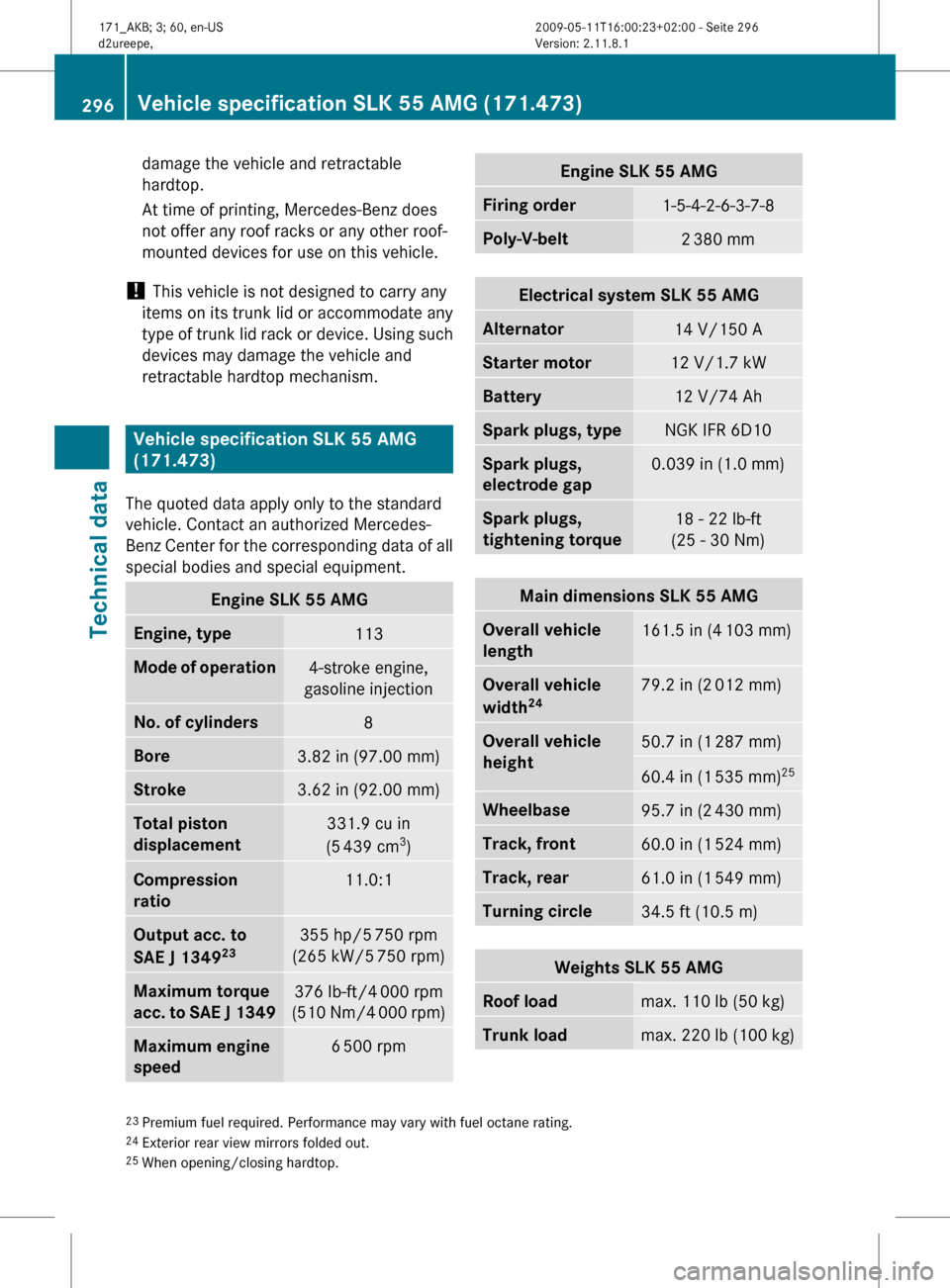
damage the vehicle and retractable
hardtop.
At time of printing, Mercedes-Benz does
not offer any roof racks or any other roof-
mounted devices for use on this vehicle.
! This vehicle is not designed to carry any
items on its trunk lid or accommodate any
type
of trunk lid rack or device. Using such
devices may damage the vehicle and
retractable hardtop mechanism. Vehicle specification SLK 55 AMG
(171.473)
The quoted data apply only to the standard
vehicle. Contact an authorized Mercedes-
Benz
Center for the corresponding data of all
special bodies and special equipment. Engine SLK 55 AMG
Engine, type
113
Mode of operation
4-stroke engine,
gasoline injection No. of cylinders
8
Bore
3.82 in (97.00 mm)
Stroke
3.62 in (92.00 mm)
Total piston
displacement
331.9 cu in
(5 439 cm 3
) Compression
ratio
11.0:1
Output acc. to
SAE J 1349
23 355 hp/5
750 rpm
(265 kW/5 750 rpm) Maximum torque
acc.
to SAE J 1349 376 lb-ft/4
000 rpm
(510 Nm/4 000 rpm) Maximum engine
speed
6 500 rpm Engine SLK 55 AMG
Firing order
1-5-4-2-6-3-7-8
Poly-V-belt
2 380 mm
Electrical system SLK 55 AMG
Alternator
14 V/150 A
Starter motor
12 V/1.7 kW
Battery
12 V/74 Ah
Spark plugs, type
NGK IFR 6D10
Spark plugs,
electrode gap
0.039 in (1.0 mm)
Spark plugs,
tightening torque
18 - 22 lb-ft
(25 - 30 Nm) Main dimensions SLK 55 AMG
Overall vehicle
length
161.5 in (4
103 mm) Overall vehicle
width
24 79.2 in (2
012 mm) Overall vehicle
height
50.7 in (1
287 mm) 60.4 in (1
535 mm) 25 Wheelbase
95.7 in (2
430 mm) Track, front
60.0 in (1
524 mm) Track, rear
61.0 in (1
549 mm) Turning circle
34.5 ft (10.5 m)
Weights SLK 55 AMG
Roof load
max. 110 lb (50 kg)
Trunk load
max. 220 lb (100 kg)
23
Premium fuel required. Performance may vary with fuel octane rating.
24 Exterior rear view mirrors folded out.
25 When opening/closing hardtop. 296
Vehicle specification SLK 55 AMG (171.473)
Technical data
171_AKB; 3; 60, en-US
d2ureepe,
Version: 2.11.8.1 2009-05-11T16:00:23+02:00 - Seite 296
Page 299 of 312
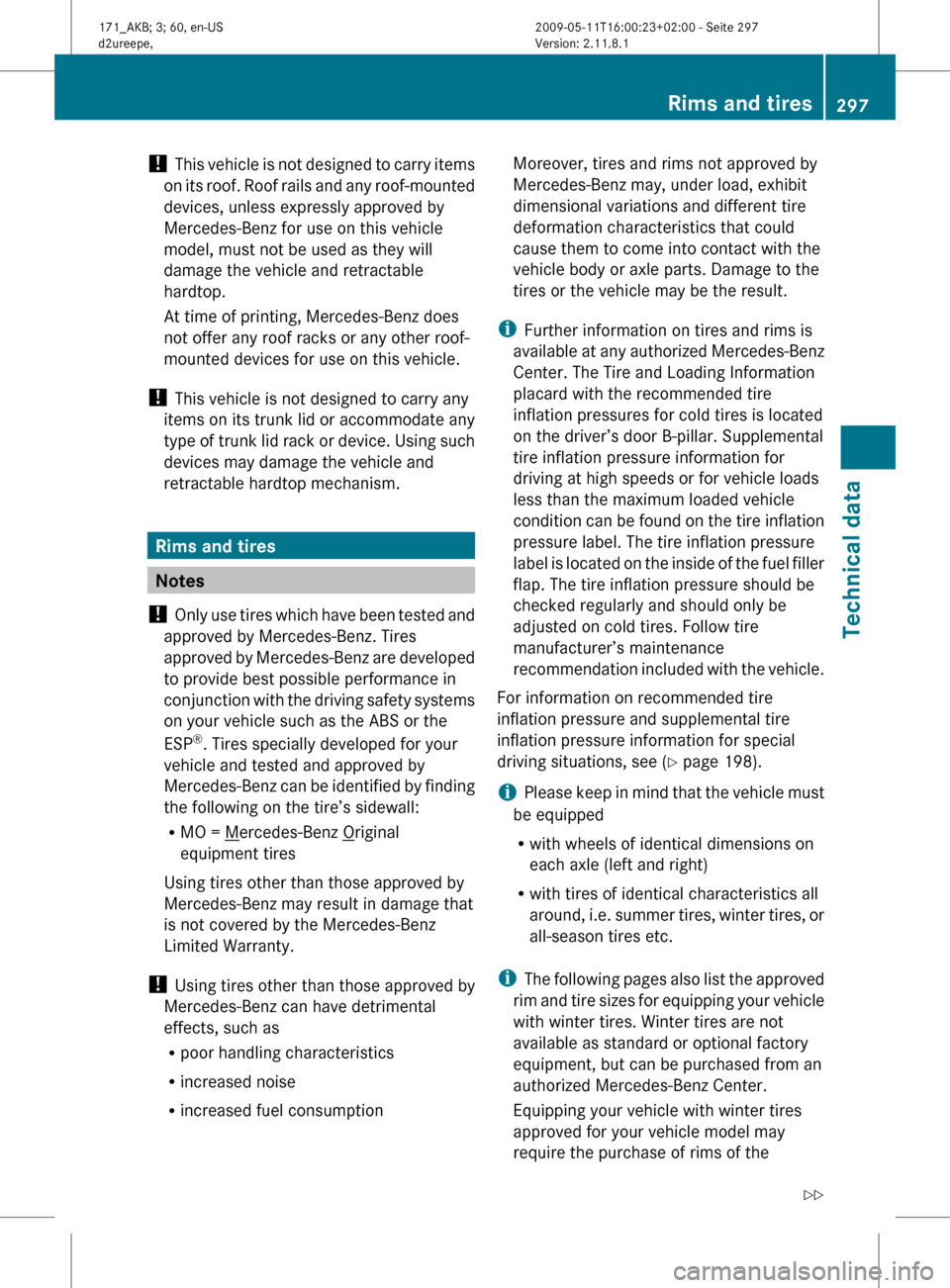
!
This vehicle is not designed to carry items
on its roof. Roof rails and any roof-mounted
devices, unless expressly approved by
Mercedes-Benz for use on this vehicle
model, must not be used as they will
damage the vehicle and retractable
hardtop.
At time of printing, Mercedes-Benz does
not offer any roof racks or any other roof-
mounted devices for use on this vehicle.
! This vehicle is not designed to carry any
items on its trunk lid or accommodate any
type of trunk lid rack or device. Using such
devices may damage the vehicle and
retractable hardtop mechanism. Rims and tires
Notes
! Only
use tires which have been tested and
approved by Mercedes-Benz. Tires
approved by Mercedes-Benz are developed
to provide best possible performance in
conjunction with the driving safety systems
on your vehicle such as the ABS or the
ESP ®
. Tires specially developed for your
vehicle and tested and approved by
Mercedes-Benz can be identified by finding
the following on the tire’s sidewall:
R MO = Mercedes-Benz Original
equipment tires
Using tires other than those approved by
Mercedes-Benz may result in damage that
is not covered by the Mercedes-Benz
Limited Warranty.
! Using tires other than those approved by
Mercedes-Benz can have detrimental
effects, such as
R poor handling characteristics
R increased noise
R increased fuel consumption Moreover, tires and rims not approved by
Mercedes-Benz may, under load, exhibit
dimensional variations and different tire
deformation characteristics that could
cause them to come into contact with the
vehicle body or axle parts. Damage to the
tires or the vehicle may be the result.
i Further information on tires and rims is
available
at any authorized Mercedes-Benz
Center. The Tire and Loading Information
placard with the recommended tire
inflation pressures for cold tires is located
on the driver’s door B-pillar. Supplemental
tire inflation pressure information for
driving at high speeds or for vehicle loads
less than the maximum loaded vehicle
condition can be found on the tire inflation
pressure label. The tire inflation pressure
label is located on the inside of the fuel filler
flap. The tire inflation pressure should be
checked regularly and should only be
adjusted on cold tires. Follow tire
manufacturer’s maintenance
recommendation included with the vehicle.
For information on recommended tire
inflation pressure and supplemental tire
inflation pressure information for special
driving situations, see ( Y page 198).
i Please keep in mind that the vehicle must
be equipped
R with wheels of identical dimensions on
each axle (left and right)
R with tires of identical characteristics all
around, i.e. summer tires, winter tires, or
all-season tires etc.
i The following pages also list the approved
rim and tire sizes for equipping your vehicle
with winter tires. Winter tires are not
available as standard or optional factory
equipment, but can be purchased from an
authorized Mercedes-Benz Center.
Equipping your vehicle with winter tires
approved for your vehicle model may
require the purchase of rims of the Rims and tires
297
Technical data
171_AKB; 3; 60, en-US
d2ureepe, Version: 2.11.8.1 2009-05-11T16:00:23+02:00 - Seite 297 Z
Page 302 of 312
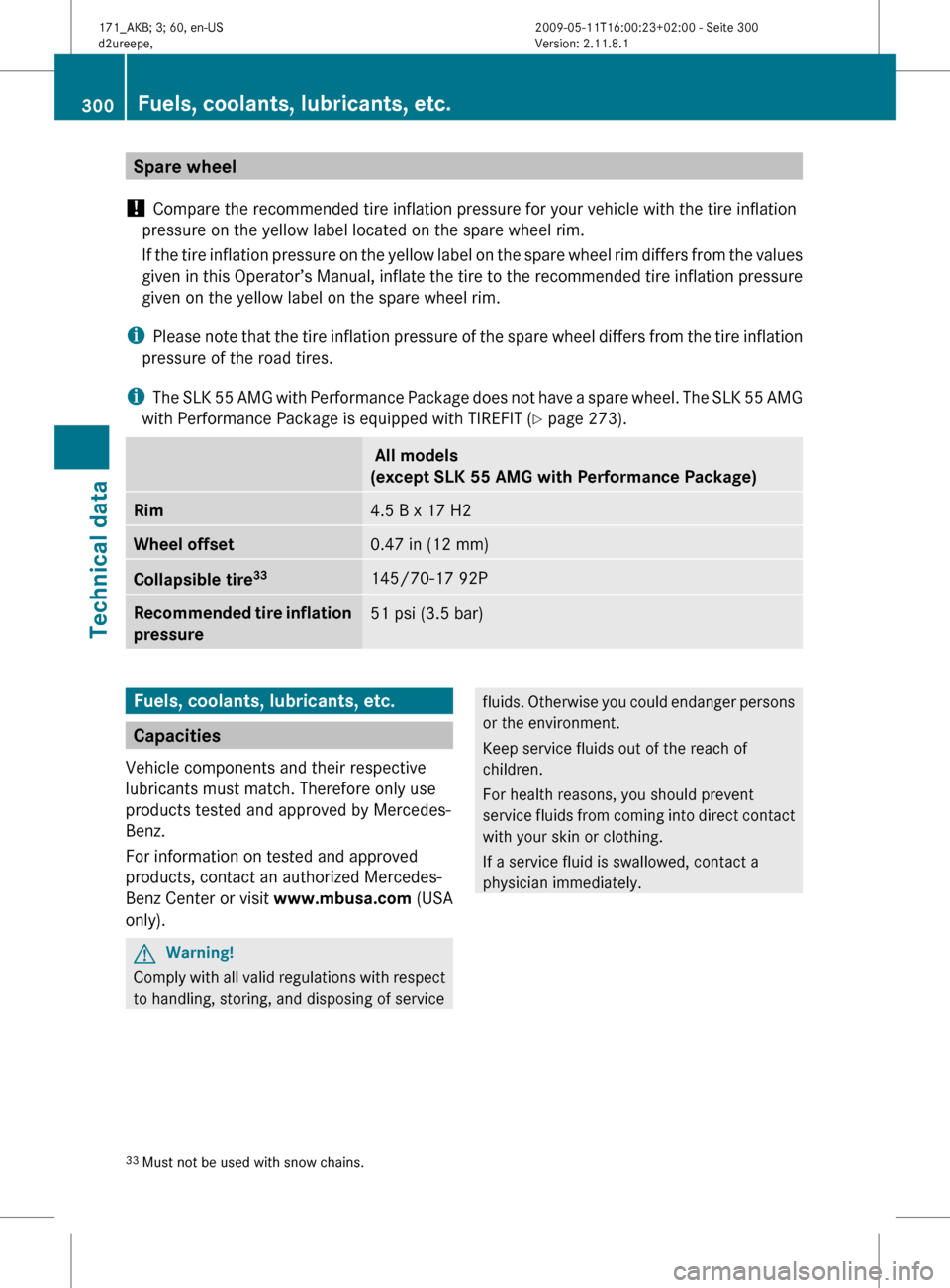
Spare wheel
! Compare the recommended tire inflation pressure for your vehicle with the tire inflation
pressure on the yellow label located on the spare wheel rim.
If
the tire inflation pressure on the yellow label on the spare wheel rim differs from the values
given in this Operator’s Manual, inflate the tire to the recommended tire inflation pressure
given on the yellow label on the spare wheel rim.
i Please note that the tire inflation pressure of the spare wheel differs from the tire inflation
pressure of the road tires.
i The SLK 55 AMG with Performance Package does not have a spare wheel. The SLK 55 AMG
with Performance Package is equipped with TIREFIT ( Y page 273). All models
(except SLK 55 AMG with Performance Package)
Rim
4.5 B x 17 H2
Wheel offset
0.47 in (12 mm)
Collapsible tire
33 145/70-17 92P
Recommended tire inflation
pressure
51 psi (3.5 bar)
Fuels, coolants, lubricants, etc.
Capacities
Vehicle components and their respective
lubricants must match. Therefore only use
products tested and approved by Mercedes-
Benz.
For information on tested and approved
products, contact an authorized Mercedes-
Benz Center or visit www.mbusa.com (USA
only). G
Warning!
Comply with all valid regulations with respect
to handling, storing, and disposing of service fluids. Otherwise you could endanger persons
or the environment.
Keep service fluids out of the reach of
children.
For health reasons, you should prevent
service
fluids from coming into direct contact
with your skin or clothing.
If a service fluid is swallowed, contact a
physician immediately.
33 Must not be used with snow chains. 300
Fuels, coolants, lubricants, etc.
Technical data
171_AKB; 3; 60, en-US
d2ureepe,
Version: 2.11.8.1 2009-05-11T16:00:23+02:00 - Seite 300
Page 306 of 312
of these oxygenates to gasoline does not
exceed 10%; MTBE must not exceed 15%.
The ratio of methanol to gasoline must not
exceed 3% plus additional cosolvents.
Using
mixtures of ethanol and methanol is not
allowed. Gasohol, which contains 10%
ethanol and 90% unleaded gasoline, can be
used.
These blends must also meet all other fuel
requirements, such as resistance to spark
knock, boiling range, vapor pressure, etc. Gasoline additives
A major concern among engine
manufacturers is carbon build-up caused by
gasoline. Mercedes-Benz recommends only
the use of quality gasoline containing
additives that prevent the build-up of carbon
deposits.
After an extended period of using fuels
without such additives carbon deposits can
build up, especially on the intake valves and
in the combustion area, leading to engine
performance problems such as:
R Warm-up hesitation
R Unstable idle
R Knocking/pinging
R Misfire
R Power loss
In areas where carbon deposits may be
encountered due to lack of availability of
gasoline which contains these additives, the
use of Mercedes-Benz approved additives is
recommended.
Contact
an authorized Mercedes-Benz Center
or visit www.mbusa.com (USA only) for a
listing of approved products. Follow
directions on the product label.
Do not blend other fuel additives with fuel.
This only results in unnecessary cost and may
be harmful to the engine operation. !
Damage or malfunction resulting from
poor
fuel quality or from blending additional
fuel additives other than those tested and
approved by us for use on Mercedes-Benz
vehicles are not covered by the Mercedes-
Benz Limited Warranty or by any pre-owned
or Extended Limited Warranties. Coolants
The engine coolant is a mixture of water and
anticorrosion/antifreeze, which provides:
R Corrosion protection
R Freeze protection
R Boiling
protection (by increasing the boiling
point)
The cooling system was filled at the factory
with a coolant providing freeze protection to
approximately -35‡ (-37†) and corrosion
protection.
! Add premixed coolant solution only.
Adding water and MB 325.0 Anticorrosion/
Antifreeze separately from each other,
could cause engine damage not covered by
the Mercedes-Benz Limited Warranty.
If the antifreeze mixture is effective to -35‡
(-37†), the boiling point of the coolant in the
pressurized cooling system is reached at
approximately 266‡ (130†).
The coolant solution must be used year round
to provide the necessary corrosion protection
and increase boil-over protection. Refer to
the Maintenance Booklet for replacement
interval.
Coolant system design and coolant used
determine the replacement interval. The
replacement interval published in the
Maintenance Booklet is only applicable if
MB 325.0 Anticorrosion/Antifreeze solution
or other Mercedes-Benz approved products
of equal specification are used to renew the
coolant concentration or bring it back up to
the proper level. 304
Fuels, coolants, lubricants, etc.
Technical data
171_AKB; 3; 60, en-US
d2ureepe,
Version: 2.11.8.1 2009-05-11T16:00:23+02:00 - Seite 304