engine MERCEDES-BENZ SLS AMG 2011 Owners Manual
[x] Cancel search | Manufacturer: MERCEDES-BENZ, Model Year: 2011, Model line: SLS AMG, Model: MERCEDES-BENZ SLS AMG 2011Pages: 436, PDF Size: 17.73 MB
Page 419 of 436
Leave the engine running under all
circumstances.
Removing the SmartKey from the starter
switch or opening a door with the ignition
switched off will automatically shift the into
park position P.XStart the engine ( Y page 259).XWith the vehicle at a standstill, depress the
brake pedal and keep it pressed.XShift the transmission into neutral position
N .XCheck the transmission position in the
instrument cluster ( Y page 265).XRelease the brake pedal.XIf engaged, release the electronic parking
brake.XSwitch on the hazard warning flasher
( Y page 252).XLeave the engine running throughout the
entire towing procedure.
! The vehicle may be towed only for
distances up to 30 miles (50 km) and at a
speed not to exceed 30 mph (50 km/h).
! Make sure the electronic parking brake is
released. If the electronic parking brake is
malfunctioning, contact an authorized
Mercedes-Benz Center.
! While towing, check the temperature of
the transmission fluid via the control
system in the AMG menu. The transmission
fluid temperature may not rise above 248‡
(120†). Otherwise, the towing procedure
must be stopped immediately.
i While being towed with the hazard
warning flasher in use, use the combination
switch in the usual manner to signal turns.
Only the selected turn signal will operate.
Upon canceling the turn signal, the hazard
warning flasher will operate again.
Fuses
Introduction
The electrical fuses in your vehicle serve to
switch off malfunctioning power circuits.
If a fuse is blown, the components and
systems secured by that fuse will stop
operating.
GWarning!
Only use fuses approved by Mercedes-Benz
with the specified amperage for the system in
question and do not attempt to repair or
bridge a blown fuse. Using other than
approved fuses or using repaired or bridged
fuses may cause an overload leading to a fire,
and/or cause damage to electrical
components and/or systems. Have the cause
determined and remedied by an authorized
Mercedes-Benz Center.
A blown fuse must be replaced by an
appropriate spare fuse (recognizable by its
color or the fuse rating given on the fuse) of
the amperage recommended in the fuse
chart. Any Mercedes-Benz Center will be glad
to advise you on this subject.
i In case of a blown fuse contact Roadside
Assistance or an authorized Mercedes-
Benz Center.
If a newly inserted fuse blows again, have the
cause determined and rectified by an
authorized Mercedes-Benz Center.
The fuse chart is located in the trunk with the
vehicle tool kit ( Y page 362). The fuse chart
explains the fuse allocation and fuse
amperages.
Before replacing fuses
XEngage the electronic parking brake.XMake sure the transmission is in park
position P.XSwitch off all electrical consumers.XTurn off the engine.Fuses417Practical hintsBA 197 USA, CA Edition A 2011; 1; 27, en-UShereepeVersion: 3.0.3.52010-03-24T15:31:10+01:00 - Seite 417Z
Page 423 of 436
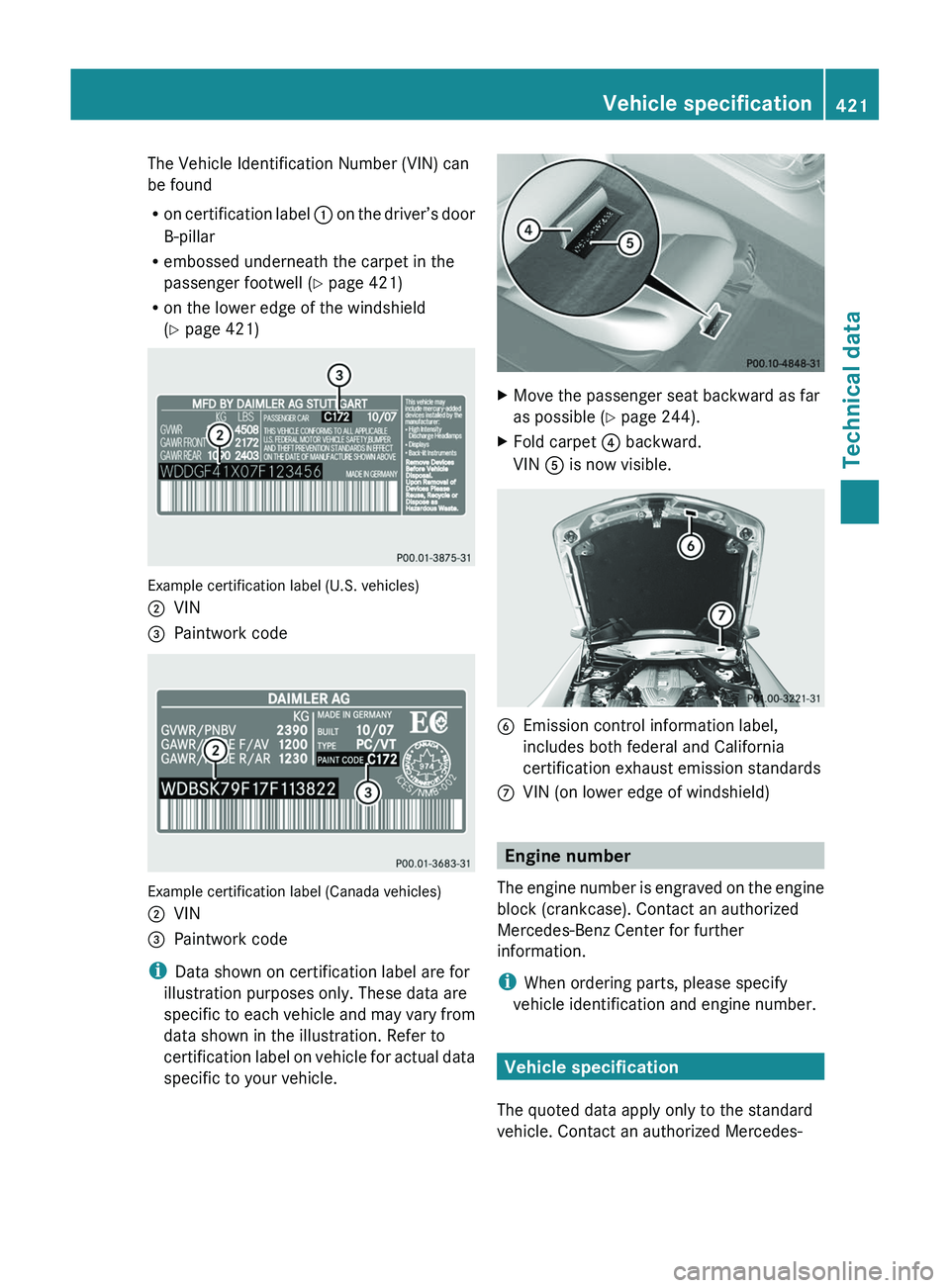
The Vehicle Identification Number (VIN) can
be found
R on certification label 0046 on the driver’s door
B-pillar
R embossed underneath the carpet in the
passenger footwell ( Y page 421)
R on the lower edge of the windshield
( Y page 421)
Example certification label (U.S. vehicles)
0047VIN008APaintwork code
Example certification label (Canada vehicles)
0047VIN008APaintwork code
i
Data shown on certification label are for
illustration purposes only. These data are
specific to each vehicle and may vary from
data shown in the illustration. Refer to
certification label on vehicle for actual data
specific to your vehicle.
XMove the passenger seat backward as far
as possible ( Y page 244). XFold carpet 0088 backward.
VIN 0086 is now visible.0087Emission control information label,
includes both federal and California
certification exhaust emission standards006EVIN (on lower edge of windshield)
Engine number
The engine number is engraved on the engine
block (crankcase). Contact an authorized
Mercedes-Benz Center for further
information.
i When ordering parts, please specify
vehicle identification and engine number.
Vehicle specification
The quoted data apply only to the standard
vehicle. Contact an authorized Mercedes-
Vehicle specification421Technical dataBA 197 USA, CA Edition A 2011; 1; 27, en-UShereepeVersion: 3.0.3.52010-03-24T15:31:10+01:00 - Seite 421
Page 424 of 436
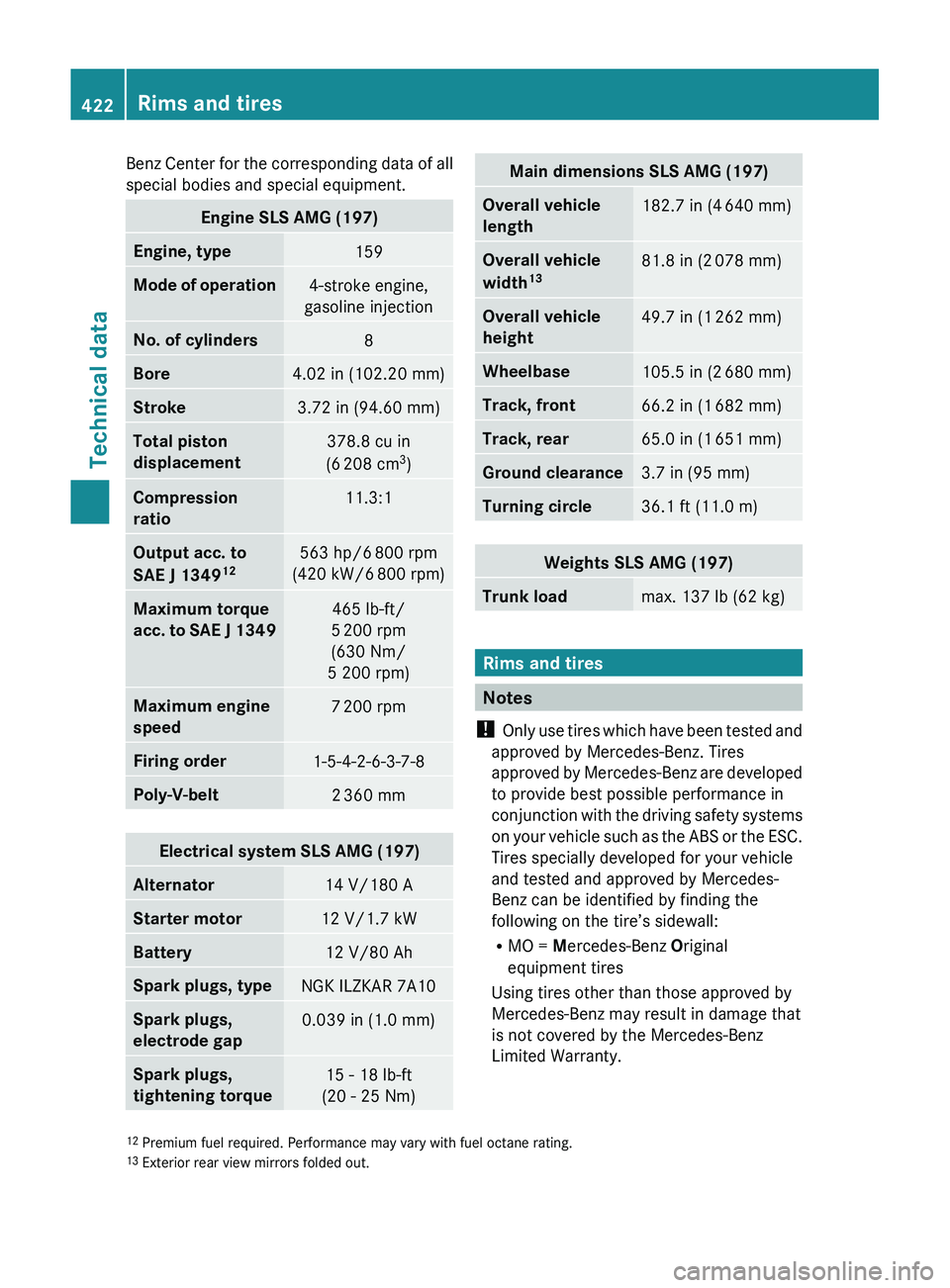
Benz Center for the corresponding data of all
special bodies and special equipment.Engine SLS AMG (197)Engine, type159Mode of operation4-stroke engine,
gasoline injectionNo. of cylinders8Bore4.02 in (102.20 mm)Stroke3.72 in (94.60 mm)Total piston
displacement378.8 cu in
(6 208 cm 3
)Compression
ratio11.3:1Output acc. to
SAE J 1349 12
563 hp/6 800 rpm
(420 kW/6 800 rpm)Maximum torque
acc. to SAE J 1349465 lb-ft/
5 200 rpm
(630 Nm/
5 200 rpm)Maximum engine
speed7 200 rpmFiring order1-5-4-2-6-3-7-8Poly-V-belt2 360 mmElectrical system SLS AMG (197)Alternator14 V/180 AStarter motor12 V/1.7 kWBattery12 V/80 AhSpark plugs, typeNGK ILZKAR 7A10Spark plugs,
electrode gap0.039 in (1.0 mm)Spark plugs,
tightening torque15 - 18 lb-ft
(20 - 25 Nm)Main dimensions SLS AMG (197)Overall vehicle
length182.7 in (4 640 mm)Overall vehicle
width 13
81.8 in (2 078 mm)Overall vehicle
height49.7 in (1 262 mm)Wheelbase105.5 in (2 680 mm)Track, front66.2 in (1 682 mm)Track, rear65.0 in (1 651 mm)Ground clearance3.7 in (95 mm)Turning circle36.1 ft (11.0 m)Weights SLS AMG (197)Trunk loadmax. 137 lb (62 kg)
Rims and tires
Notes
! Only use tires which have been tested and
approved by Mercedes-Benz. Tires
approved by Mercedes-Benz are developed
to provide best possible performance in
conjunction with the driving safety systems
on your vehicle such as the ABS or the ESC.
Tires specially developed for your vehicle
and tested and approved by Mercedes-
Benz can be identified by finding the
following on the tire’s sidewall:
R MO = Mercedes-Benz Original
equipment tires
Using tires other than those approved by
Mercedes-Benz may result in damage that
is not covered by the Mercedes-Benz
Limited Warranty.
12 Premium fuel required. Performance may vary with fuel octane rating.
13 Exterior rear view mirrors folded out.422Rims and tiresTechnical data
BA 197 USA, CA Edition A 2011; 1; 27, en-UShereepeVersion: 3.0.3.52010-03-24T15:31:10+01:00 - Seite 422
Page 427 of 436
Fuels, coolants, lubricants, etc.
Capacities
Vehicle components and their respective lubricants must match. Therefore only use products
tested and approved by Mercedes-Benz.
For information on tested and approved products, contact an authorized Mercedes-Benz
Center or visit http://www.MBUSA.com (USA only).
GWarning!
Comply with all valid regulations with respect to handling, storing, and disposing of service fluids.
Otherwise you could endanger persons or the environment.
Keep service fluids out of the reach of children.
For health reasons, you should prevent service fluids from coming into direct contact with your
skin or clothing.
If a service fluid is swallowed, contact a physician immediately.
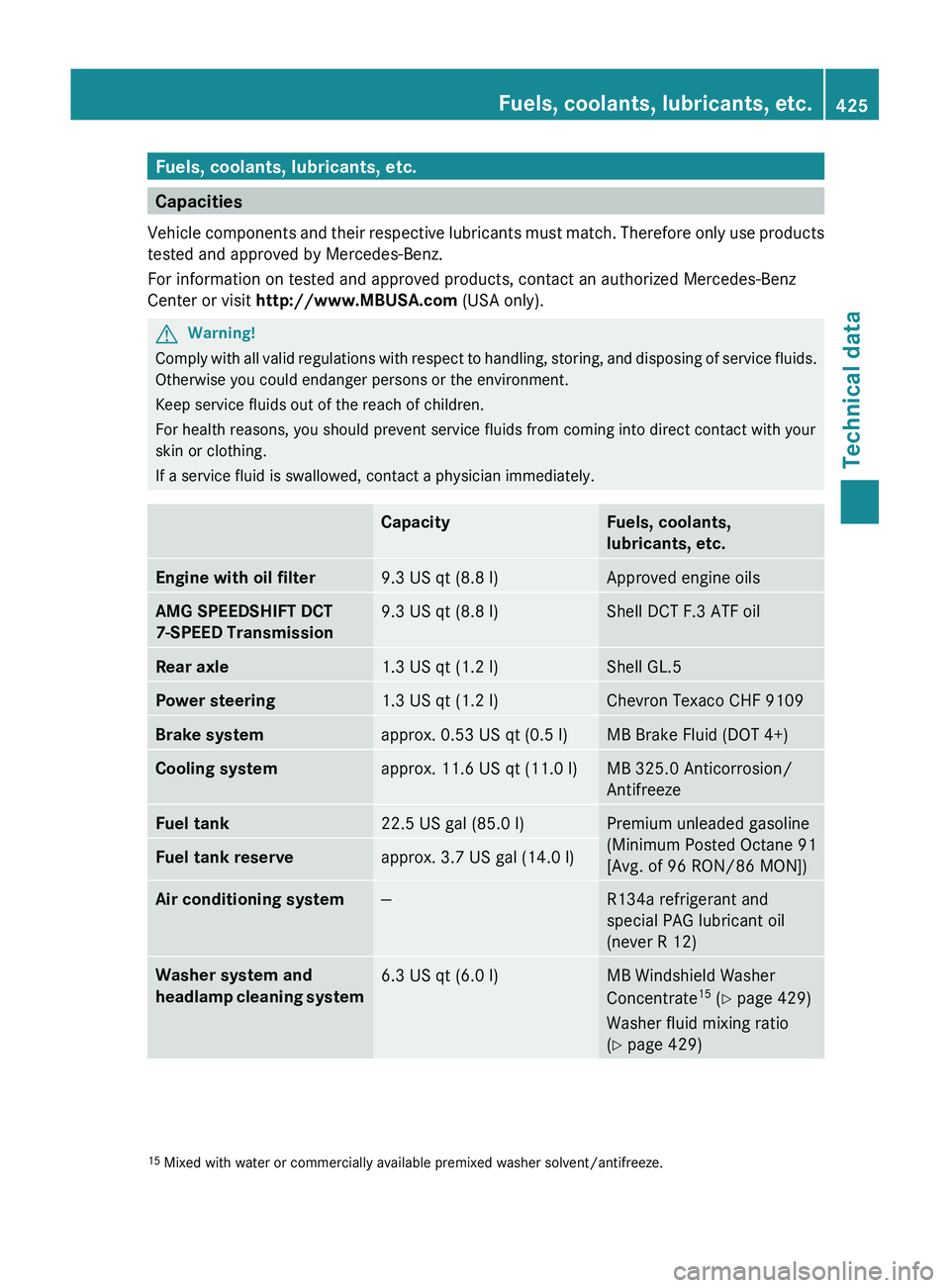
CapacityFuels, coolants,
lubricants, etc.Engine with oil filter 9.3 US qt (8.8 l)Approved engine oilsAMG SPEEDSHIFT DCT
7-SPEED Transmission 9.3 US qt (8.8 l)Shell DCT F.3 ATF oilRear axle 1.3 US qt (1.2 l)Shell GL.5Power steering 1.3 US qt (1.2 l)Chevron Texaco CHF 9109Brake system approx. 0.53 US qt (0.5 l)MB Brake Fluid (DOT 4+)Cooling system approx. 11.6 US qt (11.0 l)MB 325.0 Anticorrosion/
AntifreezeFuel tank 22.5 US gal (85.0 l)Premium unleaded gasoline
(Minimum Posted Octane 91
[Avg. of 96 RON/86 MON])Fuel tank reserveapprox. 3.7 US gal (14.0 l)Air conditioning system—R134a refrigerant and
special PAG lubricant oil
(never R 12)Washer system and
headlamp cleaning system 6.3 US qt (6.0 l)MB Windshield Washer
Concentrate 15
(Y page 429)
Washer fluid mixing ratio
( Y page 429)15
Mixed with water or commercially available premixed washer solvent/antifreeze.Fuels, coolants, lubricants, etc.425Technical dataBA 197 USA, CA Edition A 2011; 1; 27, en-UShereepeVersion: 3.0.3.52010-03-24T15:31:10+01:00 - Seite 425Z
Page 428 of 436
Approved engine oils
Engine oils are specifically tested for their
suitability in our engines and durability for our
service intervals. Therefore, only use
approved engine oils and oil filters required
for vehicles with the Maintenance System.
For a listing of approved engine oils and oil
filters, contact an authorized Mercedes-Benz
Center or visit http://www.MBUSA.com
(USA only).
! Using engine oils and oil filters of a
specification other than those expressly
required for the Maintenance System, or
changing of oil and oil filter at change
intervals longer than those called for by the
Maintenance System will result in engine or
emission control system damage not
covered by the Mercedes-Benz Limited
Warranty.
Please follow Maintenance System
recommendations for scheduled oil
changes. Failure to do so will result in
engine or emission control system damage
not covered by the Mercedes-Benz Limited
Warranty.MB sheet number229.5 16
i
MB sheet numbers are printed on the
outside of oil containers.
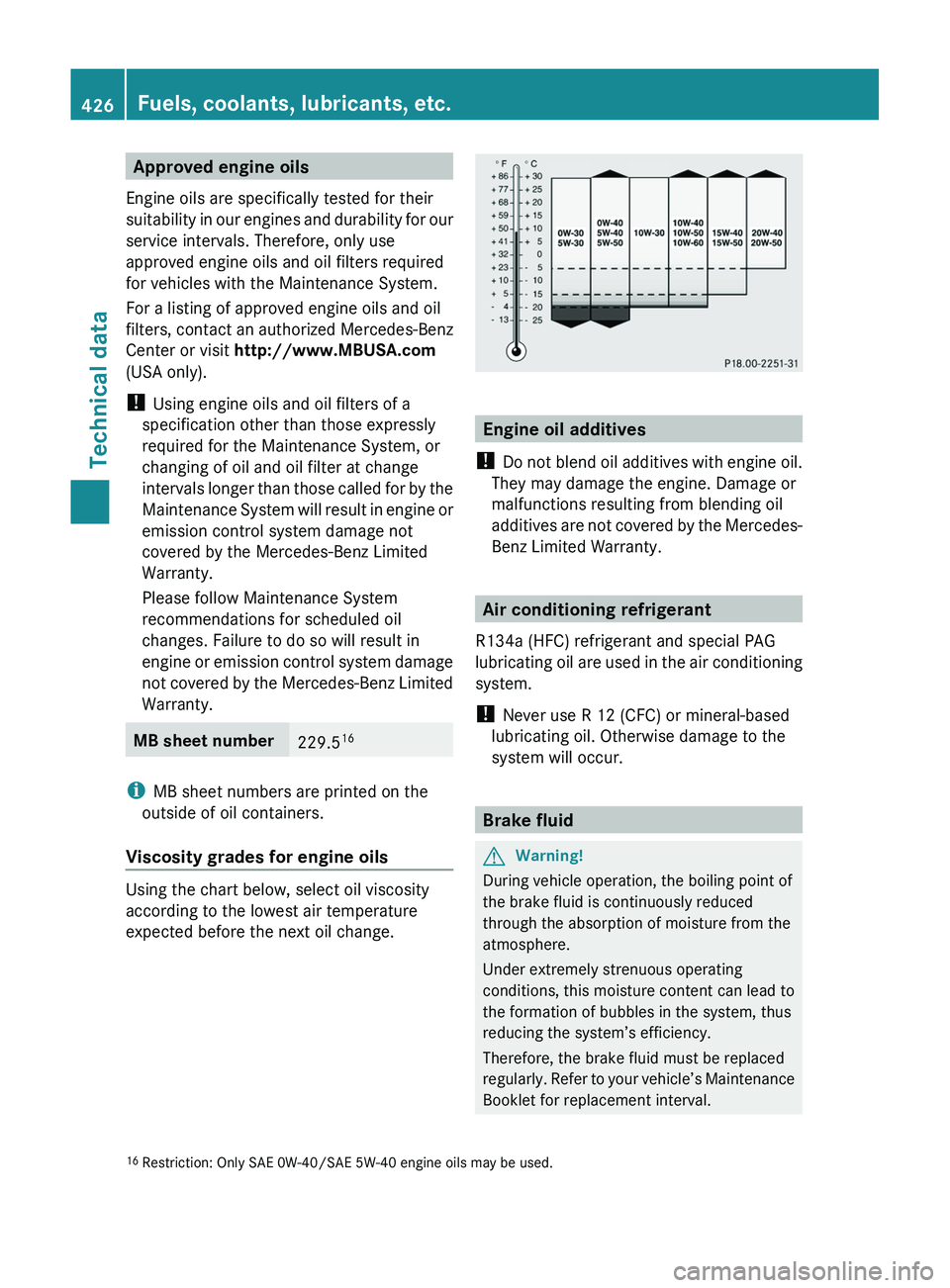
Viscosity grades for engine oils
Using the chart below, select oil viscosity
according to the lowest air temperature
expected before the next oil change.
Engine oil additives
! Do not blend oil additives with engine oil.
They may damage the engine. Damage or
malfunctions resulting from blending oil
additives are not covered by the Mercedes-
Benz Limited Warranty.
Air conditioning refrigerant
R134a (HFC) refrigerant and special PAG
lubricating oil are used in the air conditioning
system.
! Never use R 12 (CFC) or mineral-based
lubricating oil. Otherwise damage to the
system will occur.
Brake fluid
GWarning!
During vehicle operation, the boiling point of
the brake fluid is continuously reduced
through the absorption of moisture from the
atmosphere.
Under extremely strenuous operating
conditions, this moisture content can lead to
the formation of bubbles in the system, thus
reducing the system’s efficiency.
Therefore, the brake fluid must be replaced
regularly. Refer to your vehicle’s Maintenance
Booklet for replacement interval.
16 Restriction: Only SAE 0W-40/SAE 5W-40 engine oils may be used.426Fuels, coolants, lubricants, etc.Technical data
BA 197 USA, CA Edition A 2011; 1; 27, en-UShereepeVersion: 3.0.3.52010-03-24T15:31:10+01:00 - Seite 426
Page 429 of 436
Only brake fluid approved by Mercedes-Benz
is recommended. Any authorized Mercedes-
Benz Center will provide you with additional
information.
Premium unleaded gasoline
GWarning!
Gasoline is highly flammable and poisonous.
It burns violently and can cause serious
personal injury.
Never allow sparks, flames or smoking
materials near gasoline!
Turn off the engine before refueling.
Whenever you are around gasoline, avoid
inhaling fumes and any skin or clothing
contact. Extinguish all smoking materials.
Direct skin contact with fuels and the
inhalation of fuel vapors are damaging your
health.
! To maintain the engine’s durability and
performance, premium unleaded gasoline
must be used.
If premium unleaded gasoline is not
available and low octane gasoline is used,
follow these precautions:
R Have the fuel tank only partially filled
with unleaded regular gasoline and fill up
with premium unleaded gasoline as soon
as possible.
R Avoid full throttle driving and abrupt
acceleration.
R Do not exceed an engine speed of
3 000 rpm if the vehicle is loaded with a
light load such as two persons and no
luggage.
R Do not exceed 2
/ 3 of maximum
accelerator pedal position if the vehicle
is fully loaded or operating in
mountainous terrain.
Fuel requirements
Only use premium unleaded gasoline. The
octane number (posted at the pump) must be
91 min. It is an average of both the Research
Octane Number (RON) and the Motor Octane
Number (MON): (RON+MON)/2. This is also
known as the ANTI-KNOCK INDEX.
Reformulated gasolines (RFG) and/or
unleaded gasoline containing oxygenates
such as ethanol, TAME, ETBE, IPA, IBA, and
TBA can be used provided the ratio of any one
of these oxygenates to gasoline does not
exceed 10%; MTBE must not exceed 15%.
The ratio of methanol to gasoline must not
exceed 3% plus additional cosolvents.
Using mixtures of ethanol and methanol is not
allowed. Gasohol, which contains 10%
ethanol and 90% unleaded gasoline, can be
used.
These blends must also meet all other fuel
requirements, such as resistance to spark
knock, boiling range, vapor pressure, etc.
Gasoline additives
A major concern among engine
manufacturers is carbon build-up caused by
gasoline. Mercedes-Benz recommends only
the use of quality gasoline containing
additives that prevent the build-up of carbon
deposits.
After an extended period of using fuels
without such additives carbon deposits can
build up, especially on the intake valves and
in the combustion area, leading to engine
performance problems such as:
R Warm-up hesitation
R Unstable idle
R Knocking/pinging
R Misfire
R Power loss
In areas where carbon deposits may be
encountered due to lack of availability of
gasoline which contains these additives, the
Fuels, coolants, lubricants, etc.427Technical dataBA 197 USA, CA Edition A 2011; 1; 27, en-UShereepeVersion: 3.0.3.52010-03-24T15:31:10+01:00 - Seite 427Z
Page 430 of 436

use of Mercedes-Benz approved additives is
recommended.
Contact an authorized Mercedes-Benz Center
or visit http://www.MBUSA.com (USA
only) for a listing of approved products.
Follow directions on the product label.
Do not blend other fuel additives with fuel.
This only results in unnecessary cost and may
be harmful to the engine operation.
! Damage or malfunction resulting from
poor fuel quality or from blending additional
fuel additives other than those tested and
approved by us for use on Mercedes-Benz
vehicles are not covered by the Mercedes-
Benz Limited Warranty or by any pre-owned
or Extended Limited Warranties.
Coolants
The engine coolant is a mixture of water and
anticorrosion/antifreeze, which provides:
R Corrosion protection
R Freeze protection
R Boiling protection (by increasing the boiling
point)
The cooling system was filled at the factory
with a coolant providing freeze protection to
approximately -35‡ (-37†) and corrosion
protection.
! Add premixed coolant solution only.
Adding water and MB 325.0 Anticorrosion/
Antifreeze separately from each other,
could cause engine damage not covered by
the Mercedes-Benz Limited Warranty.
If the antifreeze mixture is effective to -35‡
(-37†) , the boiling point of the coolant in the
pressurized cooling system is reached at
approximately 266‡ (130†).
The coolant solution must be used year round
to provide the necessary corrosion protection
and increase boil-over protection. Refer to
the Maintenance Booklet for replacement
interval.
Coolant system design and coolant used
determine the replacement interval. The
replacement interval published in the
Maintenance Booklet is only applicable if
MB 325.0 Anticorrosion/Antifreeze solution
or other Mercedes-Benz approved products
of equal specification are used to renew the
coolant concentration or bring it back up to
the proper level.
For information on other Mercedes-Benz
approved products of equal specification,
contact an authorized Mercedes-Benz Center
or visit http://www.MBUSA.com (USA
only).
To provide important corrosion protection,
the solution must be at least 50%
anticorrosion/antifreeze (equivalent to
freeze protection to approximately -35‡
[-37†]).
If you use a solution that is more than 55%
anticorrosion/antifreeze (freeze protection
to approximately -49‡ [-45†]), the engine
temperature will increase due to the lower
heat transfer capability of the solution.
Therefore, do not use more than this amount
of anticorrosion/antifreeze.
If the coolant level is low, water and MB 325.0
Anticorrosion/Antifreeze should be used to
bring it up to the proper level (have cooling
system checked for signs of leakage). Please
make sure the mixture is in accordance with
label instructions.
The water in the cooling system must meet
minimum requirements, which are usually
satisfied by normal drinking water.
If you are not sure about the water quality,
contact an authorized Mercedes-Benz
Center.
Anticorrosion/antifreeze
Your vehicle contains a number of aluminum
parts. The use of aluminum components in
motor vehicle engines necessitates that
anticorrosion/antifreeze coolant used in
such engines be specifically formulated to
protect the aluminum parts. Failure to use
428Fuels, coolants, lubricants, etc.Technical data
BA 197 USA, CA Edition A 2011; 1; 27, en-UShereepeVersion: 3.0.3.52010-03-24T15:31:10+01:00 - Seite 428
Page 431 of 436
such anticorrosion/antifreeze coolant will
result in a significantly shortened service life.
Therefore, the following product is strongly
recommended for use in your vehicle:
MB 325.0 Anticorrosion/Antifreeze agent.
Before the start of the winter season (or once
a year in hot southern regions), you should
have the anticorrosion/antifreeze
concentration checked.
The coolant is also regularly checked each
time you bring your vehicle to an authorized
Mercedes-Benz Center for service.Approximate freeze protection-35‡ (-37†)-49‡ (-45†)5.8 US qt (5.5 l)6.3 US qt (6.0 l)
Washer system and headlamp
cleaning system
GWarning!
Washer solvent/antifreeze is highly
flammable. Do not spill washer solvent/
antifreeze on hot engine parts, because it may
ignite and burn. You could be seriously
burned.
XUse MB Windshield Washer Concentrate
“MB SummerFit”.XMix with water for temperatures above
freezing point.XMix with commercially available premixed
washer solvent/antifreeze for
temperatures below freezing point.
Washer fluid mixing ratio
For temperatures above the freezing point:
1 part “MB SummerFit” to 100 parts water
(1.34 fl oz [40 ml] “MB SummerFit” to 1 gal
[4.0 l] water)
For temperatures below freezing point:
1 part “MB SummerFit” to 100 parts solvent
(1.34 fl oz [40 ml] “MB SummerFit” to 1 gal
[4.0 l] solvent)
Fuels, coolants, lubricants, etc.429Technical dataBA 197 USA, CA Edition A 2011; 1; 27, en-UShereepeVersion: 3.0.3.52010-03-24T15:31:10+01:00 - Seite 429Z