technical data MERCEDES-BENZ SLS AMG 2011 User Guide
[x] Cancel search | Manufacturer: MERCEDES-BENZ, Model Year: 2011, Model line: SLS AMG, Model: MERCEDES-BENZ SLS AMG 2011Pages: 436, PDF Size: 17.73 MB
Page 339 of 436
GAWR from the certification label. The certification label can be found on the driver’s door
B-pillar, see the “Technical data” section ( Y page 421).
Gross Vehicle Weight Rating (GVWR): The total weight of the vehicle, all occupants, all cargo,
and the trailer tongue load (if applicable) must never exceed the GVWR.
Gross Axle Weight Rating (GAWR): The total allowable weight that can be carried by a single
axle (front or rear).
To assure that your vehicle does not exceed the maximum permissible weight limits (GVWR
and GAWR for front and rear axle), have the loaded vehicle (including driver, passengers and
all cargo and, if applicable, trailer fully loaded) weighed on a suitable commercial scale.
Trailer tongue load
The tongue load of any trailer is an important weight to measure because it affects the load
you can carry in your vehicle. If a trailer is towed, the tongue load must be added to the weight
of all occupants riding and any cargo you are carrying in the vehicle. The tongue load typically
is 10% of the trailer weight and everything loaded in it.
Your Mercedes-Benz has been designed primarily to carry passengers and their cargo.
Mercedes-Benz does not recommend trailer towing with your vehicle.Maximum tire loadGWarning!
Do not overload the tires by exceeding the
specified load limit as indicated on the Tire
and Loading Information placard on the
driver’s door B-pillar. Overloading the tires
can overheat them, possibly causing a
blowout. Overloading the tires can also result
in handling or steering problems, or brake
failure.
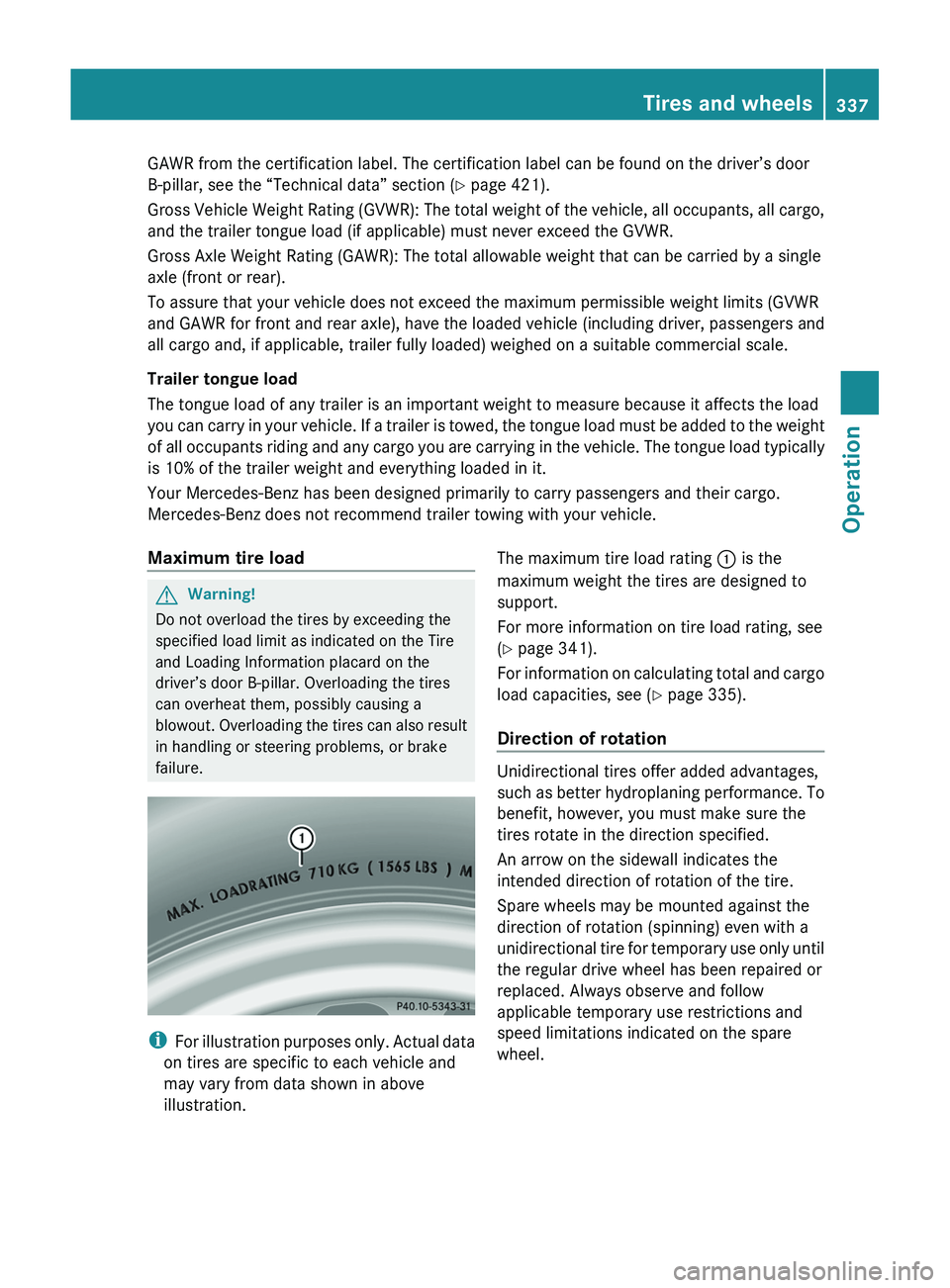
i For illustration purposes only. Actual data
on tires are specific to each vehicle and
may vary from data shown in above
illustration.
The maximum tire load rating 0046 is the
maximum weight the tires are designed to
support.
For more information on tire load rating, see
( Y page 341).
For information on calculating total and cargo
load capacities, see ( Y page 335).
Direction of rotation
Unidirectional tires offer added advantages,
such as better hydroplaning performance. To
benefit, however, you must make sure the
tires rotate in the direction specified.
An arrow on the sidewall indicates the
intended direction of rotation of the tire.
Spare wheels may be mounted against the
direction of rotation (spinning) even with a
unidirectional tire for temporary use only until
the regular drive wheel has been repaired or
replaced. Always observe and follow
applicable temporary use restrictions and
speed limitations indicated on the spare
wheel.
Tires and wheels337OperationBA 197 USA, CA Edition A 2011; 1; 27, en-UShereepeVersion: 3.0.3.52010-03-24T15:31:10+01:00 - Seite 337Z
Page 345 of 436
IndexSpeed ratingZR...(..Y)above 186 mph (300 km/h)ZRabove 149 mph (240 km/h)
RAt the tire manufacturer’s option, any tire
with a speed capability above 149 mph
(240 km/h) can include a “ZR” in the size
designation (for example: 245/40 ZR18).
To determine the maximum speed
capability of the tire, the service
description for the tire must be referred to.
The service description is comprised of
load index 0086 and speed symbol 0087.
If your tire includes “ZR” in the size
designation and no service description is
given, the tire manufacturer must be
consulted for the maximum speed
capability.
If a service description is given, the speed
capability is limited by the speed symbol in
the service description. Example:
245/40 ZR18 97Y. In this example, “97Y”
is the service description. The letter “Y”
designates the speed rating and the speed
capability of the tire is limited to 186 mph
(300 km/h).
R Any tire with a speed capability above
186 mph (300 km/h) must include a “ZR”
in the size designation AND the service
description must be placed in parenthesis.
Example: 275/40 ZR 18 (99Y). The “(Y)”
speed symbol in parenthesis designates
the maximum speed capability of the tire
as being above 186 mph (300 km/h).
Consult the tire manufacturer for the actual
maximum permissible speed of the tire.
All-season and winter tires
IndexSpeed ratingQ M+S 10up to 100 mph (160 km/h)T M+S 10up to 118 mph (190 km/h)IndexSpeed ratingH
M+S 10up to 130 mph (210 km/h)V M+S 10up to 149 mph (240 km/h)
i
Not all M+S rated tires provide special
winter performance. Make sure the tires
you use show M+S and the mountain/
snowflake 004Dmarking on the tire
sidewall. These tires meet specific snow
traction performance requirements of the
Rubber Manufacturers Association (RMA)
and the Rubber Association of Canada
(RAC) and have been designed specifically
for use in snow conditions.
The factory equipped tires on your vehicle
may have a tire speed rating above the
maximum speed permitted by the electronic
speed limiter.
Make sure your tires have the required tire
speed rating as specified for your vehicle in
the “Technical data” section ( Y page 424),
for example when purchasing new tires.
If you are uncertain about the correct reading
of the information given on a tire’s sidewall,
any authorized Mercedes-Benz Center will be
glad to assist you.
Load identification
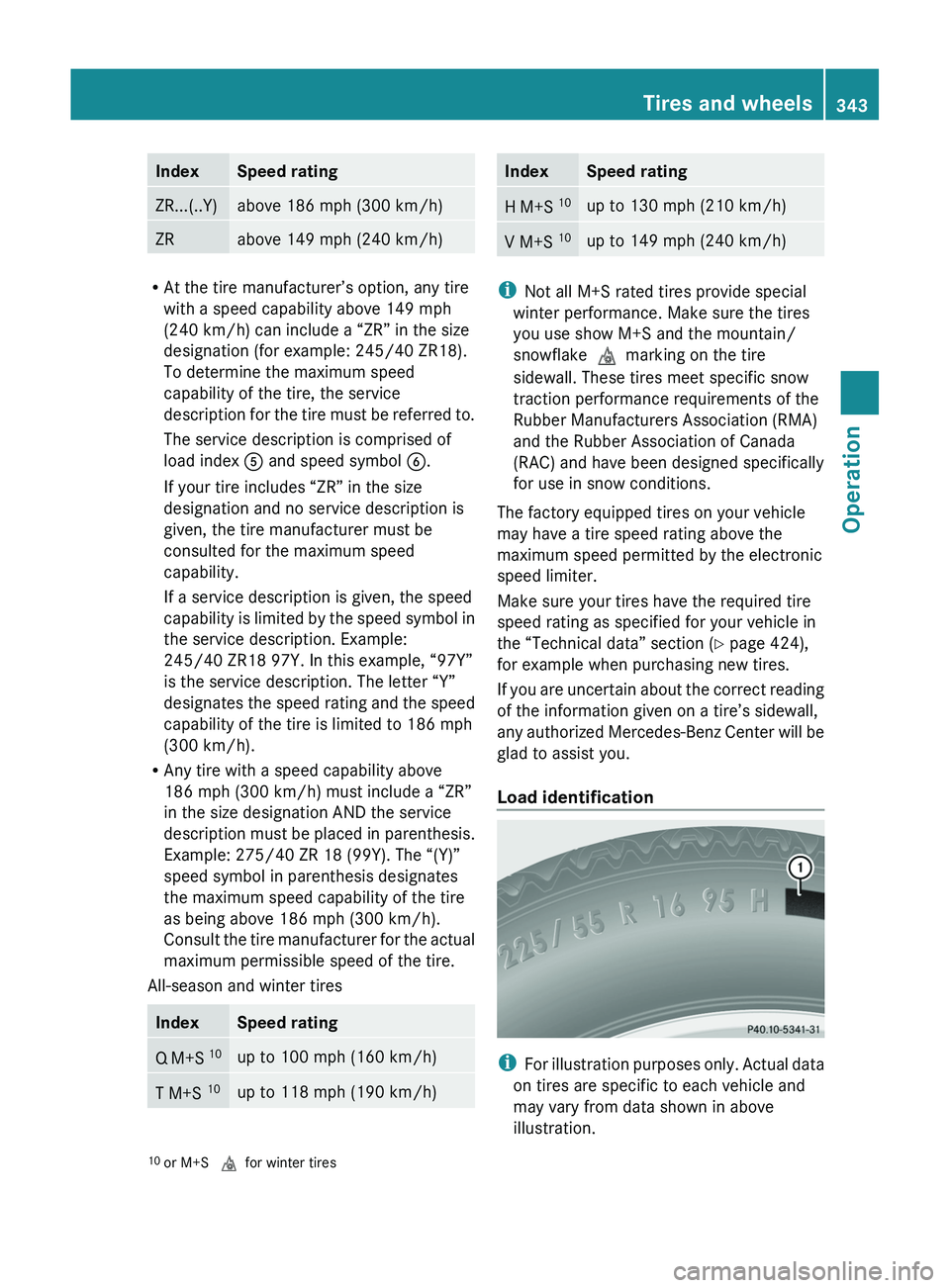
i For illustration purposes only. Actual data
on tires are specific to each vehicle and
may vary from data shown in above
illustration.
10 or M+S 004Dfor winter tiresTires and wheels343OperationBA 197 USA, CA Edition A 2011; 1; 27, en-UShereepeVersion: 3.0.3.52010-03-24T15:31:10+01:00 - Seite 343Z
Page 349 of 436
determined by tire manufacturers using U.S.
government testing procedures. The ratings
are molded into the sidewall of the tire.
Vehicle maximum load on the tire
Load on an individual tire that is determined
by distributing to each axle its share of the
maximum loaded vehicle weight and dividing
it by two.
Winter driving
General information
Have your vehicle winterized at an authorized
Mercedes-Benz Center.
Winter tires
Always use winter tires at temperatures
below 45‡ (7†) and whenever wintry road
conditions prevail. Not all M+S rated tires
provide special winter performance. Make
sure the tires you use show the mountain/
snowflake 004Dmarking on the tire sidewall.
These tires meet specific snow traction
performance requirements of the Rubber
Manufacturers Association (RMA) and the
Rubber Association of Canada (RAC) and
have been designed specifically for use in
snow conditions. Use of winter tires is the
only way to achieve the maximum
effectiveness of your vehicle’s driving safety
systems such as the ABS and the ESC in
winter operation.
For safe handling, make sure all mounted
winter tires are of the same make and have
the same tread design.
GWarning!
Winter tires with a tread depth of less than 1
/ 6
in (4 mm) must be replaced. They are no
longer suitable for winter operation.
For information on winter tires for your
vehicle model, see the “Technical data”
section ( Y page 424).
Always observe the speed rating of the winter
tires installed on your vehicle.
After installing winter tires:XCheck the tire inflation pressure and adjust
it if necessary ( Y page 329).XRestart the Advanced Tire Pressure
Monitoring System ( Y page 329).
i
Vehicle speeds of up to 149 mph
(240 km/h) with winter tires of version 1:
As opposed to the information given on the
tire inflation pressure label on the inside of
the fuel filler flap, the tire inflation pressure
can be reduced by
R front -30 kPa (0.3 bar, 4 psi)
R rear -90 kPa (0.6 bar, 9 psi)
The continuous-travel comfort increases
while the fuel consumption may be
increased slightly.
Snow chains
! Some tire sizes do not leave adequate
clearance for snow chains. To help avoid
serious damage to your vehicle or tires,
make sure the use of snow chains is
permissible as specified in the “Technical
data” section of this Operator’s Manual.
Snow chains should only be driven on snow-
covered roads at speeds not to exceed
30 mph (50 km/h). Remove chains as soon
as possible when driving on roads without
snow.
Observe the following guidelines when using
snow chains:
R Use of snow chains is not permissible with
all wheel/tire combinations ( Y page 424).
R Use snow chains in pairs and on rear
wheels only. Follow the manufacturer’s
mounting instructions.
! If snow chains are mounted to the front
wheels, they may scrape against the body
or axle components. The tires or the vehicle
could be damaged as a result.
Winter driving347OperationBA 197 USA, CA Edition A 2011; 1; 27, en-UShereepeVersion: 3.0.3.52010-03-24T15:31:10+01:00 - Seite 347Z
Page 421 of 436
Vehicle equipment ............................420
Parts service ..................................... 420
Warranty coverage ...........................420
Identification labels ..........................420
Vehicle specification ........................421
Rims and tires ................................... 422
Fuels, coolants, lubricants, etc. ......425419Technical dataBA 197 USA, CA Edition A 2011; 1; 27, en-UShereepeVersion: 3.0.3.52010-03-24T15:31:10+01:00 - Seite 419
Page 422 of 436
Vehicle equipment
i This Operator’s Manual describes all
features, standard or optional, potentially
available for your vehicle at the time of
purchase. Please be aware that your
vehicle might not be equipped with all
features described in this manual.
Parts service
All authorized Mercedes-Benz Centers
maintain a stock of Genuine Mercedes-Benz
Parts required for maintenance and repair
work. In addition, strategically located parts
distribution centers provide quick and
reliable parts service.
More than 300 000 different parts for
Mercedes-Benz models are available.
Genuine Mercedes-Benz Parts are subjected
to stringent quality inspections. Each part has
been specifically developed, manufactured or
selected for and adapted to Mercedes-Benz
vehicles.
Therefore, Genuine Mercedes-Benz Parts
should be installed.
! Do not use non-genuine Mercedes-Benz
parts and accessories not authorized by
Mercedes-Benz. Doing so could damage
the vehicle, which is not covered by the
Mercedes-Benz Limited Warranty. Also, it
could compromise the vehicle’s durability
or safety.
Warranty coverage
Your vehicle is covered under the terms of the
warranties printed in the Service and
Warranty Information booklet.
Your authorized Mercedes-Benz Center will
exchange or repair any defective parts
originally installed in the vehicle in
accordance with the terms of the following
warranties:
R New Vehicle Limited Warranty
R Emission System Warranty
R Emission Performance Warranty
R California, Connecticut, Maine,
Massachusetts, New York, Pennsylvania,
Rhode Island, and Vermont Emission
Control Systems Warranty
R State Warranty Enforcement Laws (Lemon
Laws)
Replacement parts and accessories are
covered by the Mercedes-Benz Parts and
Accessories warranties, copies of which are
available at any authorized Mercedes-Benz
Center.
Loss of Service and Warranty
Information booklet
Should you lose your Service and Warranty
Information booklet, have an authorized
Mercedes-Benz Center arrange for a
replacement. It will be mailed to you.
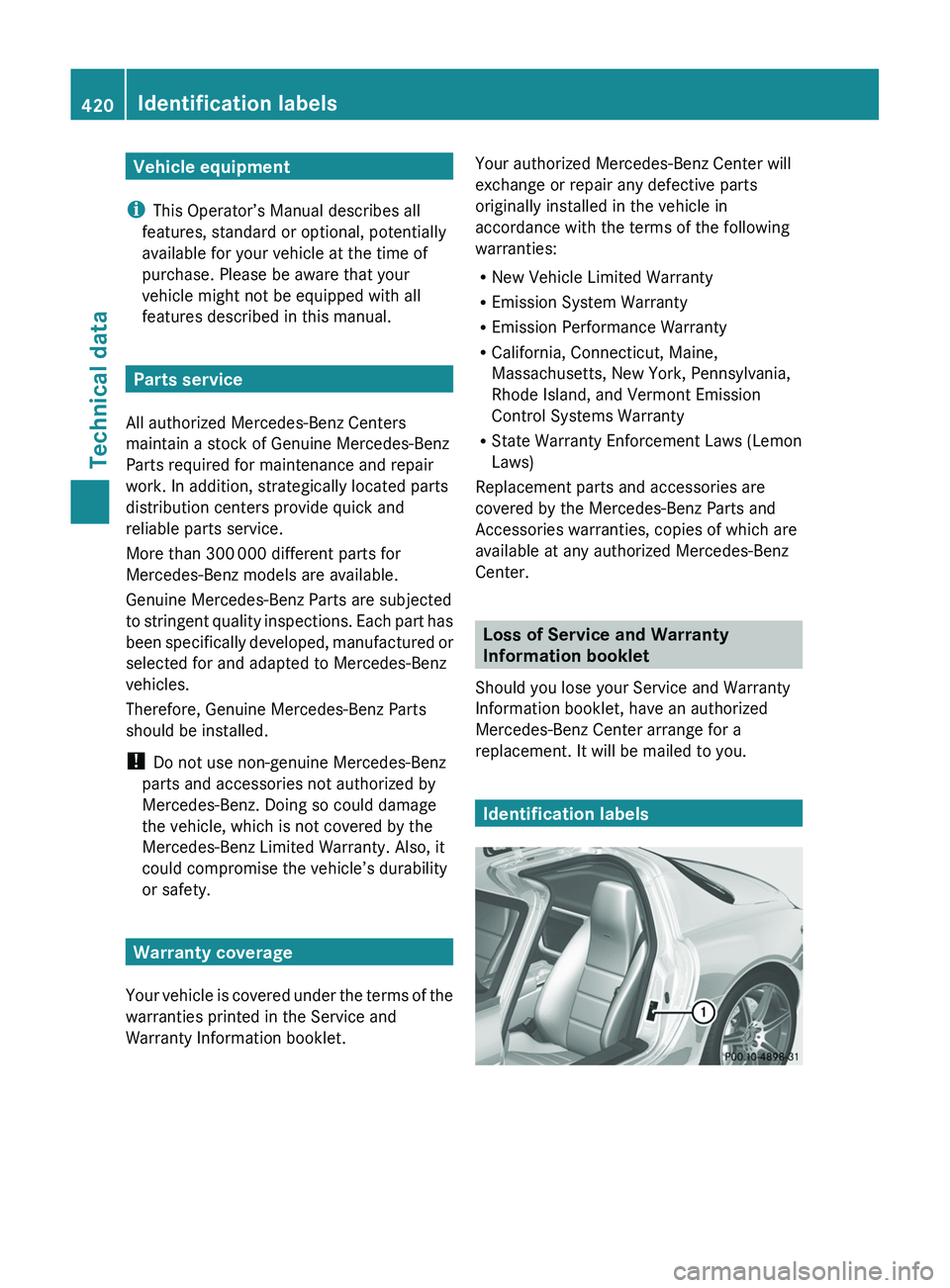
Identification labels
420Identification labelsTechnical data
BA 197 USA, CA Edition A 2011; 1; 27, en-UShereepeVersion: 3.0.3.52010-03-24T15:31:10+01:00 - Seite 420
Page 423 of 436
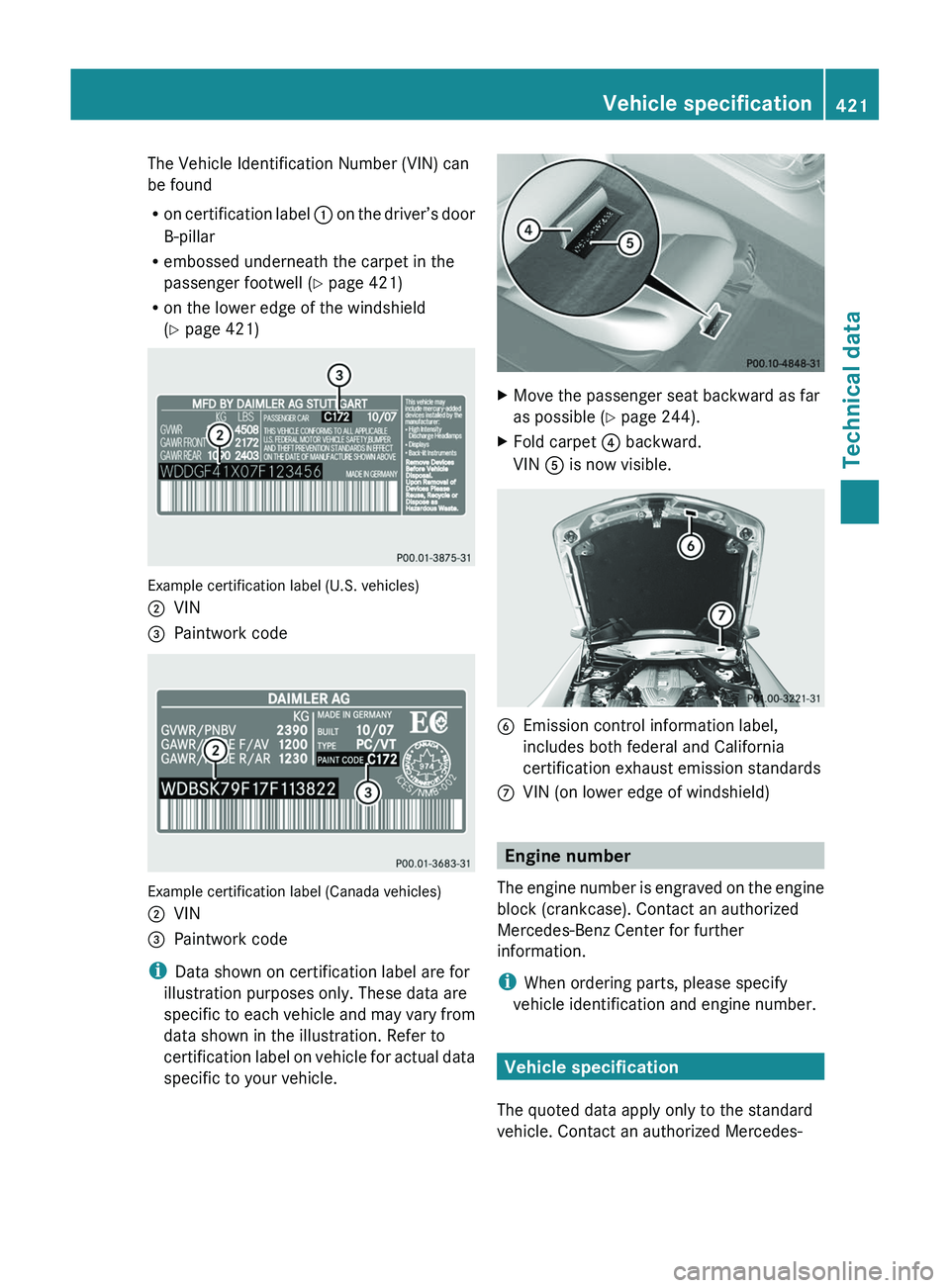
The Vehicle Identification Number (VIN) can
be found
R on certification label 0046 on the driver’s door
B-pillar
R embossed underneath the carpet in the
passenger footwell ( Y page 421)
R on the lower edge of the windshield
( Y page 421)
Example certification label (U.S. vehicles)
0047VIN008APaintwork code
Example certification label (Canada vehicles)
0047VIN008APaintwork code
i
Data shown on certification label are for
illustration purposes only. These data are
specific to each vehicle and may vary from
data shown in the illustration. Refer to
certification label on vehicle for actual data
specific to your vehicle.
XMove the passenger seat backward as far
as possible ( Y page 244). XFold carpet 0088 backward.
VIN 0086 is now visible.0087Emission control information label,
includes both federal and California
certification exhaust emission standards006EVIN (on lower edge of windshield)
Engine number
The engine number is engraved on the engine
block (crankcase). Contact an authorized
Mercedes-Benz Center for further
information.
i When ordering parts, please specify
vehicle identification and engine number.
Vehicle specification
The quoted data apply only to the standard
vehicle. Contact an authorized Mercedes-
Vehicle specification421Technical dataBA 197 USA, CA Edition A 2011; 1; 27, en-UShereepeVersion: 3.0.3.52010-03-24T15:31:10+01:00 - Seite 421
Page 424 of 436
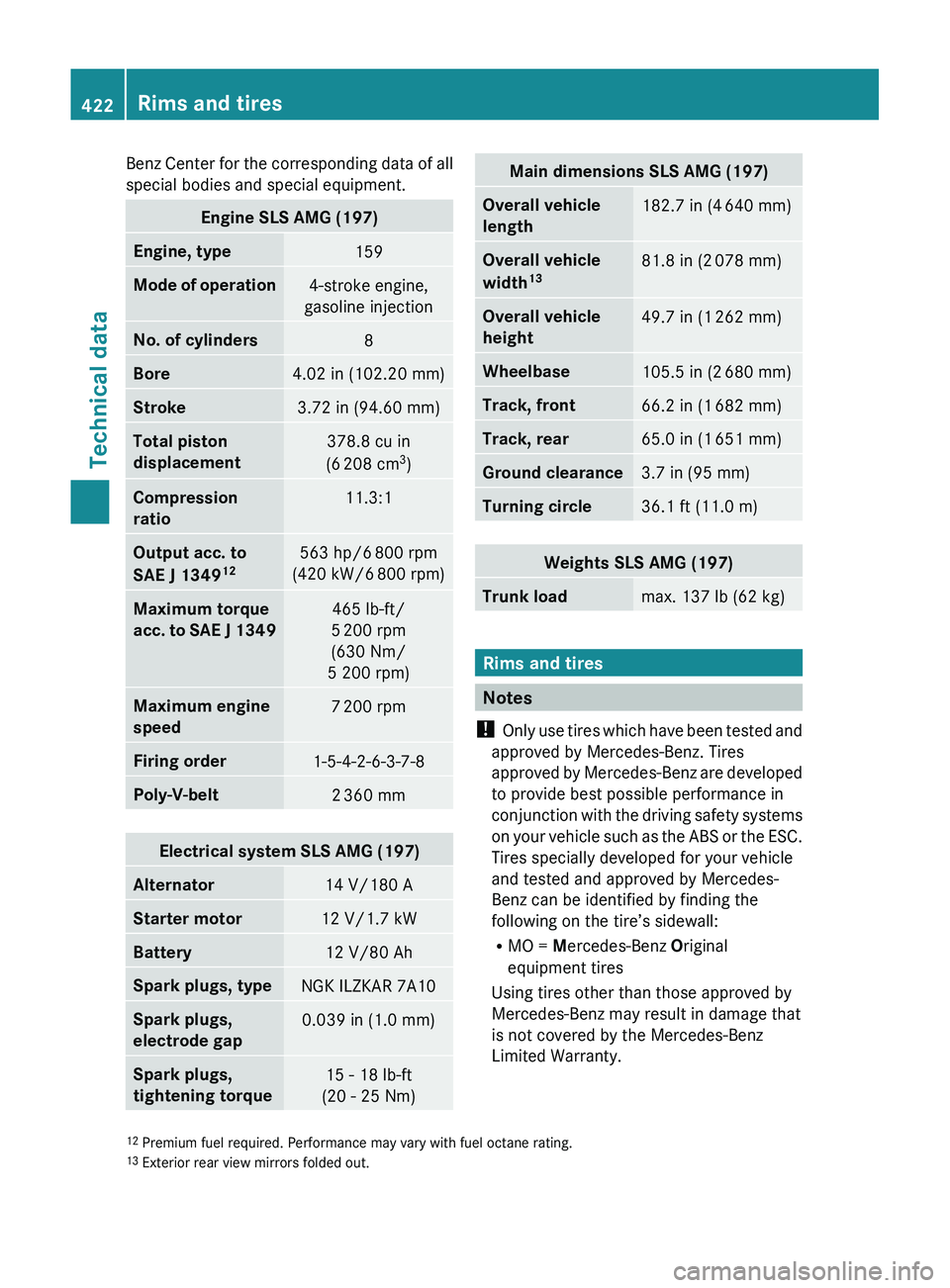
Benz Center for the corresponding data of all
special bodies and special equipment.Engine SLS AMG (197)Engine, type159Mode of operation4-stroke engine,
gasoline injectionNo. of cylinders8Bore4.02 in (102.20 mm)Stroke3.72 in (94.60 mm)Total piston
displacement378.8 cu in
(6 208 cm 3
)Compression
ratio11.3:1Output acc. to
SAE J 1349 12
563 hp/6 800 rpm
(420 kW/6 800 rpm)Maximum torque
acc. to SAE J 1349465 lb-ft/
5 200 rpm
(630 Nm/
5 200 rpm)Maximum engine
speed7 200 rpmFiring order1-5-4-2-6-3-7-8Poly-V-belt2 360 mmElectrical system SLS AMG (197)Alternator14 V/180 AStarter motor12 V/1.7 kWBattery12 V/80 AhSpark plugs, typeNGK ILZKAR 7A10Spark plugs,
electrode gap0.039 in (1.0 mm)Spark plugs,
tightening torque15 - 18 lb-ft
(20 - 25 Nm)Main dimensions SLS AMG (197)Overall vehicle
length182.7 in (4 640 mm)Overall vehicle
width 13
81.8 in (2 078 mm)Overall vehicle
height49.7 in (1 262 mm)Wheelbase105.5 in (2 680 mm)Track, front66.2 in (1 682 mm)Track, rear65.0 in (1 651 mm)Ground clearance3.7 in (95 mm)Turning circle36.1 ft (11.0 m)Weights SLS AMG (197)Trunk loadmax. 137 lb (62 kg)
Rims and tires
Notes
! Only use tires which have been tested and
approved by Mercedes-Benz. Tires
approved by Mercedes-Benz are developed
to provide best possible performance in
conjunction with the driving safety systems
on your vehicle such as the ABS or the ESC.
Tires specially developed for your vehicle
and tested and approved by Mercedes-
Benz can be identified by finding the
following on the tire’s sidewall:
R MO = Mercedes-Benz Original
equipment tires
Using tires other than those approved by
Mercedes-Benz may result in damage that
is not covered by the Mercedes-Benz
Limited Warranty.
12 Premium fuel required. Performance may vary with fuel octane rating.
13 Exterior rear view mirrors folded out.422Rims and tiresTechnical data
BA 197 USA, CA Edition A 2011; 1; 27, en-UShereepeVersion: 3.0.3.52010-03-24T15:31:10+01:00 - Seite 422
Page 425 of 436
! Using tires other than those approved by
Mercedes-Benz can have detrimental
effects, such as
R poor handling characteristics
R increased noise
R increased fuel consumption
Moreover, tires and rims not approved by
Mercedes-Benz may, under load, exhibit
dimensional variations and different tire
deformation characteristics that could
cause them to come into contact with the
vehicle body or axle parts. Damage to the
tires or the vehicle may be the result.
i Further information on tires and rims is
available at any authorized Mercedes-Benz
Center. The Tire and Loading Information
placard with the recommended tire
inflation pressures for cold tires is located
on the driver’s door B-pillar. Supplemental
tire inflation pressure information for
driving at high speeds or for vehicle loads
less than the maximum loaded vehicle
condition can be found on the tire inflation
pressure label. The tire inflation pressure
label is located on the inside of the fuel filler
flap. The tire inflation pressure should be
checked regularly and should only be
adjusted on cold tires. Follow tire
manufacturer’s maintenance
recommendation included with the vehicle.
For information on recommended tire
inflation pressure and supplemental tire
inflation pressure information for special
driving situations, see ( Y page 327).
i Please keep in mind that the vehicle must
be equipped
R with wheels of identical dimensions on
each axle (left and right)
R with tires of identical characteristics all
around, i.e. summer tires, winter tires, or
all-season tires etc.
i The following pages also list the approved
rim and tire sizes for equipping your vehicle
with winter tires. Winter tires are notavailable as standard or optional factory
equipment, but can be purchased from an
authorized Mercedes-Benz Center.
Equipping your vehicle with winter tires
approved for your vehicle model may
require the purchase of rims of the
recommended size for use with these
winter tires. This depends on vehicle model
and the standard or optional factory-
equipped wheel rim/tire configuration on
your vehicle. For more information contact
an authorized Mercedes-Benz Center.Rims and tires423Technical dataBA 197 USA, CA Edition A 2011; 1; 27, en-UShereepeVersion: 3.0.3.52010-03-24T15:31:10+01:00 - Seite 423
Page 426 of 436
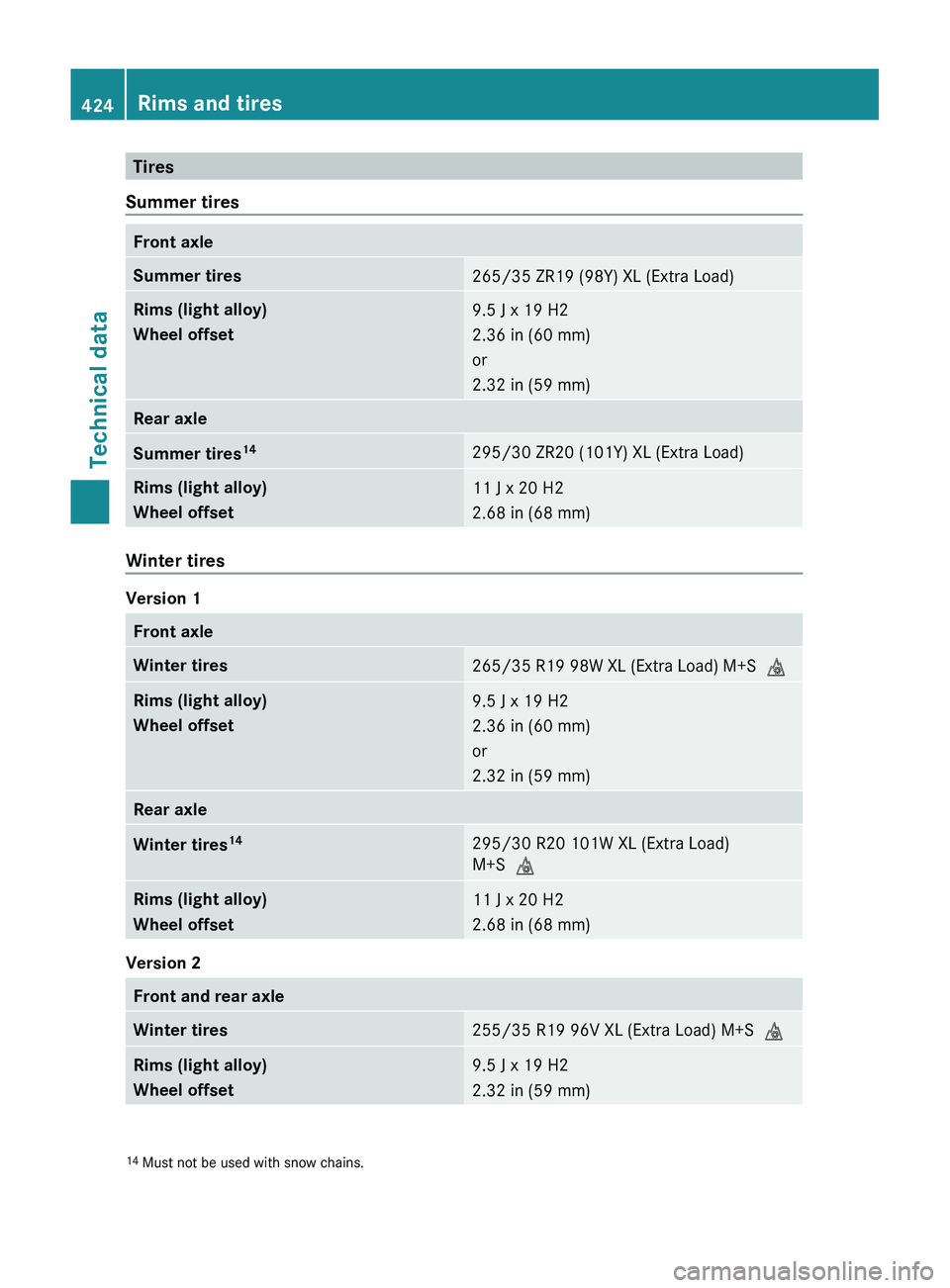
Tires
Summer tiresFront axleSummer tires265/35 ZR19 (98Y) XL (Extra Load)Rims (light alloy)
Wheel offset9.5 J x 19 H2
2.36 in (60 mm)
or
2.32 in (59 mm)Rear axleSummer tires 14295/30 ZR20 (101Y) XL (Extra Load)Rims (light alloy)
Wheel offset11 J x 20 H2
2.68 in (68 mm)
Winter tires
Version 1
Front axleWinter tires265/35 R19 98W XL (Extra Load) M+S004DRims (light alloy)
Wheel offset9.5 J x 19 H2
2.36 in (60 mm)
or
2.32 in (59 mm)Rear axleWinter tires 14295/30 R20 101W XL (Extra Load)
M+S 004DRims (light alloy)
Wheel offset11 J x 20 H2
2.68 in (68 mm)
Version 2
Front and rear axleWinter tires255/35 R19 96V XL (Extra Load) M+S 004DRims (light alloy)
Wheel offset9.5 J x 19 H2
2.32 in (59 mm)14 Must not be used with snow chains.424Rims and tiresTechnical data
BA 197 USA, CA Edition A 2011; 1; 27, en-UShereepeVersion: 3.0.3.52010-03-24T15:31:10+01:00 - Seite 424
Page 427 of 436
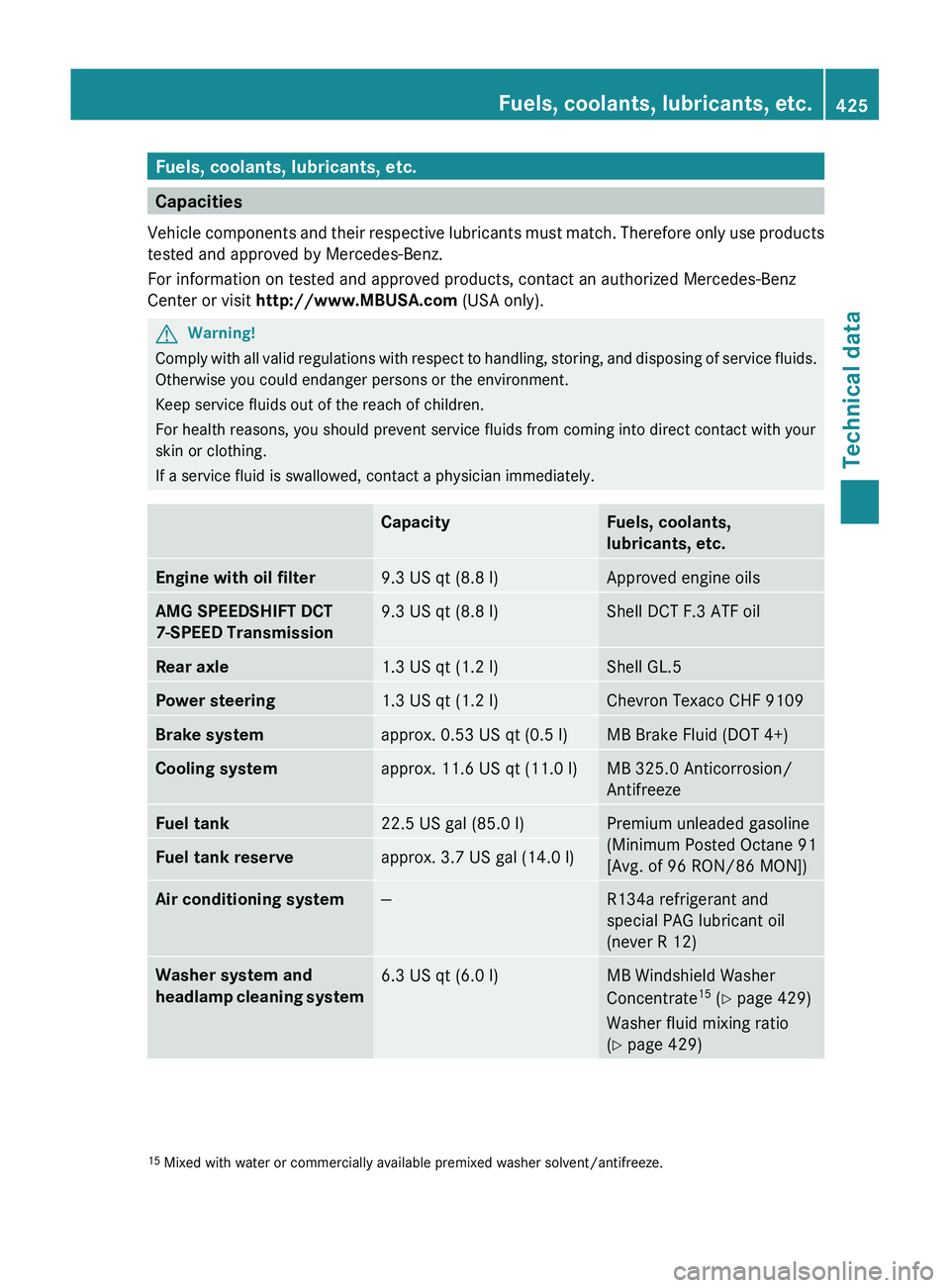
Fuels, coolants, lubricants, etc.
Capacities
Vehicle components and their respective lubricants must match. Therefore only use products
tested and approved by Mercedes-Benz.
For information on tested and approved products, contact an authorized Mercedes-Benz
Center or visit http://www.MBUSA.com (USA only).
GWarning!
Comply with all valid regulations with respect to handling, storing, and disposing of service fluids.
Otherwise you could endanger persons or the environment.
Keep service fluids out of the reach of children.
For health reasons, you should prevent service fluids from coming into direct contact with your
skin or clothing.
If a service fluid is swallowed, contact a physician immediately.
CapacityFuels, coolants,
lubricants, etc.Engine with oil filter 9.3 US qt (8.8 l)Approved engine oilsAMG SPEEDSHIFT DCT
7-SPEED Transmission 9.3 US qt (8.8 l)Shell DCT F.3 ATF oilRear axle 1.3 US qt (1.2 l)Shell GL.5Power steering 1.3 US qt (1.2 l)Chevron Texaco CHF 9109Brake system approx. 0.53 US qt (0.5 l)MB Brake Fluid (DOT 4+)Cooling system approx. 11.6 US qt (11.0 l)MB 325.0 Anticorrosion/
AntifreezeFuel tank 22.5 US gal (85.0 l)Premium unleaded gasoline
(Minimum Posted Octane 91
[Avg. of 96 RON/86 MON])Fuel tank reserveapprox. 3.7 US gal (14.0 l)Air conditioning system—R134a refrigerant and
special PAG lubricant oil
(never R 12)Washer system and
headlamp cleaning system 6.3 US qt (6.0 l)MB Windshield Washer
Concentrate 15
(Y page 429)
Washer fluid mixing ratio
( Y page 429)15
Mixed with water or commercially available premixed washer solvent/antifreeze.Fuels, coolants, lubricants, etc.425Technical dataBA 197 USA, CA Edition A 2011; 1; 27, en-UShereepeVersion: 3.0.3.52010-03-24T15:31:10+01:00 - Seite 425Z