light MERCEDES-BENZ SLS AMG COUPE 2012 Owner's Manual
[x] Cancel search | Manufacturer: MERCEDES-BENZ, Model Year: 2012, Model line: SLS AMG COUPE, Model: MERCEDES-BENZ SLS AMG COUPE 2012Pages: 288, PDF Size: 18.46 MB
Page 54 of 288
label on the restraint system. You will also
find the statement in the instruction manual
provided with the child restraint system.
When using any infant restraint, child
restraint or booster seat, make sure to
carefully read and follow all manufacturer's
instructions for installation and use.
Please read the warning labels affixed to the
interior of the vehicle or to the infant restraint
or child restraint system.GWARNING
Children under 12 years must be secured
correctly in a suitable infant or child restraint
system or booster seat suitable for the size
and weight of the child.
The infant or child restraint system must be
correctly secured using the vehicle's seat belt
in complete accordance with the child seat
manufacturer's instructions.
Occupants, in particular children, must sit as
upright as possible, fasten the seat belt
correctly and use a suitable infant restraint
system, child restraint system or booster seat
suitable for the size and weight of the child.
Children can be killed or seriously injured by
an inflating air bag. Please observe the
following important information:
R your vehicle is equipped with air bag
technology designed to deactivate the
passenger front air bag in your vehicle
when the system senses the weight of a
typical 12-month-old child or less along
with the weight of a standard appropriate
child restraint on the passenger seat.
R a child in a rear-facing child restraint on the
passenger seat will be seriously injured or
even killed if the passenger front air bag
inflates in a collision which could occur
under some circumstances, even with the
air bag technology installed in your vehicle.
R if you install a rearward-facing child
restraint system on the front-passenger
seat, make sure the 45 indicator
lamp is illuminated, indicating that the
front-passenger front air bag is disabled. If
the 45 indicator lamp does not light
up or goes out when the child restraint
system is installed, check the anchorages
of the restraint system. Check the
45 indicator lamp regularly while
driving to ensure that the 45
indicator lamp is illuminated. If the
45 indicator lamp goes out or
remains out, you may only carry a child on
the front-passenger seat once the system
has been repaired.
a child in a rear-facing child restraint on the
passenger seat will be seriously injured or
even killed if the passenger front air bag
inflates.
R when securing a child in a child restraint
system on the front-passenger seat, you
must:
- move the front-passenger seat as far
back as possible
- use a child restraint system that is
suitable for the age, size and weight of
the child
- observe the manufacturer's installation
instructions in order to install and secure
the child restraint system correctly.
R for children larger than the typical 12-
month-old child, the passenger front air bag
may or may not be activated.GWARNING
Infants and small children should never share
a seat belt with another occupant. During an
accident, they could be crushed between the
occupant and seat belt.
A child's risk of serious or fatal injuries is
significantly increased if the child restraints
are not properly secured in the vehicle and/
or the child is not properly secured in the child
restraint.
Children too big for a toddler restraint must
ride in seats using regular seat belts. Position
the shoulder belt across the chest and
shoulder, not face or neck. A booster seat
may be necessary to achieve proper seat belt
positioning for children over 41 lb (18 kg) until
52Children in the vehicleSafety
Page 56 of 288

XInstall the child restraint system.XTension Top Tether belt ?. Comply with
the manufacturer's installation
instructions when doing so.
The child restraint system with Top Tether
belt ? has been removed:
XSlide cover : onto Top Tether
anchorage ;.
Panic alarm
X To activate: press ! button : for at
least one second.
An alarm sounds and the exterior lighting
flashes.XTo deactivate: press ! button :
again.
or
XInsert the SmartKey into the ignition lock.
or
XPress the Start/Stop button.
The SmartKey must be in the vehicle.
i USA only:
This device complies with Part 15 of the
FCC Rules. Operation is subject to the
following two conditions:
1. This device may not cause interference,
and
2. this device must accept any interference
received, including interference that may
cause undesired operation of the device.
Any unauthorized modification to this
device could void the user's authority to
operate the equipment.
The product label with FCC ID and IC
certification number can be found in the
battery case of the SmartKey.
i Canada only:
This device complies with RSS-210 of
Industry Canada. Operation is subject to
the following two conditions:
1. This device may not cause interference,
and
2. this device must accept any interference
received, including interference that may
cause undesired operation of the device.
Any unauthorized modification to this
device could void the user's authority to
operate the equipment.
The product label with FCC ID and IC
certification number can be found in the
battery case of the SmartKey.
Driving safety systems
Driving safety systems overview
In this section, you will find information about
the following driving safety systems:
R ABS ( Anti-lock Braking System)
R BAS ( Brake Assist System)
R ESP ®
(E lectronic Stability Program)
R EBD ( electronic brake force distribution)
R ADAPTIVE BRAKE
Important safety notes
GWARNING
The following factors increase the risk of
accidents:
R Excessive speed, especially in turns
R Wet and slippery road surfaces
R Following another vehicle too closely
54Driving safety systemsSafety
Page 57 of 288
The driving safety systems described in this
section cannot reduce these risks or prevent
the natural laws of physics from acting on the
vehicle. They cannot increase braking or
steering efficiency beyond that afforded by
the condition of the vehicle brakes and tires
or the traction afforded.
Only a safe, attentive, and skillful driver can
prevent accidents.
The capabilities of a vehicle equipped with the
driving safety systems described in this
section must never be exploited in a reckless
or dangerous manner which could jeopardize
the user's safety or the safety of others.
Always adjust your driving style to the
prevailing road and weather conditions and
keep a safe distance to other road users and
objects on the street.
If a driving system malfunctions, other driving
safety systems may also switch off. Observe
indicator and warning lamps that may come
on as well as messages in the multifunction
display that may appear.
i In wintry driving conditions, always use
winter tires (M+S tires) and if necessary,
snow chains. Only in this way will the
driving safety systems described in this
section work as effectively as possible.
ABS (Anti-lock Braking System)
Important safety notes
GWARNING
Do not pump the brake pedal. Use firm, steady
brake pedal pressure instead. Pumping the
brake pedal reduces the braking effect.
ABS regulates brake pressure in such a way
that the wheels do not lock when you brake.
This allows you to continue steering the
vehicle when braking.
ABS works from a speed of about
5 mph(8 km/h) upwards, regardless of road-
surface conditions. ABS works on slippery
surfaces, even when you only brake gently.
The ! warning lamp in the instrument
cluster lights up when the ignition is switched
on. It goes out when the engine is running.
Braking
If ABS intervenes when braking, you will feel
a pulsing in the brake pedal.
XIf ABS intervenes: continue to depress the
brake pedal with force until the braking
situation is over.XTo make a full brake application:
depress the brake pedal with full force.GWARNING
If the ABS malfunctions, other driving systems
such as the BAS or the ESP ®
are also switched
off. Observe indicator and warning lamps that
may come on as well as messages in the
multifunction display that may appear.
If the ABS malfunctions, the wheels may lock
during hard braking, reducing the steering
capability and extending the braking distance.
The pulsating brake pedal can be an
indication of hazardous road conditions and
functions as a reminder to take extra care
while driving.
BAS (Brake Assist System)
Observe the "Important safety notes" section
( Y page 56).
BAS operates in emergency braking
situations. If you depress the brake pedal
quickly, BAS automatically boosts the braking
force, thus shortening the stopping distance.
XKeep the brake pedal firmly depressed until
the emergency braking situation is over.
ABS prevents the wheels from locking.
The brakes will function as usual once you
release the brake pedal. BAS is deactivated.
Driving safety systems55SafetyZ
Page 58 of 288
GWARNING
If the BAS malfunctions, the brake system still
functions, but without the additional brake
boost available that the BAS would normally
provide in an emergency braking maneuver.
Therefore, the braking distance may increase.
ESP ®
(Electronic Stability Program)
Important safety notes
GWARNING
Under no circumstances should you
deactivate ESP ®
when the ÷ ESP®
warning lamp in the instrument cluster
flashes. Proceed as follows:
R when driving off, apply as little throttle as
possible.
R while driving, ease up on the accelerator
pedal.
R adapt your speed to suit the prevailing road
and weather conditions.
Failure to observe these guidelines could
cause the vehicle to skid. ESP ®
cannot
prevent accidents resulting from excessive
speed.
! Switch the ignition off when:
R the electric parking brake is being tested
using a brake dynamometer.
R the vehicle is being towed with the rear
axle raised.
Application of the brakes by ESP ®
may
otherwise destroy the brake system.
i Only use wheels with the recommended
tire sizes. Only then will ESP ®
function
properly.
You can select between the three following
states of ESP ®
:
R ESP ®
is activated.
R SPORT handling mode is activated.
R ESP ®
is deactivated.
ESP ®
is activated as soon as you start the
engine. When SPORT handling mode is
activated, the M warning lamp lights up in
the instrument panel. When ESP ®
is
deactivated, the å and h warning
lamps light up in the instrument panel.
ETS (Electronic Traction System)
Observe the "Important safety notes" section
( Y page 56).
Traction control is part of ESP ®
.
Traction control brakes the drive wheels
individually if they spin. This enables you to
pull away and accelerate on slippery surfaces,
for example if the road surface is slippery on
one side.
Traction control remains active if you
deactivate ESP ®
.
Characteristics of ESP ®
GWARNING
ESP should not be deactivated during normal
driving.
Deactivating ESP SPORT will have the
following effects:
R there is no limit to the engine torque.
R the system-based traction control is
limited.
"ESP OFF" is designed for driving on closed
tracks when the vehicle's natural oversteer
and understeer characteristics are desired
and requires a highly skilled and experienced
driver able to handle these critical driving
situations.
You could lose control of your vehicle and
cause an accident.
Please be aware of these limits when you
switch off ESP.
GWARNING
Activate ESP ®
as soon as the situations
described above no longer apply. ESP ®
will
otherwise not be able to stabilize the vehicle
56Driving safety systemsSafety
Page 59 of 288
if the vehicle starts to skid or a wheel starts
to spin.
ESP ®
monitors driving stability and traction,
i.e. power transmission between the tires and
the road surface.
If ESP ®
detects that the vehicle is deviating
from the direction desired by the driver, one
or more wheels are braked to stabilize the
vehicle. If necessary, the engine output is also
modified to keep the vehicle on the desired
course within physical limits. ESP ®
assists
the driver when pulling away on wet or
slippery roads. ESP ®
can also stabilize the
vehicle during braking.
If ESP ®
intervenes, the h warning lamp
flashes in the instrument cluster.GWARNING
If the h warning lamp in the instrument
cluster flashes, proceed as follows:
R do not deactivate ESP ®
under any
circumstances
R only depress the accelerator pedal as far as
necessary when pulling away.
R adapt your driving style to suit the
prevailing road and weather conditions.
Otherwise, the vehicle could go into a skid.
ESP ®
cannot reduce the risk of an accident if
you drive too fast. ESP ®
cannot override the
laws of physics.
i Only use wheels with the recommended
tire sizes. Only then will ESP ®
function
properly.
ESP ®
is activated automatically when the
engine is running. In the following situations,
it may be better to activate SPORT handling
mode or deactivate ESP ®
:
R when using snow chains
R in deep snow
R on sand or gravel
GWARNING
Activate ESP ®
as soon as the situations
described above no longer apply. Otherwise,
ESP ®
will only be able to stabilize the vehicle
to a limited degree if the vehicle starts to skid
or if a wheel starts to spin.
Characteristics when ESP ®
is
deactivated
When you deactivate ESP ®
:
R ESP ®
no longer improves driving stability.
R engine torque is no longer limited and the
drive wheels are able to spin. The spinning
wheels produce a cutting effect for better
traction.
R traction control is still activated.
R ESP ®
still provides support when you brake
firmly.
i If ESP ®
is deactivated and one or more
wheels start to spin, the h warning lamp
in the instrument cluster does not flash. In
such situations, ESP ®
will not stabilize the
vehicle.
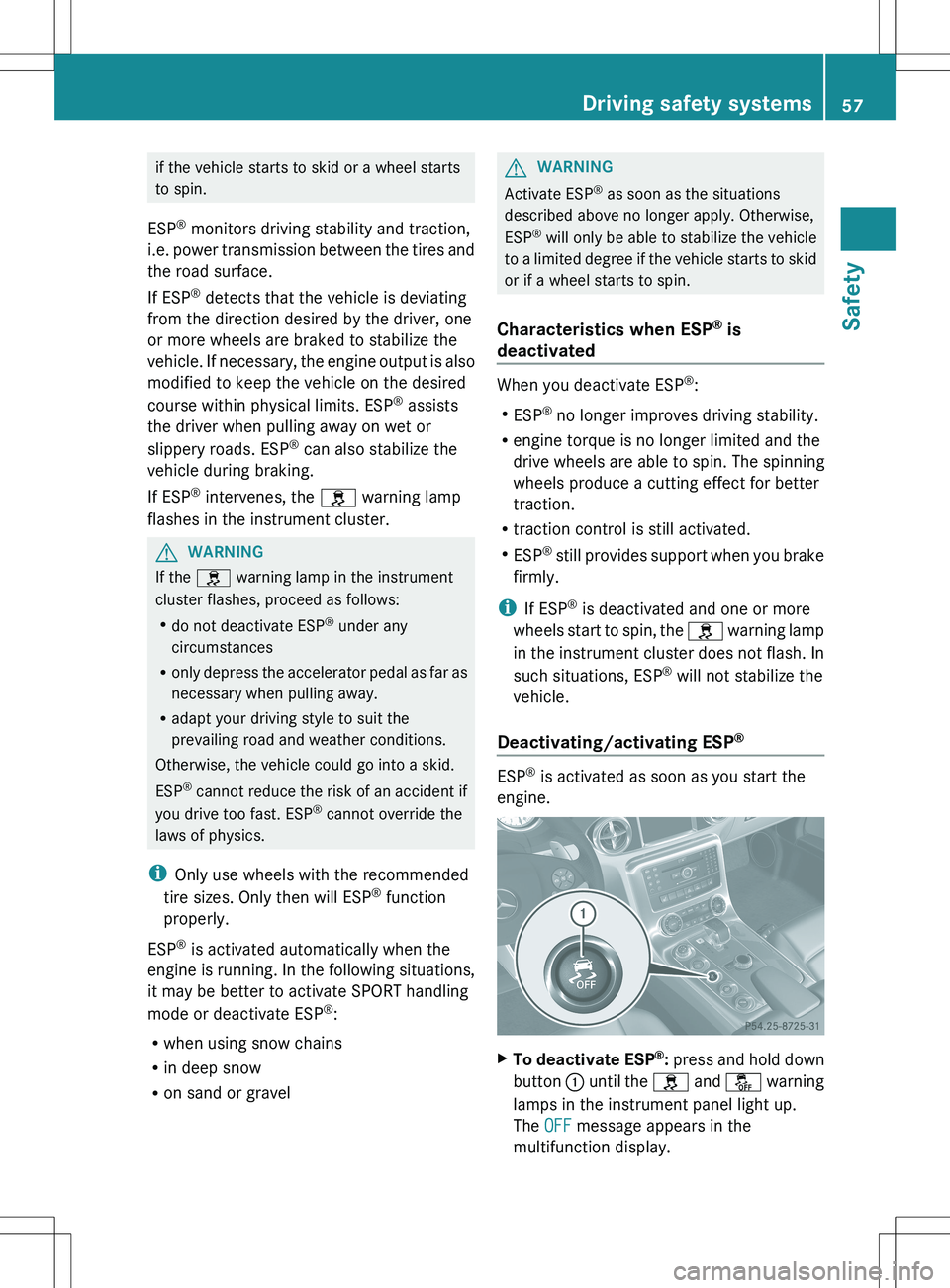
Deactivating/activating ESP ®
ESP
®
is activated as soon as you start the
engine.
XTo deactivate ESP ®
: press and hold down
button : until the h and å warning
lamps in the instrument panel light up.
The OFF message appears in the
multifunction display.Driving safety systems57SafetyZ
Page 60 of 288

GWARNING
ESP®
is deactivated if the h and å
warning lamps in the instrument cluster are
lit continuously when the engine is running.
There is an increased risk of your vehicle
skidding in certain situations.
You should always adapt your driving style to
suit the prevailing road and weather
conditions.
XTo activate ESP ®
: when SPORT handling
mode is activated or ESP ®
is deactivated,
press button : briefly.
The h and å warning lamps in the
instrument cluster go out. The ON message
appears in the multifunction display.
SPORT handling mode
GWARNING
SPORT handling mode should not be switched
on during normal driving.
Switching on SPORT handling mode will result
in the following:
R there is no limit to the engine torque.
R the system-based traction control is
limited.
SPORT handling mode is designed for driving
on closed tracks when the vehicle's own
natural oversteer and understeer
characteristics are desired and requires a
highly skilled and experienced driver able to
handle these critical driving situations.
You could lose control of your vehicle and
cause an accident.
Please be aware of these limits when you
switch on SPORT handling mode.
Do not switch on SPORT handling mode when
a spare wheel is mounted.
GWARNING
Switch off SPORT handling mode and
immediately switch on ESP ®
if one of the
previously stated conditions no longer
applies. SPORT handling mode will otherwise
only stabilize the vehicle to a limited degree if
it begins to lurch or if a wheel spins.
SPORT handling mode raises the intervention
threshold for stabilizing the vehicle. This
allows for a sportier driving style on
designated race circuits and may in certain
situations improve the traction in comparison
with ESP ®
.
When SPORT handling mode is activated:
R ESP ®
only improves driving stability to a
limited degree.
R engine torque is only restricted to a limited
degree, and the drive wheels are able to
spin. The spinning wheels produce a
cutting effect for better traction.
R traction control is still activated.
R ESP ®
still provides support when you brake
firmly.
i If SPORT handling mode is activated and
one or more wheels start to spin, the
h warning lamp in the instrument
cluster flashes. ESP ®
only stabilizes the
vehicle to a limited degree.XTo activate SPORT handling mode:
briefly press button :.
The M warning lamp in the instrument
cluster lights up. The SPORT handling 58Driving safety systemsSafety
Page 63 of 288
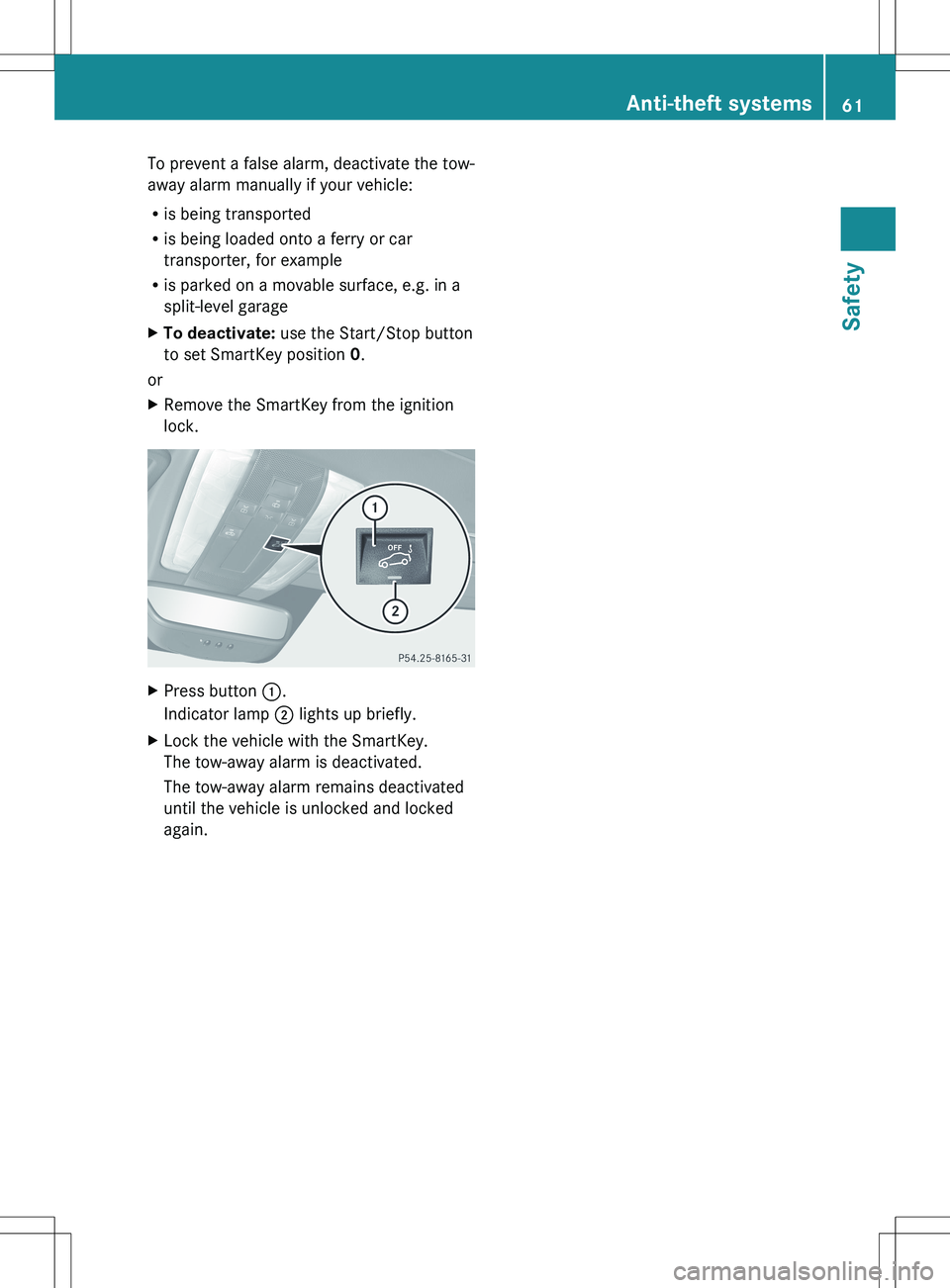
To prevent a false alarm, deactivate the tow-
away alarm manually if your vehicle:
R is being transported
R is being loaded onto a ferry or car
transporter, for example
R is parked on a movable surface, e.g. in a
split-level garageXTo deactivate: use the Start/Stop button
to set SmartKey position 0.
or
XRemove the SmartKey from the ignition
lock.XPress button :.
Indicator lamp ; lights up briefly.XLock the vehicle with the SmartKey.
The tow-away alarm is deactivated.
The tow-away alarm remains deactivated
until the vehicle is unlocked and locked
again.Anti-theft systems61SafetyZ
Page 67 of 288
When it is dark, the surround lighting also
comes on if it is activated in the on-board
computer ( Y page 158).
You can also set an audible signal to confirm
that the vehicle has been locked or unlocked.
The audible signal can be activated and
deactivated using the on-board computer
( Y page 159).XTo unlock centrally: press the %
button.
If you do not open the vehicle within
approximately 40 seconds of unlocking:
R the vehicle is locked again.
R the anti-theft alarm system is armed again.
XTo lock centrally: press the & button.
Changing the settings of the locking
system
You can change the setting of the locking
system in such a way that only the driver's
door and the fuel filler flap are unlocked. This
is useful if you frequently travel on your own.
XTo change the setting: press and hold
down the % and & buttons
simultaneously for approximately six
seconds until the battery check lamp
( Y page 66) flashes twice.
The SmartKey now functions as follows:
XTo unlock the driver's door: press the
% button once.XTo unlock centrally: press the %
button twice.XTo lock centrally: press the & button.
Restoring the factory settings
XPress the % and & buttons
simultaneously for approximately six
seconds until the battery check lamp
flashes twice.Mechanical key
General notes
If the vehicle can no longer be locked or
unlocked with the SmartKey, use the
mechanical key.
If you use the mechanical key to unlock and
open the driver's door, the anti-theft alarm
system will be triggered ( Y page 59).
There are several ways to turn off the alarm:
XPress the % or & button on the
SmartKey.
or
XInsert the SmartKey into the ignition lock.XTo unlock the fuel filler flap: insert the
SmartKey into the ignition lock.
Removing the mechanical key
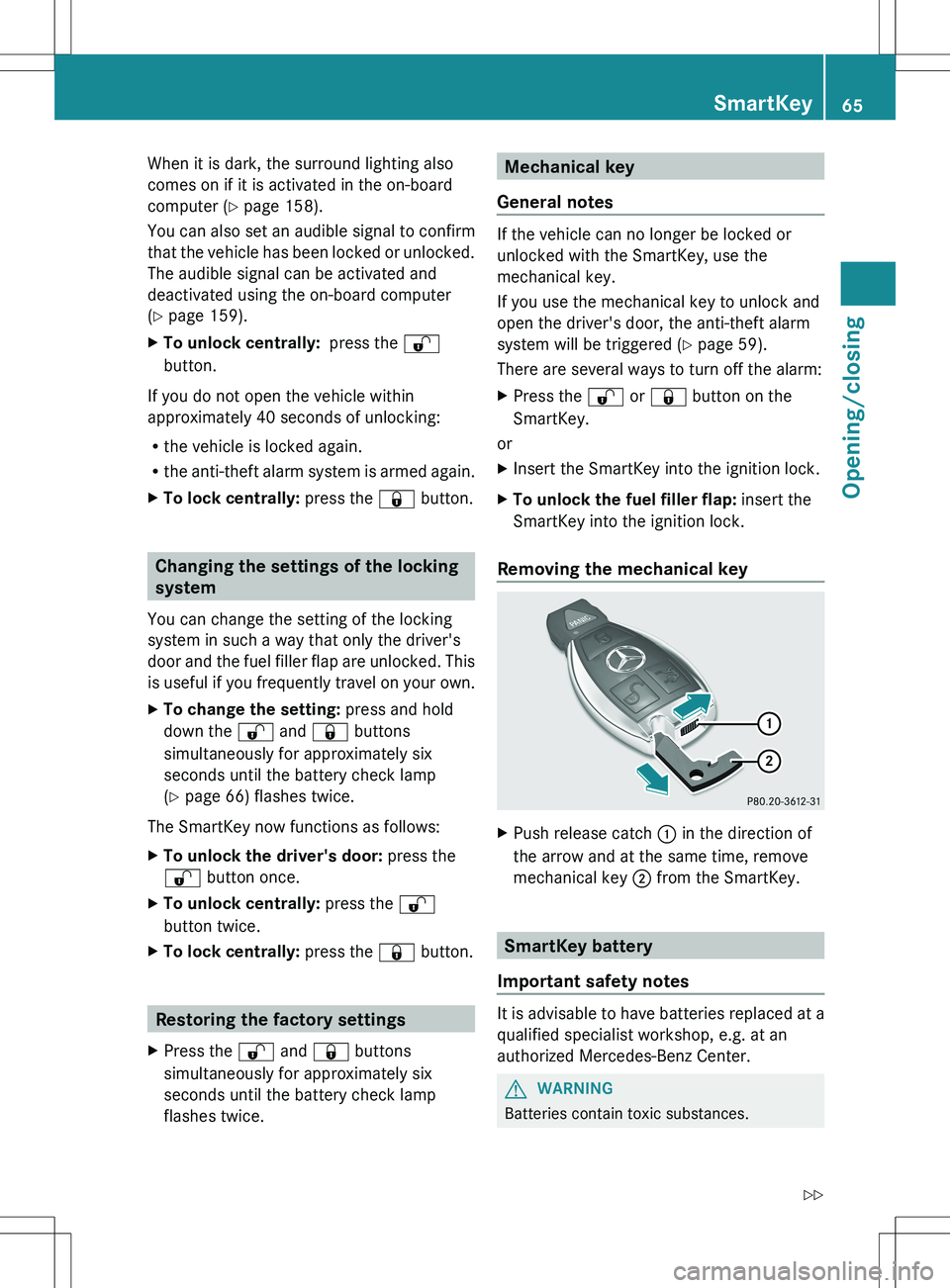
XPush release catch : in the direction of
the arrow and at the same time, remove
mechanical key ; from the SmartKey.
SmartKey battery
Important safety notes
It is advisable to have batteries replaced at a
qualified specialist workshop, e.g. at an
authorized Mercedes-Benz Center.
GWARNING
Batteries contain toxic substances.
SmartKey65Opening/closingZ
Page 68 of 288
Swallowing batteries can lead to serious
health issues or death.
Keep batteries out of the reach of children.
Seek medical attention immediately if a
battery is swallowed.GWARNING
The SmartKey batteries contain perchlorate
material, which may require special handling
and regard for the environment. Observe
government disposal guidelines. California
residents, see www.dtsc.ca.gov/
HazardousWaste/Perchlorate/
index.cfm .
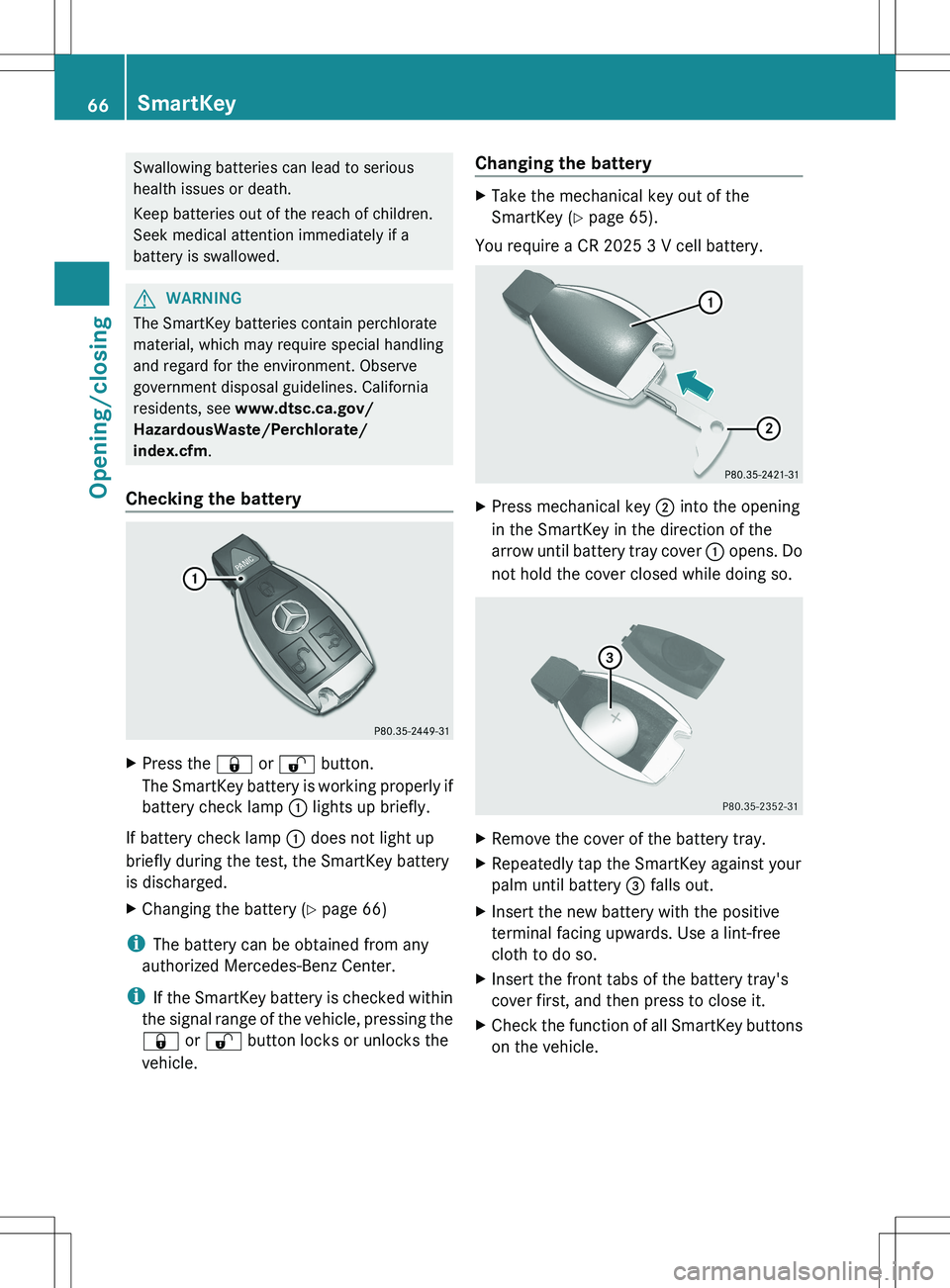
Checking the battery
XPress the & or % button.
The SmartKey battery is working properly if
battery check lamp : lights up briefly.
If battery check lamp : does not light up
briefly during the test, the SmartKey battery
is discharged.
XChanging the battery ( Y page 66)
i
The battery can be obtained from any
authorized Mercedes-Benz Center.
i If the SmartKey battery is checked within
the signal range of the vehicle, pressing the
& or % button locks or unlocks the
vehicle.
Changing the batteryXTake the mechanical key out of the
SmartKey ( Y page 65).
You require a CR 2025 3 V cell battery.
XPress mechanical key ; into the opening
in the SmartKey in the direction of the
arrow until battery tray cover : opens. Do
not hold the cover closed while doing so.XRemove the cover of the battery tray.XRepeatedly tap the SmartKey against your
palm until battery = falls out.XInsert the new battery with the positive
terminal facing upwards. Use a lint-free
cloth to do so.XInsert the front tabs of the battery tray's
cover first, and then press to close it.XCheck the function of all SmartKey buttons
on the vehicle.66SmartKeyOpening/closing
Page 70 of 288
ProblemPossible causes/consequences and M SolutionsThe engine cannot be
started using the
SmartKey.The on-board voltage is too low.XSwitch off non-essential consumers, such as seat heating or
interior lighting, and try to start the engine again.XRemove the SmartKey and reinsert it into the ignition lock.XStart the engine within 30 seconds of inserting the SmartKey
into the ignition lock.XRepeat if necessary.
If this does not work:
XCheck the starter battery and charge it if necessary
( Y page 240).
or
XJump-start the vehicle ( Y page 243).
or
XConsult a qualified specialist workshop.The SmartKey cannot
be turned in the ignition
lock.The SmartKey has been in position 0 for a considerable time.XRemove the SmartKey and reinsert it into the ignition lock.XCheck the starter battery and charge it if necessary
( Y page 240).XStart the engine.The on-board voltage is too low.XSwitch off nonessential consumers, such as seat heating or
interior lighting, and try to turn the SmartKey again.
If this does not work:
XCheck the starter battery and charge it if necessary
( Y page 240).
or
XJump-start the vehicle ( Y page 243).
or
XConsult a qualified specialist workshop.68SmartKeyOpening/closing