sensor MERCEDES-BENZ SLS AMG COUPE 2014 Owners Manual
[x] Cancel search | Manufacturer: MERCEDES-BENZ, Model Year: 2014, Model line: SLS AMG COUPE, Model: MERCEDES-BENZ SLS AMG COUPE 2014Pages: 292, PDF Size: 37.82 MB
Page 7 of 292
Blind Spot Assist
Activating/deactivating .................157
Display message ............................ 181
Notes/function .............................. 145
Brake Assist
see BAS (Brake Assist System)
Brake fluid
Display message ............................ 169
Notes ............................................. 283
Brake lamps (display message) .......174
Brakes ABS .................................................. 54
BAS .................................................. 55
Brake fluid (notes) .........................283
Display message ............................ 165
Display messages ..........................165
Driving tips .................................... 135
High-performance brake system ....137
Important safety notes ..................135
Maintenance .................................. 136
Warning lamp ........................ 190, 192
Breakdown
see Flat tire
see Towing away/tow-starting
Bulbs
see Replacing bulbs C
California Important notice for retail
customers and lessees ....................20
Calling up a malfunction
see Display messages
Capacities
see Technical data
Car
see Vehicle
Care
Car wash ........................................ 223
Display ........................................... 229
Exhaust pipe .................................. 228
Exterior lights ................................ 228
Gear or selector lever ....................229
Matte finish ................................... 226
Notes ............................................. 223
Paint .............................................. 225
Plastic trim .................................... 229Power washer
................................ 225
Rear view camera .......................... 228
Seat belt ........................................ 230
Seat cover ..................................... 230
Sensors ......................................... 228
Soft top .......................................... 226
Steering wheel ............................... 229
Trim pieces .................................... 229
Washing by hand ........................... 224
Wheels ........................................... 225
Windows ........................................ 227
Wiper blades .................................. 227
Wooden trim .................................. 229
Car wash (care) ................................. 223
CD player/CD changer (on-board
computer) .......................................... 155
Center console Lower section .................................. 31
Upper section .................................. 30
Central locking
Automatic locking (on-board
computer) ...................................... 159
Locking/unlocking (SmartKey) ........62
Changing bulbs
License plate lighting .....................101
Charge maintenance socket ............214
Children In the vehicle ................................... 51
Restraint systems ............................ 51
Child seat
Special seat belt retractor ...............53
Top Tether ....................................... 53
Cigarette lighter ................................ 203
Climate control Automatic climate control (dual-
zone) .............................................. 107
Controlling automatically ...............110
Cooling with air dehumidification ..108
Defrosting the windows .................112
Defrosting the windshield ..............111
Important safety notes ..................106
Indicator lamp ................................ 110
Maximum cooling .......................... 111
Notes on using automatic climate
control ........................................... 108
Overview of systems ......................106
Problems with cooling with air
dehumidification ............................ 110 Index
5
Page 13 of 292
O
Occupant Classification System
(OCS) Faults .............................................. .46
Operation ........................................ .42
System self-test ............................... 45
Occupant safety
Children in the vehicle .....................51
Important safety notes ....................36
OCS
Faults ............................................... 46
Operation ........................................ .42
System self-test ............................... 45
Odometer ........................................... 152
On-board computer AMG menu ..................................... 161
Audio menu ................................... 154
Convenience submenu ..................160
Displaying a service message ........222
Display messages ..........................163
Factory settings ............................. 160
Important safety notes ..................150
Instrument cluster submenu ..........157
Lighting submenu .......................... 158
Menu overview .............................. 152
Message memory .......................... 164
Navigation menu ............................ 153
Operation ....................................... 151
RACETIMER ................................... 161
Service menu ................................. 157
Settings menu ............................... 157
Standard displa y............................ 152
Telephone menu ............................ 155
Trip menu ...................................... 152
Vehicle submenu ........................... 160
Video DVD operation .....................155
Opening and closing ...........................68
Operating safety Declaration of conformity ................22
Important safety notes ....................21
Operating system
see On-board computer
Operator's Manual
Vehicle equipment ...........................19
Outside temperature display ...........150
Overhead control panel ......................32 P
Paint code number ............................278
Paintwork (cleaning instructions) ...225
Panic alarm .......................................... 36
Parcel net ........................................... 201
Parking ............................................... 131
Important safety notes ..................131
Position of exterior mirror, front-
passenger side ................................. 92
Rear view camera .......................... 144
see PARKTRONIC
Parking aid
see Exterior mirrors
see PARKTRONIC
Parking brake
Display message ............................ 166
Electric parking brake ....................133
Parking lamps
Switching on/off .............................. 97
PARKTRONIC
Deactivating/activating .................143
Driving system ............................... 141
Function/notes ............................. 141
Problem (malfunction) ...................144
Range of the sensors .....................142
Warning displa y............................. 142
PASSENGER AIR BAG OFF indicator
lamp ...................................................... 42
Plastic trim (cleaning instructions) .229
Power washers .................................. 225
Power windows see Side windows
Program selector ............................... 124
Protection of the environment General notes .................................. 18
Pulling away ...................................... 120 Q
Qualified specialist workshop ...........22 R
RACE START ....................................... 125
RACETIMER (on-board computer) ....161
Radio Selecting a station .........................154
see separate operating instructions Index
11
Page 14 of 292
Radio-wave reception/
transmission in the vehicle
Declaration of conformity ................22
Reading lamp ....................................... 99
Rear spoiler Display message ............................ 189
Extending/retracting .....................210
Problem ......................................... 211
Rear view camera
Cleaning instructions .....................228
Function/notes ............................. 144
Rear-view mirror
Anti-glare (manual) ..........................90
Dipping (automatic) .........................91
Rear window defroster
Problem (malfunction) ...................113
Switching on/off ........................... 112
Refrigerant (air-conditioning
system)
Important safety notes ..................282
Refueling
Fuel gauge ....................................... 27
Important safety notes ..................129
Refueling proces s.......................... 129
see Fuel
Remote control
Garage door opene r....................... 211
Programming (garage door opener) 212
Replacing bulbs
Important safety notes ..................100
Reporting safety defects ....................23
Reserve (fuel tank) see Fuel
Reserve fuel
Display message ............................ 179
Warning lamp ................................. 196
see Fuel
Restraint system
see SRS (Supplemental Restraint
System)
Reversing lamps (display message) 175
Roadside Assistance (breakdown) ....20
Roof see Soft top
Route
see Route guidance (navigation)
Route guidance (navigation) ............153 S
Safety Children in the vehicle .....................51
Child restraint systems ....................51
Occupant Classification System
(OCS) ............................................... 42
Safety system
see Driving safety systems
Seat belts
Belt force limiters ............................ 50
Cleaning ......................................... 230
Correct usage .................................. 48
Emergency Tensioning Devices ....... .50
Fastening ......................................... 49
Important safety guidelines .............47
Releasing ......................................... 49
Safety guidelines ............................. 37
Special seat belt retractor ...............53
Warning lamp ................................. 191
Warning lamp (function) ................... 49
Seats
Adjusting (electrically) .....................86
Adjusting (manually). .......................86
Adjusting lumbar support ................86
Cleaning the cover .........................230
Correct driver's seat position ........... 84
Important safety notes ....................85
Seat heating problem ......................87
Storing settings (memory function) .. 92
Switching AIRSCARF on/off ............88
Switching seat heating on/off .........87
Selector lever
Positions ........................................ 121
Sensors (cleaning instructions) .......228
Service interval display Displaying service messages .........222
Hiding service messages ...............222
Notes ............................................. 222
Service messages ..........................222
Service menu (on-board computer) .157
Service products Brake fluid ..................................... 283
Coolant (engine) ............................ 283
Engine oil ....................................... 281
Fuel ................................................ 280
Important safety notes ..................279
Notes ............................................. 27912
Index
Page 20 of 292
Protection of the environment
General notes
H
Environmental note
Daimler's declared policy is one of
comprehensive environmental protection.
The objectives are for the natural resources
that form the basis of our existence on this
planet to be used sparingly and in a manner
that takes the requirements of both nature
and humanity into account.
You too can help to protect the environment
by operating your vehicle in an
environmentally responsible manner.
Fuel consumption and the rate of engine,
transmission, brake and tire wear are affected
by these factors:
R operating conditions of your vehicle
R your personal driving style
You can influence both factors. You should
bear the following in mind:
Operating conditions:
R avoid short trips as these increase fuel
consumption.
R always make sure that the tire pressures
are correct.
R do not carry any unnecessary weight.
R remove roof racks once you no longer need
them.
R a regularly serviced vehicle will contribute
to environmental protection. You should
therefore adhere to the service intervals.
R always have service work carried out at a
qualified specialist workshop.
Personal driving style:
R do not depress the accelerator pedal when
starting the engine.
R do not warm up the engine when the vehicle
is stationary.
R drive carefully and maintain a safe distance
from the vehicle in front.
R avoid frequent, sudden acceleration and
braking. R
change gear in good time and use each gear
only up to Ôof its maximum engine speed.
R switch off the engine in stationary traffic.
R keep an eye on the vehicle's fuel
consumption. Environmental concerns and
recommendations
Wherever the operating instructions require
you to dispose of materials, first try to
regenerate or re-use them. Observe the
relevant environmental rules and regulations
when disposing of materials. In this way you
will help to protect the environment. Genuine Mercedes-Benz parts
H
Environmental note
Daimler AG also supplies reconditioned major
assemblies and parts which are of the same
quality as new parts. They are covered by the
same Limited Warranty entitlements as new
parts.
! Air bags and Emergency Tensioning
Devices, as well as control units and
sensors for these restraint systems, may be
installed in the following areas of your
vehicle:
R doors
R door pillars
R door sills
R seats
R cockpit
R instrument cluster
R center console
Do not install accessories such as audio
systems in these areas. Do not carry out
repairs or welding. You could impair the
operating efficiency of the restraint
systems. 18
Introduction
Page 39 of 292
SRS (Supplemental Restraint System)
Introduction SRS reduces the risk of occupants coming
into contact with the vehicle's interior in the
event of an accident. It can also reduce the
effect of the forces to which occupants are
subjected during an accident.
SRS consists of:
R 6 SRS warning lamp
R air bags
R air bag control unit (with crash sensors)
R Emergency Tensioning Devices
R seat belt force limiters
SRS warning lamp G
WARNING
If SRS is malfunctioning, child restraint
system components may be triggered
unintentionally or might not be triggered at all
in the event of an accident with a high rate of
vehicle deceleration. There is an increased
risk of injury, possibly even fatal.
Have SRS checked and repaired immediately
at a qualified specialist workshop.
SRS functions are checked regularly when
you switch on the ignition and when the
engine is running. Therefore, malfunctions
can be detected in good time.
The 6 SRS warning lamp in the instrument
cluster lights up when the ignition is switched
on. It goes out no later than a few seconds
after the engine is started.
The SRS components are in operational
readiness when the 6SRS indicator lamp
goes out while the engine is running. There is a malfunction if:
R
the 6 SRS warning lamp does not light
up when the ignition is switched on
R the engine is running and the 6SRS
warning lamp does not go out after a few
seconds
R the engine is running and the 6SRS
warning lamp lights up again
Safety guidelines for seat belts,
Emergency Tensioning Devices (ETDs)
and air bags G
WARNING
R Damaged seat belts or seat belts that have
been subjected to stress in an accident
must be replaced. Their anchoring points
must also be checked. Only use seat belts
installed or supplied by an authorized
Mercedes-Benz Center.
R Air bags and pyrotechnic Emergency
Tensioning Devices (ETDs) contain
perchlorate material, which may require
special handling and regard for the
environment. Check your national disposal
guidelines. California residents, see
www.dtsc.ca.gov/HazardousWaste/
Perchlorate/index.cfm .
R Air bags and ETDs are designed to function
on a one-time-only basis. An air bag or ETD
that has deployed must be replaced.
R Do not pass seat belts over sharp edges.
They could tear.
R Do not make any modification that could
change the effectiveness of the seat belts.
R Do not bleach or dye seat belts as this may
severely weaken them. In a crash they may
not be able to provide adequate protection.
R No modifications of any kind may be made
to any components or wiring of the SRS.
R Do not change or remove any component
or part of the SRS.
R Do not install additional trim material, seat
covers, badges, etc. over the steering
wheel hub, front-passenger front air bag Occupant safety
37Safety
Z
Page 43 of 292
Driver's/front-passenger knee bag
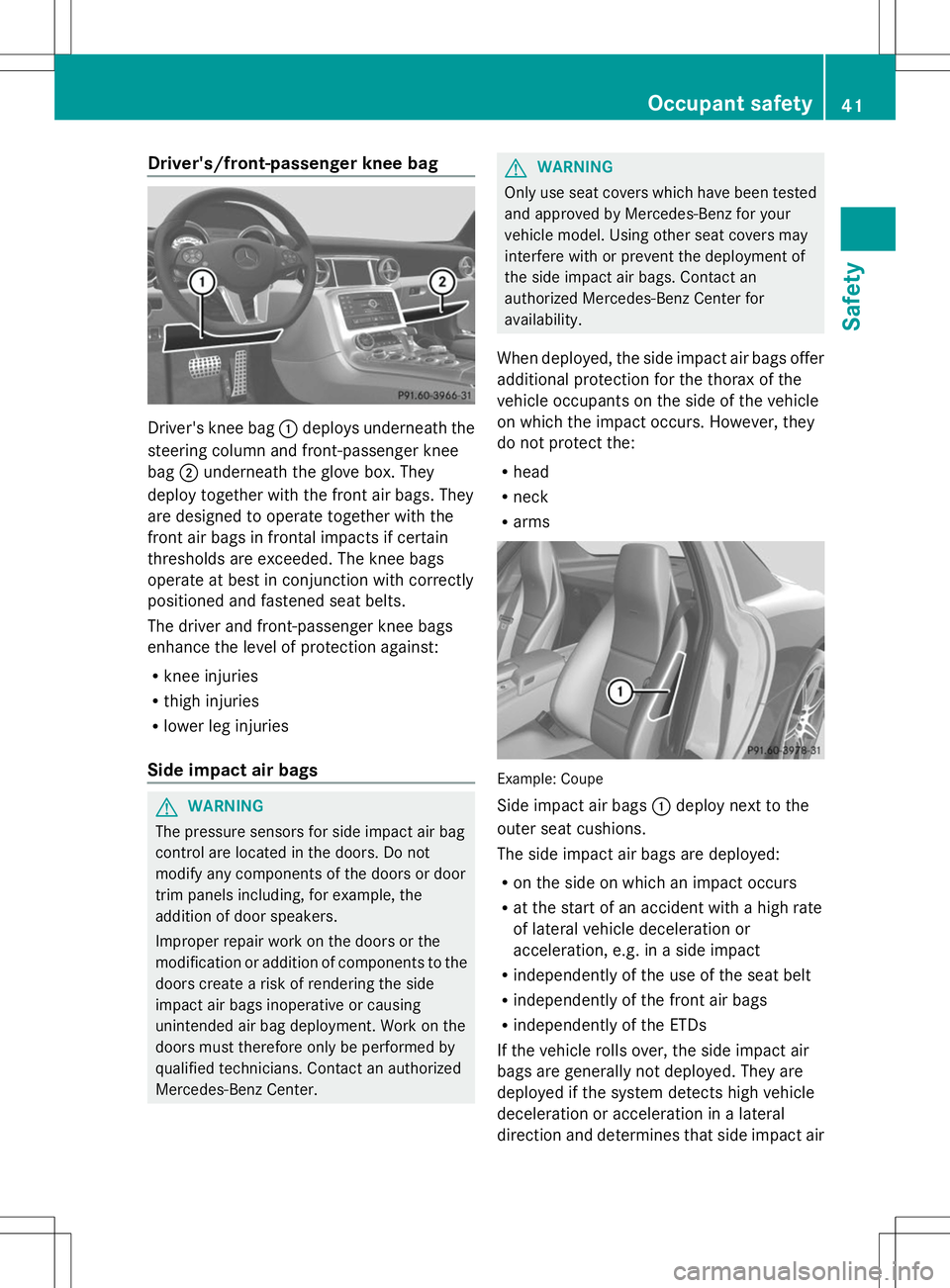
Driver's knee bag
:deploys underneath the
steering column and front-passenger knee
bag ;underneath the glove box. They
deploy together with the front air bags. They
are designed to operate together with the
front air bags in frontal impacts if certain
thresholds are exceeded. The knee bags
operate at best in conjunction with correctly
positioned and fastened seat belts.
The driver and front-passenger knee bags
enhance the level of protection against:
R knee injuries
R thigh injuries
R lower leg injuries
Side impact air bags G
WARNING
The pressure sensors for side impact air bag
control are located in the doors. Do not
modify any components of the doors or door
trim panels including, for example, the
addition of door speakers.
Improper repair work on the doors or the
modification or addition of components to the
doors create a risk of rendering the side
impact air bags inoperative or causing
unintended air bag deployment. Work on the
doors must therefore only be performed by
qualified technicians. Contact an authorized
Mercedes-Benz Center. G
WARNING
Only use seat covers which have been tested
and approved by Mercedes-Benz for your
vehicle model. Using other seat covers may
interfere with or prevent the deployment of
the side impact air bags. Contact an
authorized Mercedes-Benz Center for
availability.
When deployed, the side impact air bags offer
additional protection for the thorax of the
vehicle occupants on the side of the vehicle
on which the impact occurs. However, they
do not protect the:
R head
R neck
R arms Example: Coupe
Side impact air bags
:deploy next to the
outer seat cushions.
The side impact air bags are deployed:
R on the side on which an impact occurs
R at the start of an accident with a high rate
of lateral vehicle deceleration or
acceleration, e.g. in a side impact
R independently of the use of the seat belt
R independently of the front air bags
R independently of the ETDs
If the vehicle rolls over, the side impact air
bags are generally not deployed. They are
deployed if the system detects high vehicle
deceleration or acceleration in a lateral
direction and determines that side impact air Occupant safety
41Safety Z
Page 44 of 292
bag deployment can offer additional
protection to that provided by the seat belt.
Side impact air bags will not deploy in side
impacts which do not exceed the system's
preset deployment thresholds for lateral
acceleration/deceleration. You will then be
protected by the fastened seat belt.
If the OCS detects that the front-passenger
seat is not occupied and the front-passenger
seat belt is not fastened (the belt tongue is
not engaged in the seat belt buckle), the side
impact air bag on the front-passenger side
will not deploy. The side impact air bag on the
front-passenger side will deploy if the front-
passenger seat belt is fastened, regardless of
whether the front-passenger seat is occupied
or not.
Head bags The head bags enhance the level of protection
for the head (but not chest or arms) of the
vehicle occupants on the side of the vehicle
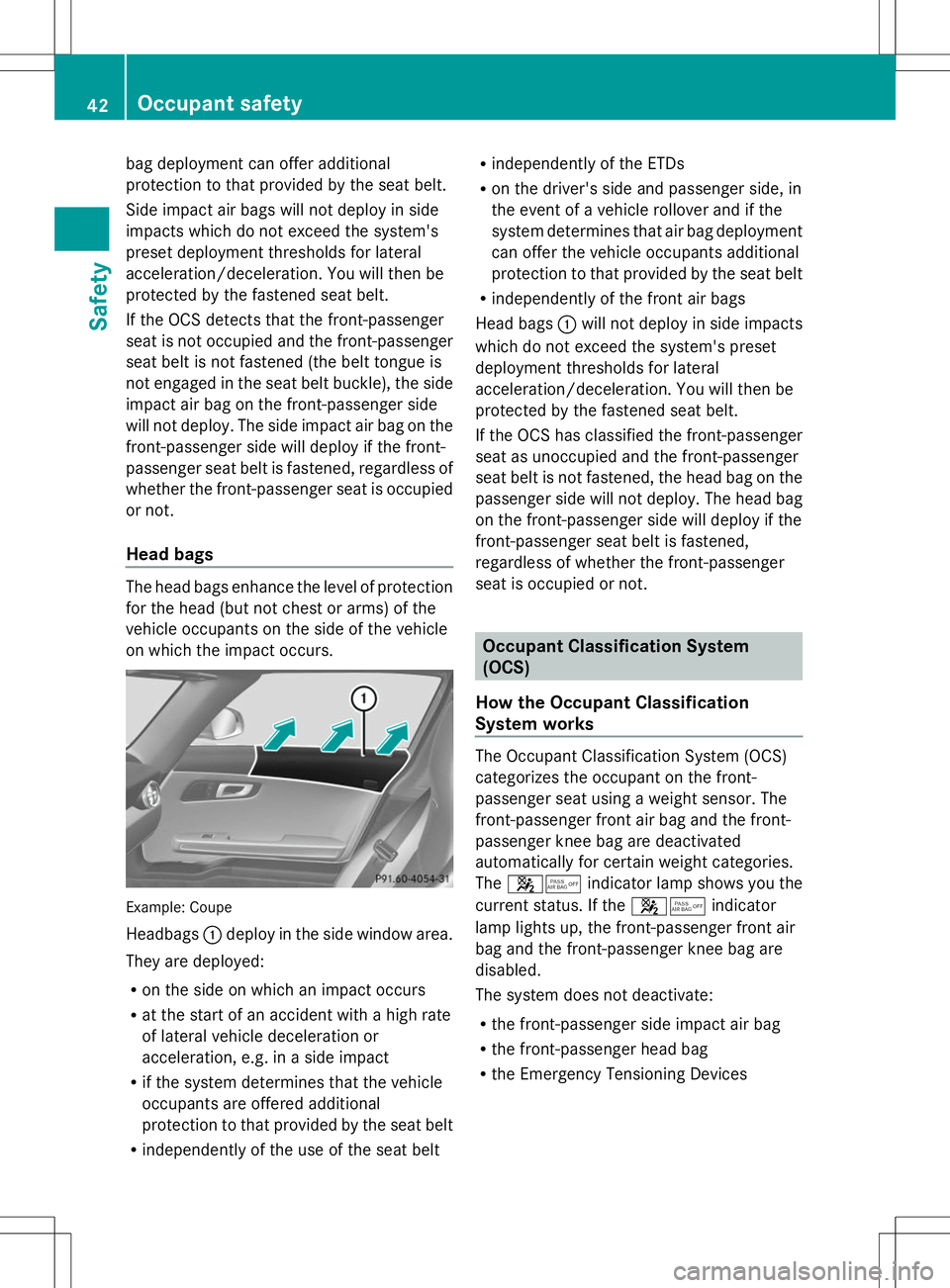
on which the impact occurs. Example: Coupe
Headbags
:deploy in the side window area.
They are deployed:
R on the side on which an impact occurs
R at the start of an accident with a high rate
of lateral vehicle deceleration or
acceleration, e.g. in a side impact
R if the system determines that the vehicle
occupants are offered additional
protection to that provided by the seat belt
R independently of the use of the seat belt R
independently of the ETDs
R on the driver's side and passenger side, in
the event of a vehicle rollover and if the
system determines that air bag deployment
can offer the vehicle occupants additional
protection to that provided by the seat belt
R independently of the front air bags
Head bags :will not deploy in side impacts
which do not exceed the system's preset
deployment thresholds for lateral
acceleration/deceleration. You will then be
protected by the fastened seat belt.
If the OCS has classified the front-passenger
seat as unoccupied and the front-passenger
seat belt is not fastened, the head bag on the
passenger side will not deploy. The head bag
on the front-passenger side will deploy if the
front-passenger seat belt is fastened,
regardless of whether the front-passenger
seat is occupied or not. Occupant Classification System
(OCS)
How the Occupant Classification
System works The Occupant Classification System (OCS)
categorizes the occupant on the front-
passenger seat using a weight sensor. The
front-passenger front air bag and the front-
passenger knee bag are deactivated
automatically for certain weight categories.
The 45 indicator lamp shows you the
current status. If the 45indicator
lamp lights up, the front-passenger front air
bag and the front-passenger knee bag are
disabled.
The system does not deactivate:
R the front-passenger side impact air bag
R the front-passenger head bag
R the Emergency Tensioning Devices 42
Occupant safetySafety
Page 45 of 292
To be classified correctly, the front passenger
must sit:
R with the seat belt fastened correctly
R in a position that is as upright as possible
with their back against the seat backrest
R with their feet on the floor
If the front-passenger's weight is transferred
to another object in the vehicle (e.g. by
leaning on armrests), OCS may not be able to
approximate the occupant's weight category.
In order to determine whether or not the front
passenger has been detected, both the driver
and the front passenger should observe the
45 indicator lamp.
If the front-passenger seat, the seat cover or
the seat cushion are damaged, have the
necessary repair work carried out at an
authorized Mercedes-Benz Center.
For safety reasons, Mercedes-Benz
recommends that you only use seat
accessories that have been approved by
Mercedes-Benz. G
WARNING
If the 45 indicator lamp lights up when
the front-passenger seat is occupied by an
adult or a larger person, ask the passenger to
reposition themselves on the seat so that the
45 indicator lamp goes out.
In the event of a collision, the air bag control
unit will not allow front-passenger front air
bag and front-passenger knee bag
deployment when the OCS has classified the
front-passenger occupant as weighing as
much as or less than a typical 12-month-old
child in a standard child restraint or if the
front-passenger seat is classified as being
unoccupied.
If OCS has detected that the front passenger
weighs the same as or less than a typical 12-
month-old child in a standard child restraint
system, the 45indicator lamp lights
up when the engine is started and remains lit.
This indicates that the front-passenger front
air bag is deactivated. If OCS determines that the front-passenger
seat is unoccupied, the
45indicator
lamp lights up once the engine has been
started and remains lit. This shows that the
front-passenger front air bag and front-
passenger knee bag are deactivated.
If OCS determines that the front passenger
weighs more than a typical 12 month old child
in a standard child restraint system and
classifies this as a small person (e.g. a
teenager or small adult), the 45
indicator lamp lights up for approximately 6
seconds when the engine is started.
Depending on occupant weight sensor
readings from the seat, it will then remain
illuminated or go out. If the 45
indicator lamp is illuminated, the front-
passenger front air bag is deactivated. With
the 45 indicator lamp out, the front-
passenger front air bag and front-passenger
knee bag are deactivated.
If OCS has determined that the front
passenger is an adult or medium sized person,
the 45 indicator lamp lights up for
approximately 6 seconds when the engine is
started and then goes out. This shows that the
front-passenger front air bag and front-
passenger knee bag are activated.
If the 45 indicator lamp is illuminated,
the front-passenger front air bag and the
front-passenger knee bag are deactivated and
are not deployed.
If the 45 indicator lamp does not light
up, the front-passenger air bag is enabled and
will be deployed:
R in the event of certain frontal impacts
R if the impact exceeds a preset deployment
threshold
R independently of the other air bags
If the front-passenger air bag is deployed, the
rate of inflation is influenced by:
R the rate of vehicle deceleration as assessed
by the air bag control unit
R the front passenger's weight category as
determined by the OCS Occupant safety
43Safety Z
Page 93 of 292
mirror using adjustment button
=as long
as the indicator lamp is lit.
X Press adjustment button =up, down, or
to the left or right until you have adjusted
the exterior mirror to the desired position.
You should have a good overview of traffic
conditions.
Folding the exterior mirrors in or out
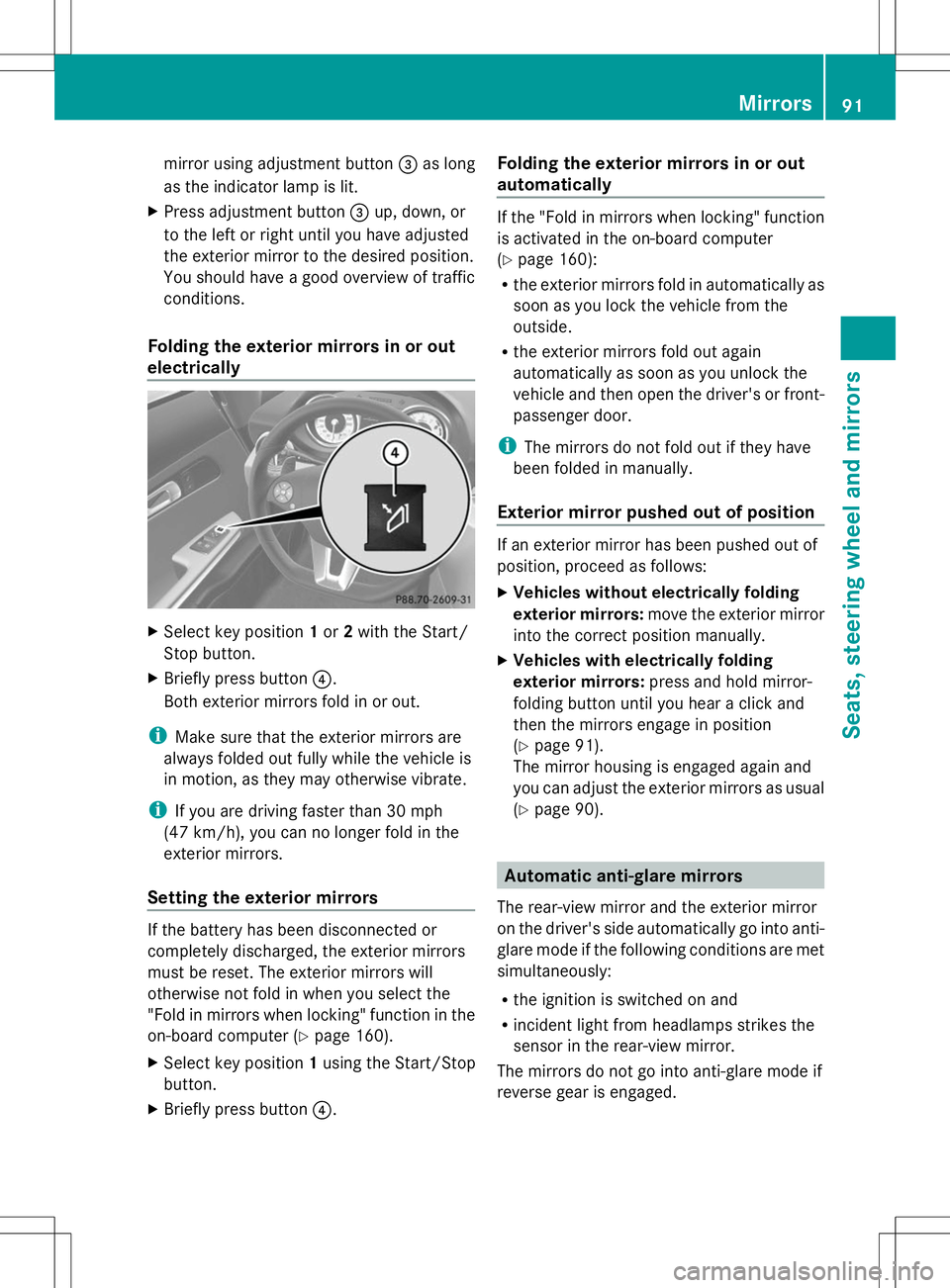
electrically X
Select key position 1or 2with the Start/
Stop button.
X Briefly press button ?.
Both exterior mirrors fold in or out.
i Make sure that the exterior mirrors are
always folded out fully while the vehicle is
in motion, as they may otherwise vibrate.
i If you are driving faster than 30 mph
(47 km/h), you can no longer fold in the
exterior mirrors.
Setting the exterior mirrors If the battery has been disconnected or
completely discharged, the exterior mirrors
must be reset. The exterior mirrors will
otherwise not fold in when you select the
"Fold in mirrors when locking" function in the
on-board computer (Y page 160).
X Select key position 1using the Start/Stop
button.
X Briefly press button ?. Folding the exterior mirrors in or out
automatically If the "Fold in mirrors when locking" function
is activated in the on-board computer
(Y
page 160):
R the exterior mirrors fold in automatically as
soon as you lock the vehicle from the
outside.
R the exterior mirrors fold out again
automatically as soon as you unlock the
vehicle and then open the driver's or front-
passenger door.
i The mirrors do not fold out if they have
been folded in manually.
Exterior mirror pushed out of position If an exterior mirror has been pushed out of
position, proceed as follows:
X
Vehicles without electrically folding
exterior mirrors: move the exterior mirror
into the correct position manually.
X Vehicles with electrically folding
exterior mirrors: press and hold mirror-
folding button until you hear a click and
then the mirrors engage in position
(Y page 91).
The mirror housing is engaged again and
you can adjust the exterior mirrors as usual
(Y page 90). Automatic anti-glare mirrors
The rear-view mirror and the exterior mirror
on the driver's side automatically go into anti-
glare mode if the following conditions are met
simultaneously:
R the ignition is switched on and
R incident light from headlamps strikes the
sensor in the rear-view mirror.
The mirrors do not go into anti-glare mode if
reverse gear is engaged. Mirrors
91Seats, steering wheel and mirrors Z
Page 98 of 292
Useful information
i This Operator's Manual describes all
models and all standard and optional
equipment of your vehicle available at the
time of publication of the Operator's
Manual. Country-specific differences are
possible. Please note that your vehicle may
not be equipped with all features
described. This also applies to safety-
related systems and functions.
i Please read the information on qualified
specialist workshops (Y page 22).Exterior lighting
General notes
For reasons of safety, Mercedes-Benz
recommends that you drive with the lights
switched on even during the daytime. In some
countries, operation of the headlamps varies
due to legal requirements and self-imposed
obligations. Driving abroad
Converting to symmetrical low beam
when driving abroad: switch the headlamps
to symmetrical low beam in countries in
which traffic drives on the opposite side of the
road to the country where the vehicle is
registered. This prevents glare to oncoming
traffic. Symmetrical lights do not illuminate
as large an area of the edge of the road.
Have the headlamps converted at a qualified
specialist workshop, e.g. an authorized
Mercedes-Benz Center, as close to the border
as possible before driving in these countries.
Converting to asymmetrical low beam
after returning: have the headlamps
converted back to asymmetrical low beam at
a qualified specialist workshop, e.g. an
authorized Mercedes-Benz Center, as soon as
possible after crossing the border again. Setting the exterior lighting
Setting options Exterior lighting can be set using:
R
the light switch
R the combination switch (Y page 98)
R the on-board computer (Y page 158)
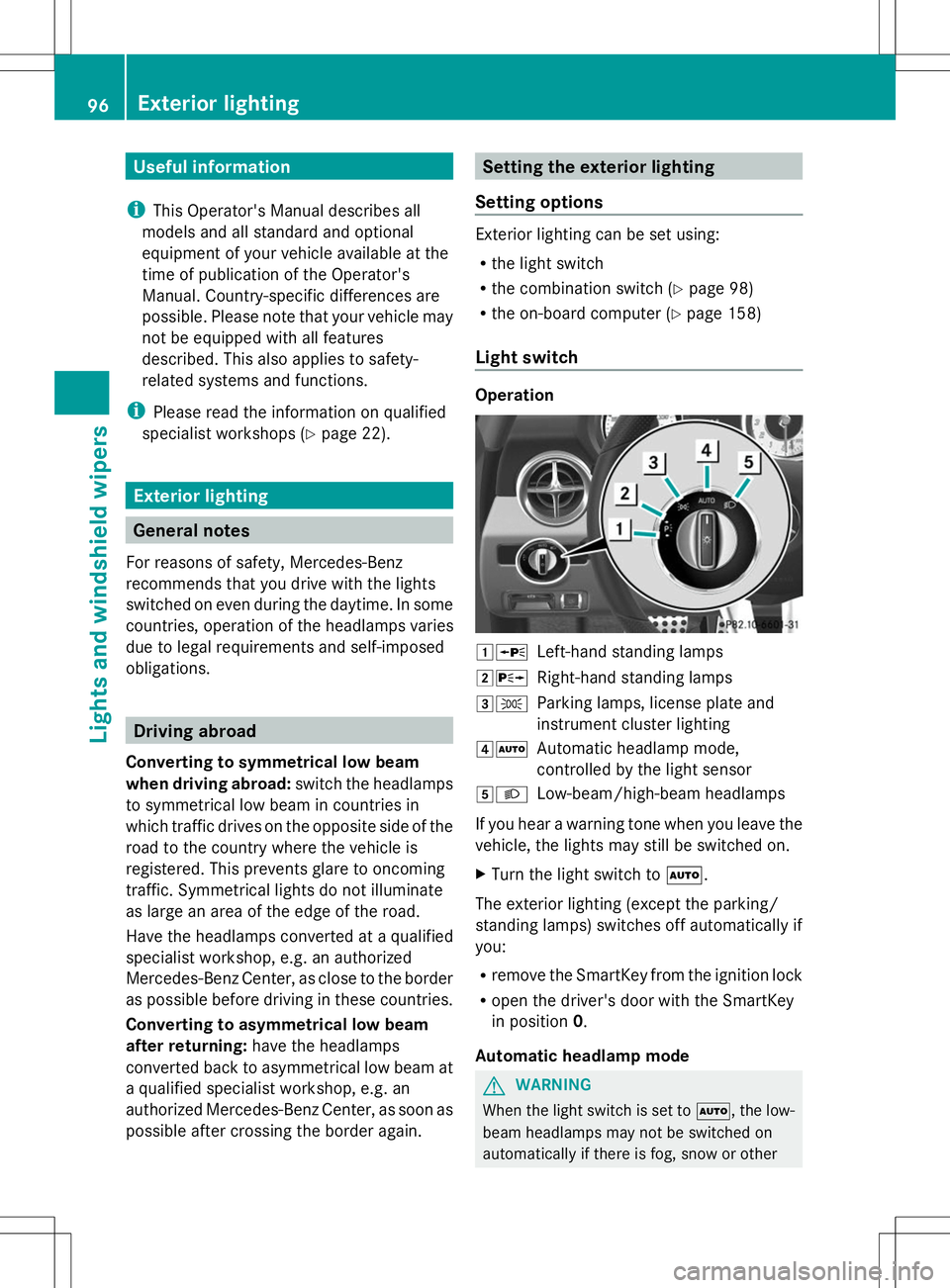
Light switch Operation
1W
Left-hand standing lamps
2X Right-hand standing lamps
3T Parking lamps, license plate and
instrument cluster lighting
4Ã Automatic headlamp mode,
controlled by the light sensor
5L Low-beam/high-beam headlamps
If you hear a warning tone when you leave the
vehicle, the lights may still be switched on.
X Turn the light switch to Ã.
The exterior lighting (except the parking/
standing lamps) switches off automatically if
you:
R remove the SmartKey from the ignition lock
R open the driver's door with the SmartKey
in position 0.
Automatic headlamp mode G
WARNING
When the light switch is set to Ã, the low-
beam headlamps may not be switched on
automatically if there is fog, snow or other 96
Exterior lightingLights and windshield wipers