wheel MERCEDES-BENZ SLS-CLASS 2013 Owners Manual
[x] Cancel search | Manufacturer: MERCEDES-BENZ, Model Year: 2013, Model line: SLS-CLASS, Model: MERCEDES-BENZ SLS-CLASS 2013Pages: 286, PDF Size: 3.6 MB
Page 271 of 286
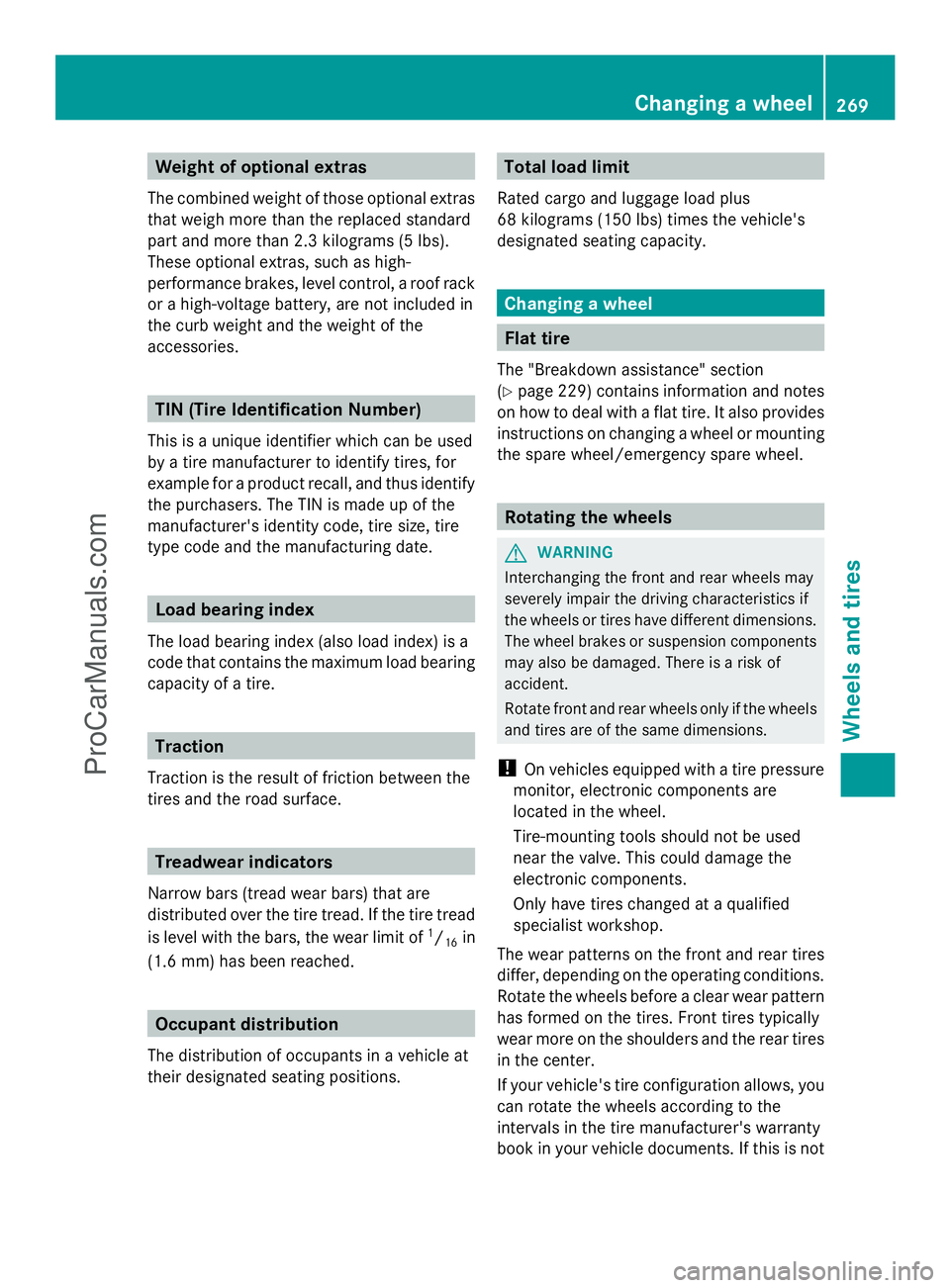
Weight of optional extras
The combined weight of those optional extras
that weigh more than the replaced standard
part and more than 2.3 kilograms (5 lbs).
These optional extras, such as high-
performance brakes, level control, a roof rack
or a high-voltage battery, are not included in
the curb weight and the weight of the
accessories. TIN (Tire Identification Number)
This is a unique identifier which can be used
by a tire manufacturer to identify tires, for
example for a product recall, and thus identify
the purchasers. The TIN is made up of the
manufacturer's identity code, tire size, tire
type code and the manufacturing date. Load bearing index
The load bearing index (also load index) is a
code that contains the maximum load bearing
capacity of a tire. Traction
Traction is the result of friction between the
tires and the road surface. Treadwear indicators
Narrow bars (tread wear bars) that are
distributed over the tire tread. If the tire tread
is level with the bars, the wear limit of 1
/ 16 in
(1.6 mm) has been reached. Occupant distribution
The distribution of occupants in a vehicle at
their designated seating positions. Total load limit
Rated cargo and luggage load plus
68 kilograms (150 lbs) times the vehicle's
designated seating capacity. Changing a wheel
Flat tire
The "Breakdown assistance" section
(Y page 229) contains information and notes
on how to deal with a flat tire. It also provides
instructions on changing a wheel or mounting
the spare wheel/emergency spare wheel. Rotating the wheels
G
WARNING
Interchanging the front and rear wheels may
severely impair the driving characteristics if
the wheels or tires have different dimensions.
The wheel brakes or suspension components
may also be damaged. There is a risk of
accident.
Rotate front and rear wheels only if the wheels
and tires are of the same dimensions.
! On vehicles equipped with a tire pressure
monitor, electronic components are
located in the wheel.
Tire-mounting tools should not be used
near the valve. This could damage the
electronic components.
Only have tires changed at a qualified
specialist workshop.
The wear patterns on the front and rear tires
differ, depending on the operating conditions.
Rotate the wheels before a clear wear pattern
has formed on the tires. Front tires typically
wear more on the shoulders and the rear tires
in the center.
If your vehicle's tire configuration allows, you
can rotate the wheels according to the
intervals in the tire manufacturer's warranty
book in your vehicle documents. If this is not Changing a wheel
269Wheels and tires Z
ProCarManuals.com
Page 272 of 286
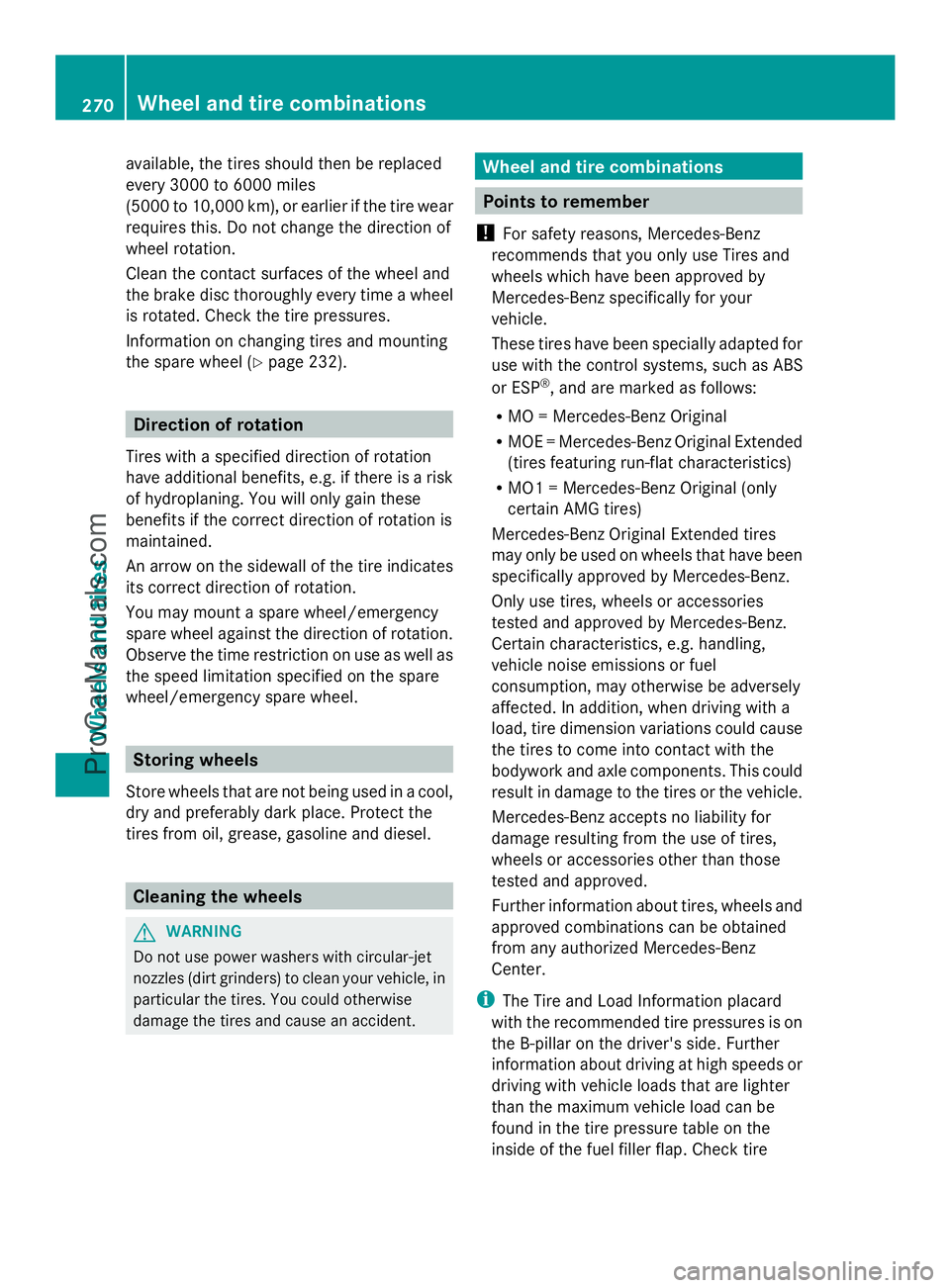
available, the tires should then be replaced
every 3000 to 6000 miles
(5000 to 10,000 km ),or earlier if the tire wear
requires this. Do not change the direction of
wheel rotation.
Clean the contact surfaces of the wheel and
the brake disc thoroughly every time a wheel
is rotated. Check the tire pressures.
Information on changing tires and mounting
the spare wheel (Y page 232).Direction of rotation
Tires with a specified direction of rotation
have additional benefits, e.g. if there is a risk
of hydroplaning. You will only gain these
benefits if the correct direction of rotation is
maintained.
An arrow on the sidewall of the tire indicates
its correct direction of rotation.
You may mount a spare wheel/emergency
spare wheel against the direction of rotation.
Observe the time restriction on use as well as
the speed limitation specified on the spare
wheel/emergency spare wheel. Storing wheels
Store wheels that are not being used in a cool,
dry and preferably dark place. Protect the
tires from oil, grease, gasoline and diesel. Cleaning the wheels
G
WARNING
Do not use power washers with circular-jet
nozzles (dirt grinders) to clean your vehicle, in
particular the tires. You could otherwise
damage the tires and cause an accident. Wheel and tire combinations
Points to remember
! For safety reasons, Mercedes-Benz
recommends that you only use Tires and
wheels which have been approved by
Mercedes-Benz specifically for your
vehicle.
These tires have been specially adapted for
use with the control systems, such as ABS
or ESP ®
, and are marked as follows:
R MO = Mercedes-Benz Original
R MOE = Mercedes-Benz Original Extended
(tires featuring run-flat characteristics)
R MO1 = Mercedes-Benz Original (only
certain AMG tires)
Mercedes-Benz Original Extended tires
may only be used on wheels that have been
specifically approved by Mercedes-Benz.
Only use tires, wheels or accessories
tested and approved by Mercedes-Benz.
Certain characteristics, e.g. handling,
vehicle noise emissions or fuel
consumption, may otherwise be adversely
affected. In addition, when driving with a
load, tire dimension variations could cause
the tires to come into contact with the
bodywork and axle components. This could
result in damage to the tires or the vehicle.
Mercedes-Benz accepts no liability for
damage resulting from the use of tires,
wheels or accessories other than those
tested and approved.
Further information about tires, wheels and
approved combinations can be obtained
from any authorized Mercedes-Benz
Center.
i The Tire and Load Information placard
with the recommended tire pressures is on
the B-pillar on the driver's side. Further
information about driving at high speeds or
driving with vehicle loads that are lighter
than the maximum vehicle load can be
found in the tire pressure table on the
inside of the fuel filler flap. Check tire 270
Wheel and tire combinationsWheels and tires
ProCarManuals.com
Page 273 of 286
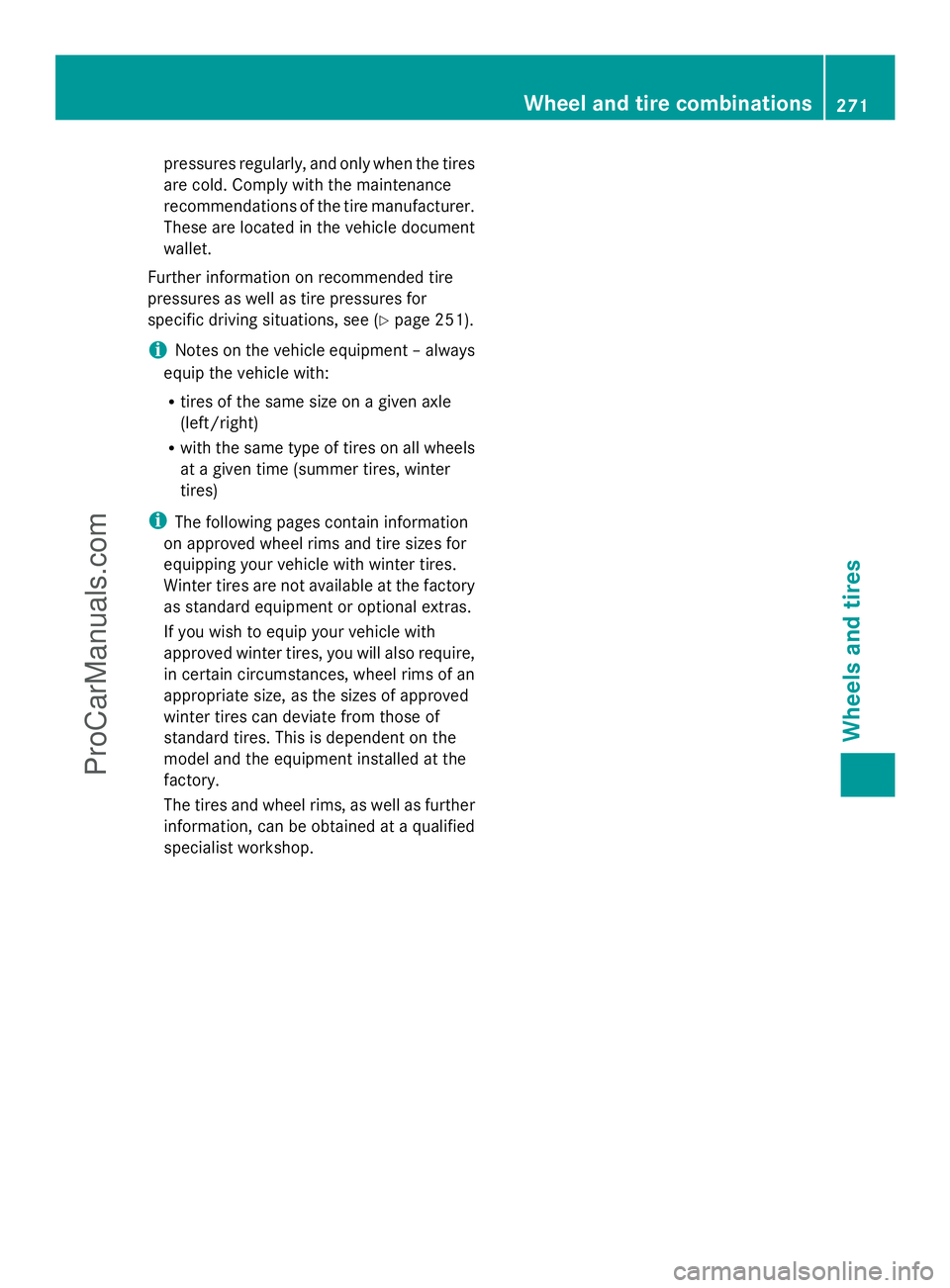
pressures regularly, and only when the tires
are cold. Comply with the maintenance
recommendations of the tire manufacturer.
These are located in the vehicle document
wallet.
Further information on recommended tire
pressures as well as tire pressures for
specific driving situations, see (Y page 251).
i Notes on the vehicle equipment – always
equip the vehicle with:
R tires of the same size on a given axle
(left/right)
R with the same type of tires on all wheels
at a given time (summer tires, winter
tires)
i The following pages contain information
on approved wheel rims and tire sizes for
equipping your vehicle with winter tires.
Winter tires are not available at the factory
as standard equipment or optional extras.
If you wish to equip your vehicle with
approved winter tires, you will also require,
in certain circumstances, wheel rims of an
appropriate size, as the sizes of approved
winter tires can deviate from those of
standard tires. This is dependent on the
model and the equipment installed at the
factory.
The tires and wheel rims, as well as further
information, can be obtained at a qualified
specialist workshop. Wheel and tire combinations
271Wheels and tires Z
ProCarManuals.com
Page 274 of 286
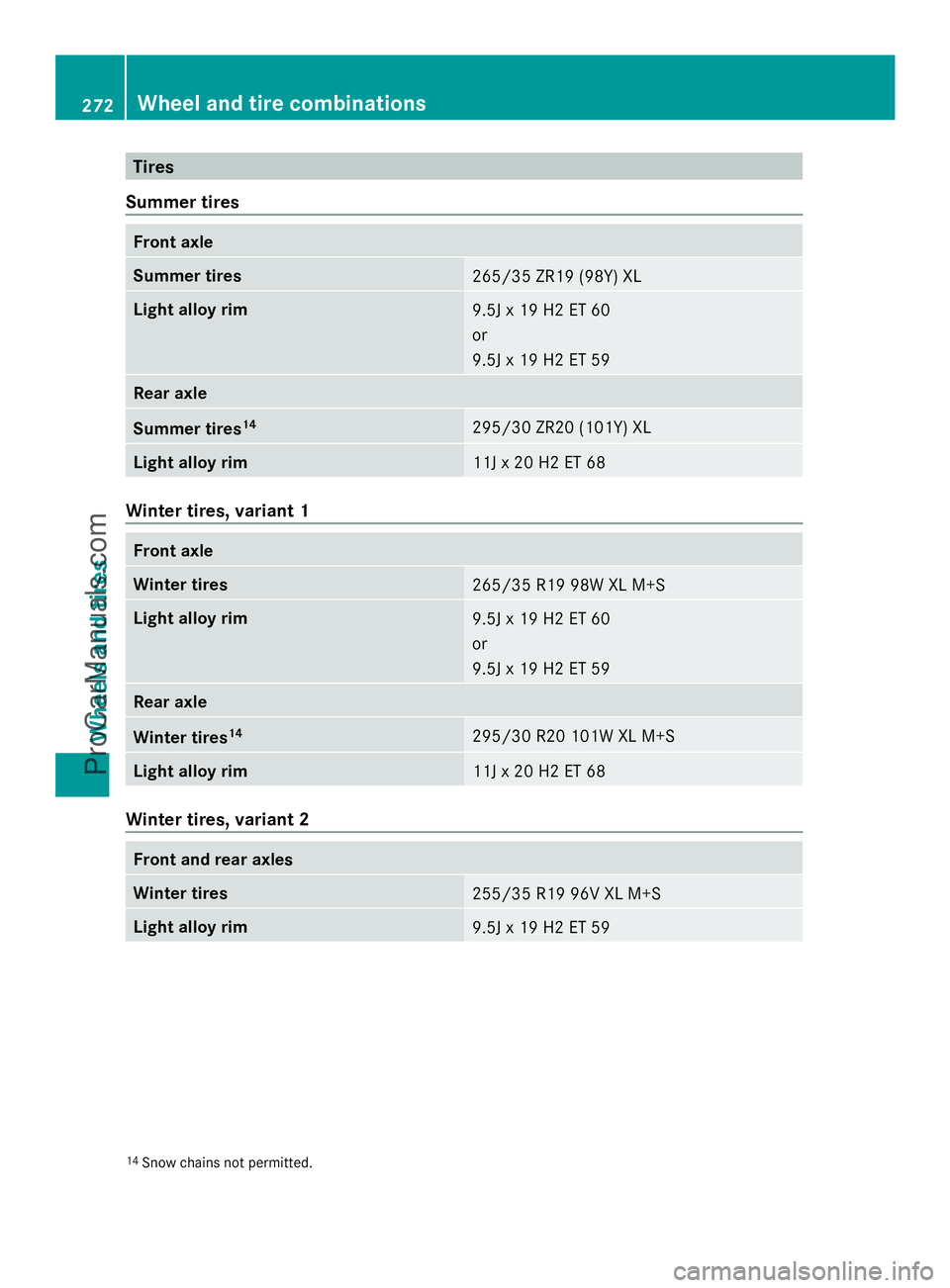
Tires
Summer tires Front axle
Summer tires
265/35 ZR19 (98Y) XL
Light alloy rim
9.5J x 19 H2 ET 60
or
9.5J x 19 H2 ET 59 Rear axle
Summer tires
14 295/30 ZR20 (101Y) XL
Light alloy rim
11J x 20 H2 ET 68
Winter tires, variant 1
Front axle
Winter tires
265/35 R19 98W XL M+S
Light alloy rim
9.5J x 19 H2 ET 60
or
9.5J x 19 H2 ET 59 Rear axle
Winter tires
14 295/30 R20 101W XL M+S
Light alloy rim
11J x 20 H2 ET 68
Winter tires, variant 2
Front and rear axles
Winter tires
255/35 R19 96V XL M+S
Light alloy rim
9.5J x 19 H2 ET 59
14
Snow chains not permitted. 272
Wheel and tire combinationsWheels and tires
ProCarManuals.com
Page 276 of 286
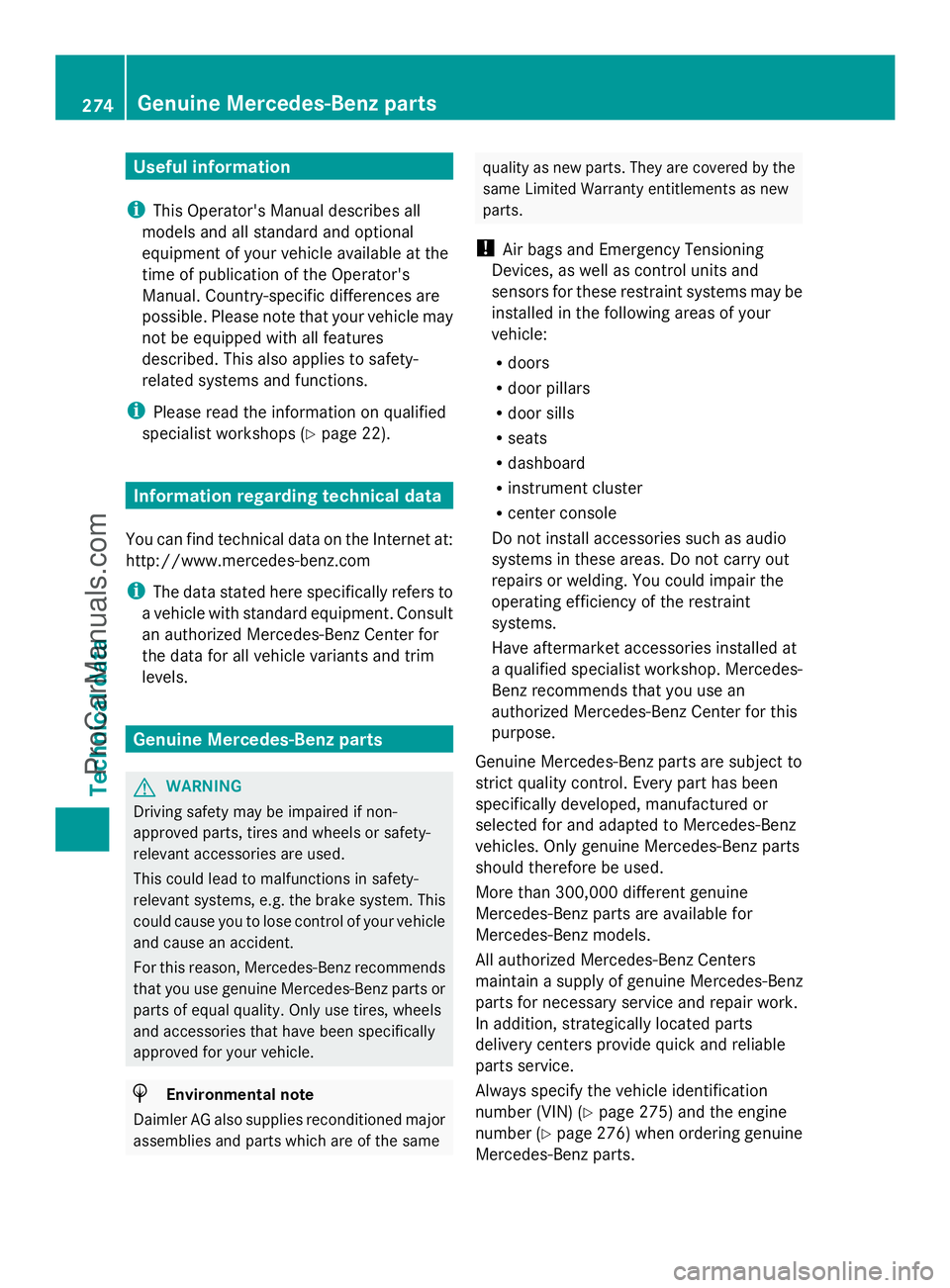
Useful information
i This Operator's Manual describes all
models and all standard and optional
equipment of your vehicle available at the
time of publication of the Operator's
Manual. Country-specific differences are
possible. Please note that your vehicle may
not be equipped with all features
described. This also applies to safety-
related systems and functions.
i Please read the information on qualified
specialist workshops (Y page 22).Information regarding technical data
You can find technical data on the Internet at:
http://www.mercedes-benz.com
i The data stated here specifically refers to
a vehicle with standard equipment. Consult
an authorized Mercedes-Benz Center for
the data for all vehicle variants and trim
levels. Genuine Mercedes-Benz parts
G
WARNING
Driving safety may be impaired if non-
approved parts, tires and wheels or safety-
relevant accessories are used.
This could lead to malfunctions in safety-
relevant systems, e.g. the brake system. This
could cause you to lose control of your vehicle
and cause an accident.
For this reason, Mercedes-Benz recommends
that you use genuine Mercedes-Benz parts or
parts of equal quality. Only use tires, wheels
and accessories that have been specifically
approved for your vehicle. H
Environmental note
Daimler AG also supplies reconditioned major
assemblies and parts which are of the same quality as new parts. They are covered by the
same Limited Warranty entitlements as new
parts.
! Air bags and Emergency Tensioning
Devices, as well as control units and
sensors for these restraint systems may be
installed in the following areas of your
vehicle:
R doors
R door pillars
R door sills
R seats
R dashboard
R instrument cluster
R center console
Do not install accessories such as audio
systems in these areas. Do not carry out
repairs or welding. You could impair the
operating efficiency of the restraint
systems.
Have aftermarket accessories installed at
a qualified specialist workshop. Mercedes-
Benz recommends that you use an
authorized Mercedes-Benz Center for this
purpose.
Genuine Mercedes-Benz parts are subject to
strict quality control. Every part has been
specifically developed, manufactured or
selected for and adapted to Mercedes-Benz
vehicles. Only genuine Mercedes-Benz parts
should therefore be used.
More than 300,000 different genuine
Mercedes-Benz parts are available for
Mercedes-Benz models.
All authorized Mercedes-Benz Centers
maintain a supply of genuine Mercedes-Benz
parts for necessary service and repair work.
In addition, strategically located parts
delivery centers provide quick and reliable
parts service.
Always specify the vehicle identification
number (VIN) (Y page 275) and the engine
number (Y page 276)when ordering genuine
Mercedes-Benz parts. 274
Genuine Mercedes-Benz partsTechnical data
ProCarManuals.com
Page 284 of 286
At temperatures below freezing:
X
Fill the washer fluid reservoir with a mixture
of water and windshield washer fluid, e.g.
MB WinterFit.
Adapt the mixing ratio to the outside
temperature.
R Down to 14 ‡ ( Ò10 †): mix 1 part MB
WinterFit to 2 parts water.
R Down to Ò4 ‡ (Ò20 †): mix 1 part MB
WinterFit to 1 part water.
R Down to Ò20.2 ‡ (Ò 29 †): mix 2 parts MB
WinterFit to 1 part water.
i Add windshield washer fluid, e.g. MB
SummerFit or MB WinterFit, to the washer
fluid all year round.
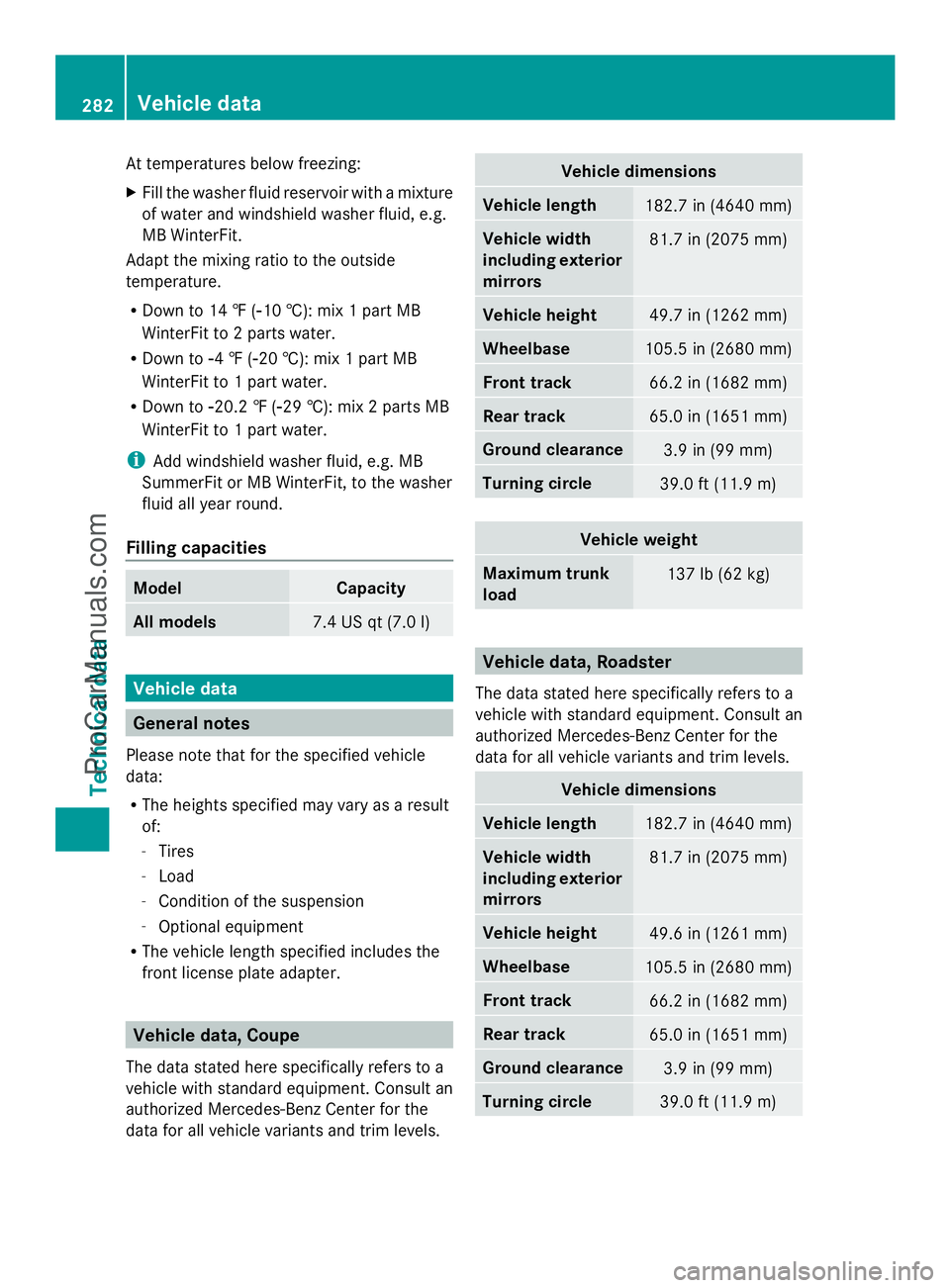
Filling capacities Model Capacity
All models
7.4 US qt (7.0 l)
Vehicle data
General notes
Please note that for the specified vehicle
data:
R The heights specified may vary as a result
of:
-Tires
- Load
- Condition of the suspension
- Optional equipment
R The vehicle length specified includes the
front license plate adapter. Vehicle data, Coupe
The data stated here specifically refers to a
vehicle with standard equipment. Consult an
authorized Mercedes-Benz Center for the
data for all vehicle variants and trim levels. Vehicle dimensions
Vehicle length
182.7 in (4640 mm)
Vehicle width
including exterior
mirrors
81.7 in (2075 mm)
Vehicle height
49.7 in (1262 mm)
Wheelbase
105.5 in (2680 mm)
Front track
66.2 in (1682 mm)
Rear track
65.0 in (1651 mm)
Ground clearance
3.9 in (99 mm)
Turning circle
39.0 ft (11.9 m)
Vehicle weight
Maximum trunk
load
137 lb (62 kg)
Vehicle data, Roadster
The data stated here specifically refers to a
vehicle with standard equipment. Consult an
authorized Mercedes-Benz Center for the
data for all vehicle variants and trim levels. Vehicle dimensions
Vehicle length
182.7 in (4640 mm)
Vehicle width
including exterior
mirrors
81.7 in (2075 mm)
Vehicle height
49.6 in (1261 mm)
Wheelbase
105.5 in (2680 mm)
Front track
66.2 in (1682 mm)
Rear track
65.0 in (1651 mm)
Ground clearance
3.9 in (99 mm)
Turning circle
39.0 ft (11.9 m)282
Vehicle dataTechnical data
ProCarManuals.com