ECU MERCEDES-BENZ SLS-CLASS 2013 User Guide
[x] Cancel search | Manufacturer: MERCEDES-BENZ, Model Year: 2013, Model line: SLS-CLASS, Model: MERCEDES-BENZ SLS-CLASS 2013Pages: 286, PDF Size: 3.6 MB
Page 81 of 286
The wind screen protects against wind when
driving with the soft top open. It is secured
between the roll bars.
The wind screen is in a bag on the tank
partition wall in the trunk.
X Open the trunk. X
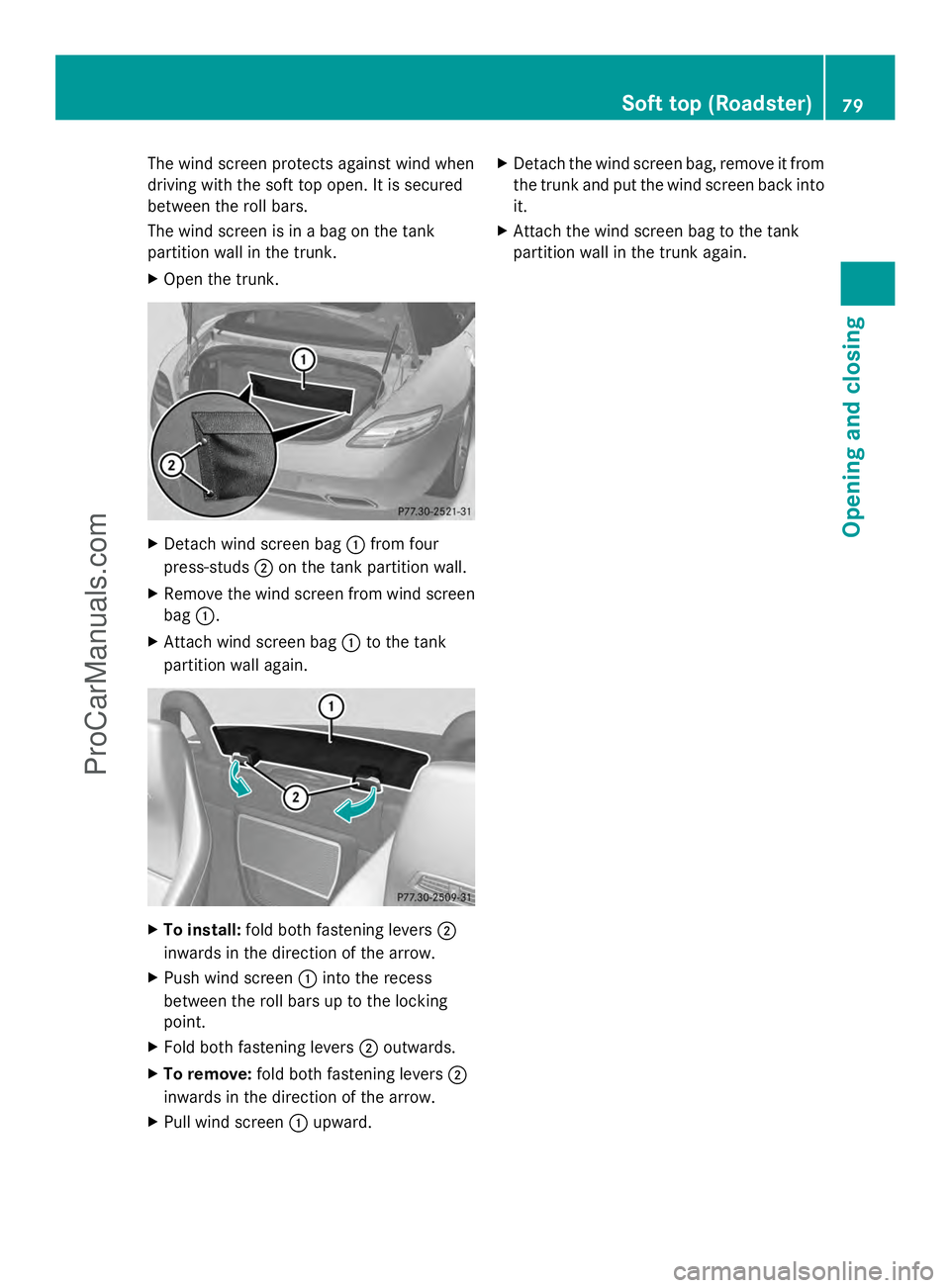
Detach wind screen bag :from four
press-studs ;on the tank partition wall.
X Remove the wind screen from wind screen
bag :.
X Attach wind screen bag :to the tank
partition wall again. X
To install: fold both fastening levers ;
inwards in the direction of the arrow.
X Push wind screen :into the recess
between the roll bars up to the locking
point.
X Fold both fastening levers ;outwards.
X To remove: fold both fastening levers ;
inwards in the direction of the arrow.
X Pull wind screen :upward. X
Detach the wind screen bag, remove it from
the trunk and put the wind screen back into
it.
X Attach the wind screen bag to the tank
partition wall in the trunk again. Soft top (Roadster)
79Opening and closing Z
ProCarManuals.com
Page 85 of 286
Seats
Important safety notes
G
WARNING
In order to avoid possible loss of vehicle
control, the following must be done before the
vehicle is put into motion:
R seat adjustment
R steering wheel adjustment
R rear-view mirror adjustment
R fastening of seat belts G
WARNING
In order to avoid possible loss of vehicle
control, all seat, head restraint, steering
wheel and rear view mirror adjustments, as
well as fastening of seat belts, must be done
before setting the vehicle in motion. G
WARNING
Do not adjust the driver's seat while driving.
Adjusting the seat while driving could cause
the driver to lose control of the vehicle.
Never travel in a moving vehicle with the seat
backrest in an excessively reclined position as
this can be dangerous. You could slide under
the seat belt in a collision. If you slide under
it, the seat belt would apply force at the
abdomen or neck. This could cause serious or
fatal injuries. The seat backrest and seat belts
provide the best restraint when the wearer is
in a position that is as upright as possible and
seat belts are properly positioned on the
body. G
WARNING
Your seat belt must be adjusted so that you
can correctly fasten your seat belt.
Observe the following points:
R adjust the seat backrest until your arms are
slightly angled when holding the steering
wheel.
R adjust the seat to a comfortable seating
position that still allows you to reach the accelerator/brake pedal safely. The
position should be as far back as possible
with the driver still able to operate the
controls properly.
R adjust the head restraint so that it is as
close to the head as possible and the center
of the head restraint supports the back of
the head at eye level.
R never place hands under the seat or near
any moving parts while a seat is being
adjusted.
Failure to do so could result in an accident
and/or serious personal injury. G
WARNING
The electrically adjustable seats can be
operated at any time. Therefore, do not leave
children unattended in the vehicle, or with
access to an unlocked vehicle. A child's
unsupervised access to a vehicle could result
in an accident and/or serious personal injury. G
WARNING
Children 12 years old and under must be
seated and properly secured in an
appropriately sized infant restraint, toddler
restraint or booster seat recommended for
the size and weight of the child. For additional
information, see section "Children in the
vehicle".
A child's risk of serious or fatal injuries is
significantly increased if the child restraints
are not properly secured in the vehicle and/
or the child is not properly secured in the child
restraint.
! To avoid damage to the seats and the seat
heating, observe the following information:
R do not spill any liquids on the seats. If
liquid is spilled on the seats, dry them as
soon as possible.
R if the seat covers are damp or wet, do not
switch on the seat heating. The seat
heating should also not to be used to dry
the seats. Seats
83Seats, steering wheel and mirrors Z
ProCarManuals.com
Page 114 of 286
Useful information
i This Operator's Manual describes all
models and all standard and optional
equipment of your vehicle available at the
time of publication of the Operator's
Manual. Country-specific differences are
possible. Please note that your vehicle may
not be equipped with all features
described. This also applies to safety-
related systems and functions.
i Please read the information on qualified
specialist workshops (Y page 22).Notes on breaking-in a new vehicle
Important safety notes
New brake pads/linings only reach their
optimum braking effect after several hundred
kilometers of driving. Until that time, you may
need to use increased brake pedal pressure
while braking. This also applies after the
brake discs or the brake pads/linings have
been replaced. The first 1,000miles (1,500 km)
The more you look after the engine when it is
new, the more satisfied you will be with its
performance in the future.
R You should therefore drive at varying
vehicle and engine speeds for the first
1,000 miles (1,500 km).
R For the first 1,000 miles (1,500 km), do not
drive faster than 85 mph (140 km/h).
R Only allow the engine to reach a maximum
engine speed of 4,500 rpm briefly.
R Avoid heavy loads, e.g. driving at full
throttle, during this period. Do not exceed
Ô of the maximum permitted engine speed
for each gear.
R Select the manual drive program Min good
time.
R Do not carry out a RACE START. R
Do not manually shift to a lower gear to
brake the vehicle.
R If possible, do not depress the accelerator
pedal past the point of resistance
(kickdown).
R Only select the shift range limits 3,2or 1
when driving slowly, e.g. in mountainous
terrain.
After 1,000 miles (1,500km), you can
increase the engine speed gradually and bring
the vehicle up to full speed.
i You should also observe these breaking-
in notes if your vehicle's engine or
transmission has been replaced.
i Always observe the respective speed
limits. Driving
Important safety notes
G
WARNING
Objects in the driver's footwell can restrict the
pedal travel or obstruct a depressed pedal.
The operating and road safety of the vehicle
is jeopardized. There is a risk of an accident.
Make sure that all objects in the vehicle are
stowed correctly, and that they cannot enter
the driver's footwell. Install the floormats
securely and as specified in order to ensure
sufficient clearance for the pedals. Do not use
loose floormats. G
WARNING
If you switch off the ignition while driving,
safety-relevant functions are only available
with limitations, or not at all. This could affect,
for example, the power steering and the brake
boosting effect. You will require considerably
more effort to steer and brake. There is a risk
of an accident.
Do not switch off the ignition while driving.
! Warm up the engine quickly. Do not use
the engine's full performance until it has 112
DrivingDriving and parking
ProCarManuals.com
Page 117 of 286
lever can still be moved but the parking lock
remains engaged.
X Depress the brake pedal and keep it
depressed.
X Use the E-SELECT lever to shift the
transmission to position Dor R.
X Release the brake pedal.
X Carefully depress the accelerator pedal.
The electric parking brake is automatically
released (Y page 129).
i The vehicle locks centrally once you have
pulled away. The locking knobs in the doors
drop down. The automatic door lock can
also be deactivated (Roadster only).
Hill start assist G
WARNING
After a short time, hill start assist will no
longer brake your vehicle and it could roll
away. There is a risk of an accident and injury.
Therefore, quickly move your foot from the
brake pedal to the accelerator pedal. Never
leave the vehicle when it is held by hill start
assist.
Hill start assist will aid you when pulling away
on a hill. It holds the vehicle for a short time
after you have removed your foot from the
brake pedal. This gives you enough time to
move your foot from the brake pedal to the
accelerator pedal and depress it before the
vehicle begins to roll.
X Take your foot off the brake pedal.
i Once you have taken your foot off the
brake pedal, the vehicle is held for around
one second.
X Pull away.
Hill start assist does not function if:
R you are pulling away on a level road or on
a downhill gradient.
R the transmission is in position N.R
the vehicle is secured with the electric
parking brake.
R ESP ®
is malfunctioning. Driving
115Driving and parking Z
ProCarManuals.com
Page 121 of 286
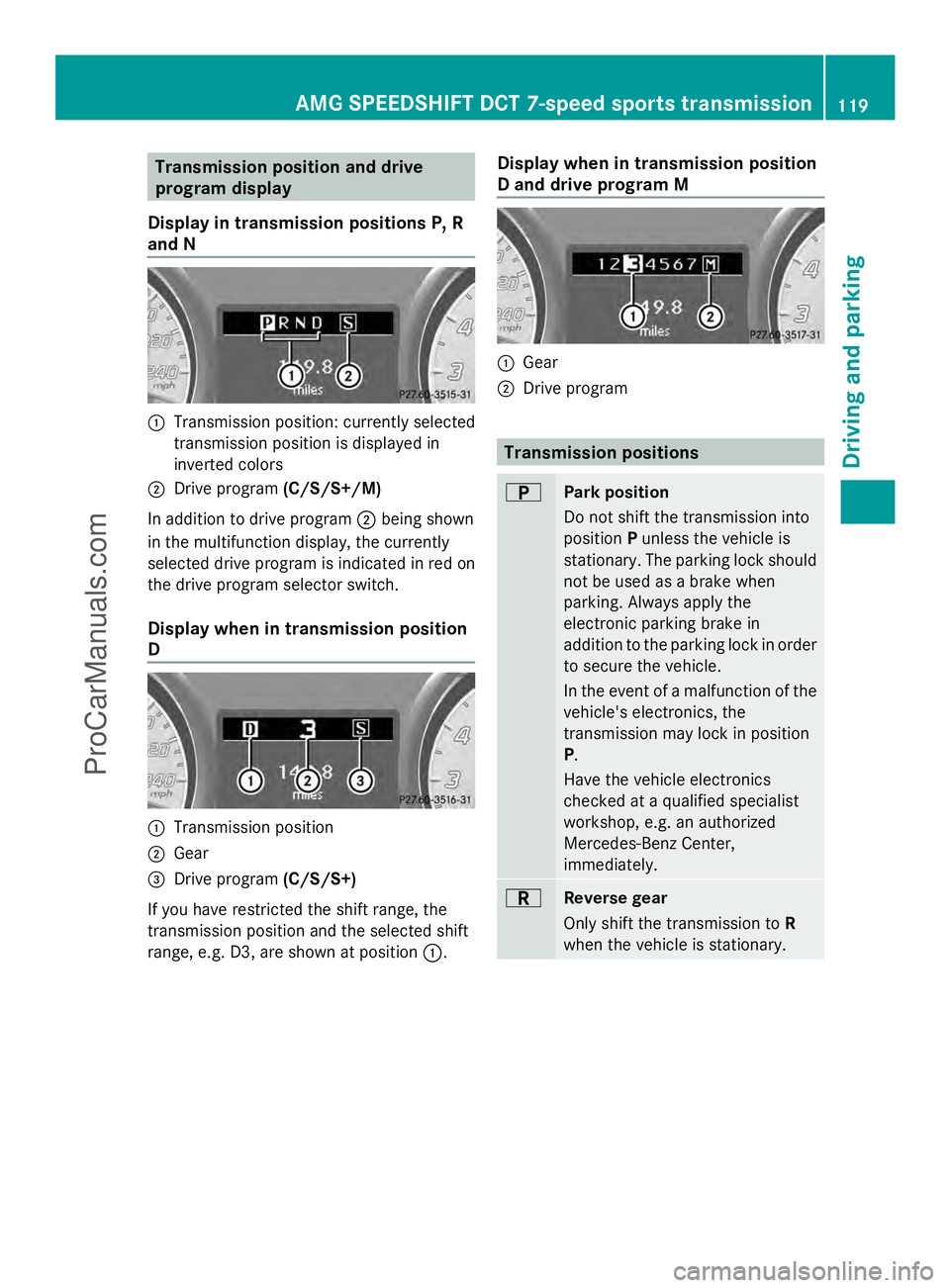
Transmission position and drive
program display
Display in transmission positions P, R
and N :
Transmission position: currently selected
transmission position is displayed in
inverted colors
; Drive program (C/S/S+/M)
In addition to drive program ;being shown
in the multifunction display, the currently
selected drive program is indicated in red on
the drive program selector switch.
Display when in transmission position
D :
Transmission position
; Gear
= Drive program (C/S/S+)
If you have restricted the shift range, the
transmission position and the selected shift
range, e.g. D3, are shown at position :.Display when in transmission position
D and drive program M :
Gear
; Drive program Transmission positions
B
Park position
Do not shift the transmission into
position
Punless the vehicle is
stationary. The parking lock should
not be used as a brake when
parking. Always apply the
electronic parking brake in
addition to the parking lock in order
to secure the vehicle.
In the event of a malfunction of the
vehicle's electronics, the
transmission may lock in position
P.
Have the vehicle electronics
checked at a qualified specialist
workshop, e.g. an authorized
Mercedes-Benz Center,
immediately. C
Reverse gear
Only shift the transmission to
R
when the vehicle is stationary. AMG SPEEDSHIFT
DCT 7-speed sports transmission
119Driving and parking Z
ProCarManuals.com
Page 129 of 286
Problems with fuel and the fuel tank
Problem Possible causes/consequences and
M
MSolutions Fuel is leaking from the
vehicle.
G
Risk of explosion or fire
The fuel line or the fuel tank is defective.
X Set the Start/Stop button to key position 0immediately.
X Do not restart the engine under any circumstances.
X Consult a qualified specialist workshop. The fuel filler flap
cannot be opened. The fuel filler flap is not unlocked.
or
The SmartKey battery is discharged.
X
Unlock the vehicle (Y page 67).
or
X Unlock the vehicle using the mechanical key (Y page 69).The fuel filler flap is unlocked, but the opening mechanism is
jammed.
X
Consult a qualified specialist workshop. Parking
Important safety notes
G
WARNING
If flammable materials such as leaves, grass
or twigs are exposed to prolonged contact to
parts of the exhaust system that heat up, they
could ignite. There is a risk of fire.
Park the vehicle so that no flammable
materials come into contact with parts of the
vehicle which are hot. Take particular care not
to park on dry grassland or harvested grain
fields. G
WARNING
If you leave children unsupervised in the
vehicle, they could set it in motion by, for
example:
R releasing the parking brake
R shifting the automatic transmission out of
the parking position P
R starting the engine. They could also operate the vehicle's
equipment. There is a risk of an accident and
injury.
When leaving the vehicle, always take the
SmartKey with you and lock the vehicle. Never
leave children unsupervised in the vehicle.
! If the engine speed is too high or if the
vehicle is rolling, do not shift the
transmission directly from Dto R, from R
to Dor directly to P.
Do not open the driver's door while the
vehicle is in motion. At low speeds in
transmission position Dor R, park position
P is otherwise engaged automatically.
The transmission could be damaged.
! Always secure the vehicle correctly
against rolling away. Otherwise, the vehicle
or its drivetrain could be damaged. Parking
127Driving and parking Z
ProCarManuals.com
Page 130 of 286
To ensure that the vehicle is secured against
rolling away unintentionally:
R the electric parking brake must be applied.
R the transmission must be in position P.
R the SmartKey must be in position 0in the
ignition lock and then removed from the
ignition lock, or the Start/Stop button must
be pressed.
R on steep uphill or downhill gradients, turn
the front wheels towards the curb.
R on steep uphill or downhill gradients, the
front axle of an empty vehicle must be
secured, for example with a wheel chock.
R on steep uphill or downhill gradients, the
rear axle of a laden vehicle must be
additionally secured, for example with a
wheel chock. Switching off the engine
Important safety notes G
WARNING
When the engine is switched off, the
transmission shifts into neutral position N.
The vehicle may roll away. There is a risk of
an accident.
After switching off the engine, always switch
to parking position P. Prevent the parked
vehicle from rolling away by applying the
parking brake.
! Do not open the driver's door while the
vehicle is in motion. At low speeds in
transmission position Dor R, park position
P is otherwise engaged automatically. This
can damage the transmission.
i Observe the display messages in the
instrument cluster.
AMG SPEEDSHIFT DCT 7-speed sports
transmission X
Shift the transmission to Pwith the button
in the center console. Using the Start/Stop button
X
Press the Start/Stop button (Y page 113).
The engine stops and all the indicator
lamps in the instrument cluster go out.
X Apply the electric parking brake.
i If you switch the engine off with the
transmission in position Ror D, the
transmission automatically shifts to N.
If you move the E-SELECT lever to Nbefore
switching off the engine, the transmission
remains for approximately 30 minutes
in N.
If you open the driver's or front-passenger
door during this period, the transmission
automatically shifts to P.
i The engine can be turned off while the
vehicle is in motion by pressing and holding
the Start/Stop button for about three
seconds.
Using the SmartKey
! Do not remove the SmartKey while the
vehicle is in motion. At low speeds, park
position Pwill otherwise be engaged
automatically.
Do not open the driver's door while the
vehicle is in motion. At low speeds,
transmission position Pis engaged
automatically.
This can damage the transmission.
X Turn the SmartKey to position 0in the
ignition lock and remove it.
The parking lock is activated.
X Apply the electric parking brake.
i If you move the E-SELECT lever to N
before switching off the engine, the
transmission remains for approximately
30 minutes in N. If you open the driver's or
front-passenger door during this period,
the transmission automatically shifts to P.128
ParkingDriving and parking
ProCarManuals.com
Page 189 of 286
Seat belts
Problem Possible causes/consequences and
M
MSolutions 7
After starting
the engine, the
red seat belt
warning lamp
lights up for six
seconds. The seat belt warning lamp reminds the driver and front passenger
to fasten their seat belts.
X
Fasten your seat belt (Y page 49).7
After the engine
starts, a warning
tone sounds for
up to six
seconds. The driver's seat belt is not fastened.
G WARNING
If you do not wear the seat belt correctly, it no longer offers the
intended level of protection in the event of an accident. Under
certain circumstances, this could cause severe or even fatal
injuries in the event of an accident.
X Fasten your seat belt (Y page 49).
The warning tone ceases. 7
The red seat belt
warning lamp
lights up after
the engine
starts, as soon
as the driver's
door or the
front-passenger
door is closed. The driver or front passenger has not fastened their seat belt.
G WARNING
If you do not wear the seat belt correctly, it no longer offers the
intended level of protection in the event of an accident. Under
certain circumstances, this could cause severe or even fatal
injuries in the event of an accident.
X Fasten your seat belt (Y page 49).
The warning lamp goes out. There are objects on the front-passenger seat.
G WARNING
If you place objects on the front-passenger seat, the system could
identify the seat as being occupied. In the event of an accident,
the restraint systems on the front-passenger side are triggered.
X Remove the objects from the front-passenger seat and stow
them in a secure place.
The warning lamp goes out. Displays and operation
187On-board computer and displays Z
ProCarManuals.com
Page 190 of 286
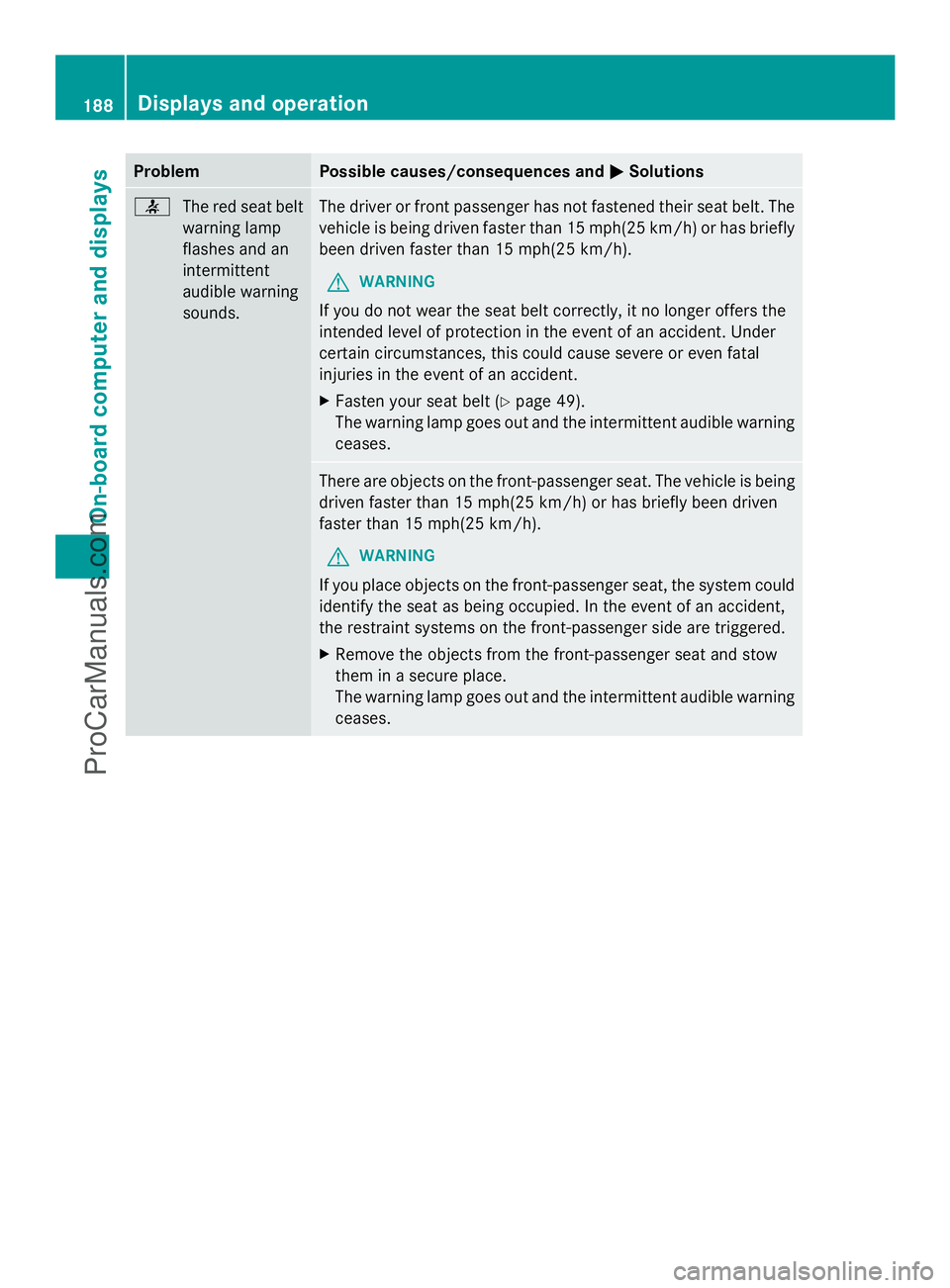
Problem Possible causes/consequences and
M
MSolutions 7
The red seat belt
warning lamp
flashes and an
intermittent
audible warning
sounds. The driver or front passenger has not fastened their seat belt. The
vehicle is being driven faster than 15 mph(25 km/h) or has briefly
been driven faster than 15 mph(25 km/h).
G WARNING
If you do not wear the seat belt correctly, it no longer offers the
intended level of protection in the event of an accident. Under
certain circumstances, this could cause severe or even fatal
injuries in the event of an accident.
X Fasten your seat belt (Y page 49).
The warning lamp goes out and the intermittent audible warning
ceases. There are objects on the front-passenger seat. The vehicle is being
driven faster than 15 mph(25 km/h) or has briefly been driven
faster than 15 mph(25 km/h).
G WARNING
If you place objects on the front-passenger seat, the system could
identify the seat as being occupied. In the event of an accident,
the restraint systems on the front-passenger side are triggered.
X Remove the objects from the front-passenger seat and stow
them in a secure place.
The warning lamp goes out and the intermittent audible warning
ceases. 188
Displays and operationOn-board computer and displays
ProCarManuals.com
Page 198 of 286
Useful information
i This Operator's Manual describes all
models and all standard and optional
equipment of your vehicle available at the
time of publication of the Operator's
Manual. Country-specific differences are
possible. Please note that your vehicle may
not be equipped with all features
described. This also applies to safety-
related systems and functions.
i Please read the information on qualified
specialist workshops (Y page 22).Stowage areas
Stowage space
Important safety notes G
WARNING
If you do not correctly store objects in the
vehicle interior, they can slip or be flung
around, thus striking vehicle occupants.
There is a risk of injury, especially when
braking or abruptly changing directions.
R Always store objects so that they cannot be
flung around in these or in similar
situations.
R Always make sure that objects do not
protrude from stowage compartments,
parcel nets or stowage nets.
R Close lockable stowage compartments
while driving.
R Stow and secure objects that are heavy,
hard, pointy, sharp-edged, fragile or too
large in the trunk. Glove box X
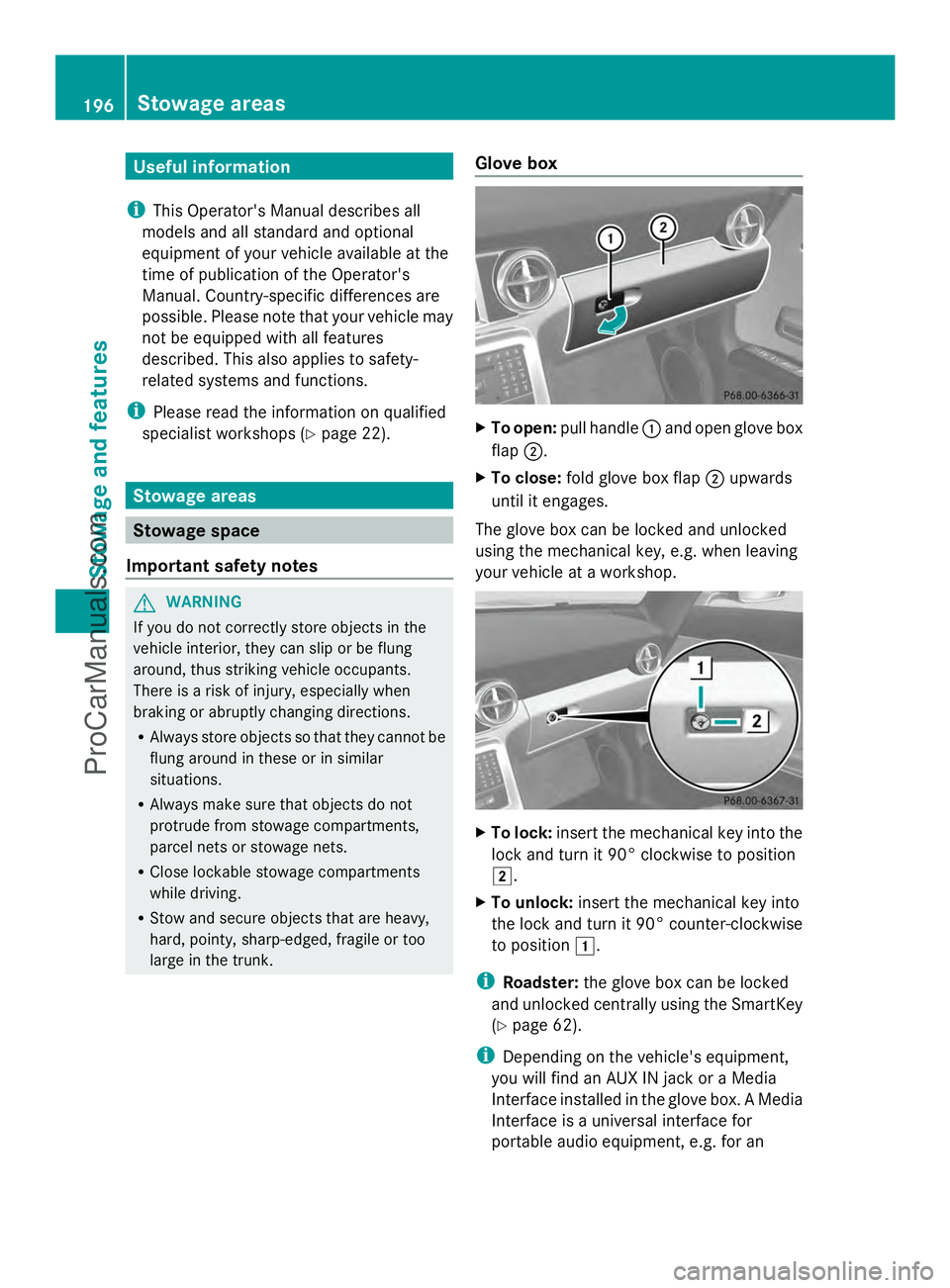
To open: pull handle :and open glove box
flap ;.
X To close: fold glove box flap ;upwards
until it engages.
The glove box can be locked and unlocked
using the mechanical key, e.g. when leaving
your vehicle at a workshop. X
To lock: insert the mechanical key into the
lock and turn it 90° clockwise to position
2.
X To unlock: insert the mechanical key into
the lock and turn it 90° counter-clockwise
to position 1.
i Roadster: the glove box can be locked
and unlocked centrally using the SmartKey
(Y page 62).
i Depending on the vehicle's equipment,
you will find an AUX IN jack or a Media
Interface installed in the glove box. A Media
Interface is a universal interface for
portable audio equipment, e.g. for an 196
Stowage areasStowage and features
ProCarManuals.com