display MERCEDES-BENZ SLS COUPE 2010 Owners Manual
[x] Cancel search | Manufacturer: MERCEDES-BENZ, Model Year: 2010, Model line: SLS COUPE, Model: MERCEDES-BENZ SLS COUPE 2010Pages: 361, PDF Size: 6.32 MB
Page 308 of 361
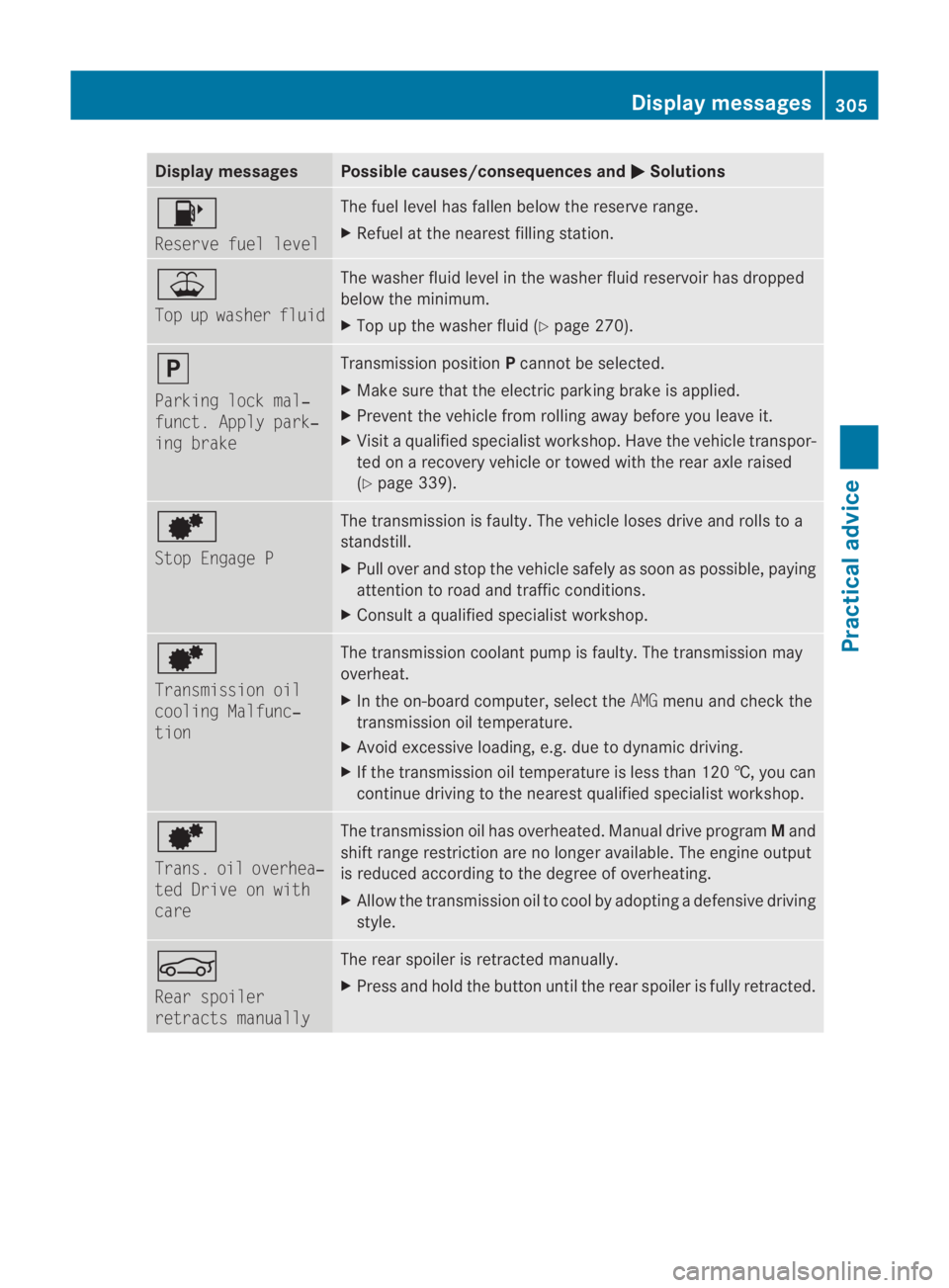
Display messages Possible causes/consequences and
0003 Solutions
0007
Reserve fuel level The fuel level has fallen belo
wthe reserve range.
X Refuel at the nearest filling station. 0016
Top up washer fluid The washer fluid level in the washer fluid reservoir has dropped
below the minimum.
X
Top up the washer fluid (Y page 270).0009
Parking lock mal‐
funct. Apply park‐
ing brake Transmission position
Pcannot be selected.
X Make sure that the electric parking brake is applied.
X Prevent the vehicle from rolling away before you leave it.
X Visit a qualified specialist workshop. Have the vehicle transpor-
ted on a recovery vehicle or towed with the rear axle raised
(Y page 339). 0001
Stop Engage P The transmission is faulty. The vehicle loses drive and rolls to a
standstill.
X
Pull over and stop the vehicle safely as soon as possible, paying
attention to road and traffic conditions.
X Consult a qualified specialist workshop. 0001
Transmission oil
cooling Malfunc‐
tion The transmission coolant pump is faulty. The transmission may
overheat.
X In the on-board computer, select the AMGmenu and check the
transmission oil temperature.
X Avoid excessive loading, e.g. due to dynamic driving.
X If the transmission oil temperature is less than 120 †, you can
continue driving to the nearest qualified specialist workshop. 0001
Trans. oil overhea‐
ted Drive on with
care The transmission oil has overheated. Manual drive program
Mand
shift range restriction are no longer available. The engine output
is reduced according to the degree of overheating.
X Allow the transmission oil to cool by adopting a defensive driving
style. 0005
Rear spoiler
retracts manually The rear spoiler is retracted manually.
X
Press and hold the button until the rear spoiler is fully retracted. Display messages
305Practical advice
BA 197 ECE RE 2010/6a; 1; 2, en-GB
sabbaeu Version: 3.0.3.6 2010-05-07T14:19:43+02:00 - Seite 305 Z
Page 309 of 361
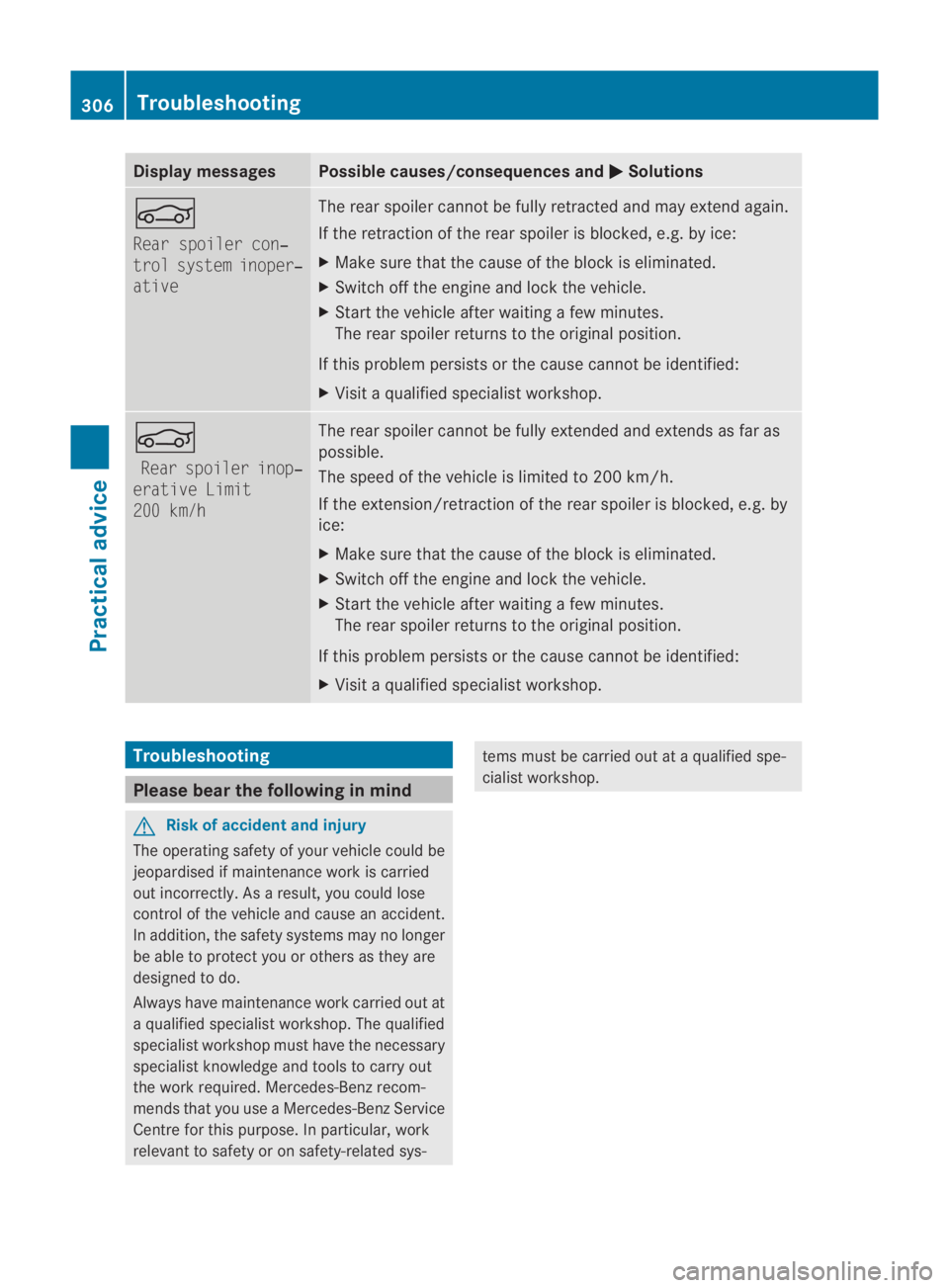
Display messages Possible causes/consequences and
0003 Solutions
0005
Rear spoiler con‐
trol system inoper‐
ative The rear spoiler canno
tbe fully retracted and may extend again.
If the retraction of the rear spoiler is blocked, e.g. by ice:
X Make sure that the cause of the block is eliminated.
X Switch off the engine and lock the vehicle.
X Start the vehicle after waiting a few minutes.
The rear spoiler returns to the original position.
If this problem persists or the cause cannot be identified:
X Visit a qualified specialist workshop. 0005
Rear spoiler inop‐
erative Limit
200 km/h The rear spoiler cannot be fully extended and extends as far as
possible.
The speed of the vehicle is limited to 200 km/h.
If the extension/retraction of the rear spoiler is blocked, e.g. by
ice:
X
Make sure that the cause of the block is eliminated.
X Switch off the engine and lock the vehicle.
X Start the vehicle after waiting a few minutes.
The rear spoiler returns to the original position.
If this problem persists or the cause cannot be identified:
X Visit a qualified specialist workshop. Troubleshooting
Please bear the following in mind
G
Risk of accident and injury
The operating safety of your vehicle could be
jeopardised if maintenance work is carried
out incorrectly. As aresult, you could lose
control of the vehicle and cause an accident.
In addition, the safety systems may no longer
be able to protec tyou or others as they are
designed to do.
Always have maintenance work carried out at
a qualified specialist workshop. The qualified
specialist workshop must have the necessary
specialist knowledge and tools to carry out
the work required. Mercedes-Benz recom-
mends that you use a Mercedes-Benz Service
Centre for this purpose. In particular, work
relevant to safety or on safety-related sys- tems must be carried out at a qualified spe-
cialist workshop.306
TroubleshootingPractical advice
BA 197 ECE RE 2010/6a; 1; 2, en-GB
sabbaeu
Version: 3.0.3.6 2010-05-07T14:19:43+02:00 - Seite 306
Page 311 of 361
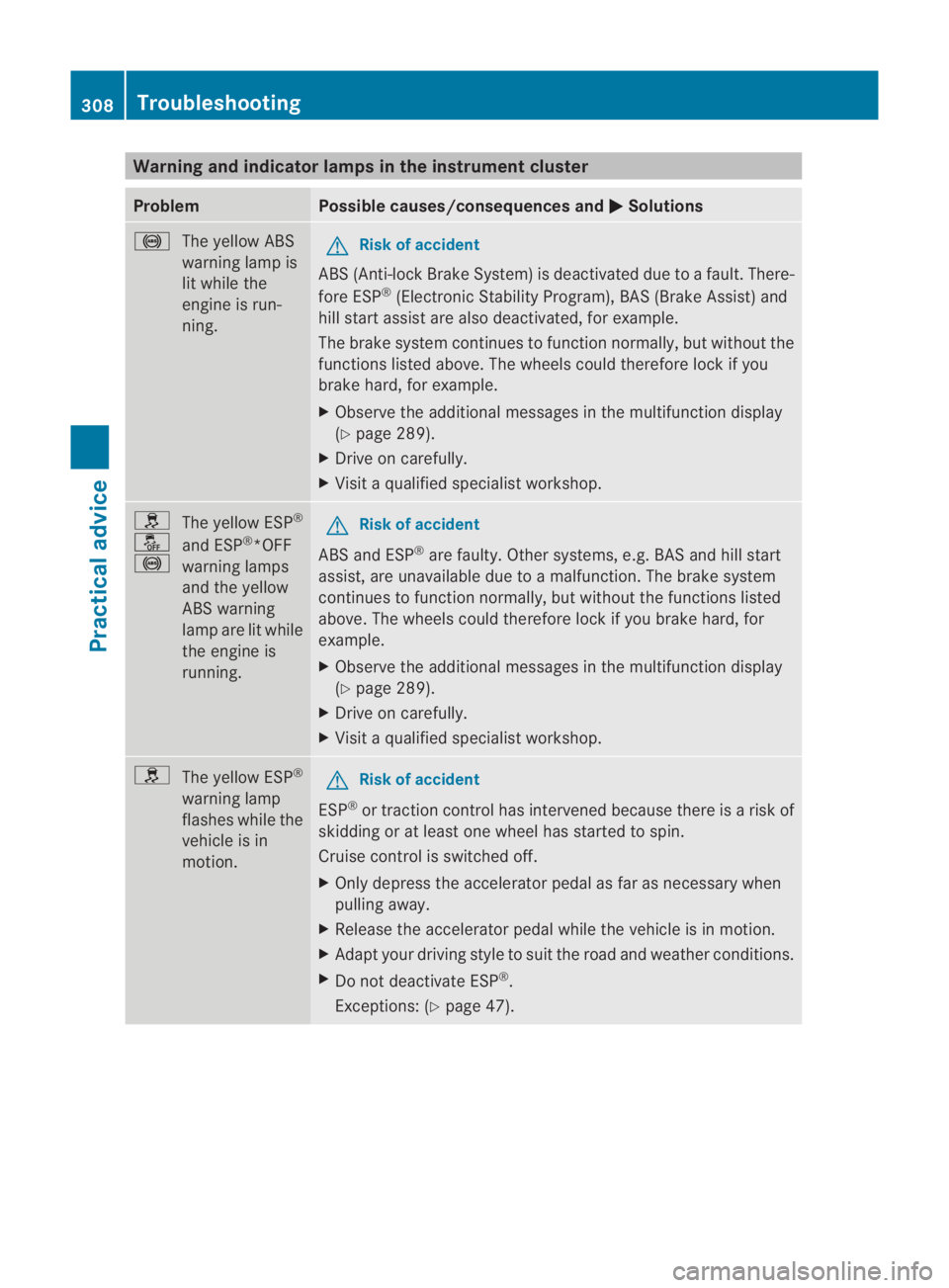
Warning and indicator lamps in the instrument cluster
Problem Possible causes/consequences and
0003 Solutions
0012
The yellow ABS
warning lamp is
lit while the
engine is run-
ning. G
Risk of accident
ABS (Anti-lock Brake System) is deactivated due to a fault. There-
fore ESP ®
(Electronic Stability Program), BAS (Brake Assist) and
hill start assist are also deactivated, for example.
The brake syste mcontinues to function normally, but without the
functions listed above. The wheels could therefore lock if you
brake hard, for example.
X Observe the additional messages in the multifunction display
(Y page 289).
X Drive on carefully.
X Visit a qualified specialist workshop. 0002
0001
0012
The yellow ESP
®
and ESP ®
*OFF
warning lamps
and the yellow
ABS warning
lamp are lit while
the engine is
running. G
Risk of accident
ABS and ESP ®
are faulty. Other systems, e.g. BAS and hill start
assist, are unavailable due to a malfunction. The brake system
continues to function normally, but without the functions listed
above. The wheels could therefore lock if you brake hard, for
example.
X Observe the additional messages in the multifunction display
(Y page 289).
X Drive on carefully.
X Visit a qualified specialist workshop. 0002
The yellow ESP ®
warning lamp
flashes while the
vehicle is in
motion. G
Risk of accident
ESP ®
or traction control has intervened because there is a risk of
skidding or at least one wheel has started to spin.
Cruise control is switched off.
X Only depress the accelerator pedal as far as necessary when
pulling away.
X Release the accelerator pedal while the vehicle is in motion.
X Adapt your driving style to suit the road and weather conditions.
X Do not deactivate ESP ®
.
Exceptions: (Y page 47).308
TroubleshootingPractical advice
BA 197 ECE RE 2010/6a; 1; 2, en-GB
sabbaeu
Version: 3.0.3.6 2010-05-07T14:19:43+02:00 - Seite 308
Page 312 of 361
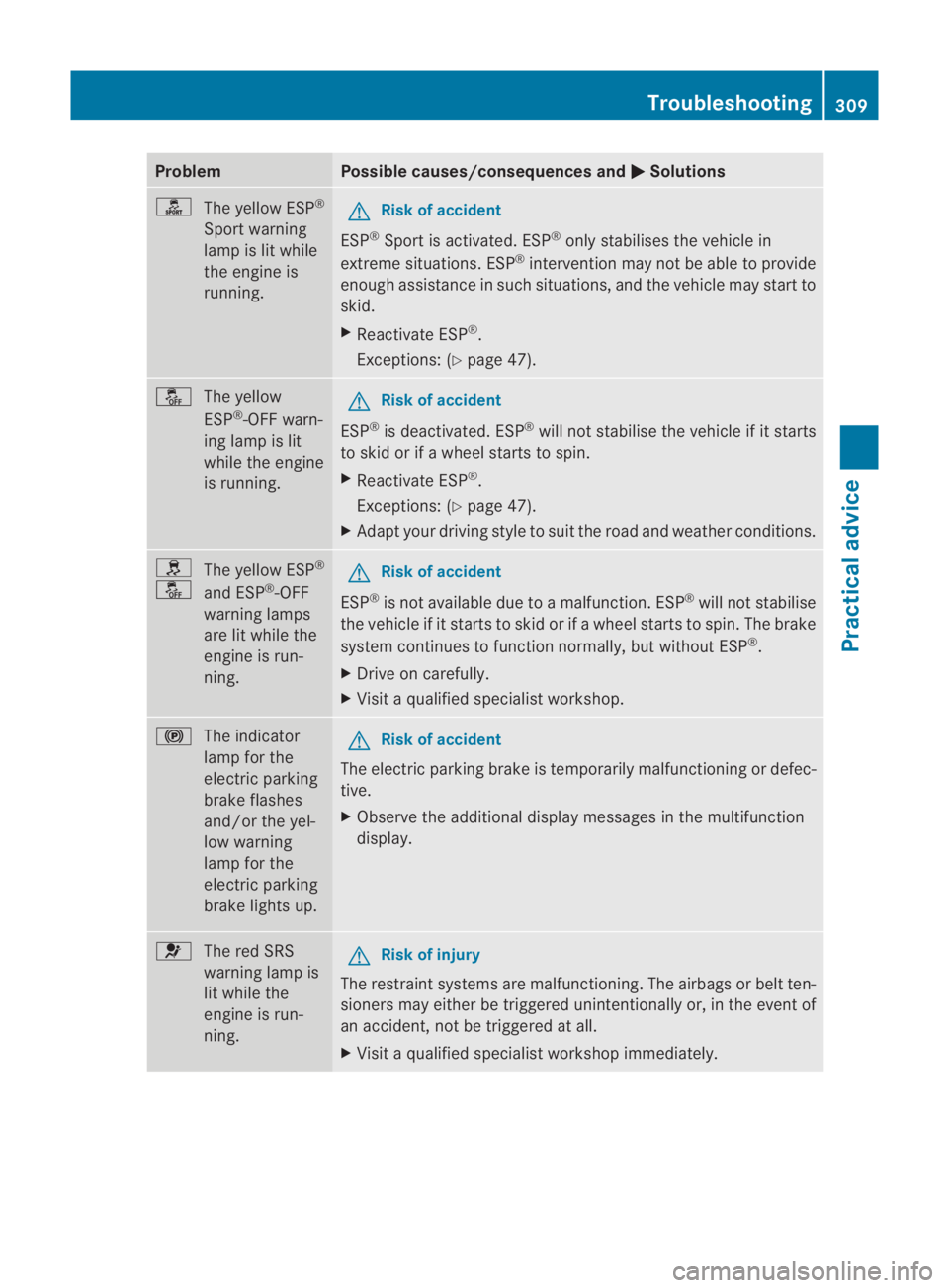
Problem Possible causes/consequences and
0003 Solutions
0005
The yellow ESP ®
Sport warning
lamp is lit while
the engine is
running. G
Risk of accident
ESP ®
Sport is activated. ESP ®
only stabilises the vehicle in
extreme situations. ESP ®
intervention may not be able to provide
enough assistance in such situations, and the vehicle may start to
skid.
X Reactivate ESP ®
.
Exceptions: (Y page 47). 0001
The yellow
ESP®
-OFF warn-
ing lamp is lit
while the engine
is running. G
Risk of accident
ESP ®
is deactivated. ESP ®
will not stabilise the vehicle if it starts
to skid or if a wheel starts to spin.
X Reactivate ESP ®
.
Exceptions: (Y page 47).
X Adapt your driving style to suit the road and weather conditions. 0002
0001
The yellow ESP
®
and ESP ®
-OFF
warning lamps
are lit while the
engine is run-
ning. G
Risk of accident
ESP ®
is not available due to a malfunction .ESP ®
will not stabilise
the vehicle if it starts to skid or if a wheel starts to spin. The brake
system continues to function normally, but without ESP ®
.
X Drive on carefully.
X Visit a qualified specialist workshop. 0009
The indicator
lamp for the
electric parking
brake flashes
and/or the yel-
low warning
lamp for the
electric parking
brake lights up. G
Ris
kofa ccident
The electric parking brak eis temporarily malfunctioning or defec-
tive.
X Observe the additional display messages in the multifunction
display. 0018
The red SRS
warning lamp is
lit while the
engine is run-
ning. G
Risk of injury
The restraint systems are malfunctioning. The airbags or belt ten-
sioners may either be triggered unintentionally or, in the event of
an accident, not be triggered at all.
X Visit a qualified specialist workshop immediately. Troubleshooting
309Practical advice
BA 197 ECE RE 2010/6a; 1; 2, en-GB
sabbaeu Version: 3.0.3.6 2010-05-07T14:19:43+02:00 - Seite 309 Z
Page 313 of 361
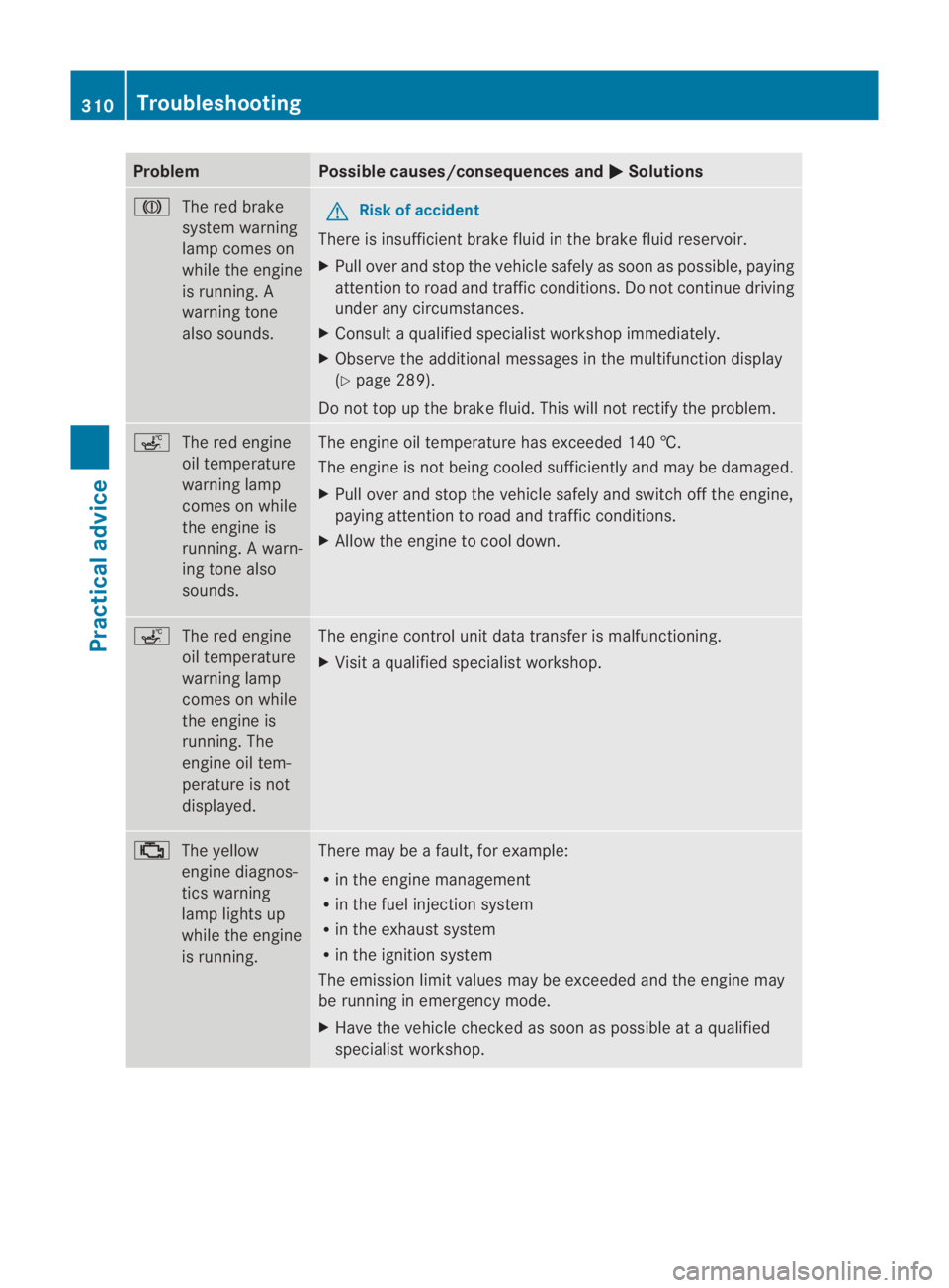
Problem Possible causes/consequences and
0003 Solutions
0004
The red brake
system warning
lamp comes on
while the engine
is running. A
warning tone
also sounds. G
Risk of accident
There is insufficient brake fluid in the brake fluid reservoir.
X Pull over and stop the vehicle safely as soon as possible, paying
attention to road and traffic conditions. Do not continue driving
under any circumstances.
X Consult a qualified specialist workshop immediately.
X Observe the additional messages in the multifunction display
(Y page 289).
Do not top up the brake fluid. This will not rectify the problem. 0003
The red engine
oil temperature
warning lamp
comes on while
the engine is
running. A warn-
ing tone also
sounds. The engine oil temperature has exceeded 140 †.
The engine is not being cooled sufficiently and may be damaged.
X
Pull over and stop the vehicle safely and switch off the engine,
paying attention to road and traffic conditions.
X Allow the engine to cool down. 0003
The red engine
oil temperature
warning lamp
comes on while
the engine is
running. The
engine oil tem-
perature is not
displayed. The engine control unit data transfer is malfunctioning.
X
Visit a qualified specialist workshop. 000A
The yellow
engine diagnos-
tics warning
lamp lights up
while the engine
is running. There may be a fault, for example:
R
in the engine management
R in the fuel injection system
R in the exhaust system
R in the ignition system
The emission limit values may be exceeded and the engine may
be running in emergency mode.
X Have the vehicle checked as soon as possible at a qualified
specialist workshop. 310
TroubleshootingPractical advice
BA 197 ECE RE 2010/6a; 1; 2, en-GB
sabbaeu
Version: 3.0.3.6 2010-05-07T14:19:43+02:00 - Seite 310
Page 314 of 361
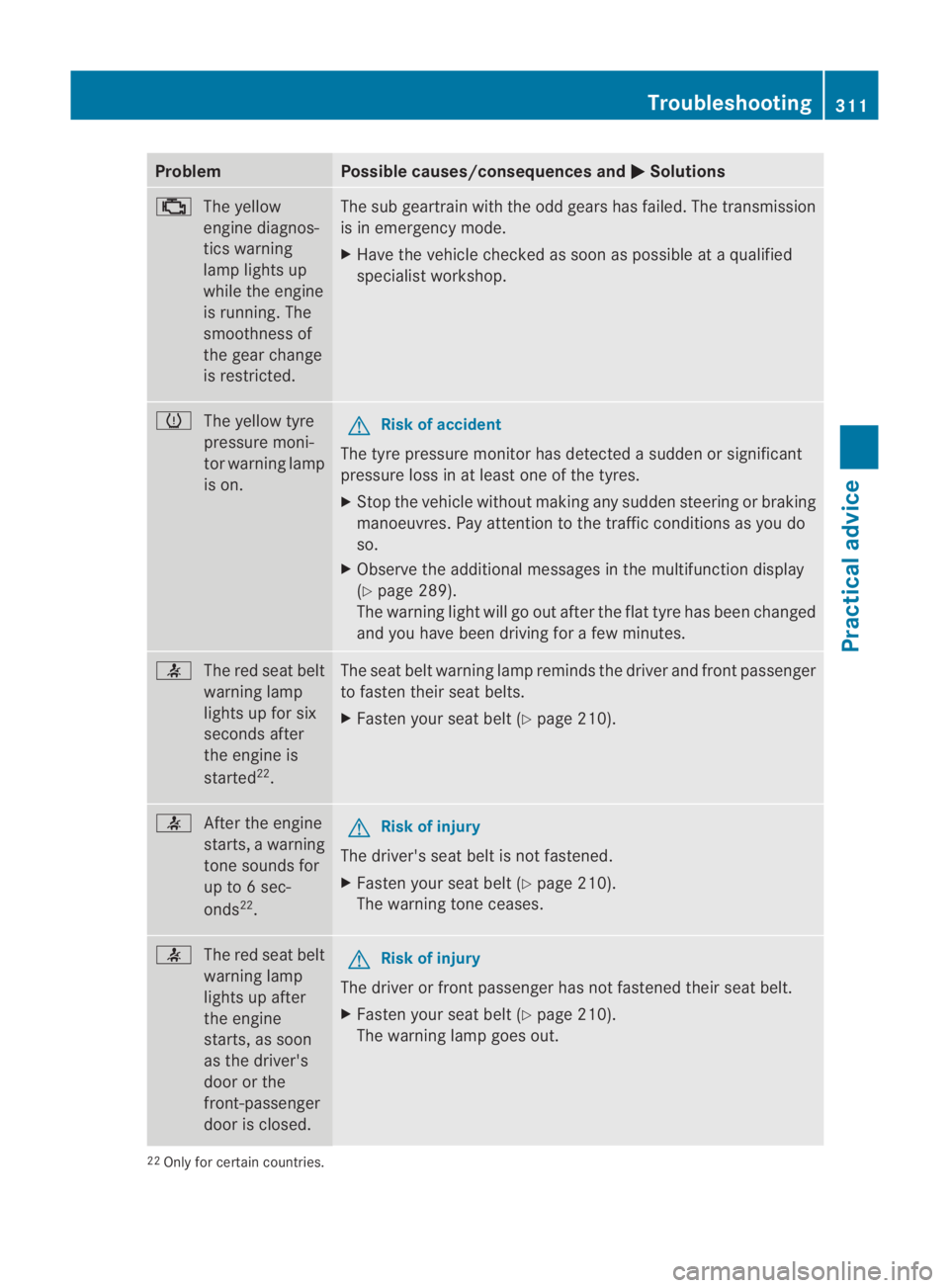
Problem Possible causes/consequences and
0003 Solutions
000A
The yellow
engine diagnos-
tics warning
lamp lights up
while the engine
is running. The
smoothness of
the gear change
is restricted. The sub geartrain with the odd gears has failed. The transmission
is in emergency mode.
X
Have the vehicle checked as soon as possible at a qualified
specialist workshop. 000D
The yellow tyre
pressure moni-
tor warning lamp
is on. G
Risk of accident
The tyre pressure monitor has detected a sudden or significant
pressure loss in at least one of the tyres.
X Stop the vehicle without making any sudden steering or braking
manoeuvres. Pay attention to the traffic conditions as you do
so.
X Observe the additional messages in the multifunction display
(Y page 289).
The warning light will go out after the flat tyre has been changed
and you have been driving for a few minutes. 0019
The red seat belt
warning lamp
lights up for six
seconds after
the engine is
started 22
. The seat belt warning lamp reminds the driver and front passenger
to fasten their seat belts.
X
Fasten your seat belt (Y page 210).0019
After the engine
starts, a warning
tone sounds for
up to 6 sec-
onds22
. G
Risk of injury
The driver's seat belt is not fastened.
X Fasten your seat belt (Y page 210).
The warning tone ceases. 0019
The red seat belt
warning lamp
lights up after
the engine
starts, as soon
as the driver's
door or the
front-passenger
door is closed. G
Risk of injury
The driver or front passenger has not fastened their seat belt.
X Fasten your seat belt (Y page 210).
The warning lamp goes out. 22
Only for certain countries. Troubleshooting
311Practical advice
BA 197 ECE RE 2010/6a; 1; 2, en-GB
sabbaeu Version: 3.0.3.6 2010-05-07T14:19:43+02:00 - Seite 311 Z
Page 315 of 361
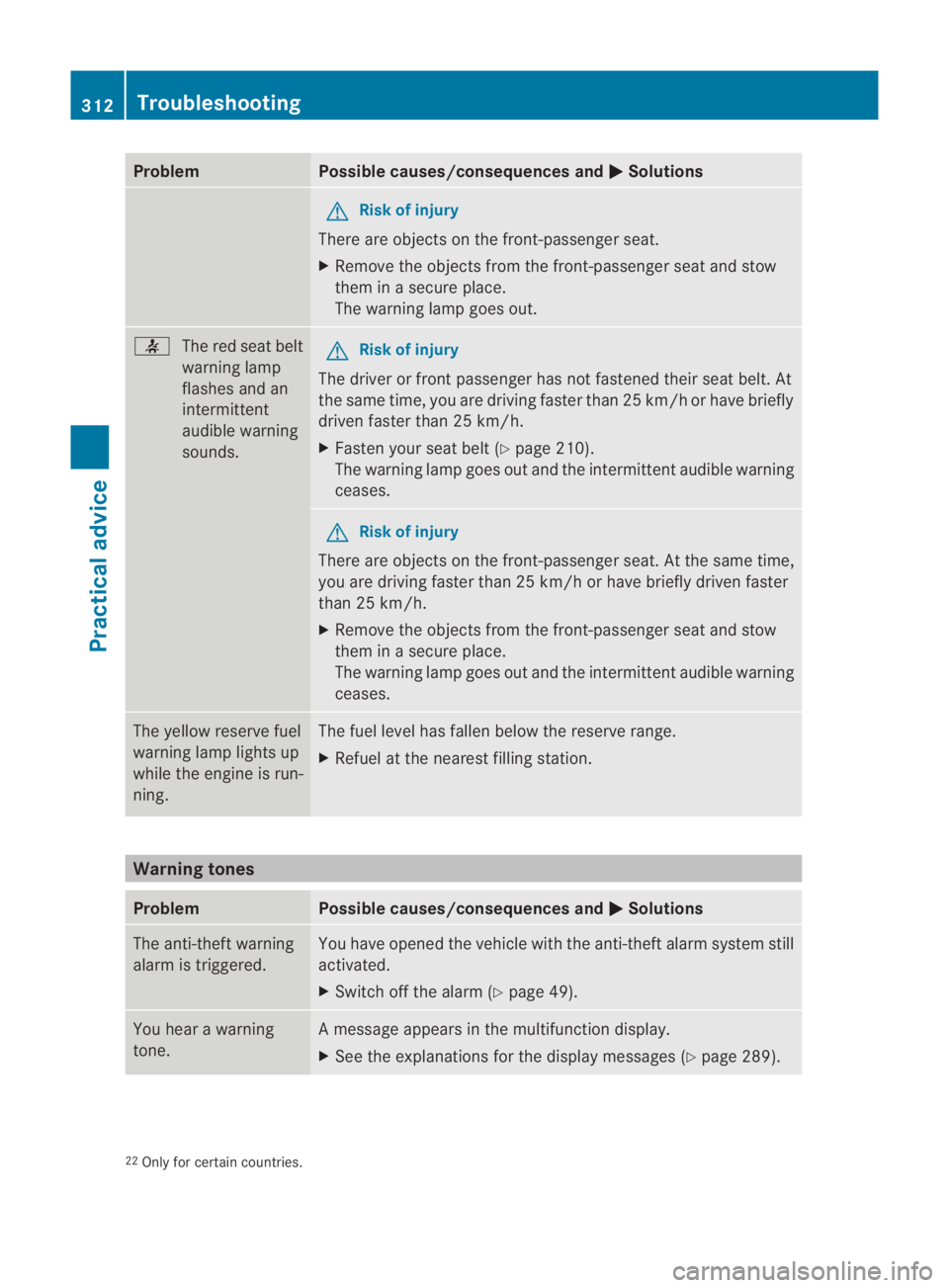
Problem Possible causes/consequences and
0003 Solutions
G
Risk of injury
There are objects on the front-passenger seat.
X Remove the objects from the front-passenger seat and stow
them in a secure place.
The warning lamp goes out. 0019
The red seat belt
warning lamp
flashes and an
intermittent
audible warning
sounds. G
Risk of injury
The driver or front passenger has not fastened their seat belt. At
the same time, you are driving faster than 25 km/ho rhave briefly
driven faster than 25 km/h.
X Faste nyour seat belt (Y page 210).
The warning lamp goes out and the intermittent audible warning
ceases. G
Risk of injury
There are objects on the front-passenger seat. At the same time,
you are driving faster than 25 km/h or have briefly driven faster
than 25 km/h.
X Remove the objects from the front-passenger seat and stow
them in a secure place.
The warning lamp goes out and the intermittent audible warning
ceases. The yellow reserve fuel
warning lamp lights up
while the engine is run-
ning. The fuel level has fallen below the reserve range.
X
Refuel at the nearest filling station. Warning tones
Problem Possible causes/consequences and
0003 Solutions
The anti-theft warning
alarm is triggered. You have opened the vehicle with the anti-theft alarm system still
activated.
X
Switch off the alarm (Y page 49).You hear a warning
tone. Am
essage appears in the multifunction display.
X See the explanations for the display messages ( Ypage 289). 22
Only for certain countries. 312
TroubleshootingPractical advice
BA 197 ECE RE 2010/6a; 1; 2, en-GB
sabbaeu
Version: 3.0.3.6 2010-05-07T14:19:43+02:00 - Seite 312
Page 319 of 361
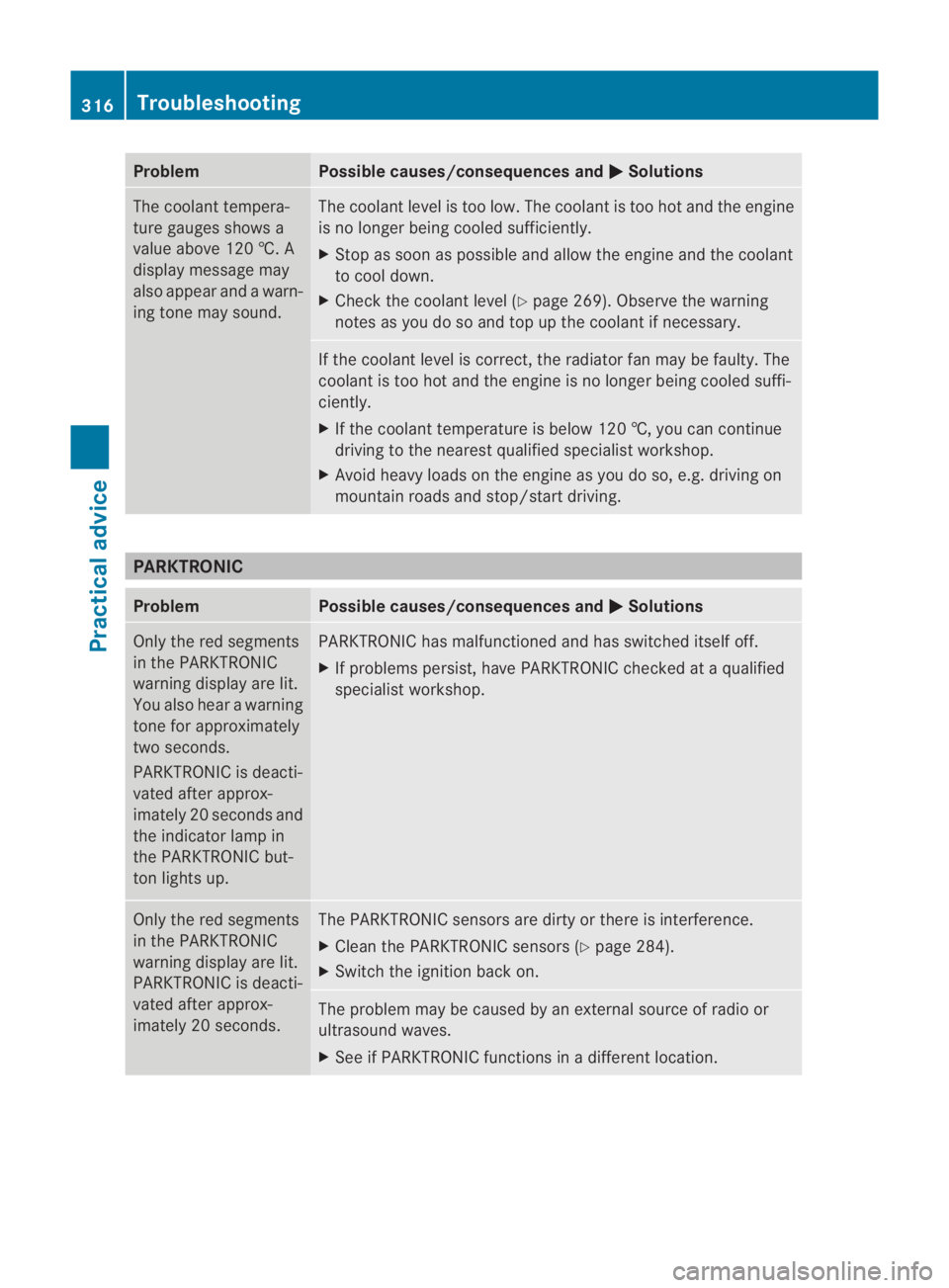
Problem Possible causes/consequences and
0003 Solutions
The coolant tempera-
ture gauges shows a
value above 120 †. A
display message may
also appeara
nd a warn-
ing tone may sound. The coolant level is too low. The coolant is too hot and the engine
is no longe
rbeing cooled sufficiently.
X Stop as soon as possible and allow the engine and the coolant
to cool down.
X Check the coolant level (Y page 269). Observe the warning
notes as you do so and top up the coolant if necessary. If the coolant level is correct, the radiator fan may be faulty. The
coolant is too hot and the engine is no longer being cooled suffi-
ciently.
X
If the coolant temperature is below 120 †, you can continue
driving to the nearest qualified specialist workshop.
X Avoid heavy loads on the engine as you do so, e.g. driving on
mountain roads and stop/start driving. PARKTRONIC
Problem Possible causes/consequences and
0003 Solutions
Only the red segments
in the PARKTRONIC
warning display are lit.
You also hear a warning
tone for approximately
two seconds.
PARKTRONIC is deacti-
vated after approx-
imately 20 seconds and
the indicator lamp in
the PARKTRONIC but-
ton lights up. PARKTRONIC has malfunctioned and has switched itself off.
X
If problems persist, have PARKTRONIC checked at a qualified
specialist workshop. Only the red segments
in the PARKTRONIC
warning display are lit.
PARKTRONIC is deacti-
vated after approx-
imately 20 seconds. The PARKTRONIC sensors are dirty or there is interference.
X
Clean the PARKTRONIC sensors (Y page 284).
X Switch the ignition back on. The problem may be caused by an external source of radio or
ultrasound waves.
X
See if PARKTRONIC functions in a different location. 316
TroubleshootingPractical advice
BA 197 ECE RE 2010/6a; 1; 2, en-GB
sabbaeu
Version: 3.0.3.6 2010-05-07T14:19:43+02:00 - Seite 316
Page 331 of 361
Do not switch off the tyre inflation com-
pressor during this phase.
X Let the tyre inflation compressor run for a
maximum of te nminutes. The tyre should
the nhave a pressure of at least
180 kPa (1.8 bar) (maximum
350 kPa (3.5 bar)).
Switch the tyre inflation compressor off
briefly to read the correct value from pres-
sure gauge 0013.
! Do not operate the tyre inflation com-
pressor for longer than ten minutes at a
time without a break .Itmay otherwise
overheat.
The tyre inflation compressor can be oper-
ated again once it has cooled down.
If a pressure of 180 kPa (1.8 bar) is not
reached after ten minutes:
X Switch off and disconnect the tyre inflation
compressor and drive the vehicle forwards
or backwards approximately 10 m.
This distributes the TIREFIT more evenly.
X Leave TIREFIT fille rbottle 0001attached to
the flange.
X Pump up the tyre again. G
Risk of accident
If the tyre pressure is less than 130 kPa
(1.3 bar), the tyre is too severely damaged. Do
not drive any further. Consult a qualified spe-
cialist workshop which has the necessary
specialist knowledge and tools to carry out
the work required. Mercedes-Benz recom-
mends that you use a Mercedes-Benz Service
Centre for this purpose. In particular, work
relevant to safety or on safety-related sys-
tems must be carried out at a qualified spe-
cialist workshop. If the tyre pressure is at least
180 kPa (1.8 bar):
X
Press on/offs witch0002on the tyre inflation
compressor to 0.
The tyre inflatio ncompressor is switched
off.
X Remove connector 0014from the 12 V
socket.
X Remove filler hose 000Cfrom tyre valve 000E
and refit the dust protection cap. Screw the
valve cap onto the valve again.
Leave TIREFIT filler bottle 0001attached to
flange 000D.
X Stow the TIREFIT kit in a safe and accessi-
ble place in the vehicle.
X Pull away immediately.
! After use, excess TIREFIT may run out of
the filler hose. This could cause stains. G
Risk of accident
The vehicle's handling characteristics may be
affected if you drive with a tyre that is inflated
with TIREFIT. This could cause an accident.
Therefore, do not exceed amaximum speed
of 80 km/h.
Affix th e"max. 80 km/h" sticker within the
driver's field of vision.
X Stop after driving for approximately three
kilometres or ten minutes and check the
tyre pressure using the tyre inflation com-
pressor.
i On tyres that are equipped with a tyre
pressure sensor (tyre pressure monitor),
the use of sealant can leadt o error mes-
sages and incorrect displays. Therefore,
use pressure gauge 0013in the TIREFIT kit to
check and correct the tyre pressure. G
Risk of accident
If the tyre pressure is less than 130 kPa
(1.3 bar), the tyre is too severely damaged. Do
not drive any further. Consult a qualified spe-
cialist workshop which has the necessary
specialist knowledge and tools to carry out 328
Flat tyrePractical advice
BA 197 ECE RE 2010/6a; 1; 2, en-GB
sabbaeu
Version: 3.0.3.6 2010-05-07T14:19:43+02:00 - Seite 328
Page 343 of 361
Towing the vehicle with the rear axle
raised !
The engine must be switched off (key in
ignition lock in position 0or position 1) if
the vehicle is being towed with the front
axle raised or if the parking brake is being
tested on a dynamometer. Otherwise,
intervention by ESP ®
could damage the
brake system.
Towing the vehicle with atow rope or
tow bar G
Ris
kofa ccident
If the brake system is malfunctioning, you
must use a rigid tow bar to tow the vehicle.
Before towing away, mak esure that the steer-
ing can be moved and is not locked.
If there is a malfunctio ninthe power supply
or the vehicle's electrical system, you must
not tow the vehicle. G
Risk of accident
The following can occur if the vehicle is towed:
R the engine may not start.
R the on-board electronics may fail.
R the battery voltage may drop too much.
In these cases, the rear axle will be locked.
As a result, you might lose control of the vehi-
cle, cause an accident and injure yourself and
others.
! Use the key instead of the Start/Stop
button when towing the vehicle.
Start the engine and keep it running. Turn
the key to position 2in the ignition. Set the
transmission selector lever to N.Make sure
that you then leave the key in position 2.
Chec kthe transmission position in the
instrument cluster. When towing the vehicle, proceed as follows:
X
Insert the key into the ignition lock
(Y page 203).
X Start the engine and leave the key in the
ignition.
X Move the transmission selector lever to N.
X Check the transmission position in the
instrumentc luster display (Y page 227).
X Leave the engine running during the entire
towing procedure.
Also observe the following notes:
R When towing, observe the legal require-
ments in all countries concerned.
R If the engine does not start, try jump-start-
ing it (Y page 338). Tow-starting the vehicle
is not permitted.
R If it is not possible to jump-star tthe vehicle,
have it transported to the nearest qualified
specialist workshop, e.g. aMercedes-Benz
Service Centre.
R If the transmission has been damaged,
have the vehicle transported to the nearest
qualified specialist workshop, e.g. a
Mercedes-Benz Service Centre. Observe
the display messages in the instrument
cluster.
R If you are towing the vehicle over a longer
distance, this must be done with the rear
axle raised.
! Make sure that the electric parking brake
is released. If the electric parking brake is
faulty, visit a qualified specialist workshop.
Mercedes-Benzr ecommends that you use
a Mercedes-Benz Service Centre.
! When towing, pull away slowly and
smoothly. If the tractive power is too high,
the vehicles could be damaged.
! Only secure the tow cable or towing bar
to the towing eyes. You could otherwise
damage the vehicle.
! Do not use the towing eye for recovery,
as this could damage the vehicle. If in
doubt, recover the vehicle with a crane. 340
Towing and tow-startingPractical advice
BA 197 ECE RE 2010/6a; 1; 2, en-GB
sabbaeu
Version: 3.0.3.6 2010-05-07T14:19:43+02:00 - Seite 340