engine MERCEDES-BENZ SLS COUPE 2010 Manual PDF
[x] Cancel search | Manufacturer: MERCEDES-BENZ, Model Year: 2010, Model line: SLS COUPE, Model: MERCEDES-BENZ SLS COUPE 2010Pages: 361, PDF Size: 6.32 MB
Page 312 of 361
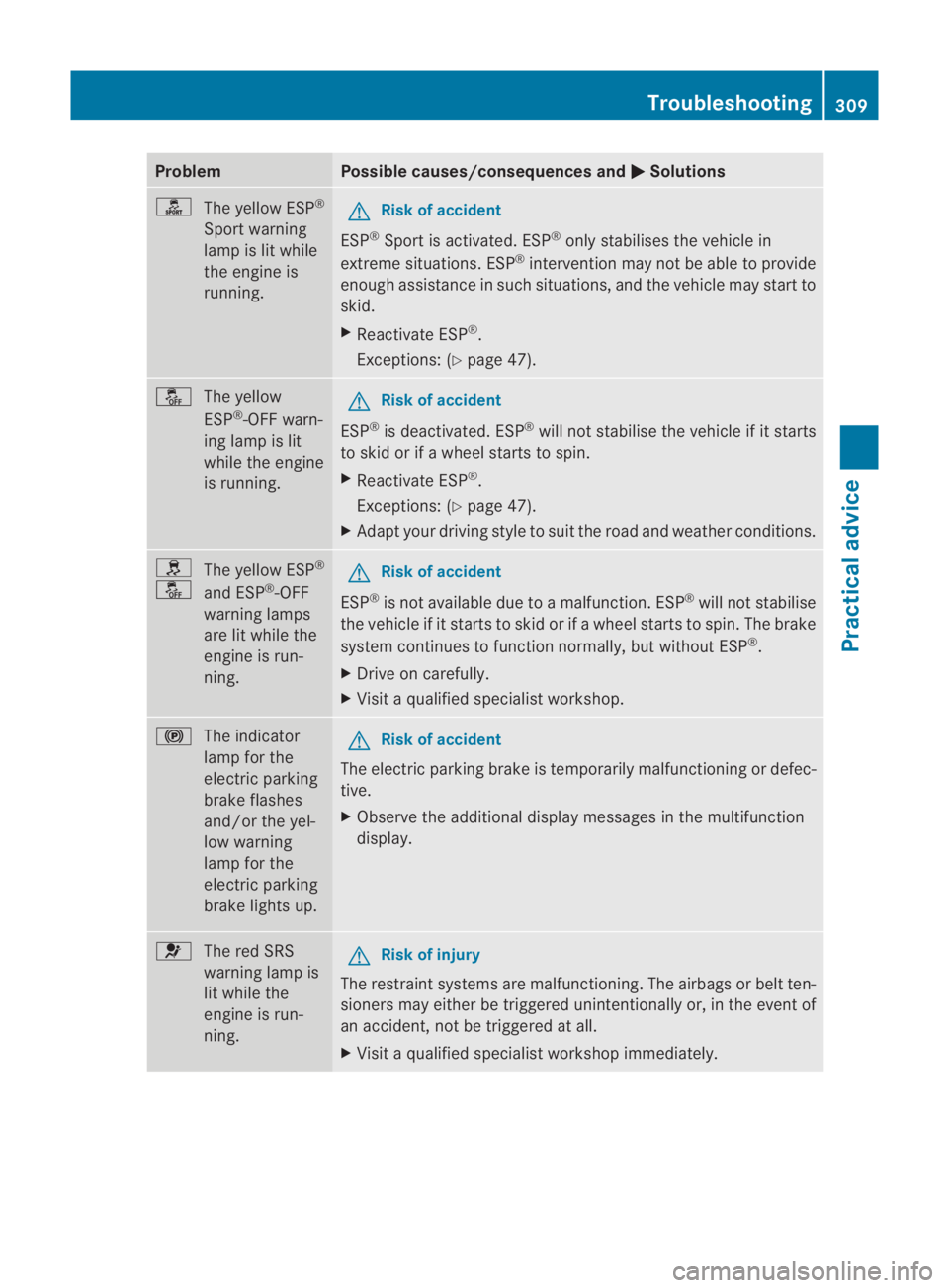
Problem Possible causes/consequences and
0003 Solutions
0005
The yellow ESP ®
Sport warning
lamp is lit while
the engine is
running. G
Risk of accident
ESP ®
Sport is activated. ESP ®
only stabilises the vehicle in
extreme situations. ESP ®
intervention may not be able to provide
enough assistance in such situations, and the vehicle may start to
skid.
X Reactivate ESP ®
.
Exceptions: (Y page 47). 0001
The yellow
ESP®
-OFF warn-
ing lamp is lit
while the engine
is running. G
Risk of accident
ESP ®
is deactivated. ESP ®
will not stabilise the vehicle if it starts
to skid or if a wheel starts to spin.
X Reactivate ESP ®
.
Exceptions: (Y page 47).
X Adapt your driving style to suit the road and weather conditions. 0002
0001
The yellow ESP
®
and ESP ®
-OFF
warning lamps
are lit while the
engine is run-
ning. G
Risk of accident
ESP ®
is not available due to a malfunction .ESP ®
will not stabilise
the vehicle if it starts to skid or if a wheel starts to spin. The brake
system continues to function normally, but without ESP ®
.
X Drive on carefully.
X Visit a qualified specialist workshop. 0009
The indicator
lamp for the
electric parking
brake flashes
and/or the yel-
low warning
lamp for the
electric parking
brake lights up. G
Ris
kofa ccident
The electric parking brak eis temporarily malfunctioning or defec-
tive.
X Observe the additional display messages in the multifunction
display. 0018
The red SRS
warning lamp is
lit while the
engine is run-
ning. G
Risk of injury
The restraint systems are malfunctioning. The airbags or belt ten-
sioners may either be triggered unintentionally or, in the event of
an accident, not be triggered at all.
X Visit a qualified specialist workshop immediately. Troubleshooting
309Practical advice
BA 197 ECE RE 2010/6a; 1; 2, en-GB
sabbaeu Version: 3.0.3.6 2010-05-07T14:19:43+02:00 - Seite 309 Z
Page 313 of 361
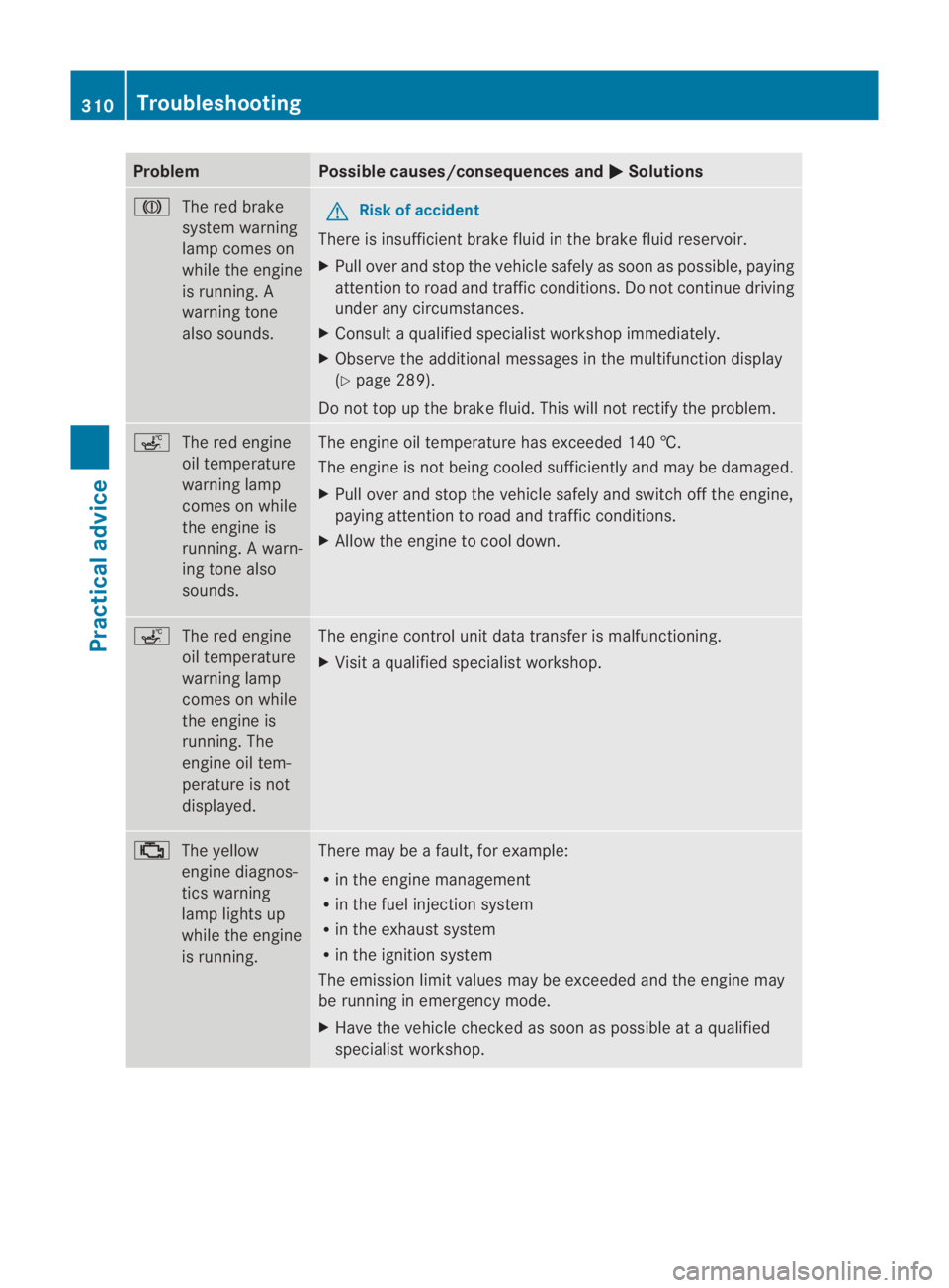
Problem Possible causes/consequences and
0003 Solutions
0004
The red brake
system warning
lamp comes on
while the engine
is running. A
warning tone
also sounds. G
Risk of accident
There is insufficient brake fluid in the brake fluid reservoir.
X Pull over and stop the vehicle safely as soon as possible, paying
attention to road and traffic conditions. Do not continue driving
under any circumstances.
X Consult a qualified specialist workshop immediately.
X Observe the additional messages in the multifunction display
(Y page 289).
Do not top up the brake fluid. This will not rectify the problem. 0003
The red engine
oil temperature
warning lamp
comes on while
the engine is
running. A warn-
ing tone also
sounds. The engine oil temperature has exceeded 140 †.
The engine is not being cooled sufficiently and may be damaged.
X
Pull over and stop the vehicle safely and switch off the engine,
paying attention to road and traffic conditions.
X Allow the engine to cool down. 0003
The red engine
oil temperature
warning lamp
comes on while
the engine is
running. The
engine oil tem-
perature is not
displayed. The engine control unit data transfer is malfunctioning.
X
Visit a qualified specialist workshop. 000A
The yellow
engine diagnos-
tics warning
lamp lights up
while the engine
is running. There may be a fault, for example:
R
in the engine management
R in the fuel injection system
R in the exhaust system
R in the ignition system
The emission limit values may be exceeded and the engine may
be running in emergency mode.
X Have the vehicle checked as soon as possible at a qualified
specialist workshop. 310
TroubleshootingPractical advice
BA 197 ECE RE 2010/6a; 1; 2, en-GB
sabbaeu
Version: 3.0.3.6 2010-05-07T14:19:43+02:00 - Seite 310
Page 314 of 361
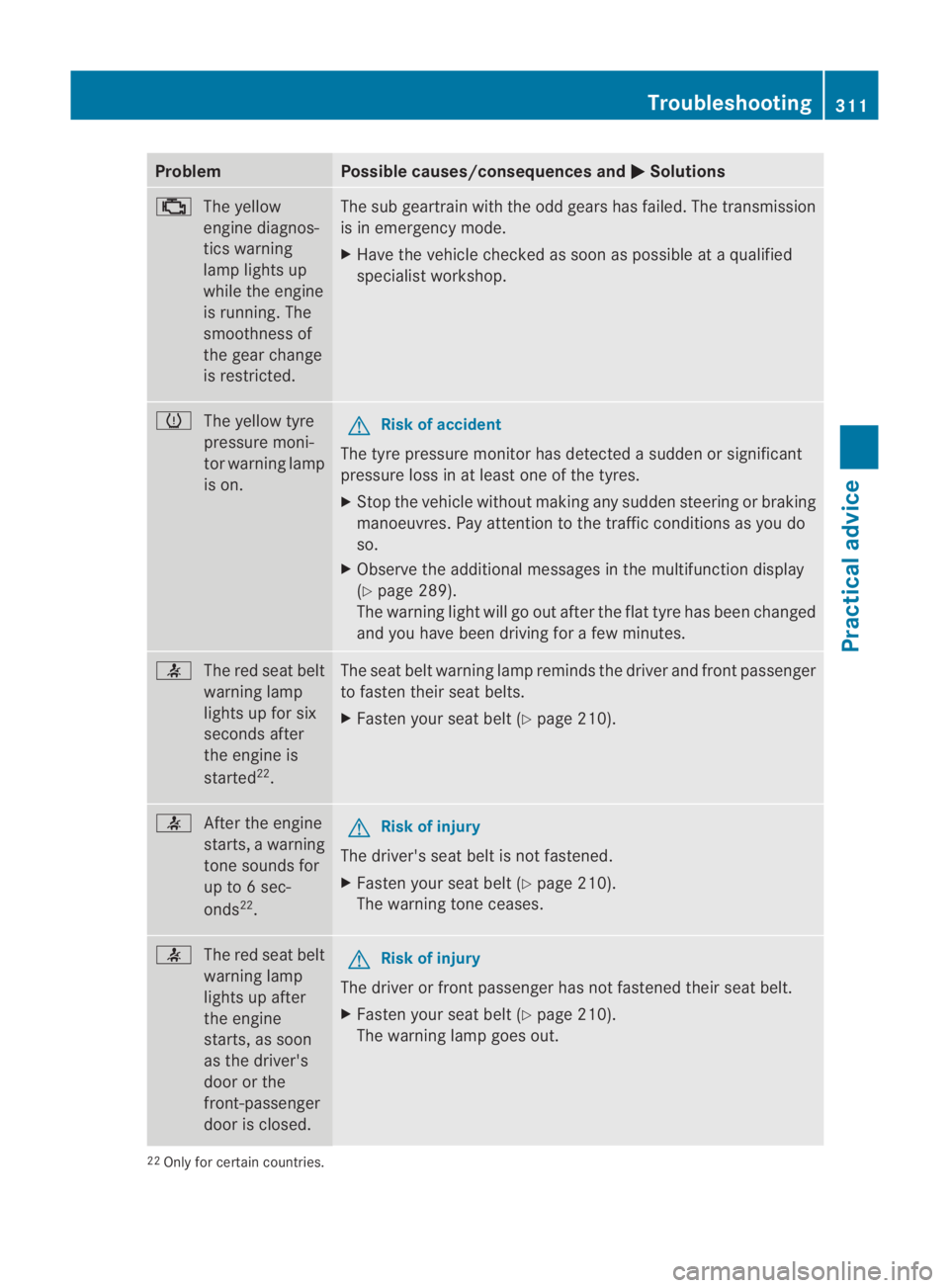
Problem Possible causes/consequences and
0003 Solutions
000A
The yellow
engine diagnos-
tics warning
lamp lights up
while the engine
is running. The
smoothness of
the gear change
is restricted. The sub geartrain with the odd gears has failed. The transmission
is in emergency mode.
X
Have the vehicle checked as soon as possible at a qualified
specialist workshop. 000D
The yellow tyre
pressure moni-
tor warning lamp
is on. G
Risk of accident
The tyre pressure monitor has detected a sudden or significant
pressure loss in at least one of the tyres.
X Stop the vehicle without making any sudden steering or braking
manoeuvres. Pay attention to the traffic conditions as you do
so.
X Observe the additional messages in the multifunction display
(Y page 289).
The warning light will go out after the flat tyre has been changed
and you have been driving for a few minutes. 0019
The red seat belt
warning lamp
lights up for six
seconds after
the engine is
started 22
. The seat belt warning lamp reminds the driver and front passenger
to fasten their seat belts.
X
Fasten your seat belt (Y page 210).0019
After the engine
starts, a warning
tone sounds for
up to 6 sec-
onds22
. G
Risk of injury
The driver's seat belt is not fastened.
X Fasten your seat belt (Y page 210).
The warning tone ceases. 0019
The red seat belt
warning lamp
lights up after
the engine
starts, as soon
as the driver's
door or the
front-passenger
door is closed. G
Risk of injury
The driver or front passenger has not fastened their seat belt.
X Fasten your seat belt (Y page 210).
The warning lamp goes out. 22
Only for certain countries. Troubleshooting
311Practical advice
BA 197 ECE RE 2010/6a; 1; 2, en-GB
sabbaeu Version: 3.0.3.6 2010-05-07T14:19:43+02:00 - Seite 311 Z
Page 315 of 361
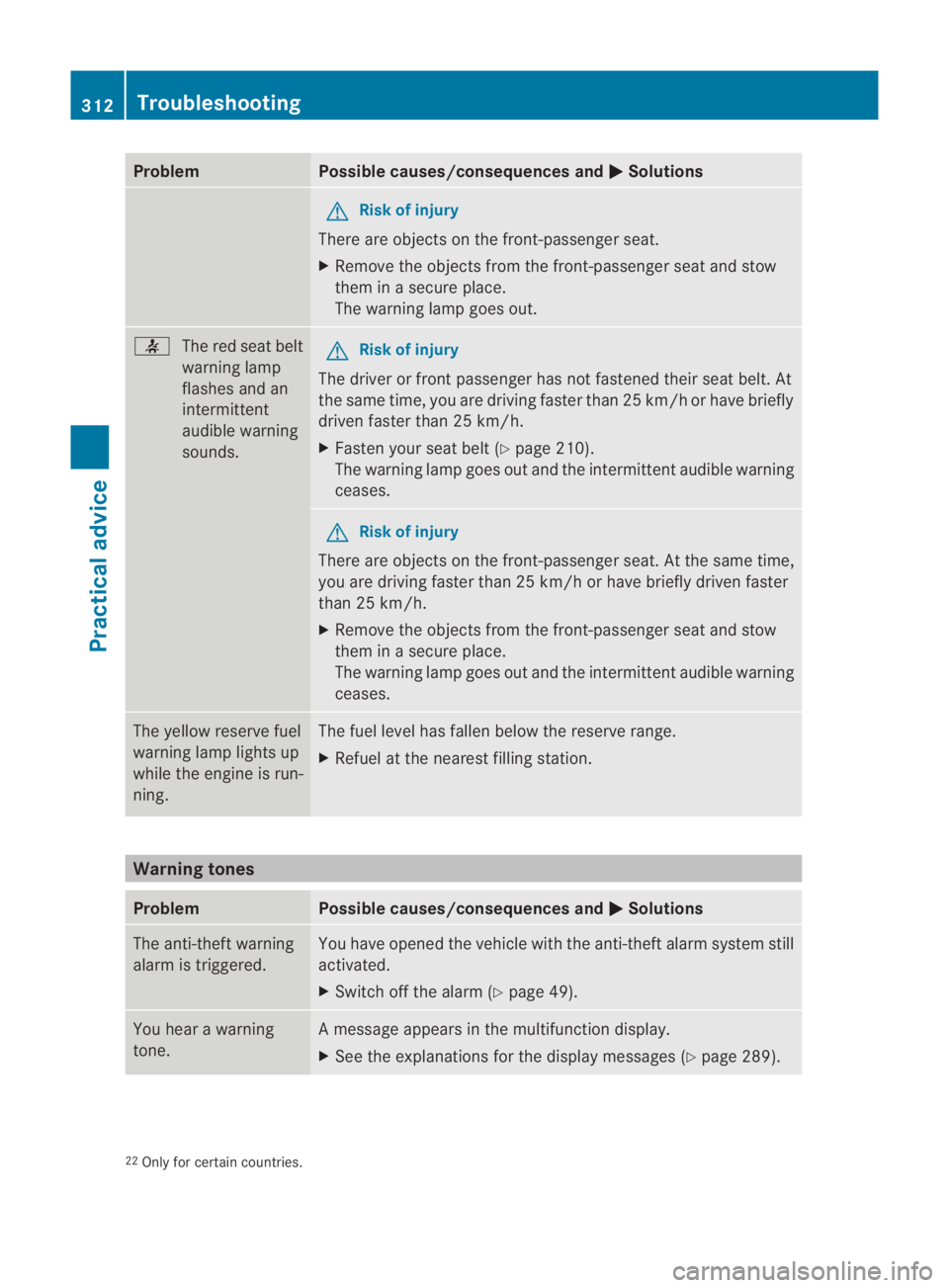
Problem Possible causes/consequences and
0003 Solutions
G
Risk of injury
There are objects on the front-passenger seat.
X Remove the objects from the front-passenger seat and stow
them in a secure place.
The warning lamp goes out. 0019
The red seat belt
warning lamp
flashes and an
intermittent
audible warning
sounds. G
Risk of injury
The driver or front passenger has not fastened their seat belt. At
the same time, you are driving faster than 25 km/ho rhave briefly
driven faster than 25 km/h.
X Faste nyour seat belt (Y page 210).
The warning lamp goes out and the intermittent audible warning
ceases. G
Risk of injury
There are objects on the front-passenger seat. At the same time,
you are driving faster than 25 km/h or have briefly driven faster
than 25 km/h.
X Remove the objects from the front-passenger seat and stow
them in a secure place.
The warning lamp goes out and the intermittent audible warning
ceases. The yellow reserve fuel
warning lamp lights up
while the engine is run-
ning. The fuel level has fallen below the reserve range.
X
Refuel at the nearest filling station. Warning tones
Problem Possible causes/consequences and
0003 Solutions
The anti-theft warning
alarm is triggered. You have opened the vehicle with the anti-theft alarm system still
activated.
X
Switch off the alarm (Y page 49).You hear a warning
tone. Am
essage appears in the multifunction display.
X See the explanations for the display messages ( Ypage 289). 22
Only for certain countries. 312
TroubleshootingPractical advice
BA 197 ECE RE 2010/6a; 1; 2, en-GB
sabbaeu
Version: 3.0.3.6 2010-05-07T14:19:43+02:00 - Seite 312
Page 316 of 361
Problem Possible causes/consequences and
0003 Solutions
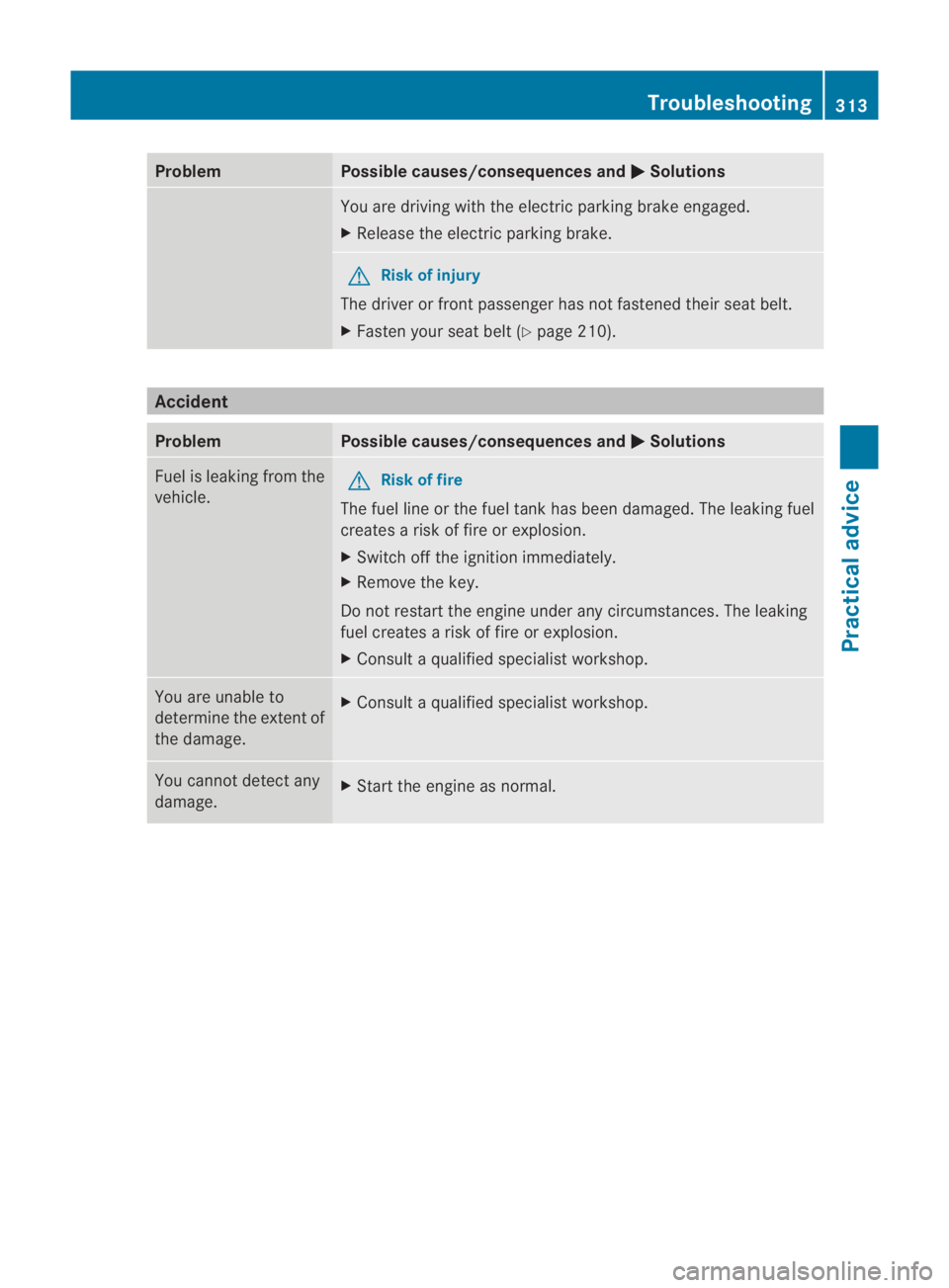
You are driving with the electric parking brake engaged.
X
Release the electric parking brake. G
Risk of injury
The driver or front passenger has not fastened their seat belt.
X Fasten your seat belt (Y page 210).Accident
Problem Possible causes/consequences and
0003 Solutions
Fuel is leaking from the
vehicle.
G
Risk of fire
The fuel line or the fuel tank has been damaged. The leaking fuel
creates a risk of fire or explosion.
X Switch off the ignition immediately.
X Remove the key.
Do not restart the engine under any circumstances. The leaking
fuel creates a risk of fire or explosion.
X Consult a qualified specialist workshop. You are unable to
determine the extentof
the damage.
X
Consult a qualified specialis tworkshop. You cannot detect any
damage.
X
Start the engine as normal. Troubleshooting
313Practical advice
BA 197 ECE RE 2010/6a; 1; 2, en-GB
sabbaeu Version: 3.0.3.6 2010-05-07T14:19:43+02:00 - Seite 313 Z
Page 317 of 361
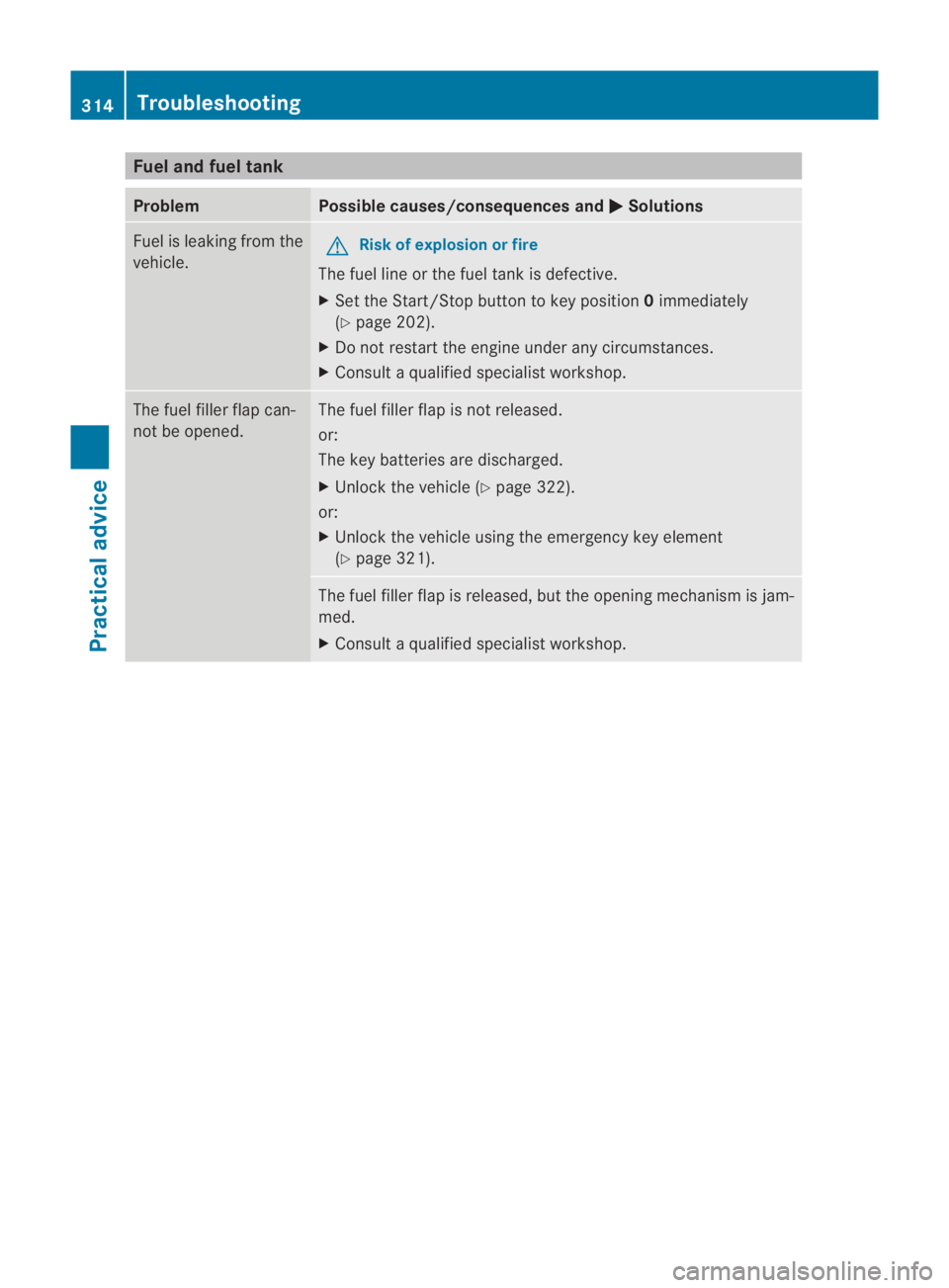
Fuel and fuel tank
Problem Possible causes/consequences and
0003 Solutions
Fuel is leaking from the
vehicle.
G
Ris
kofe xplosion or fire
The fuel line or the fuel tank is defective.
X Set the Start/Stop button to key position 0immediately
(Y page 202).
X Do not restart the engine under any circumstances.
X Consult a qualified specialist workshop. The fuel filler flap can-
not be opened. The fuel filler flap is not released.
or:
The key batteries are discharged.
X
Unlock the vehicle (Y page 322).
or:
X Unlock the vehicle using the emergency key element
(Y page 321). The fuel filler flap is released, but the opening mechanism is jam-
med.
X
Consult a qualified specialist workshop. 314
TroubleshootingPractical advice
BA 197 ECE RE 2010/6a; 1; 2, en-GB
sabbaeu
Version: 3.0.3.6 2010-05-07T14:19:43+02:00 - Seite 314
Page 318 of 361
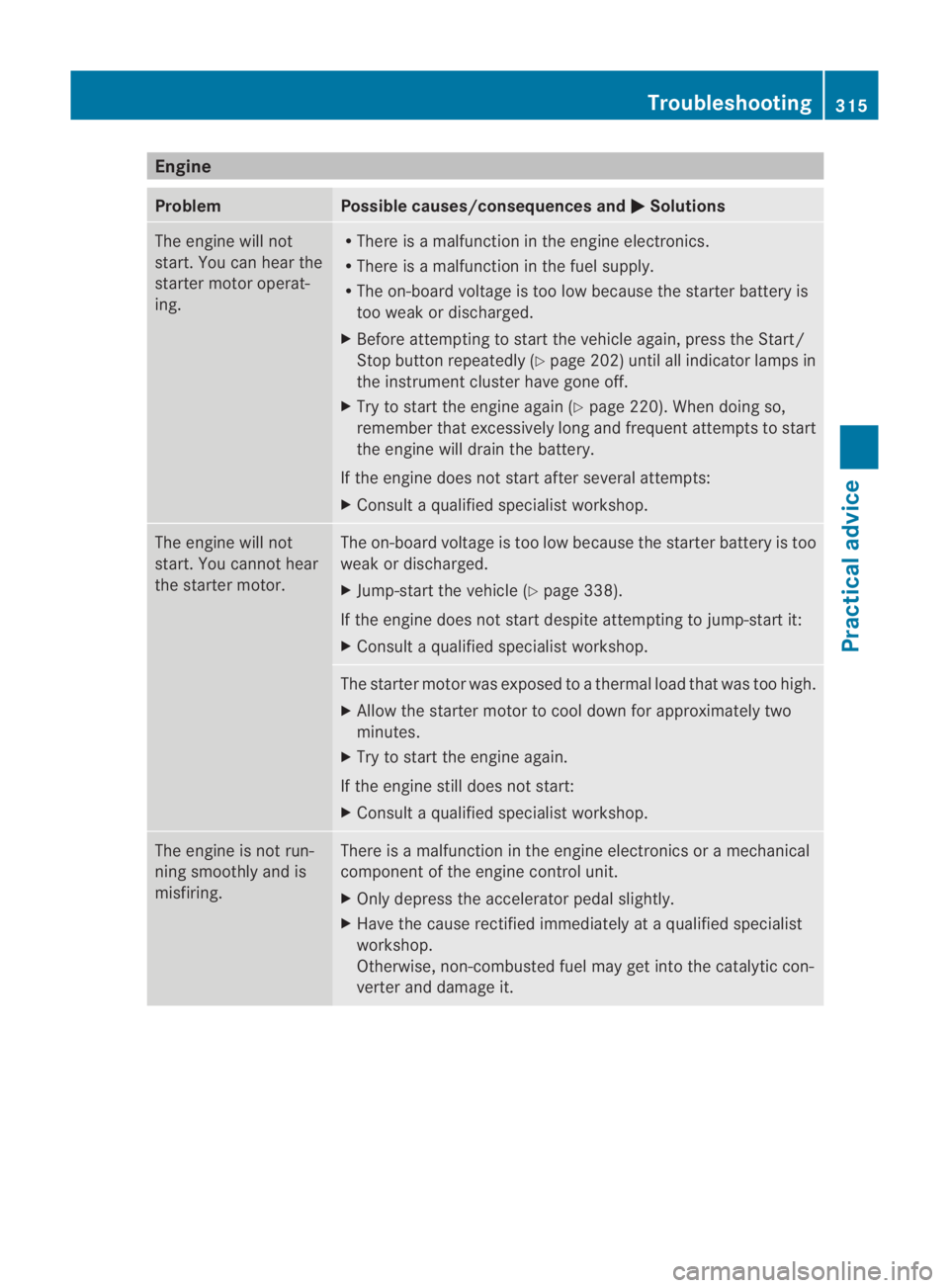
Engine
Problem Possible causes/consequences and
0003 Solutions
The engine will not
start. You can hear the
starter motor operat-
ing. R
There is a malfunctio ninthe engine electronics.
R There is a malfunction in the fuel supply.
R The on-board voltage is too low because the starter battery is
too weak or discharged.
X Before attempting to start the vehicle again, press the Start/
Stop button repeatedly (Y page 202) until all indicator lamps in
the instrument cluster have gone off.
X Try to start the engine again (Y page 220). When doing so,
remember that excessively long and frequent attempts to start
the engine will drain the battery.
If the engine does not start after several attempts:
X Consult a qualified specialist workshop. The engine will not
start. You cannot hear
the starter motor. The on-board voltage is too low because the starter battery is too
weak or discharged.
X
Jump-start the vehicle (Y page 338).
If the engine does not start despite attempting to jump-start it:
X Consult a qualified specialist workshop. The starter motor was exposed to a thermal load that was too high.
X
Allow the starter motor to cool down for approximately two
minutes.
X Try to start the engine again.
If the engine still does not start:
X Consult a qualified specialist workshop. The engine is not run-
ning smoothly and is
misfiring. There is a malfunction in the engine electronics or a mechanical
component of the engine control unit.
X
Only depress the accelerator pedal slightly.
X Have the cause rectified immediately at a qualified specialist
workshop.
Otherwise, non-combusted fuel may get into the catalytic con-
verter and damage it. Troubleshooting
315Practical advice
BA 197 ECE RE 2010/6a; 1; 2, en-GB
sabbaeu Version: 3.0.3.6 2010-05-07T14:19:43+02:00 - Seite 315 Z
Page 319 of 361
Problem Possible causes/consequences and
0003 Solutions
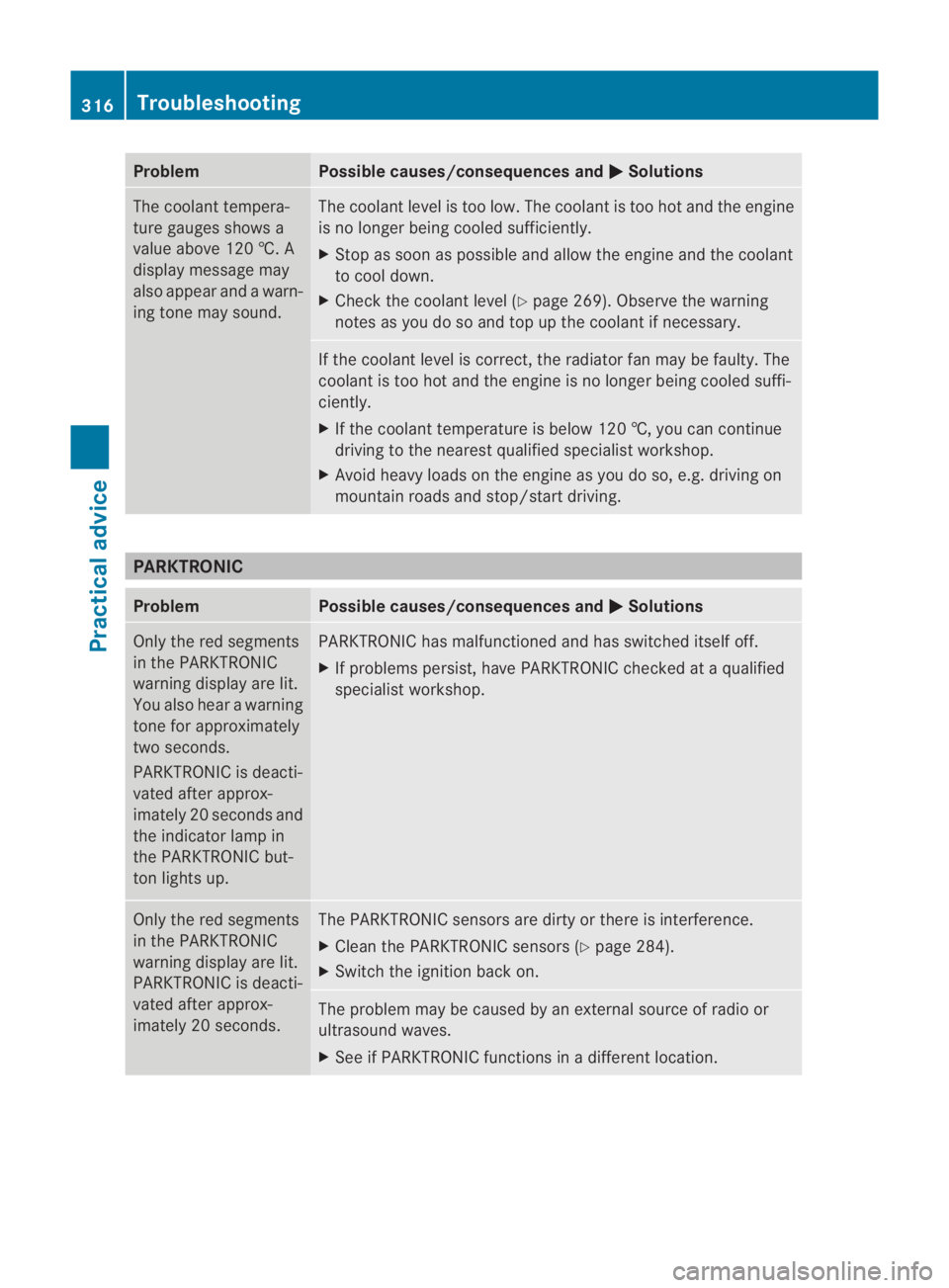
The coolant tempera-
ture gauges shows a
value above 120 †. A
display message may
also appeara
nd a warn-
ing tone may sound. The coolant level is too low. The coolant is too hot and the engine
is no longe
rbeing cooled sufficiently.
X Stop as soon as possible and allow the engine and the coolant
to cool down.
X Check the coolant level (Y page 269). Observe the warning
notes as you do so and top up the coolant if necessary. If the coolant level is correct, the radiator fan may be faulty. The
coolant is too hot and the engine is no longer being cooled suffi-
ciently.
X
If the coolant temperature is below 120 †, you can continue
driving to the nearest qualified specialist workshop.
X Avoid heavy loads on the engine as you do so, e.g. driving on
mountain roads and stop/start driving. PARKTRONIC
Problem Possible causes/consequences and
0003 Solutions
Only the red segments
in the PARKTRONIC
warning display are lit.
You also hear a warning
tone for approximately
two seconds.
PARKTRONIC is deacti-
vated after approx-
imately 20 seconds and
the indicator lamp in
the PARKTRONIC but-
ton lights up. PARKTRONIC has malfunctioned and has switched itself off.
X
If problems persist, have PARKTRONIC checked at a qualified
specialist workshop. Only the red segments
in the PARKTRONIC
warning display are lit.
PARKTRONIC is deacti-
vated after approx-
imately 20 seconds. The PARKTRONIC sensors are dirty or there is interference.
X
Clean the PARKTRONIC sensors (Y page 284).
X Switch the ignition back on. The problem may be caused by an external source of radio or
ultrasound waves.
X
See if PARKTRONIC functions in a different location. 316
TroubleshootingPractical advice
BA 197 ECE RE 2010/6a; 1; 2, en-GB
sabbaeu
Version: 3.0.3.6 2010-05-07T14:19:43+02:00 - Seite 316
Page 323 of 361
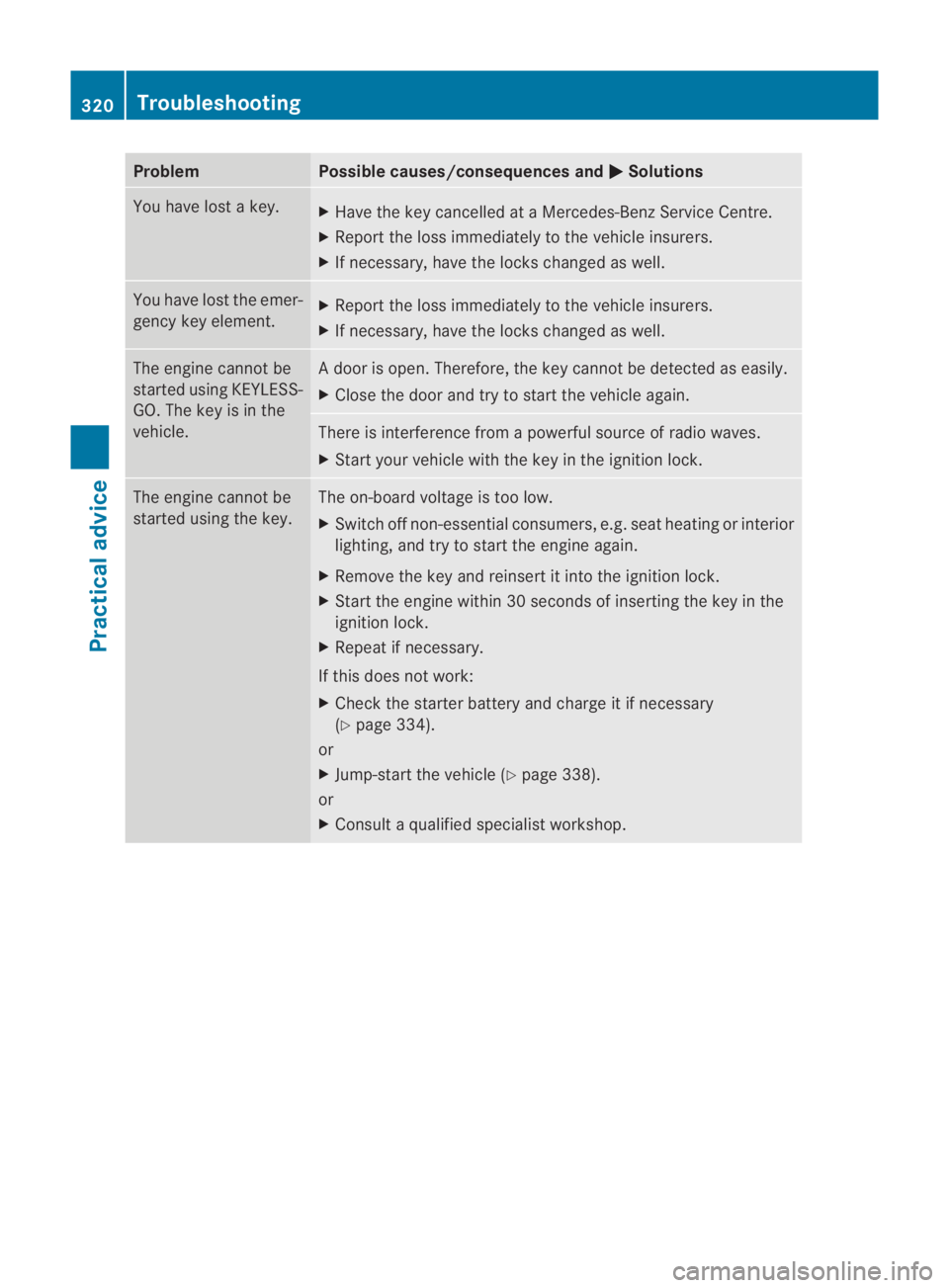
Problem Possible causes/consequences and
0003 Solutions
You have lost a key.
X
Have the key cancelled at a Mercedes-Benz Service Centre.
X Report the loss immediately to the vehicle insurers.
X If necessary, have the locks changed as well. You have lost the emer-
gency key element.
X
Report the loss immediately to the vehicle insurers.
X If necessary, have the locks changed as well. The engine cannot be
started using KEYLESS-
GO. The key is in the
vehicle. Ad
oor is open. Therefore, the key cannot be detected as easily.
X Close the door and try to start the vehicle again. There is interference from a powerful source of radio waves.
X
Start your vehicle with the key in the ignition lock. The engine cannot be
started using the key. The on-board voltage is too low.
X
Switch off non-essential consumers, e.g. seat heating or interior
lighting, and try to start the engine again.
X Remove the key and reinsert it into the ignition lock.
X Start the engine within 30 seconds of inserting the key in the
ignition lock.
X Repeat if necessary.
If this does not work:
X Check the starter battery and charge it if necessary
(Y page 334).
or
X Jump-start the vehicle (Y page 338).
or
X Consult a qualified specialist workshop. 320
TroubleshootingPractical advice
BA 197 ECE RE 2010/6a; 1; 2, en-GB
sabbaeu
Version: 3.0.3.6 2010-05-07T14:19:43+02:00 - Seite 320
Page 324 of 361
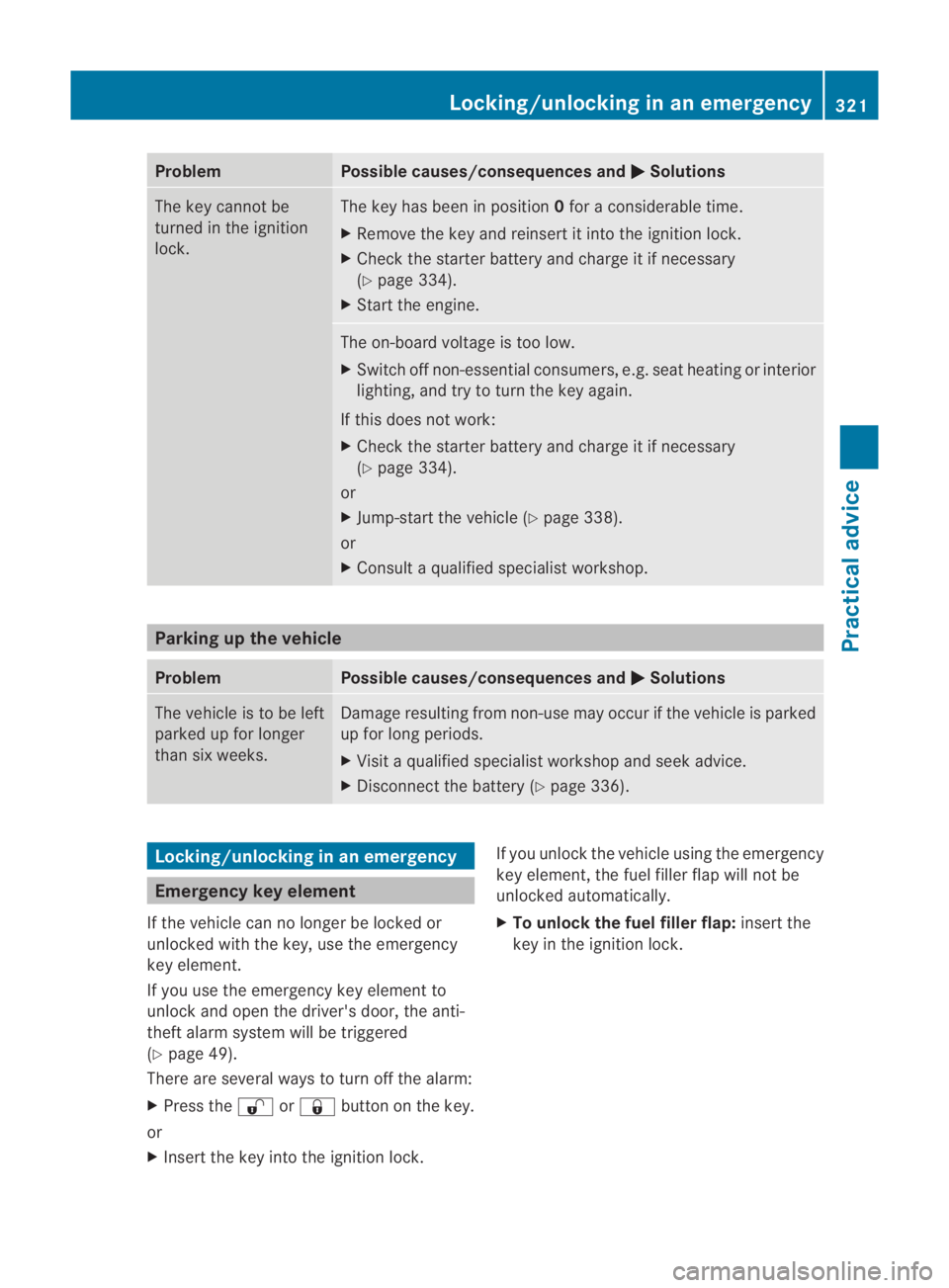
Problem Possible causes/consequences and
0003 Solutions
The key cannot be
turned in the ignition
lock. The key has been in position
0for a considerable time.
X Remove the key and reinsert it into the ignition lock.
X Check the starter battery and charge it if necessary
(Y page 334).
X Start the engine. The on-board voltage is too low.
X
Switch off non-essential consumers, e.g. seat heating or interior
lighting, and try to turn the key again.
If this does not work:
X Check the starter battery and charge it if necessary
(Y page 334).
or
X Jump-start the vehicle (Y page 338).
or
X Consult a qualified specialist workshop. Parking up the vehicle
Problem Possible causes/consequences and
0003 Solutions
The vehicle is to be left
parked up for longer
than six weeks. Damage resulting from non-use may occur if the vehicle is parked
up for long periods.
X
Visit a qualified specialist workshop and seek advice.
X Disconnect the battery (Y page 336).Locking/unlocking in an emergency
Emergency key element
If the vehicle can no longer be locked or
unlocked with the key, use the emergency
key element.
If you use the emergency key element to
unlock and open the driver's door, the anti-
theft alarm system will be triggered
(Y page 49).
There are several ways to turn off the alarm:
X Press the 000Bor0009 button on the key.
or
X Insert the key into the ignition lock. If you unlock the vehicle using the emergency
key element, the fuel filler flap will not be
unlocked automatically.
X
To unlock the fuel filler flap: insert the
key in the ignition lock. Locking/unlocking in an emergency
321Practical advice
BA 197 ECE RE 2010/6a; 1; 2, en-GB
sabbaeu Version: 3.0.3.6 2010-05-07T14:19:43+02:00 - Seite 321 Z