automatic transmission fluid MERCEDES-BENZ SPRINTER 2006 User Guide
[x] Cancel search | Manufacturer: MERCEDES-BENZ, Model Year: 2006, Model line: SPRINTER, Model: MERCEDES-BENZ SPRINTER 2006Pages: 2305, PDF Size: 48.12 MB
Page 1744 of 2305
TRANSMISSION
TABLE OF CONTENTS
page
AUTOMATIC TRANSMISSION NAG1 - SERVICE
INFORMATION............................1
AUTOMATIC TRANSMISSION NAG1 - SERVICE
INFORMATION
TABLE OF CONTENTS
page page
AUTOMATIC TRANSMISSION NAG1 - SERVICE
INFORMATION
DESCRIPTION..........................3
OPERATION............................4
DIAGNOSIS AND TESTING
AUTOMATIC TRANSMISSION............39
PRELIMINARY........................39
ROAD TESTING......................39
AUTOMATIC TRANSMISSION............40
STANDARD PROCEDURE - ALUMINUM
THREAD REPAIR......................42
REMOVAL.............................42
DISASSEMBLY.........................46
ASSEMBLY............................52
INSTALLATION.........................60
SCHEMATICS AND DIAGRAMS............65
SPECIFICATIONS - NAG1 AUTOMATIC
TRANSMISSION......................86
SPECIAL TOOLS - AUTOMATIC
TRANSMISSION - NAG1................87
INPUT CLUTCHES
DESCRIPTION.........................90
OPERATION...........................91
INPUT CLUTCH K1
DISASSEMBLY.........................92
ASSEMBLY............................94
INPUT CLUTCH K2
DISASSEMBLY.........................97
ASSEMBLY............................99
INPUT CLUTCH K3
DISASSEMBLY........................102
ASSEMBLY...........................103
ELECTROHYDRAULIC UNIT
DESCRIPTION........................105
OPERATION..........................112
REMOVAL............................120
DISASSEMBLY........................121
ASSEMBLY...........................125INSTALLATION........................129
FLUID AND FILTER
DESCRIPTION........................131
OPERATION..........................131
DIAGNOSIS AND TESTING
EFFECTS OF INCORRECT FLUID LEVEL . . 131
CAUSES OF BURNT FLUID.............132
FLUID CONTAMINATION...............132
STANDARD PROCEDURE
CHECK OIL LEVEL...................132
TRANSMISSION FILL.................133
FLUID/FILTER SERVICE...............134
FREEWHEELING CLUTCH
DESCRIPTION........................135
OPERATION..........................135
DISASSEMBLY........................136
ASSEMBLY...........................138
GEARSHIFT CABLE
DIAGNOSIS AND TESTING
GEARSHIFT CABLE..................138
REMOVAL............................139
INSTALLATION........................140
HOLDING CLUTCHES
DESCRIPTION........................141
OPERATION..........................142
HOLDING CLUTCH B1
DISASSEMBLY........................143
ASSEMBLY...........................145
HOLDING CLUTCH B2
DISASSEMBLY........................148
ASSEMBLY...........................150
INPUT SPEED SENSORS
DESCRIPTION........................153
OPERATION..........................154
OIL PUMP
DESCRIPTION........................154
OPERATION..........................154
DISASSEMBLY........................155
VATRANSMISSION 21 - 1
Page 1782 of 2305
DIAGNOSIS AND TESTING
AUTOMATIC TRANSMISSION
CAUTION: Before attempting any repair on a NAG1
automatic transmission, check for Diagnostic Trou-
ble Codes with the appropriate scan tool.
Transmission malfunctions may be caused by these
general conditions:
²Poor engine performance.
²Improper adjustments.
²Hydraulic malfunctions.
²Mechanical malfunctions.
²Electronic malfunctions.
²Transfer case performance (if equipped).
Diagnosis of these problems should always begin
by checking the easily accessible variables: fluid level
and condition, gearshift cable adjustment. Then per-
form a road test to determine if the problem has been
corrected or if more diagnosis is necessary.
PRELIMINARY
Two basic procedures are required. One procedure
for vehicles that are drivable and an alternate proce-
dure for disabled vehicles (will not back up or move
forward).
VEHICLE IS DRIVABLE
(1) Check for transmission fault codes using the
appropriate scan tool.
(2) Check fluid level and condition.
(3) Adjust gearshift cable if complaint was based
on delayed, erratic, or harsh shifts.
(4) Road test and note how transmission upshifts,
downshifts, and engages.
VEHICLE IS DISABLED
(1) Check fluid level and condition.(2) Check for broken or disconnected gearshift
cable.
(3) Check for cracked, leaking cooler lines, or loose
or missing pressure-port plugs.
(4) Raise and support vehicle on safety stands,
start engine, shift transmission into gear, and note
following:
(a) If propeller shaft turns but wheels do not,
problem is with differential or axle shafts.
(b) If propeller shaft does not turn and transmis-
sion is noisy, stop engine. Remove oil pan, and
check for debris. If pan is clear, remove transmis-
sion and check for damaged driveplate, converter,
oil pump, or input shaft.
(c) If propeller shaft does not turn and transmis-
sion is not noisy, perform hydraulic-pressure test to
determine if problem is hydraulic or mechanical.
ROAD TESTING
Before road testing, be sure the fluid level and con-
trol cable adjustments have been checked and
adjusted if necessary. Verify that all diagnostic trou-
ble codes have been resolved.
Observe engine performance during the road test.
A poorly tuned engine will not allow accurate analy-
sis of transmission operation.
Operate the transmission in all gear ranges. Check
for shift variations and engine flare which indicates
slippage. Note if shifts are harsh, spongy, delayed,
early, or if part throttle downshifts are sensitive.
Slippage indicated by engine flare, usually means
clutch, overrunning clutch, or line pressure problems.
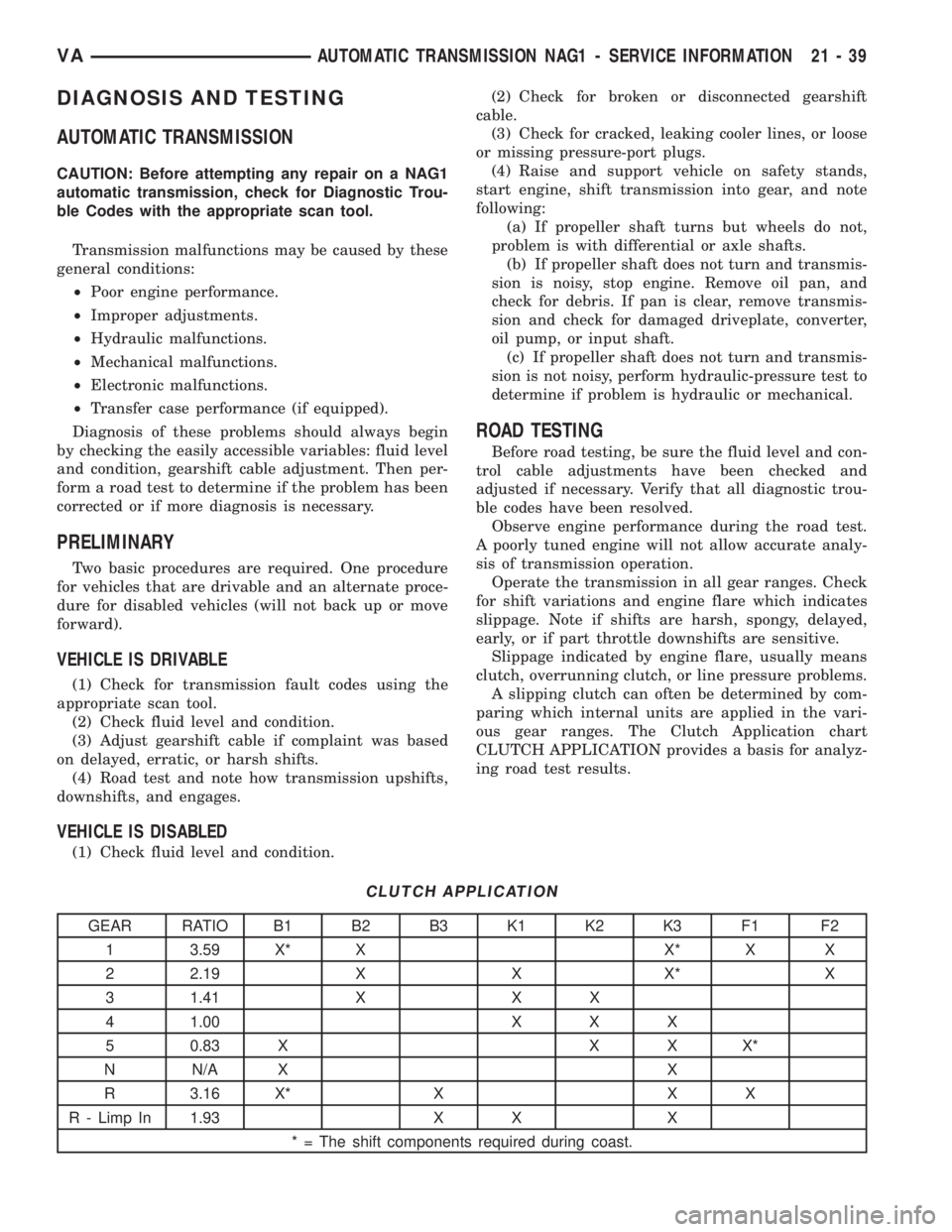
A slipping clutch can often be determined by com-
paring which internal units are applied in the vari-
ous gear ranges. The Clutch Application chart
CLUTCH APPLICATION provides a basis for analyz-
ing road test results.
CLUTCH APPLICATION
GEAR RATIO B1 B2 B3 K1 K2 K3 F1 F2
1 3.59 X* X X* X X
2 2.19 X X X* X
3 1.41 X X X
4 1.00 X X X
5 0.83 X X X X*
N N/A X X
R 3.16 X* X X X
R - Limp In 1.93 X X X
* = The shift components required during coast.
VAAUTOMATIC TRANSMISSION NAG1 - SERVICE INFORMATION 21 - 39
Page 1796 of 2305
NOTE: During the measurement the snap ring (7)
(Fig. 49) must contact the upper bearing surface of
the groove in the outer multiple-disc carrier (8).
NOTE: Pay attention to sequence of discs. If the
original clutch discs are reused, be sure to return
the disc identified on disassembly as belonging on
top of the spring washer (4) to its original location.
Place new friction multiple-discs in ATF fluid for
one hour before installing.
(4) Insert and measure spring washer (4) (Fig. 49)
and multiple-disc pack B3 (2, 6).
(a) Put multiple-discs for multiple-disc holding
clutch B3 together in the sequence shown in the
illustration and insert individually.
(b)
CAUTION: Apply only light pressure (less than 10 N
(3 lbs.) of force) to the clutch pack when measuring
the clutch clearance with the feeler gauge. Applying
excessive force to the clutch will give an incorrect
reading and lead to a transmission failure.Using a
feeler gauge, determine the play ªLº at three points
between the snap ring (7) and outer multiple-disc
(1). B3 clutch clearance should be 1.0-1.4 mm
(0.039-0.055 in.). Adjust the clearance as necessary.
(c) Adjust with snap-ring (7), if necessary. Snap-
rings are available in thicknesses of 3.2 mm (0.126
in.), 3.5 mm (0.138 in.), 3.8 mm (0.150 in.), 4.1 mm
(0.162 in.), 4.4 mm (0.173 in.), and 4.7 mm (0.185
in.).
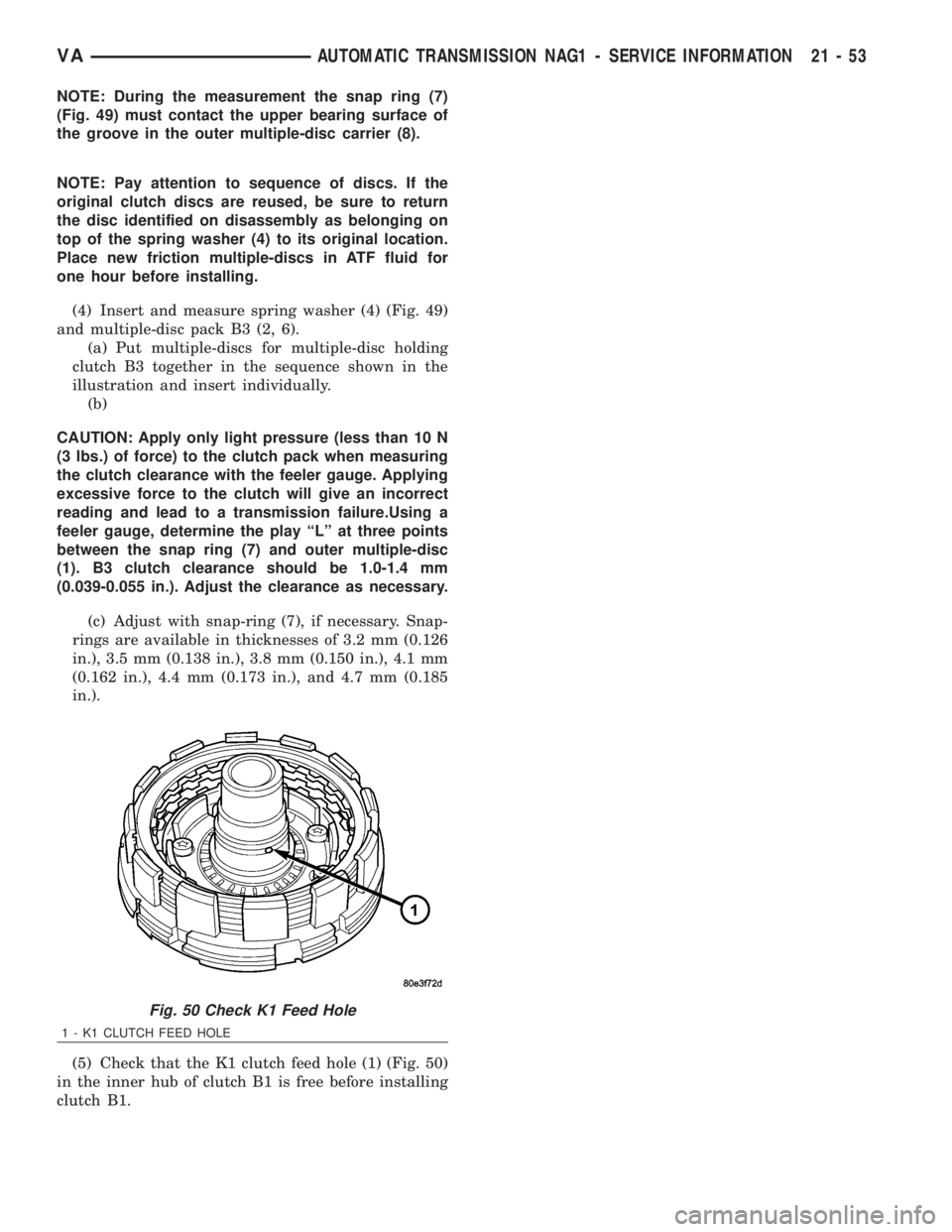
(5) Check that the K1 clutch feed hole (1) (Fig. 50)
in the inner hub of clutch B1 is free before installing
clutch B1.
Fig. 50 Check K1 Feed Hole
1 - K1 CLUTCH FEED HOLE
VAAUTOMATIC TRANSMISSION NAG1 - SERVICE INFORMATION 21 - 53
Page 1807 of 2305
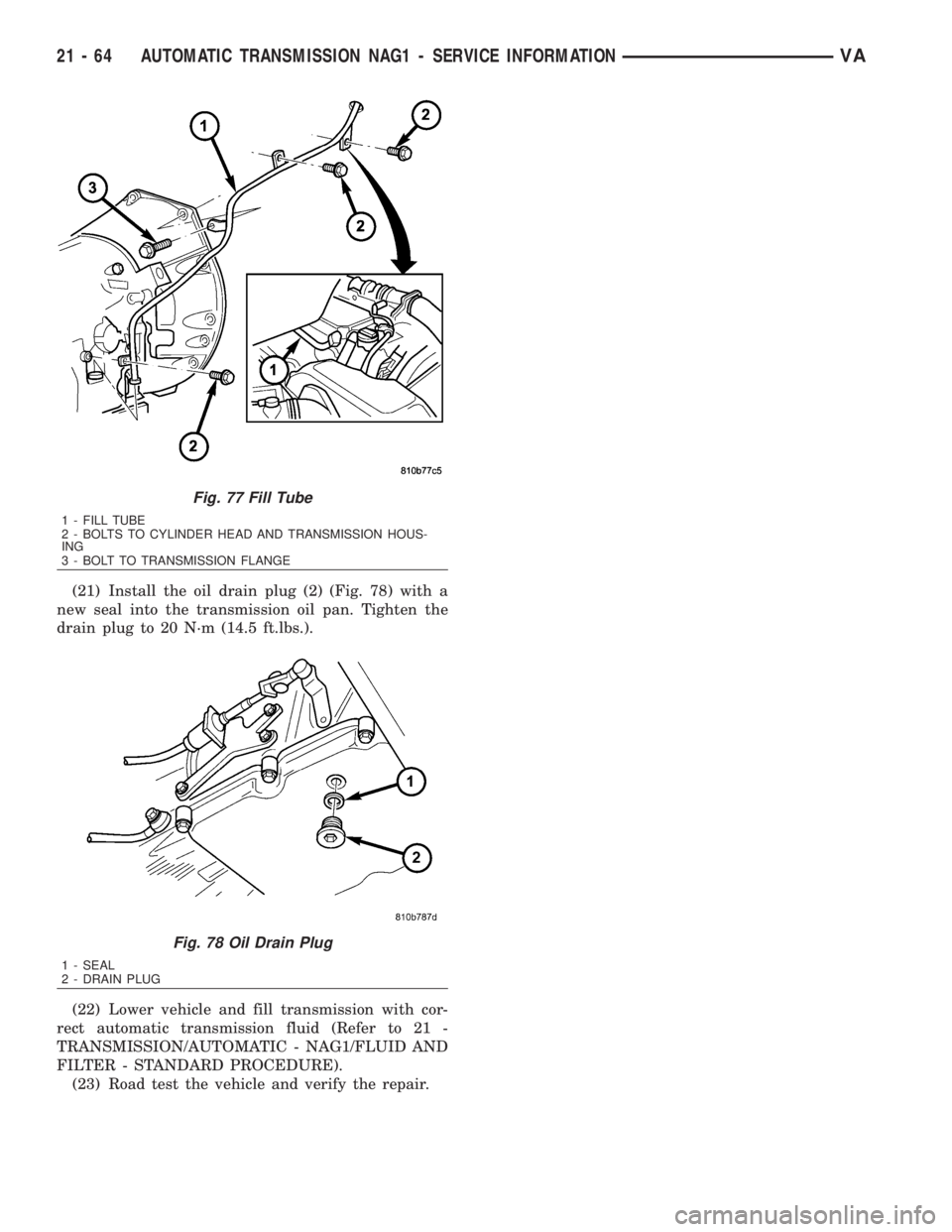
(21) Install the oil drain plug (2) (Fig. 78) with a
new seal into the transmission oil pan. Tighten the
drain plug to 20 N´m (14.5 ft.lbs.).
(22) Lower vehicle and fill transmission with cor-
rect automatic transmission fluid (Refer to 21 -
TRANSMISSION/AUTOMATIC - NAG1/FLUID AND
FILTER - STANDARD PROCEDURE).
(23) Road test the vehicle and verify the repair.
Fig. 77 Fill Tube
1 - FILL TUBE
2 - BOLTS TO CYLINDER HEAD AND TRANSMISSION HOUS-
ING
3 - BOLT TO TRANSMISSION FLANGE
Fig. 78 Oil Drain Plug
1 - SEAL
2 - DRAIN PLUG
21 - 64 AUTOMATIC TRANSMISSION NAG1 - SERVICE INFORMATIONVA
Page 1838 of 2305
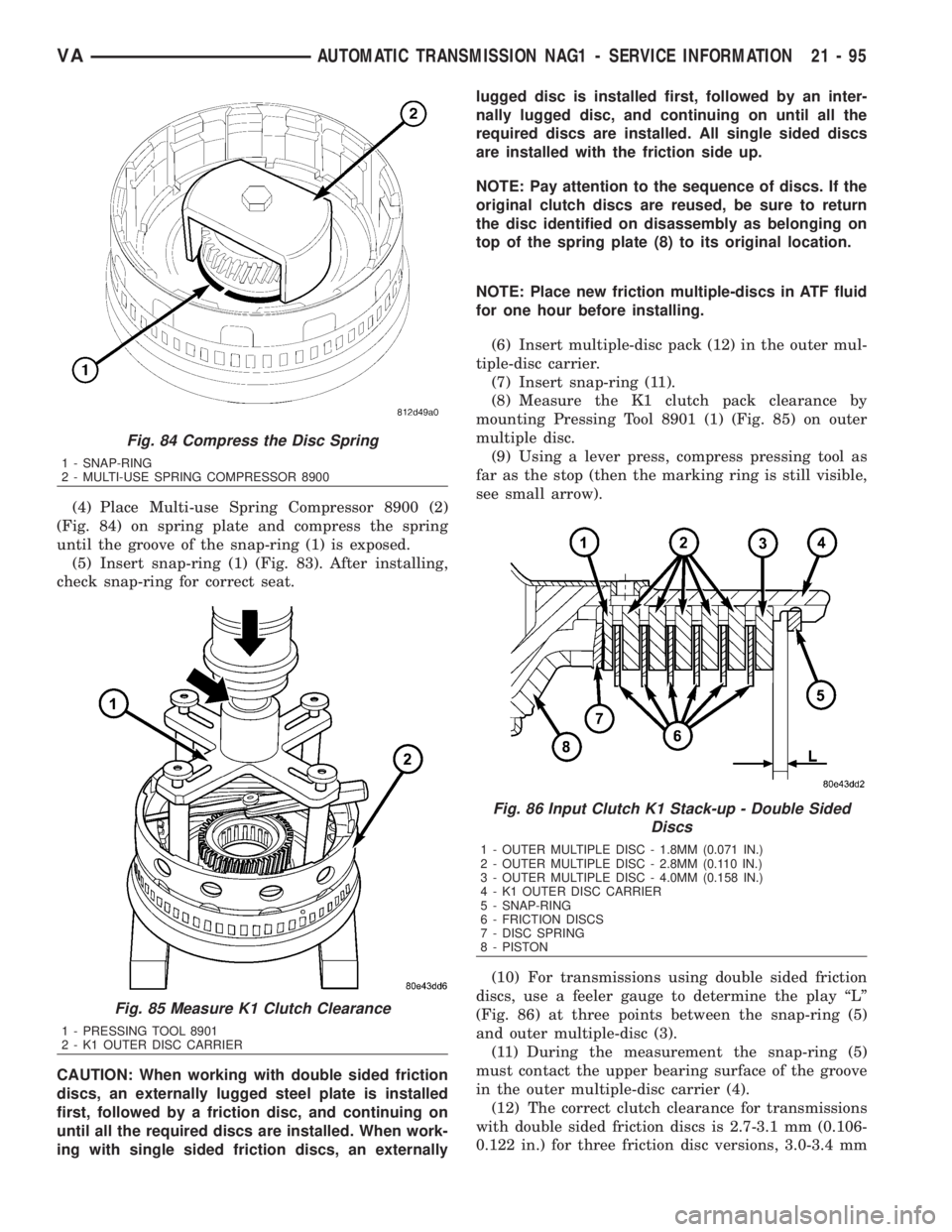
(4) Place Multi-use Spring Compressor 8900 (2)
(Fig. 84) on spring plate and compress the spring
until the groove of the snap-ring (1) is exposed.
(5) Insert snap-ring (1) (Fig. 83). After installing,
check snap-ring for correct seat.
CAUTION: When working with double sided friction
discs, an externally lugged steel plate is installed
first, followed by a friction disc, and continuing on
until all the required discs are installed. When work-
ing with single sided friction discs, an externallylugged disc is installed first, followed by an inter-
nally lugged disc, and continuing on until all the
required discs are installed. All single sided discs
are installed with the friction side up.
NOTE: Pay attention to the sequence of discs. If the
original clutch discs are reused, be sure to return
the disc identified on disassembly as belonging on
top of the spring plate (8) to its original location.
NOTE: Place new friction multiple-discs in ATF fluid
for one hour before installing.
(6) Insert multiple-disc pack (12) in the outer mul-
tiple-disc carrier.
(7) Insert snap-ring (11).
(8) Measure the K1 clutch pack clearance by
mounting Pressing Tool 8901 (1) (Fig. 85) on outer
multiple disc.
(9) Using a lever press, compress pressing tool as
far as the stop (then the marking ring is still visible,
see small arrow).
(10) For transmissions using double sided friction
discs, use a feeler gauge to determine the play ªLº
(Fig. 86) at three points between the snap-ring (5)
and outer multiple-disc (3).
(11) During the measurement the snap-ring (5)
must contact the upper bearing surface of the groove
in the outer multiple-disc carrier (4).
(12) The correct clutch clearance for transmissions
with double sided friction discs is 2.7-3.1 mm (0.106-
0.122 in.) for three friction disc versions, 3.0-3.4 mm
Fig. 84 Compress the Disc Spring
1 - SNAP-RING
2 - MULTI-USE SPRING COMPRESSOR 8900
Fig. 85 Measure K1 Clutch Clearance
1 - PRESSING TOOL 8901
2 - K1 OUTER DISC CARRIER
Fig. 86 Input Clutch K1 Stack-up - Double Sided
Discs
1 - OUTER MULTIPLE DISC - 1.8MM (0.071 IN.)
2 - OUTER MULTIPLE DISC - 2.8MM (0.110 IN.)
3 - OUTER MULTIPLE DISC - 4.0MM (0.158 IN.)
4 - K1 OUTER DISC CARRIER
5 - SNAP-RING
6 - FRICTION DISCS
7 - DISC SPRING
8 - PISTON
VAAUTOMATIC TRANSMISSION NAG1 - SERVICE INFORMATION 21 - 95
Page 1846 of 2305
ASSEMBLY
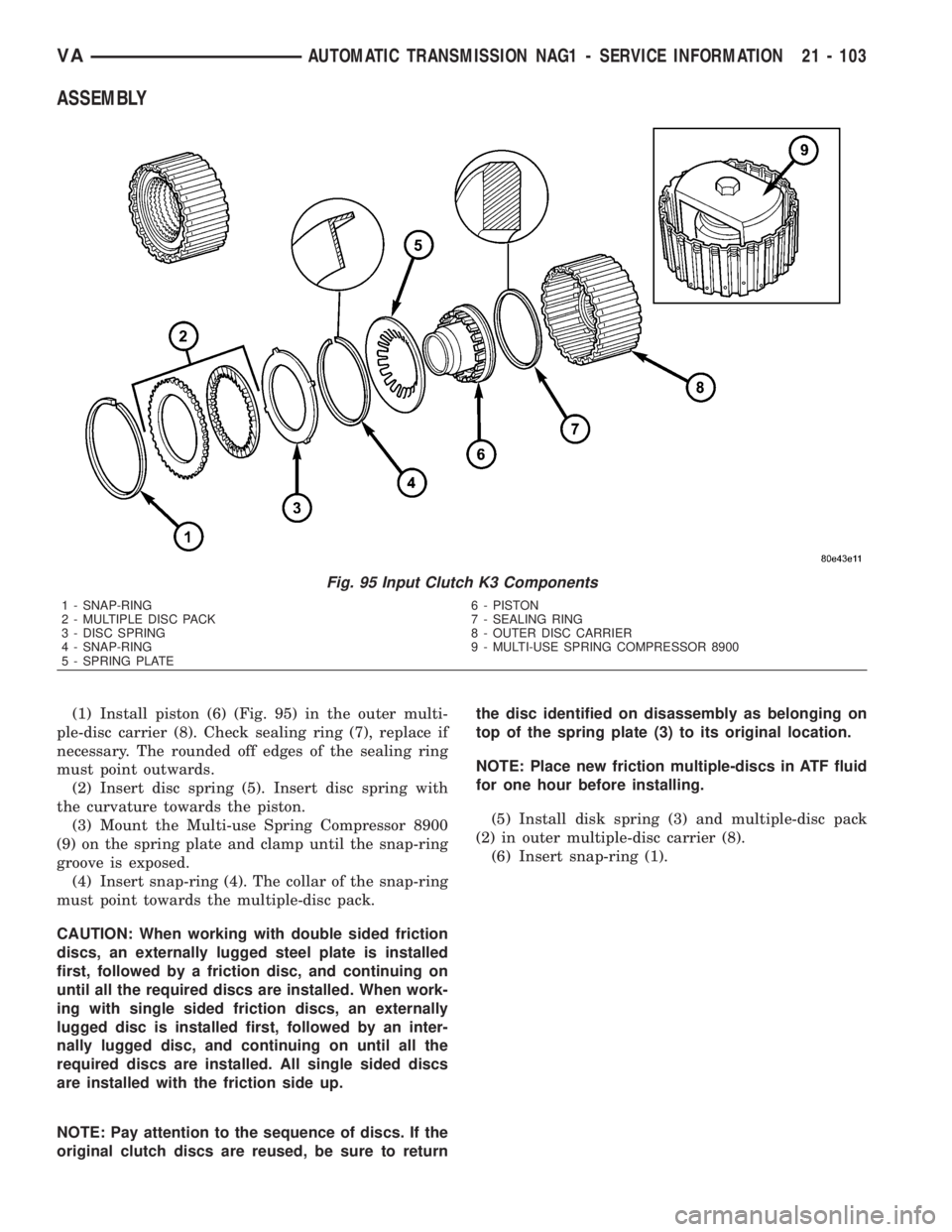
(1) Install piston (6) (Fig. 95) in the outer multi-
ple-disc carrier (8). Check sealing ring (7), replace if
necessary. The rounded off edges of the sealing ring
must point outwards.
(2) Insert disc spring (5). Insert disc spring with
the curvature towards the piston.
(3) Mount the Multi-use Spring Compressor 8900
(9) on the spring plate and clamp until the snap-ring
groove is exposed.
(4) Insert snap-ring (4). The collar of the snap-ring
must point towards the multiple-disc pack.
CAUTION: When working with double sided friction
discs, an externally lugged steel plate is installed
first, followed by a friction disc, and continuing on
until all the required discs are installed. When work-
ing with single sided friction discs, an externally
lugged disc is installed first, followed by an inter-
nally lugged disc, and continuing on until all the
required discs are installed. All single sided discs
are installed with the friction side up.
NOTE: Pay attention to the sequence of discs. If the
original clutch discs are reused, be sure to returnthe disc identified on disassembly as belonging on
top of the spring plate (3) to its original location.
NOTE: Place new friction multiple-discs in ATF fluid
for one hour before installing.
(5) Install disk spring (3) and multiple-disc pack
(2) in outer multiple-disc carrier (8).
(6) Insert snap-ring (1).
Fig. 95 Input Clutch K3 Components
1 - SNAP-RING 6 - PISTON
2 - MULTIPLE DISC PACK 7 - SEALING RING
3 - DISC SPRING 8 - OUTER DISC CARRIER
4 - SNAP-RING 9 - MULTI-USE SPRING COMPRESSOR 8900
5 - SPRING PLATE
VAAUTOMATIC TRANSMISSION NAG1 - SERVICE INFORMATION 21 - 103
Page 1854 of 2305
Shift Pressure Shift Valve
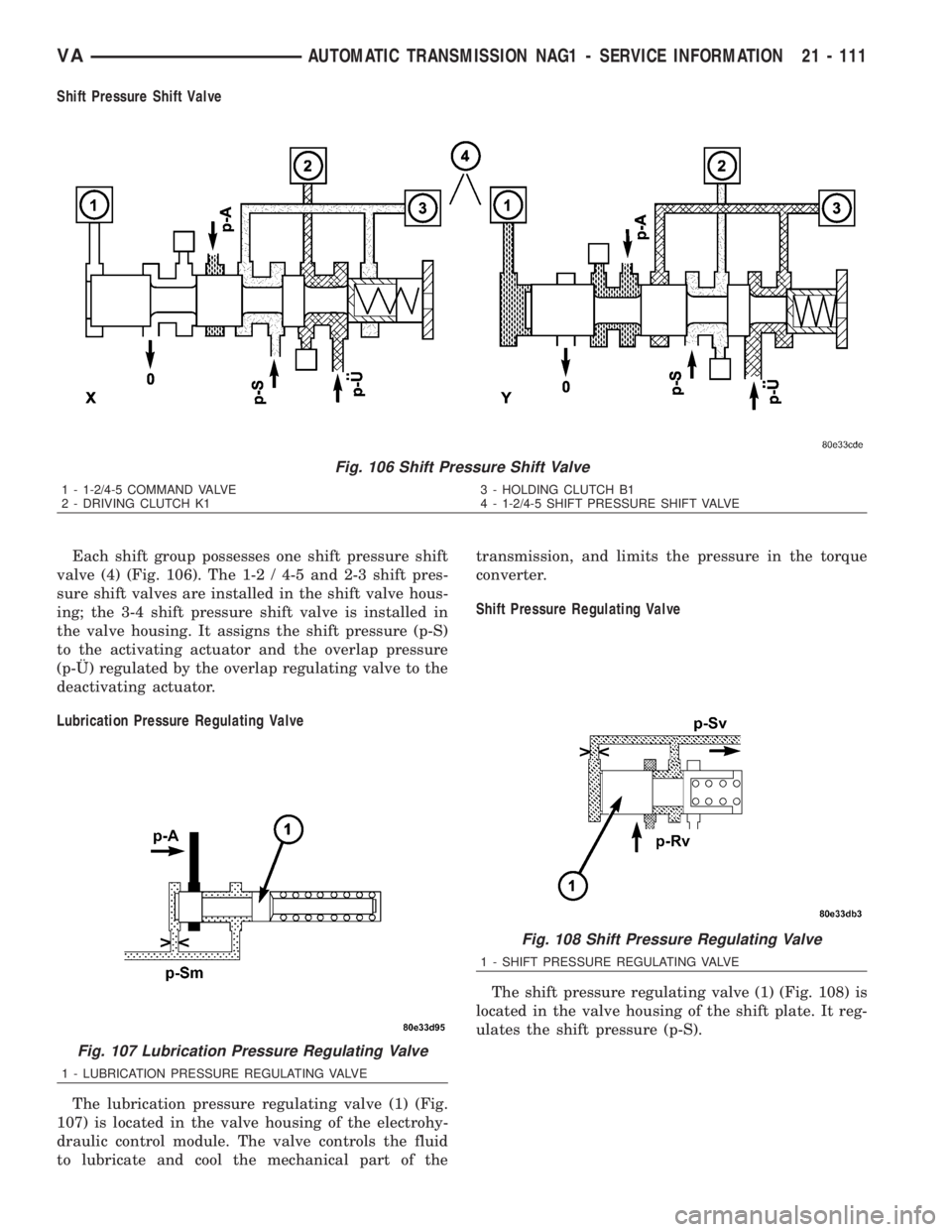
Each shift group possesses one shift pressure shift
valve (4) (Fig. 106). The 1-2 / 4-5 and 2-3 shift pres-
sure shift valves are installed in the shift valve hous-
ing; the 3-4 shift pressure shift valve is installed in
the valve housing. It assigns the shift pressure (p-S)
to the activating actuator and the overlap pressure
(p-š) regulated by the overlap regulating valve to the
deactivating actuator.
Lubrication Pressure Regulating Valve
The lubrication pressure regulating valve (1) (Fig.
107) is located in the valve housing of the electrohy-
draulic control module. The valve controls the fluid
to lubricate and cool the mechanical part of thetransmission, and limits the pressure in the torque
converter.
Shift Pressure Regulating Valve
The shift pressure regulating valve (1) (Fig. 108) is
located in the valve housing of the shift plate. It reg-
ulates the shift pressure (p-S).
Fig. 106 Shift Pressure Shift Valve
1 - 1-2/4-5 COMMAND VALVE
2 - DRIVING CLUTCH K13 - HOLDING CLUTCH B1
4 - 1-2/4-5 SHIFT PRESSURE SHIFT VALVE
Fig. 107 Lubrication Pressure Regulating Valve
1 - LUBRICATION PRESSURE REGULATING VALVE
Fig. 108 Shift Pressure Regulating Valve
1 - SHIFT PRESSURE REGULATING VALVE
VAAUTOMATIC TRANSMISSION NAG1 - SERVICE INFORMATION 21 - 111
Page 1863 of 2305
REMOVAL
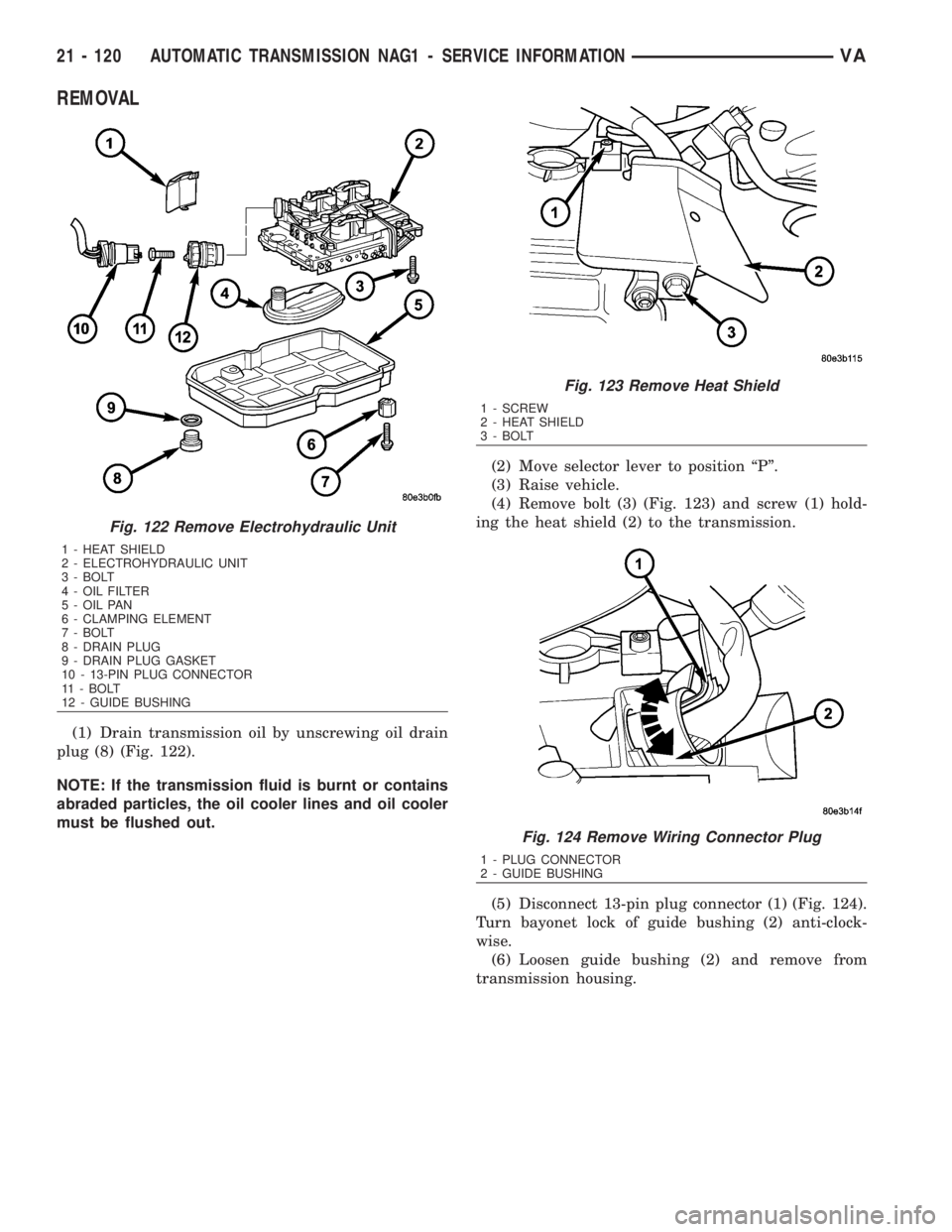
(1) Drain transmission oil by unscrewing oil drain
plug (8) (Fig. 122).
NOTE: If the transmission fluid is burnt or contains
abraded particles, the oil cooler lines and oil cooler
must be flushed out.(2) Move selector lever to position ªPº.
(3) Raise vehicle.
(4) Remove bolt (3) (Fig. 123) and screw (1) hold-
ing the heat shield (2) to the transmission.
(5) Disconnect 13-pin plug connector (1) (Fig. 124).
Turn bayonet lock of guide bushing (2) anti-clock-
wise.
(6) Loosen guide bushing (2) and remove from
transmission housing.
Fig. 122 Remove Electrohydraulic Unit
1 - HEAT SHIELD
2 - ELECTROHYDRAULIC UNIT
3 - BOLT
4 - OIL FILTER
5 - OIL PAN
6 - CLAMPING ELEMENT
7 - BOLT
8 - DRAIN PLUG
9 - DRAIN PLUG GASKET
10 - 13-PIN PLUG CONNECTOR
11 - BOLT
12 - GUIDE BUSHING
Fig. 123 Remove Heat Shield
1 - SCREW
2 - HEAT SHIELD
3 - BOLT
Fig. 124 Remove Wiring Connector Plug
1 - PLUG CONNECTOR
2 - GUIDE BUSHING
21 - 120 AUTOMATIC TRANSMISSION NAG1 - SERVICE INFORMATIONVA
Page 1873 of 2305
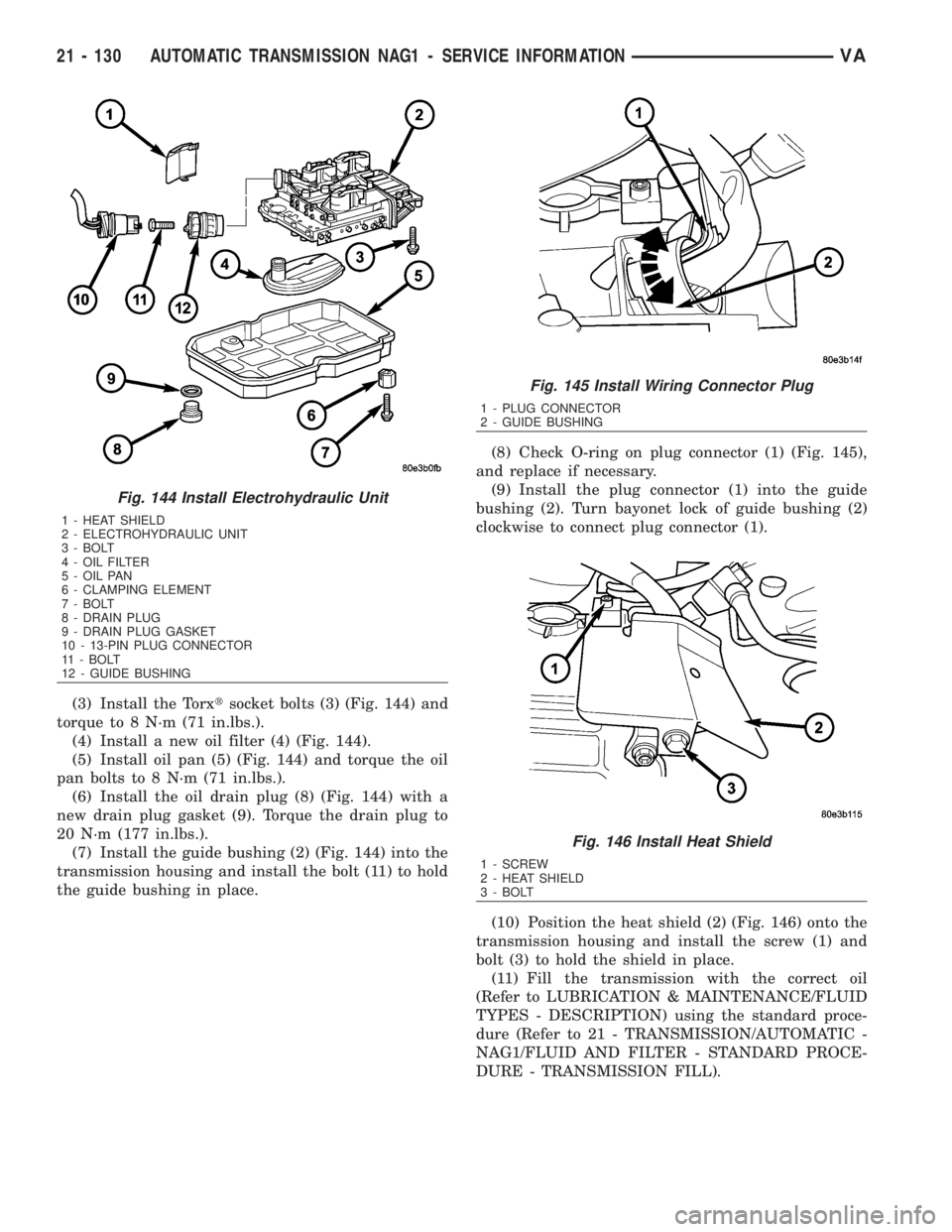
(3) Install the Torxtsocket bolts (3) (Fig. 144) and
torque to 8 N´m (71 in.lbs.).
(4) Install a new oil filter (4) (Fig. 144).
(5) Install oil pan (5) (Fig. 144) and torque the oil
pan bolts to 8 N´m (71 in.lbs.).
(6) Install the oil drain plug (8) (Fig. 144) with a
new drain plug gasket (9). Torque the drain plug to
20 N´m (177 in.lbs.).
(7) Install the guide bushing (2) (Fig. 144) into the
transmission housing and install the bolt (11) to hold
the guide bushing in place.(8) Check O-ring on plug connector (1) (Fig. 145),
and replace if necessary.
(9) Install the plug connector (1) into the guide
bushing (2). Turn bayonet lock of guide bushing (2)
clockwise to connect plug connector (1).
(10) Position the heat shield (2) (Fig. 146) onto the
transmission housing and install the screw (1) and
bolt (3) to hold the shield in place.
(11) Fill the transmission with the correct oil
(Refer to LUBRICATION & MAINTENANCE/FLUID
TYPES - DESCRIPTION) using the standard proce-
dure (Refer to 21 - TRANSMISSION/AUTOMATIC -
NAG1/FLUID AND FILTER - STANDARD PROCE-
DURE - TRANSMISSION FILL).
Fig. 144 Install Electrohydraulic Unit
1 - HEAT SHIELD
2 - ELECTROHYDRAULIC UNIT
3 - BOLT
4 - OIL FILTER
5 - OIL PAN
6 - CLAMPING ELEMENT
7 - BOLT
8 - DRAIN PLUG
9 - DRAIN PLUG GASKET
10 - 13-PIN PLUG CONNECTOR
11 - BOLT
12 - GUIDE BUSHING
Fig. 145 Install Wiring Connector Plug
1 - PLUG CONNECTOR
2 - GUIDE BUSHING
Fig. 146 Install Heat Shield
1 - SCREW
2 - HEAT SHIELD
3 - BOLT
21 - 130 AUTOMATIC TRANSMISSION NAG1 - SERVICE INFORMATIONVA
Page 1874 of 2305
FLUID AND FILTER
DESCRIPTION
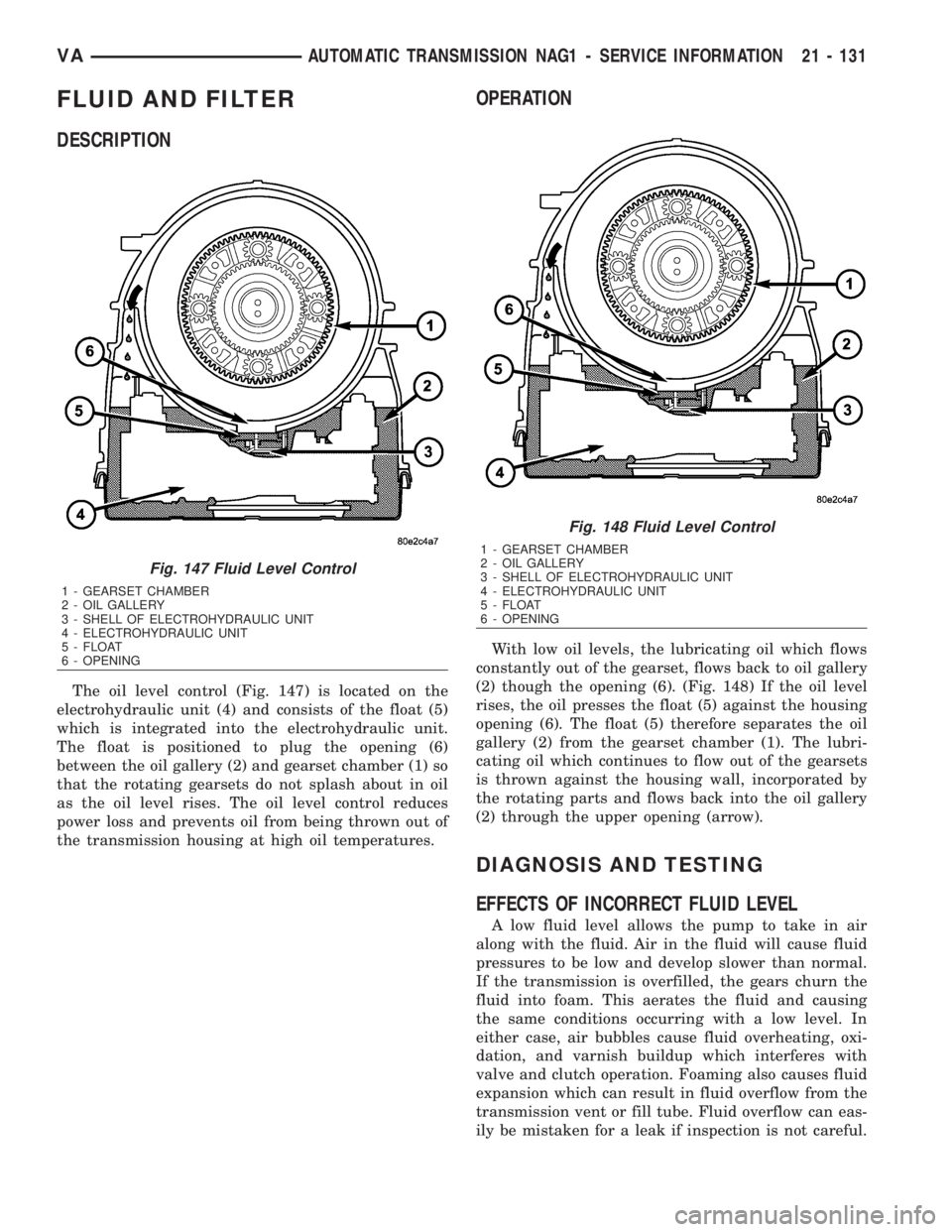
The oil level control (Fig. 147) is located on the
electrohydraulic unit (4) and consists of the float (5)
which is integrated into the electrohydraulic unit.
The float is positioned to plug the opening (6)
between the oil gallery (2) and gearset chamber (1) so
that the rotating gearsets do not splash about in oil
as the oil level rises. The oil level control reduces
power loss and prevents oil from being thrown out of
the transmission housing at high oil temperatures.
OPERATION
With low oil levels, the lubricating oil which flows
constantly out of the gearset, flows back to oil gallery
(2) though the opening (6). (Fig. 148) If the oil level
rises, the oil presses the float (5) against the housing
opening (6). The float (5) therefore separates the oil
gallery (2) from the gearset chamber (1). The lubri-
cating oil which continues to flow out of the gearsets
is thrown against the housing wall, incorporated by
the rotating parts and flows back into the oil gallery
(2) through the upper opening (arrow).
DIAGNOSIS AND TESTING
EFFECTS OF INCORRECT FLUID LEVEL
A low fluid level allows the pump to take in air
along with the fluid. Air in the fluid will cause fluid
pressures to be low and develop slower than normal.
If the transmission is overfilled, the gears churn the
fluid into foam. This aerates the fluid and causing
the same conditions occurring with a low level. In
either case, air bubbles cause fluid overheating, oxi-
dation, and varnish buildup which interferes with
valve and clutch operation. Foaming also causes fluid
expansion which can result in fluid overflow from the
transmission vent or fill tube. Fluid overflow can eas-
ily be mistaken for a leak if inspection is not careful.
Fig. 147 Fluid Level Control
1 - GEARSET CHAMBER
2 - OIL GALLERY
3 - SHELL OF ELECTROHYDRAULIC UNIT
4 - ELECTROHYDRAULIC UNIT
5 - FLOAT
6 - OPENING
Fig. 148 Fluid Level Control
1 - GEARSET CHAMBER
2 - OIL GALLERY
3 - SHELL OF ELECTROHYDRAULIC UNIT
4 - ELECTROHYDRAULIC UNIT
5 - FLOAT
6 - OPENING
VAAUTOMATIC TRANSMISSION NAG1 - SERVICE INFORMATION 21 - 131