ECU MERCEDES-BENZ SPRINTER 2006 Service Manual
[x] Cancel search | Manufacturer: MERCEDES-BENZ, Model Year: 2006, Model line: SPRINTER, Model: MERCEDES-BENZ SPRINTER 2006Pages: 2305, PDF Size: 48.12 MB
Page 1640 of 2305
REMOVAL
(1) Disconnect the negative battery cable.
(2) Raise and support the vehicle.
(3) Drain engine oil into a suitable, and appropri-
ately marked container.
(4) Remove engine mount to chassis nuts.
(5) Lower vehicle and install engine support.
(6) Remove the turbo charger heat shield to radia-
tor support bolts.
(7) Raise engine until the weight of the engine no
longer rests on the engine mounts.
(8) Raise and support the vehicle.
(9) Detach the front stabilizer bar at the front axle
and rotate it downward.
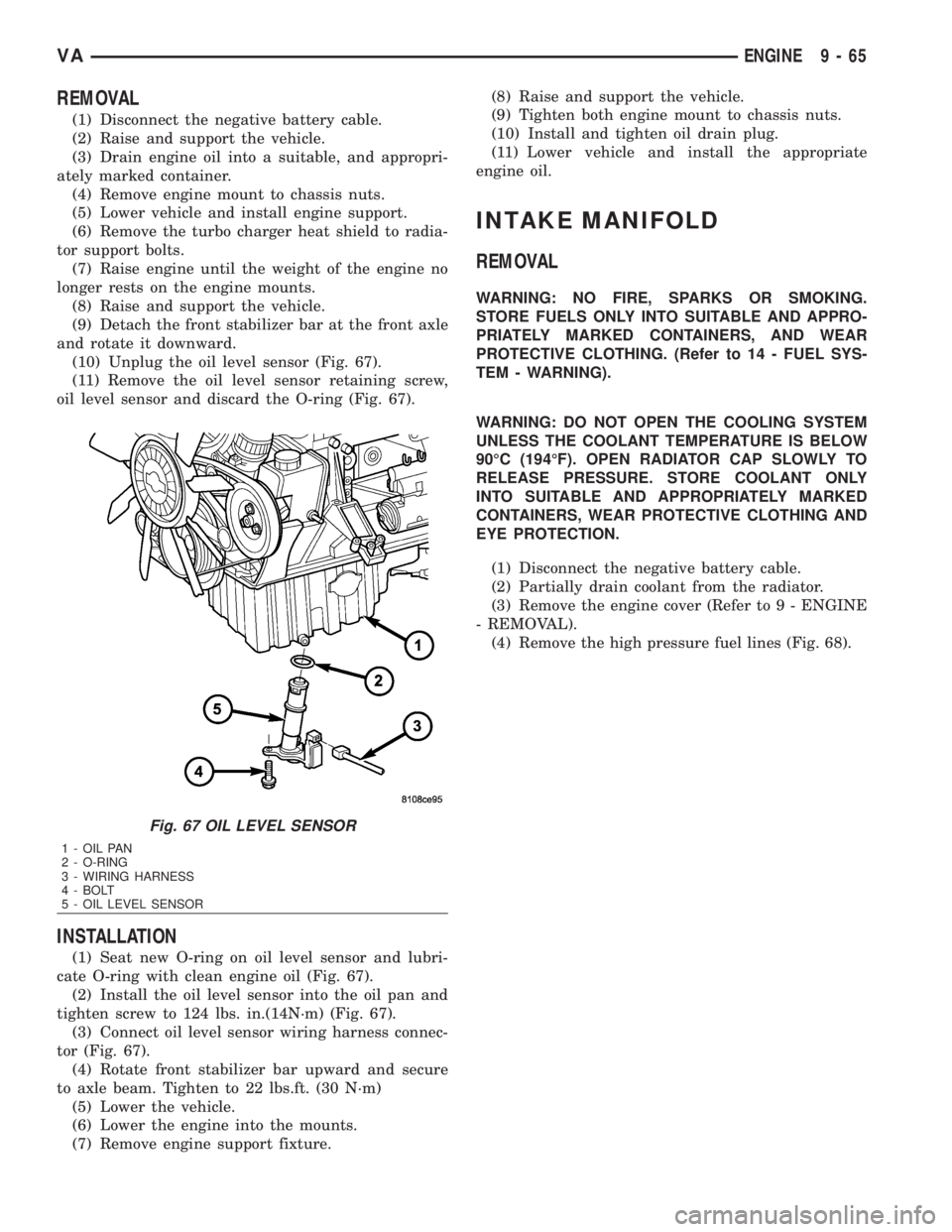
(10) Unplug the oil level sensor (Fig. 67).
(11) Remove the oil level sensor retaining screw,
oil level sensor and discard the O-ring (Fig. 67).
INSTALLATION
(1) Seat new O-ring on oil level sensor and lubri-
cate O-ring with clean engine oil (Fig. 67).
(2) Install the oil level sensor into the oil pan and
tighten screw to 124 lbs. in.(14N´m) (Fig. 67).
(3) Connect oil level sensor wiring harness connec-
tor (Fig. 67).
(4) Rotate front stabilizer bar upward and secure
to axle beam. Tighten to 22 lbs.ft. (30 N´m)
(5) Lower the vehicle.
(6) Lower the engine into the mounts.
(7) Remove engine support fixture.(8) Raise and support the vehicle.
(9) Tighten both engine mount to chassis nuts.
(10) Install and tighten oil drain plug.
(11) Lower vehicle and install the appropriate
engine oil.
INTAKE MANIFOLD
REMOVAL
WARNING: NO FIRE, SPARKS OR SMOKING.
STORE FUELS ONLY INTO SUITABLE AND APPRO-
PRIATELY MARKED CONTAINERS, AND WEAR
PROTECTIVE CLOTHING. (Refer to 14 - FUEL SYS-
TEM - WARNING).
WARNING: DO NOT OPEN THE COOLING SYSTEM
UNLESS THE COOLANT TEMPERATURE IS BELOW
90ÉC (194ÉF). OPEN RADIATOR CAP SLOWLY TO
RELEASE PRESSURE. STORE COOLANT ONLY
INTO SUITABLE AND APPROPRIATELY MARKED
CONTAINERS, WEAR PROTECTIVE CLOTHING AND
EYE PROTECTION.
(1) Disconnect the negative battery cable.
(2) Partially drain coolant from the radiator.
(3) Remove the engine cover (Refer to 9 - ENGINE
- REMOVAL).
(4) Remove the high pressure fuel lines (Fig. 68).
Fig. 67 OIL LEVEL SENSOR
1 - OIL PAN
2 - O-RING
3 - WIRING HARNESS
4 - BOLT
5 - OIL LEVEL SENSOR
VAENGINE 9 - 65
Page 1643 of 2305
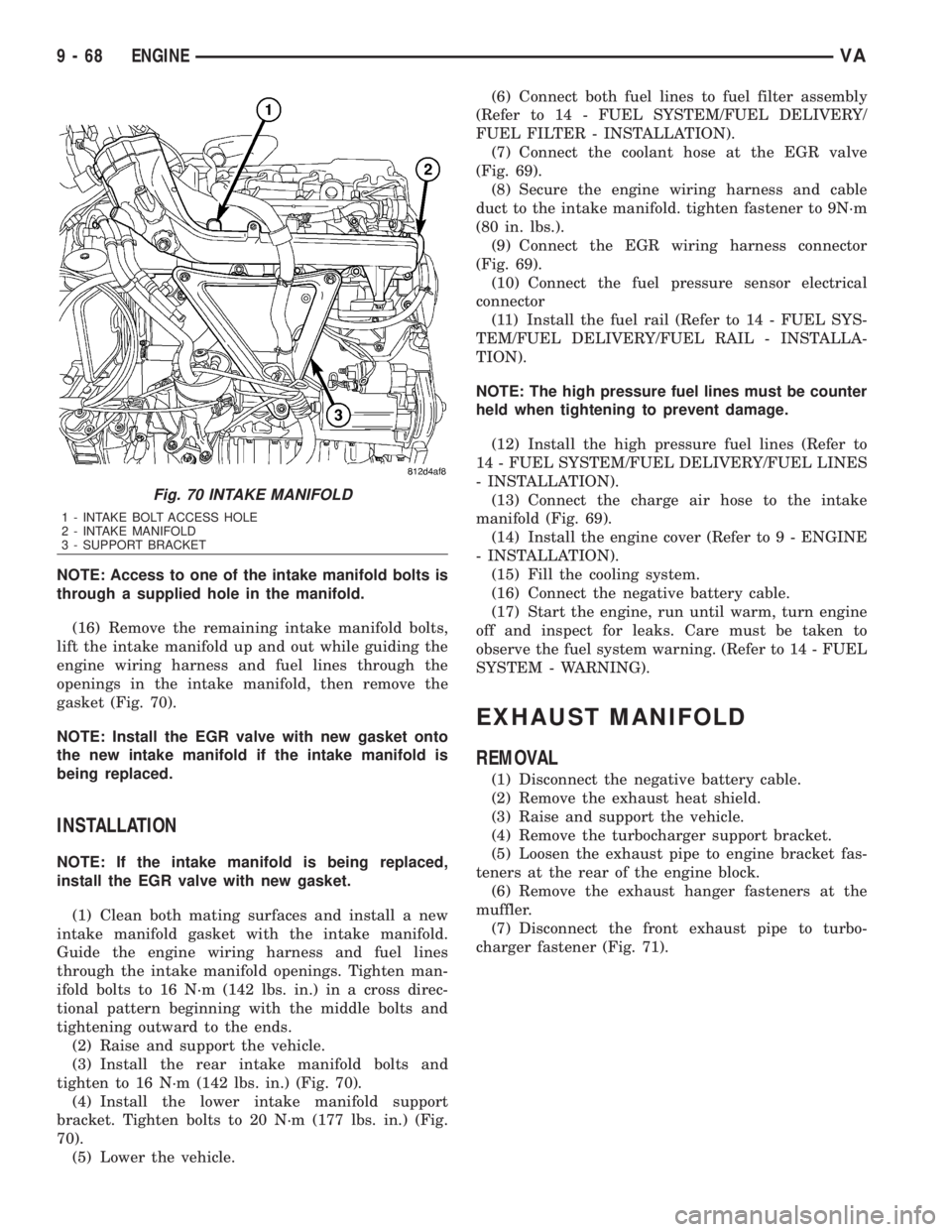
NOTE: Access to one of the intake manifold bolts is
through a supplied hole in the manifold.
(16) Remove the remaining intake manifold bolts,
lift the intake manifold up and out while guiding the
engine wiring harness and fuel lines through the
openings in the intake manifold, then remove the
gasket (Fig. 70).
NOTE: Install the EGR valve with new gasket onto
the new intake manifold if the intake manifold is
being replaced.
INSTALLATION
NOTE: If the intake manifold is being replaced,
install the EGR valve with new gasket.
(1) Clean both mating surfaces and install a new
intake manifold gasket with the intake manifold.
Guide the engine wiring harness and fuel lines
through the intake manifold openings. Tighten man-
ifold bolts to 16 N´m (142 lbs. in.) in a cross direc-
tional pattern beginning with the middle bolts and
tightening outward to the ends.
(2) Raise and support the vehicle.
(3) Install the rear intake manifold bolts and
tighten to 16 N´m (142 lbs. in.) (Fig. 70).
(4) Install the lower intake manifold support
bracket. Tighten bolts to 20 N´m (177 lbs. in.) (Fig.
70).
(5) Lower the vehicle.(6) Connect both fuel lines to fuel filter assembly
(Refer to 14 - FUEL SYSTEM/FUEL DELIVERY/
FUEL FILTER - INSTALLATION).
(7) Connect the coolant hose at the EGR valve
(Fig. 69).
(8) Secure the engine wiring harness and cable
duct to the intake manifold. tighten fastener to 9N´m
(80 in. lbs.).
(9) Connect the EGR wiring harness connector
(Fig. 69).
(10) Connect the fuel pressure sensor electrical
connector
(11) Install the fuel rail (Refer to 14 - FUEL SYS-
TEM/FUEL DELIVERY/FUEL RAIL - INSTALLA-
TION).
NOTE: The high pressure fuel lines must be counter
held when tightening to prevent damage.
(12) Install the high pressure fuel lines (Refer to
14 - FUEL SYSTEM/FUEL DELIVERY/FUEL LINES
- INSTALLATION).
(13) Connect the charge air hose to the intake
manifold (Fig. 69).
(14) Install the engine cover (Refer to 9 - ENGINE
- INSTALLATION).
(15) Fill the cooling system.
(16) Connect the negative battery cable.
(17) Start the engine, run until warm, turn engine
off and inspect for leaks. Care must be taken to
observe the fuel system warning. (Refer to 14 - FUEL
SYSTEM - WARNING).
EXHAUST MANIFOLD
REMOVAL
(1) Disconnect the negative battery cable.
(2) Remove the exhaust heat shield.
(3) Raise and support the vehicle.
(4) Remove the turbocharger support bracket.
(5) Loosen the exhaust pipe to engine bracket fas-
teners at the rear of the engine block.
(6) Remove the exhaust hanger fasteners at the
muffler.
(7) Disconnect the front exhaust pipe to turbo-
charger fastener (Fig. 71).
Fig. 70 INTAKE MANIFOLD
1 - INTAKE BOLT ACCESS HOLE
2 - INTAKE MANIFOLD
3 - SUPPORT BRACKET
9 - 68 ENGINEVA
Page 1651 of 2305
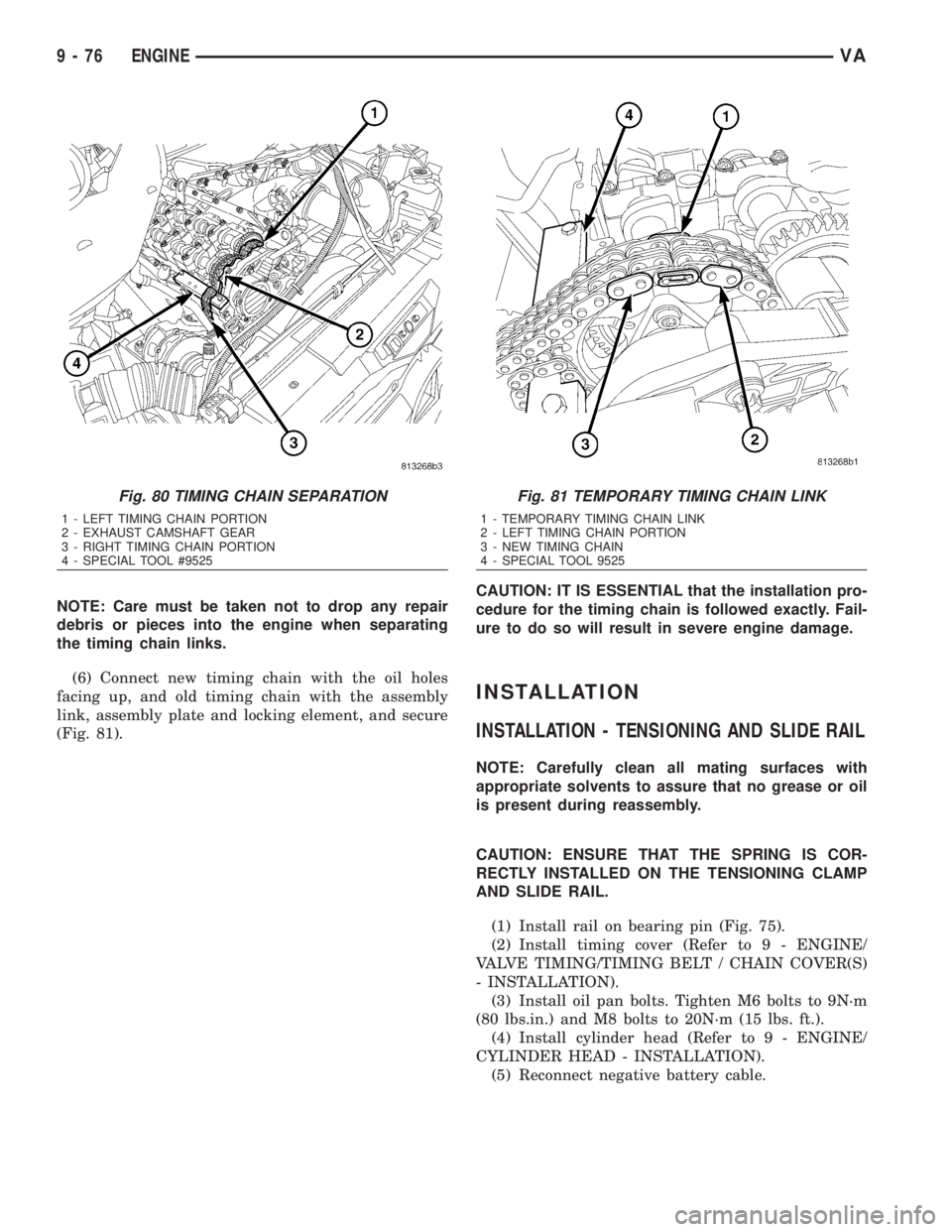
NOTE: Care must be taken not to drop any repair
debris or pieces into the engine when separating
the timing chain links.
(6) Connect new timing chain with the oil holes
facing up, and old timing chain with the assembly
link, assembly plate and locking element, and secure
(Fig. 81).CAUTION: IT IS ESSENTIAL that the installation pro-
cedure for the timing chain is followed exactly. Fail-
ure to do so will result in severe engine damage.
INSTALLATION
INSTALLATION - TENSIONING AND SLIDE RAIL
NOTE: Carefully clean all mating surfaces with
appropriate solvents to assure that no grease or oil
is present during reassembly.
CAUTION: ENSURE THAT THE SPRING IS COR-
RECTLY INSTALLED ON THE TENSIONING CLAMP
AND SLIDE RAIL.
(1) Install rail on bearing pin (Fig. 75).
(2) Install timing cover (Refer to 9 - ENGINE/
VALVE TIMING/TIMING BELT / CHAIN COVER(S)
- INSTALLATION).
(3) Install oil pan bolts. Tighten M6 bolts to 9N´m
(80 lbs.in.) and M8 bolts to 20N´m (15 lbs. ft.).
(4) Install cylinder head (Refer to 9 - ENGINE/
CYLINDER HEAD - INSTALLATION).
(5) Reconnect negative battery cable.
Fig. 80 TIMING CHAIN SEPARATION
1 - LEFT TIMING CHAIN PORTION
2 - EXHAUST CAMSHAFT GEAR
3 - RIGHT TIMING CHAIN PORTION
4 - SPECIAL TOOL #9525
Fig. 81 TEMPORARY TIMING CHAIN LINK
1 - TEMPORARY TIMING CHAIN LINK
2 - LEFT TIMING CHAIN PORTION
3 - NEW TIMING CHAIN
4 - SPECIAL TOOL 9525
9 - 76 ENGINEVA
Page 1653 of 2305
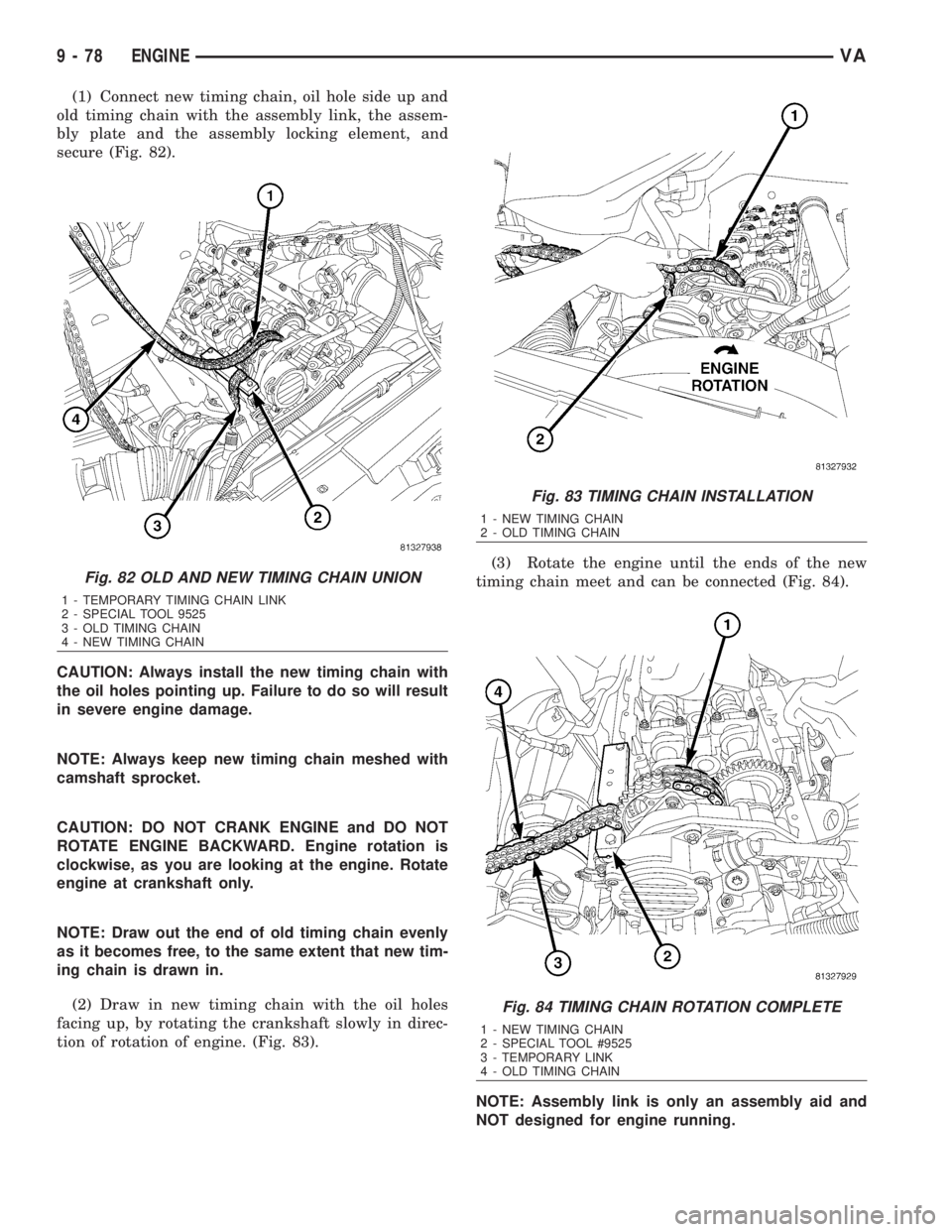
(1) Connect new timing chain, oil hole side up and
old timing chain with the assembly link, the assem-
bly plate and the assembly locking element, and
secure (Fig. 82).
CAUTION: Always install the new timing chain with
the oil holes pointing up. Failure to do so will result
in severe engine damage.
NOTE: Always keep new timing chain meshed with
camshaft sprocket.
CAUTION: DO NOT CRANK ENGINE and DO NOT
ROTATE ENGINE BACKWARD. Engine rotation is
clockwise, as you are looking at the engine. Rotate
engine at crankshaft only.
NOTE: Draw out the end of old timing chain evenly
as it becomes free, to the same extent that new tim-
ing chain is drawn in.
(2) Draw in new timing chain with the oil holes
facing up, by rotating the crankshaft slowly in direc-
tion of rotation of engine. (Fig. 83).(3) Rotate the engine until the ends of the new
timing chain meet and can be connected (Fig. 84).
NOTE: Assembly link is only an assembly aid and
NOT designed for engine running.
Fig. 82 OLD AND NEW TIMING CHAIN UNION
1 - TEMPORARY TIMING CHAIN LINK
2 - SPECIAL TOOL 9525
3 - OLD TIMING CHAIN
4 - NEW TIMING CHAIN
Fig. 83 TIMING CHAIN INSTALLATION
1 - NEW TIMING CHAIN
2 - OLD TIMING CHAIN
Fig. 84 TIMING CHAIN ROTATION COMPLETE
1 - NEW TIMING CHAIN
2 - SPECIAL TOOL #9525
3 - TEMPORARY LINK
4 - OLD TIMING CHAIN
9 - 78 ENGINEVA
Page 1654 of 2305
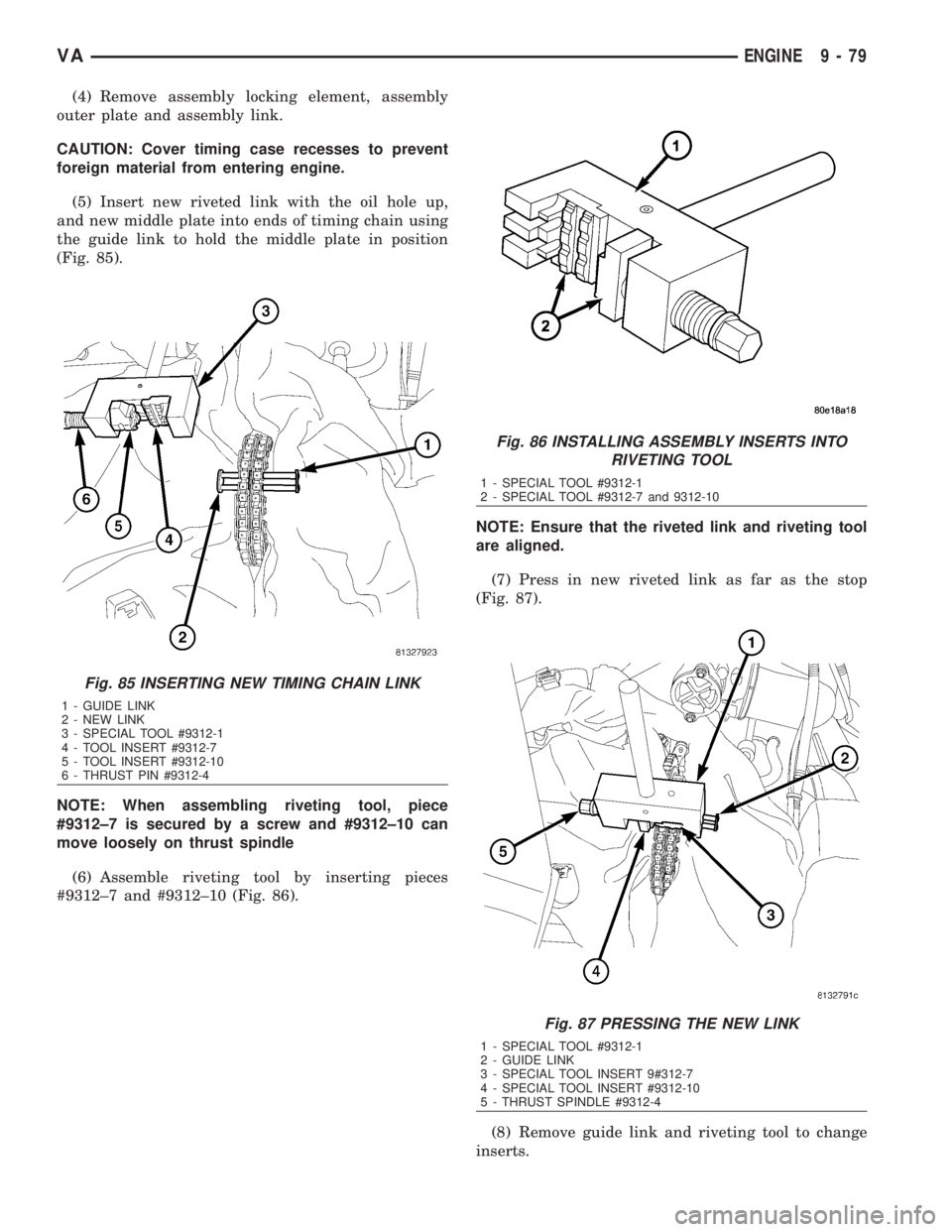
(4) Remove assembly locking element, assembly
outer plate and assembly link.
CAUTION: Cover timing case recesses to prevent
foreign material from entering engine.
(5) Insert new riveted link with the oil hole up,
and new middle plate into ends of timing chain using
the guide link to hold the middle plate in position
(Fig. 85).
NOTE: When assembling riveting tool, piece
#9312±7 is secured by a screw and #9312±10 can
move loosely on thrust spindle
(6) Assemble riveting tool by inserting pieces
#9312±7 and #9312±10 (Fig. 86).NOTE: Ensure that the riveted link and riveting tool
are aligned.
(7) Press in new riveted link as far as the stop
(Fig. 87).
(8) Remove guide link and riveting tool to change
inserts.
Fig. 85 INSERTING NEW TIMING CHAIN LINK
1 - GUIDE LINK
2 - NEW LINK
3 - SPECIAL TOOL #9312-1
4 - TOOL INSERT #9312-7
5 - TOOL INSERT #9312-10
6 - THRUST PIN #9312-4
Fig. 86 INSTALLING ASSEMBLY INSERTS INTO
RIVETING TOOL
1 - SPECIAL TOOL #9312-1
2 - SPECIAL TOOL #9312-7 and 9312-10
Fig. 87 PRESSING THE NEW LINK
1 - SPECIAL TOOL #9312-1
2 - GUIDE LINK
3 - SPECIAL TOOL INSERT 9#312-7
4 - SPECIAL TOOL INSERT #9312-10
5 - THRUST SPINDLE #9312-4
VAENGINE 9 - 79
Page 1655 of 2305
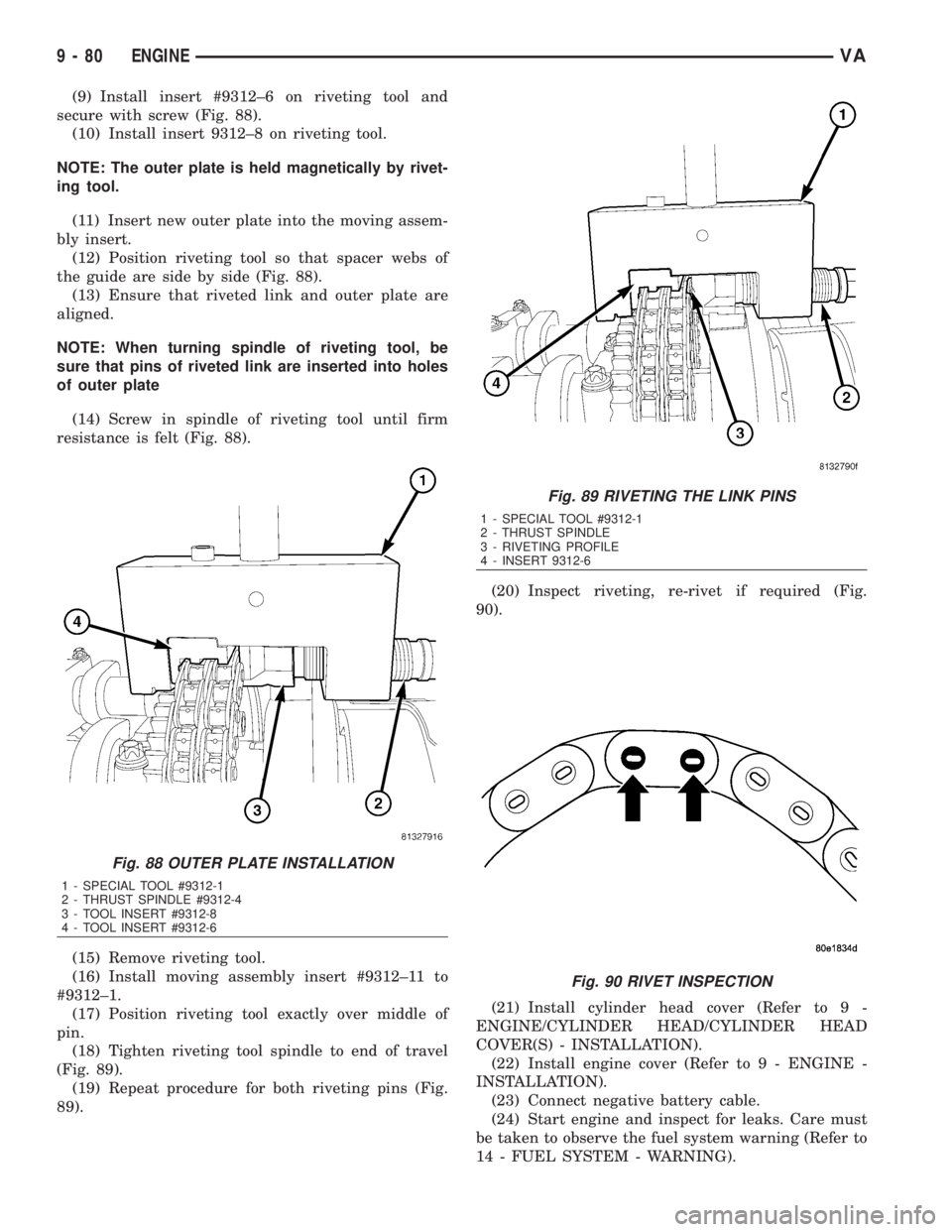
(9) Install insert #9312±6 on riveting tool and
secure with screw (Fig. 88).
(10) Install insert 9312±8 on riveting tool.
NOTE: The outer plate is held magnetically by rivet-
ing tool.
(11) Insert new outer plate into the moving assem-
bly insert.
(12) Position riveting tool so that spacer webs of
the guide are side by side (Fig. 88).
(13) Ensure that riveted link and outer plate are
aligned.
NOTE: When turning spindle of riveting tool, be
sure that pins of riveted link are inserted into holes
of outer plate
(14) Screw in spindle of riveting tool until firm
resistance is felt (Fig. 88).
(15) Remove riveting tool.
(16) Install moving assembly insert #9312±11 to
#9312±1.
(17) Position riveting tool exactly over middle of
pin.
(18) Tighten riveting tool spindle to end of travel
(Fig. 89).
(19) Repeat procedure for both riveting pins (Fig.
89).(20) Inspect riveting, re-rivet if required (Fig.
90).
(21) Install cylinder head cover (Refer to 9 -
ENGINE/CYLINDER HEAD/CYLINDER HEAD
COVER(S) - INSTALLATION).
(22) Install engine cover (Refer to 9 - ENGINE -
INSTALLATION).
(23) Connect negative battery cable.
(24) Start engine and inspect for leaks. Care must
be taken to observe the fuel system warning (Refer to
14 - FUEL SYSTEM - WARNING).
Fig. 88 OUTER PLATE INSTALLATION
1 - SPECIAL TOOL #9312-1
2 - THRUST SPINDLE #9312-4
3 - TOOL INSERT #9312-8
4 - TOOL INSERT #9312-6
Fig. 89 RIVETING THE LINK PINS
1 - SPECIAL TOOL #9312-1
2 - THRUST SPINDLE
3 - RIVETING PROFILE
4 - INSERT 9312-6
Fig. 90 RIVET INSPECTION
9 - 80 ENGINEVA
Page 1658 of 2305
EXHAUST SYSTEM
TABLE OF CONTENTS
page page
EXHAUST SYSTEM
DESCRIPTION - 2.7L DIESEL...............1
DIAGNOSIS AND TESTING - DIESEL ENGINE . . 2
CATALYTIC CONVERTER
REMOVAL.............................3
INSTALLATION..........................3
EXHAUST PIPE
REMOVAL.............................3
INSTALLATION..........................3
TAILPIPE
REMOVAL.............................3
INSTALLATION..........................3
TURBOCHARGER SYSTEM
DESCRIPTION..........................3
OPERATION............................4
CHARGE AIR COOLER AND PLUMBING
DESCRIPTION..........................4OPERATION............................5
DIAGNOSIS AND TESTING - CHARGE AIR
COOLER SYSTEM - LEAKS...............5
REMOVAL.............................5
CLEANING.............................5
INSPECTION...........................6
INSTALLATION..........................6
TURBOCHARGER
DESCRIPTION..........................6
OPERATION............................6
REMOVAL
REMOVAL............................7
REMOVAL - VACUUM TRANSDUCER.......8
INSTALLATION
INSTALLATION........................8
INSTALLATION - VACUUM TRANSDUCER . . . 9
EXHAUST SYSTEM
DESCRIPTION - 2.7L DIESEL
CAUTION: Avoid application of rust prevention com-
pounds or undercoating materials to exhaust sys-
tem floor pan exhaust heat shields. Light overspray
near the edges is permitted. Application of coating
will result in excessive floor pan temperatures and
objectionable fumes.
The diesel engine exhaust system consists of an
engine exhaust manifold, turbocharger, exhaust pipe,
resonator, extension pipe (if needed), muffler and
exhaust tailpipe (Fig. 1).
The exhaust system must be properly aligned and
secured to prevent stress, leakage and body contact.
The exhaust components should be kept a minimum
of 25.4 mm (1.0 in.) away from the body and frame.
If the system contacts any body panel, it may amplify
objectionable noises from the engine or body.
VAEXHAUST SYSTEM 11 - 1
Page 1683 of 2305
If a high-pressure line connection is leaking, coun-
terhold and tighten the connection to specification
then perform this procedure again (Refer to 14 -
FUEL SYSTEM - STANDARD PROCEDURE).
Replace any damaged, restricted or leaking high-
pressure fuel lines with the correct replacement
line.
CAUTION: The high-pressure fuel lines cannot con-
tact each other or other components. Do not
attempt to weld high-pressure fuel lines or to repair
lines that are damaged. Only use the recommended
lines when replacement of high-pressure fuel line is
necessary.
DIAGNOSIS AND TESTING - AIR IN FUEL SYS-
TEM
Air will enter the fuel system whenever fuel supply
lines, separator filters, injection pump, high-pressure
lines or injectors are removed or disconnected. Air
trapped in the fuel system can result in hard start-
ing, a rough running engine, engine misfire, low
power, excessive smoke and fuel knock.
Inspect the fuel system from the fuel tank to the
injectors for loose connections (Refer to 14 - FUEL
SYSTEM - WARNING). Leaking fuel is an indicator
of loose connections or defective seals. Air can also
enter the fuel system between the fuel tank and the
fuel pump. Inspect the fuel tank module and fuel
lines for damage that might allow air into the sys-
tem.With the DRBIIItconnected to the vehicle, select
Engine and the select Sensor Display. Page down to
view Fuel Pressure Set Point and Actual Fuel Pres-
sure. Start the engine and observe the Fuel Pressure
Set Point and the Actual Fuel Pressure. If the Actual
Fuel Pressure Oscillates above and below the Fuel
Pressure Set Point in a regular cycle, inspect the fuel
system for air intrusion.
If the Actual Fuel Pressure gradually drops below
the Fuel Pressure Set Point then spikes well above
the Fuel Pressure Set Point, replace the fuel pres-
sure soleniod (Refer to 14 - FUEL SYSTEM/FUEL
INJECTION/FUEL PRESSURE SOLENOID -
REMOVAL), and recheck.
DIAGNOSIS AND TESTING - INJECTOR LEAK
QUANTITY
WARNING: REVIEW THE HIGH PRESSURE FUEL
SYSTEM WARNING BEFORE BEGINNING SERVICE
(Refer to 14 - FUEL SYSTEM - WARNING).
CRANKING TEST
NOTE: If an injector is found to be out of specifica-
tion, repeat this test procedure after the injector
replacement. Hydraulic flow will take the path of
least resistance and multiple failures may be identi-
fied.
Perform this test with the engine at operating tem-
perature, when possible. This test will assist in
determining a defective or internally leaking injec-
tor(s) is present by measuring the amount of fuel
return.
(1) Turn the ignition off.
(2) Remove the engine cover (Refer to 9 - ENGINE
- REMOVAL).
(3) Disconnect the fuel return hoses at the top of
the injectors.
(4) Pinch off the fuel return line at the banjo bolt
fitting of the fuel rail.
(5) Disconnect the fuel rail solenoid and camshaft
position sensor.
(6) Install the test vials onto the injectors and
secure with the return hose clips (Fig. 2).
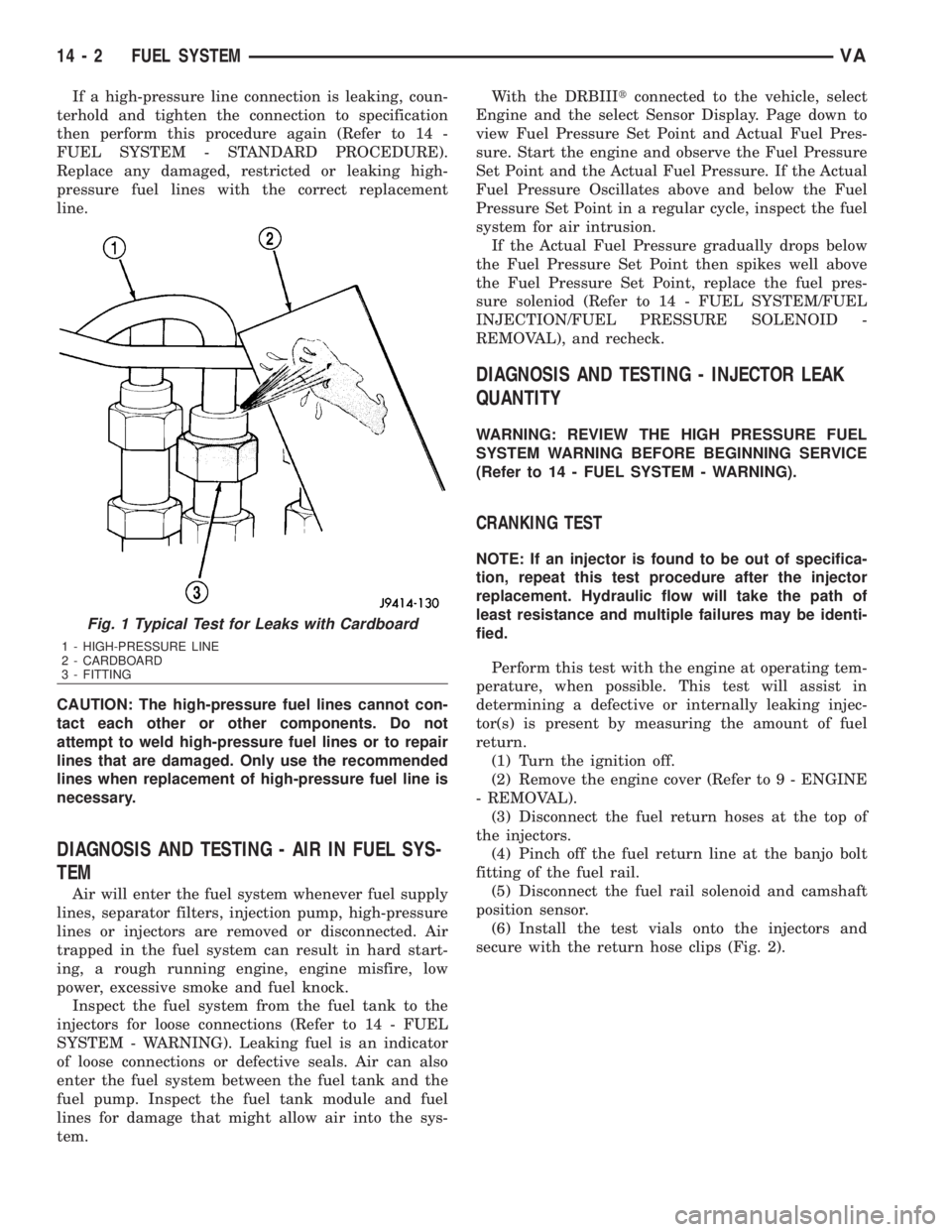
Fig. 1 Typical Test for Leaks with Cardboard
1 - HIGH-PRESSURE LINE
2 - CARDBOARD
3 - FITTING
14 - 2 FUEL SYSTEMVA
Page 1684 of 2305
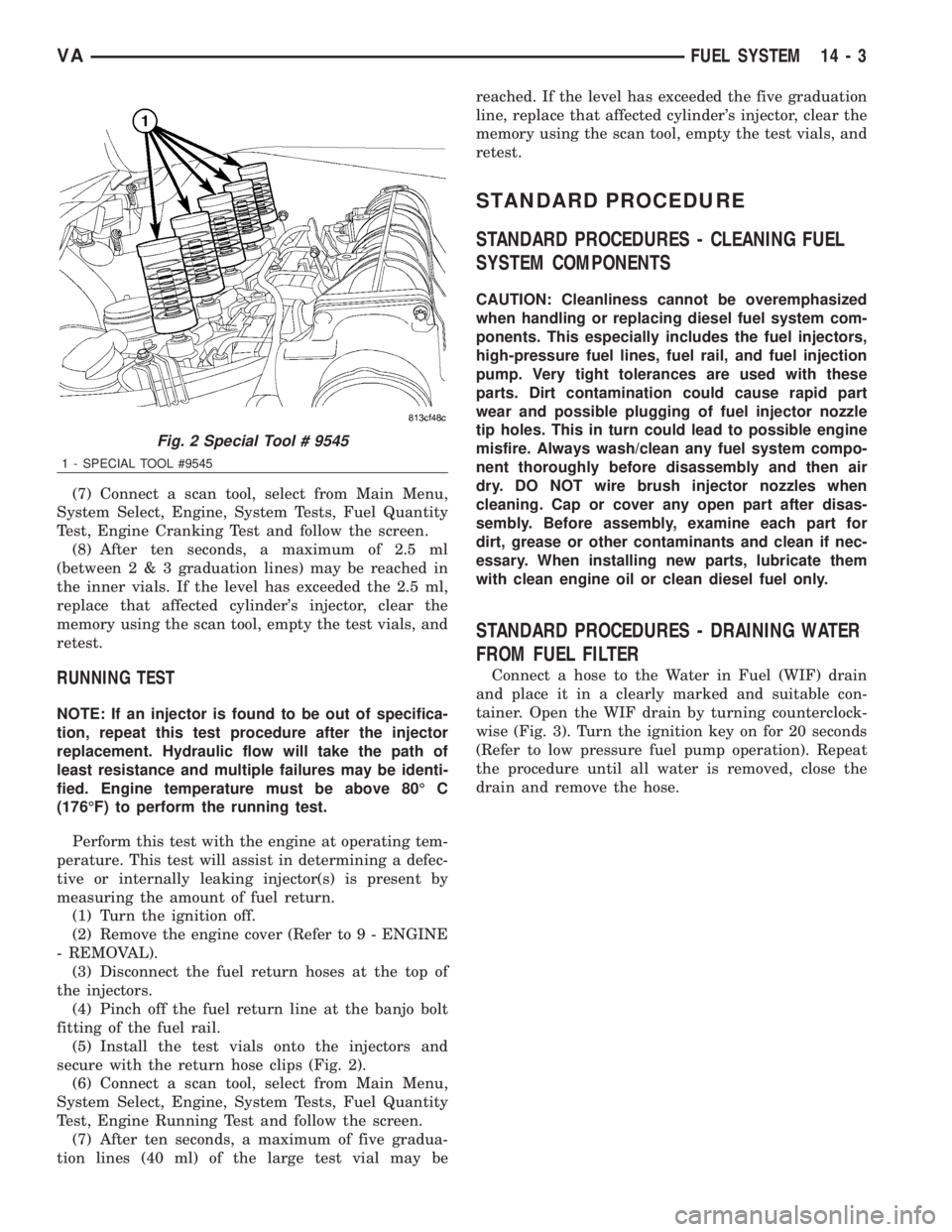
(7) Connect a scan tool, select from Main Menu,
System Select, Engine, System Tests, Fuel Quantity
Test, Engine Cranking Test and follow the screen.
(8) After ten seconds, a maximum of 2.5 ml
(between2&3graduation lines) may be reached in
the inner vials. If the level has exceeded the 2.5 ml,
replace that affected cylinder's injector, clear the
memory using the scan tool, empty the test vials, and
retest.
RUNNING TEST
NOTE: If an injector is found to be out of specifica-
tion, repeat this test procedure after the injector
replacement. Hydraulic flow will take the path of
least resistance and multiple failures may be identi-
fied. Engine temperature must be above 80É C
(176ÉF) to perform the running test.
Perform this test with the engine at operating tem-
perature. This test will assist in determining a defec-
tive or internally leaking injector(s) is present by
measuring the amount of fuel return.
(1) Turn the ignition off.
(2) Remove the engine cover (Refer to 9 - ENGINE
- REMOVAL).
(3) Disconnect the fuel return hoses at the top of
the injectors.
(4) Pinch off the fuel return line at the banjo bolt
fitting of the fuel rail.
(5) Install the test vials onto the injectors and
secure with the return hose clips (Fig. 2).
(6) Connect a scan tool, select from Main Menu,
System Select, Engine, System Tests, Fuel Quantity
Test, Engine Running Test and follow the screen.
(7) After ten seconds, a maximum of five gradua-
tion lines (40 ml) of the large test vial may bereached. If the level has exceeded the five graduation
line, replace that affected cylinder's injector, clear the
memory using the scan tool, empty the test vials, and
retest.
STANDARD PROCEDURE
STANDARD PROCEDURES - CLEANING FUEL
SYSTEM COMPONENTS
CAUTION: Cleanliness cannot be overemphasized
when handling or replacing diesel fuel system com-
ponents. This especially includes the fuel injectors,
high-pressure fuel lines, fuel rail, and fuel injection
pump. Very tight tolerances are used with these
parts. Dirt contamination could cause rapid part
wear and possible plugging of fuel injector nozzle
tip holes. This in turn could lead to possible engine
misfire. Always wash/clean any fuel system compo-
nent thoroughly before disassembly and then air
dry. DO NOT wire brush injector nozzles when
cleaning. Cap or cover any open part after disas-
sembly. Before assembly, examine each part for
dirt, grease or other contaminants and clean if nec-
essary. When installing new parts, lubricate them
with clean engine oil or clean diesel fuel only.
STANDARD PROCEDURES - DRAINING WATER
FROM FUEL FILTER
Connect a hose to the Water in Fuel (WIF) drain
and place it in a clearly marked and suitable con-
tainer. Open the WIF drain by turning counterclock-
wise (Fig. 3). Turn the ignition key on for 20 seconds
(Refer to low pressure fuel pump operation). Repeat
the procedure until all water is removed, close the
drain and remove the hose.
Fig. 2 Special Tool # 9545
1 - SPECIAL TOOL #9545
VAFUEL SYSTEM 14 - 3
Page 1698 of 2305
REMOVAL - HIGH PRESSURE PUMP
(Refer to 14 - FUEL SYSTEM - WARNING)
(1) Disconnect negative battery cable.
(2) Remove viscous fan clutch (Refer to 7 - COOL-
ING/ENGINE/FAN DRIVE VISCOUS CLUTCH -
REMOVAL).
(3) Unplug electrical connectors at high pressure
pump.
CAUTION: DO NOT slacken the threaded connec-
tion. Use a wrench to counterhold at the threaded
connection when loosening and tightening the
union nut. DO NOT EXCEED tightening torque.
CAUTION: DO NOT crimp or bend fuel line. Capture
all fluids that flow out of connections.
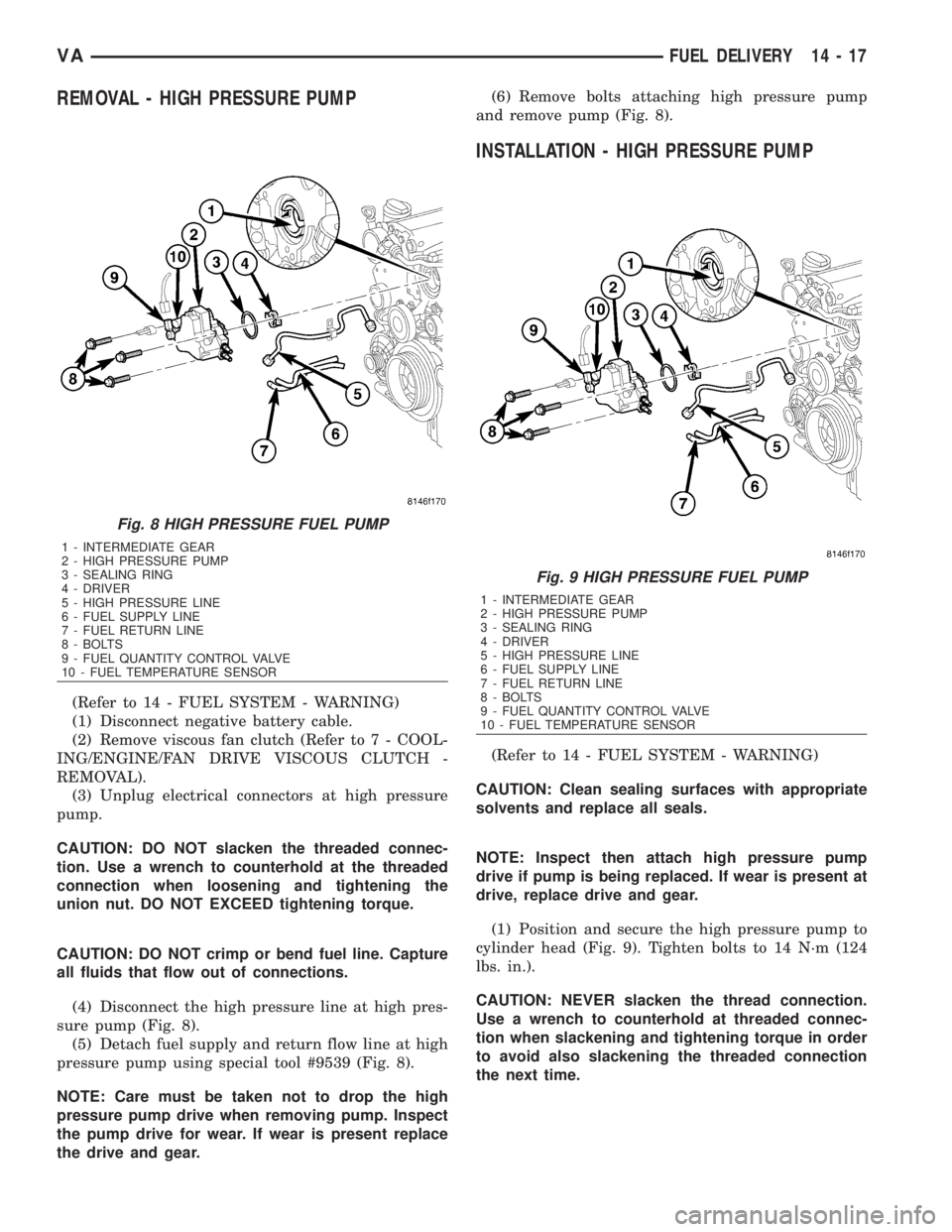
(4) Disconnect the high pressure line at high pres-
sure pump (Fig. 8).
(5) Detach fuel supply and return flow line at high
pressure pump using special tool #9539 (Fig. 8).
NOTE: Care must be taken not to drop the high
pressure pump drive when removing pump. Inspect
the pump drive for wear. If wear is present replace
the drive and gear.(6) Remove bolts attaching high pressure pump
and remove pump (Fig. 8).
INSTALLATION - HIGH PRESSURE PUMP
(Refer to 14 - FUEL SYSTEM - WARNING)
CAUTION: Clean sealing surfaces with appropriate
solvents and replace all seals.
NOTE: Inspect then attach high pressure pump
drive if pump is being replaced. If wear is present at
drive, replace drive and gear.
(1) Position and secure the high pressure pump to
cylinder head (Fig. 9). Tighten bolts to 14 N´m (124
lbs. in.).
CAUTION: NEVER slacken the thread connection.
Use a wrench to counterhold at threaded connec-
tion when slackening and tightening torque in order
to avoid also slackening the threaded connection
the next time.
Fig. 8 HIGH PRESSURE FUEL PUMP
1 - INTERMEDIATE GEAR
2 - HIGH PRESSURE PUMP
3 - SEALING RING
4 - DRIVER
5 - HIGH PRESSURE LINE
6 - FUEL SUPPLY LINE
7 - FUEL RETURN LINE
8 - BOLTS
9 - FUEL QUANTITY CONTROL VALVE
10 - FUEL TEMPERATURE SENSOR
Fig. 9 HIGH PRESSURE FUEL PUMP
1 - INTERMEDIATE GEAR
2 - HIGH PRESSURE PUMP
3 - SEALING RING
4 - DRIVER
5 - HIGH PRESSURE LINE
6 - FUEL SUPPLY LINE
7 - FUEL RETURN LINE
8 - BOLTS
9 - FUEL QUANTITY CONTROL VALVE
10 - FUEL TEMPERATURE SENSOR
VAFUEL DELIVERY 14 - 17