lock MERCEDES-BENZ SPRINTER 2006 Service Manual
[x] Cancel search | Manufacturer: MERCEDES-BENZ, Model Year: 2006, Model line: SPRINTER, Model: MERCEDES-BENZ SPRINTER 2006Pages: 2305, PDF Size: 48.12 MB
Page 1604 of 2305
(3) Remove injectors (Refer to 14 - FUEL SYS-
TEM/FUEL INJECTION/FUEL INJECTOR -
REMOVAL).
(4) Clean injectors and recesses (Refer to 14 -
FUEL SYSTEM/FUEL INJECTION/FUEL INJEC-
TOR - STANDARD PROCEDURE).
(5) Remove cylinder head cover (Refer to 9 -
ENGINE/CYLINDER HEAD/CYLINDER HEAD
COVER(S) - REMOVAL).
NOTE: Rotate engine at crankshaft only. DO NOT
crank engine at the camshaft and DO NOT rotate
the engine backward.
(6) Position piston of cylinder #1 to ignition TDC.
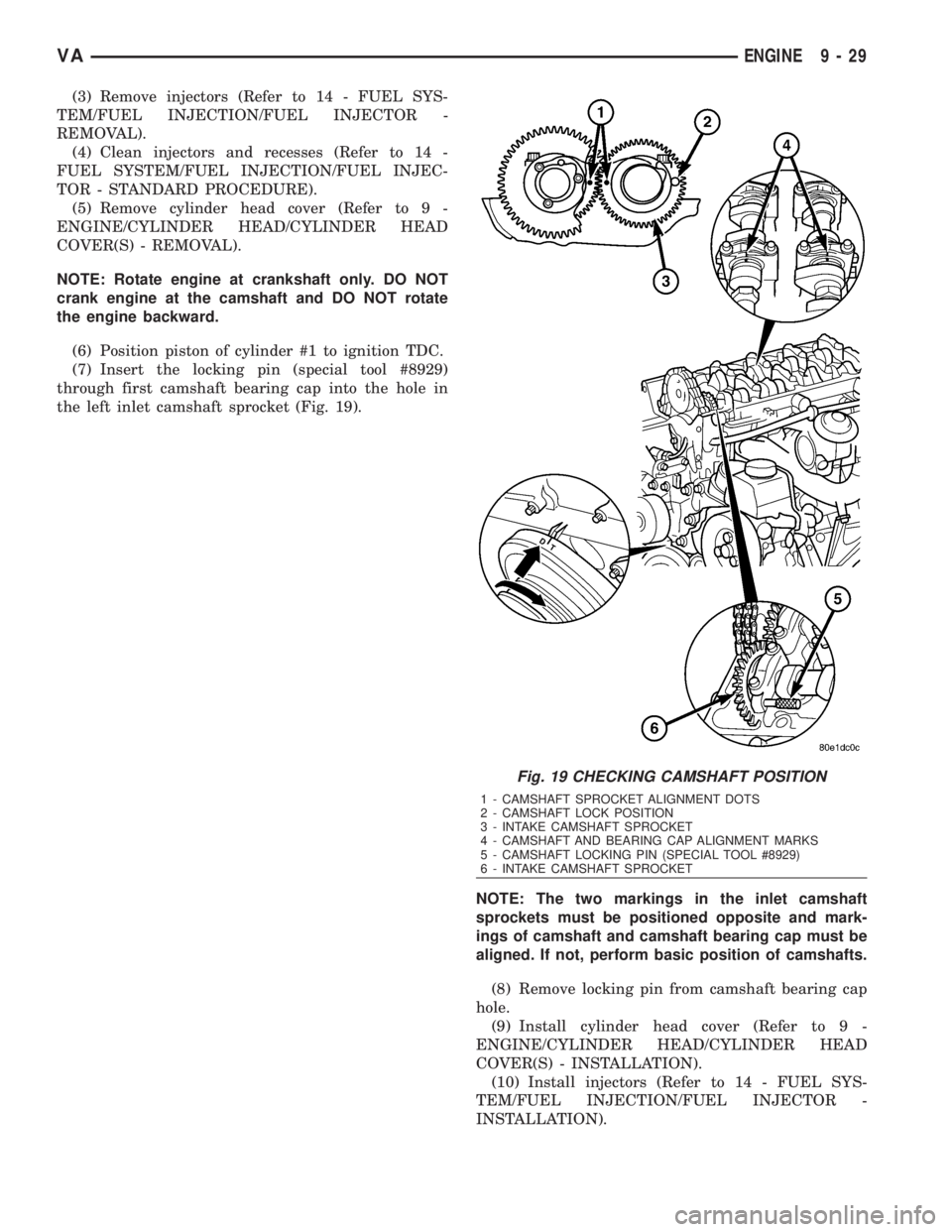
(7) Insert the locking pin (special tool #8929)
through first camshaft bearing cap into the hole in
the left inlet camshaft sprocket (Fig. 19).
NOTE: The two markings in the inlet camshaft
sprockets must be positioned opposite and mark-
ings of camshaft and camshaft bearing cap must be
aligned. If not, perform basic position of camshafts.
(8) Remove locking pin from camshaft bearing cap
hole.
(9) Install cylinder head cover (Refer to 9 -
ENGINE/CYLINDER HEAD/CYLINDER HEAD
COVER(S) - INSTALLATION).
(10) Install injectors (Refer to 14 - FUEL SYS-
TEM/FUEL INJECTION/FUEL INJECTOR -
INSTALLATION).
Fig. 19 CHECKING CAMSHAFT POSITION
1 - CAMSHAFT SPROCKET ALIGNMENT DOTS
2 - CAMSHAFT LOCK POSITION
3 - INTAKE CAMSHAFT SPROCKET
4 - CAMSHAFT AND BEARING CAP ALIGNMENT MARKS
5 - CAMSHAFT LOCKING PIN (SPECIAL TOOL #8929)
6 - INTAKE CAMSHAFT SPROCKET
VAENGINE 9 - 29
Page 1605 of 2305
WARNING: USE EXTREME CAUTION WHEN THE
ENGINE IS OPERATING. DO NOT STAND IN A
DIRECT LINE WITH THE FAN. DO NOT PUT YOUR
HANDS NEAR THE PULLEYS, BELTS OR FAN. DO
NO WEAR LOOSE CLOTHING.
(11) Start the engine and inspect for leaks.
STANDARD PROCEDURE - INSPECTING TAP-
PET CLEARANCE
(1) Check engine oil level, adjust as necessary.
(2) Warm engine to operating temperature
(approx. 80ÉC, 176ÉF).
(3) Remove the cylinder head cover (Refer to 9 -
ENGINE/CYLINDER HEAD/CYLINDER HEAD
COVER(S) - REMOVAL).
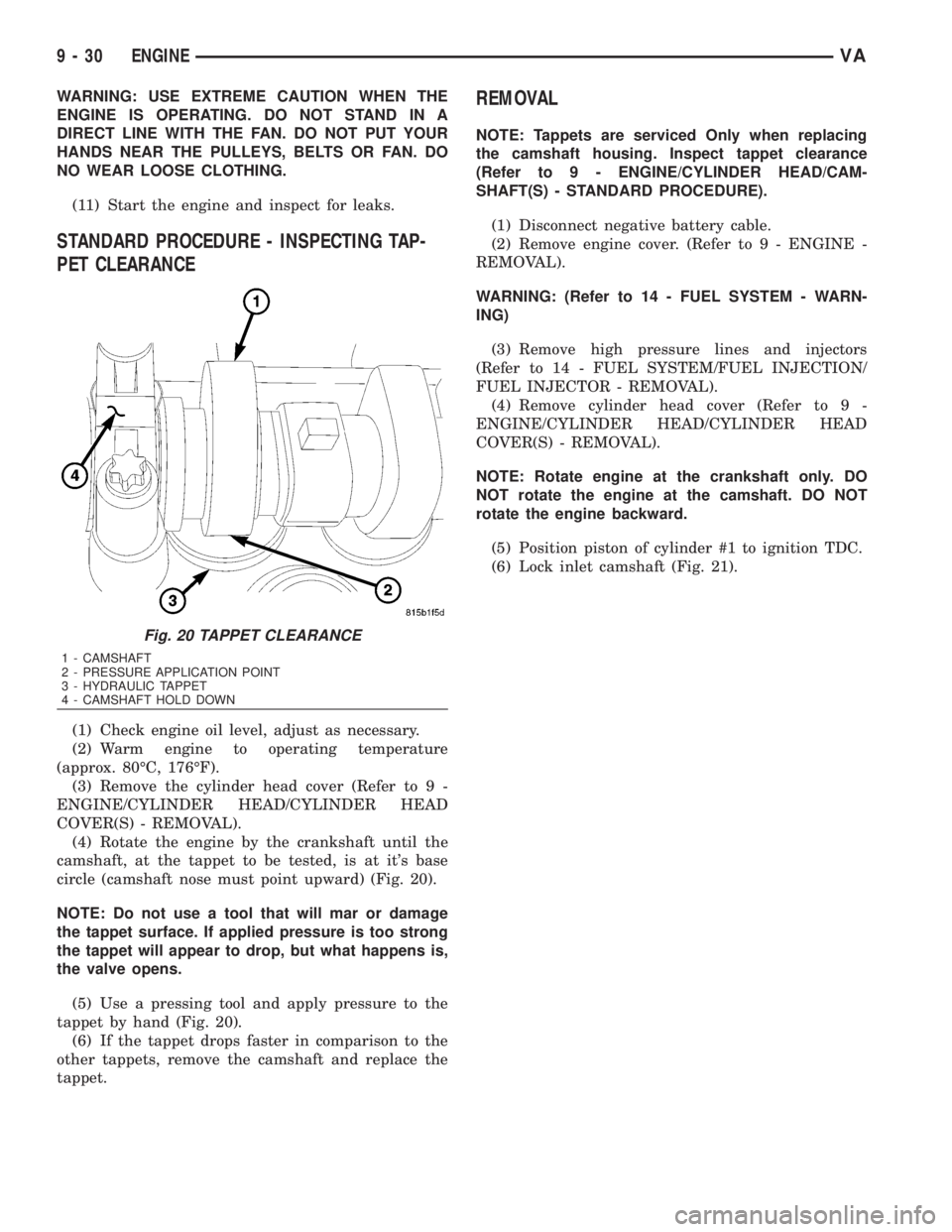
(4) Rotate the engine by the crankshaft until the
camshaft, at the tappet to be tested, is at it's base
circle (camshaft nose must point upward) (Fig. 20).
NOTE: Do not use a tool that will mar or damage
the tappet surface. If applied pressure is too strong
the tappet will appear to drop, but what happens is,
the valve opens.
(5) Use a pressing tool and apply pressure to the
tappet by hand (Fig. 20).
(6) If the tappet drops faster in comparison to the
other tappets, remove the camshaft and replace the
tappet.
REMOVAL
NOTE: Tappets are serviced Only when replacing
the camshaft housing. Inspect tappet clearance
(Refer to 9 - ENGINE/CYLINDER HEAD/CAM-
SHAFT(S) - STANDARD PROCEDURE).
(1) Disconnect negative battery cable.
(2) Remove engine cover. (Refer to 9 - ENGINE -
REMOVAL).
WARNING: (Refer to 14 - FUEL SYSTEM - WARN-
ING)
(3) Remove high pressure lines and injectors
(Refer to 14 - FUEL SYSTEM/FUEL INJECTION/
FUEL INJECTOR - REMOVAL).
(4) Remove cylinder head cover (Refer to 9 -
ENGINE/CYLINDER HEAD/CYLINDER HEAD
COVER(S) - REMOVAL).
NOTE: Rotate engine at the crankshaft only. DO
NOT rotate the engine at the camshaft. DO NOT
rotate the engine backward.
(5) Position piston of cylinder #1 to ignition TDC.
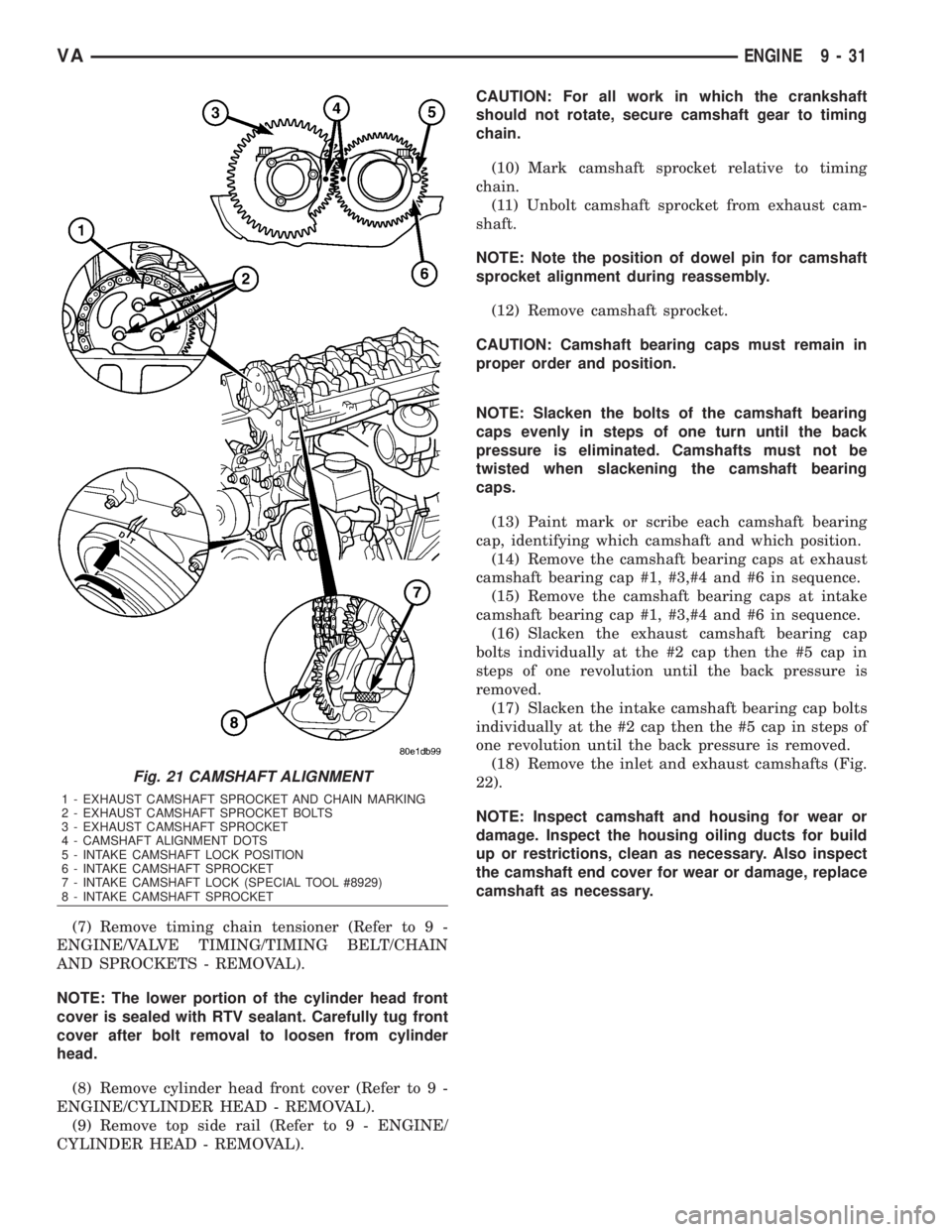
(6) Lock inlet camshaft (Fig. 21).
Fig. 20 TAPPET CLEARANCE
1 - CAMSHAFT
2 - PRESSURE APPLICATION POINT
3 - HYDRAULIC TAPPET
4 - CAMSHAFT HOLD DOWN
9 - 30 ENGINEVA
Page 1606 of 2305
(7) Remove timing chain tensioner (Refer to 9 -
ENGINE/VALVE TIMING/TIMING BELT/CHAIN
AND SPROCKETS - REMOVAL).
NOTE: The lower portion of the cylinder head front
cover is sealed with RTV sealant. Carefully tug front
cover after bolt removal to loosen from cylinder
head.
(8) Remove cylinder head front cover (Refer to 9 -
ENGINE/CYLINDER HEAD - REMOVAL).
(9) Remove top side rail (Refer to 9 - ENGINE/
CYLINDER HEAD - REMOVAL).CAUTION: For all work in which the crankshaft
should not rotate, secure camshaft gear to timing
chain.
(10) Mark camshaft sprocket relative to timing
chain.
(11) Unbolt camshaft sprocket from exhaust cam-
shaft.
NOTE: Note the position of dowel pin for camshaft
sprocket alignment during reassembly.
(12) Remove camshaft sprocket.
CAUTION: Camshaft bearing caps must remain in
proper order and position.
NOTE: Slacken the bolts of the camshaft bearing
caps evenly in steps of one turn until the back
pressure is eliminated. Camshafts must not be
twisted when slackening the camshaft bearing
caps.
(13) Paint mark or scribe each camshaft bearing
cap, identifying which camshaft and which position.
(14) Remove the camshaft bearing caps at exhaust
camshaft bearing cap #1, #3,#4 and #6 in sequence.
(15) Remove the camshaft bearing caps at intake
camshaft bearing cap #1, #3,#4 and #6 in sequence.
(16) Slacken the exhaust camshaft bearing cap
bolts individually at the #2 cap then the #5 cap in
steps of one revolution until the back pressure is
removed.
(17) Slacken the intake camshaft bearing cap bolts
individually at the #2 cap then the #5 cap in steps of
one revolution until the back pressure is removed.
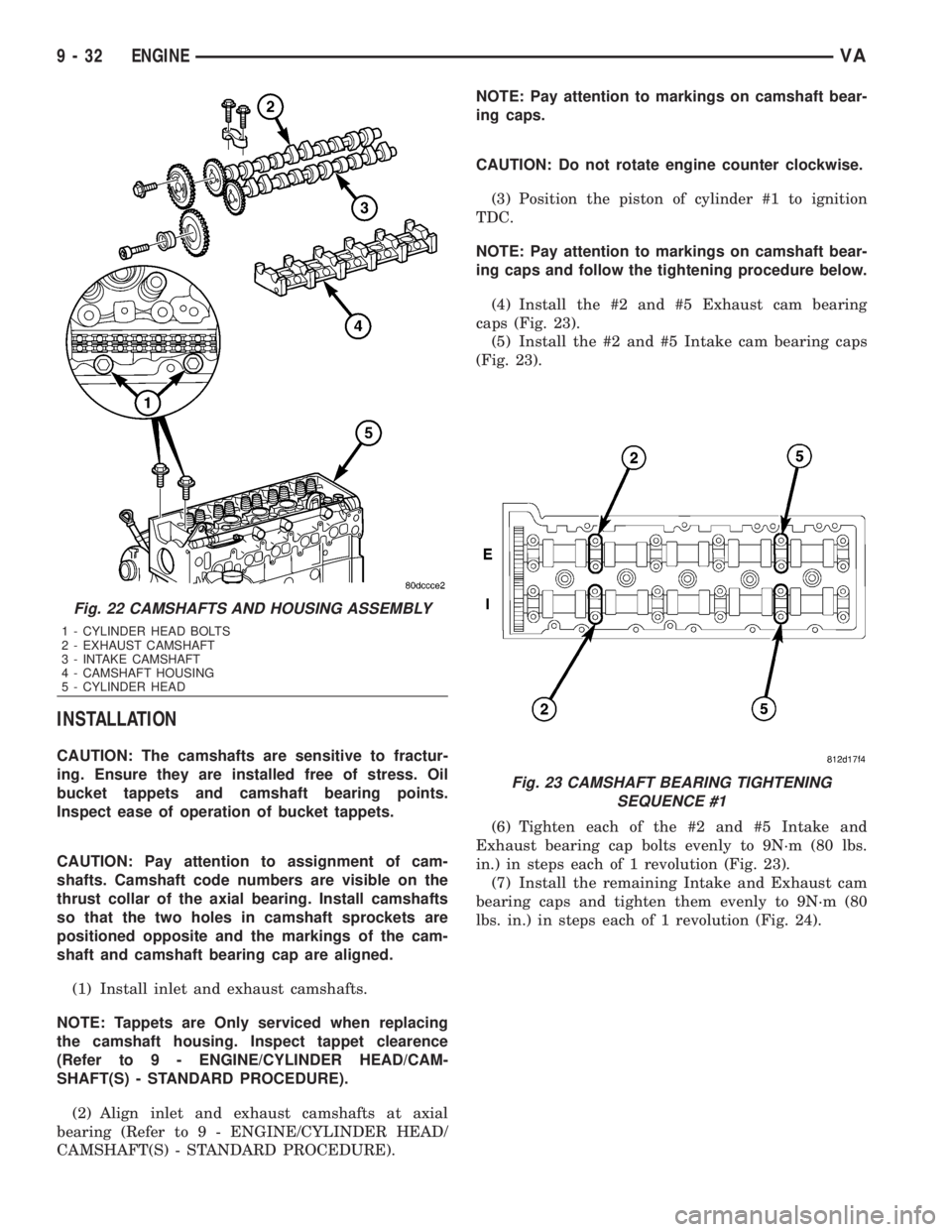
(18) Remove the inlet and exhaust camshafts (Fig.
22).
NOTE: Inspect camshaft and housing for wear or
damage. Inspect the housing oiling ducts for build
up or restrictions, clean as necessary. Also inspect
the camshaft end cover for wear or damage, replace
camshaft as necessary.
Fig. 21 CAMSHAFT ALIGNMENT
1 - EXHAUST CAMSHAFT SPROCKET AND CHAIN MARKING
2 - EXHAUST CAMSHAFT SPROCKET BOLTS
3 - EXHAUST CAMSHAFT SPROCKET
4 - CAMSHAFT ALIGNMENT DOTS
5 - INTAKE CAMSHAFT LOCK POSITION
6 - INTAKE CAMSHAFT SPROCKET
7 - INTAKE CAMSHAFT LOCK (SPECIAL TOOL #8929)
8 - INTAKE CAMSHAFT SPROCKET
VAENGINE 9 - 31
Page 1607 of 2305
INSTALLATION
CAUTION: The camshafts are sensitive to fractur-
ing. Ensure they are installed free of stress. Oil
bucket tappets and camshaft bearing points.
Inspect ease of operation of bucket tappets.
CAUTION: Pay attention to assignment of cam-
shafts. Camshaft code numbers are visible on the
thrust collar of the axial bearing. Install camshafts
so that the two holes in camshaft sprockets are
positioned opposite and the markings of the cam-
shaft and camshaft bearing cap are aligned.
(1) Install inlet and exhaust camshafts.
NOTE: Tappets are Only serviced when replacing
the camshaft housing. Inspect tappet clearence
(Refer to 9 - ENGINE/CYLINDER HEAD/CAM-
SHAFT(S) - STANDARD PROCEDURE).
(2) Align inlet and exhaust camshafts at axial
bearing (Refer to 9 - ENGINE/CYLINDER HEAD/
CAMSHAFT(S) - STANDARD PROCEDURE).NOTE: Pay attention to markings on camshaft bear-
ing caps.
CAUTION: Do not rotate engine counter clockwise.
(3) Position the piston of cylinder #1 to ignition
TDC.
NOTE: Pay attention to markings on camshaft bear-
ing caps and follow the tightening procedure below.
(4) Install the #2 and #5 Exhaust cam bearing
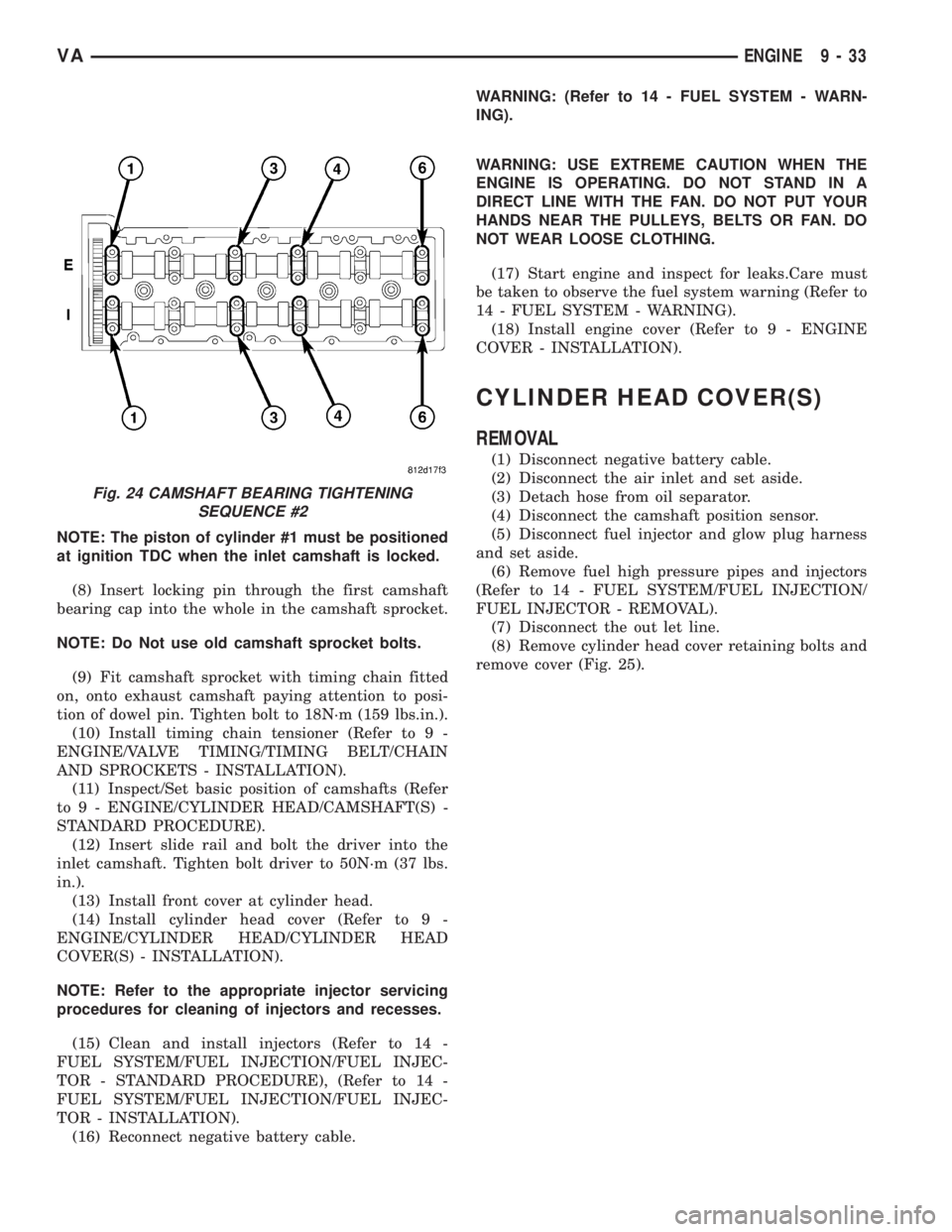
caps (Fig. 23).
(5) Install the #2 and #5 Intake cam bearing caps
(Fig. 23).
(6) Tighten each of the #2 and #5 Intake and
Exhaust bearing cap bolts evenly to 9N´m (80 lbs.
in.) in steps each of 1 revolution (Fig. 23).
(7) Install the remaining Intake and Exhaust cam
bearing caps and tighten them evenly to 9N´m (80
lbs. in.) in steps each of 1 revolution (Fig. 24).
Fig. 22 CAMSHAFTS AND HOUSING ASSEMBLY
1 - CYLINDER HEAD BOLTS
2 - EXHAUST CAMSHAFT
3 - INTAKE CAMSHAFT
4 - CAMSHAFT HOUSING
5 - CYLINDER HEAD
Fig. 23 CAMSHAFT BEARING TIGHTENING
SEQUENCE #1
9 - 32 ENGINEVA
Page 1608 of 2305
NOTE: The piston of cylinder #1 must be positioned
at ignition TDC when the inlet camshaft is locked.
(8) Insert locking pin through the first camshaft
bearing cap into the whole in the camshaft sprocket.
NOTE: Do Not use old camshaft sprocket bolts.
(9) Fit camshaft sprocket with timing chain fitted
on, onto exhaust camshaft paying attention to posi-
tion of dowel pin. Tighten bolt to 18N´m (159 lbs.in.).
(10) Install timing chain tensioner (Refer to 9 -
ENGINE/VALVE TIMING/TIMING BELT/CHAIN
AND SPROCKETS - INSTALLATION).
(11) Inspect/Set basic position of camshafts (Refer
to 9 - ENGINE/CYLINDER HEAD/CAMSHAFT(S) -
STANDARD PROCEDURE).
(12) Insert slide rail and bolt the driver into the
inlet camshaft. Tighten bolt driver to 50N´m (37 lbs.
in.).
(13) Install front cover at cylinder head.
(14) Install cylinder head cover (Refer to 9 -
ENGINE/CYLINDER HEAD/CYLINDER HEAD
COVER(S) - INSTALLATION).
NOTE: Refer to the appropriate injector servicing
procedures for cleaning of injectors and recesses.
(15) Clean and install injectors (Refer to 14 -
FUEL SYSTEM/FUEL INJECTION/FUEL INJEC-
TOR - STANDARD PROCEDURE), (Refer to 14 -
FUEL SYSTEM/FUEL INJECTION/FUEL INJEC-
TOR - INSTALLATION).
(16) Reconnect negative battery cable.WARNING: (Refer to 14 - FUEL SYSTEM - WARN-
ING).
WARNING: USE EXTREME CAUTION WHEN THE
ENGINE IS OPERATING. DO NOT STAND IN A
DIRECT LINE WITH THE FAN. DO NOT PUT YOUR
HANDS NEAR THE PULLEYS, BELTS OR FAN. DO
NOT WEAR LOOSE CLOTHING.
(17) Start engine and inspect for leaks.Care must
be taken to observe the fuel system warning (Refer to
14 - FUEL SYSTEM - WARNING).
(18) Install engine cover (Refer to 9 - ENGINE
COVER - INSTALLATION).
CYLINDER HEAD COVER(S)
REMOVAL
(1) Disconnect negative battery cable.
(2) Disconnect the air inlet and set aside.
(3) Detach hose from oil separator.
(4) Disconnect the camshaft position sensor.
(5) Disconnect fuel injector and glow plug harness
and set aside.
(6) Remove fuel high pressure pipes and injectors
(Refer to 14 - FUEL SYSTEM/FUEL INJECTION/
FUEL INJECTOR - REMOVAL).
(7) Disconnect the out let line.
(8) Remove cylinder head cover retaining bolts and
remove cover (Fig. 25).
Fig. 24 CAMSHAFT BEARING TIGHTENING
SEQUENCE #2
VAENGINE 9 - 33
Page 1610 of 2305
VALVE SPRINGS
REMOVAL
REMOVAL - VALVE SPRINGS
(1) Disconnect negative battery cable.
(2) Remove injectors (Refer to 14 - FUEL SYS-
TEM/FUEL INJECTION/FUEL INJECTOR -
REMOVAL).
(3) Remove cylinder head cover (Refer to 9 -
ENGINE/CYLINDER HEAD/CYLINDER HEAD
COVER(S) - REMOVAL).
(4) Remove timing chain tensioner (Refer to 9 -
ENGINE/VALVE TIMING/TIMING BELT/CHAIN
AND SPROCKETS - REMOVAL).
(5) Remove front cover at cylinder head (Refer to 9
- ENGINE/CYLINDER HEAD - REMOVAL).
(6) Remove top guide rail (Refer to 9 - ENGINE/
CYLINDER HEAD - REMOVAL).
(7) Remove camshafts (Refer to 9 - ENGINE/CYL-
INDER HEAD/CAMSHAFT(S) - REMOVAL).
NOTE: The timing chain must be held in up position
so as not to jam during procedure.
(8) Position piston of cylinder to be processed to
DTC by rotating the crankshaft clockwise.DO NOT
crank engine. DO NOT rotate engine backward.
CAUTION: Make sure the crankshaft lock is in posi-
tion and properly secured for each cylinder being
serviced. Failure to do so may result in damage to
the vehicle or personal injury.
(9) Install crankshaft lock, special tool #8932.
(10) Seal injector hole with adaptor # 9534 and
retain with original tensioning claw.
(11) Connect regulated air supply to special tool #
9534 and pressurize the cylinder to 5 bar (73 psi.).
WARNING: Valve springs and retainers must be
kept in order of the cylinder they were removed.
NOTE: Using valve service tools #9307, screw
retaining fork into threaded edge of cylinder head
and position thrust piece vertically at top of each
exhaust valve spring retainer. Use the cam bearing
cap threaded holes to position service tool for
removal of intake valve spring retainers.
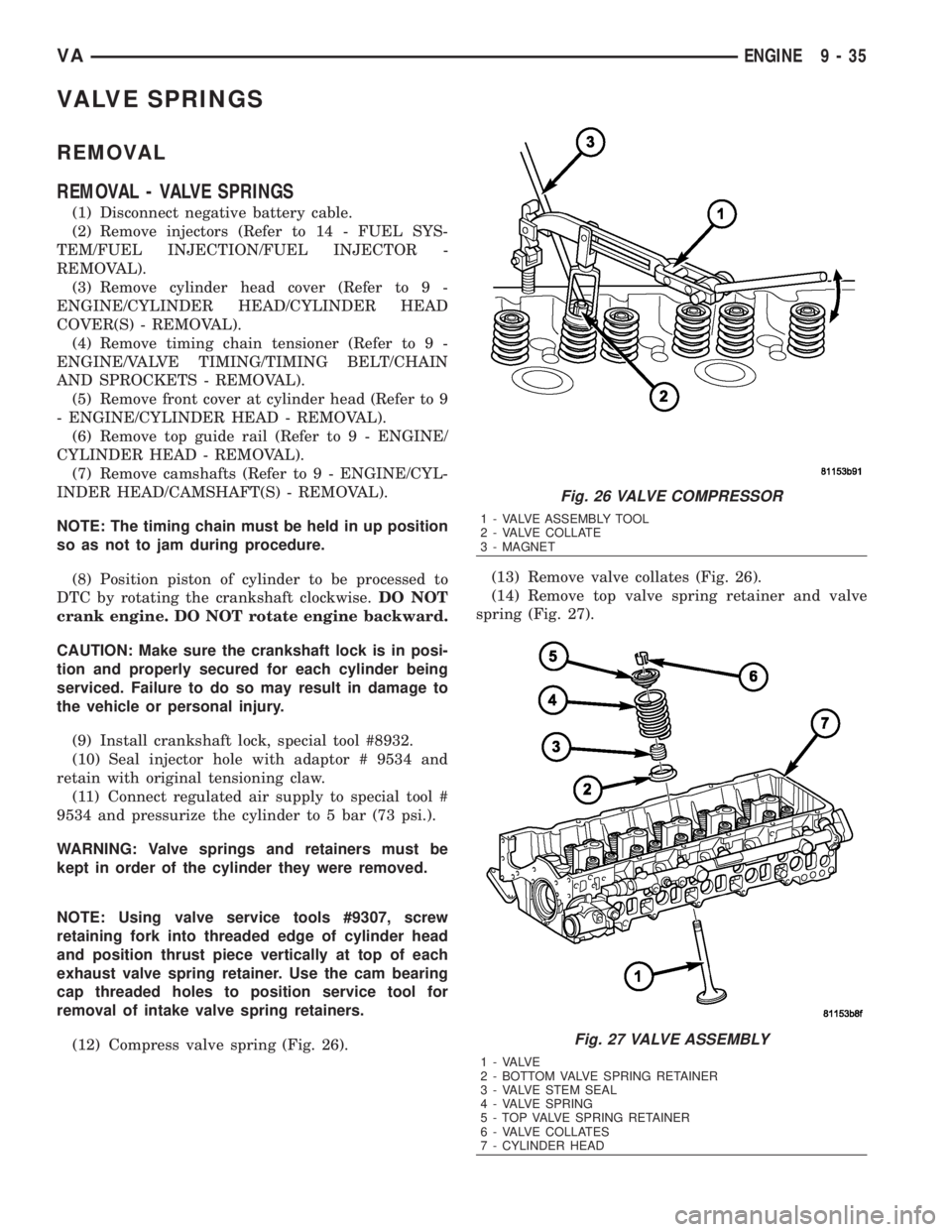
(12) Compress valve spring (Fig. 26).(13) Remove valve collates (Fig. 26).
(14) Remove top valve spring retainer and valve
spring (Fig. 27).
Fig. 26 VALVE COMPRESSOR
1 - VALVE ASSEMBLY TOOL
2 - VALVE COLLATE
3 - MAGNET
Fig. 27 VALVE ASSEMBLY
1 - VALVE
2 - BOTTOM VALVE SPRING RETAINER
3 - VALVE STEM SEAL
4 - VALVE SPRING
5 - TOP VALVE SPRING RETAINER
6 - VALVE COLLATES
7 - CYLINDER HEAD
VAENGINE 9 - 35
Page 1611 of 2305
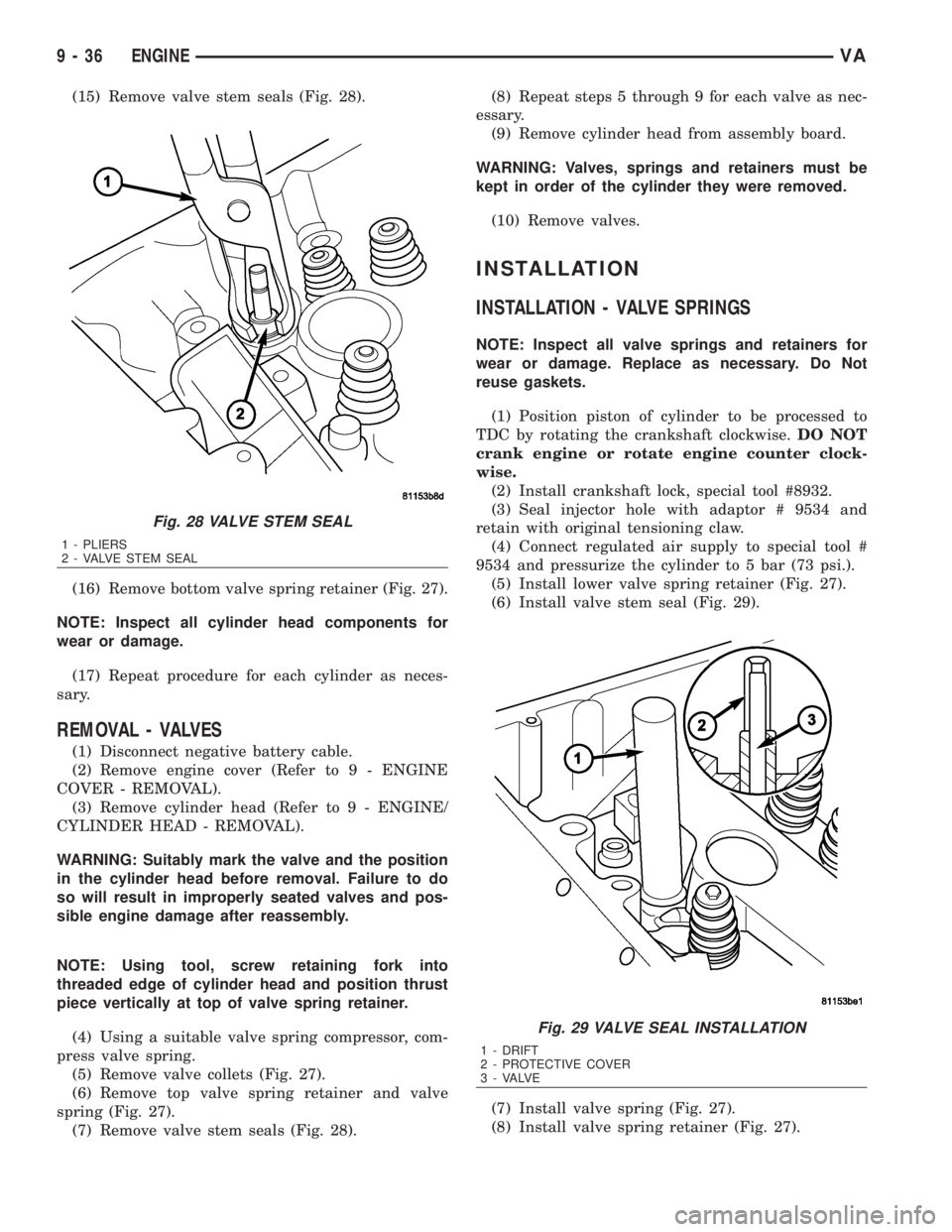
(15) Remove valve stem seals (Fig. 28).
(16) Remove bottom valve spring retainer (Fig. 27).
NOTE: Inspect all cylinder head components for
wear or damage.
(17) Repeat procedure for each cylinder as neces-
sary.
REMOVAL - VALVES
(1) Disconnect negative battery cable.
(2) Remove engine cover (Refer to 9 - ENGINE
COVER - REMOVAL).
(3) Remove cylinder head (Refer to 9 - ENGINE/
CYLINDER HEAD - REMOVAL).
WARNING: Suitably mark the valve and the position
in the cylinder head before removal. Failure to do
so will result in improperly seated valves and pos-
sible engine damage after reassembly.
NOTE: Using tool, screw retaining fork into
threaded edge of cylinder head and position thrust
piece vertically at top of valve spring retainer.
(4) Using a suitable valve spring compressor, com-
press valve spring.
(5) Remove valve collets (Fig. 27).
(6) Remove top valve spring retainer and valve
spring (Fig. 27).
(7) Remove valve stem seals (Fig. 28).(8) Repeat steps 5 through 9 for each valve as nec-
essary.
(9) Remove cylinder head from assembly board.
WARNING: Valves, springs and retainers must be
kept in order of the cylinder they were removed.
(10) Remove valves.
INSTALLATION
INSTALLATION - VALVE SPRINGS
NOTE: Inspect all valve springs and retainers for
wear or damage. Replace as necessary. Do Not
reuse gaskets.
(1) Position piston of cylinder to be processed to
TDC by rotating the crankshaft clockwise.DO NOT
crank engine or rotate engine counter clock-
wise.
(2) Install crankshaft lock, special tool #8932.
(3) Seal injector hole with adaptor # 9534 and
retain with original tensioning claw.
(4) Connect regulated air supply to special tool #
9534 and pressurize the cylinder to 5 bar (73 psi.).
(5) Install lower valve spring retainer (Fig. 27).
(6) Install valve stem seal (Fig. 29).
(7) Install valve spring (Fig. 27).
(8) Install valve spring retainer (Fig. 27).
Fig. 28 VALVE STEM SEAL
1 - PLIERS
2 - VALVE STEM SEAL
Fig. 29 VALVE SEAL INSTALLATION
1 - DRIFT
2 - PROTECTIVE COVER
3 - VALVE
9 - 36 ENGINEVA
Page 1612 of 2305
NOTE: Using valve service tools #9307, screw
retaining fork into threaded edge of cylinder head
and position thrust piece vertically at the top of
each exhaust valve spring retainer. Use the cam
bearing cap threaded holes to position service tool
for installation of intake valve spring retainers.
NOTE: Ensure that the valve keepers are seated
properly.
(9) Compress valve and install valve collates (Fig.
26).
CAUTION: Make sure the crankshaft lock is in posi-
tion and properly secured for each cylinder being
serviced. Failure to do so may result in damage to
the vehicle or personal injury.
(10) Repeat procedure for each cylinder as neces-
sary.
(11) Remove special tooling from cylinder head.
(12) Position piston of #1 cylinder to ignition TDC.
(13) Install camshafts and check basic position
(Refer to 9 - ENGINE/CYLINDER HEAD/CAM-
SHAFT(S) - INSTALLATION).
(14) Install top guide rail (Refer to 9 - ENGINE/
CYLINDER HEAD - INSTALLATION).
(15) Install front cover at cylinder head (Refer to 9
- ENGINE/CYLINDER HEAD - INSTALLATION).
(16) Install timing chain tensioner with new gas-
ket (Refer to 9 - ENGINE/VALVE TIMING/TIMING
BELT/CHAIN AND SPROCKETS - INSTALLATION)
(17) Install cylinder head cover (Refer to 9 -
ENGINE/CYLINDER HEAD/CYLINDER HEAD
COVER(S) - INSTALLATION).
WARNING: (Refer to 14 - FUEL SYSTEM - WARN-
ING).
(18) Install injectors (Refer to 14 - FUEL SYS-
TEM/FUEL INJECTION/FUEL INJECTOR -
INSTALLATION).
(19) Reconnect negative battery cable.
(20) Start the engine, allow to warm, turn engine
off and inspect for leaks. Care must be taken to
observe the fuel system warning (Refer to 14 - FUEL
SYSTEM - WARNING)
(21) Install engine cover (Refer to 9 - ENGINE
COVER - INSTALLATION).
INSTALLATION - VALVES
WARNING: Valves must be kept in their original
positions in cylinder head. Failure to do so will
result in engine damage.NOTE: Inspect all valves, springs and retainers for
wear or damage. Replace as necessary.
(1) Install valves in their original position in the
cylinder head.
(2) Install lower valve spring retainer.
(3) Install valve stem seal.
(4) Install valve spring.
(5) Install valve spring retainer.
NOTE: Using tool, screw retaining fork into
threaded edge of cylinder head and position thrust
piece vertically at the top of each valve spring
retainer.
NOTE: Ensure that the valve keepers are seated
properly.
(6) Using a suitable valve spring compressor, com-
press valve spring and install valve keepers.
(7) Repeat steps 3 through 7 for each valve as nec-
essary.
(8) Remove valve assembly from cylinder head.
(9) Install cylinder head on engine block (Refer to
9 - ENGINE/CYLINDER HEAD - INSTALLATION).
(10) Install glow plugs (Refer to 8 - ELECTRICAL/
IGNITION CONTROL/GLOW PLUG - INSTALLA-
TION).
(11) Connect negative battery cable.
WARNING: US EXTREME CAUTION WHEN THE
ENGINE IS IN OPERATION. DO NOT STAND IN A
DIRECT LINE WITH THE FAN. DO NOT PUT YOUR
HANDS NEAR THE PULLEYS, BELTS OR FAN. DO
NOT WEAR LOOSE CLOTHING.
(12) Start engine and check for leaks. Care must
be taken to observe the fuel system warning (Refer to
14 - FUEL SYSTEM - WARNING)
(13) Install engine cover (Refer to 9 - ENGINE
COVER - INSTALLATION).
ENGINE BLOCK
STANDARD PROCEDURE
STANDARD PROCEDURE - REPLACING ENGINE
CORE AND OIL GALLERY PLUGS
Using a blunt tool such as a drift and a hammer,
strike the bottom edge of the cup plug. With the cup
plug rotated, grasp firmly with pliers or other suit-
able tool and remove plug (Fig. 30).
VAENGINE 9 - 37
Page 1613 of 2305
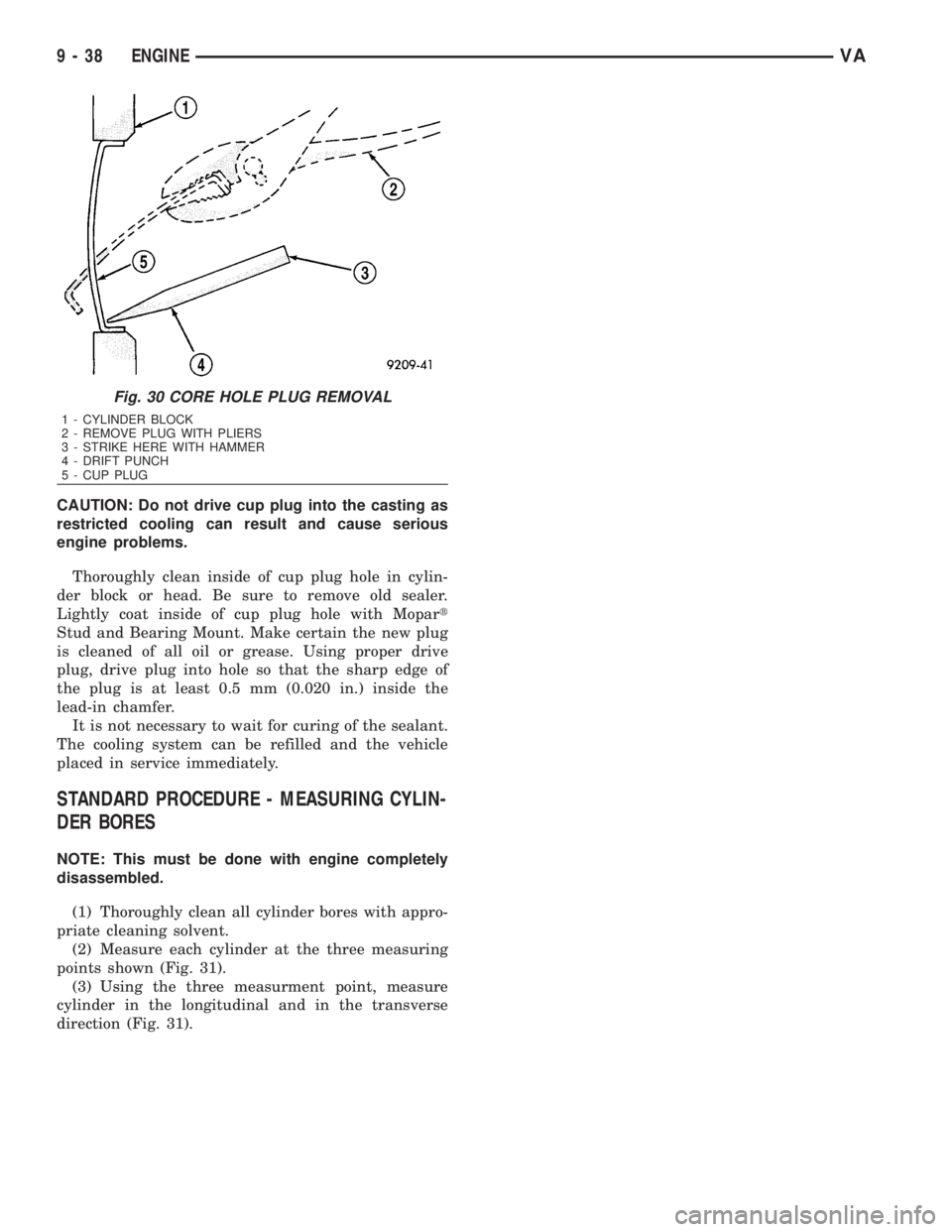
CAUTION: Do not drive cup plug into the casting as
restricted cooling can result and cause serious
engine problems.
Thoroughly clean inside of cup plug hole in cylin-
der block or head. Be sure to remove old sealer.
Lightly coat inside of cup plug hole with Mopart
Stud and Bearing Mount. Make certain the new plug
is cleaned of all oil or grease. Using proper drive
plug, drive plug into hole so that the sharp edge of
the plug is at least 0.5 mm (0.020 in.) inside the
lead-in chamfer.
It is not necessary to wait for curing of the sealant.
The cooling system can be refilled and the vehicle
placed in service immediately.
STANDARD PROCEDURE - MEASURING CYLIN-
DER BORES
NOTE: This must be done with engine completely
disassembled.
(1) Thoroughly clean all cylinder bores with appro-
priate cleaning solvent.
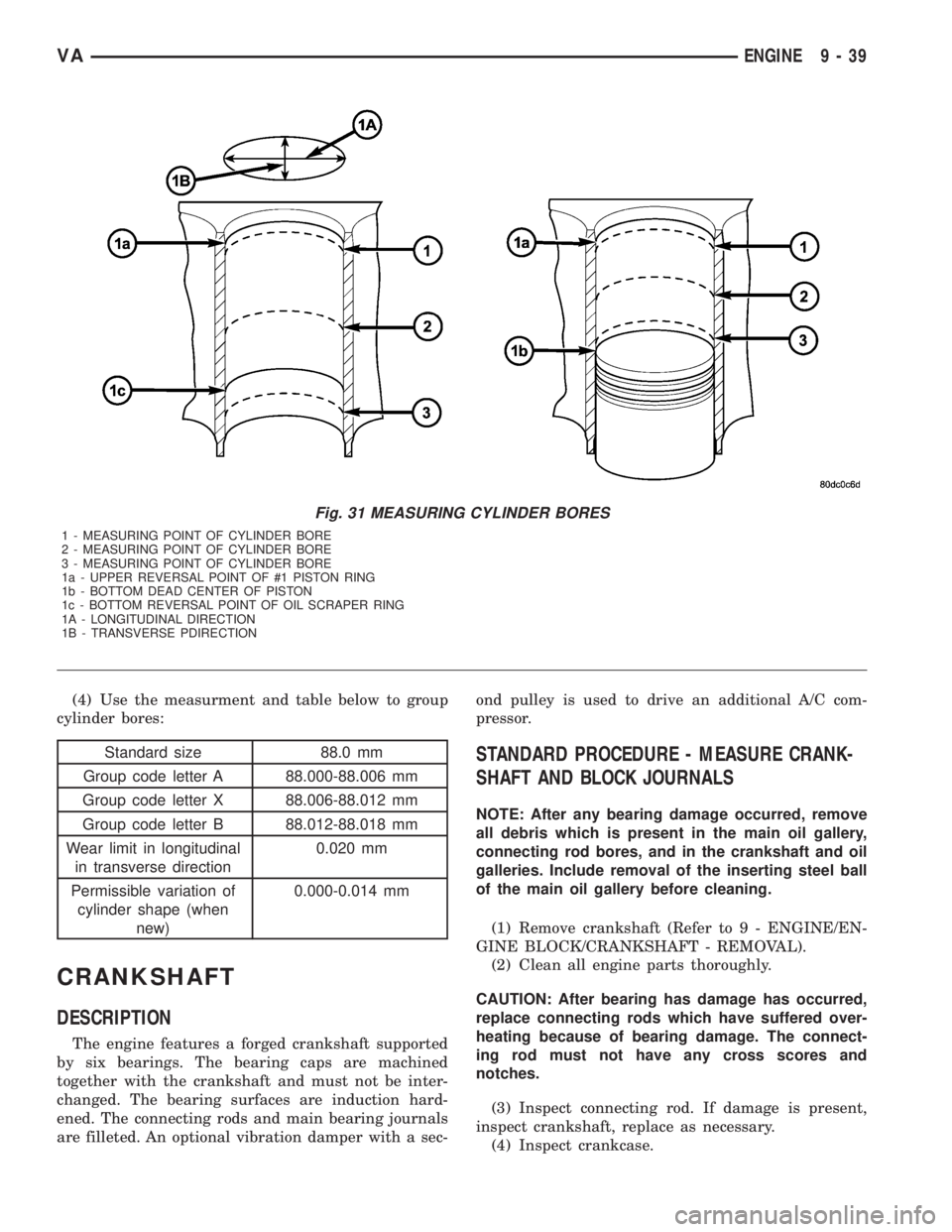
(2) Measure each cylinder at the three measuring
points shown (Fig. 31).
(3) Using the three measurment point, measure
cylinder in the longitudinal and in the transverse
direction (Fig. 31).
Fig. 30 CORE HOLE PLUG REMOVAL
1 - CYLINDER BLOCK
2 - REMOVE PLUG WITH PLIERS
3 - STRIKE HERE WITH HAMMER
4 - DRIFT PUNCH
5 - CUP PLUG
9 - 38 ENGINEVA
Page 1614 of 2305
(4) Use the measurment and table below to group
cylinder bores:
Standard size 88.0 mm
Group code letter A 88.000-88.006 mm
Group code letter X 88.006-88.012 mm
Group code letter B 88.012-88.018 mm
Wear limit in longitudinal
in transverse direction0.020 mm
Permissible variation of
cylinder shape (when
new)0.000-0.014 mm
CRANKSHAFT
DESCRIPTION
The engine features a forged crankshaft supported
by six bearings. The bearing caps are machined
together with the crankshaft and must not be inter-
changed. The bearing surfaces are induction hard-
ened. The connecting rods and main bearing journals
are filleted. An optional vibration damper with a sec-ond pulley is used to drive an additional A/C com-
pressor.
STANDARD PROCEDURE - MEASURE CRANK-
SHAFT AND BLOCK JOURNALS
NOTE: After any bearing damage occurred, remove
all debris which is present in the main oil gallery,
connecting rod bores, and in the crankshaft and oil
galleries. Include removal of the inserting steel ball
of the main oil gallery before cleaning.
(1) Remove crankshaft (Refer to 9 - ENGINE/EN-
GINE BLOCK/CRANKSHAFT - REMOVAL).
(2) Clean all engine parts thoroughly.
CAUTION: After bearing has damage has occurred,
replace connecting rods which have suffered over-
heating because of bearing damage. The connect-
ing rod must not have any cross scores and
notches.
(3) Inspect connecting rod. If damage is present,
inspect crankshaft, replace as necessary.
(4) Inspect crankcase.
Fig. 31 MEASURING CYLINDER BORES
1 - MEASURING POINT OF CYLINDER BORE
2 - MEASURING POINT OF CYLINDER BORE
3 - MEASURING POINT OF CYLINDER BORE
1a - UPPER REVERSAL POINT OF #1 PISTON RING
1b - BOTTOM DEAD CENTER OF PISTON
1c - BOTTOM REVERSAL POINT OF OIL SCRAPER RING
1A - LONGITUDINAL DIRECTION
1B - TRANSVERSE PDIRECTION
VAENGINE 9 - 39