instrument panel MERCEDES-BENZ SPRINTER 2006 Workshop Manual
[x] Cancel search | Manufacturer: MERCEDES-BENZ, Model Year: 2006, Model line: SPRINTER, Model: MERCEDES-BENZ SPRINTER 2006Pages: 2305, PDF Size: 48.12 MB
Page 962 of 2305
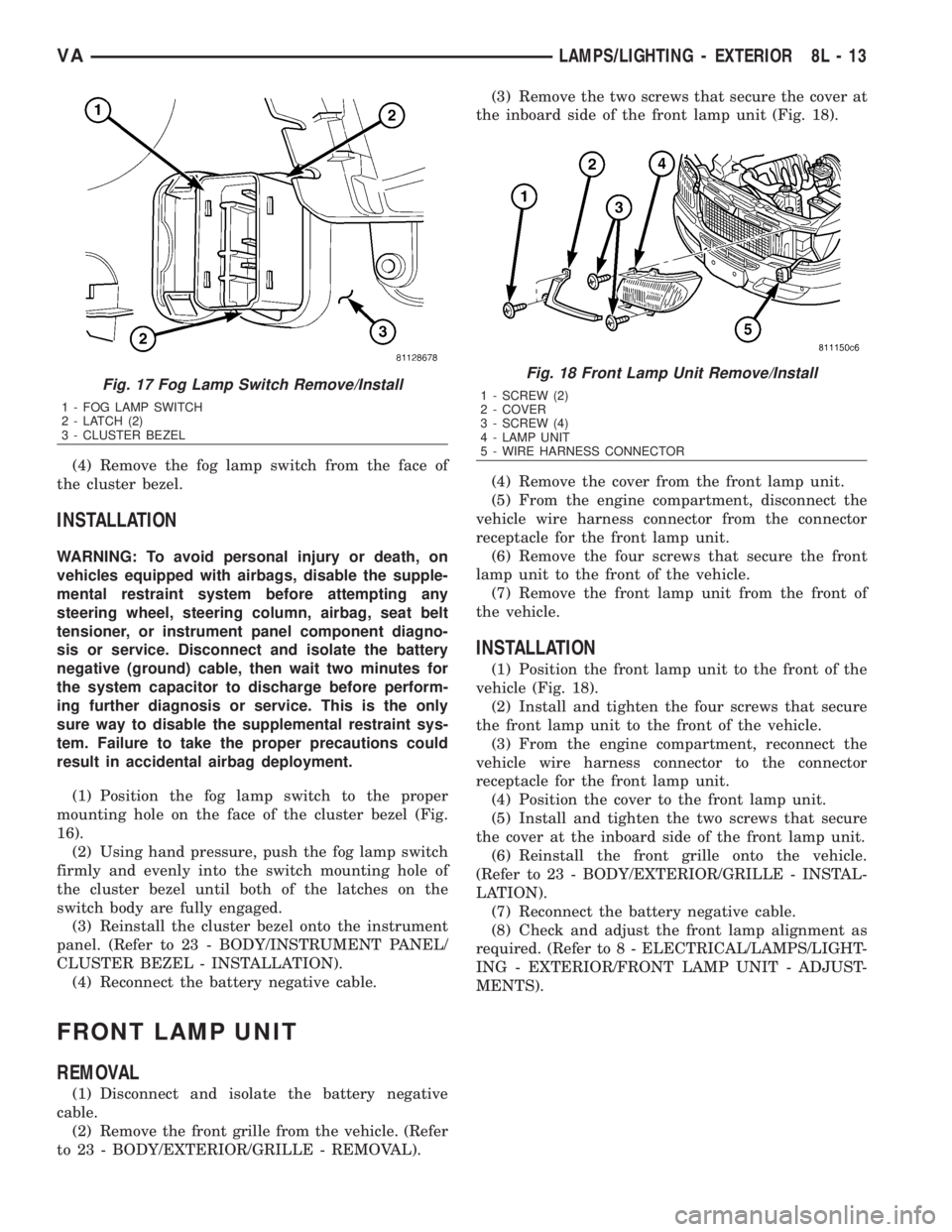
(4) Remove the fog lamp switch from the face of
the cluster bezel.
INSTALLATION
WARNING: To avoid personal injury or death, on
vehicles equipped with airbags, disable the supple-
mental restraint system before attempting any
steering wheel, steering column, airbag, seat belt
tensioner, or instrument panel component diagno-
sis or service. Disconnect and isolate the battery
negative (ground) cable, then wait two minutes for
the system capacitor to discharge before perform-
ing further diagnosis or service. This is the only
sure way to disable the supplemental restraint sys-
tem. Failure to take the proper precautions could
result in accidental airbag deployment.
(1) Position the fog lamp switch to the proper
mounting hole on the face of the cluster bezel (Fig.
16).
(2) Using hand pressure, push the fog lamp switch
firmly and evenly into the switch mounting hole of
the cluster bezel until both of the latches on the
switch body are fully engaged.
(3) Reinstall the cluster bezel onto the instrument
panel. (Refer to 23 - BODY/INSTRUMENT PANEL/
CLUSTER BEZEL - INSTALLATION).
(4) Reconnect the battery negative cable.
FRONT LAMP UNIT
REMOVAL
(1) Disconnect and isolate the battery negative
cable.
(2) Remove the front grille from the vehicle. (Refer
to 23 - BODY/EXTERIOR/GRILLE - REMOVAL).(3) Remove the two screws that secure the cover at
the inboard side of the front lamp unit (Fig. 18).
(4) Remove the cover from the front lamp unit.
(5) From the engine compartment, disconnect the
vehicle wire harness connector from the connector
receptacle for the front lamp unit.
(6) Remove the four screws that secure the front
lamp unit to the front of the vehicle.
(7) Remove the front lamp unit from the front of
the vehicle.
INSTALLATION
(1) Position the front lamp unit to the front of the
vehicle (Fig. 18).
(2) Install and tighten the four screws that secure
the front lamp unit to the front of the vehicle.
(3) From the engine compartment, reconnect the
vehicle wire harness connector to the connector
receptacle for the front lamp unit.
(4) Position the cover to the front lamp unit.
(5) Install and tighten the two screws that secure
the cover at the inboard side of the front lamp unit.
(6) Reinstall the front grille onto the vehicle.
(Refer to 23 - BODY/EXTERIOR/GRILLE - INSTAL-
LATION).
(7) Reconnect the battery negative cable.
(8) Check and adjust the front lamp alignment as
required. (Refer to 8 - ELECTRICAL/LAMPS/LIGHT-
ING - EXTERIOR/FRONT LAMP UNIT - ADJUST-
MENTS).
Fig. 17 Fog Lamp Switch Remove/Install
1 - FOG LAMP SWITCH
2 - LATCH (2)
3 - CLUSTER BEZEL
Fig. 18 Front Lamp Unit Remove/Install
1 - SCREW (2)
2 - COVER
3 - SCREW (4)
4 - LAMP UNIT
5 - WIRE HARNESS CONNECTOR
VALAMPS/LIGHTING - EXTERIOR 8L - 13
Page 966 of 2305
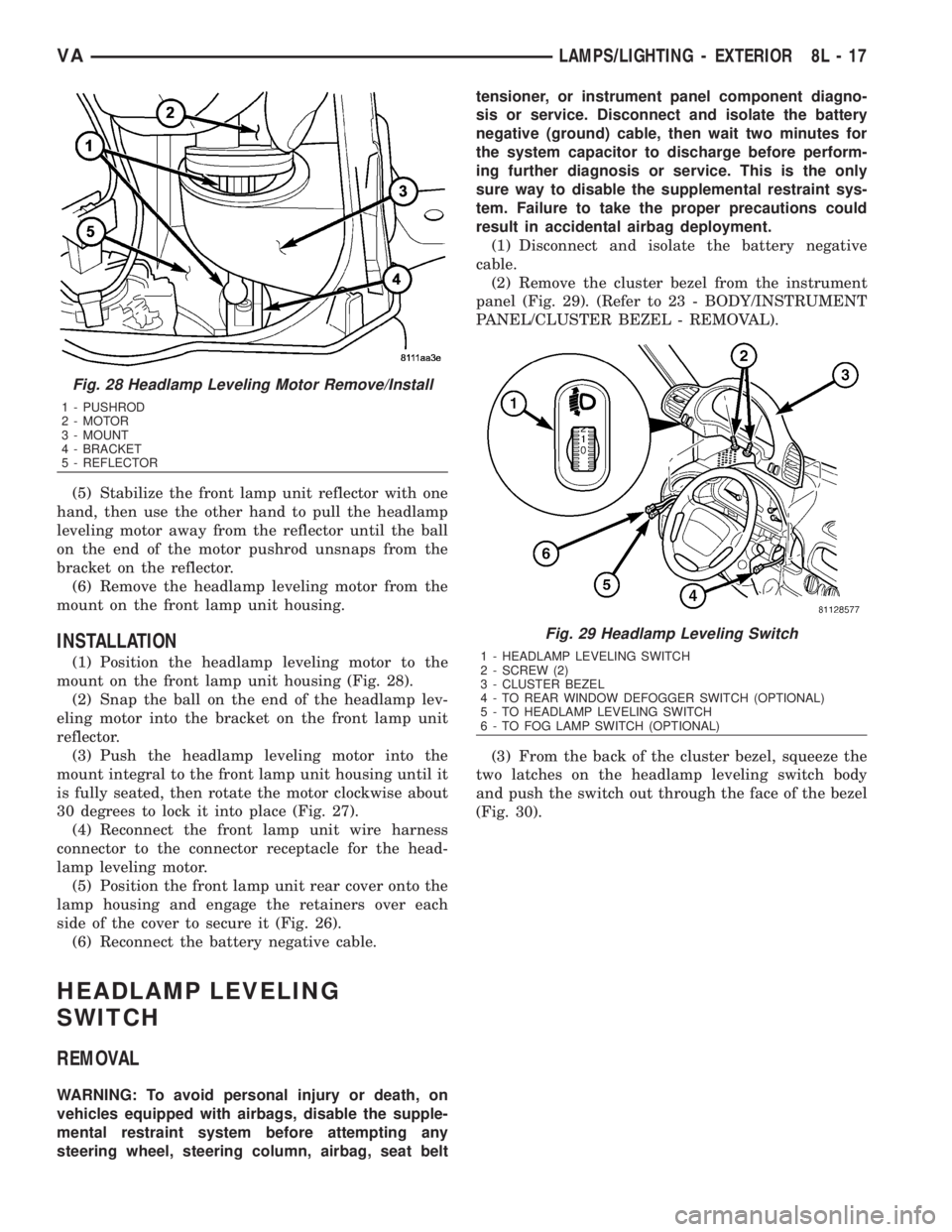
(5) Stabilize the front lamp unit reflector with one
hand, then use the other hand to pull the headlamp
leveling motor away from the reflector until the ball
on the end of the motor pushrod unsnaps from the
bracket on the reflector.
(6) Remove the headlamp leveling motor from the
mount on the front lamp unit housing.
INSTALLATION
(1) Position the headlamp leveling motor to the
mount on the front lamp unit housing (Fig. 28).
(2) Snap the ball on the end of the headlamp lev-
eling motor into the bracket on the front lamp unit
reflector.
(3) Push the headlamp leveling motor into the
mount integral to the front lamp unit housing until it
is fully seated, then rotate the motor clockwise about
30 degrees to lock it into place (Fig. 27).
(4) Reconnect the front lamp unit wire harness
connector to the connector receptacle for the head-
lamp leveling motor.
(5) Position the front lamp unit rear cover onto the
lamp housing and engage the retainers over each
side of the cover to secure it (Fig. 26).
(6) Reconnect the battery negative cable.
HEADLAMP LEVELING
SWITCH
REMOVAL
WARNING: To avoid personal injury or death, on
vehicles equipped with airbags, disable the supple-
mental restraint system before attempting any
steering wheel, steering column, airbag, seat belttensioner, or instrument panel component diagno-
sis or service. Disconnect and isolate the battery
negative (ground) cable, then wait two minutes for
the system capacitor to discharge before perform-
ing further diagnosis or service. This is the only
sure way to disable the supplemental restraint sys-
tem. Failure to take the proper precautions could
result in accidental airbag deployment.
(1) Disconnect and isolate the battery negative
cable.
(2) Remove the cluster bezel from the instrument
panel (Fig. 29). (Refer to 23 - BODY/INSTRUMENT
PANEL/CLUSTER BEZEL - REMOVAL).
(3) From the back of the cluster bezel, squeeze the
two latches on the headlamp leveling switch body
and push the switch out through the face of the bezel
(Fig. 30).
Fig. 28 Headlamp Leveling Motor Remove/Install
1 - PUSHROD
2 - MOTOR
3 - MOUNT
4 - BRACKET
5 - REFLECTOR
Fig. 29 Headlamp Leveling Switch
1 - HEADLAMP LEVELING SWITCH
2 - SCREW (2)
3 - CLUSTER BEZEL
4 - TO REAR WINDOW DEFOGGER SWITCH (OPTIONAL)
5 - TO HEADLAMP LEVELING SWITCH
6 - TO FOG LAMP SWITCH (OPTIONAL)
VALAMPS/LIGHTING - EXTERIOR 8L - 17
Page 967 of 2305
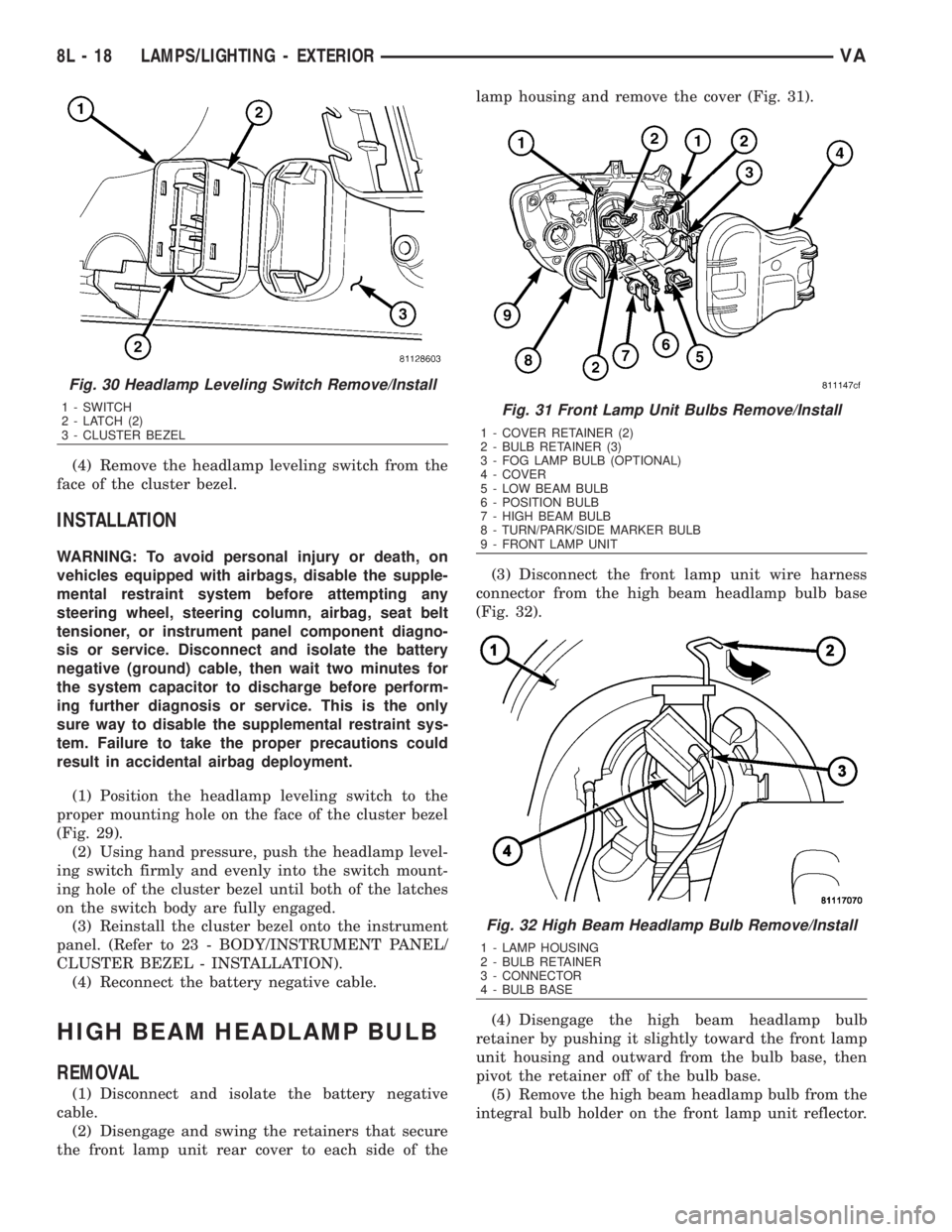
(4) Remove the headlamp leveling switch from the
face of the cluster bezel.
INSTALLATION
WARNING: To avoid personal injury or death, on
vehicles equipped with airbags, disable the supple-
mental restraint system before attempting any
steering wheel, steering column, airbag, seat belt
tensioner, or instrument panel component diagno-
sis or service. Disconnect and isolate the battery
negative (ground) cable, then wait two minutes for
the system capacitor to discharge before perform-
ing further diagnosis or service. This is the only
sure way to disable the supplemental restraint sys-
tem. Failure to take the proper precautions could
result in accidental airbag deployment.
(1) Position the headlamp leveling switch to the
proper mounting hole on the face of the cluster bezel
(Fig. 29).
(2) Using hand pressure, push the headlamp level-
ing switch firmly and evenly into the switch mount-
ing hole of the cluster bezel until both of the latches
on the switch body are fully engaged.
(3) Reinstall the cluster bezel onto the instrument
panel. (Refer to 23 - BODY/INSTRUMENT PANEL/
CLUSTER BEZEL - INSTALLATION).
(4) Reconnect the battery negative cable.
HIGH BEAM HEADLAMP BULB
REMOVAL
(1) Disconnect and isolate the battery negative
cable.
(2) Disengage and swing the retainers that secure
the front lamp unit rear cover to each side of thelamp housing and remove the cover (Fig. 31).
(3) Disconnect the front lamp unit wire harness
connector from the high beam headlamp bulb base
(Fig. 32).
(4) Disengage the high beam headlamp bulb
retainer by pushing it slightly toward the front lamp
unit housing and outward from the bulb base, then
pivot the retainer off of the bulb base.
(5) Remove the high beam headlamp bulb from the
integral bulb holder on the front lamp unit reflector.
Fig. 30 Headlamp Leveling Switch Remove/Install
1 - SWITCH
2 - LATCH (2)
3 - CLUSTER BEZELFig. 31 Front Lamp Unit Bulbs Remove/Install
1 - COVER RETAINER (2)
2 - BULB RETAINER (3)
3 - FOG LAMP BULB (OPTIONAL)
4 - COVER
5 - LOW BEAM BULB
6 - POSITION BULB
7 - HIGH BEAM BULB
8 - TURN/PARK/SIDE MARKER BULB
9 - FRONT LAMP UNIT
Fig. 32 High Beam Headlamp Bulb Remove/Install
1 - LAMP HOUSING
2 - BULB RETAINER
3 - CONNECTOR
4 - BULB BASE
8L - 18 LAMPS/LIGHTING - EXTERIORVA
Page 970 of 2305
MULTI - FUNCTION SWITCH
REMOVAL
WARNING: To avoid personal injury or death, on
vehicles equipped with airbags, disable the supple-
mental restraint system before attempting any
steering wheel, steering column, airbag, seat belt
tensioner, or instrument panel component diagno-
sis or service. Disconnect and isolate the battery
negative (ground) cable, then wait two minutes for
the system capacitor to discharge before perform-
ing further diagnosis or service. This is the only
sure way to disable the supplemental restraint sys-
tem. Failure to take the proper precautions could
result in accidental airbag deployment.
(1) Disconnect and isolate the battery negative
cable.
(2) Remove the fuse block from the underside of
the steering column. (Refer to 8 - ELECTRICAL/
POWER DISTRIBUTION/FUSE BLOCK -
REMOVAL).
(3) Remove the clockspring from the steering col-
umn. (Refer to 8 - ELECTRICAL/RESTRAINTS/
CLOCKSPRING - REMOVAL).
(4) If the vehicle is so equipped, remove the steer-
ing angle sensor from the steering column. (Refer to
5 - BRAKES/ELECTRICAL/STEERING ANGLE
SENSOR - REMOVAL).
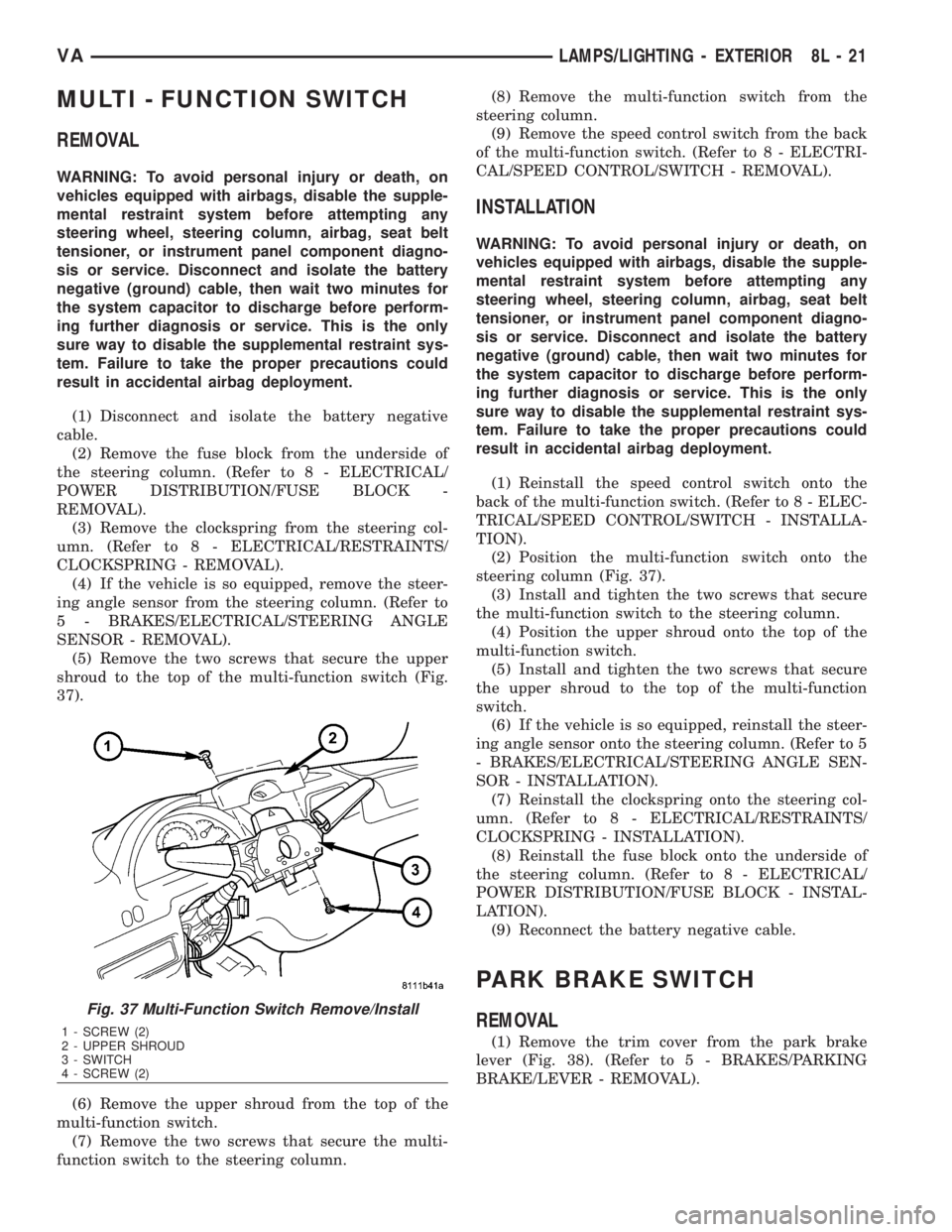
(5) Remove the two screws that secure the upper
shroud to the top of the multi-function switch (Fig.
37).
(6) Remove the upper shroud from the top of the
multi-function switch.
(7) Remove the two screws that secure the multi-
function switch to the steering column.(8) Remove the multi-function switch from the
steering column.
(9) Remove the speed control switch from the back
of the multi-function switch. (Refer to 8 - ELECTRI-
CAL/SPEED CONTROL/SWITCH - REMOVAL).
INSTALLATION
WARNING: To avoid personal injury or death, on
vehicles equipped with airbags, disable the supple-
mental restraint system before attempting any
steering wheel, steering column, airbag, seat belt
tensioner, or instrument panel component diagno-
sis or service. Disconnect and isolate the battery
negative (ground) cable, then wait two minutes for
the system capacitor to discharge before perform-
ing further diagnosis or service. This is the only
sure way to disable the supplemental restraint sys-
tem. Failure to take the proper precautions could
result in accidental airbag deployment.
(1) Reinstall the speed control switch onto the
back of the multi-function switch. (Refer to 8 - ELEC-
TRICAL/SPEED CONTROL/SWITCH - INSTALLA-
TION).
(2) Position the multi-function switch onto the
steering column (Fig. 37).
(3) Install and tighten the two screws that secure
the multi-function switch to the steering column.
(4) Position the upper shroud onto the top of the
multi-function switch.
(5) Install and tighten the two screws that secure
the upper shroud to the top of the multi-function
switch.
(6) If the vehicle is so equipped, reinstall the steer-
ing angle sensor onto the steering column. (Refer to 5
- BRAKES/ELECTRICAL/STEERING ANGLE SEN-
SOR - INSTALLATION).
(7) Reinstall the clockspring onto the steering col-
umn. (Refer to 8 - ELECTRICAL/RESTRAINTS/
CLOCKSPRING - INSTALLATION).
(8) Reinstall the fuse block onto the underside of
the steering column. (Refer to 8 - ELECTRICAL/
POWER DISTRIBUTION/FUSE BLOCK - INSTAL-
LATION).
(9) Reconnect the battery negative cable.
PARK BRAKE SWITCH
REMOVAL
(1) Remove the trim cover from the park brake
lever (Fig. 38). (Refer to 5 - BRAKES/PARKING
BRAKE/LEVER - REMOVAL).
Fig. 37 Multi-Function Switch Remove/Install
1 - SCREW (2)
2 - UPPER SHROUD
3 - SWITCH
4 - SCREW (2)
VALAMPS/LIGHTING - EXTERIOR 8L - 21
Page 975 of 2305
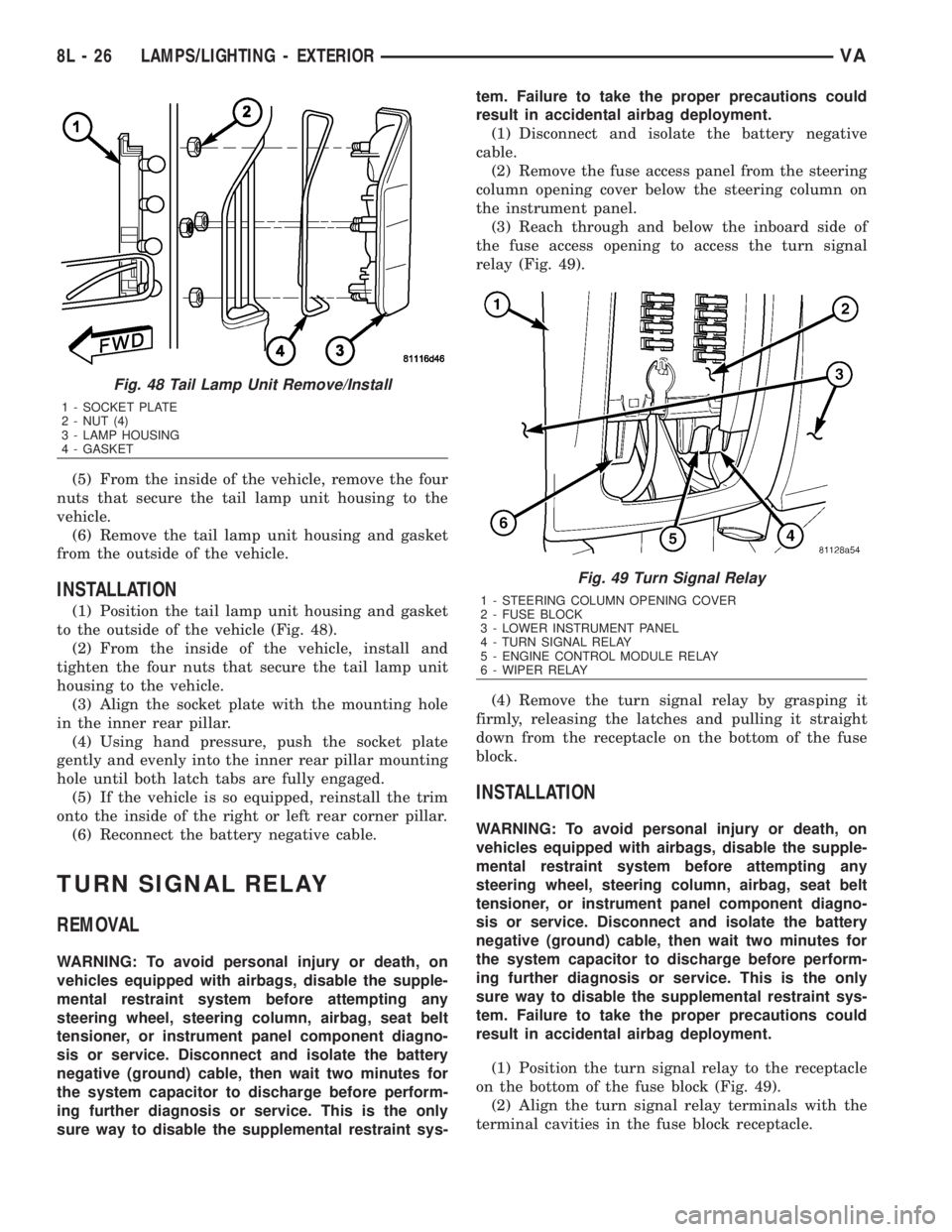
(5) From the inside of the vehicle, remove the four
nuts that secure the tail lamp unit housing to the
vehicle.
(6) Remove the tail lamp unit housing and gasket
from the outside of the vehicle.
INSTALLATION
(1) Position the tail lamp unit housing and gasket
to the outside of the vehicle (Fig. 48).
(2) From the inside of the vehicle, install and
tighten the four nuts that secure the tail lamp unit
housing to the vehicle.
(3) Align the socket plate with the mounting hole
in the inner rear pillar.
(4) Using hand pressure, push the socket plate
gently and evenly into the inner rear pillar mounting
hole until both latch tabs are fully engaged.
(5) If the vehicle is so equipped, reinstall the trim
onto the inside of the right or left rear corner pillar.
(6) Reconnect the battery negative cable.
TURN SIGNAL RELAY
REMOVAL
WARNING: To avoid personal injury or death, on
vehicles equipped with airbags, disable the supple-
mental restraint system before attempting any
steering wheel, steering column, airbag, seat belt
tensioner, or instrument panel component diagno-
sis or service. Disconnect and isolate the battery
negative (ground) cable, then wait two minutes for
the system capacitor to discharge before perform-
ing further diagnosis or service. This is the only
sure way to disable the supplemental restraint sys-tem. Failure to take the proper precautions could
result in accidental airbag deployment.
(1) Disconnect and isolate the battery negative
cable.
(2) Remove the fuse access panel from the steering
column opening cover below the steering column on
the instrument panel.
(3) Reach through and below the inboard side of
the fuse access opening to access the turn signal
relay (Fig. 49).
(4) Remove the turn signal relay by grasping it
firmly, releasing the latches and pulling it straight
down from the receptacle on the bottom of the fuse
block.
INSTALLATION
WARNING: To avoid personal injury or death, on
vehicles equipped with airbags, disable the supple-
mental restraint system before attempting any
steering wheel, steering column, airbag, seat belt
tensioner, or instrument panel component diagno-
sis or service. Disconnect and isolate the battery
negative (ground) cable, then wait two minutes for
the system capacitor to discharge before perform-
ing further diagnosis or service. This is the only
sure way to disable the supplemental restraint sys-
tem. Failure to take the proper precautions could
result in accidental airbag deployment.
(1) Position the turn signal relay to the receptacle
on the bottom of the fuse block (Fig. 49).
(2) Align the turn signal relay terminals with the
terminal cavities in the fuse block receptacle.
Fig. 48 Tail Lamp Unit Remove/Install
1 - SOCKET PLATE
2 - NUT (4)
3 - LAMP HOUSING
4 - GASKET
Fig. 49 Turn Signal Relay
1 - STEERING COLUMN OPENING COVER
2 - FUSE BLOCK
3 - LOWER INSTRUMENT PANEL
4 - TURN SIGNAL RELAY
5 - ENGINE CONTROL MODULE RELAY
6 - WIPER RELAY
8L - 26 LAMPS/LIGHTING - EXTERIORVA
Page 976 of 2305

(3) Push firmly and evenly on the top of the turn
signal relay until the terminals are fully seated in
the terminal cavities in the receptacle of the fuse
block and both latches are fully engaged.
(4) Reinstall the fuse access panel onto the steer-
ing column opening cover below the steering column
on the instrument panel.
(5) Reconnect the battery negative cable.
VALAMPS/LIGHTING - EXTERIOR 8L - 27
Page 977 of 2305
LAMPS / LIGHTING - INTERIOR
TABLE OF CONTENTS
page page
LAMPS/LIGHTING - INTERIOR
DESCRIPTION.........................28
OPERATION...........................29
SPECIFICATIONS - INTERIOR LIGHTING.....29
ASH RECEIVER/CIGAR LIGHTER LAMP UNIT
REMOVAL.............................30
INSTALLATION.........................30
CARGO/DOME LAMP BULB
REMOVAL.............................30
INSTALLATION.........................30
CARGO/DOME LAMP UNIT
REMOVAL.............................31
INSTALLATION.........................31
CARGO LAMP SWITCH
REMOVAL
REMOVAL - INSTRUMENT PANEL........31
REMOVAL - BULKHEAD................31
REMOVAL - REAR PILLAR..............31
INSTALLATION
INSTALLATION - INSTRUMENT PANEL.....32
INSTALLATION - BULKHEAD.............32
INSTALLATION - REAR PILLAR...........32
DOME/READING LAMP BULB
REMOVAL.............................32INSTALLATION.........................32
DOME/READING LAMP UNIT
REMOVAL.............................32
INSTALLATION.........................33
DOME LAMP/INTRUSION SENSOR BULB
REMOVAL.............................33
INSTALLATION.........................33
DOME LAMP/INTRUSION SENSOR
REMOVAL.............................33
INSTALLATION.........................34
DOOR JAMB SWITCH
REMOVAL.............................34
INSTALLATION.........................34
ENTRY/EXIT LAMP BULB
REMOVAL.............................34
INSTALLATION.........................35
ENTRY/EXIT LAMP UNIT
REMOVAL.............................35
INSTALLATION.........................35
TIME DELAY RELAY
REMOVAL.............................35
INSTALLATION.........................36
LAMPS / LIGHTING - INTERIOR
DESCRIPTION
The interior lighting for this model includes the
following standard and optional incandescent interior
lamps and controls:
²Ash Receiver/Cigar Lighter Lamp- An avail-
able ash receiver/cigar lighter lamp is secured by an
integral mount to the outside of the cigar lighter halo
ring. A single lamp serves to illuminate both the
translucent halo ring and the ash receiver.
²Cargo/Dome Lamp- Several cargo/dome lamp
units located overhead in both the front and rear of
the vehicle interior are standard equipment. These
lamps feature a single incandescent bulb. An optional
version of these lamps includes an integral three-po-
sition switch that protrudes through the lamp lens.
²Cargo Lamp Switch- Toggle-type remote
cargo lamp switches located in the accessory switch
bezel in the center of the instrument panel, on the
back side of the cargo compartment bulkhead panel,
and on the rear cargo door pillar are an available
option on all van models. The instrument panel
switch has two Light-Emitting Diode (LED) units,one for illumination and a second that provides an
indication. The switches mounted in the cargo com-
partment also have two LED units, but only the indi-
cation LED unit is functional in this application.
²Dome/Reading Lamp- An optional equipment
dome/reading lamp unit is located in the windshield
header area between the driver and passenger sun
visors. This lamp features two incandescent bulbs,
one dome lamp bulb and a second, dedicated reading
lamp bulb. An integral four-position switch protrudes
through the lamp lens.
²Dome Lamp/Intrusion Sensor- An optional
equipment dome lamp/intrusion sensor unit is
located overhead in the vehicle interior. This lamp
features four incandescent bulbs, two for dome lamps
and two for dedicated right and left reading lamps.
This lamp has two integral three-position switches,
one to control interior lamp operation and one to con-
trol reading lamp operation. This lamp also houses
three intrusion sensors that are part of an optional
vehicle theft security system.
²Door Jamb Switch- A door jamb switch for
each front door is standard equipment on all models.
A door jamb switch for each sliding side door and the
8L - 28 LAMPS/LIGHTING - INTERIORVA
Page 978 of 2305
right rear door is standard equipment on wagon mod-
els. The sliding and rear door jamb switches are not
available for van models.
²Entry/Exit Lamp- An entry/exit lamp to illu-
minate each front and sliding side door step well is
optional equipment on wagon models.
²Time Delay Relay- Vehicles equipped with the
optional remote cargo lamp switches also have a time
delay relay located in the electrical center within the
driver side front seat riser.
Hard wired circuitry connects the interior lighting
system components to the electrical system of the
vehicle. These hard wired circuits are integral to sev-
eral wire harnesses, which are routed throughout the
vehicle and retained by many different methods.
These circuits may be connected to each other, to the
vehicle electrical system and to the interior lighting
system components through the use of a combination
of soldered splices, splice block connectors, and many
different types of wire harness terminal connectors
and insulators. Refer to the appropriate wiring infor-
mation. The wiring information includes wiring dia-
grams, proper wire and connector repair procedures,
further details on wire harness routing and reten-
tion, as well as pin-out and location views for the
various wire harness connectors, splices and grounds.
OPERATION
The interior lighting systems can be divided into
two general classifications based upon the circuit
that controls their operation: The interior lighting
circuit, or the exterior lighting circuit. The hard
wired circuits and components of the interior lighting
systems may be diagnosed and tested using conven-
tional diagnostic tools and procedures.
INTERIOR LIGHTING CIRCUIT
Depending upon the vehicle model (van or wagon)
and the selected vehicle options the interior lighting
circuit may include dome/cargo lamps located over-
head in the front and rear of the vehicle, a dome/
reading lamp located in the header area above the
windshield between the sun visors, and entry/exit
lamps located in the front and sliding side door step
wells.
WAGON MODELS
In all wagon models, the lamps in the interior
lighting circuit are provided with battery current at
all times by a fuse in the fuse block beneath the
steering column. The front, side, and rear door jamb
switches control a ground path for each of these
lamps, except for the optional reading lamp. If the
lamp has an optional integral switch, that switch has
three separate positions. The first position provides a
ground path independent of the door jamb switches
to turn the lamp On. The second, or center position
allows the door jamb switches to control the lamp.The third position segregates that lamp from the
door jamb switch input, turning the lamp Off. In the
case of the optional dome/reading lamp, the integral
lamp switch has a fourth position which will illumi-
nate only the reading lamp bulb.
VAN MODELS
Unless a van model is equipped with an optional
remote cargo lamp switch, all of the lamps in the
interior lighting circuit operate the same way as the
wagon models except that there are only two door
jamb switches, one for each front door. If the vehicle
is equipped with an optional remote cargo lamp
switch, the lamps in the rear of the vehicle on the
interior lighting circuit are provided with battery
current by the time delay relay. The time delay relay
is a smart relay containing active electronic elements
that comprise an electronic timer logic circuit. When
the remote cargo lamp switches provide the proper
input to the time delay relay, the relay logic responds
by energizing the relay control coil. The energized
relay control coil provides battery current to all of
the lamps on the rear interior lighting circuit and to
the indicator Light-Emitting Diode (LED) units in
the remote cargo switches causing each to illuminate.
If a remote cargo lamp switch remains On for more
than about fifteen minutes, the time delay relay will
then automatically de-energize the rear interior
lighting circuits until the remote cargo lamp switch
is cycled Off and then back On.
EXTERIOR LIGHTING CIRCUIT
The exterior lighting circuit provides battery cur-
rent to the optional ash receiver/cigar lighter lamp
and to the illumination Light-Emitting Diode (LED)
unit within the remote cargo lamp switch in the
instrument panel accessory switch bezel whenever
the exterior lamps are turned On.
SPECIFICATIONS - INTERIOR LIGHTING
VALAMPS/LIGHTING - INTERIOR 8L - 29
Page 979 of 2305
BULB SPECIFICATIONS
LAMP BULB
Cargo/Dome Lamp K - 12V 18W
Dome/Reading Lamp K - 12V 10W
Dome Lamp w/Intrusion
SensorK - 12V 6W
Entry/Exit Lamp W5W - 12V 5W
ASH RECEIVER / CIGAR
LIGHTER LAMP UNIT
REMOVAL
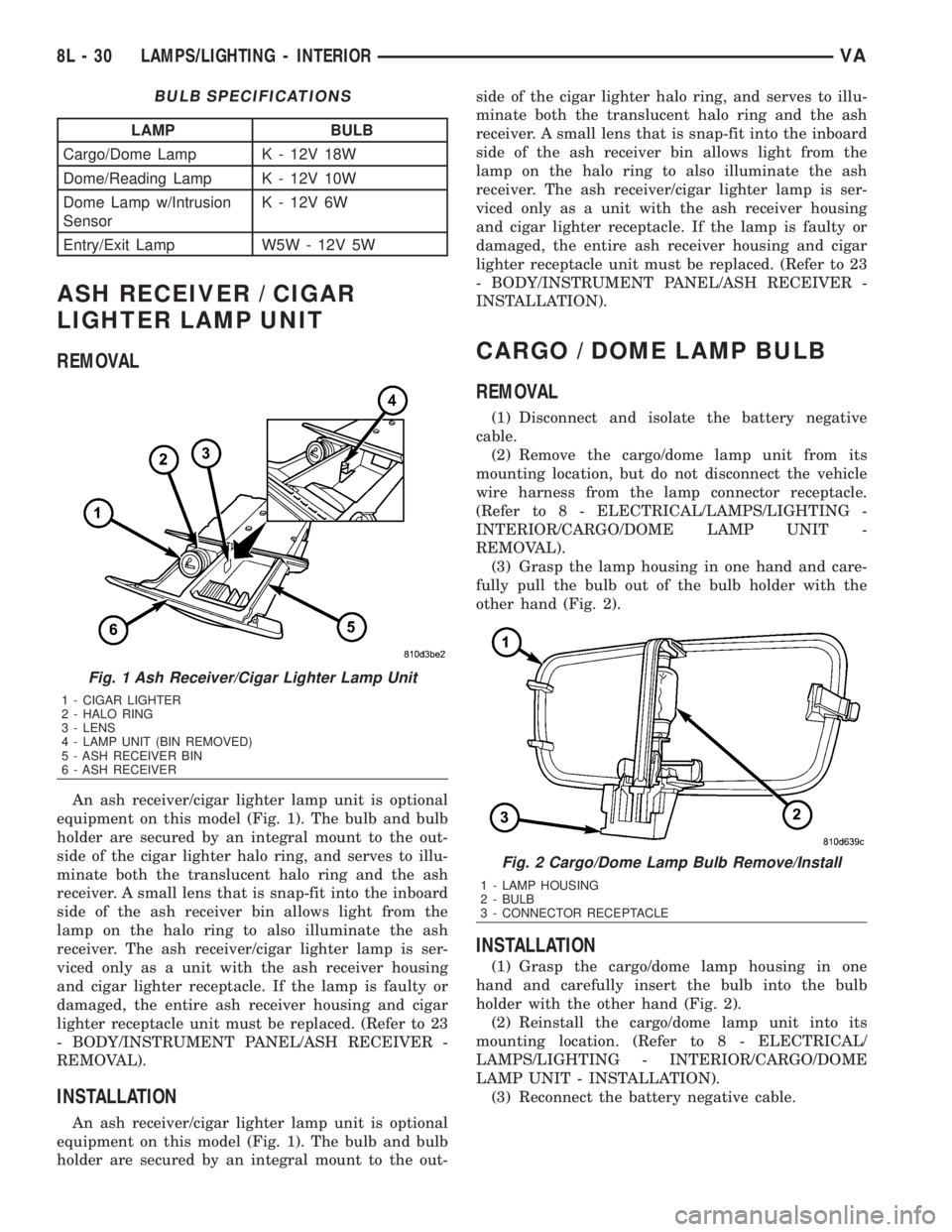
An ash receiver/cigar lighter lamp unit is optional
equipment on this model (Fig. 1). The bulb and bulb
holder are secured by an integral mount to the out-
side of the cigar lighter halo ring, and serves to illu-
minate both the translucent halo ring and the ash
receiver. A small lens that is snap-fit into the inboard
side of the ash receiver bin allows light from the
lamp on the halo ring to also illuminate the ash
receiver. The ash receiver/cigar lighter lamp is ser-
viced only as a unit with the ash receiver housing
and cigar lighter receptacle. If the lamp is faulty or
damaged, the entire ash receiver housing and cigar
lighter receptacle unit must be replaced. (Refer to 23
- BODY/INSTRUMENT PANEL/ASH RECEIVER -
REMOVAL).
INSTALLATION
An ash receiver/cigar lighter lamp unit is optional
equipment on this model (Fig. 1). The bulb and bulb
holder are secured by an integral mount to the out-side of the cigar lighter halo ring, and serves to illu-
minate both the translucent halo ring and the ash
receiver. A small lens that is snap-fit into the inboard
side of the ash receiver bin allows light from the
lamp on the halo ring to also illuminate the ash
receiver. The ash receiver/cigar lighter lamp is ser-
viced only as a unit with the ash receiver housing
and cigar lighter receptacle. If the lamp is faulty or
damaged, the entire ash receiver housing and cigar
lighter receptacle unit must be replaced. (Refer to 23
- BODY/INSTRUMENT PANEL/ASH RECEIVER -
INSTALLATION).
CARGO / DOME LAMP BULB
REMOVAL
(1) Disconnect and isolate the battery negative
cable.
(2) Remove the cargo/dome lamp unit from its
mounting location, but do not disconnect the vehicle
wire harness from the lamp connector receptacle.
(Refer to 8 - ELECTRICAL/LAMPS/LIGHTING -
INTERIOR/CARGO/DOME LAMP UNIT -
REMOVAL).
(3) Grasp the lamp housing in one hand and care-
fully pull the bulb out of the bulb holder with the
other hand (Fig. 2).
INSTALLATION
(1) Grasp the cargo/dome lamp housing in one
hand and carefully insert the bulb into the bulb
holder with the other hand (Fig. 2).
(2) Reinstall the cargo/dome lamp unit into its
mounting location. (Refer to 8 - ELECTRICAL/
LAMPS/LIGHTING - INTERIOR/CARGO/DOME
LAMP UNIT - INSTALLATION).
(3) Reconnect the battery negative cable.
Fig. 1 Ash Receiver/Cigar Lighter Lamp Unit
1 - CIGAR LIGHTER
2 - HALO RING
3 - LENS
4 - LAMP UNIT (BIN REMOVED)
5 - ASH RECEIVER BIN
6 - ASH RECEIVER
Fig. 2 Cargo/Dome Lamp Bulb Remove/Install
1 - LAMP HOUSING
2 - BULB
3 - CONNECTOR RECEPTACLE
8L - 30 LAMPS/LIGHTING - INTERIORVA
Page 980 of 2305
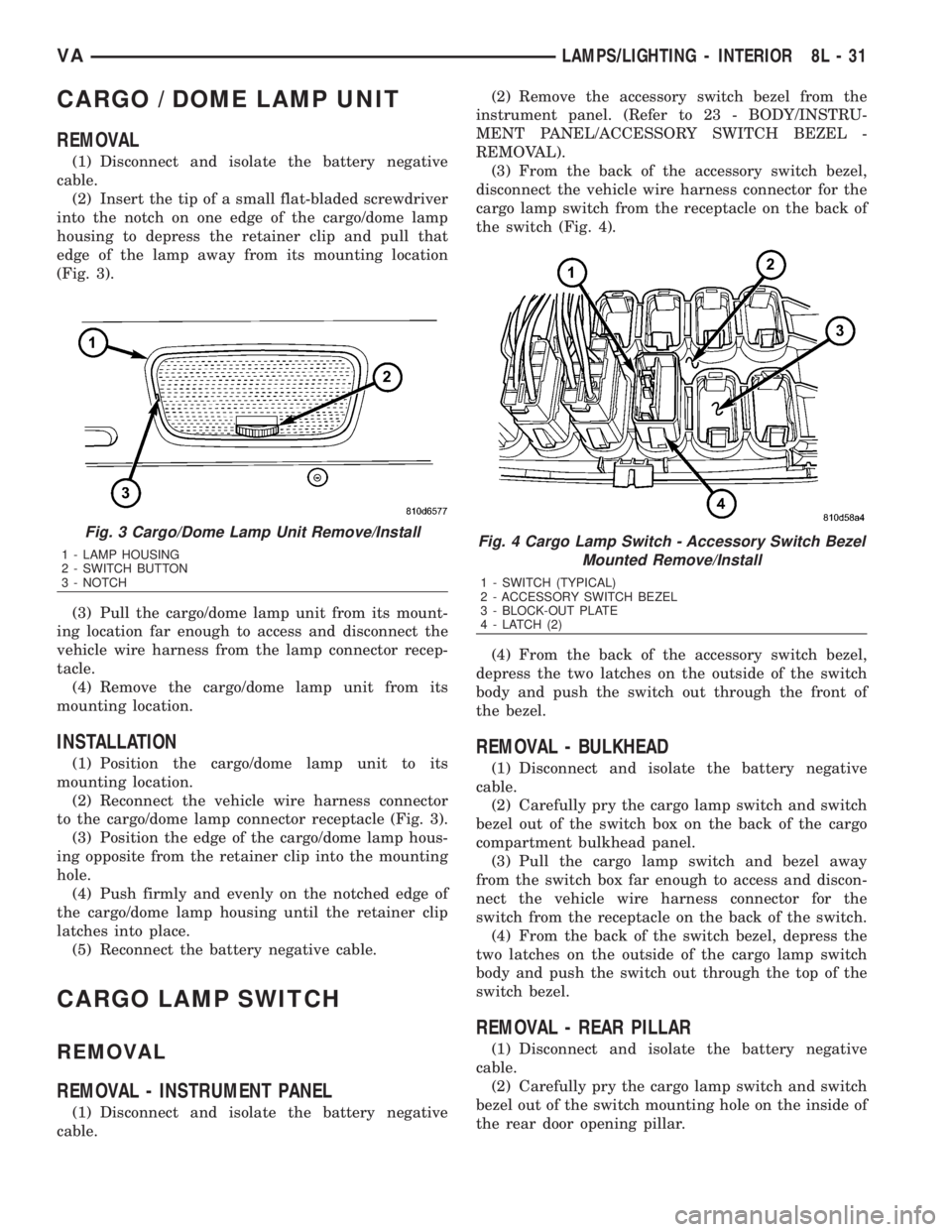
CARGO / DOME LAMP UNIT
REMOVAL
(1) Disconnect and isolate the battery negative
cable.
(2) Insert the tip of a small flat-bladed screwdriver
into the notch on one edge of the cargo/dome lamp
housing to depress the retainer clip and pull that
edge of the lamp away from its mounting location
(Fig. 3).
(3) Pull the cargo/dome lamp unit from its mount-
ing location far enough to access and disconnect the
vehicle wire harness from the lamp connector recep-
tacle.
(4) Remove the cargo/dome lamp unit from its
mounting location.
INSTALLATION
(1) Position the cargo/dome lamp unit to its
mounting location.
(2) Reconnect the vehicle wire harness connector
to the cargo/dome lamp connector receptacle (Fig. 3).
(3) Position the edge of the cargo/dome lamp hous-
ing opposite from the retainer clip into the mounting
hole.
(4) Push firmly and evenly on the notched edge of
the cargo/dome lamp housing until the retainer clip
latches into place.
(5) Reconnect the battery negative cable.
CARGO LAMP SWITCH
REMOVAL
REMOVAL - INSTRUMENT PANEL
(1) Disconnect and isolate the battery negative
cable.(2) Remove the accessory switch bezel from the
instrument panel. (Refer to 23 - BODY/INSTRU-
MENT PANEL/ACCESSORY SWITCH BEZEL -
REMOVAL).
(3) From the back of the accessory switch bezel,
disconnect the vehicle wire harness connector for the
cargo lamp switch from the receptacle on the back of
the switch (Fig. 4).
(4) From the back of the accessory switch bezel,
depress the two latches on the outside of the switch
body and push the switch out through the front of
the bezel.
REMOVAL - BULKHEAD
(1) Disconnect and isolate the battery negative
cable.
(2) Carefully pry the cargo lamp switch and switch
bezel out of the switch box on the back of the cargo
compartment bulkhead panel.
(3) Pull the cargo lamp switch and bezel away
from the switch box far enough to access and discon-
nect the vehicle wire harness connector for the
switch from the receptacle on the back of the switch.
(4) From the back of the switch bezel, depress the
two latches on the outside of the cargo lamp switch
body and push the switch out through the top of the
switch bezel.
REMOVAL - REAR PILLAR
(1) Disconnect and isolate the battery negative
cable.
(2) Carefully pry the cargo lamp switch and switch
bezel out of the switch mounting hole on the inside of
the rear door opening pillar.
Fig. 3 Cargo/Dome Lamp Unit Remove/Install
1 - LAMP HOUSING
2 - SWITCH BUTTON
3 - NOTCHFig. 4 Cargo Lamp Switch - Accessory Switch Bezel
Mounted Remove/Install
1 - SWITCH (TYPICAL)
2 - ACCESSORY SWITCH BEZEL
3 - BLOCK-OUT PLATE
4 - LATCH (2)
VALAMPS/LIGHTING - INTERIOR 8L - 31