engine oil MERCEDES-BENZ SPRINTER 2006 Repair Manual
[x] Cancel search | Manufacturer: MERCEDES-BENZ, Model Year: 2006, Model line: SPRINTER, Model: MERCEDES-BENZ SPRINTER 2006Pages: 2305, PDF Size: 48.12 MB
Page 940 of 2305
next required engine oil maintenance is anticipated.
ASSYST also provides several audible indications
using the electronic tone generator on the instrument
cluster circuit board to supplement these visual dis-
plays.
The indications of the ASSYST engine oil mainte-
nance indicator are not visible when the LCD is not
illuminated. When illuminated, the ASSYST indica-
tions appear as dark characters and icons silhouetted
against an amber field. When the exterior lighting is
turned Off, the display is illuminated at maximum
brightness. When the exterior lighting is turned On,
the display illumination level can be adjusted in con-
cert with the cluster general illumination lighting
using the ª+º (plus) and ª2º (minus) multi-function
indicator push buttons. The ASSYST engine oil main-
tenance indicator is serviced as a unit with the
instrument cluster.
OPERATION
The ASSYST engine oil maintenance indicator
microprocessor uses numerous criteria besides time
and mileage to evaluate vehicle maintenance require-
ments. Time data is taken from the electronic digital
clock integral to the instrument cluster. Vehicle dis-
tance data is obtained from the Controller Antilock
Brake (CAB) over the Controller Area Network
(CAN) data bus. Coolant temperature, engine oil
temperature, engine oil level, engine oil quality,
engine speed, and engine load data are obtained from
the Engine Control Module (ECM) over the CAN
data bus. Using all of the available data and internal
programming, the ASSYST microprocessor then cal-
culates the estimated time and distance to the next
required engine oil maintenance interval. The
ASSYST uses the multi-function indicator LCD to
display that data and, when necessary, issues audible
alerts to the vehicle operator through the electronic
tone generator on the cluster circuit board.
See the owner's manual in the vehicle glove box for
more information on the features, use, operation and
resetting procedures for the ASSYST maintenance
computer. Proper diagnosis and testing of the
ASSYST engine oil maintenance computer, the CAN
data bus and the electronic data bus message inputs
to the EMIC that are used by the ASSYST computer
for its calculations requires the use of a diagnostic
scan tool. Refer to the appropriate diagnostic infor-
mation.
MALFUNCTION INDICATOR
LAMP (MIL)
DESCRIPTION
A Malfunction Indicator Lamp (MIL) is standard
equipment on all instrument clusters. The MIL islocated near the lower edge of the instrument cluster,
to the right of the multi-function indicator display.
The MIL consists of the International Control and
Display Symbol icon for ªEngineº imprinted within a
rectangular cutout in the opaque layer of the instru-
ment cluster overlay. The dark outer layer of the
overlay prevents the indicator from being clearly vis-
ible when it is not illuminated. An amber Light
Emitting Diode (LED) behind the cutout in the
opaque layer of the overlay causes the icon to appear
silhouetted against an amber field through the trans-
lucent outer layer of the overlay when the indicator
is illuminated from behind by the LED, which is sol-
dered onto the instrument cluster electronic circuit
board. The MIL is serviced as a unit with the instru-
ment cluster.
OPERATION
The Malfunction Indicator Lamp (MIL) gives an
indication to the vehicle operator when the Engine
Control Module (ECM) has recorded a Diagnostic
Trouble Code (DTC) for an On-Board Diagnostics II
(OBDII) emissions-related circuit or component mal-
function. The MIL is controlled by a transistor on the
instrument cluster circuit board based upon cluster
programming and electronic messages received by
the cluster from the ECM over the Controller Area
Network (CAN) data bus. The MIL Light Emitting
Diode (LED) is completely controlled by the instru-
ment cluster logic circuit, and that logic will only
allow this indicator to operate when the instrument
cluster detects that the ignition switch is in the On
position. Therefore, the LED will always be off when
the ignition switch is in any position except On. The
LED only illuminates when it is provided a path to
ground by the instrument cluster transistor. The
instrument cluster will turn on the MIL for the fol-
lowing reasons:
²Bulb Test- Each time the ignition switch is
turned to the On position the MIL is illuminated as a
bulb test. The indicator will remain illuminated until
the engine is started, or until the ignition switch is
turned to the Off position, whichever occurs first.
²MIL Lamp-On Message- Each time the clus-
ter receives a MIL lamp-on message from the ECM,
the indicator will be illuminated. The indicator will
remain illuminated until the detected fault is
repaired, or until the ignition switch is turned to the
Off position, whichever occurs first. For more infor-
mation on the ECM and the DTC set and reset
parameters, (Refer to 25 - EMISSIONS CONTROL -
OPERATION).
²Communication Error- If the cluster receives
no lamp-on or lamp-off message from the ECM, the
MIL is illuminated by the instrument cluster. The
indicator remains controlled and illuminated by the
cluster until a valid lamp-on or lamp-off message is
received from the ECM.
VAINSTRUMENT CLUSTER 8J - 21
Page 941 of 2305
The ECM continually monitors the fuel and emis-
sions system circuits and sensors to decide whether
the system is in good operating condition. The ECM
then sends the proper lamp-on or lamp-off messages
to the instrument cluster. If the instrument cluster
turns on the MIL after the bulb test, it may indicate
that a malfunction has occurred and that the fuel
and emissions systems may require service. For
proper diagnosis of the fuel and emissions systems,
the ECM, the CAN data bus, or the electronic mes-
sage inputs to the instrument cluster that control the
MIL, a diagnostic scan tool is required. Refer to the
appropriate diagnostic information.
MULTI - FUNCTION INDICA-
TOR
DESCRIPTION
A multi-function indicator is standard equipment
on all instrument clusters. The multi-function indica-
tor is located near the lower edge of the instrument
cluster, directly below the speedometer. The multi-
function indicator consists of a Liquid Crystal Dis-
play (LCD) unit and four push button-controlled
switches that are soldered onto the instrument clus-
ter electronic circuit board. The LCD is visible
through a large rectangular cutout in the instrument
cluster overlay, while the four switch push buttons
extend through a black plastic switch bezel located
on the cluster lens directly below the LCD. The four
multi-function indicator push buttons allow the vehi-
cle operator to configure and adjust several of the
display features. The buttons are labeled from left to
right: ªmiº (miles) or ªkmº (kilometers), an icon
depicting an analog clock face (clock), ª2º (minus),
and ª+º (plus).
The multi-function indicator LCD displays both
alpha-numeric characters and numerous icons to pro-
vide information to the vehicle operator. The indica-
tions of the multi-function indicator are not visible
when the LCD is not illuminated. When illuminated
the indications appear as dark characters and icons
silhouetted against an amber field. When the exterior
lighting is turned Off, the display is illuminated at
maximum brightness. When the exterior lighting is
turned On the display illumination level can be
adjusted in concert with the cluster general illumina-
tion lighting using the ª+º (plus) and ª2º (minus)
multi-function indicator push buttons. The multi-
function indicator LCD unit and push button
switches are serviced as a unit with the instrument
cluster.
OPERATION
The multi-function indicator has several display
capabilities including odometer, trip odometer, clock,engine oil level data, gear selector indicator
(PRNDL), certain diagnostic information and, on
vehicles so equipped, an optional Active Service SYS-
Tem (ASSYST) engine oil maintenance indicator and
an optional outside ambient temperature indicator.
The multi-function indicator is completely controlled
by the instrument cluster logic circuit, and that logic
will allow this indication to be viewed whenever the
multi-function indicator Liquid Crystal Display
(LCD) is activated. Therefore, the indicator remains
functional regardless of the ignition switch position.
With the ignition switch in the Off or Accessory posi-
tions and the key removed from the ignition lock cyl-
inder, the display is activated when the park lamps
are turned On or, for about thirty seconds after any
one of the multi-function indicator switch push but-
tons is depressed. Otherwise, the display unit is
active for about thirty seconds after the key is
inserted into the ignition lock cylinder, and inactive
about thirty seconds after the key is removed from
the ignition lock cylinder.
The multi-function indicator ªmiº (miles) or
ªkmº(kilometers) switch push button is used to con-
trol the odometer/trip odometer display modes. The
multi-function indicator clock switch push button is
used to control the clock/outside temperature display
modes. The multi-function indicator ª+º (plus) and
ª2º (minus) switch push buttons are used to adjust
the cluster general illumination dimming level, the
clock, and other cluster settings. See the owner's
manual in the vehicle glove box for more information
on the features, use, operation and setting proce-
dures for the various standard and optional multi-
function indicator displays.
Proper testing of the multi-function indicator LCD
unit, the CAN data bus and the electronic data bus
message inputs to the instrument cluster that control
some of the multi-function indicator functions
requires the use of a diagnostic scan tool. Refer to
the appropriate diagnostic information. Additional
details for the odometer/trip odometer, the clock, the
gear selector indicator, the ambient temperature indi-
cator and the ASSYST warning and reminder func-
tions of the multi-function indicator may be found
elsewhere in this service information.
ODOMETER
DESCRIPTION
An odometer and trip odometer are standard
equipment in all instrument clusters. The odometer
and trip odometer values are displayed on the left
side of the multi-function indicator Liquid Crystal
Display (LCD). The LCD is soldered onto the cluster
electronic circuit board and is visible through a win-
dow with a clear lens located near the lower edge of
8J - 22 INSTRUMENT CLUSTERVA
Page 953 of 2305
seat riser, a fog lamp switch installed in the cluster
bezel on the instrument panel outboard of the steer-
ing column, and a fog lamp bulb installed in each of
the two front lamp units. The front fog lamps have a
path to ground at all times through their connection
to the vehicle wire harness. The headlamp switch cir-
cuitry of the left (lighting) control stalk of the multi-
function switch controls front fog lamp operation by
providing battery current to the front fog lamp relay
only when the low beam headlamps are selected. The
fog lamp switch controls front fog lamp operation by
energizing or de-energizing the front fog lamp relay
control coil.
HAZARD WARNING LAMPS
With the hazard switch in the On position, the
hazard switch button illuminates and the right and
left turn signal indicators as well as the right and
left turn signal lamps begin to flash on and off. When
the hazard warning system is activated, the hazard
switch circuitry within the multi-function switch and
the wipers, turn signals and engine start control
module electronic circuitry within the fuse block will
repeatedly energize and de-energize the turn signal
relay located in the fuse block. The turn signal relay
switches battery current from a fused B(+) fuse in
the fuse block to the turn signal indicators and the
turn signal lamps. The flashing of the hazard switch
button illumination lamp is also controlled by the
output from the turn signal relay.
HEADLAMPS
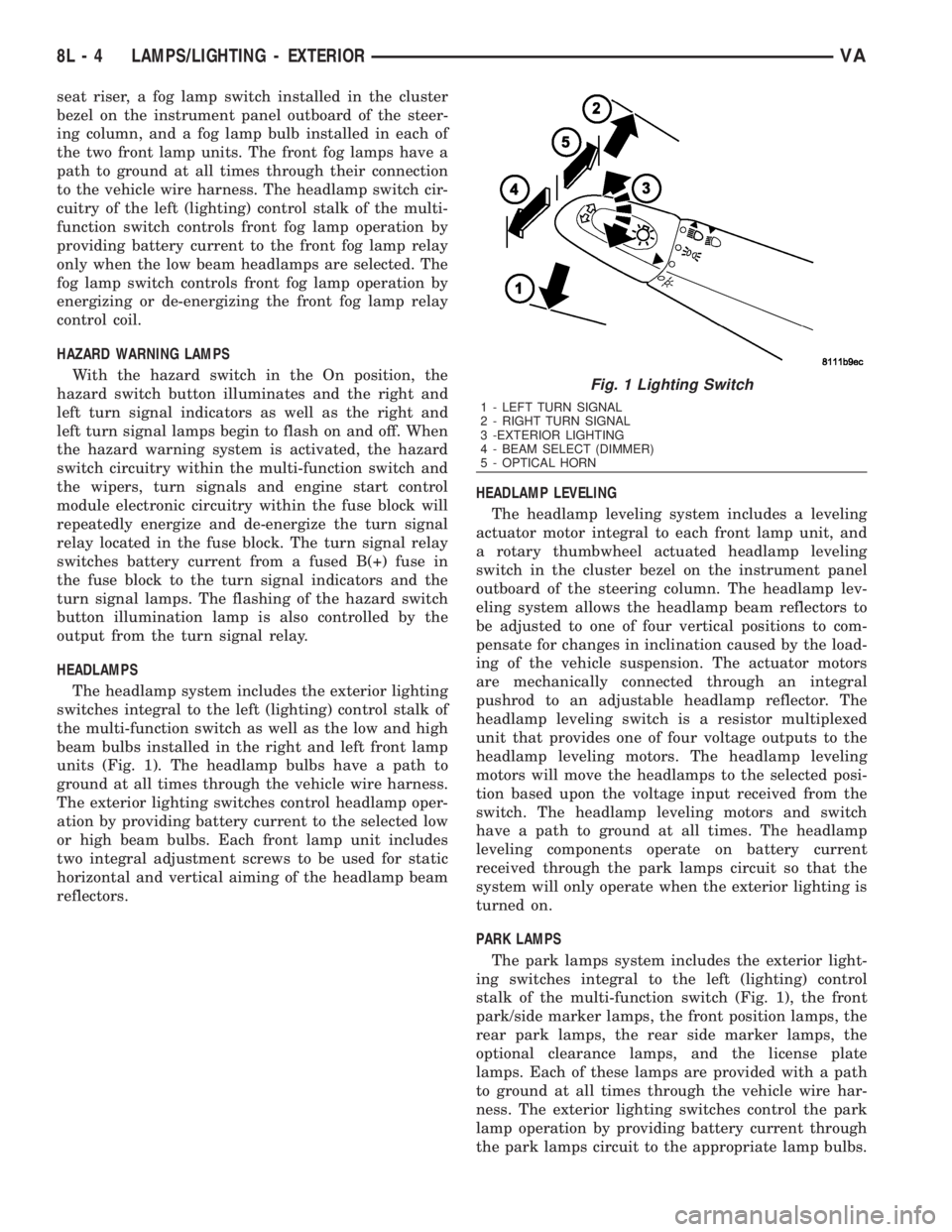
The headlamp system includes the exterior lighting
switches integral to the left (lighting) control stalk of
the multi-function switch as well as the low and high
beam bulbs installed in the right and left front lamp
units (Fig. 1). The headlamp bulbs have a path to
ground at all times through the vehicle wire harness.
The exterior lighting switches control headlamp oper-
ation by providing battery current to the selected low
or high beam bulbs. Each front lamp unit includes
two integral adjustment screws to be used for static
horizontal and vertical aiming of the headlamp beam
reflectors.HEADLAMP LEVELING
The headlamp leveling system includes a leveling
actuator motor integral to each front lamp unit, and
a rotary thumbwheel actuated headlamp leveling
switch in the cluster bezel on the instrument panel
outboard of the steering column. The headlamp lev-
eling system allows the headlamp beam reflectors to
be adjusted to one of four vertical positions to com-
pensate for changes in inclination caused by the load-
ing of the vehicle suspension. The actuator motors
are mechanically connected through an integral
pushrod to an adjustable headlamp reflector. The
headlamp leveling switch is a resistor multiplexed
unit that provides one of four voltage outputs to the
headlamp leveling motors. The headlamp leveling
motors will move the headlamps to the selected posi-
tion based upon the voltage input received from the
switch. The headlamp leveling motors and switch
have a path to ground at all times. The headlamp
leveling components operate on battery current
received through the park lamps circuit so that the
system will only operate when the exterior lighting is
turned on.
PARK LAMPS
The park lamps system includes the exterior light-
ing switches integral to the left (lighting) control
stalk of the multi-function switch (Fig. 1), the front
park/side marker lamps, the front position lamps, the
rear park lamps, the rear side marker lamps, the
optional clearance lamps, and the license plate
lamps. Each of these lamps are provided with a path
to ground at all times through the vehicle wire har-
ness. The exterior lighting switches control the park
lamp operation by providing battery current through
the park lamps circuit to the appropriate lamp bulbs.
Fig. 1 Lighting Switch
1 - LEFT TURN SIGNAL
2 - RIGHT TURN SIGNAL
3 -EXTERIOR LIGHTING
4 - BEAM SELECT (DIMMER)
5 - OPTICAL HORN
8L - 4 LAMPS/LIGHTING - EXTERIORVA
Page 1077 of 2305
WIPER RELAY
DESCRIPTION
A wiper relay is standard equipment on all models.
The wiper relay (or intermittent wipe relay) is
located in a dedicated receptacle on the bottom left of
the fuse block on the underside of the steering col-
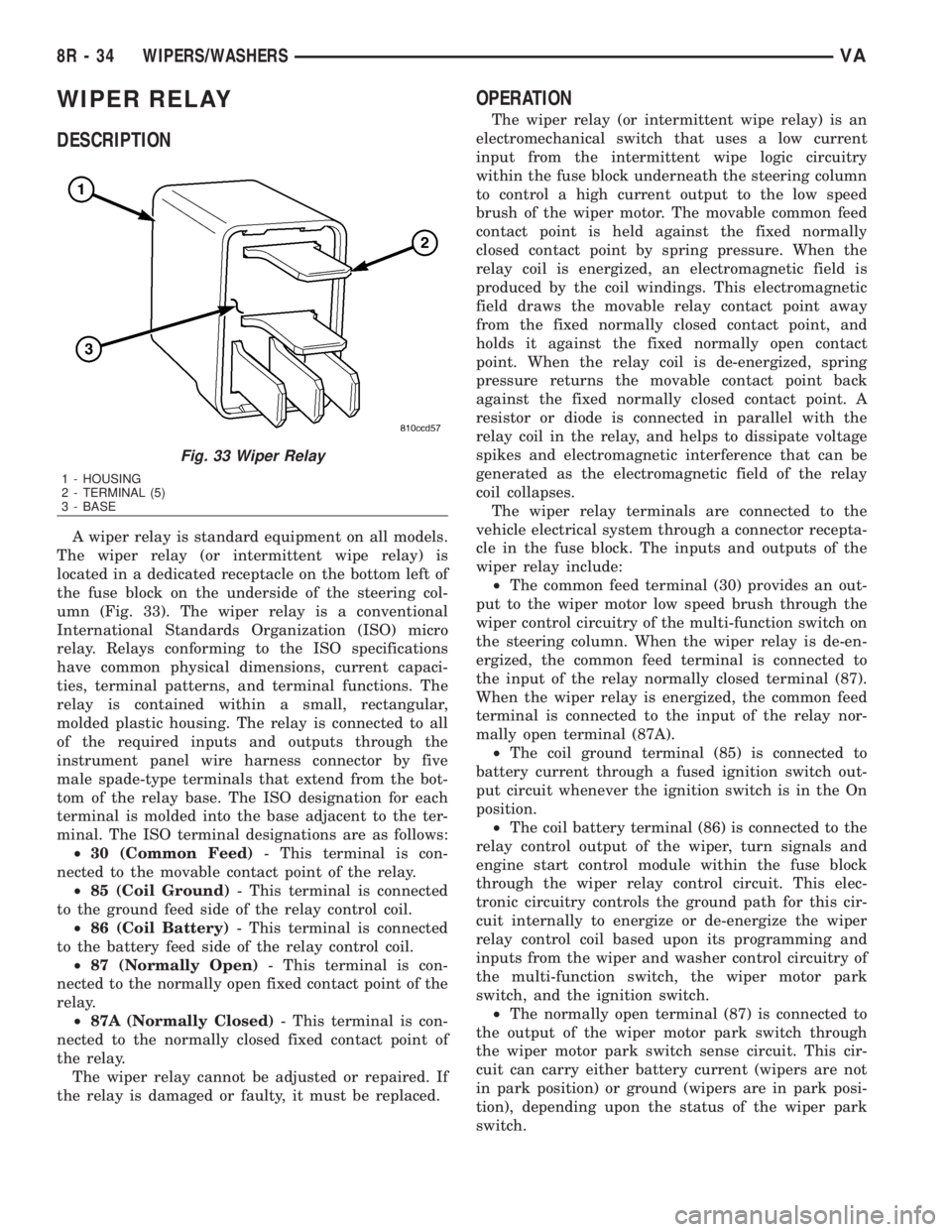
umn (Fig. 33). The wiper relay is a conventional
International Standards Organization (ISO) micro
relay. Relays conforming to the ISO specifications
have common physical dimensions, current capaci-
ties, terminal patterns, and terminal functions. The
relay is contained within a small, rectangular,
molded plastic housing. The relay is connected to all
of the required inputs and outputs through the
instrument panel wire harness connector by five
male spade-type terminals that extend from the bot-
tom of the relay base. The ISO designation for each
terminal is molded into the base adjacent to the ter-
minal. The ISO terminal designations are as follows:
²30 (Common Feed)- This terminal is con-
nected to the movable contact point of the relay.
²85 (Coil Ground)- This terminal is connected
to the ground feed side of the relay control coil.
²86 (Coil Battery)- This terminal is connected
to the battery feed side of the relay control coil.
²87 (Normally Open)- This terminal is con-
nected to the normally open fixed contact point of the
relay.
²87A (Normally Closed)- This terminal is con-
nected to the normally closed fixed contact point of
the relay.
The wiper relay cannot be adjusted or repaired. If
the relay is damaged or faulty, it must be replaced.
OPERATION
The wiper relay (or intermittent wipe relay) is an
electromechanical switch that uses a low current
input from the intermittent wipe logic circuitry
within the fuse block underneath the steering column
to control a high current output to the low speed
brush of the wiper motor. The movable common feed
contact point is held against the fixed normally
closed contact point by spring pressure. When the
relay coil is energized, an electromagnetic field is
produced by the coil windings. This electromagnetic
field draws the movable relay contact point away
from the fixed normally closed contact point, and
holds it against the fixed normally open contact
point. When the relay coil is de-energized, spring
pressure returns the movable contact point back
against the fixed normally closed contact point. A
resistor or diode is connected in parallel with the
relay coil in the relay, and helps to dissipate voltage
spikes and electromagnetic interference that can be
generated as the electromagnetic field of the relay
coil collapses.
The wiper relay terminals are connected to the
vehicle electrical system through a connector recepta-
cle in the fuse block. The inputs and outputs of the
wiper relay include:
²The common feed terminal (30) provides an out-
put to the wiper motor low speed brush through the
wiper control circuitry of the multi-function switch on
the steering column. When the wiper relay is de-en-
ergized, the common feed terminal is connected to
the input of the relay normally closed terminal (87).
When the wiper relay is energized, the common feed
terminal is connected to the input of the relay nor-
mally open terminal (87A).
²The coil ground terminal (85) is connected to
battery current through a fused ignition switch out-
put circuit whenever the ignition switch is in the On
position.
²The coil battery terminal (86) is connected to the
relay control output of the wiper, turn signals and
engine start control module within the fuse block
through the wiper relay control circuit. This elec-
tronic circuitry controls the ground path for this cir-
cuit internally to energize or de-energize the wiper
relay control coil based upon its programming and
inputs from the wiper and washer control circuitry of
the multi-function switch, the wiper motor park
switch, and the ignition switch.
²The normally open terminal (87) is connected to
the output of the wiper motor park switch through
the wiper motor park switch sense circuit. This cir-
cuit can carry either battery current (wipers are not
in park position) or ground (wipers are in park posi-
tion), depending upon the status of the wiper park
switch.
Fig. 33 Wiper Relay
1 - HOUSING
2 - TERMINAL (5)
3 - BASE
8R - 34 WIPERS/WASHERSVA
Page 1092 of 2305

8W-02 COMPONENT INDEX
Component Page
A/C Auxiliary Fan..................... 8W-42
A/C Auxiliary Fan Relay................ 8W-42
A/C Compressor Clutch................. 8W-42
A/C Compressor Clutch Relay............ 8W-42
A/C Roof Auxiliary Fan................. 8W-42
A/C Roof Auxiliary Fan Relay............ 8W-42
Accelerator Pedal Position Sensor......... 8W-30
Additional Heat Exchanger.............. 8W-42
Additional Heat Exchanger Relay......... 8W-42
Additional Heat Exchanger Switch........ 8W-42
Air Outlet Temperature Sensor........... 8W-42
Airbag Control Module................. 8W-43
Airbag Squibs........................ 8W-43
Ambient Temperature Sensor............ 8W-42
Anti Icing Switch..................... 8W-42
Ash Receiver Lamp.................... 8W-44
Automatic Temperature Control Module.... 8W-42
Auxiliary Heater Control................ 8W-42
Battery............................. 8W-20
Battery Relay-Auxiliary................ 8W-20
Battery-Auxiliary..................... 8W-20
Beam Select Switch.................... 8W-50
Blower Motor Resistor Block............. 8W-42
Blower Motor-Front.................... 8W-42
Blower Stage I Diode................... 8W-42
Body Plug Connector................... 8W-11
Boost Pressure Sensor.................. 8W-30
Boost Pressure Servomotor.............. 8W-30
Boost Pressure Solenoid................ 8W-30
Brake Fluid Level Switch............... 8W-35
Brake Lamp Switch.................... 8W-35
Brake Lamp Switch 4 Pole.............. 8W-35
Brake Pressure Sensor................. 8W-35
Brake Wear Sensors................... 8W-35
CTEL Antenna Connector............... 8W-55
CTEL Connector...................... 8W-55
Cabin Heater Assembly................. 8W-42
Cabin Heater Module.................. 8W-42
Camshaft Position Sensor............... 8W-30
Center High Mounted Stop Lamp......... 8W-51
Central Timer Module.................. 8W-45
Cigar Lighter......................... 8W-41
Cigar Lighter Lamp................... 8W-44
Circulation Pump..................... 8W-42
Circulation Pump Diode................ 8W-42
Circulation Pump Relay-Cabin Heater
Module........................... 8W-42
Clockspring....................... 8W-41, 43
Controller Antilock Brake............... 8W-35
Courtesy Lamps...................... 8W-44
Crankcase Heater..................... 8W-30
Crankshaft Position Sensor.............. 8W-30Component Page
Cylinder Lock Switch-Driver............. 8W-61
D+ Relays........................ 8W-10, 11
Data Link Connector................... 8W-18
Daytime Running Lamp Relays........... 8W-50
Differential Lock Solenoid Valve.......... 8W-31
Dome Lamp.......................... 8W-44
Door Jamb Switch-Rear................. 8W-61
Door Jamb Switches................... 8W-44
Door Jamb Switches-Sliding............. 8W-61
Door Lock Motor/Ajar Switch Assemblies . . . 8W-61
Dosing Pump......................... 8W-42
EGR Valve........................... 8W-30
Electrohydraulic Control Unit............ 8W-31
Engine Control Module................. 8W-30
Engine Control Relay.................. 8W-31
Engine Coolant Level Switch............. 8W-30
Engine Coolant Temperature Sensor....... 8W-30
Engine Oil Sensor..................... 8W-30
Evaporator Temperature Sensor.......... 8W-42
Fan Stage 1 Relay..................... 8W-42
Fog Lamp Relay...................... 8W-50
Fog Lamp Switch..................... 8W-50
Fuel Injectors........................ 8W-30
Fuel Level Sensor..................... 8W-30
Fuel Pressure Sensor.................. 8W-30
Fuel Pressure Solenoid................. 8W-30
Fuel Pump........................... 8W-30
Fuel Pump Relay...................... 8W-30
Fuel Quantity Control Valve............. 8W-30
Fuel Shutdown Solenoid................ 8W-30
Fuel Temperature Sensor............... 8W-30
Fuse Blocks.................... 8W-10, 11, 30
Fuse/Relay Block...................... 8W-11
Fused Ignition Switch Run-Start Relay..... 8W-11
Fuses......................... 8W-10, 11, 42
Generator........................... 8W-20
Glow Plug Control Module.............. 8W-30
Glow Plugs.......................... 8W-30
Grounds............................ 8W-15
Hazard Warning Switch................ 8W-52
Headlamp Adjust Switch................ 8W-50
Headlamp Assemblies............... 8W-50, 52
Headlamp Switch..................... 8W-50
Heated Seat Modules.................. 8W-63
Heated Seat Switches.................. 8W-63
Heater Timer-Auxiliary................. 8W-42
High Idle Switch...................... 8W-30
High Pressure Switch.................. 8W-42
Hood Ajar Switch..................... 8W-39
Horn............................... 8W-41
Horn Relay.......................... 8W-41
Horn Switch......................... 8W-41
VA8W-02 COMPONENT INDEX 8W - 02 - 1
Page 1214 of 2305
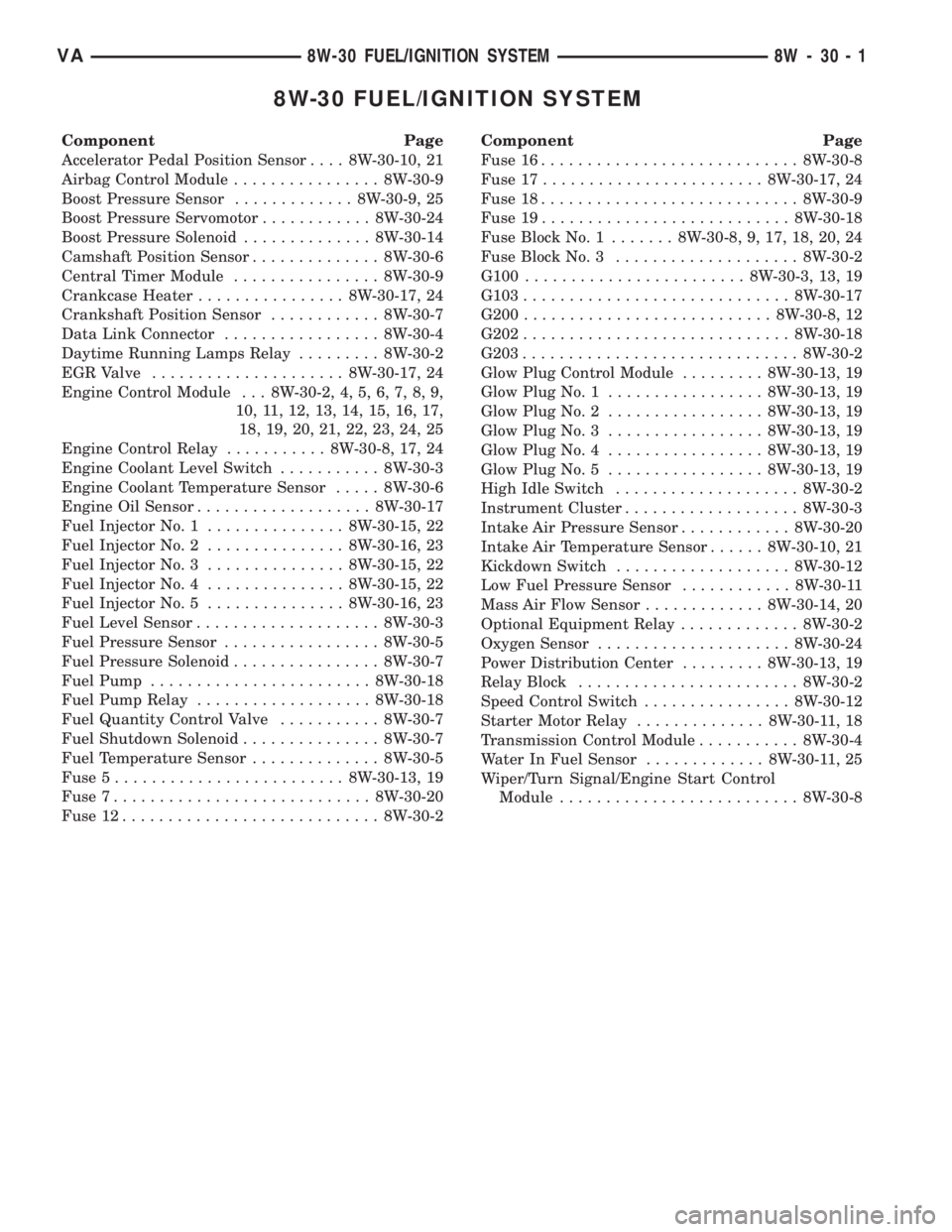
8W-30 FUEL/IGNITION SYSTEM
Component Page
Accelerator Pedal Position Sensor.... 8W-30-10, 21
Airbag Control Module................ 8W-30-9
Boost Pressure Sensor............. 8W-30-9, 25
Boost Pressure Servomotor............ 8W-30-24
Boost Pressure Solenoid.............. 8W-30-14
Camshaft Position Sensor.............. 8W-30-6
Central Timer Module................ 8W-30-9
Crankcase Heater................ 8W-30-17, 24
Crankshaft Position Sensor............ 8W-30-7
Data Link Connector................. 8W-30-4
Daytime Running Lamps Relay......... 8W-30-2
EGR Valve..................... 8W-30-17, 24
Engine Control Module . . . 8W-30-2, 4, 5, 6, 7, 8, 9,
10, 11, 12, 13, 14, 15, 16, 17,
18, 19, 20, 21, 22, 23, 24, 25
Engine Control Relay........... 8W-30-8, 17, 24
Engine Coolant Level Switch........... 8W-30-3
Engine Coolant Temperature Sensor..... 8W-30-6
Engine Oil Sensor................... 8W-30-17
Fuel Injector No. 1............... 8W-30-15, 22
Fuel Injector No. 2............... 8W-30-16, 23
Fuel Injector No. 3............... 8W-30-15, 22
Fuel Injector No. 4............... 8W-30-15, 22
Fuel Injector No. 5............... 8W-30-16, 23
Fuel Level Sensor.................... 8W-30-3
Fuel Pressure Sensor................. 8W-30-5
Fuel Pressure Solenoid................ 8W-30-7
Fuel Pump........................ 8W-30-18
Fuel Pump Relay................... 8W-30-18
Fuel Quantity Control Valve........... 8W-30-7
Fuel Shutdown Solenoid............... 8W-30-7
Fuel Temperature Sensor.............. 8W-30-5
Fuse 5......................... 8W-30-13, 19
Fuse 7............................ 8W-30-20
Fuse 12............................ 8W-30-2Component Page
Fuse 16............................ 8W-30-8
Fuse 17........................ 8W-30-17, 24
Fuse 18............................ 8W-30-9
Fuse 19........................... 8W-30-18
Fuse Block No. 1....... 8W-30-8, 9, 17, 18, 20, 24
Fuse Block No. 3.................... 8W-30-2
G100........................ 8W-30-3, 13, 19
G103............................. 8W-30-17
G200........................... 8W-30-8, 12
G202............................. 8W-30-18
G203.............................. 8W-30-2
Glow Plug Control Module......... 8W-30-13, 19
Glow Plug No. 1................. 8W-30-13, 19
Glow Plug No. 2................. 8W-30-13, 19
Glow Plug No. 3................. 8W-30-13, 19
Glow Plug No. 4................. 8W-30-13, 19
Glow Plug No. 5................. 8W-30-13, 19
High Idle Switch.................... 8W-30-2
Instrument Cluster................... 8W-30-3
Intake Air Pressure Sensor............ 8W-30-20
Intake Air Temperature Sensor...... 8W-30-10, 21
Kickdown Switch................... 8W-30-12
Low Fuel Pressure Sensor............ 8W-30-11
Mass Air Flow Sensor............. 8W-30-14, 20
Optional Equipment Relay............. 8W-30-2
Oxygen Sensor..................... 8W-30-24
Power Distribution Center......... 8W-30-13, 19
Relay Block........................ 8W-30-2
Speed Control Switch................ 8W-30-12
Starter Motor Relay.............. 8W-30-11, 18
Transmission Control Module........... 8W-30-4
Water In Fuel Sensor............. 8W-30-11, 25
Wiper/Turn Signal/Engine Start Control
Module.......................... 8W-30-8
VA8W-30 FUEL/IGNITION SYSTEM 8W - 30 - 1
Page 1419 of 2305

Component Page
Cigar Lighter...................... 8W-80-30
Cigar Lighter Lamp................. 8W-80-30
Circulation Pump (Cabin Heater
Module)........................ 8W-80-31
Circulation Pump (Rest System)........ 8W-80-31
Circulation Pump Diode.............. 8W-80-31
Clockspring C1..................... 8W-80-31
Clockspring C2..................... 8W-80-31
Controller Antilock Brake............. 8W-80-32
Courtesy Lamp-Driver Door........... 8W-80-33
Courtesy Lamp-Left Sliding Door....... 8W-80-33
Courtesy Lamp-Passenger Door........ 8W-80-33
Courtesy Lamp-Right Sliding Door...... 8W-80-33
Crankcase Heater................... 8W-80-34
Crankshaft Position Sensor........... 8W-80-34
CTEL Antenna Connector............. 8W-80-34
CTEL Connector.................... 8W-80-34
Cylinder Lock Switch-Driver.......... 8W-80-35
Data Link Connector................ 8W-80-35
Differential Lock Solenoid Valve........ 8W-80-35
Dome Lamp....................... 8W-80-35
Door Lock Motor/Ajar Switch
Assembly-Driver C1............... 8W-80-36
Door Lock Motor/Ajar Switch
Assembly-Driver C2............... 8W-80-36
Door Lock Motor/Ajar Switch
Assembly-Left Sliding C1........... 8W-80-36
Door Lock Motor/Ajar Switch
Assembly-Left Sliding C2........... 8W-80-36
Door Lock Motor/Ajar Switch
Assembly-Passenger C1............ 8W-80-36
Door Lock Motor/Ajar Switch
Assembly-Passenger C2............ 8W-80-37
Door Lock Motor/Ajar Switch
Assembly-Rear C1................ 8W-80-37
Door Lock Motor/Ajar Switch
Assembly-Rear C2................ 8W-80-37
Door Lock Motor/Ajar Switch
Assembly-Right Sliding C1.......... 8W-80-37
Door Lock Motor/Ajar Switch
Assembly-Right Sliding C2.......... 8W-80-37
Dosing Pump...................... 8W-80-38
EGR Valve........................ 8W-80-38
Electrohydraulic Control Unit......... 8W-80-38
Engine Control Module C1 (Except
OBD).......................... 8W-80-38
Engine Control Module C1 (OBD)...... 8W-80-39
Engine Control Module C2 (Except
OBD).......................... 8W-80-40
Engine Control Module C2 (OBD)...... 8W-80-41
Engine Control Module C3 (Except
OBD).......................... 8W-80-42
Engine Control Module C4 (Except
OBD).......................... 8W-80-43Component Page
Engine Control Module C5 (Except
OBD).......................... 8W-80-44
Engine Coolant Level Switch.......... 8W-80-44
Engine Coolant Temperature Sensor.... 8W-80-44
Engine Oil Sensor................... 8W-80-44
Evaporator Temperature Sensor........ 8W-80-45
Fog Lamp Switch................... 8W-80-45
Fuel Injector No. 1.................. 8W-80-45
Fuel Injector No. 2.................. 8W-80-45
Fuel Injector No. 3.................. 8W-80-46
Fuel Injector No. 4.................. 8W-80-46
Fuel Injector No. 5.................. 8W-80-46
Fuel Level Sensor................... 8W-80-46
Fuel Pressure Sensor................ 8W-80-47
Fuel Pressure Solenoid............... 8W-80-47
Fuel Pump (OBD)................... 8W-80-47
Fuel Pump Relay (OBD).............. 8W-80-47
Fuel Quantity Control Valve (OBD)..... 8W-80-47
Fuel Shutdown Solenoid.............. 8W-80-48
Fuel Temperature Sensor............. 8W-80-48
Fuse Block No. 1 C1................. 8W-80-48
Fuse Block No. 1 C2................. 8W-80-49
Fuse Block No. 1 C3................. 8W-80-49
Fuse Block No. 1 C4................. 8W-80-49
Fuse Block No. 1 C5................. 8W-80-49
Glow Plug Control Module C1......... 8W-80-50
Glow Plug Control Module C2......... 8W-80-50
Headlamp Adjust Switch............. 8W-80-50
Headlamp Assembly-Left............. 8W-80-51
Headlamp Assembly-Right............ 8W-80-51
Heated Seat Module-Driver........... 8W-80-51
Heated Seat Module-Passenger........ 8W-80-52
Heated Seat Switch-Driver............ 8W-80-52
Heated Seat Switch-Passenger......... 8W-80-52
Heater Timer-auxiliary............... 8W-80-53
High Idle Switch.................... 8W-80-53
Hood Ajar Switch................... 8W-80-53
Horn............................. 8W-80-54
Horn (VTSS)....................... 8W-80-54
Ignition Lock Switch................. 8W-80-54
Instrument Cluster C1............... 8W-80-54
Instrument Cluster C2............... 8W-80-55
Instrument Panel Socket............. 8W-80-55
Intake Air Pressure Sensor (OBD)...... 8W-80-55
Intake Air Temperature Sensor........ 8W-80-56
Interior Lamp No. 1................. 8W-80-56
Interior Lamp No. 2................. 8W-80-56
Interior Lamp No. 3................. 8W-80-56
Interior Lamp No. 4................. 8W-80-56
Interior Lamp No. 5................. 8W-80-57
Interior Lamp-Left.................. 8W-80-57
Interior Lamp-middle Front........... 8W-80-57
Interior Lamp-middle Rear............ 8W-80-57
Interior Lamp-Rear No. 1............. 8W-80-58
Interior Lamp-Rear No. 2............. 8W-80-58
8W - 80 - 2 8W-80 CONNECTOR PIN-OUTSVA
Page 1456 of 2305
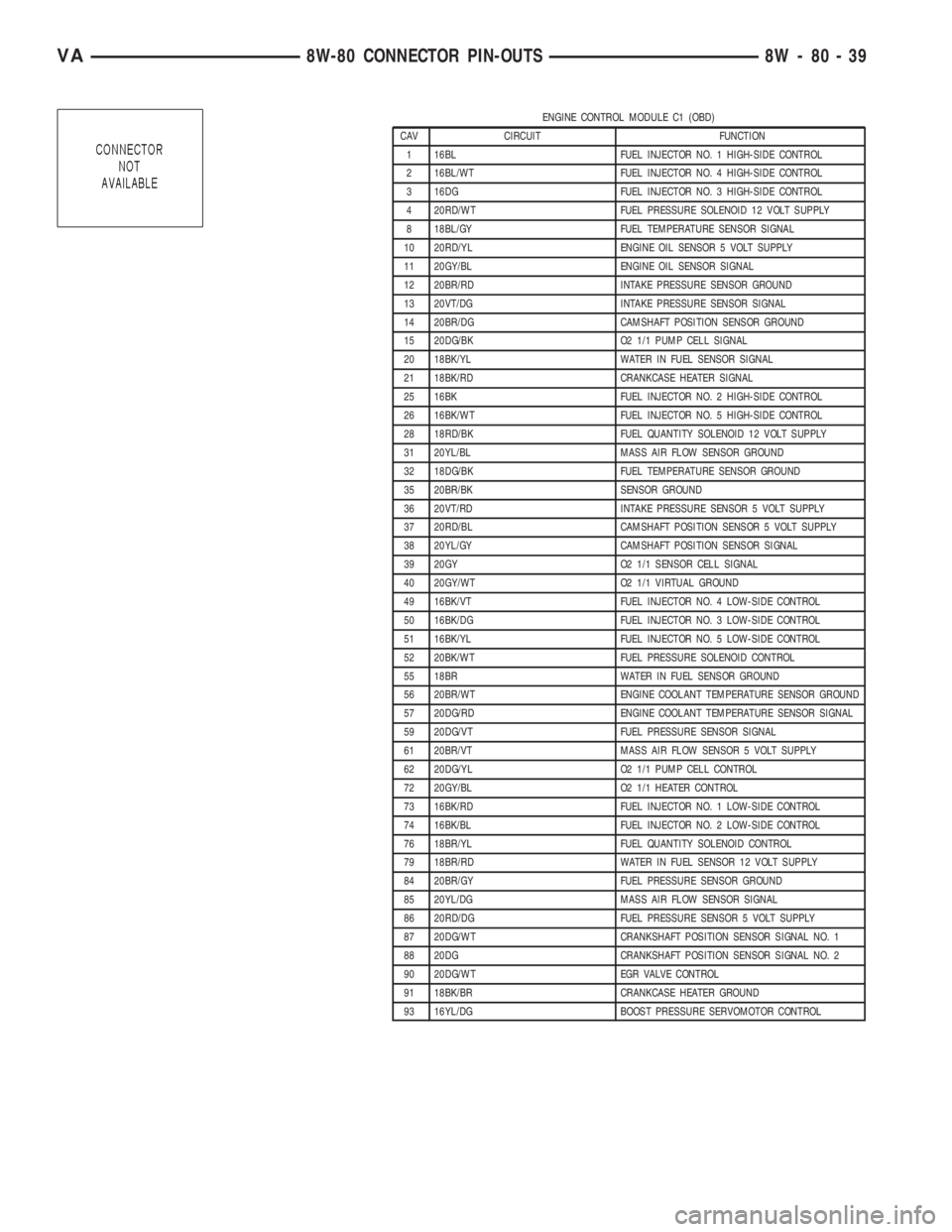
ENGINE CONTROL MODULE C1 (OBD)
CAV CIRCUIT FUNCTION
1 16BL FUEL INJECTOR NO. 1 HIGH-SIDE CONTROL
2 16BL/WT FUEL INJECTOR NO. 4 HIGH-SIDE CONTROL
3 16DG FUEL INJECTOR NO. 3 HIGH-SIDE CONTROL
4 20RD/WT FUEL PRESSURE SOLENOID 12 VOLT SUPPLY
8 18BL/GY FUEL TEMPERATURE SENSOR SIGNAL
10 20RD/YL ENGINE OIL SENSOR 5 VOLT SUPPLY
11 20GY/BL ENGINE OIL SENSOR SIGNAL
12 20BR/RD INTAKE PRESSURE SENSOR GROUND
13 20VT/DG INTAKE PRESSURE SENSOR SIGNAL
14 20BR/DG CAMSHAFT POSITION SENSOR GROUND
15 20DG/BK O2 1/1 PUMP CELL SIGNAL
20 18BK/YL WATER IN FUEL SENSOR SIGNAL
21 18BK/RD CRANKCASE HEATER SIGNAL
25 16BK FUEL INJECTOR NO. 2 HIGH-SIDE CONTROL
26 16BK/WT FUEL INJECTOR NO. 5 HIGH-SIDE CONTROL
28 18RD/BK FUEL QUANTITY SOLENOID 12 VOLT SUPPLY
31 20YL/BL MASS AIR FLOW SENSOR GROUND
32 18DG/BK FUEL TEMPERATURE SENSOR GROUND
35 20BR/BK SENSOR GROUND
36 20VT/RD INTAKE PRESSURE SENSOR 5 VOLT SUPPLY
37 20RD/BL CAMSHAFT POSITION SENSOR 5 VOLT SUPPLY
38 20YL/GY CAMSHAFT POSITION SENSOR SIGNAL
39 20GY O2 1/1 SENSOR CELL SIGNAL
40 20GY/WT O2 1/1 VIRTUAL GROUND
49 16BK/VT FUEL INJECTOR NO. 4 LOW-SIDE CONTROL
50 16BK/DG FUEL INJECTOR NO. 3 LOW-SIDE CONTROL
51 16BK/YL FUEL INJECTOR NO. 5 LOW-SIDE CONTROL
52 20BK/WT FUEL PRESSURE SOLENOID CONTROL
55 18BR WATER IN FUEL SENSOR GROUND
56 20BR/WT ENGINE COOLANT TEMPERATURE SENSOR GROUND
57 20DG/RD ENGINE COOLANT TEMPERATURE SENSOR SIGNAL
59 20DG/VT FUEL PRESSURE SENSOR SIGNAL
61 20BR/VT MASS AIR FLOW SENSOR 5 VOLT SUPPLY
62 20DG/YL O2 1/1 PUMP CELL CONTROL
72 20GY/BL O2 1/1 HEATER CONTROL
73 16BK/RD FUEL INJECTOR NO. 1 LOW-SIDE CONTROL
74 16BK/BL FUEL INJECTOR NO. 2 LOW-SIDE CONTROL
76 18BR/YL FUEL QUANTITY SOLENOID CONTROL
79 18BR/RD WATER IN FUEL SENSOR 12 VOLT SUPPLY
84 20BR/GY FUEL PRESSURE SENSOR GROUND
85 20YL/DG MASS AIR FLOW SENSOR SIGNAL
86 20RD/DG FUEL PRESSURE SENSOR 5 VOLT SUPPLY
87 20DG/WT CRANKSHAFT POSITION SENSOR SIGNAL NO. 1
88 20DG CRANKSHAFT POSITION SENSOR SIGNAL NO. 2
90 20DG/WT EGR VALVE CONTROL
91 18BK/BR CRANKCASE HEATER GROUND
93 16YL/DG BOOST PRESSURE SERVOMOTOR CONTROL
VA8W-80 CONNECTOR PIN-OUTS 8W - 80 - 39
Page 1460 of 2305
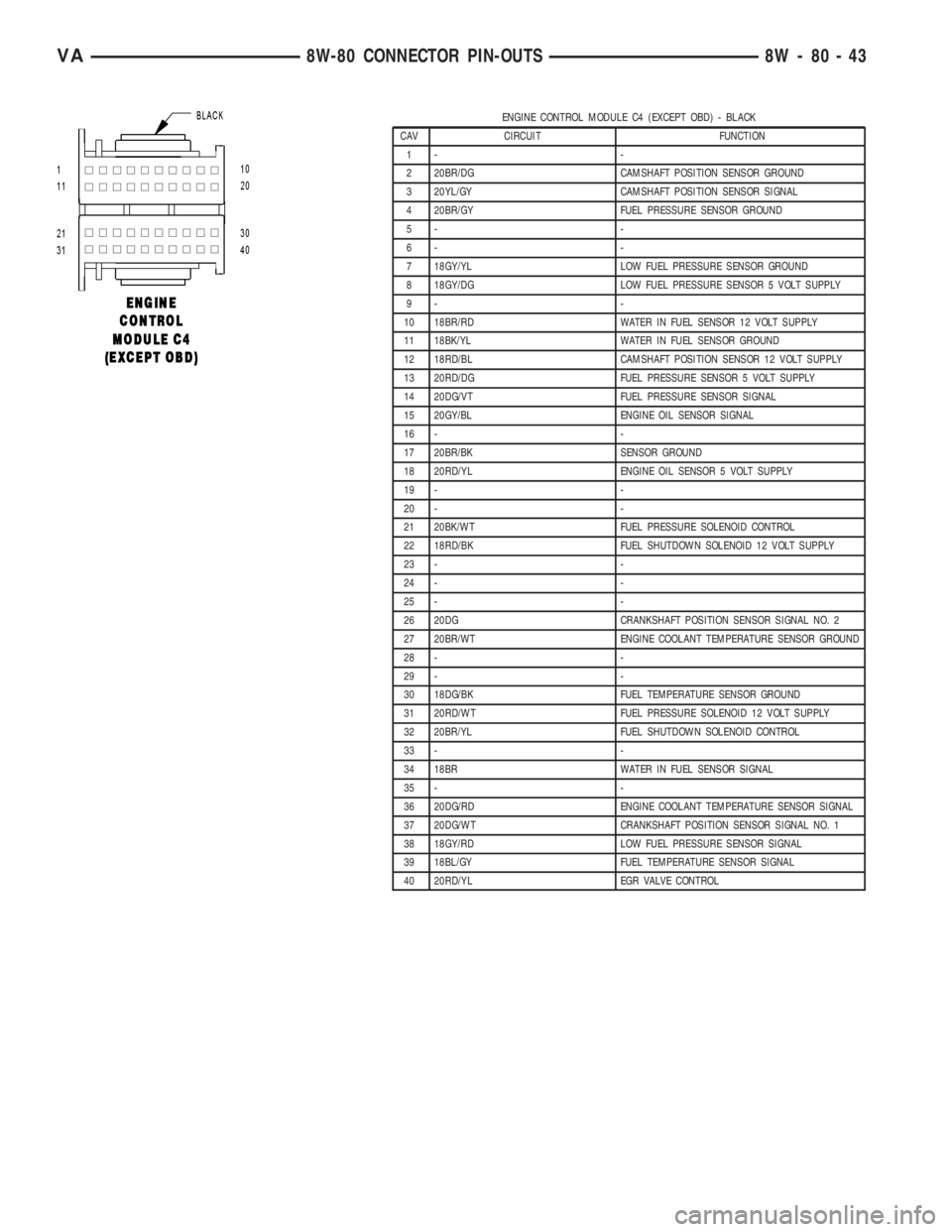
ENGINE CONTROL MODULE C4 (EXCEPT OBD) - BLACK
CAV CIRCUIT FUNCTION
1- -
2 20BR/DG CAMSHAFT POSITION SENSOR GROUND
3 20YL/GY CAMSHAFT POSITION SENSOR SIGNAL
4 20BR/GY FUEL PRESSURE SENSOR GROUND
5- -
6- -
7 18GY/YL LOW FUEL PRESSURE SENSOR GROUND
8 18GY/DG LOW FUEL PRESSURE SENSOR 5 VOLT SUPPLY
9- -
10 18BR/RD WATER IN FUEL SENSOR 12 VOLT SUPPLY
11 18BK/YL WATER IN FUEL SENSOR GROUND
12 18RD/BL CAMSHAFT POSITION SENSOR 12 VOLT SUPPLY
13 20RD/DG FUEL PRESSURE SENSOR 5 VOLT SUPPLY
14 20DG/VT FUEL PRESSURE SENSOR SIGNAL
15 20GY/BL ENGINE OIL SENSOR SIGNAL
16 - -
17 20BR/BK SENSOR GROUND
18 20RD/YL ENGINE OIL SENSOR 5 VOLT SUPPLY
19 - -
20 - -
21 20BK/WT FUEL PRESSURE SOLENOID CONTROL
22 18RD/BK FUEL SHUTDOWN SOLENOID 12 VOLT SUPPLY
23 - -
24 - -
25 - -
26 20DG CRANKSHAFT POSITION SENSOR SIGNAL NO. 2
27 20BR/WT ENGINE COOLANT TEMPERATURE SENSOR GROUND
28 - -
29 - -
30 18DG/BK FUEL TEMPERATURE SENSOR GROUND
31 20RD/WT FUEL PRESSURE SOLENOID 12 VOLT SUPPLY
32 20BR/YL FUEL SHUTDOWN SOLENOID CONTROL
33 - -
34 18BR WATER IN FUEL SENSOR SIGNAL
35 - -
36 20DG/RD ENGINE COOLANT TEMPERATURE SENSOR SIGNAL
37 20DG/WT CRANKSHAFT POSITION SENSOR SIGNAL NO. 1
38 18GY/RD LOW FUEL PRESSURE SENSOR SIGNAL
39 18BL/GY FUEL TEMPERATURE SENSOR SIGNAL
40 20RD/YL EGR VALVE CONTROL
VA8W-80 CONNECTOR PIN-OUTS 8W - 80 - 43
Page 1461 of 2305
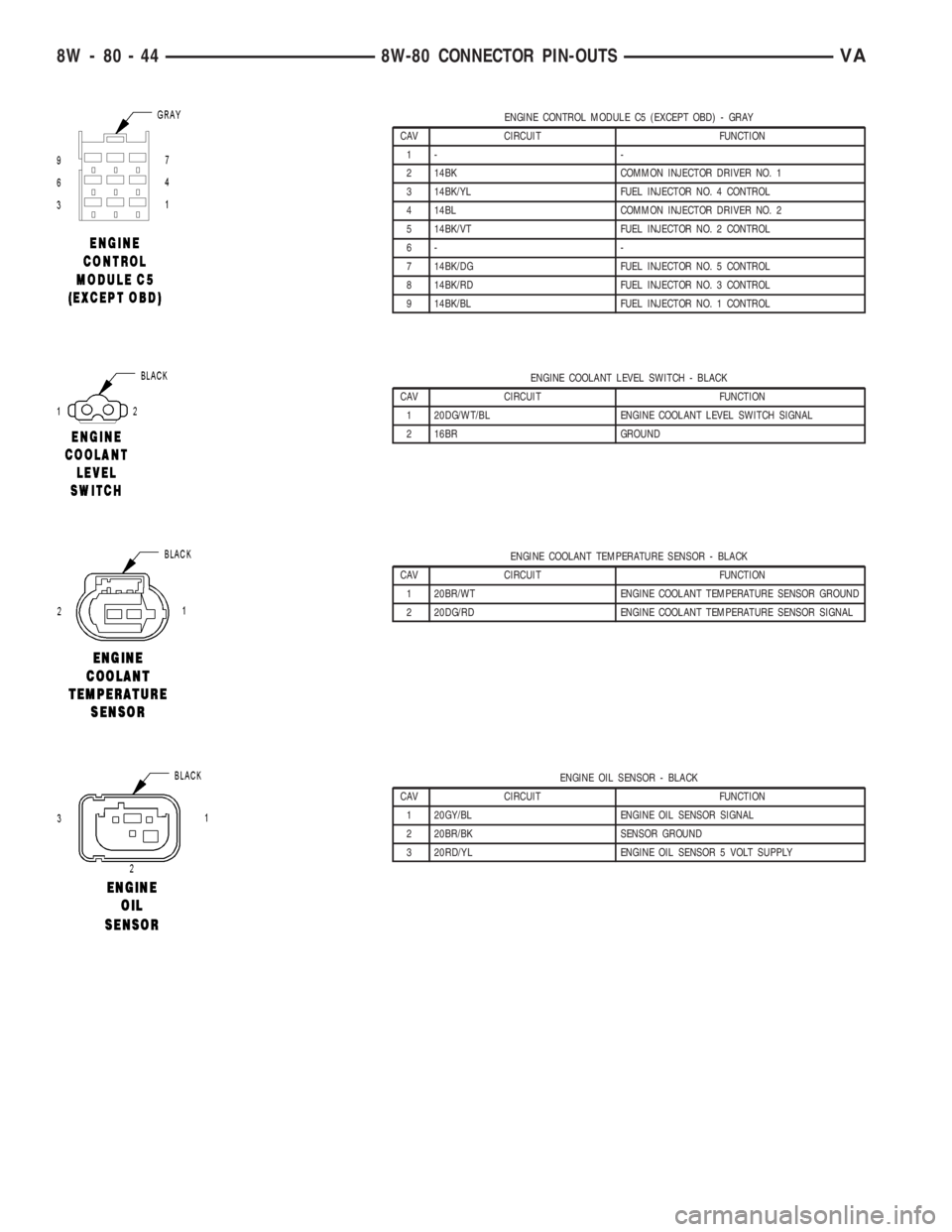
ENGINE CONTROL MODULE C5 (EXCEPT OBD) - GRAY
CAV CIRCUIT FUNCTION
1- -
2 14BK COMMON INJECTOR DRIVER NO. 1
3 14BK/YL FUEL INJECTOR NO. 4 CONTROL
4 14BL COMMON INJECTOR DRIVER NO. 2
5 14BK/VT FUEL INJECTOR NO. 2 CONTROL
6- -
7 14BK/DG FUEL INJECTOR NO. 5 CONTROL
8 14BK/RD FUEL INJECTOR NO. 3 CONTROL
9 14BK/BL FUEL INJECTOR NO. 1 CONTROL
ENGINE COOLANT LEVEL SWITCH - BLACK
CAV CIRCUIT FUNCTION
1 20DG/WT/BL ENGINE COOLANT LEVEL SWITCH SIGNAL
2 16BR GROUND
ENGINE COOLANT TEMPERATURE SENSOR - BLACK
CAV CIRCUIT FUNCTION
1 20BR/WT ENGINE COOLANT TEMPERATURE SENSOR GROUND
2 20DG/RD ENGINE COOLANT TEMPERATURE SENSOR SIGNAL
ENGINE OIL SENSOR - BLACK
CAV CIRCUIT FUNCTION
1 20GY/BL ENGINE OIL SENSOR SIGNAL
2 20BR/BK SENSOR GROUND
3 20RD/YL ENGINE OIL SENSOR 5 VOLT SUPPLY
8W - 80 - 44 8W-80 CONNECTOR PIN-OUTSVA