fuel pump MERCEDES-BENZ SPRINTER 2006 Service Manual
[x] Cancel search | Manufacturer: MERCEDES-BENZ, Model Year: 2006, Model line: SPRINTER, Model: MERCEDES-BENZ SPRINTER 2006Pages: 2305, PDF Size: 48.12 MB
Page 9 of 2305
TABLE OF CONTENTS - Continued
A/C COMPRESSOR CONTROL SHORTED LOW (ACTIVE)....................132
AIR OUTLET TEMP SENSOR HIGH OR OPEN (ACTIVE).....................134
AIR OUTLET TEMP SENSOR SHORTED LOW (ACTIVE).....................136
ATC FUNCTION TEST COOL FAILURE....................................138
ATC FUNCTION TEST FAILURE..........................................138
ATC FUNCTION TEST HEAT FAILURE.....................................138
AUX FAN RELAY CONTROL HIGH OR OPEN (ACTIVE)......................140
AUX FAN RELAY CONTROL SHORTED LOW (ACTIVE)......................142
BLOWER STAGE 1 HIGH OR OPEN (ACTIVE)..............................144
BLOWER STAGE 1 SHORTED LOW (ACTIVE)..............................146
CABIN HEATER CONTROL HIGH OR OPEN (ACTIVE).......................148
CABIN HEATER CONTROL SHORTED LOW (ACTIVE).......................150
CIRC PUMP CONTROL HIGH OR OPEN (ACTIVE)..........................152
CIRC PUMP CONTROL SHORTED LOW (ACTIVE)..........................154
EVAP TEMP SENSOR HIGH OR OPEN (ACTIVE)...........................156
EVAP TEMP SENSOR SHORTED LOW (ACTIVE)...........................158
NO COMMUNICATION BUS (ACTIVE).....................................160
NO COMMUNICATION WITH ECM (ACTIVE)...............................163
NO COMMUNICATION WITH IC (ACTIVE)..................................165
RECIRC AIR SOLENOID CONTROL HIGH OR OPEN (ACTIVE)................167
RECIRC AIR SOLENOID CONTROL SHORTED LOW (ACTIVE)................169
REFRIG PRESS SENSOR HIGH OR OPEN (ACTIVE)........................171
REFRIG PRESS SENSOR SHORTED LOW (ACTIVE)........................173
WATER CYCLE VALVE CONTROL HIGH OR OPEN (ACTIVE).................175
WATER CYCLE VALVE CONTROL SHORTED LOW (ACTIVE).................177
INSTRUMENT CLUSTER
AMBIENT TEMP SENSOR OPEN/SHORT TO BATTERY......................179
AMBIENT TEMP SENSOR SHORT TO GROUND............................181
FUEL LEVEL SENSOR OPEN/SHORT TO BATTERY.........................182
FUEL LEVEL SENSOR SHORT TO GROUND...............................184
INSTRUMENT CLUSTER INTERNAL FAILURE B1043........................185
INSTRUMENT CLUSTER INTERNAL FAILURE B1053........................186
INSTRUMENT CLUSTER OVERVOLTAGE..................................187
NO CAN COMMUNICATION WITH ABS....................................188
NO CAN COMMUNICATION WITH ECM...................................190
NO CAN COMMUNICATION WITH TCM....................................192
PREGLOW INDICATOR LAMP FAILURE...................................194
SRS INDICATOR LAMP FAILURE.........................................195
POWER DOOR LOCKS/RKE
DRIVER DOOR AJAR INDICATOR DRIVER CIRCUIT SHORT TO GROUND......196
PASSENGER DOOR AJAR INDICATOR DRIVER CIRCUIT SHORT TO GROUND .198
REPLACE CONTROL MODULE..........................................200
RKE INTERFACE CIRCUIT SHORT TO GROUND - CTM......................201
RKE INTERFACE CIRCUIT SHORT TO GROUND - SKREEM..................203
RKE INTERFACE CIRCUIT SHORT TO VOLTAGE - CTM.....................205
RKE INTERFACE CIRCUIT SHORT TO VOLTAGE - SKREEM..................206
THE ACM HAS UNLOCKED THE DOORS..................................208
UNKNOWN TROUBLE CODE UNKNOWN DTC TYPE 2......................209
*RKE INOPERATIVE....................................................210
*RKE POOR RANGE...................................................211
iv
Page 11 of 2305
TABLE OF CONTENTS - Continued
8.9VEHICLE THEFT SECURITY SYSTEM................................254
8.9.1SECURITY SYSTEM MODULE..............................254
8.9.2INTRUSION SENSORS....................................254
8.9.3SWITCHES..............................................255
8.9.4SIREN..................................................255
9.0 CONNECTOR PINOUTS................................................257
A/C AUXILIARY FAN....................................................257
AIR OUTLET TEMPERATURE SENSOR...................................257
AIRBAG CONTROL MODULE - YELLOW...................................257
AIRBAG SQUIB-DRIVER - YELLOW.......................................258
AIRBAG SQUIB-PASSENGER - YELLOW..................................258
AMBIENT TEMPERATURE SENSOR......................................258
AUTOMATIC TEMPERATURE CONTROL MODULE C1 - BROWN..............259
AUTOMATIC TEMPERATURE CONTROL MODULE C2.......................259
AUXILIARY HEATER CONTROL..........................................259
BLOWER MOTOR RESISTOR BLOCK.....................................259
BLOWER MOTOR-FRONT - BLACK.......................................260
C205 - YELLOW (DASH SIDE)...........................................260
C205 - YELLOW (MAIN BODY SIDE)......................................260
CENTRAL TIMER MODULE C1 - PINK.....................................260
CENTRAL TIMER MODULE C2 - LT. GREEN...............................261
CIRCULATION PUMP (CABIN HEATER MODULE)...........................261
CIRCULATION PUMP (REST SYSTEM)....................................261
CIRCULATION PUMP DIODE............................................261
CLOCKSPRING C2 - YELLOW...........................................262
CONTROLLER ANTILOCK BRAKE........................................262
CYLINDER LOCK SWITCH-DRIVER.......................................263
DATA LINK CONNECTOR - BLACK........................................263
DOOR LOCK MOTOR/AJAR SWITCH ASSEMBLY-DRIVER C1.................263
DOOR LOCK MOTOR/AJAR SWITCH ASSEMBLY-DRIVER C2.................263
DOOR LOCK MOTOR/AJAR SWITCH ASSEMBLY-LEFT SLIDING C1...........263
DOOR LOCK MOTOR/AJAR SWITCH ASSEMBLY-LEFT SLIDING C2...........264
DOOR LOCK MOTOR/AJAR SWITCH ASSEMBLY-PASSENGER C1............264
DOOR LOCK MOTOR/AJAR SWITCH ASSEMBLY-PASSENGER C2............264
DOOR LOCK MOTOR/AJAR SWITCH ASSEMBLY-REAR C1...................264
DOOR LOCK MOTOR/AJAR SWITCH ASSEMBLY-REAR C2...................264
DOOR LOCK MOTOR/AJAR SWITCH ASSEMBLY-RIGHT SLIDING C1..........265
DOOR LOCK MOTOR/AJAR SWITCH ASSEMBLY-RIGHT SLIDING C2..........265
DOSING PUMP........................................................265
ENGINE CONTROL MODULE C1 (EXCEPT OBD) - BLACK...................265
ENGINE CONTROL MODULE C2 (EXCEPT OBD) - BLACK...................266
ENGINE CONTROL MODULE C2 (OBD)...................................267
ENGINE CONTROL MODULE C3 (EXCEPT OBD) - BLACK...................268
EVAPORATOR TEMPERATURE SENSOR..................................269
FUEL LEVEL SENSOR..................................................269
FUSES (FUSE BLOCK NO. 1)............................................271
FUSE BLOCK NO. 1 C1.................................................271
FUSE BLOCK NO. 1 C2.................................................271
FUSE BLOCK NO. 1 C3 - BLACK.........................................272
FUSE BLOCK NO. 1 C4 - BLACK.........................................272
FUSE BLOCK NO. 1 C5 - BLACK.........................................272
vi
Page 20 of 2305
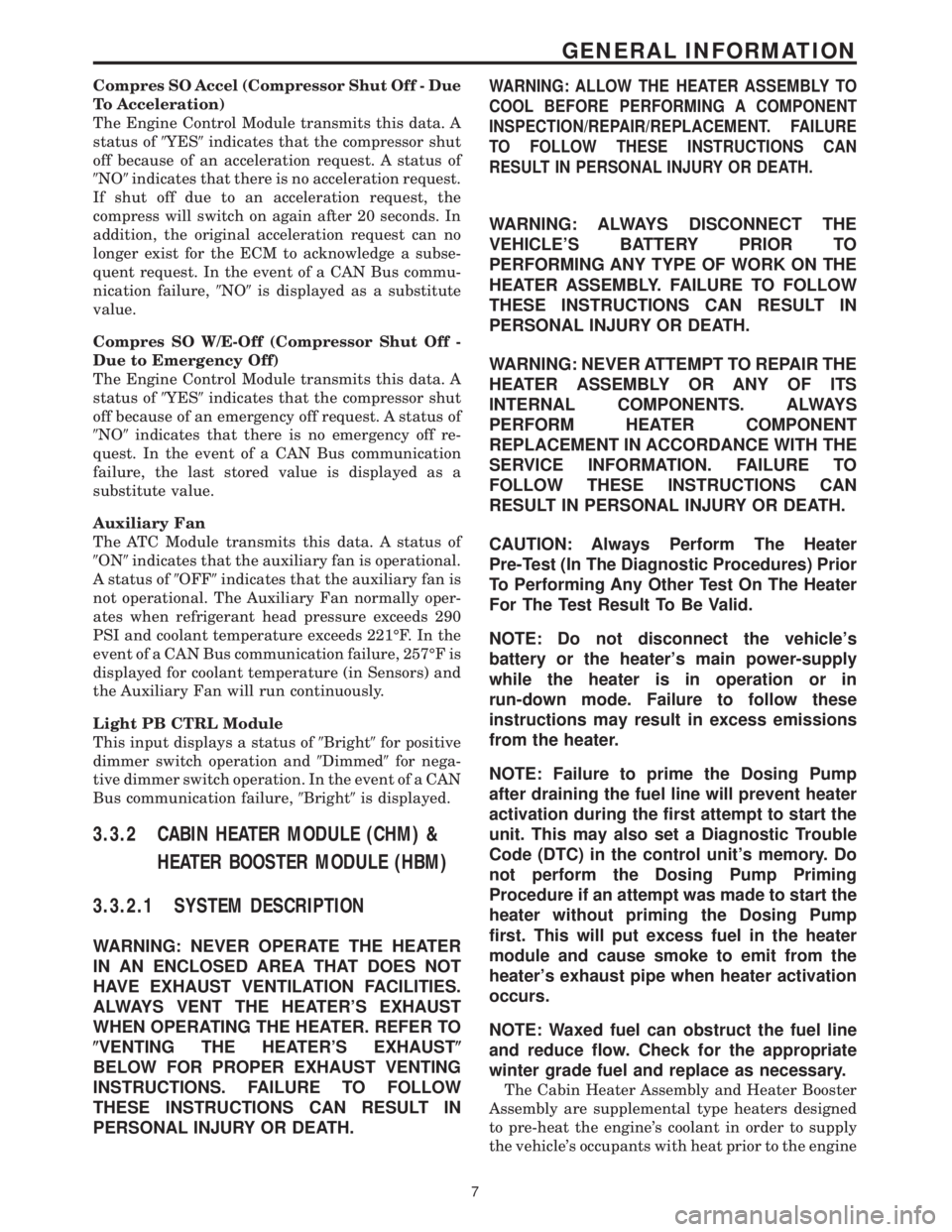
Compres SO Accel (Compressor Shut Off - Due
To Acceleration)
The Engine Control Module transmits this data. A
status of9YES9indicates that the compressor shut
off because of an acceleration request. A status of
9NO9indicates that there is no acceleration request.
If shut off due to an acceleration request, the
compress will switch on again after 20 seconds. In
addition, the original acceleration request can no
longer exist for the ECM to acknowledge a subse-
quent request. In the event of a CAN Bus commu-
nication failure,9NO9is displayed as a substitute
value.
Compres SO W/E-Off (Compressor Shut Off -
Due to Emergency Off)
The Engine Control Module transmits this data. A
status of9YES9indicates that the compressor shut
off because of an emergency off request. A status of
9NO9indicates that there is no emergency off re-
quest. In the event of a CAN Bus communication
failure, the last stored value is displayed as a
substitute value.
Auxiliary Fan
The ATC Module transmits this data. A status of
9ON9indicates that the auxiliary fan is operational.
A status of9OFF9indicates that the auxiliary fan is
not operational. The Auxiliary Fan normally oper-
ates when refrigerant head pressure exceeds 290
PSI and coolant temperature exceeds 221ÉF. In the
event of a CAN Bus communication failure, 257ÉF is
displayed for coolant temperature (in Sensors) and
the Auxiliary Fan will run continuously.
Light PB CTRL Module
This input displays a status of9Bright9for positive
dimmer switch operation and9Dimmed9for nega-
tive dimmer switch operation. In the event of a CAN
Bus communication failure,9Bright9is displayed.
3.3.2 CABIN HEATER MODULE (CHM) &
HEATER BOOSTER MODULE (HBM)
3.3.2.1 SYSTEM DESCRIPTION
WARNING: NEVER OPERATE THE HEATER
IN AN ENCLOSED AREA THAT DOES NOT
HAVE EXHAUST VENTILATION FACILITIES.
ALWAYS VENT THE HEATER'S EXHAUST
WHEN OPERATING THE HEATER. REFER TO
(VENTING THE HEATER'S EXHAUST(
BELOW FOR PROPER EXHAUST VENTING
INSTRUCTIONS. FAILURE TO FOLLOW
THESE INSTRUCTIONS CAN RESULT IN
PERSONAL INJURY OR DEATH.
WARNING: ALLOW THE HEATER ASSEMBLY TO
COOL BEFORE PERFORMING A COMPONENT
INSPECTION/REPAIR/REPLACEMENT. FAILURE
TO FOLLOW THESE INSTRUCTIONS CAN
RESULT IN PERSONAL INJURY OR DEATH.
WARNING: ALWAYS DISCONNECT THE
VEHICLE'S BATTERY PRIOR TO
PERFORMING ANY TYPE OF WORK ON THE
HEATER ASSEMBLY. FAILURE TO FOLLOW
THESE INSTRUCTIONS CAN RESULT IN
PERSONAL INJURY OR DEATH.
WARNING: NEVER ATTEMPT TO REPAIR THE
HEATER ASSEMBLY OR ANY OF ITS
INTERNAL COMPONENTS. ALWAYS
PERFORM HEATER COMPONENT
REPLACEMENT IN ACCORDANCE WITH THE
SERVICE INFORMATION. FAILURE TO
FOLLOW THESE INSTRUCTIONS CAN
RESULT IN PERSONAL INJURY OR DEATH.
CAUTION: Always Perform The Heater
Pre-Test (In The Diagnostic Procedures) Prior
To Performing Any Other Test On The Heater
For The Test Result To Be Valid.
NOTE: Do not disconnect the vehicle's
battery or the heater's main power-supply
while the heater is in operation or in
run-down mode. Failure to follow these
instructions may result in excess emissions
from the heater.
NOTE: Failure to prime the Dosing Pump
after draining the fuel line will prevent heater
activation during the first attempt to start the
unit. This may also set a Diagnostic Trouble
Code (DTC) in the control unit's memory. Do
not perform the Dosing Pump Priming
Procedure if an attempt was made to start the
heater without priming the Dosing Pump
first. This will put excess fuel in the heater
module and cause smoke to emit from the
heater's exhaust pipe when heater activation
occurs.
NOTE: Waxed fuel can obstruct the fuel line
and reduce flow. Check for the appropriate
winter grade fuel and replace as necessary.
The Cabin Heater Assembly and Heater Booster
Assembly are supplemental type heaters designed
to pre-heat the engine's coolant in order to supply
the vehicle's occupants with heat prior to the engine
7
GENERAL INFORMATION
Page 21 of 2305
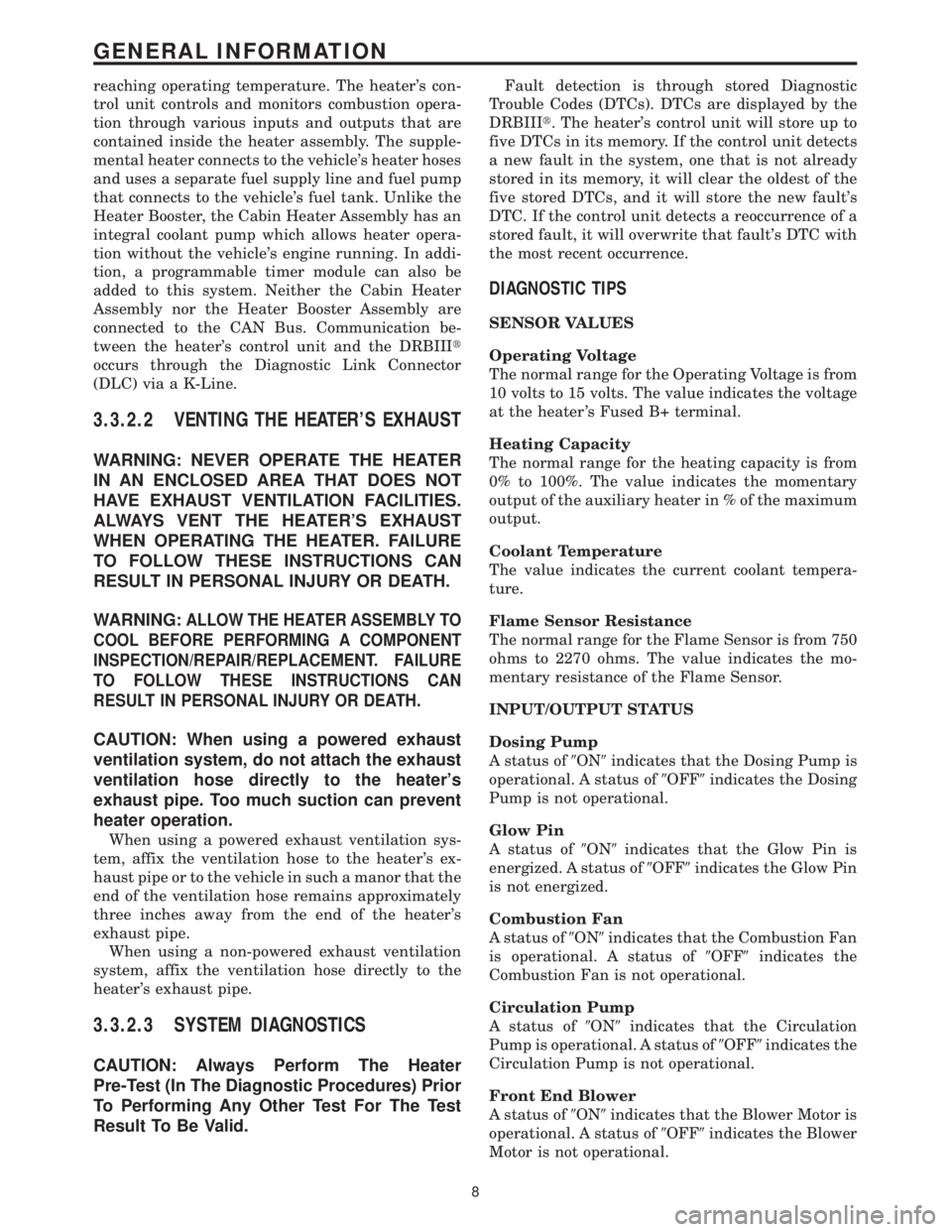
reaching operating temperature. The heater's con-
trol unit controls and monitors combustion opera-
tion through various inputs and outputs that are
contained inside the heater assembly. The supple-
mental heater connects to the vehicle's heater hoses
and uses a separate fuel supply line and fuel pump
that connects to the vehicle's fuel tank. Unlike the
Heater Booster, the Cabin Heater Assembly has an
integral coolant pump which allows heater opera-
tion without the vehicle's engine running. In addi-
tion, a programmable timer module can also be
added to this system. Neither the Cabin Heater
Assembly nor the Heater Booster Assembly are
connected to the CAN Bus. Communication be-
tween the heater's control unit and the DRBIIIt
occurs through the Diagnostic Link Connector
(DLC) via a K-Line.
3.3.2.2 VENTING THE HEATER'S EXHAUST
WARNING: NEVER OPERATE THE HEATER
IN AN ENCLOSED AREA THAT DOES NOT
HAVE EXHAUST VENTILATION FACILITIES.
ALWAYS VENT THE HEATER'S EXHAUST
WHEN OPERATING THE HEATER. FAILURE
TO FOLLOW THESE INSTRUCTIONS CAN
RESULT IN PERSONAL INJURY OR DEATH.
WARNING:
ALLOW THE HEATER ASSEMBLY TO
COOL BEFORE PERFORMING A COMPONENT
INSPECTION/REPAIR/REPLACEMENT. FAILURE
TO FOLLOW THESE INSTRUCTIONS CAN
RESULT IN PERSONAL INJURY OR DEATH.
CAUTION: When using a powered exhaust
ventilation system, do not attach the exhaust
ventilation hose directly to the heater's
exhaust pipe. Too much suction can prevent
heater operation.
When using a powered exhaust ventilation sys-
tem, affix the ventilation hose to the heater's ex-
haust pipe or to the vehicle in such a manor that the
end of the ventilation hose remains approximately
three inches away from the end of the heater's
exhaust pipe.
When using a non-powered exhaust ventilation
system, affix the ventilation hose directly to the
heater's exhaust pipe.
3.3.2.3 SYSTEM DIAGNOSTICS
CAUTION: Always Perform The Heater
Pre-Test (In The Diagnostic Procedures) Prior
To Performing Any Other Test For The Test
Result To Be Valid.
Fault detection is through stored Diagnostic
Trouble Codes (DTCs). DTCs are displayed by the
DRBIIIt. The heater's control unit will store up to
five DTCs in its memory. If the control unit detects
a new fault in the system, one that is not already
stored in its memory, it will clear the oldest of the
five stored DTCs, and it will store the new fault's
DTC. If the control unit detects a reoccurrence of a
stored fault, it will overwrite that fault's DTC with
the most recent occurrence.
DIAGNOSTIC TIPS
SENSOR VALUES
Operating Voltage
The normal range for the Operating Voltage is from
10 volts to 15 volts. The value indicates the voltage
at the heater 's Fused B+ terminal.
Heating Capacity
The normal range for the heating capacity is from
0% to 100%. The value indicates the momentary
output of the auxiliary heater in % of the maximum
output.
Coolant Temperature
The value indicates the current coolant tempera-
ture.
Flame Sensor Resistance
The normal range for the Flame Sensor is from 750
ohms to 2270 ohms. The value indicates the mo-
mentary resistance of the Flame Sensor.
INPUT/OUTPUT STATUS
Dosing Pump
A status of9ON9indicates that the Dosing Pump is
operational. A status of9OFF9indicates the Dosing
Pump is not operational.
Glow Pin
A status of9ON9indicates that the Glow Pin is
energized. A status of9OFF9indicates the Glow Pin
is not energized.
Combustion Fan
A status of9ON9indicates that the Combustion Fan
is operational. A status of9OFF9indicates the
Combustion Fan is not operational.
Circulation Pump
A status of9ON9indicates that the Circulation
Pump is operational. A status of9OFF9indicates the
Circulation Pump is not operational.
Front End Blower
A status of9ON9indicates that the Blower Motor is
operational. A status of9OFF9indicates the Blower
Motor is not operational.
8
GENERAL INFORMATION
Page 101 of 2305
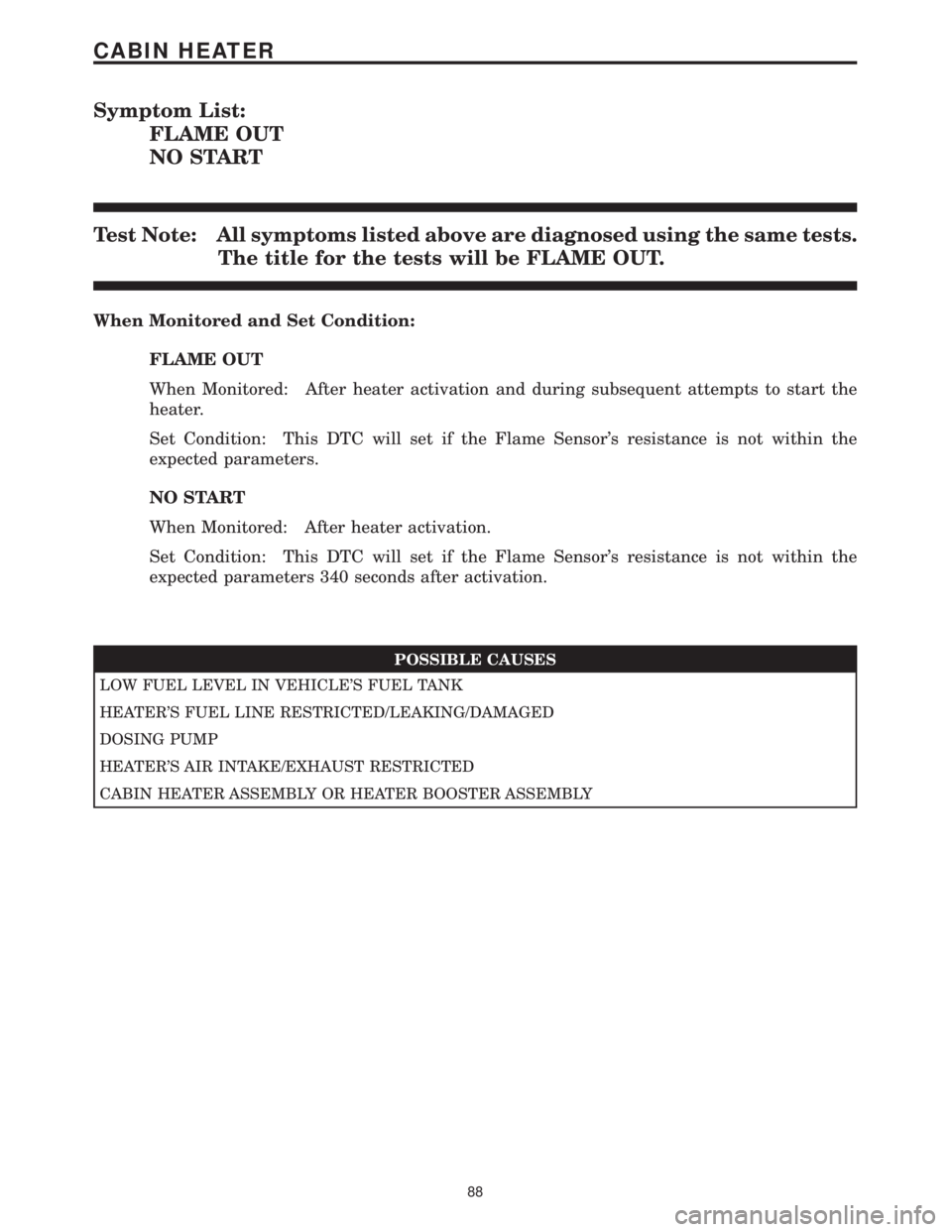
Symptom List:
FLAME OUT
NO START
Test Note: All symptoms listed above are diagnosed using the same tests.
The title for the tests will be FLAME OUT.
When Monitored and Set Condition:
FLAME OUT
When Monitored: After heater activation and during subsequent attempts to start the
heater.
Set Condition: This DTC will set if the Flame Sensor's resistance is not within the
expected parameters.
NO START
When Monitored: After heater activation.
Set Condition: This DTC will set if the Flame Sensor's resistance is not within the
expected parameters 340 seconds after activation.
POSSIBLE CAUSES
LOW FUEL LEVEL IN VEHICLE'S FUEL TANK
HEATER'S FUEL LINE RESTRICTED/LEAKING/DAMAGED
DOSING PUMP
HEATER'S AIR INTAKE/EXHAUST RESTRICTED
CABIN HEATER ASSEMBLY OR HEATER BOOSTER ASSEMBLY
88
CABIN HEATER
Page 103 of 2305
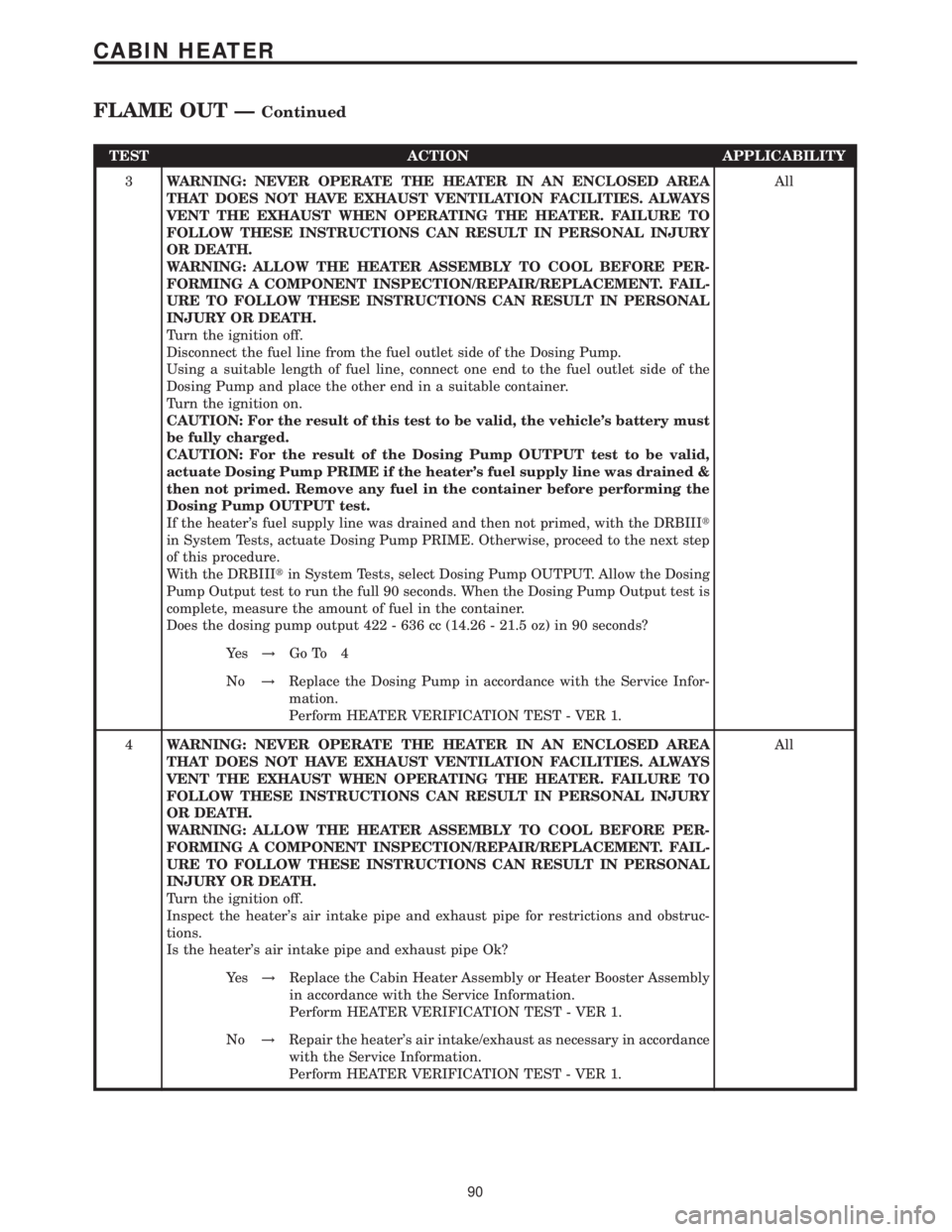
TEST ACTION APPLICABILITY
3WARNING: NEVER OPERATE THE HEATER IN AN ENCLOSED AREA
THAT DOES NOT HAVE EXHAUST VENTILATION FACILITIES. ALWAYS
VENT THE EXHAUST WHEN OPERATING THE HEATER. FAILURE TO
FOLLOW THESE INSTRUCTIONS CAN RESULT IN PERSONAL INJURY
OR DEATH.
WARNING: ALLOW THE HEATER ASSEMBLY TO COOL BEFORE PER-
FORMING A COMPONENT INSPECTION/REPAIR/REPLACEMENT. FAIL-
URE TO FOLLOW THESE INSTRUCTIONS CAN RESULT IN PERSONAL
INJURY OR DEATH.
Turn the ignition off.
Disconnect the fuel line from the fuel outlet side of the Dosing Pump.
Using a suitable length of fuel line, connect one end to the fuel outlet side of the
Dosing Pump and place the other end in a suitable container.
Turn the ignition on.
CAUTION: For the result of this test to be valid, the vehicle's battery must
be fully charged.
CAUTION: For the result of the Dosing Pump OUTPUT test to be valid,
actuate Dosing Pump PRIME if the heater's fuel supply line was drained &
then not primed. Remove any fuel in the container before performing the
Dosing Pump OUTPUT test.
If the heater's fuel supply line was drained and then not primed, with the DRBIIIt
in System Tests, actuate Dosing Pump PRIME. Otherwise, proceed to the next step
of this procedure.
With the DRBIIItin System Tests, select Dosing Pump OUTPUT. Allow the Dosing
Pump Output test to run the full 90 seconds. When the Dosing Pump Output test is
complete, measure the amount of fuel in the container.
Does the dosing pump output 422 - 636 cc (14.26 - 21.5 oz) in 90 seconds?All
Ye s!Go To 4
No!Replace the Dosing Pump in accordance with the Service Infor-
mation.
Perform HEATER VERIFICATION TEST - VER 1.
4WARNING: NEVER OPERATE THE HEATER IN AN ENCLOSED AREA
THAT DOES NOT HAVE EXHAUST VENTILATION FACILITIES. ALWAYS
VENT THE EXHAUST WHEN OPERATING THE HEATER. FAILURE TO
FOLLOW THESE INSTRUCTIONS CAN RESULT IN PERSONAL INJURY
OR DEATH.
WARNING: ALLOW THE HEATER ASSEMBLY TO COOL BEFORE PER-
FORMING A COMPONENT INSPECTION/REPAIR/REPLACEMENT. FAIL-
URE TO FOLLOW THESE INSTRUCTIONS CAN RESULT IN PERSONAL
INJURY OR DEATH.
Turn the ignition off.
Inspect the heater's air intake pipe and exhaust pipe for restrictions and obstruc-
tions.
Is the heater's air intake pipe and exhaust pipe Ok?All
Ye s!Replace the Cabin Heater Assembly or Heater Booster Assembly
in accordance with the Service Information.
Perform HEATER VERIFICATION TEST - VER 1.
No!Repair the heater's air intake/exhaust as necessary in accordance
with the Service Information.
Perform HEATER VERIFICATION TEST - VER 1.
90
CABIN HEATER
FLAME OUT ÐContinued
Page 195 of 2305
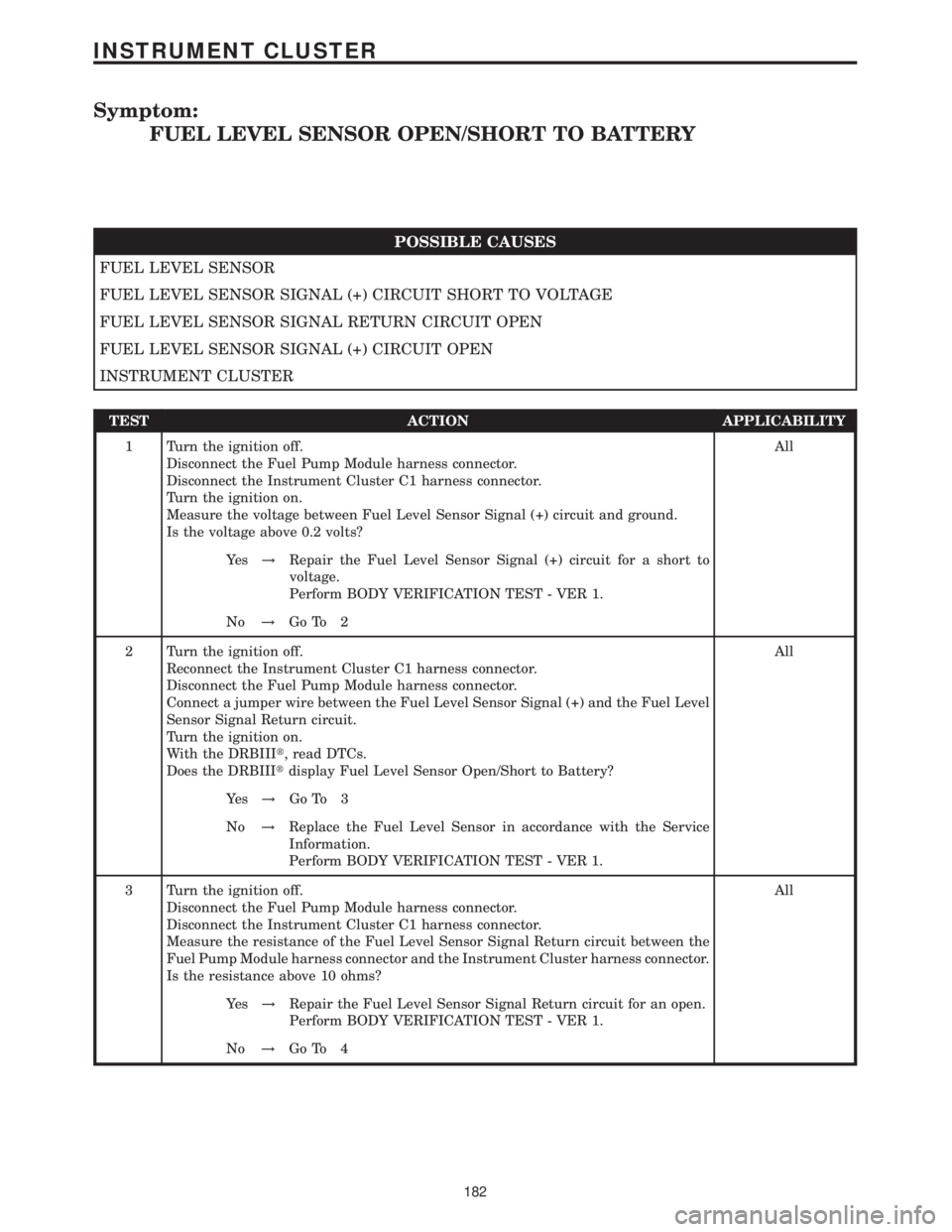
Symptom:
FUEL LEVEL SENSOR OPEN/SHORT TO BATTERY
POSSIBLE CAUSES
FUEL LEVEL SENSOR
FUEL LEVEL SENSOR SIGNAL (+) CIRCUIT SHORT TO VOLTAGE
FUEL LEVEL SENSOR SIGNAL RETURN CIRCUIT OPEN
FUEL LEVEL SENSOR SIGNAL (+) CIRCUIT OPEN
INSTRUMENT CLUSTER
TEST ACTION APPLICABILITY
1 Turn the ignition off.
Disconnect the Fuel Pump Module harness connector.
Disconnect the Instrument Cluster C1 harness connector.
Turn the ignition on.
Measure the voltage between Fuel Level Sensor Signal (+) circuit and ground.
Is the voltage above 0.2 volts?All
Ye s!Repair the Fuel Level Sensor Signal (+) circuit for a short to
voltage.
Perform BODY VERIFICATION TEST - VER 1.
No!Go To 2
2 Turn the ignition off.
Reconnect the Instrument Cluster C1 harness connector.
Disconnect the Fuel Pump Module harness connector.
Connect a jumper wire between the Fuel Level Sensor Signal (+) and the Fuel Level
Sensor Signal Return circuit.
Turn the ignition on.
With the DRBIIIt, read DTCs.
Does the DRBIIItdisplay Fuel Level Sensor Open/Short to Battery?All
Ye s!Go To 3
No!Replace the Fuel Level Sensor in accordance with the Service
Information.
Perform BODY VERIFICATION TEST - VER 1.
3 Turn the ignition off.
Disconnect the Fuel Pump Module harness connector.
Disconnect the Instrument Cluster C1 harness connector.
Measure the resistance of the Fuel Level Sensor Signal Return circuit between the
Fuel Pump Module harness connector and the Instrument Cluster harness connector.
Is the resistance above 10 ohms?All
Ye s!Repair the Fuel Level Sensor Signal Return circuit for an open.
Perform BODY VERIFICATION TEST - VER 1.
No!Go To 4
182
INSTRUMENT CLUSTER
Page 196 of 2305
TEST ACTION APPLICABILITY
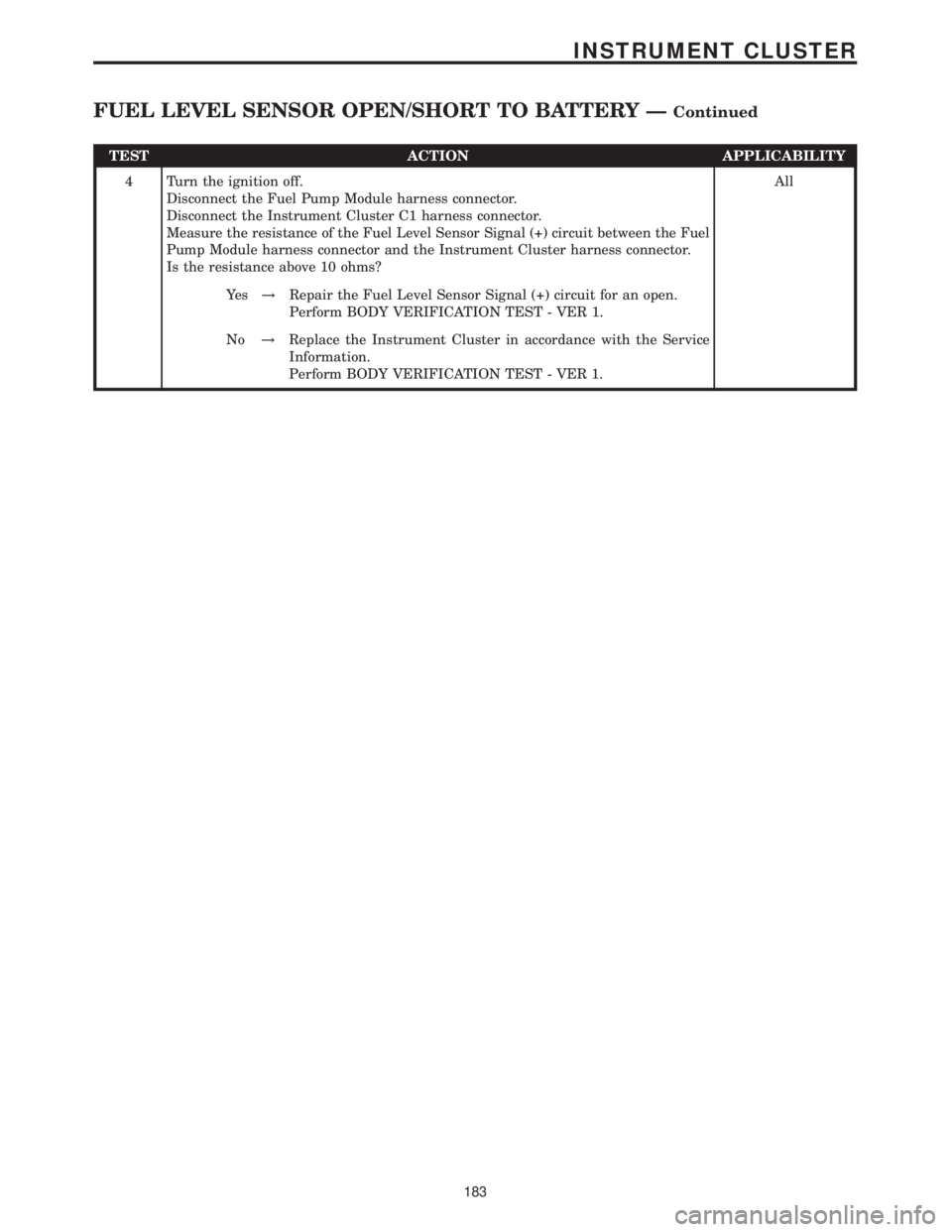
4 Turn the ignition off.
Disconnect the Fuel Pump Module harness connector.
Disconnect the Instrument Cluster C1 harness connector.
Measure the resistance of the Fuel Level Sensor Signal (+) circuit between the Fuel
Pump Module harness connector and the Instrument Cluster harness connector.
Is the resistance above 10 ohms?All
Ye s!Repair the Fuel Level Sensor Signal (+) circuit for an open.
Perform BODY VERIFICATION TEST - VER 1.
No!Replace the Instrument Cluster in accordance with the Service
Information.
Perform BODY VERIFICATION TEST - VER 1.
183
INSTRUMENT CLUSTER
FUEL LEVEL SENSOR OPEN/SHORT TO BATTERY ÐContinued
Page 197 of 2305
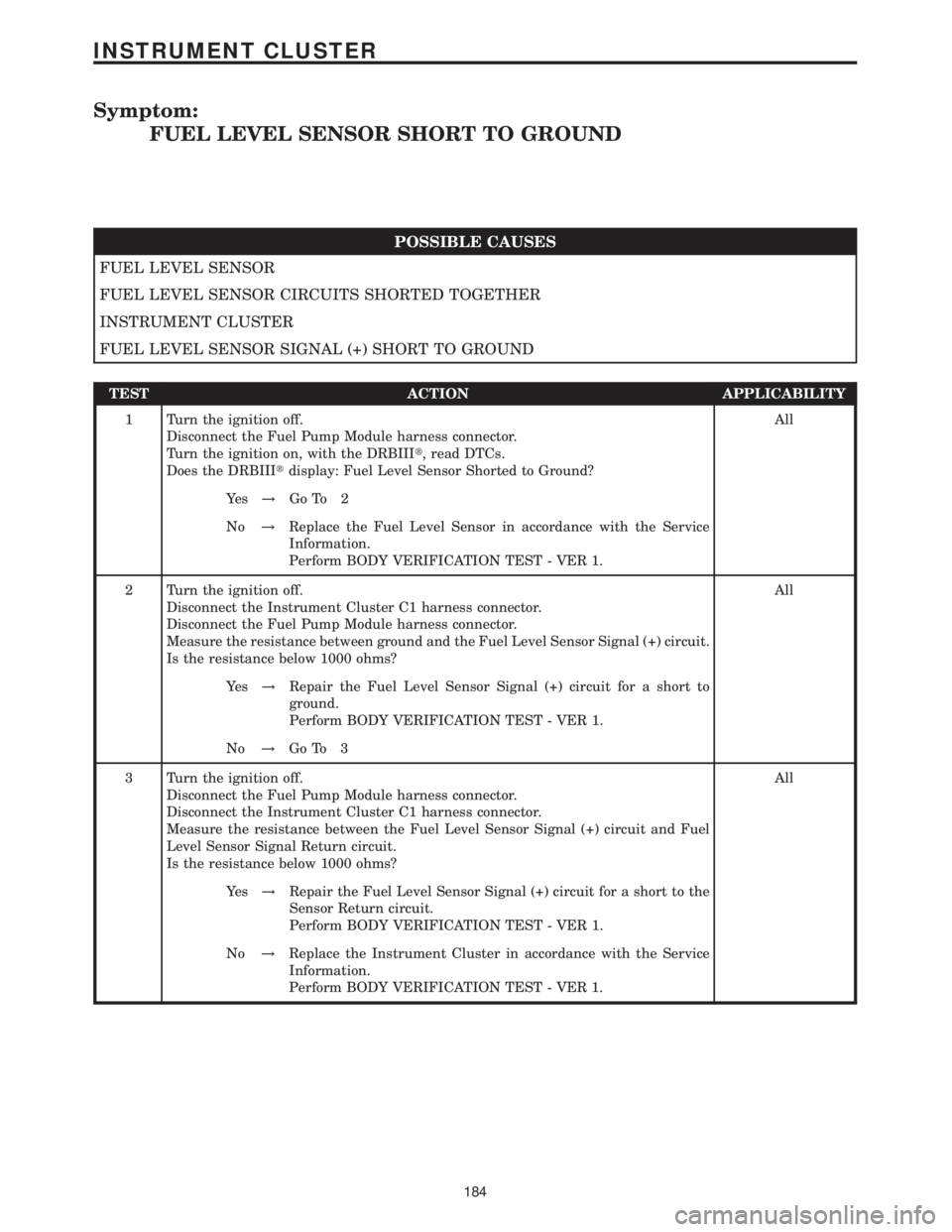
Symptom:
FUEL LEVEL SENSOR SHORT TO GROUND
POSSIBLE CAUSES
FUEL LEVEL SENSOR
FUEL LEVEL SENSOR CIRCUITS SHORTED TOGETHER
INSTRUMENT CLUSTER
FUEL LEVEL SENSOR SIGNAL (+) SHORT TO GROUND
TEST ACTION APPLICABILITY
1 Turn the ignition off.
Disconnect the Fuel Pump Module harness connector.
Turn the ignition on, with the DRBIIIt, read DTCs.
Does the DRBIIItdisplay: Fuel Level Sensor Shorted to Ground?All
Ye s!Go To 2
No!Replace the Fuel Level Sensor in accordance with the Service
Information.
Perform BODY VERIFICATION TEST - VER 1.
2 Turn the ignition off.
Disconnect the Instrument Cluster C1 harness connector.
Disconnect the Fuel Pump Module harness connector.
Measure the resistance between ground and the Fuel Level Sensor Signal (+) circuit.
Is the resistance below 1000 ohms?All
Ye s!Repair the Fuel Level Sensor Signal (+) circuit for a short to
ground.
Perform BODY VERIFICATION TEST - VER 1.
No!Go To 3
3 Turn the ignition off.
Disconnect the Fuel Pump Module harness connector.
Disconnect the Instrument Cluster C1 harness connector.
Measure the resistance between the Fuel Level Sensor Signal (+) circuit and Fuel
Level Sensor Signal Return circuit.
Is the resistance below 1000 ohms?All
Ye s!Repair the Fuel Level Sensor Signal (+) circuit for a short to the
Sensor Return circuit.
Perform BODY VERIFICATION TEST - VER 1.
No!Replace the Instrument Cluster in accordance with the Service
Information.
Perform BODY VERIFICATION TEST - VER 1.
184
INSTRUMENT CLUSTER
Page 259 of 2305
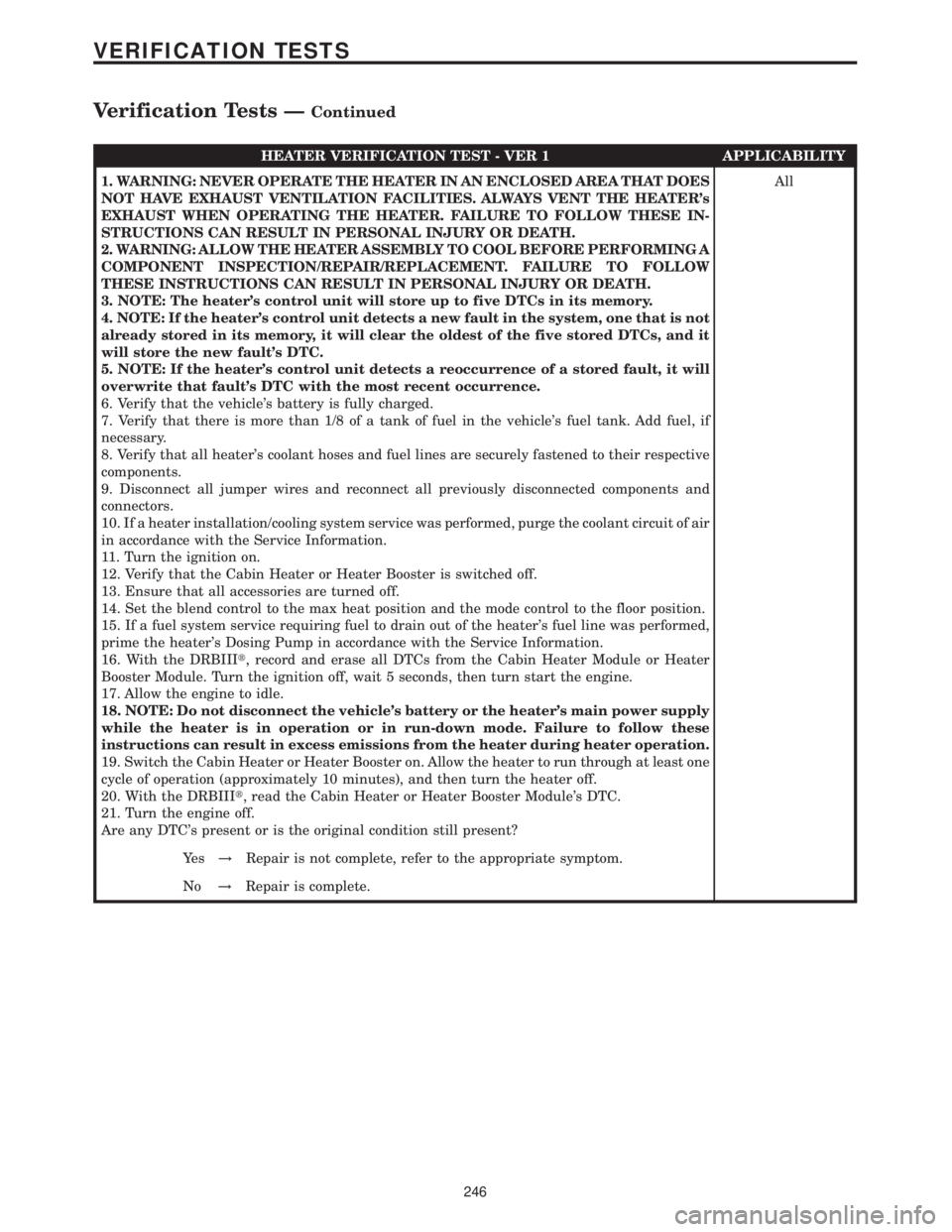
HEATER VERIFICATION TEST - VER 1 APPLICABILITY
1. WARNING: NEVER OPERATE THE HEATER IN AN ENCLOSED AREA THAT DOES
NOT HAVE EXHAUST VENTILATION FACILITIES. ALWAYS VENT THE HEATER's
EXHAUST WHEN OPERATING THE HEATER. FAILURE TO FOLLOW THESE IN-
STRUCTIONS CAN RESULT IN PERSONAL INJURY OR DEATH.
2. WARNING: ALLOW THE HEATER ASSEMBLY TO COOL BEFORE PERFORMING A
COMPONENT INSPECTION/REPAIR/REPLACEMENT. FAILURE TO FOLLOW
THESE INSTRUCTIONS CAN RESULT IN PERSONAL INJURY OR DEATH.
3. NOTE: The heater's control unit will store up to five DTCs in its memory.
4. NOTE: If the heater's control unit detects a new fault in the system, one that is not
already stored in its memory, it will clear the oldest of the five stored DTCs, and it
will store the new fault's DTC.
5. NOTE: If the heater's control unit detects a reoccurrence of a stored fault, it will
overwrite that fault's DTC with the most recent occurrence.
6. Verify that the vehicle's battery is fully charged.
7. Verify that there is more than 1/8 of a tank of fuel in the vehicle's fuel tank. Add fuel, if
necessary.
8. Verify that all heater's coolant hoses and fuel lines are securely fastened to their respective
components.
9. Disconnect all jumper wires and reconnect all previously disconnected components and
connectors.
10. If a heater installation/cooling system service was performed, purge the coolant circuit of air
in accordance with the Service Information.
11. Turn the ignition on.
12. Verify that the Cabin Heater or Heater Booster is switched off.
13. Ensure that all accessories are turned off.
14. Set the blend control to the max heat position and the mode control to the floor position.
15. If a fuel system service requiring fuel to drain out of the heater's fuel line was performed,
prime the heater's Dosing Pump in accordance with the Service Information.
16. With the DRBIIIt, record and erase all DTCs from the Cabin Heater Module or Heater
Booster Module. Turn the ignition off, wait 5 seconds, then turn start the engine.
17. Allow the engine to idle.
18. NOTE: Do not disconnect the vehicle's battery or the heater's main power supply
while the heater is in operation or in run-down mode. Failure to follow these
instructions can result in excess emissions from the heater during heater operation.
19. Switch the Cabin Heater or Heater Booster on. Allow the heater to run through at least one
cycle of operation (approximately 10 minutes), and then turn the heater off.
20. With the DRBIIIt, read the Cabin Heater or Heater Booster Module's DTC.
21. Turn the engine off.
Are any DTC's present or is the original condition still present?All
Ye s!Repair is not complete, refer to the appropriate symptom.
No!Repair is complete.
246
VERIFICATION TESTS
Verification Tests ÐContinued