oil filter MERCEDES-BENZ SPRINTER 2006 Service Manual
[x] Cancel search | Manufacturer: MERCEDES-BENZ, Model Year: 2006, Model line: SPRINTER, Model: MERCEDES-BENZ SPRINTER 2006Pages: 2305, PDF Size: 48.12 MB
Page 448 of 2305
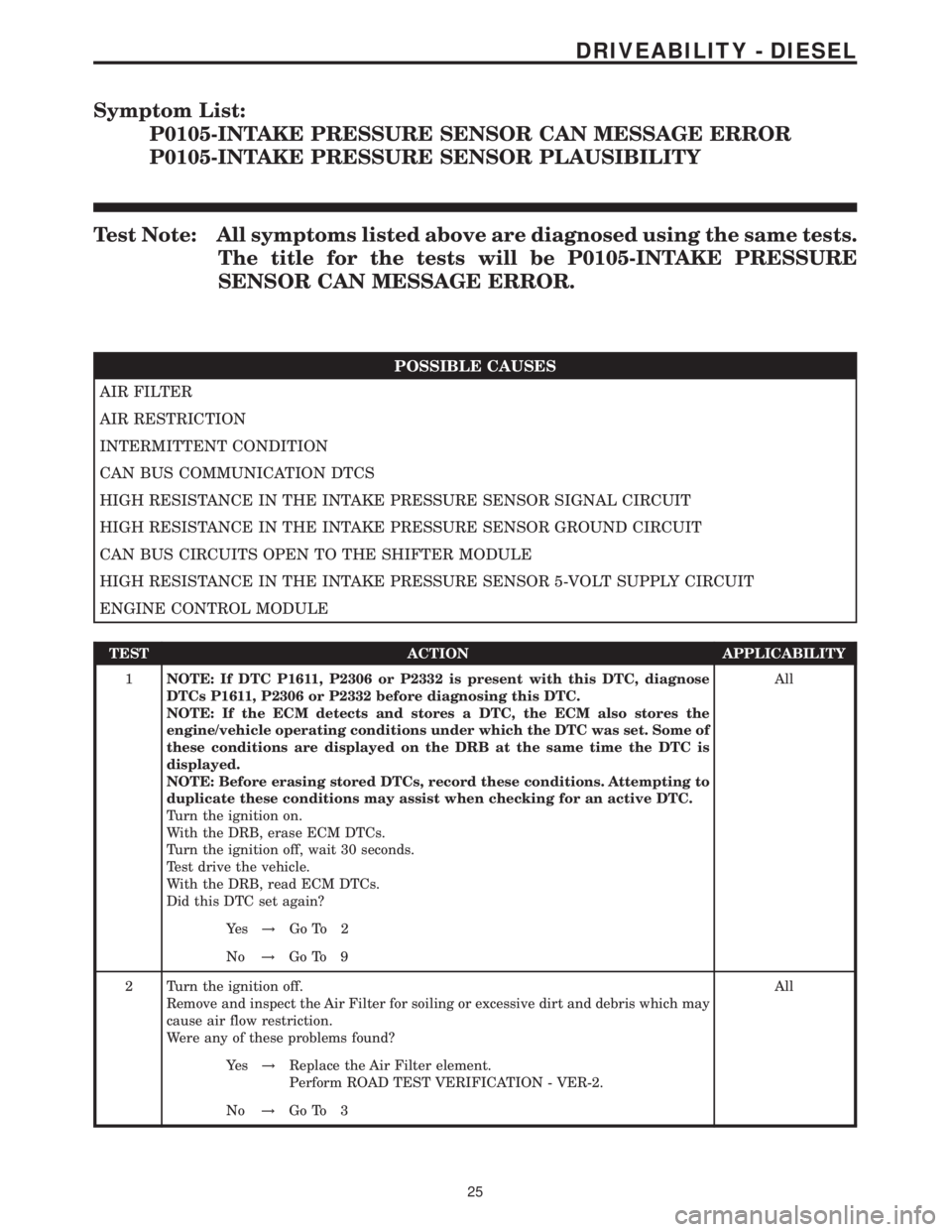
Symptom List:
P0105-INTAKE PRESSURE SENSOR CAN MESSAGE ERROR
P0105-INTAKE PRESSURE SENSOR PLAUSIBILITY
Test Note: All symptoms listed above are diagnosed using the same tests.
The title for the tests will be P0105-INTAKE PRESSURE
SENSOR CAN MESSAGE ERROR.
POSSIBLE CAUSES
AIR FILTER
AIR RESTRICTION
INTERMITTENT CONDITION
CAN BUS COMMUNICATION DTCS
HIGH RESISTANCE IN THE INTAKE PRESSURE SENSOR SIGNAL CIRCUIT
HIGH RESISTANCE IN THE INTAKE PRESSURE SENSOR GROUND CIRCUIT
CAN BUS CIRCUITS OPEN TO THE SHIFTER MODULE
HIGH RESISTANCE IN THE INTAKE PRESSURE SENSOR 5-VOLT SUPPLY CIRCUIT
ENGINE CONTROL MODULE
TEST ACTION APPLICABILITY
1NOTE: If DTC P1611, P2306 or P2332 is present with this DTC, diagnose
DTCs P1611, P2306 or P2332 before diagnosing this DTC.
NOTE: If the ECM detects and stores a DTC, the ECM also stores the
engine/vehicle operating conditions under which the DTC was set. Some of
these conditions are displayed on the DRB at the same time the DTC is
displayed.
NOTE: Before erasing stored DTCs, record these conditions. Attempting to
duplicate these conditions may assist when checking for an active DTC.
Turn the ignition on.
With the DRB, erase ECM DTCs.
Turn the ignition off, wait 30 seconds.
Test drive the vehicle.
With the DRB, read ECM DTCs.
Did this DTC set again?All
Ye s!Go To 2
No!Go To 9
2 Turn the ignition off.
Remove and inspect the Air Filter for soiling or excessive dirt and debris which may
cause air flow restriction.
Were any of these problems found?All
Ye s!Replace the Air Filter element.
Perform ROAD TEST VERIFICATION - VER-2.
No!Go To 3
25
DRIVEABILITY - DIESEL
Page 544 of 2305
TEST ACTION APPLICABILITY
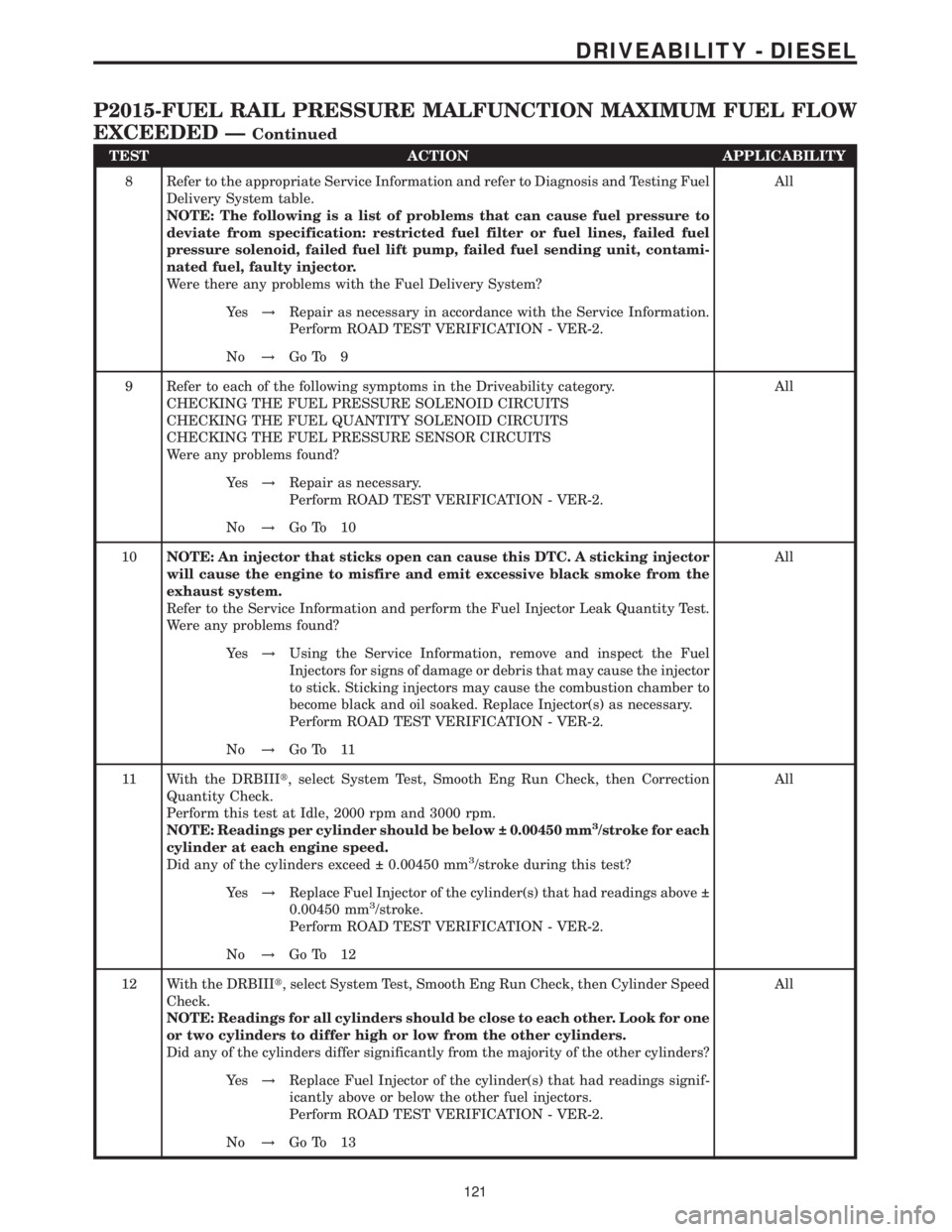
8 Refer to the appropriate Service Information and refer to Diagnosis and Testing Fuel
Delivery System table.
NOTE: The following is a list of problems that can cause fuel pressure to
deviate from specification: restricted fuel filter or fuel lines, failed fuel
pressure solenoid, failed fuel lift pump, failed fuel sending unit, contami-
nated fuel, faulty injector.
Were there any problems with the Fuel Delivery System?All
Ye s!Repair as necessary in accordance with the Service Information.
Perform ROAD TEST VERIFICATION - VER-2.
No!Go To 9
9 Refer to each of the following symptoms in the Driveability category.
CHECKING THE FUEL PRESSURE SOLENOID CIRCUITS
CHECKING THE FUEL QUANTITY SOLENOID CIRCUITS
CHECKING THE FUEL PRESSURE SENSOR CIRCUITS
Were any problems found?All
Ye s!Repair as necessary.
Perform ROAD TEST VERIFICATION - VER-2.
No!Go To 10
10NOTE: An injector that sticks open can cause this DTC. A sticking injector
will cause the engine to misfire and emit excessive black smoke from the
exhaust system.
Refer to the Service Information and perform the Fuel Injector Leak Quantity Test.
Were any problems found?All
Ye s!Using the Service Information, remove and inspect the Fuel
Injectors for signs of damage or debris that may cause the injector
to stick. Sticking injectors may cause the combustion chamber to
become black and oil soaked. Replace Injector(s) as necessary.
Perform ROAD TEST VERIFICATION - VER-2.
No!Go To 11
11 With the DRBIIIt, select System Test, Smooth Eng Run Check, then Correction
Quantity Check.
Perform this test at Idle, 2000 rpm and 3000 rpm.
NOTE: Readings per cylinder should be below 0.00450 mm
3/stroke for each
cylinder at each engine speed.
Did any of the cylinders exceed 0.00450 mm
3/stroke during this test?All
Ye s!Replace Fuel Injector of the cylinder(s) that had readings above
0.00450 mm
3/stroke.
Perform ROAD TEST VERIFICATION - VER-2.
No!Go To 12
12 With the DRBIIIt, select System Test, Smooth Eng Run Check, then Cylinder Speed
Check.
NOTE: Readings for all cylinders should be close to each other. Look for one
or two cylinders to differ high or low from the other cylinders.
Did any of the cylinders differ significantly from the majority of the other cylinders?All
Ye s!Replace Fuel Injector of the cylinder(s) that had readings signif-
icantly above or below the other fuel injectors.
Perform ROAD TEST VERIFICATION - VER-2.
No!Go To 13
121
DRIVEABILITY - DIESEL
P2015-FUEL RAIL PRESSURE MALFUNCTION MAXIMUM FUEL FLOW
EXCEEDED Ð
Continued
Page 546 of 2305
TEST ACTION APPLICABILITY
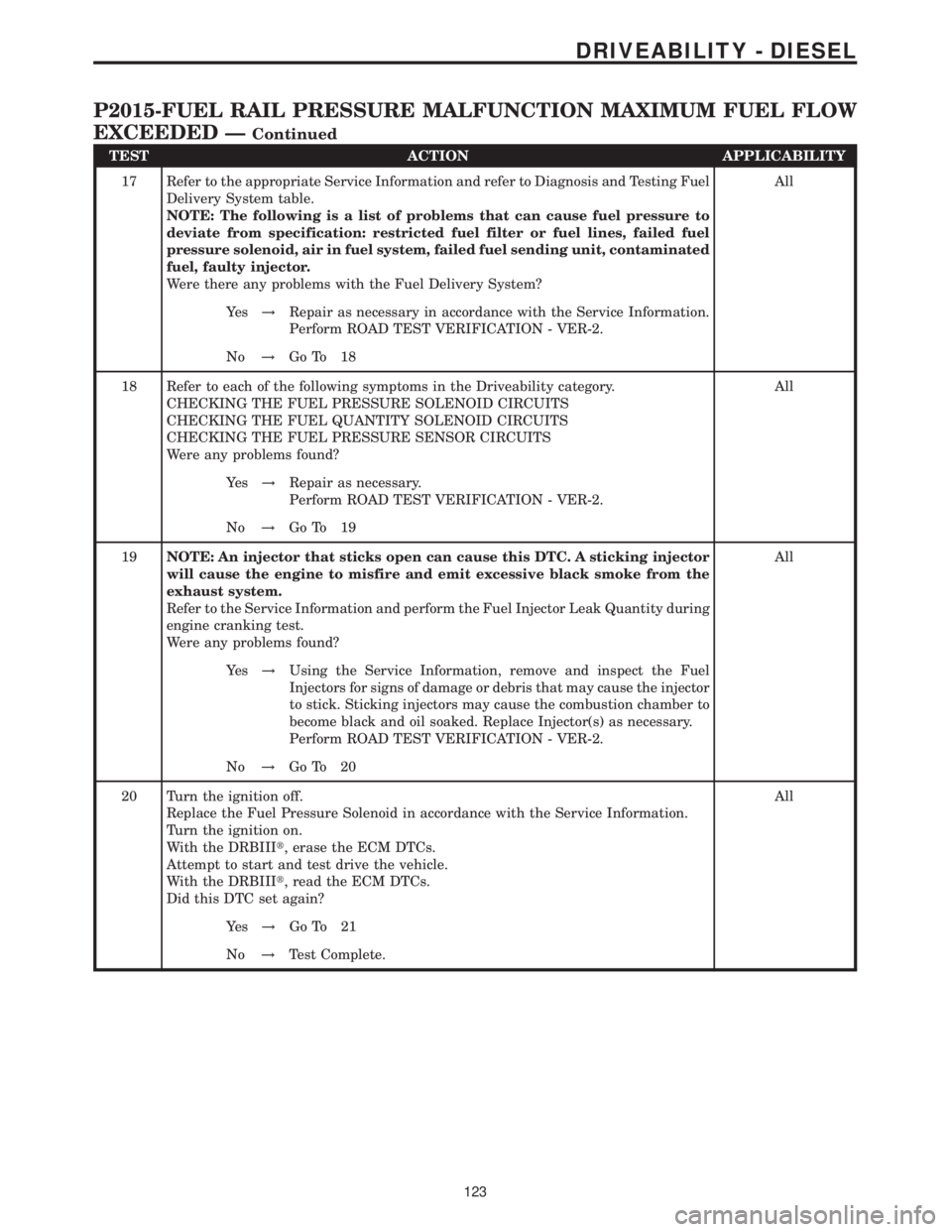
17 Refer to the appropriate Service Information and refer to Diagnosis and Testing Fuel
Delivery System table.
NOTE: The following is a list of problems that can cause fuel pressure to
deviate from specification: restricted fuel filter or fuel lines, failed fuel
pressure solenoid, air in fuel system, failed fuel sending unit, contaminated
fuel, faulty injector.
Were there any problems with the Fuel Delivery System?All
Ye s!Repair as necessary in accordance with the Service Information.
Perform ROAD TEST VERIFICATION - VER-2.
No!Go To 18
18 Refer to each of the following symptoms in the Driveability category.
CHECKING THE FUEL PRESSURE SOLENOID CIRCUITS
CHECKING THE FUEL QUANTITY SOLENOID CIRCUITS
CHECKING THE FUEL PRESSURE SENSOR CIRCUITS
Were any problems found?All
Ye s!Repair as necessary.
Perform ROAD TEST VERIFICATION - VER-2.
No!Go To 19
19NOTE: An injector that sticks open can cause this DTC. A sticking injector
will cause the engine to misfire and emit excessive black smoke from the
exhaust system.
Refer to the Service Information and perform the Fuel Injector Leak Quantity during
engine cranking test.
Were any problems found?All
Ye s!Using the Service Information, remove and inspect the Fuel
Injectors for signs of damage or debris that may cause the injector
to stick. Sticking injectors may cause the combustion chamber to
become black and oil soaked. Replace Injector(s) as necessary.
Perform ROAD TEST VERIFICATION - VER-2.
No!Go To 20
20 Turn the ignition off.
Replace the Fuel Pressure Solenoid in accordance with the Service Information.
Turn the ignition on.
With the DRBIIIt, erase the ECM DTCs.
Attempt to start and test drive the vehicle.
With the DRBIIIt, read the ECM DTCs.
Did this DTC set again?All
Ye s!Go To 21
No!Test Complete.
123
DRIVEABILITY - DIESEL
P2015-FUEL RAIL PRESSURE MALFUNCTION MAXIMUM FUEL FLOW
EXCEEDED Ð
Continued
Page 548 of 2305
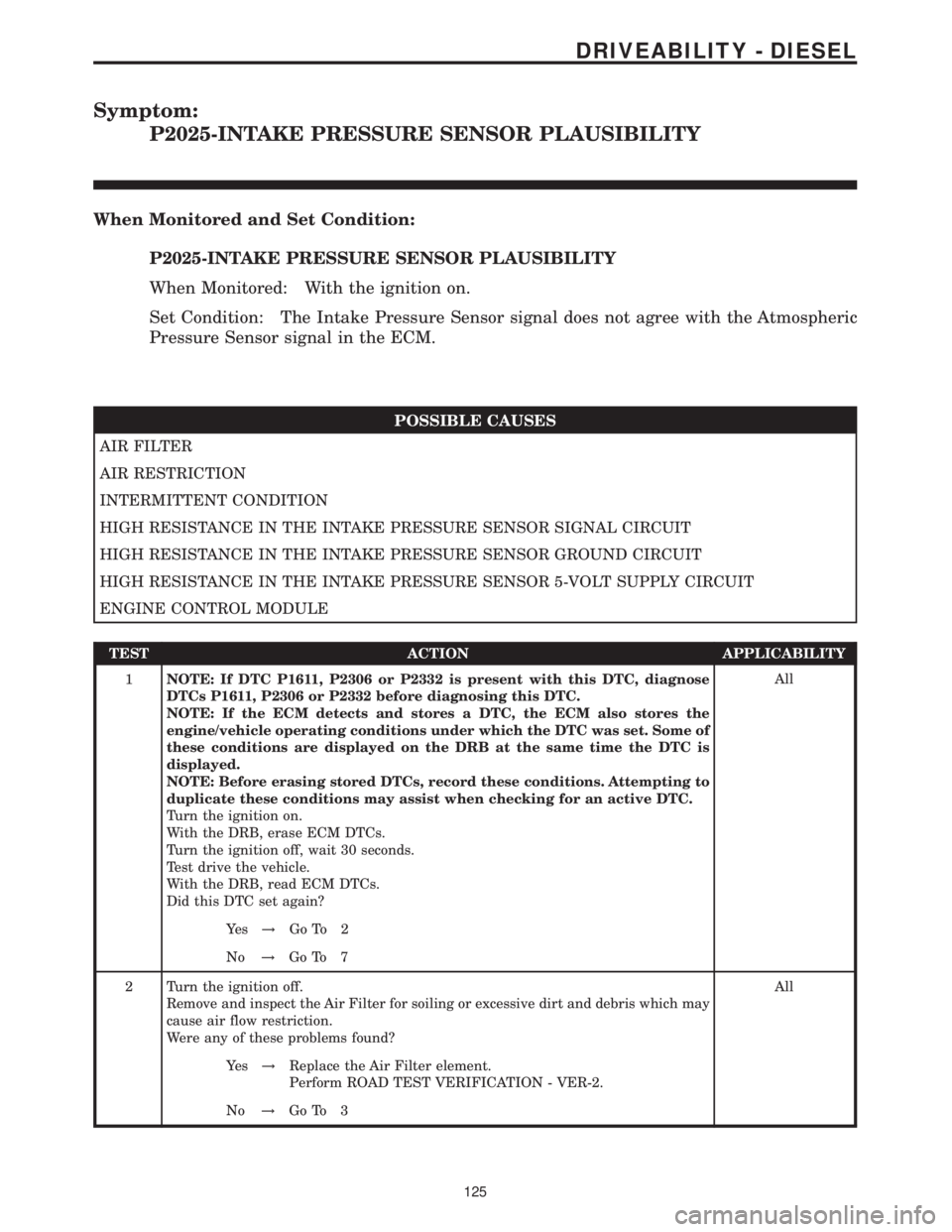
Symptom:
P2025-INTAKE PRESSURE SENSOR PLAUSIBILITY
When Monitored and Set Condition:
P2025-INTAKE PRESSURE SENSOR PLAUSIBILITY
When Monitored: With the ignition on.
Set Condition: The Intake Pressure Sensor signal does not agree with the Atmospheric
Pressure Sensor signal in the ECM.
POSSIBLE CAUSES
AIR FILTER
AIR RESTRICTION
INTERMITTENT CONDITION
HIGH RESISTANCE IN THE INTAKE PRESSURE SENSOR SIGNAL CIRCUIT
HIGH RESISTANCE IN THE INTAKE PRESSURE SENSOR GROUND CIRCUIT
HIGH RESISTANCE IN THE INTAKE PRESSURE SENSOR 5-VOLT SUPPLY CIRCUIT
ENGINE CONTROL MODULE
TEST ACTION APPLICABILITY
1NOTE: If DTC P1611, P2306 or P2332 is present with this DTC, diagnose
DTCs P1611, P2306 or P2332 before diagnosing this DTC.
NOTE: If the ECM detects and stores a DTC, the ECM also stores the
engine/vehicle operating conditions under which the DTC was set. Some of
these conditions are displayed on the DRB at the same time the DTC is
displayed.
NOTE: Before erasing stored DTCs, record these conditions. Attempting to
duplicate these conditions may assist when checking for an active DTC.
Turn the ignition on.
With the DRB, erase ECM DTCs.
Turn the ignition off, wait 30 seconds.
Test drive the vehicle.
With the DRB, read ECM DTCs.
Did this DTC set again?All
Ye s!Go To 2
No!Go To 7
2 Turn the ignition off.
Remove and inspect the Air Filter for soiling or excessive dirt and debris which may
cause air flow restriction.
Were any of these problems found?All
Ye s!Replace the Air Filter element.
Perform ROAD TEST VERIFICATION - VER-2.
No!Go To 3
125
DRIVEABILITY - DIESEL
Page 575 of 2305
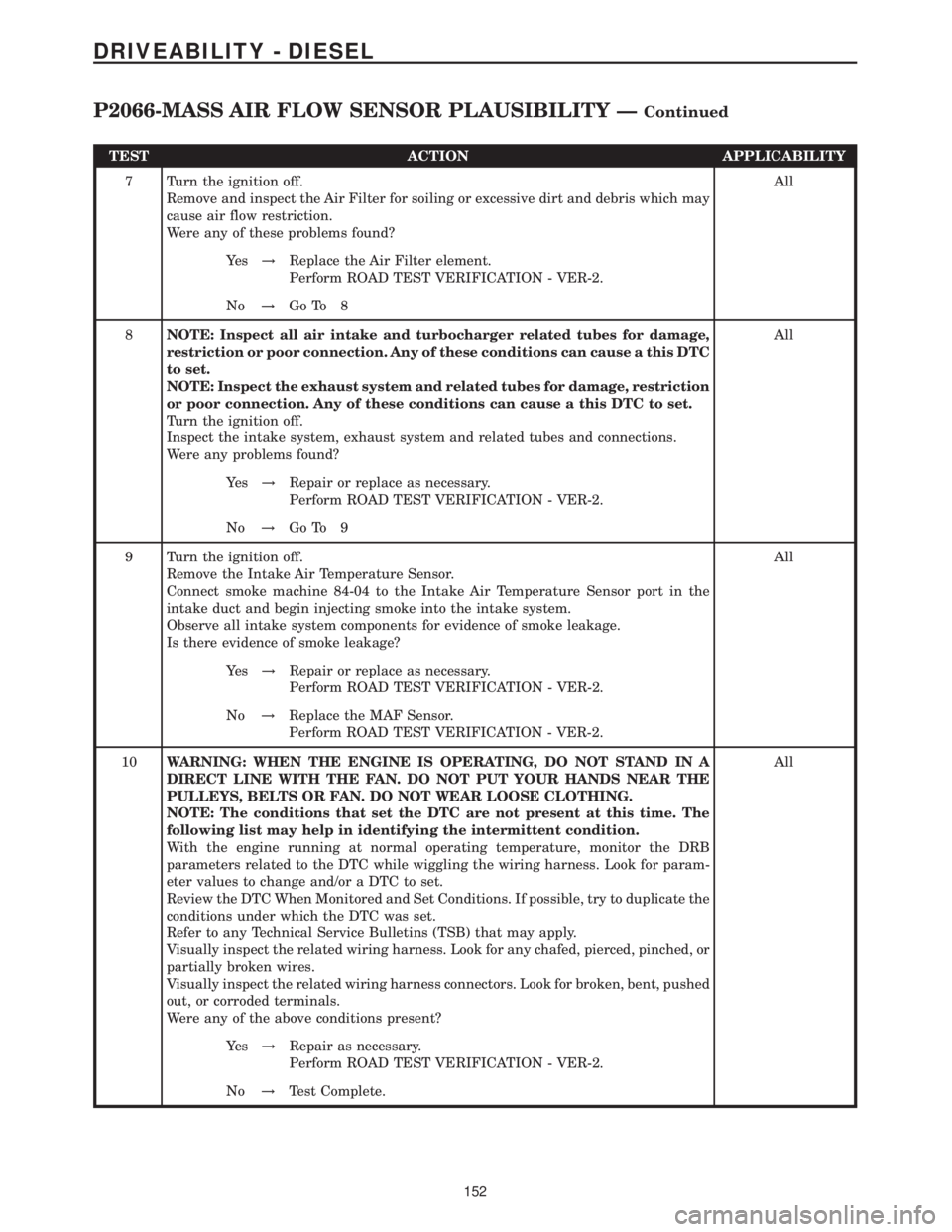
TEST ACTION APPLICABILITY
7 Turn the ignition off.
Remove and inspect the Air Filter for soiling or excessive dirt and debris which may
cause air flow restriction.
Were any of these problems found?All
Ye s!Replace the Air Filter element.
Perform ROAD TEST VERIFICATION - VER-2.
No!Go To 8
8NOTE: Inspect all air intake and turbocharger related tubes for damage,
restriction or poor connection. Any of these conditions can cause a this DTC
to set.
NOTE: Inspect the exhaust system and related tubes for damage, restriction
or poor connection. Any of these conditions can cause a this DTC to set.
Turn the ignition off.
Inspect the intake system, exhaust system and related tubes and connections.
Were any problems found?All
Ye s!Repair or replace as necessary.
Perform ROAD TEST VERIFICATION - VER-2.
No!Go To 9
9 Turn the ignition off.
Remove the Intake Air Temperature Sensor.
Connect smoke machine 84-04 to the Intake Air Temperature Sensor port in the
intake duct and begin injecting smoke into the intake system.
Observe all intake system components for evidence of smoke leakage.
Is there evidence of smoke leakage?All
Ye s!Repair or replace as necessary.
Perform ROAD TEST VERIFICATION - VER-2.
No!Replace the MAF Sensor.
Perform ROAD TEST VERIFICATION - VER-2.
10WARNING: WHEN THE ENGINE IS OPERATING, DO NOT STAND IN A
DIRECT LINE WITH THE FAN. DO NOT PUT YOUR HANDS NEAR THE
PULLEYS, BELTS OR FAN. DO NOT WEAR LOOSE CLOTHING.
NOTE: The conditions that set the DTC are not present at this time. The
following list may help in identifying the intermittent condition.
With the engine running at normal operating temperature, monitor the DRB
parameters related to the DTC while wiggling the wiring harness. Look for param-
eter values to change and/or a DTC to set.
Review the DTC When Monitored and Set Conditions. If possible, try to duplicate the
conditions under which the DTC was set.
Refer to any Technical Service Bulletins (TSB) that may apply.
Visually inspect the related wiring harness. Look for any chafed, pierced, pinched, or
partially broken wires.
Visually inspect the related wiring harness connectors. Look for broken, bent, pushed
out, or corroded terminals.
Were any of the above conditions present?All
Ye s!Repair as necessary.
Perform ROAD TEST VERIFICATION - VER-2.
No!Test Complete.
152
DRIVEABILITY - DIESEL
P2066-MASS AIR FLOW SENSOR PLAUSIBILITY ÐContinued
Page 577 of 2305
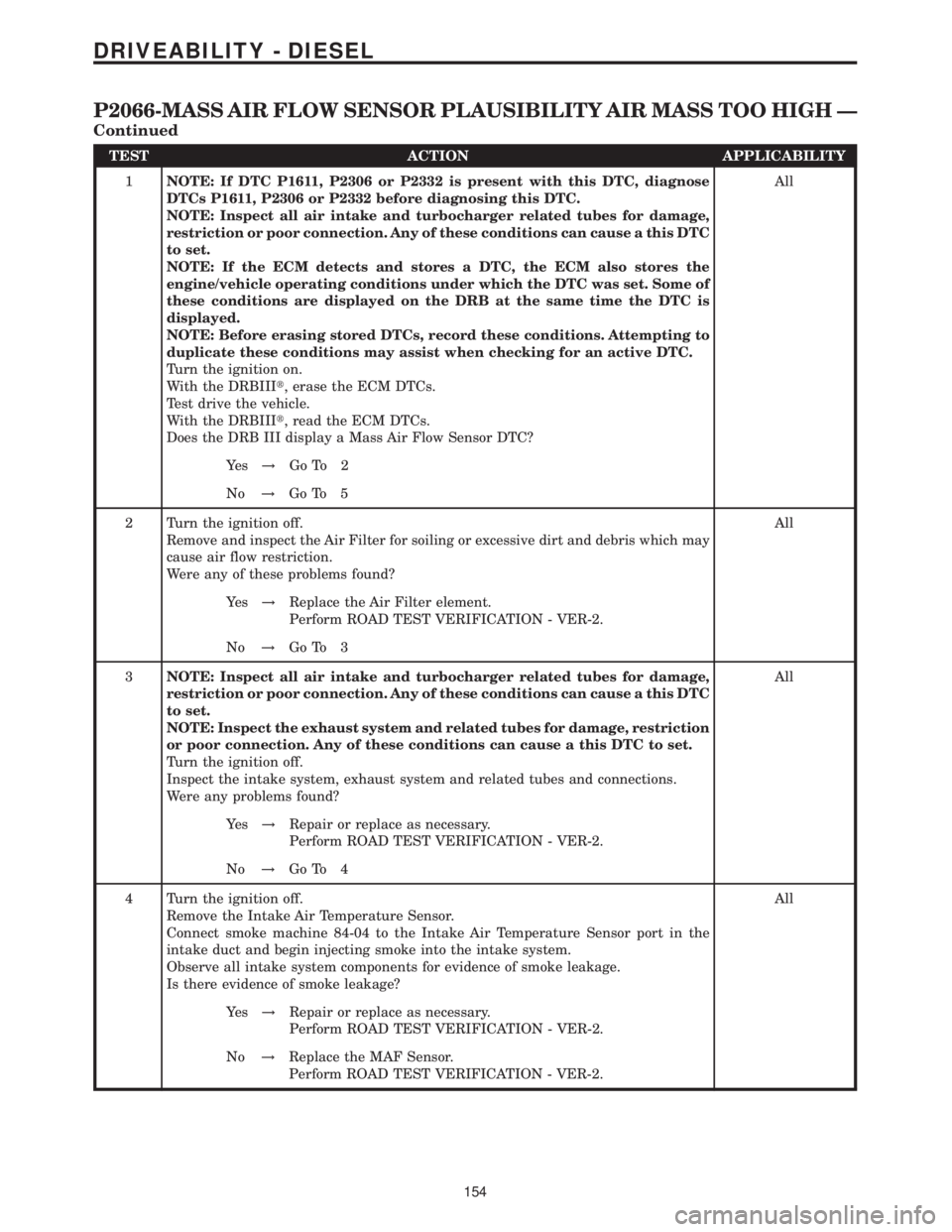
TEST ACTION APPLICABILITY
1NOTE: If DTC P1611, P2306 or P2332 is present with this DTC, diagnose
DTCs P1611, P2306 or P2332 before diagnosing this DTC.
NOTE: Inspect all air intake and turbocharger related tubes for damage,
restriction or poor connection. Any of these conditions can cause a this DTC
to set.
NOTE: If the ECM detects and stores a DTC, the ECM also stores the
engine/vehicle operating conditions under which the DTC was set. Some of
these conditions are displayed on the DRB at the same time the DTC is
displayed.
NOTE: Before erasing stored DTCs, record these conditions. Attempting to
duplicate these conditions may assist when checking for an active DTC.
Turn the ignition on.
With the DRBIIIt, erase the ECM DTCs.
Test drive the vehicle.
With the DRBIIIt, read the ECM DTCs.
Does the DRB III display a Mass Air Flow Sensor DTC?All
Ye s!Go To 2
No!Go To 5
2 Turn the ignition off.
Remove and inspect the Air Filter for soiling or excessive dirt and debris which may
cause air flow restriction.
Were any of these problems found?All
Ye s!Replace the Air Filter element.
Perform ROAD TEST VERIFICATION - VER-2.
No!Go To 3
3NOTE: Inspect all air intake and turbocharger related tubes for damage,
restriction or poor connection. Any of these conditions can cause a this DTC
to set.
NOTE: Inspect the exhaust system and related tubes for damage, restriction
or poor connection. Any of these conditions can cause a this DTC to set.
Turn the ignition off.
Inspect the intake system, exhaust system and related tubes and connections.
Were any problems found?All
Ye s!Repair or replace as necessary.
Perform ROAD TEST VERIFICATION - VER-2.
No!Go To 4
4 Turn the ignition off.
Remove the Intake Air Temperature Sensor.
Connect smoke machine 84-04 to the Intake Air Temperature Sensor port in the
intake duct and begin injecting smoke into the intake system.
Observe all intake system components for evidence of smoke leakage.
Is there evidence of smoke leakage?All
Ye s!Repair or replace as necessary.
Perform ROAD TEST VERIFICATION - VER-2.
No!Replace the MAF Sensor.
Perform ROAD TEST VERIFICATION - VER-2.
154
DRIVEABILITY - DIESEL
P2066-MASS AIR FLOW SENSOR PLAUSIBILITY AIR MASS TOO HIGH Ð
Continued
Page 639 of 2305
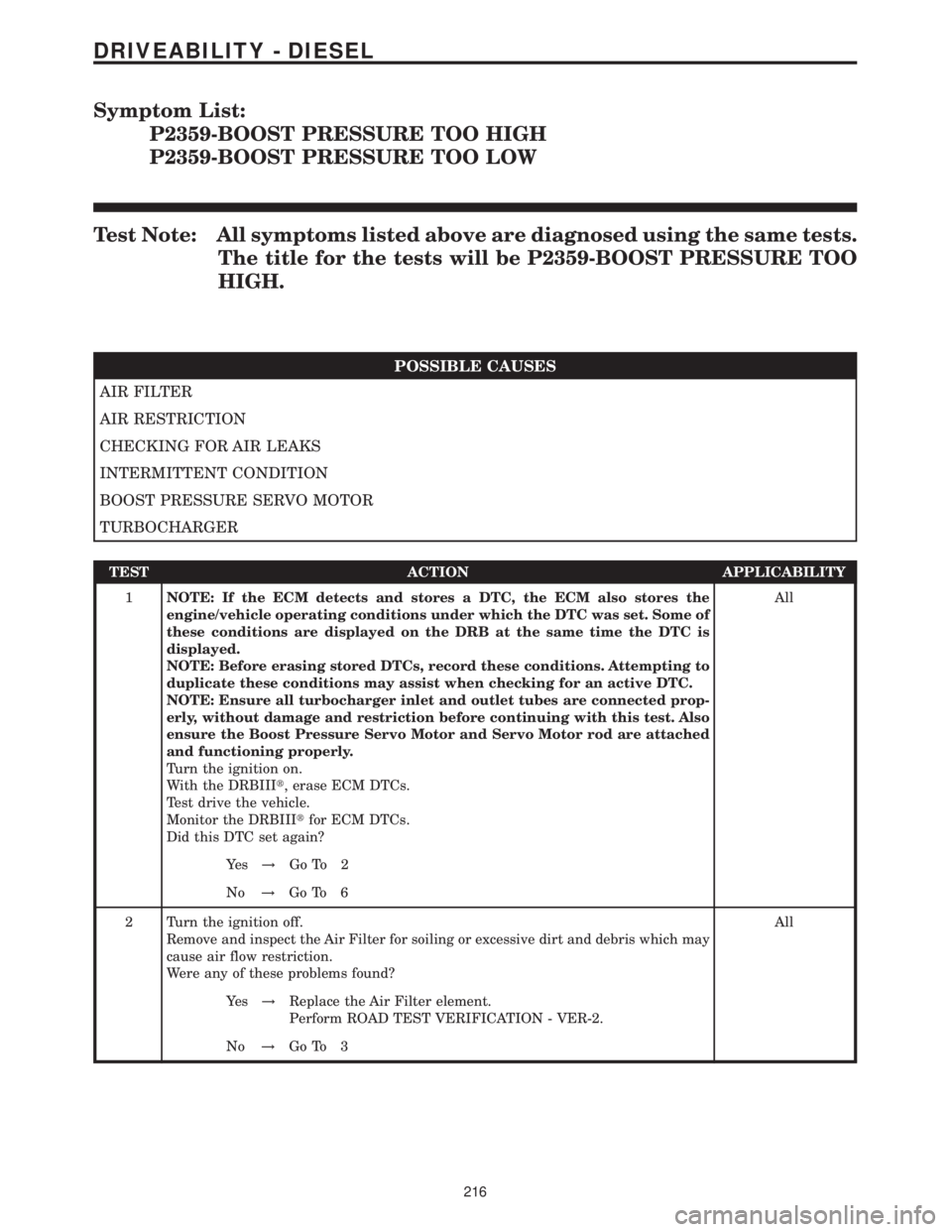
Symptom List:
P2359-BOOST PRESSURE TOO HIGH
P2359-BOOST PRESSURE TOO LOW
Test Note: All symptoms listed above are diagnosed using the same tests.
The title for the tests will be P2359-BOOST PRESSURE TOO
HIGH.
POSSIBLE CAUSES
AIR FILTER
AIR RESTRICTION
CHECKING FOR AIR LEAKS
INTERMITTENT CONDITION
BOOST PRESSURE SERVO MOTOR
TURBOCHARGER
TEST ACTION APPLICABILITY
1NOTE: If the ECM detects and stores a DTC, the ECM also stores the
engine/vehicle operating conditions under which the DTC was set. Some of
these conditions are displayed on the DRB at the same time the DTC is
displayed.
NOTE: Before erasing stored DTCs, record these conditions. Attempting to
duplicate these conditions may assist when checking for an active DTC.
NOTE: Ensure all turbocharger inlet and outlet tubes are connected prop-
erly, without damage and restriction before continuing with this test. Also
ensure the Boost Pressure Servo Motor and Servo Motor rod are attached
and functioning properly.
Turn the ignition on.
With the DRBIIIt, erase ECM DTCs.
Test drive the vehicle.
Monitor the DRBIIItfor ECM DTCs.
Did this DTC set again?All
Ye s!Go To 2
No!Go To 6
2 Turn the ignition off.
Remove and inspect the Air Filter for soiling or excessive dirt and debris which may
cause air flow restriction.
Were any of these problems found?All
Ye s!Replace the Air Filter element.
Perform ROAD TEST VERIFICATION - VER-2.
No!Go To 3
216
DRIVEABILITY - DIESEL
Page 670 of 2305
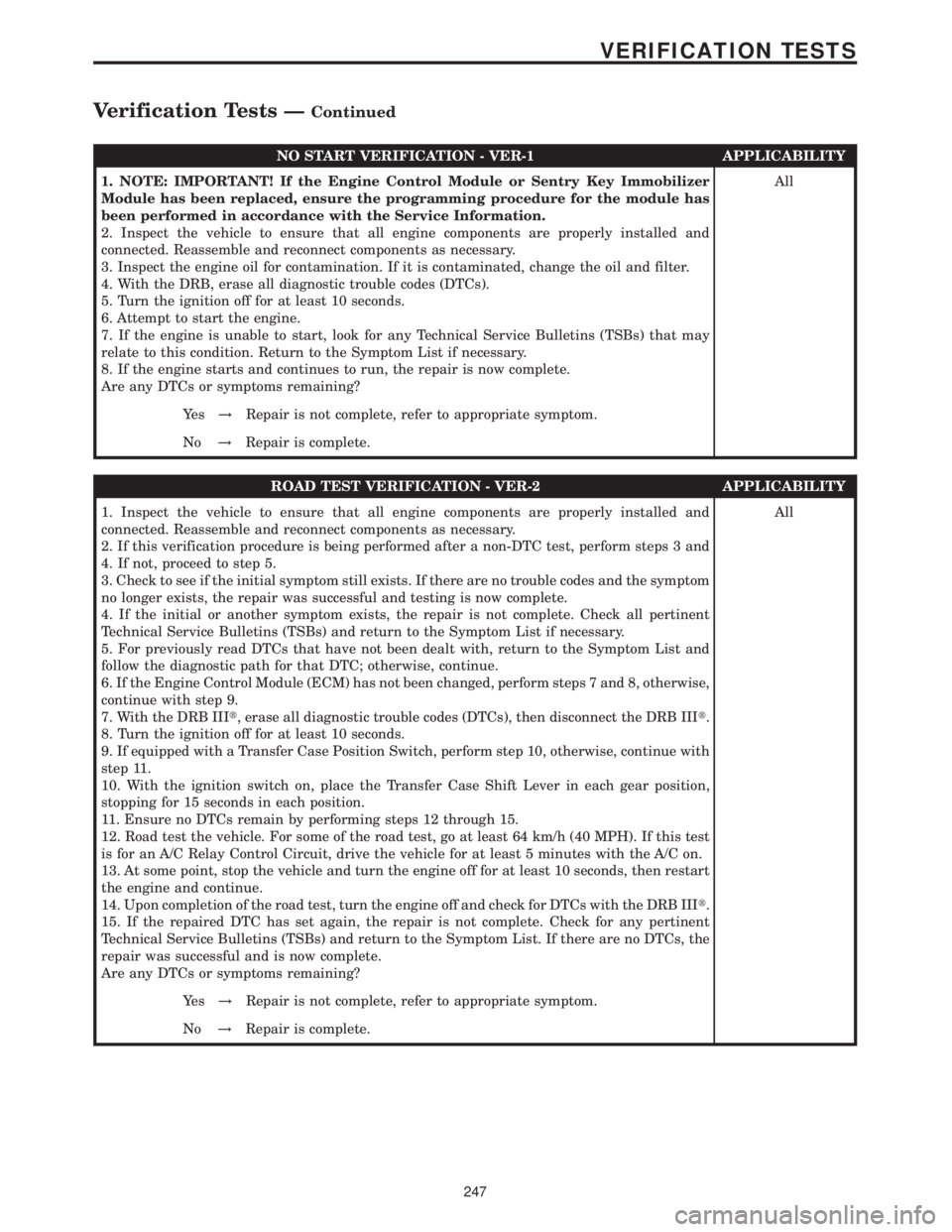
NO START VERIFICATION - VER-1 APPLICABILITY
1. NOTE: IMPORTANT! If the Engine Control Module or Sentry Key Immobilizer
Module has been replaced, ensure the programming procedure for the module has
been performed in accordance with the Service Information.
2. Inspect the vehicle to ensure that all engine components are properly installed and
connected. Reassemble and reconnect components as necessary.
3. Inspect the engine oil for contamination. If it is contaminated, change the oil and filter.
4. With the DRB, erase all diagnostic trouble codes (DTCs).
5. Turn the ignition off for at least 10 seconds.
6. Attempt to start the engine.
7. If the engine is unable to start, look for any Technical Service Bulletins (TSBs) that may
relate to this condition. Return to the Symptom List if necessary.
8. If the engine starts and continues to run, the repair is now complete.
Are any DTCs or symptoms remaining?All
Ye s!Repair is not complete, refer to appropriate symptom.
No!Repair is complete.
ROAD TEST VERIFICATION - VER-2 APPLICABILITY
1. Inspect the vehicle to ensure that all engine components are properly installed and
connected. Reassemble and reconnect components as necessary.
2. If this verification procedure is being performed after a non-DTC test, perform steps 3 and
4. If not, proceed to step 5.
3. Check to see if the initial symptom still exists. If there are no trouble codes and the symptom
no longer exists, the repair was successful and testing is now complete.
4. If the initial or another symptom exists, the repair is not complete. Check all pertinent
Technical Service Bulletins (TSBs) and return to the Symptom List if necessary.
5. For previously read DTCs that have not been dealt with, return to the Symptom List and
follow the diagnostic path for that DTC; otherwise, continue.
6. If the Engine Control Module (ECM) has not been changed, perform steps 7 and 8, otherwise,
continue with step 9.
7. With the DRB IIIt, erase all diagnostic trouble codes (DTCs), then disconnect the DRB IIIt.
8. Turn the ignition off for at least 10 seconds.
9. If equipped with a Transfer Case Position Switch, perform step 10, otherwise, continue with
step 11.
10. With the ignition switch on, place the Transfer Case Shift Lever in each gear position,
stopping for 15 seconds in each position.
11. Ensure no DTCs remain by performing steps 12 through 15.
12. Road test the vehicle. For some of the road test, go at least 64 km/h (40 MPH). If this test
is for an A/C Relay Control Circuit, drive the vehicle for at least 5 minutes with the A/C on.
13. At some point, stop the vehicle and turn the engine off for at least 10 seconds, then restart
the engine and continue.
14. Upon completion of the road test, turn the engine off and check for DTCs with the DRB IIIt.
15. If the repaired DTC has set again, the repair is not complete. Check for any pertinent
Technical Service Bulletins (TSBs) and return to the Symptom List. If there are no DTCs, the
repair was successful and is now complete.
Are any DTCs or symptoms remaining?All
Ye s!Repair is not complete, refer to appropriate symptom.
No!Repair is complete.
247
VERIFICATION TESTS
Verification Tests ÐContinued
Page 720 of 2305
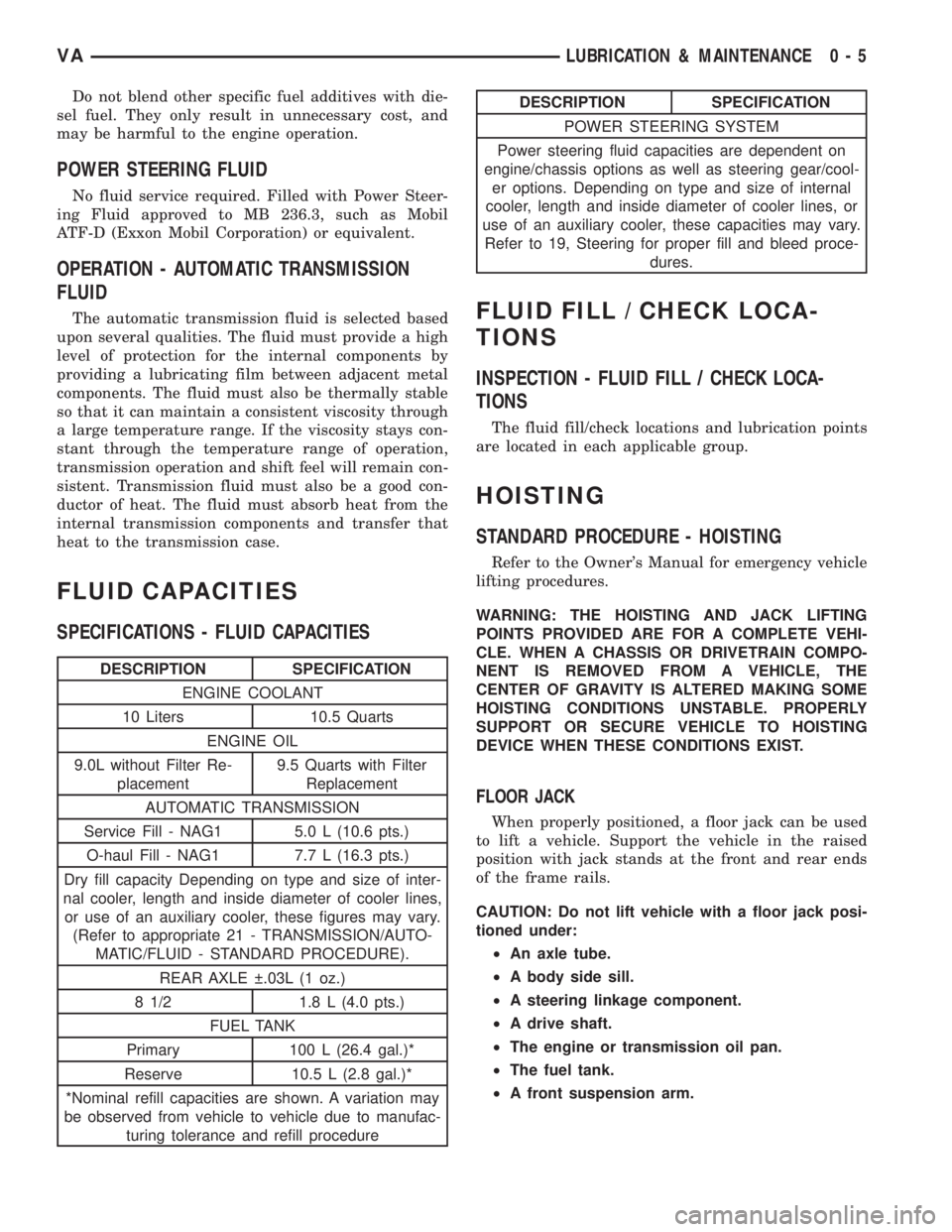
Do not blend other specific fuel additives with die-
sel fuel. They only result in unnecessary cost, and
may be harmful to the engine operation.
POWER STEERING FLUID
No fluid service required. Filled with Power Steer-
ing Fluid approved to MB 236.3, such as Mobil
ATF-D (Exxon Mobil Corporation) or equivalent.
OPERATION - AUTOMATIC TRANSMISSION
FLUID
The automatic transmission fluid is selected based
upon several qualities. The fluid must provide a high
level of protection for the internal components by
providing a lubricating film between adjacent metal
components. The fluid must also be thermally stable
so that it can maintain a consistent viscosity through
a large temperature range. If the viscosity stays con-
stant through the temperature range of operation,
transmission operation and shift feel will remain con-
sistent. Transmission fluid must also be a good con-
ductor of heat. The fluid must absorb heat from the
internal transmission components and transfer that
heat to the transmission case.
FLUID CAPACITIES
SPECIFICATIONS - FLUID CAPACITIES
DESCRIPTION SPECIFICATION
ENGINE COOLANT
10 Liters 10.5 Quarts
ENGINE OIL
9.0L without Filter Re-
placement9.5 Quarts with Filter
Replacement
AUTOMATIC TRANSMISSION
Service Fill - NAG1 5.0 L (10.6 pts.)
O-haul Fill - NAG1 7.7 L (16.3 pts.)
Dry fill capacity Depending on type and size of inter-
nal cooler, length and inside diameter of cooler lines,
or use of an auxiliary cooler, these figures may vary.
(Refer to appropriate 21 - TRANSMISSION/AUTO-
MATIC/FLUID - STANDARD PROCEDURE).
REAR AXLE .03L (1 oz.)
8 1/2 1.8 L (4.0 pts.)
FUEL TANK
Primary 100 L (26.4 gal.)*
Reserve 10.5 L (2.8 gal.)*
*Nominal refill capacities are shown. A variation may
be observed from vehicle to vehicle due to manufac-
turing tolerance and refill procedure
DESCRIPTION SPECIFICATION
POWER STEERING SYSTEM
Power steering fluid capacities are dependent on
engine/chassis options as well as steering gear/cool-
er options. Depending on type and size of internal
cooler, length and inside diameter of cooler lines, or
use of an auxiliary cooler, these capacities may vary.
Refer to 19, Steering for proper fill and bleed proce-
dures.
FLUID FILL / CHECK LOCA-
TIONS
INSPECTION - FLUID FILL / CHECK LOCA-
TIONS
The fluid fill/check locations and lubrication points
are located in each applicable group.
HOISTING
STANDARD PROCEDURE - HOISTING
Refer to the Owner's Manual for emergency vehicle
lifting procedures.
WARNING: THE HOISTING AND JACK LIFTING
POINTS PROVIDED ARE FOR A COMPLETE VEHI-
CLE. WHEN A CHASSIS OR DRIVETRAIN COMPO-
NENT IS REMOVED FROM A VEHICLE, THE
CENTER OF GRAVITY IS ALTERED MAKING SOME
HOISTING CONDITIONS UNSTABLE. PROPERLY
SUPPORT OR SECURE VEHICLE TO HOISTING
DEVICE WHEN THESE CONDITIONS EXIST.
FLOOR JACK
When properly positioned, a floor jack can be used
to lift a vehicle. Support the vehicle in the raised
position with jack stands at the front and rear ends
of the frame rails.
CAUTION: Do not lift vehicle with a floor jack posi-
tioned under:
²An axle tube.
²A body side sill.
²A steering linkage component.
²A drive shaft.
²The engine or transmission oil pan.
²The fuel tank.
²A front suspension arm.
VALUBRICATION & MAINTENANCE 0 - 5
Page 723 of 2305
effect panels. If necessary, remove the wheels from
the lifted end of the vehicle and lower the vehicle
closer to the ground, to increase the ground clearance
at the opposite end of the vehicle. Install lug nuts on
wheel attaching studs to retain brake drums.
RAMP ANGLE
If a vehicle with flat-bed towing equipment is used,
the approach ramp angle should not exceed 15
degrees.
TOWING WHEN KEYS ARE NOT AVAILABLE
When the vehicle is locked and keys are not avail-
able, use a flat bed hauler. A Wheel-lift or Sling-type
device can be used provided all the wheels are lifted
off the ground using tow dollies.
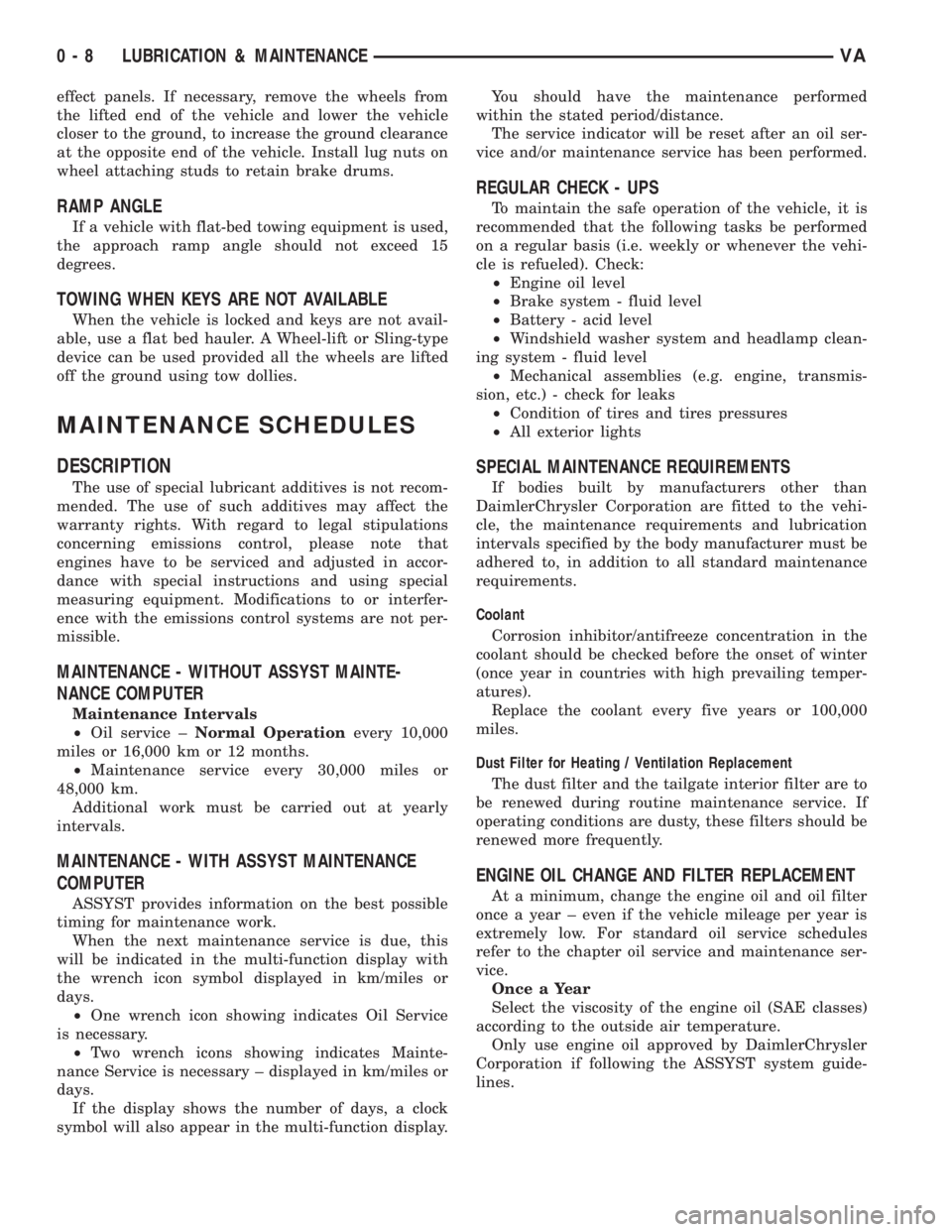
MAINTENANCE SCHEDULES
DESCRIPTION
The use of special lubricant additives is not recom-
mended. The use of such additives may affect the
warranty rights. With regard to legal stipulations
concerning emissions control, please note that
engines have to be serviced and adjusted in accor-
dance with special instructions and using special
measuring equipment. Modifications to or interfer-
ence with the emissions control systems are not per-
missible.
MAINTENANCE - WITHOUT ASSYST MAINTE-
NANCE COMPUTER
Maintenance Intervals
²Oil service ±Normal Operationevery 10,000
miles or 16,000 km or 12 months.
²Maintenance service every 30,000 miles or
48,000 km.
Additional work must be carried out at yearly
intervals.
MAINTENANCE - WITH ASSYST MAINTENANCE
COMPUTER
ASSYST provides information on the best possible
timing for maintenance work.
When the next maintenance service is due, this
will be indicated in the multi-function display with
the wrench icon symbol displayed in km/miles or
days.
²One wrench icon showing indicates Oil Service
is necessary.
²Two wrench icons showing indicates Mainte-
nance Service is necessary ± displayed in km/miles or
days.
If the display shows the number of days, a clock
symbol will also appear in the multi-function display.You should have the maintenance performed
within the stated period/distance.
The service indicator will be reset after an oil ser-
vice and/or maintenance service has been performed.
REGULAR CHECK - UPS
To maintain the safe operation of the vehicle, it is
recommended that the following tasks be performed
on a regular basis (i.e. weekly or whenever the vehi-
cle is refueled). Check:
²Engine oil level
²Brake system - fluid level
²Battery - acid level
²Windshield washer system and headlamp clean-
ing system - fluid level
²Mechanical assemblies (e.g. engine, transmis-
sion, etc.) - check for leaks
²Condition of tires and tires pressures
²All exterior lights
SPECIAL MAINTENANCE REQUIREMENTS
If bodies built by manufacturers other than
DaimlerChrysler Corporation are fitted to the vehi-
cle, the maintenance requirements and lubrication
intervals specified by the body manufacturer must be
adhered to, in addition to all standard maintenance
requirements.
Coolant
Corrosion inhibitor/antifreeze concentration in the
coolant should be checked before the onset of winter
(once year in countries with high prevailing temper-
atures).
Replace the coolant every five years or 100,000
miles.
Dust Filter for Heating / Ventilation Replacement
The dust filter and the tailgate interior filter are to
be renewed during routine maintenance service. If
operating conditions are dusty, these filters should be
renewed more frequently.
ENGINE OIL CHANGE AND FILTER REPLACEMENT
At a minimum, change the engine oil and oil filter
once a year ± even if the vehicle mileage per year is
extremely low. For standard oil service schedules
refer to the chapter oil service and maintenance ser-
vice.
Once a Year
Select the viscosity of the engine oil (SAE classes)
according to the outside air temperature.
Only use engine oil approved by DaimlerChrysler
Corporation if following the ASSYST system guide-
lines.
0 - 8 LUBRICATION & MAINTENANCEVA