window MERCEDES-BENZ SPRINTER 2010 MY10 Operator’s Manual
[x] Cancel search | Manufacturer: MERCEDES-BENZ, Model Year: 2010, Model line: SPRINTER, Model: MERCEDES-BENZ SPRINTER 2010Pages: 292, PDF Size: 6.75 MB
Page 154 of 292
Coolant heat can additionally be dissipated
by opening
the
windows and by setting the
blower fan and the interior temperature to
maximum.
R When overtaking, pay particular attention
to the extended length of your vehicle/
trailer combination.
Due to the length of your vehicle/trailer
combination, you will have to travel an
additional distance beyond the vehicle you
are overtaking before returning to the
original lane.
If the trailer begins to swing from side to side:
X do not accelerate.
X do not counter-steer.
X brake if necessary. G
Warning
Under no circumstances try to straighten the
vehicle/trailer combination by
increasing the
speed.
i You can reduce the risk of the trailer
swinging and snaking by retrofitting anti-
roll bars or trailer stability programs. You
can obtain further information from an
authorized Sprinter Dealer.
Uncoupling a trailer X
Make sure that the automatic transmission
is set to position P.
X Engage the vehicle's parking brake.
X Remove the trailer cable and uncouple the
trailer.
X Engage the trailer's parking brake.
Load distribution The Gross Trailer Weight (GTW) is the
combined weight of the trailer together with
the cargo and equipment loaded on the
trailer. The maximum permissible gross
weight is
vehicle-specific
and depends on the
equipment level: 5000 lbs (2268 kg) or
7500 lbs (3402 kg). The permissible Trailer drawbar Weight
Rating (TWR) is the maximum weight
permitted on the trailer drawbar: 750 lbs
(340 kg) or 500 lbs (227 kg) is the limit for
trailer couplings approved by the vehicle
distributor named on the inside of the front
cover.
The Gross Combined Weight Rating (GCWR)
is
the
sum of the Gross Trailer Weight and the
vehicle weight, including a driver weight of
approximately 150 lbs (68 kg). The
permissible GCWR is vehicle-specific and
depends on the equipment level.
When driving with a trailer, you should not
exceed the permitted Gross Combination
Weight Rating (GCWR).
You must distribute the load on the vehicle
and trailer so that the permitted maximum
values for the vehicle (GCWR) and trailer
(GTW) weight as well as permitted axle loads
(GAWR) and noseweight (TWR) of your vehicle
are not exceeded.
i Take into account that the vehicle's
permissible payload must be reduced to
compensate for the noseweight.
The applicable permissible values, which
must not be exceeded, can be found in your
vehicle documents and on the type plates for
the trailer tow hitch, trailer and vehicle
(Y page 277). You will also find a list of the
permissible values in the "Technical data"
(Y page 284) section. Where the values
differ, the lowest is valid.
! The permissible gross combination
weight is less than the sum of the
permissible gross vehicle weight plus the
permissible trailer load. Exceeding the
permissible gross combination weight can
lead to damage to the drivetrain, to the
transmission or to the trailer tow hitch.
For this reason, applicable values for the
permissible gross vehicle weight or the
permissible trailer load are reduced
accordingly if either the vehicle or the
trailer is fully loaded. In this case, the trailer
or the vehicle may only be partially loaded. 152
Transporting loads with the vehicle
Operation
Page 164 of 292
G
Warning
Never use openings in the bodywork as steps.
You may otherwise
damage the vehicle or lose
your footing and injure yourself or others.
If you have to clean the upper areas of the
vehicle, always use suitable ladders or other
secure climbing aids. G
Warning
Dirty or
iced-up steps and entrances create a
risk of slipping or falling.
Keep steps, entrances
and footwear free from
dirt (e.g. mud, clay, snow and ice). Cleaning the interior of the vehicle
Seat belts !
Observe the following notes on cleaning
the seat belts:
R Remove any stains or dirt immediately.
This will avoid residue or damage.
R Do not bleach
or dye the seat belts. This
could impair the function of the seat
belts.
R Do not dry the seat belts in direct
sunlight or at temperatures above
176 ‡ (80 †).
Steering wheel boss and cockpit G
Warning!
When cleaning the steering wheel boss and
dashboard, do not use cockpit sprays or
cleaning agents containing
solvents. Cleaning
agents containing solvents cause the surface
to become porous, and as a result, plastic
parts may break away and be thrown around
the interior when an air bag is deployed, which
may result in severe injuries.
Use a damp, clean and lint-free cloth to clean
the plastic components and the cockpit. If
particularly dirty, use a mild detergent. !
Do not use
dry, coarse or hard cloths and
do not scrub. You could otherwise scratch
or damage the surfaces.
Radio and monitor display X
Switch off the radio or rear-view camera
monitor and let it cool.
X Clean the display surface with a
commercially available microfiber cloth
and cleaner for TFT/LCD displays.
X After drying,
polish the display surface with
a dry microfiber cloth, applying only light
pressure.
! Do not use dry, rough or hard cloths or
abrasive products, solvents or cleaning
agents containing solvents. Do not scrub.
Only apply light pressure when cleaning.
Otherwise, you will damage the display
surface, as it is sensitive to pressure and
susceptible to scratches.
Windows !
Do not use
dry cloths, abrasive products,
solvents or cleaning agents containing
solvents to clean the inside of the windows.
Clean the inside of the windows with a
damp cloth or a commercially available
glass cleaner.
Do not touch the inside of the rear and side
windows with hard objects, e.g. an ice
scraper or ring. You could otherwise
damage the windows or the rear window
defroster. Cleaning the exterior of the vehicle
General notes Scratches, corrosive
deposits, areas affected
by corrosion and damage caused by neglect
or inadequate care cannot always be
completely remedied. In this case, visit a
qualified specialist workshop, e.g. the
nearest authorized Sprinter Dealer. 162
Cleaning and care
Operation
Page 167 of 292
from the windshield and the wiper blades to
prevent smearing.
Smears
impair the driver's
view, and their effect is made worse in
conditions where visibility is poor (e.g. glare,
mist, darkness, snow). You may therefore fail
to recognize dangers, or not recognize them
in time, and thereby cause an accident.
! Make sure that the automatic car wash is
suitable for the size of the vehicle.
Before washing the vehicle in an automatic
car wash, fold in the exterior mirrors and
remove the radio/telephone antenna.
Otherwise, the exterior mirror, antenna or
the vehicle itself could be damaged.
Make sure that the antenna is installed and
that the exterior mirrors are fully folded out
again when you leave the automatic car
wash.
! Make sure that the side windows are
completely closed, that the ventilation/
heating is switched off and that the
windshield wiper switch is set to 0.
Otherwise, the rain/light sensor could be
activated, triggering unintended wiper
movements. This can cause damage to the
vehicle.
After putting the vehicle through an
automatic car wash, wipe off wax from:
R the rear-view camera lens ( Y page 163)
R the windshield and the wiper blades. This
prevents smears and reduces wiping noise
which can be caused by residue on the
windshield. Cleaning the engine
! Water must not
enter intake or ventilation
openings. When cleaning with high
pressure water or steam cleaners, the
spray must not be aimed directly at
electrical components or the terminals of
electrical lines. Preserve the engine after the engine has
been cleaned.
Protect
the belt drive system
from exposure to the preservative agent. Alloy wheels
Clean the alloy wheels regularly.
! Do not use
any acidic or alkaline cleaning
agents. They can cause corrosion on the
wheel bolts (wheel nuts) or the retainer
springs for the wheel-balancing weights. After driving off-road or on
construction sites
G
Warning
Dirt on the vehicle can affect road and
operating safety.
It can specifically result in the following
dangers:
Stone impact. Stones trapped between the
tires can be thrown out while driving. This
could injure other
road users or damage other
vehicles (especially windscreens).
Risk of skidding. Dirt and mud on the tires/
on the road reduce the grip of the tires on the
road. This especially applies when the surface
is wet. The vehicle could then start to skid.
Risk of injury. Dirt and mud on the steps and
entrance can make the steps unsafe. This
could cause you to slip off the steps and be
injured.
For this reason, you should always clean your
vehicle carefully after driving off-road or on
construction sites before driving on public
roads. Observe the corresponding safety
notices in this chapter if you use a power
washer or an automatic car wash to clean your
vehicle.
X Clean the vehicle, paying special attention
to the following:
R
Lighting system
R Windows and exterior mirrors
R Access steps and entrances Cleaning and care
165
Operation Z
Page 176 of 292
X
To install the air filter: insert the filter
mat.
X Put cover 0046 on. Vehicle assemblies
Check the assemblies regularly for leaks. If
fluid is being lost (e.g. there are oil stains
where the vehicle is parked), have the cause
found and rectified
immediately at a qualified
specialist workshop, e.g. an authorized
Sprinter Dealer.
0040Environmental note
When used improperly, service products are
harmful to the environment.
Do not allow service products to enter the
sewage system, surface
waters, ground water
or soil. Replacing the wiper blades
G
Warning
If the windshield wipers are set to intermittent
wipe or the rain/light sensor is active, the
windshield wipers could start moving at any
time and injure you or others.
Always remove the
key from the ignition lock
before replacing the wiper blades. G
Warning
Wiper blades are wear parts. Change the
wiper blades every six months, ideally in the
spring and fall.
Otherwise, the windshield and
rear window will not be wiped properly. This
may prevent you from observing the traffic
conditions, thereby causing an accident.
! Do not open the hood when a wiper arm
is folded away from the windshield.
Otherwise, you could damage the hood.
Do not fold the wiper arms back onto the
windshield without wiper blades fitted as
this could scratch the windshield. !
Only touch the windshield wiper where it
connects to the wiper arm. You could
otherwise damage the
wiper blade inserts.
Removing X
Apply the parking brake.
X On vehicles with automatic transmission,
move the selector lever to position P.
X Turn the key to position 1 in the ignition
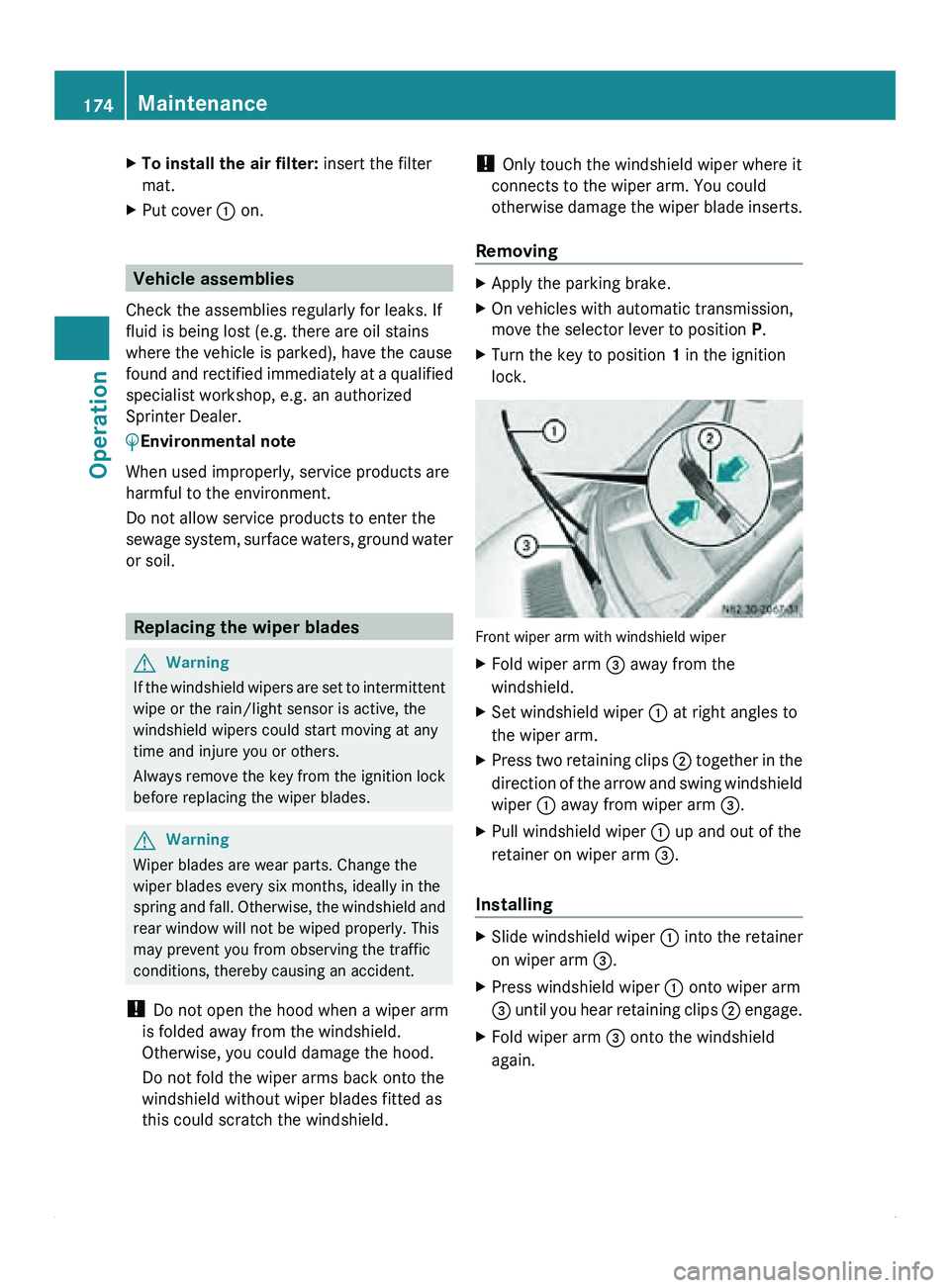
lock. Front wiper arm with windshield wiper
X
Fold wiper arm 008A away from the
windshield.
X Set windshield wiper 0046 at right angles to
the wiper arm.
X Press two retaining clips 0047 together
in
the
direction of the arrow and swing windshield
wiper 0046 away from wiper arm 008A.
X Pull windshield wiper 0046 up and out of the
retainer on wiper arm 008A.
Installing X
Slide windshield wiper 0046 into the retainer
on wiper arm 008A.
X Press windshield wiper 0046 onto wiper arm
008A until you
hear retaining clips 0047 engage.
X Fold wiper arm 008A onto the windshield
again. 174
Maintenance
Operation
Page 180 of 292
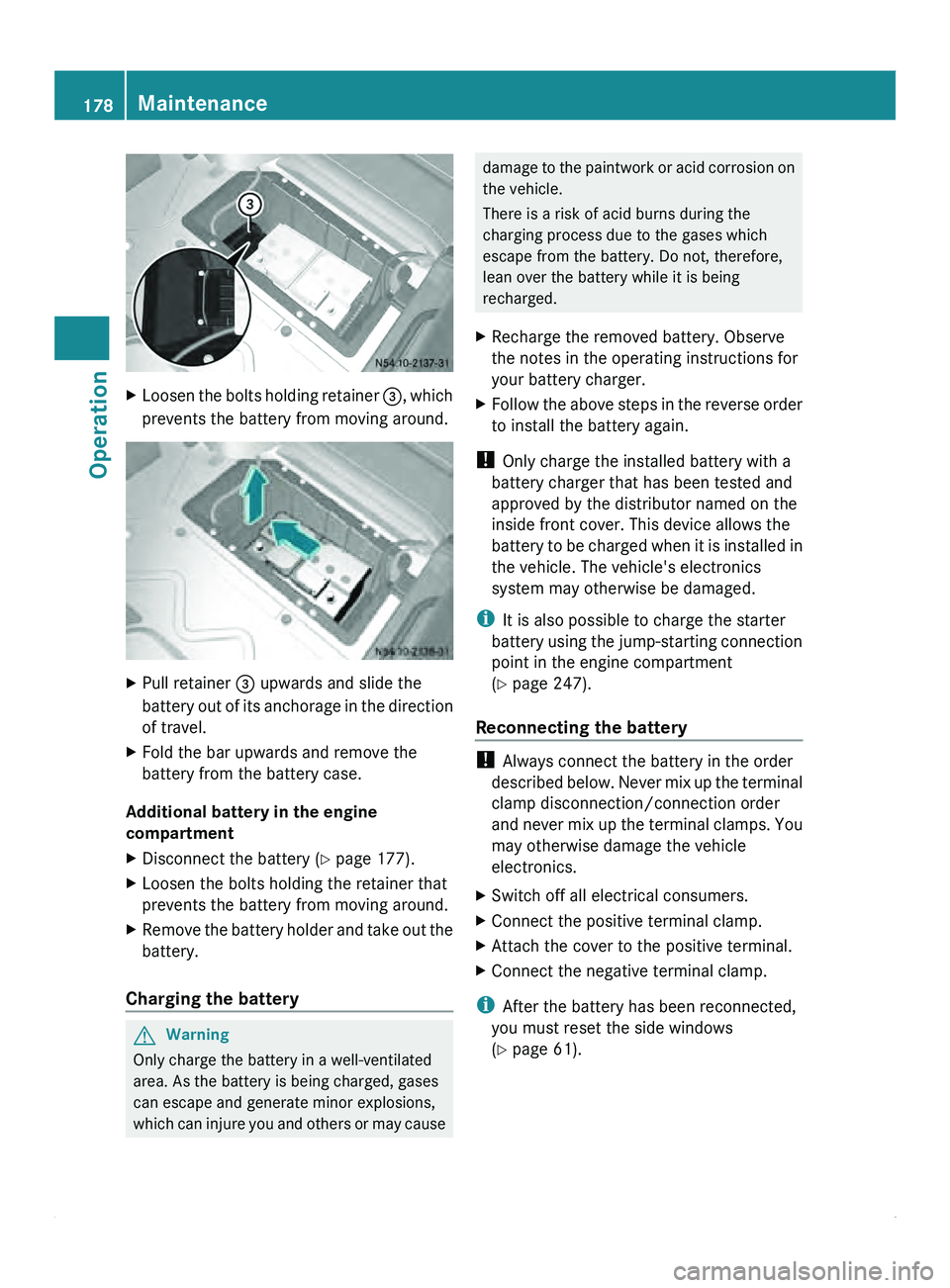
X
Loosen the bolts holding retainer 008A, which
prevents the battery from moving around. X
Pull retainer 008A upwards and slide the
battery out of
its anchorage in the direction
of travel.
X Fold the bar upwards and remove the
battery from the battery case.
Additional battery in the engine
compartment
X Disconnect the battery ( Y page 177).
X Loosen the bolts holding the retainer that
prevents the battery from moving around.
X Remove the battery holder and take out the
battery.
Charging the battery G
Warning
Only charge the battery in a well-ventilated
area. As the battery is being charged, gases
can escape and generate minor explosions,
which can injure
you and others or may cause damage to the paintwork or acid corrosion on
the vehicle.
There is a risk of acid burns during the
charging process due to the gases which
escape from the battery. Do not, therefore,
lean over the battery while it is being
recharged.
X Recharge the removed battery. Observe
the notes in the operating instructions for
your battery charger.
X Follow the above steps in the reverse order
to install the battery again.
! Only charge the installed battery with a
battery charger that has been tested and
approved by the distributor named on the
inside front cover. This device allows the
battery to be
charged when it is installed in
the vehicle. The vehicle's electronics
system may otherwise be damaged.
i It is also possible to charge the starter
battery using the jump-starting connection
point in the engine compartment
(Y page 247).
Reconnecting the battery !
Always connect the battery in the order
described below. Never
mix up the terminal
clamp disconnection/connection order
and never mix up the terminal clamps. You
may otherwise damage the vehicle
electronics.
X Switch off all electrical consumers.
X Connect the positive terminal clamp.
X Attach the cover to the positive terminal.
X Connect the negative terminal clamp.
i After the battery has been reconnected,
you must reset the side windows
(Y page 61). 178
Maintenance
Operation
Page 213 of 292
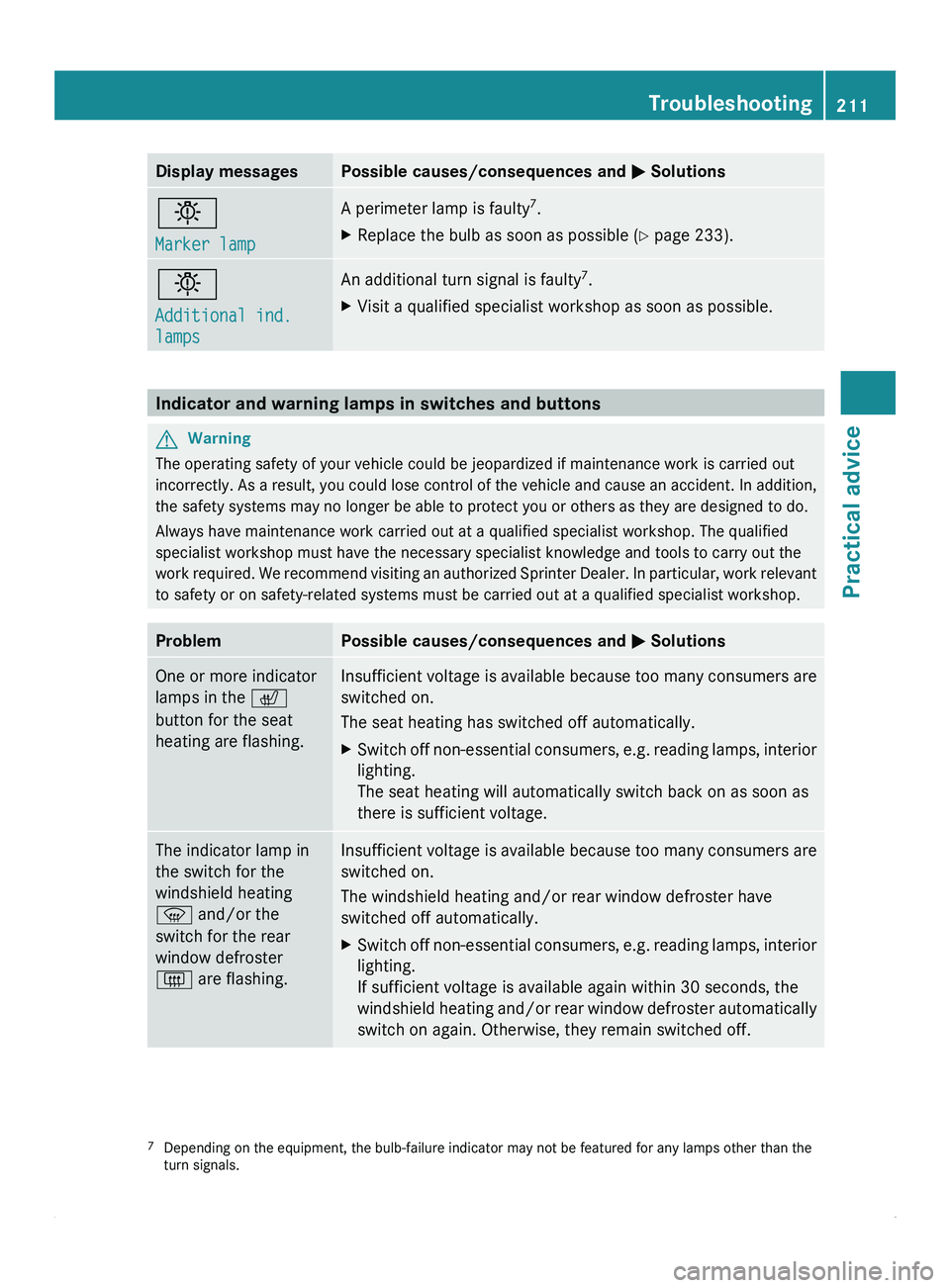
Display messages Possible causes/consequences and
0050 Solutions0055
Marker lamp A perimeter lamp is faulty
7
.
X Replace the bulb as soon as possible (Y page 233). 0055
Additional ind.
lamps An additional turn signal is faulty
7
.
X Visit a qualified specialist workshop as soon as possible. Indicator and warning lamps in switches and buttons
G
Warning
The operating safety of your vehicle could be jeopardized if maintenance work is carried out
incorrectly. As a
result, you could lose control of the vehicle and cause an accident. In addition,
the safety systems may no longer be able to protect you or others as they are designed to do.
Always have maintenance work carried out at a qualified specialist workshop. The qualified
specialist workshop must have the necessary specialist knowledge and tools to carry out the
work required. We recommend visiting an authorized Sprinter Dealer. In particular, work relevant
to safety or on safety-related systems must be carried out at a qualified specialist workshop. Problem Possible causes/consequences and
0050 SolutionsOne or more indicator
lamps in the 0072
button for the seat
heating are flashing. Insufficient voltage is available because too many consumers are
switched on.
The seat heating has switched off automatically.
X
Switch off non-essential consumers, e.g. reading lamps, interior
lighting.
The seat heating will automatically switch back on as soon as
there is sufficient voltage. The indicator lamp in
the switch for the
windshield heating
0087 and/or the
switch for the rear
window defroster
0073 are flashing. Insufficient voltage is available because too many consumers are
switched on.
The windshield heating and/or rear window defroster have
switched off automatically.
X
Switch off non-essential consumers, e.g. reading lamps, interior
lighting.
If sufficient voltage is available again within 30 seconds, the
windshield heating and/or
rear window defroster automatically
switch on again. Otherwise, they remain switched off. 7
Depending on the equipment, the bulb-failure indicator may not be featured for any lamps other than the
turn signals. Troubleshooting
211
Practical advice Z
Page 243 of 292
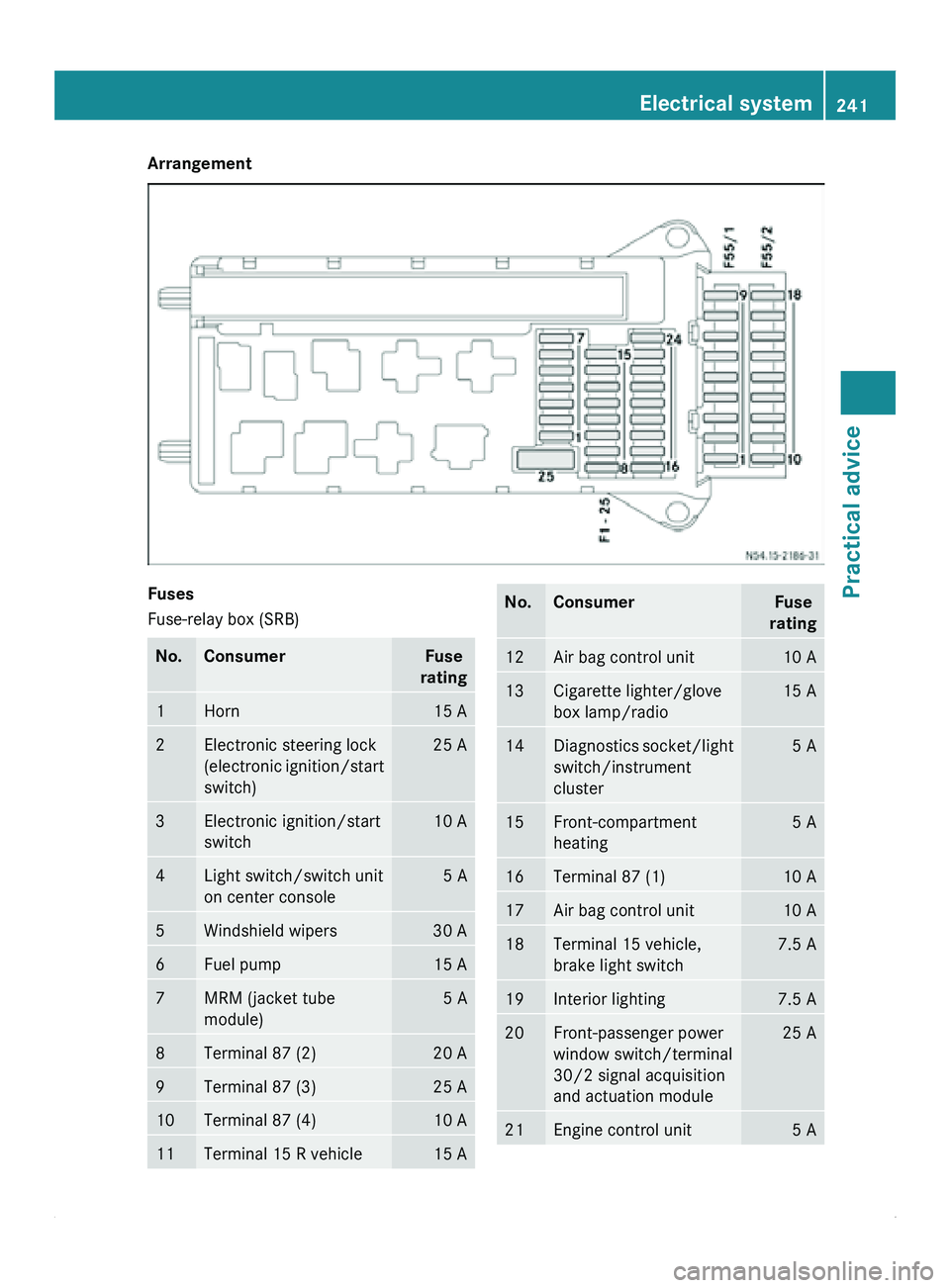
Arrangement
Fuses
Fuse-relay box (SRB)
No. Consumer Fuse
rating 1 Horn 15 A
2 Electronic steering lock
(electronic ignition/start
switch) 25 A
3 Electronic ignition/start
switch 10 A
4 Light switch/switch unit
on center console 5 A
5 Windshield wipers 30 A
6 Fuel pump 15 A
7 MRM (jacket tube
module) 5 A
8 Terminal 87 (2) 20 A
9 Terminal 87 (3) 25 A
10 Terminal 87 (4) 10 A
11 Terminal 15 R vehicle 15 A No. Consumer Fuse
rating 12 Air bag control unit 10 A
13 Cigarette lighter/glove
box lamp/radio 15 A
14 Diagnostics socket/light
switch/instrument
cluster 5 A
15 Front-compartment
heating 5 A
16 Terminal 87 (1) 10 A
17 Air bag control unit 10 A
18 Terminal 15 vehicle,
brake light switch 7.5 A
19 Interior lighting 7.5 A
20 Front-passenger power
window switch/terminal
30/2 signal acquisition
and actuation module 25 A
21 Engine control unit 5 AElectrical system
241Practical advice Z
Page 246 of 292
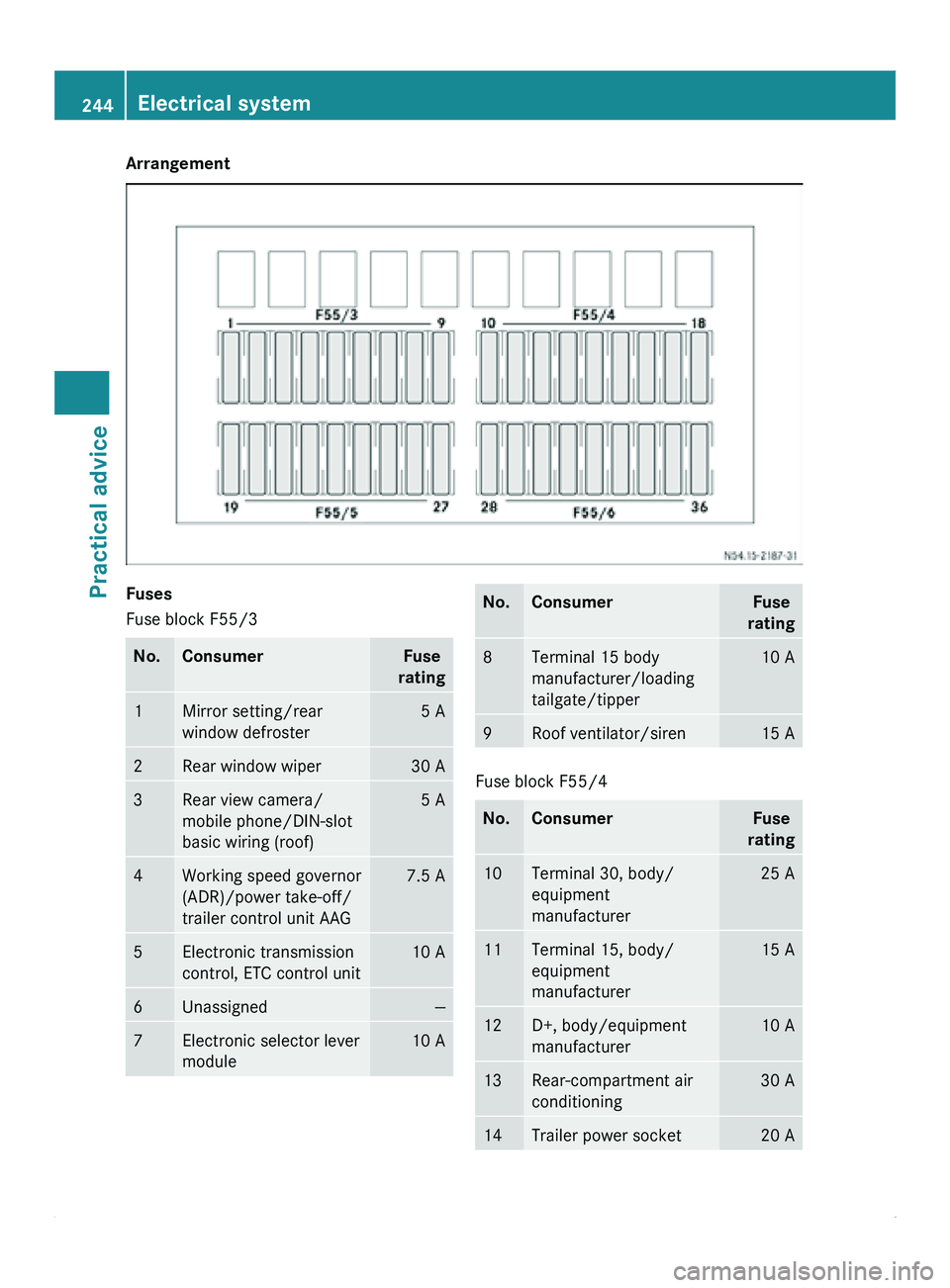
Arrangement
Fuses
Fuse block F55/3
No. Consumer Fuse
rating 1 Mirror setting/rear
window defroster 5 A
2 Rear window wiper 30 A
3 Rear view camera/
mobile phone/DIN-slot
basic wiring (roof) 5 A
4 Working speed governor
(ADR)/power take-off/
trailer control unit AAG 7.5 A
5 Electronic transmission
control, ETC control unit 10 A
6 Unassigned —
7 Electronic selector lever
module 10 A No. Consumer Fuse
rating 8 Terminal 15 body
manufacturer/loading
tailgate/tipper 10 A
9 Roof ventilator/siren 15 A
Fuse block F55/4
No. Consumer Fuse
rating 10 Terminal 30, body/
equipment
manufacturer 25 A
11 Terminal 15, body/
equipment
manufacturer 15 A
12 D+, body/equipment
manufacturer 10 A
13 Rear-compartment air
conditioning 30 A
14 Trailer power socket 20 A244
Electrical systemPractical advice
Page 247 of 292
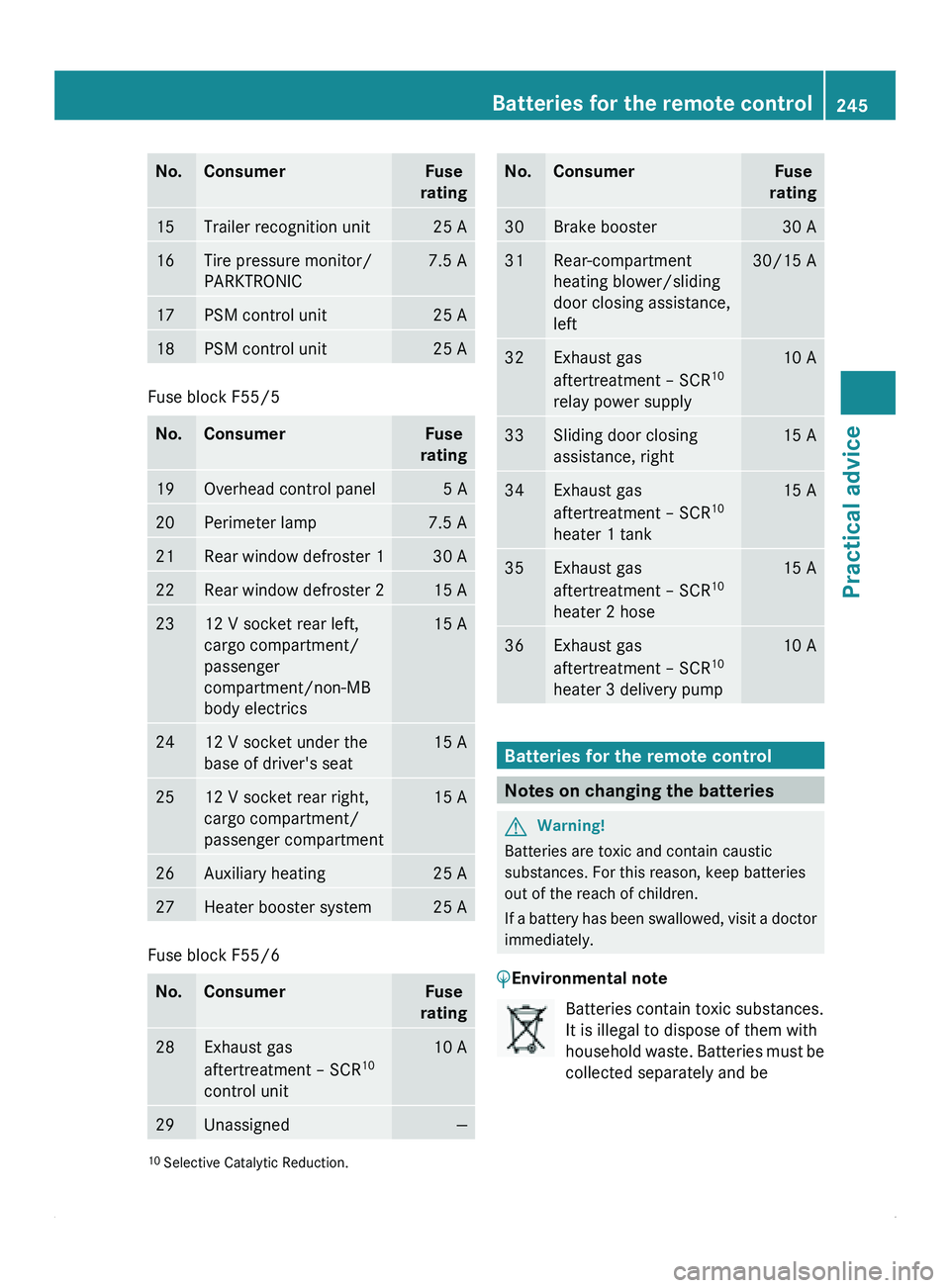
No. Consumer Fuse
rating 15 Trailer recognition unit 25 A
16 Tire pressure monitor/
PARKTRONIC 7.5 A
17 PSM control unit 25 A
18 PSM control unit 25 A
Fuse block F55/5
No. Consumer Fuse
rating 19 Overhead control panel 5 A
20 Perimeter lamp 7.5 A
21 Rear window defroster 1 30 A
22 Rear window defroster 2 15 A
23 12 V socket rear left,
cargo compartment/
passenger
compartment/non-MB
body electrics 15 A
24 12 V socket under the
base of driver's seat 15 A
25 12 V socket rear right,
cargo compartment/
passenger compartment 15 A
26 Auxiliary heating 25 A
27 Heater booster system 25 A
Fuse block F55/6
No. Consumer Fuse
rating 28 Exhaust gas
aftertreatment – SCR
10
control unit 10 A
29 Unassigned — No. Consumer Fuse
rating 30 Brake booster 30 A
31 Rear-compartment
heating blower/sliding
door closing assistance,
left 30/15 A
32 Exhaust gas
aftertreatment – SCR
10
relay power supply 10 A
33 Sliding door closing
assistance, right 15 A
34 Exhaust gas
aftertreatment – SCR
10
heater 1 tank 15 A
35 Exhaust gas
aftertreatment – SCR
10
heater 2 hose 15 A
36 Exhaust gas
aftertreatment – SCR
10
heater 3 delivery pump 10 A
Batteries for the remote control
Notes on changing the batteries
G
Warning!
Batteries are toxic and contain caustic
substances. For this reason, keep batteries
out of the reach of children.
If a battery
has been swallowed, visit a doctor
immediately.
0040Environmental note Batteries contain toxic substances.
It is illegal to dispose of them with
household
waste. Batteries
must be
collected separately and be
10 Selective Catalytic Reduction. Batteries for the remote control
245
Practical advice Z